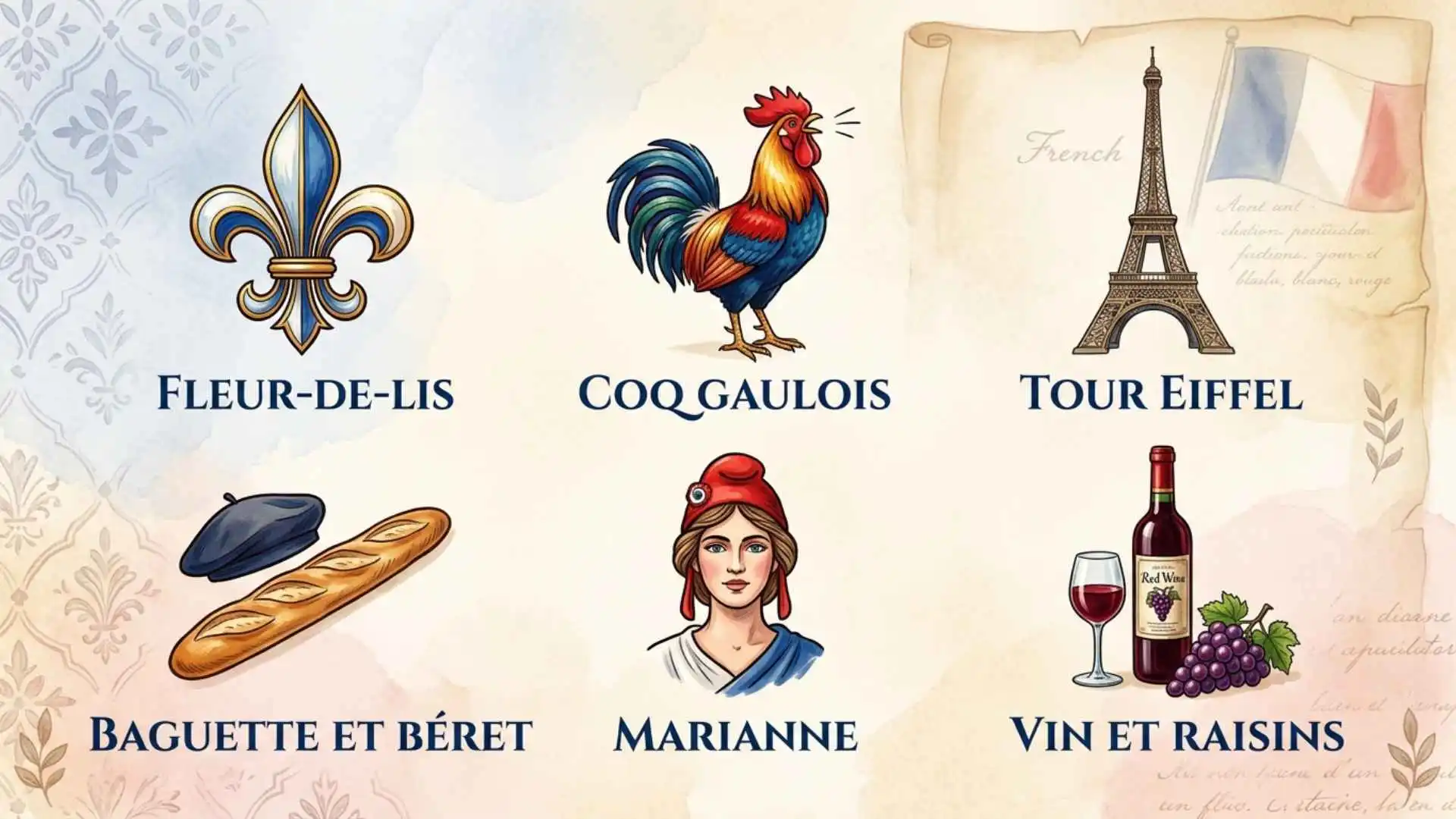
French symbols reflect the history, culture, political traditions, and national identity of France. Some are official symbols of the French Republic, while others became associated with France through centuries of history, art, architecture, literature, and popular culture. The French tricolor flag, Marianne, the Gallic rooster, fleur-de-lis, Phrygian cap, and Eiffel Tower are among the best-known examples.
Understanding French symbols also means understanding the difference between an official national emblem and a cultural symbol. For example, the French flag and Marianne have a direct connection with the French Republic, while the Eiffel Tower is primarily a famous cultural and visual symbol of France.
This guide explores the most important French symbols, their meanings, historical origins, and how they are recognized in modern French culture.
What Are French Symbols?
French symbols are images, objects, words, figures, monuments, or traditions that represent France or an aspect of French history and culture. Some symbols have official or constitutional significance, while others are simply strongly associated with the country.
French symbols can be divided into several broad categories:
- Official symbols of the French Republic
- Historical symbols of France
- Cultural symbols
- Revolutionary symbols
- Architectural and artistic symbols
- Symbols associated with French heritage
This distinction is important because not every famous symbol of France is an official national symbol.
French Symbols at a Glance
| Symbol | Type | Common Association |
| French Tricolor | Official national symbol | France and the Republic |
| Marianne | Republican symbol | Liberty and the Republic |
| Liberté, Égalité, Fraternité | National motto | Republican values |
| La Marseillaise | National anthem | National identity |
| Gallic Rooster | National emblem | French identity and vigilance |
| Fleur-de-lis | Historical symbol | French monarchy and heritage |
| Phrygian Cap | Revolutionary symbol | Liberty and revolution |
| Eiffel Tower | Cultural symbol | Paris and France |
| Bastille | Historical symbol | French Revolution |
| RF | Republican symbol | French Republic |
| Baguette | Cultural symbol | French food and daily life |
| Beret | Cultural symbol | Traditional French imagery |
| French cuisine | Cultural symbol | French culinary heritage |
| Marianne’s bust | Republican symbol | Republic and citizenship |
| French architecture | Cultural symbol | Art and national heritage |
Official National Symbols of France
Some French symbols have a direct connection with the French state and the French Republic. These are more important when discussing France’s official national identity.
The French Tricolor Flag
The French tricolor flag is one of the most recognizable symbols of France. It consists of three vertical bands of blue, white, and red.
The modern tricolor became closely associated with the French Revolution and the creation of a new political order. It eventually became the national flag of France and remains one of the country’s principal national symbols.
The flag can be seen on government buildings, public institutions, military installations, diplomatic buildings, and during national celebrations.
The three colors have acquired different historical interpretations. Rather than assigning one simple meaning to each color, it is more accurate to understand the tricolor as a symbol connected with French political and national history.
Marianne
Marianne is the female personification of the French Republic and one of the most important French republican symbols.
She is usually represented as a woman, often wearing a Phrygian cap. Her image appears in public buildings, official documents, coins, stamps, and other representations of the French state.
Marianne is associated with ideas such as:
- Liberty
- The Republic
- Citizenship
- French national identity
- Republican values
Different artists have portrayed Marianne in different ways over the years, so there is no single appearance that defines her.
Liberté, Égalité, Fraternité
“Liberté, Égalité, Fraternité” is the national motto of France.
Its English translation is:
Liberty, Equality, Fraternity.
The phrase expresses fundamental ideals associated with the French Republic. It is displayed on many French public buildings and official institutions.
The motto is especially significant because it connects modern French national identity with the political and philosophical traditions that developed around the French Revolution and the French Republic.
La Marseillaise
La Marseillaise is the national anthem of France.
It was composed in 1792 by Claude Joseph Rouget de Lisle during the French Revolution. The song became closely associated with revolutionary France and later became the national anthem.
Today, La Marseillaise is performed during official ceremonies, national celebrations, sporting events, and other occasions representing France.
As a French symbol, the anthem represents national identity and the country’s revolutionary history.
Famous Historical French Symbols
France has a long history that includes monarchy, revolution, republics, empire, and major cultural movements. Several symbols are strongly connected with these historical periods.
The Fleur-de-Lis
The fleur-de-lis is one of the most famous historical symbols associated with France.
It is a stylized flower that became strongly connected with the French monarchy, particularly during the medieval period and later centuries. It appeared in royal heraldry, coats of arms, decorative art, architecture, and other representations of the French crown.
The fleur-de-lis is commonly associated with:
- French royalty
- Medieval France
- Monarchy
- Nobility
- Historical heritage
It is important to distinguish the fleur-de-lis from the symbols of the modern French Republic. Although it remains strongly associated with French history, it is primarily a historical and heraldic symbol rather than the official emblem of today’s Republic.
The Phrygian Cap
The Phrygian cap is a traditional symbol of liberty and revolution.
During the French Revolution, the red cap became associated with revolutionary movements and the idea of freedom. It was later incorporated into representations of Marianne.
Because of this history, the Phrygian cap is often connected with:
- Freedom
- Revolution
- Resistance
- Republican ideals
- Liberation
It is one of the clearest visual symbols connecting French history with the revolutionary period.
The Bastille
The Bastille was a fortress and prison in Paris that became famous during the French Revolution.
On July 14, 1789, revolutionaries stormed the Bastille. The event became an important symbol of the revolutionary movement and the challenge to royal authority.
Although the Bastille itself no longer stands, its historical importance remains. July 14 is celebrated as France’s national day, commonly known in English as Bastille Day.
The Bastille therefore represents an important part of French revolutionary history.
The Gallic Rooster
The Gallic rooster, or coq gaulois, is a well-known French national emblem.
Its association with France has an interesting linguistic history. The Latin word gallus could refer to both a Gaul and a rooster. Over time, the rooster developed into a symbolic representation of the French people.
The rooster is commonly associated with:
- Courage
- Vigilance
- Pride
- Determination
- French identity
It has appeared on monuments, medals, sports imagery, official decorations, and other representations of France.
The rooster is particularly visible in French sporting culture, where it has become an important emblem of French teams and national representation.
Cultural Symbols of France
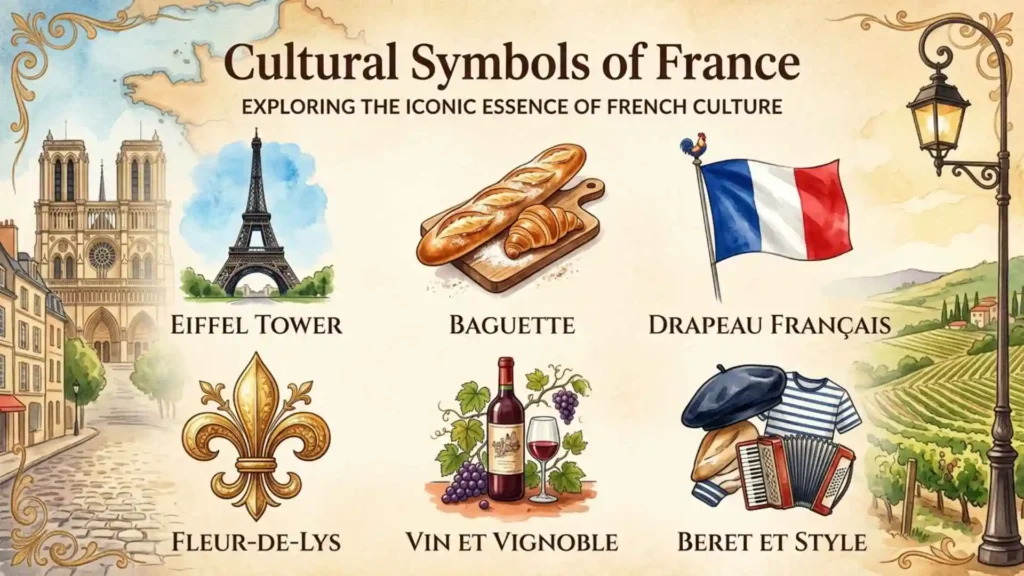
Not every famous French symbol is an official state symbol. Some objects and traditions have become closely connected with French culture in the international imagination.
The Eiffel Tower
The Eiffel Tower is probably the most recognizable visual symbol associated with France.
Located in Paris, it was constructed for the 1889 Exposition Universelle. It was designed by the company led by engineer Gustave Eiffel.
Today, the Eiffel Tower is closely associated with:
- Paris
- France
- Architecture
- Tourism
- French culture
- The Parisian skyline
The Eiffel Tower is a cultural and architectural symbol rather than the official national emblem of France.
Its worldwide recognition makes it one of the strongest visual representations of France.
The Baguette
The baguette is a famous part of French food culture.
This long, narrow loaf of bread has become strongly associated with everyday life in France. French bakeries and bread-making traditions are an important part of the country’s cultural identity.
The baguette can therefore be described as a cultural symbol of France, rather than an official national symbol.
It is frequently used in illustrations, advertisements, travel content, and popular culture to represent French daily life.
The Beret
The beret is another item commonly associated with traditional French imagery.
Although wearing a beret is not unique to France and has different historical associations in various countries, it became an important part of international stereotypes and representations of French style.
For this reason, the beret can be considered a popular cultural symbol associated with France, but it should not be confused with an official French national emblem.
French Cuisine
French cuisine is internationally recognized and represents an important part of French cultural heritage.
Bread, pastries, cheese, regional dishes, culinary techniques, and traditional dining practices have all contributed to France’s cultural reputation.
Food is not an official national symbol in the same way as the French flag, but French cuisine is an important cultural representation of the country.
French Symbols and Their Meanings
Different French symbols represent different periods and ideas. Understanding their meanings can make the symbols easier to recognize.
Symbols of Liberty
The Phrygian cap and Marianne are particularly associated with liberty and republican traditions.
The French motto also includes “Liberté,” making freedom an important part of the symbolic language of the French Republic.
Symbols of Royalty
The fleur-de-lis has a strong connection with the French monarchy and historical royal heritage.
Unlike Marianne or the tricolor flag, the fleur-de-lis is primarily associated with France’s monarchical past.
Symbols of Revolution
The Bastille, Phrygian cap, and La Marseillaise all have strong connections with the French Revolution.
Together, they help represent the dramatic political changes that transformed France at the end of the eighteenth century.
Symbols of Modern France
The tricolor flag, Marianne, national motto, and La Marseillaise are closely connected with modern French republican identity.
The Eiffel Tower also represents modern France internationally, particularly through its connection with Paris and French architecture.
French Symbols by Category
A useful way to understand French symbols is to organize them according to their historical or cultural role.
Republican Symbols
Republican symbols include:
- French tricolor flag
- Marianne
- Liberté, Égalité, Fraternité
- La Marseillaise
- The initials RF
These symbols are connected with the French Republic and its institutions.
Historical Symbols
Historical symbols include:
- Fleur-de-lis
- Bastille
- Phrygian cap
- Royal heraldry
These symbols help represent important periods of French history.
Cultural Symbols
Cultural symbols include:
- Eiffel Tower
- Baguette
- Beret
- French cuisine
- French architecture
- Parisian landmarks
These are widely associated with French culture but are not necessarily official state symbols.
French Symbols for Tattoos and Art
French symbols are also popular choices for tattoos, artwork, jewelry, logos, and decorative designs.
The meaning of a symbol can vary depending on the person using it.
Fleur-de-Lis Tattoo
A fleur-de-lis tattoo may be chosen to represent French heritage, history, royalty, elegance, or an interest in medieval symbolism.
Eiffel Tower Tattoo
An Eiffel Tower tattoo can represent France, Paris, travel, memories, architecture, or an emotional connection with French culture.
French Flag Tattoo
The tricolor flag can represent a connection with France, French heritage, national identity, or an appreciation for French culture.
Phrygian Cap Tattoo
A Phrygian cap can represent freedom, revolution, independence, or resistance because of its historical connection with revolutionary symbolism.
French Words as Tattoos
Some people choose French phrases rather than visual symbols. “Liberté,” for example, can be used as a simple representation of freedom, while “Liberté, Égalité, Fraternité” connects directly with the French national motto.
When using French text in a tattoo, spelling and accents should be checked carefully because small errors can change the appearance or meaning of the phrase.
French Symbols vs. Symbols of French Culture
The terms “French symbols” and “symbols of French culture” are sometimes used interchangeably, but they can have different meanings.
French national or republican symbols are connected with the state and national identity. Examples include the tricolor flag, Marianne, national motto, and national anthem.
French cultural symbols are objects, traditions, places, or ideas that people commonly associate with France. Examples include the Eiffel Tower, baguette, beret, and French cuisine.
This distinction helps avoid describing every famous French object as an official national symbol.
Why Are French Symbols Important?
French symbols are important because they preserve and communicate aspects of French history and identity.
A single symbol can connect the present with an earlier period. For example, the fleur-de-lis recalls the French monarchy, while the Bastille recalls the French Revolution. Marianne and the tricolor flag are connected with the modern Republic.
These symbols also make French culture easier to recognize internationally. The Eiffel Tower, for example, can immediately communicate “France” or “Paris” even without words.
Frequently Asked Questions About French Symbols
What is the main symbol of France?
There is no single symbol that represents every aspect of France. The tricolor flag is an official national symbol, while Marianne is an important symbol of the French Republic. The Eiffel Tower is one of the most recognizable cultural symbols of France internationally.
What are the most famous French symbols?
Some of the most famous French symbols include the tricolor flag, Marianne, Gallic rooster, fleur-de-lis, Phrygian cap, Eiffel Tower, Bastille, La Marseillaise, and the French national motto.
What does the French flag symbolize?
The French tricolor represents the French nation and Republic and has a strong connection with the political history of the French Revolution and modern France.
What does Marianne symbolize in France?
Marianne represents the French Republic and is associated with liberty, citizenship, and republican values.
What does the Gallic rooster symbolize?
The Gallic rooster is associated with French identity and is commonly connected with qualities such as vigilance, courage, and determination.
What does the fleur-de-lis symbolize?
The fleur-de-lis is strongly associated with French royal history, monarchy, medieval France, and historical heritage.
Is the Eiffel Tower a national symbol of France?
The Eiffel Tower is a major cultural and visual symbol of France, especially Paris. However, it is different from official republican symbols such as the tricolor flag.
What are the three French national values?
The French national motto is “Liberté, Égalité, Fraternité,” which translates as “Liberty, Equality, Fraternity.”
What symbol represents French freedom?
The Phrygian cap is strongly associated with liberty and revolutionary history, while Marianne is also connected with the ideals of the French Republic.
Why is the rooster associated with France?
The rooster became associated with France partly through the Latin word gallus, which could mean both “Gaul” and “rooster.” The bird subsequently developed into an important French emblem.
Is the fleur-de-lis an official symbol of modern France?
The fleur-de-lis is an important historical symbol associated with French monarchy and heritage, but it is not the principal official symbol of the modern French Republic.
What objects symbolize French culture?
Objects commonly associated with French culture include the baguette, beret, Eiffel Tower, French cuisine, and various forms of French art and architecture. These are cultural associations rather than all being official national symbols.
Final Thoughts on French Symbols
French symbols tell the story of France through different periods of its history and culture. The tricolor flag, Marianne, national motto, and La Marseillaise are closely connected with the French Republic, while the fleur-de-lis, Bastille, and Phrygian cap provide links to French monarchy and revolutionary history.
At the same time, cultural icons such as the Eiffel Tower, baguette, beret, and French cuisine have become widely recognized representations of France around the world.
The most important point is that French symbols do not all have the same status. Some are official republican symbols, some are historical emblems, and others are cultural icons. Understanding this difference gives a clearer and more accurate picture of what these symbols mean and why they continue to represent France today.

I am John Carter, a lifelong enthusiast of language and modern slang. I explore how words evolve and shape culture, and I enjoy uncovering the stories behind everyday expressions. I have authored “Slang and Society: The Language of Youth” and “Modern Words, Modern Worlds”, where I dive into how informal language impacts communication and identity. My goal is to make language accessible, fun, and insightful for everyone who loves words as much as I do.
 Lisa Reynolds
 Marcus Lee