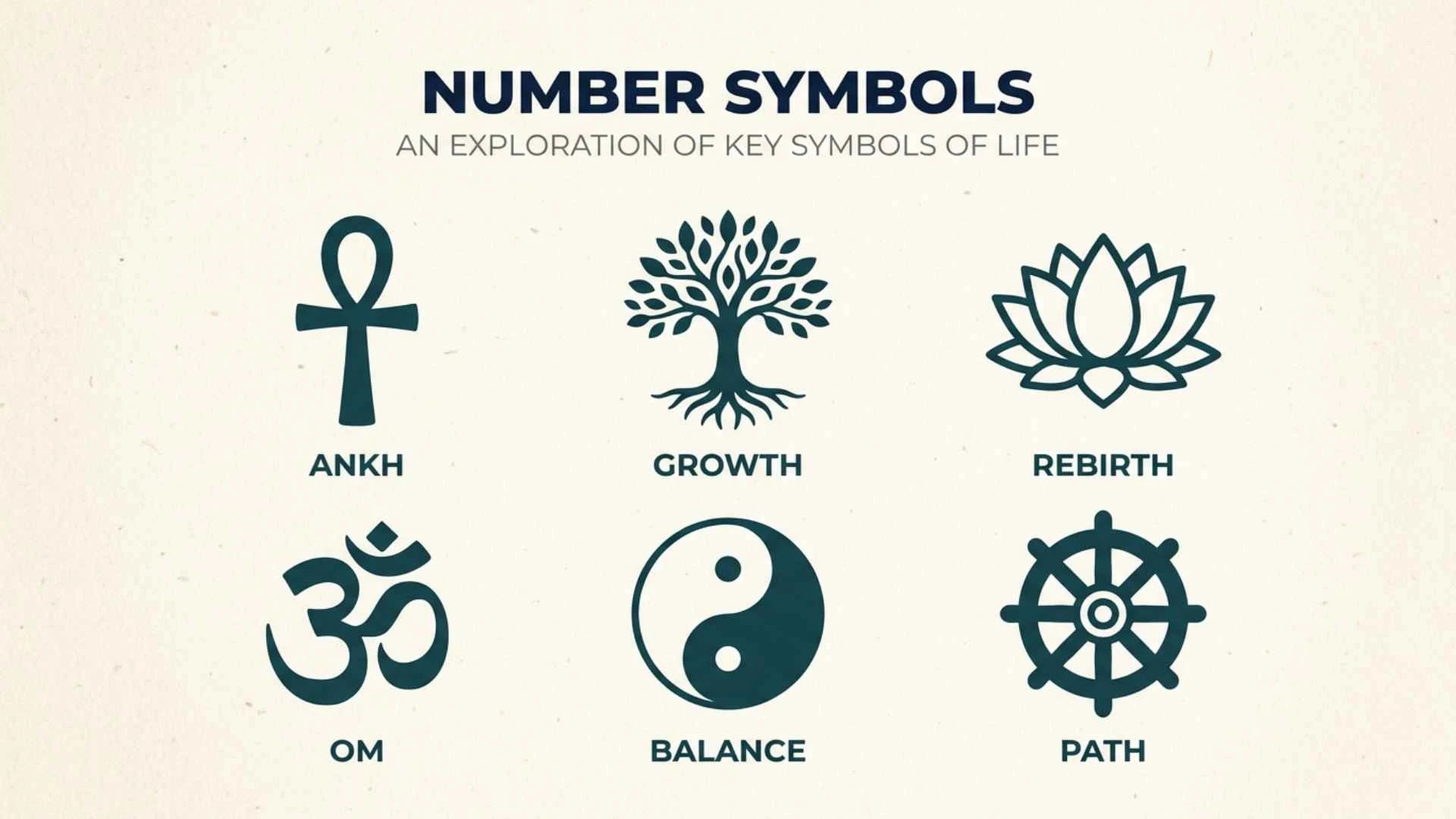
Number symbols are signs used to represent numbers, quantities, values, and numerical ideas. The most familiar number symbols are the digits 0, 1, 2, 3, 4, 5, 6, 7, 8, and 9, which form the foundation of the decimal number system used around the world.
However, number symbols are not limited to these ten digits. They can also include Roman numerals, circled numbers, superscript numbers, fractions, negative signs, decimal points, ordinal indicators, and other numerical notation. Numbers can also have symbolic meanings in mathematics, history, literature, religion, and different cultures.
This guide explains the most common number symbols, what they mean, how they are used, and the different forms you may encounter.
What Are Number Symbols?
A number symbol is a written character or group of characters used to represent a numerical value. For example, 5 is the number symbol for the quantity five, while X represents ten in Roman numerals.
Number symbols make it possible to communicate numerical information quickly and consistently. Instead of writing the word “one hundred,” we can write 100.
The meaning of a number symbol depends on its context. In mathematics, 7 simply represents a numerical value. In a cultural or literary context, however, the same number may have additional symbolic associations.
Number Symbols 0–9
The ten basic decimal digits are the most important number symbols in modern everyday use.
| Number | Symbol | Name | Common Use |
| Zero | 0 | Zero | Represents no quantity |
| One | 1 | One | Represents a single unit |
| Two | 2 | Two | Represents a pair |
| Three | 3 | Three | Represents three units |
| Four | 4 | Four | Represents four units |
| Five | 5 | Five | Represents five units |
| Six | 6 | Six | Represents six units |
| Seven | 7 | Seven | Represents seven units |
| Eight | 8 | Eight | Represents eight units |
| Nine | 9 | Nine | Represents nine units |
These digits can be combined to represent larger numbers. For example, 25, 100, 1,000, and 2026 are all created using the same basic digits.
Number Symbols to Copy and Paste
People sometimes search for number symbols because they want decorative or special numerical characters that can be copied and pasted.
Circled Number Symbols
Here are common circled number symbols:
① ② ③ ④ ⑤ ⑥ ⑦ ⑧ ⑨ ⑩
Additional examples include:
⑪ ⑫ ⑬ ⑭ ⑮ ⑯ ⑰ ⑱ ⑲ ⑳
These symbols are often used in lists, instructions, notes, designs, presentations, and social media content.
Parenthesized Number Symbols
Parenthesized numbers can also be used for lists:
⑴ ⑵ ⑶ ⑷ ⑸ ⑹ ⑺ ⑻ ⑼ ⑽
They provide a visually distinct alternative to ordinary numbered lists.
Superscript Number Symbols
Superscript numbers appear above the normal line of text:
⁰ ¹ ² ³ ⁴ ⁵ ⁶ ⁷ ⁸ ⁹
They are commonly used in mathematical expressions, scientific notation, footnotes, and references.
Subscript Number Symbols
Subscript numbers appear below the normal text line:
₀ ₁ ₂ ₃ ₄ ₅ ₆ ₇ ₈ ₉
They are frequently used in mathematics, chemistry, scientific formulas, and technical writing.
Types of Number Symbols
Number symbols can be divided into several categories depending on how they are written and used.
Decimal Digits
Decimal digits are the familiar 0–9 symbols. They are used in the base-10 number system.
For example:
0, 1, 2, 3, 4, 5, 6, 7, 8, 9
By combining these digits, we can write any whole number in the decimal system.
Roman Numerals
Roman numerals are an ancient numerical system that uses letters as number symbols.
The main Roman numeral symbols are:
| Roman Symbol | Value |
| I | 1 |
| V | 5 |
| X | 10 |
| L | 50 |
| C | 100 |
| D | 500 |
| M | 1,000 |
For example:
- I = 1
- II = 2
- III = 3
- IV = 4
- V = 5
- VI = 6
- VII = 7
- VIII = 8
- IX = 9
- X = 10
Roman numerals are still used on clocks, building inscriptions, book chapters, movie titles, monarch names, and special events.
Negative Number Symbols
A negative number is represented using a minus sign before the number.
Examples include:
−1, −5, −10, −100
The minus sign indicates that the value is below zero in the relevant number system.
Decimal Numbers
A decimal point is used to separate the whole-number part from the fractional part.
Examples include:
2.5
10.75
3.14
The exact style of decimal notation can vary by region. Some countries use a comma instead of a period as the decimal separator.
Fraction Symbols
Fractions represent parts of a whole. Common fraction symbols include:
½ ⅓ ¼ ⅔ ¾ ⅕ ⅖ ⅗ ⅘
For example, ½ means one-half, while ¾ means three-fourths.
Fractions are used in mathematics, cooking, measurements, construction, education, and everyday descriptions.
Mathematical Number Symbols
Numbers are often used together with mathematical symbols to communicate relationships and operations.
Common examples include:
- + — addition
- − — subtraction
- × — multiplication
- ÷ — division
- = — equals
- < — less than
- > — greater than
- ≤ — less than or equal to
- ≥ — greater than or equal to
- % — percent
- √ — square root
- ∞ — infinity
For example:
5 + 3 = 8
This expression uses number symbols together with mathematical operation symbols.
Number Symbols in Different Number Systems
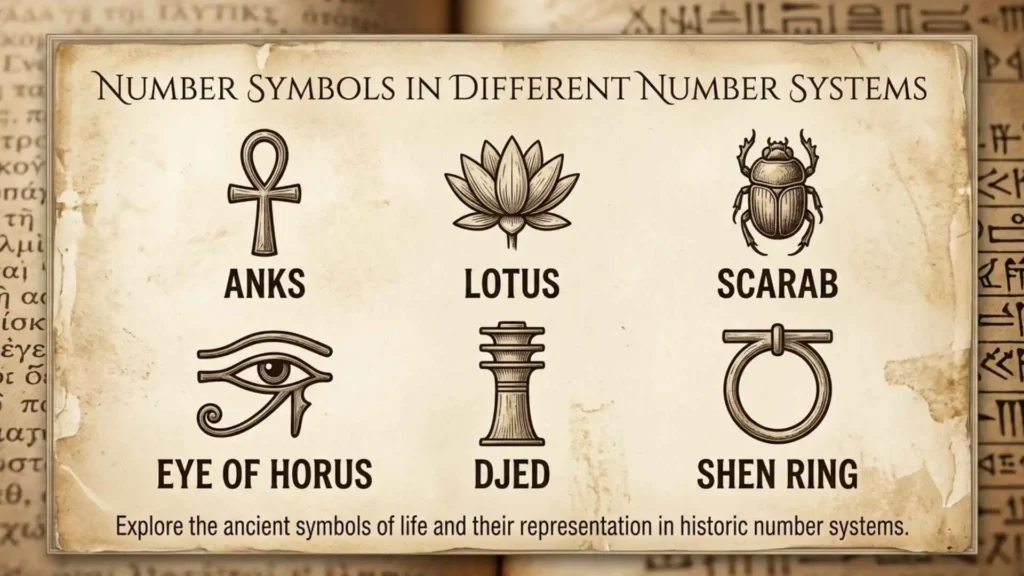
Humans have developed different ways of representing numbers throughout history.
Hindu-Arabic Numeral System
The Hindu-Arabic numeral system uses the ten digits:
0 1 2 3 4 5 6 7 8 9
It is the standard decimal system used in most modern mathematics, science, commerce, education, and technology.
One of its most important features is the use of zero as both a number and a placeholder.
Roman Numeral System
The Roman numeral system uses letters rather than the modern decimal digits.
For example:
2026 = MMXXVI
Roman numerals are not normally used for complex calculations today, but they remain important historically and culturally.
Ancient Egyptian Number Symbols
Ancient Egyptians used hieroglyphic symbols to represent numbers. Different symbols represented quantities such as one, ten, one hundred, one thousand, and larger values.
These numerical symbols were used for administrative records, trade, measurements, construction, and other activities.
Babylonian Number Symbols
The ancient Babylonians developed a numerical system based on 60. Their system was particularly important in mathematics and astronomy.
The influence of this system can still be seen today in the way we measure time and angles. For example, an hour contains 60 minutes and a minute contains 60 seconds.
What Do Numbers Symbolize?
Numbers can have meanings beyond their literal mathematical values. These symbolic interpretations depend heavily on culture, context, and tradition.
Number 0 Symbolism
Zero can represent absence, emptiness, nothingness, or a starting point.
In mathematics, zero is a specific numerical value and plays a fundamental role in arithmetic and place-value notation.
In philosophical or artistic contexts, it can sometimes be used to represent a blank beginning or the absence of something.
Number 1 Symbolism
One is commonly associated with:
- Unity
- Individuality
- Beginning
- Independence
- Uniqueness
These associations are common symbolic interpretations rather than fixed meanings.
Number 2 Symbolism
Two can represent:
- Pairs
- Partnership
- Duality
- Balance
- Opposites
Examples of pairs include day and night, hot and cold, and beginning and ending.
Number 3 Symbolism
Three frequently appears in stories, traditions, and cultural expressions.
It can be associated with:
- Progression
- Groups
- Balance
- Completion
For example, many stories use a three-part structure consisting of a beginning, middle, and ending.
Number 4 Symbolism
Four is often associated with structure and the physical world.
Examples include:
- Four seasons
- Four cardinal directions
- Four sides of a square
However, the symbolic meaning of four differs between cultures.
Number 5 Symbolism
Five is commonly associated with the human body and the senses because people traditionally speak of five major senses and five fingers on each hand.
It can therefore appear as a symbol of human experience or physical completeness in some contexts.
Number 6 Symbolism
Six has mathematical, cultural, and religious associations that vary according to context. In mathematics, it is an even number and a highly composite number.
Its symbolic interpretations should be understood within the particular tradition where they appear.
Number 7 Symbolism
Seven is one of the numbers that frequently appears in religious, cultural, and traditional contexts.
Because it appears repeatedly in different traditions, it is sometimes associated with ideas such as completeness, spirituality, or special significance. The exact interpretation depends on the culture or belief system.
Number 8 Symbolism
Eight has different symbolic associations around the world. Its shape also resembles the infinity symbol when turned sideways:
8 → ∞
In some East Asian cultural contexts, eight has been associated with prosperity and good fortune.
Number 9 Symbolism
Nine is the final single-digit number in the decimal system. Because it comes immediately before ten, it can sometimes be associated symbolically with completion or the end of a cycle.
This is a symbolic interpretation rather than a mathematical property.
Number 10 Symbolism
Ten is important because the decimal number system is based on ten digits.
It can therefore represent a complete basic counting cycle in everyday numerical notation.
Number Symbols in Religion and Culture
Numbers have appeared in religious texts, traditions, ceremonies, myths, and cultural practices throughout history.
Some numbers may have specific meanings within a particular religious tradition. For example, certain numbers may appear repeatedly in sacred stories or represent particular groups, periods, or events.
However, numerical symbolism is not universal. A number that has special significance in one tradition may have a completely different meaning in another.
When interpreting a number in a religious context, it is therefore important to consider the original text, tradition, and historical context rather than assuming that every number has a universal hidden meaning.
Number Symbols in Literature
Authors can use numbers as literary devices. A number may be repeated throughout a story to establish a pattern or highlight an important idea.
For example, a writer might use a specific number to represent:
- Time
- Age
- Repetition
- Change
- Order
- Memory
- Completion
The meaning is usually determined by the story rather than by a universal rule.
Number Symbols in Everyday Life
Number symbols are part of almost every area of modern life.
They appear in:
- Dates
- Clocks
- Phone numbers
- Addresses
- Prices
- School grades
- Sports scores
- Measurements
- Percentages
- Statistics
- Product numbers
- Identification systems
For example, 50% communicates a percentage, while 24/7 is commonly understood as meaning continuously or at all times.
Number Symbols in Technology
Numbers are essential to modern computing and digital technology.
Computers use binary notation based on two values:
0 and 1
These values are fundamental to digital information processing.
Numbers are also used in:
- Computer programming
- Software versions
- Internet protocols
- File sizes
- Digital storage
- Data analysis
- Artificial intelligence
- Scientific computing
Although users usually interact with text, images, audio, and video, numerical systems are fundamental to how digital devices store and process information.
Number Symbols and Numerology
Numerology is a belief system that assigns symbolic or spiritual meanings to numbers. It may interpret numbers based on names, dates of birth, or numerical patterns.
Some numerological traditions associate numbers with particular characteristics. For example, a system might associate 1 with independence, 2 with cooperation, or 3 with creativity.
These interpretations are part of numerological and cultural traditions. They should not be confused with scientifically established properties of numbers.
Why Are Number Symbols Important?
Number symbols are important because they provide a simple way to represent quantities and numerical relationships.
They help people:
- Communicate numerical information.
- Perform mathematical calculations.
- Record historical information.
- Measure objects and quantities.
- Organize dates and schedules.
- Develop scientific formulas.
- Build modern technology.
- Communicate data clearly.
Without numerical symbols, many everyday tasks involving money, time, measurements, science, and technology would be far more difficult.
Frequently Asked Questions About Number Symbols
What are the basic number symbols?
The basic decimal number symbols are 0, 1, 2, 3, 4, 5, 6, 7, 8, and 9.
What are number symbols used for?
Number symbols are used to represent quantities, perform calculations, record measurements, communicate dates and prices, organize information, and express mathematical relationships.
What are the symbols for numbers 1 to 10?
The numbers 1 through 10 are represented as:
1, 2, 3, 4, 5, 6, 7, 8, 9, 10
What are some special number symbols?
Examples include:
① ② ③ ④ ⑤
⁰ ¹ ² ³ ⁴ ⁵
₀ ₁ ₂ ₃ ₄ ₅
and fraction symbols such as:
½ ⅓ ¼ ⅔ ¾
What are Roman number symbols?
The main Roman numeral symbols are I, V, X, L, C, D, and M, representing 1, 5, 10, 50, 100, 500, and 1,000 respectively.
What does the number 7 symbolize?
The number 7 has different meanings in different cultures and traditions. It is often given special significance in religious and cultural contexts, but there is no single universal meaning.
What does the number 8 symbolize?
The meaning of 8 varies by culture. In some East Asian contexts, it is associated with prosperity and good fortune. Its meaning can be different in other traditions.
Are number symbols and mathematical symbols the same thing?
Not exactly. Number symbols represent numerical values, while mathematical symbols can represent operations, relationships, sets, functions, and other mathematical concepts. They are often used together.
Are number meanings universal?
No. Mathematical values are consistent within a given mathematical system, but symbolic meanings can vary between cultures, religions, historical periods, and individual contexts.
Final Thoughts
Number symbols are fundamental tools for communication, mathematics, science, technology, and everyday life. The familiar digits 0–9 form the basis of modern decimal notation, while other forms such as Roman numerals, fractions, circled numbers, superscripts, and subscripts serve specific purposes.
Numbers can also carry symbolic meanings in literature, religion, history, and culture. However, these meanings are not always universal and should be interpreted according to their context.
Whether you are looking for number symbols to copy and paste, learning about Roman numerals, studying mathematical notation, or exploring the symbolic meanings of numbers, understanding the different types and uses of number symbols provides a useful foundation for working with numerical information.

I am John Carter, a lifelong enthusiast of language and modern slang. I explore how words evolve and shape culture, and I enjoy uncovering the stories behind everyday expressions. I have authored “Slang and Society: The Language of Youth” and “Modern Words, Modern Worlds”, where I dive into how informal language impacts communication and identity. My goal is to make language accessible, fun, and insightful for everyone who loves words as much as I do.
 Lisa Reynolds
 Marcus Lee