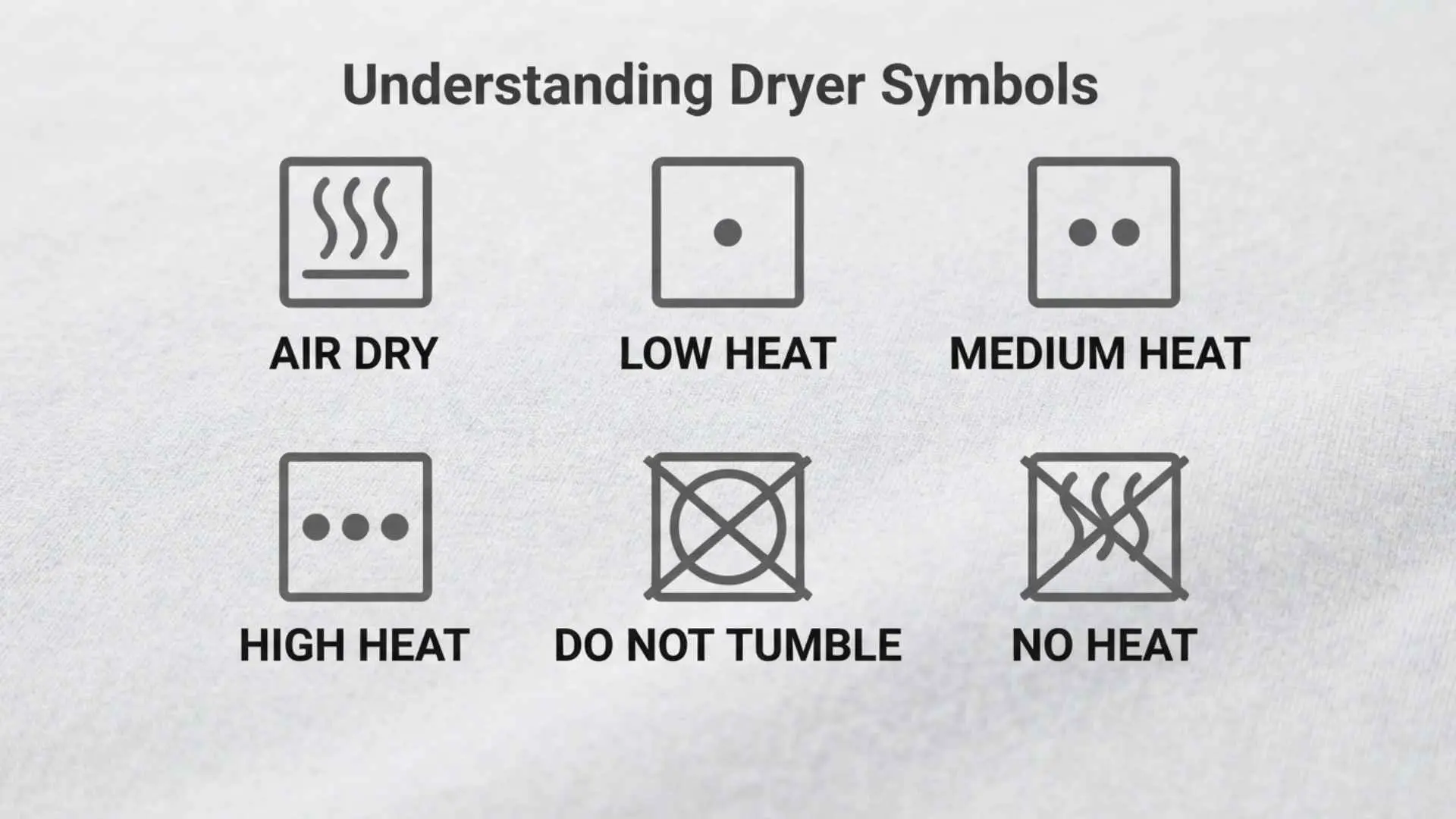
Dryer symbols tell you how to dry your clothes without damaging the fabric. These small pictures on clothing care labels show whether a garment can go into a tumble dryer, which heat level it can tolerate, or whether it needs natural drying instead.
Understanding dryer symbols and meanings can help you avoid common laundry problems. The right drying method reduces the risk of shrinkage, stretched knitwear, damaged elastic, and unwanted wrinkles.
The most important rule is simple: check the drying symbol before putting a garment in the dryer. A washing instruction doesn’t automatically mean the item can withstand tumble drying.
This guide explains the main drying symbols, their meanings, and how to follow them. You’ll also learn how to read care labels, choose suitable drying methods, and understand the difference between clothing symbols and dryer settings.
Dryer Symbols and Meanings Chart
The quickest way to understand dryer symbols is to recognize the shapes and markings inside them. Each symbol communicates a specific drying instruction.
| Dryer symbol | Meaning | What you should do |
| Square with a circle | Tumble drying permitted | Use a suitable dryer cycle |
| Circle inside square with two dots | Normal-temperature tumble drying | Use normal permitted heat |
| Circle inside square with one dot | Low-temperature tumble drying | Choose reduced heat |
| Crossed-out circle inside square | Do not tumble dry | Use an approved alternative |
| Square with one vertical line | Line drying | Hang the garment to dry |
| Square with two vertical lines | Drip line drying | Hang it without wringing |
| Square with one horizontal line | Flat drying | Lay the garment flat |
| Square with two horizontal lines | Drip flat drying | Lay it flat while dripping |
| Square with diagonal corner marking | Dry in the shade | Keep it away from direct sunlight |
Important: Some older or regional laundry charts show three dots for high-heat tumble drying. However, the current international care-label standard, ISO 3758:2023, specifies normal and low-temperature tumble-drying treatments rather than a universal three-dot high-heat category. Always check the actual symbol and applicable care-label system.
Textile Care Labelling Code Using Symbols+1
What Is the Tumble-Drying Symbol?
The tumble-drying symbol is a square containing a circle. The square represents drying, while the circle identifies mechanical drying in a tumble dryer.
When you see this symbol without a cross, tumble drying is permitted under the conditions indicated by the rest of the symbol.
However, the basic symbol doesn’t tell you every detail. You must check for dots or other markings that limit the permitted treatment.
Circle Inside a Square
A circle inside a square means tumble drying is allowed. You can place the garment in a tumble dryer if the remaining care instructions permit it.
The symbol doesn’t mean you should automatically choose the hottest cycle. Instead, look for the temperature markings and select an appropriate dryer setting.
Tumble-Drying Symbols With Dots
Dots inside the dryer symbol indicate the permitted heat level.
In many familiar care-label systems:
- One dot means low-temperature tumble drying.
- Two dots mean normal-temperature tumble drying.
- Three dots may appear on some older or regional labels to indicate higher heat.
The dots don’t tell you how many minutes to dry the garment. They indicate the permitted thermal treatment.
Under ISO 3758:2023, normal-temperature tumble drying has a maximum exhaust temperature of 80°C, while low-temperature drying has a maximum exhaust temperature of 60°C. These figures describe the standard’s treatment limits, not the exact temperature of every dryer model.
Textile Care Labelling Code Using Symbols+1
Crossed-Out Tumble-Drying Symbol
A crossed-out tumble-drying symbol means do not tumble dry.
The garment may be sensitive to heat, mechanical movement, or both. A tumble dryer can cause shrinkage, damage, stretching, or changes in the fabric’s shape.
When you see this symbol, choose a drying method allowed by the care label. Line drying or flat drying may be suitable, but check the natural-drying symbols too.
Natural Drying Symbols and Their Meanings
Natural drying symbols appear as lines inside a square. Unlike tumble-drying symbols, they describe drying without a rotating dryer drum.
The lines show how to position the garment while it dries. A diagonal marking in the corner means the garment should dry in the shade.
Line-Drying Symbol
A square with one vertical line means line drying.
Hang the garment on a clothesline, drying rack, or suitable hanger. Allow enough space for air to circulate around the fabric.
Line drying works well for many everyday garments. However, delicate items may need flat drying to prevent stretching.
Drip Line-Drying Symbol
A square with two vertical lines means drip line drying.
Hang the garment while excess water drains naturally. Avoid wringing it when the label specifies drip drying.
This method can help reduce wrinkles in suitable garments. It also avoids the extra mechanical action of a tumble dryer.
Flat-Drying Symbol
A square with one horizontal line means flat drying.
Place the garment on a clean, flat drying rack or suitable surface. Arrange it in its natural shape and avoid hanging it by the shoulders.
Flat drying is especially useful for certain knitted garments. Wet knitwear can stretch under its own weight, so a flat surface helps support its shape.
Drip Flat-Drying Symbol
A square with two horizontal lines means drip flat drying.
Lay the garment flat while water drains from it. Don’t twist or wring the fabric if the care label requires this treatment.
For this method, the washing process may need to avoid spinning. ISO 3758:2023 notes that drip-drying instructions require canceling the spin cycle.
Textile Care Labelling Code Using Symbols+1
Shade-Drying Symbol
A diagonal marking in the square indicates drying in the shade.
The diagonal marking modifies the natural-drying method. For example, a line-drying symbol with a shade marking means hang the garment away from direct sunlight.
Shade drying can help protect some dyes and delicate textiles from excessive sun exposure. It doesn’t mean the garment must remain indoors. A shaded outdoor area with good airflow may work well.
How to Read Dryer Symbols on Clothing Care Labels
A clothing care label provides instructions for washing, drying, bleaching, ironing, and sometimes professional cleaning.
You can usually find the label along an inner side seam, waistband, neckline, or lining. Its location depends on the garment’s design.
Follow these steps when reading dryer symbols and meanings.
Find the Care Label
Look inside the garment for a permanent care label. Some clothing includes several labels, such as one for fiber composition and another for care instructions.
Read the complete label before choosing a drying method.
Identify the Drying Symbol
Look for the square. If it contains a circle, it refers to tumble drying.
If it contains horizontal or vertical lines, it refers to natural drying.
Check the Dots and Crosses
Count the dots inside the tumble-drying symbol. They indicate the permitted temperature treatment.
Also check for a cross. A crossed-out symbol prohibits the treatment it represents.
Read the Complete Care Label
Don’t focus only on the dryer symbol. Check the washing instructions and any written care directions.
For example, a garment may allow machine washing but prohibit tumble drying. Washing and drying are separate treatments, so permission for one doesn’t automatically allow the other.
Dryer Symbols vs. Washing Symbols
Many people confuse dryer symbols with other laundry symbols. The easiest way to tell them apart is to identify the main shape.
| Symbol shape | Meaning |
| Washtub | Washing |
| Square | Drying |
| Triangle | Bleaching |
| Iron | Ironing |
| Circle | Professional textile care |
The washtub symbol shows washing instructions. Numbers inside it indicate the maximum washing temperature, while bars underneath indicate gentler washing processes.
The square represents drying. A circle inside the square means tumble drying, while lines inside the square indicate natural drying.
The triangle concerns bleaching. The iron represents ironing, and a standalone circle indicates professional textile care.
ginetex.net+1
Dryer Symbols for Different Fabrics
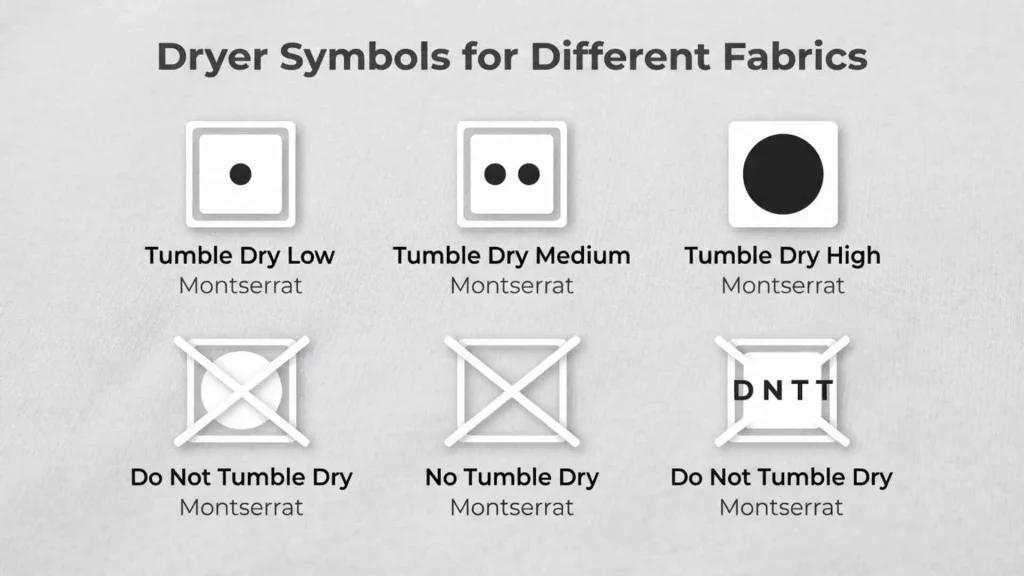
Different textile materials react differently to heat, moisture, and mechanical movement. Still, the care label remains the best guide because fabric construction and finishing also affect drying.
Cotton
Cotton appears in shirts, towels, bedding, and many everyday garments.
Some cotton items tolerate tumble drying well. However, unsuitable heat can cause shrinkage or changes in garment dimensions.
Follow the drying symbol instead of assuming every cotton item can handle high heat.
Polyester
Polyester is common in sportswear, jackets, and synthetic clothing.
It can be sensitive to excessive heat. Choose the permitted drying treatment and avoid using a hotter cycle simply because the garment feels damp.
Wool and Cashmere
Wool sweaters and cashmere garments often need careful handling.
Some wool fabrics can shrink or felt when exposed to unsuitable heat and movement. Flat drying may help protect the garment’s shape when the care label recommends it.
Silk
Silk is a delicate natural protein fiber.
Some silk garments can be affected by excessive heat or direct sunlight. Follow the label and use shade drying when instructed.
Linen
Linen comes from flax fibers and appears in shirts, trousers, and bedding.
It can wrinkle easily and may change dimensions during unsuitable drying. Use the method specified on the garment’s care label.
Denim
Denim jeans and jackets often contain cotton, although blends are common.
Excessive heat can contribute to shrinkage. Check the label before choosing a tumble-drying cycle.
Spandex and Elastane
Spandex and elastane provide stretch in leggings, underwear, and fitted clothing.
Unsuitable heat may affect elasticity. Use a drying method that protects the garment’s stretch fibers.
Cotton-Polyester Blends
Blended fabrics combine different fiber properties.
Don’t assume the cotton or polyester content alone determines the drying method. Follow the garment’s complete care instructions.
Dryer Settings vs. Dryer Symbols
Dryer settings appear on the appliance’s control panel. They aren’t the same as the symbols printed on clothing labels.
A care label tells you what treatment the garment can tolerate. The dryer setting controls how the appliance performs that treatment.
Normal or Regular Dry
Normal or regular dry is a common cycle for everyday laundry.
Use it only when the garment’s care label permits the corresponding drying treatment.
Delicate Dry
Delicate dry usually provides gentler drying conditions.
It may suit certain sensitive garments, but it doesn’t override a do-not-tumble-dry symbol.
Permanent Press
Permanent press cycles are designed to help reduce wrinkles in suitable clothing.
Many use a cooling period near the end of the cycle. Exact operation varies by dryer model.
Heavy-Duty Dry
Heavy-duty cycles are designed for suitable heavy or bulky laundry.
Don’t use this setting on garments that prohibit tumble drying. A stronger cycle doesn’t make a prohibited treatment safe.
Air Fluff
Air fluff moves air through the dryer without normal heating.
It differs from natural air drying because the garment still moves inside the appliance. Check the care label before using it.
Timed Dry and Sensor Dry
Timed dry lets you select a drying duration.
Sensor dry uses moisture sensors to adjust the cycle based on the laundry’s moisture level. Neither setting changes the garment’s care instructions.
What to Do When Dryer Symbols Are Missing or Unclear
Sometimes a care label is faded, damaged, or missing. In that situation, avoid guessing.
Check the Manufacturer’s Instructions
Look for the garment’s product page or manufacturer’s website.
A product identification code, model number, or product name may help you find the correct care instructions.
Check the Fabric Composition
Read the fiber-content label if one is available.
Fabric composition can help you understand possible heat or stretching concerns. However, it cannot replace the garment’s specific drying instructions.
Choose a Cautious Drying Method
When you can’t confirm the permitted treatment:
- Avoid high heat.
- Don’t tumble dry a garment if you suspect it may be heat-sensitive.
- Consider air drying when appropriate.
- Lay delicate knitwear flat when suitable.
- Allow enough airflow around wet clothing.
Don’t Guess at Unfamiliar Symbols
Compare unclear markings with a reliable care-label reference.
The international textile care-label system uses standardized pictograms under ISO 3758. GINETEX is the international association associated with this care-labeling system.
Textiles+1
Common Mistakes When Reading Dryer Symbols
Misreading a small symbol can lead to avoidable fabric damage. Watch out for these common mistakes:
- Confusing the washing symbol with the drying symbol.
- Assuming every circle means tumble drying.
- Ignoring a crossed-out tumble-drying symbol.
- Miscounting dots that indicate heat levels.
- Treating dryer settings as clothing care symbols.
- Assuming all cotton or polyester garments tolerate the same heat.
- Ignoring line-drying or flat-drying instructions.
- Overlooking a shade-drying marking.
- Assuming a cycle name guarantees a specific temperature.
- Reading only the drying symbol instead of the complete care label.
Why Dryer Symbols Matter for Fabric Care
Following drying instructions helps protect clothing from common laundry problems.
The correct drying method can reduce the risk of:
- Shrinkage: Some fabrics may become smaller under unsuitable heat.
- Fabric distortion: Garments can lose their intended shape.
- Loss of elasticity: Heat-sensitive stretch fibers may weaken.
- Wrinkles: Suitable drying methods can help reduce excessive creasing.
- Heat damage: Delicate fibers and decorations may suffer under unsuitable conditions.
- Reduced garment lifespan: Appropriate care helps clothing remain wearable longer.
Dryer symbols don’t guarantee that every garment will remain unchanged forever. They identify the most severe care treatments intended to avoid irreversible damage under the specified conditions.
Textiles+1
Frequently Asked Questions About Dryer Symbols
What do dryer symbols mean on clothes?
Dryer symbols show whether a garment can be tumble dried and which drying method or heat level is permitted. They appear on clothing care labels.
What is the symbol for tumble drying?
The tumble-drying symbol is a circle inside a square. Additional markings may specify the permitted heat level.
What does one dot inside the dryer symbol mean?
One dot commonly indicates low-temperature tumble drying. Under ISO 3758:2023, the low-temperature treatment has a maximum exhaust temperature of 60°C.
Textile Care Labelling Code Using Symbols
What do two dots inside the dryer symbol mean?
Two dots indicate normal-temperature tumble drying in the applicable care-label system. ISO 3758:2023 specifies a maximum exhaust temperature of 80°C for this treatment.
Textile Care Labelling Code Using Symbols
What does the do-not-tumble-dry symbol mean?
A crossed-out circle inside a square means do not tumble dry. Choose another drying method permitted by the care label.
What does a square with a horizontal line mean?
A square with one horizontal line means flat drying. Lay the garment flat instead of hanging it.
What does a square with vertical lines mean?
A square with one vertical line means line drying. Two vertical lines indicate drip line drying.
What does the shade-drying symbol mean?
A diagonal marking in the corner of a drying square means dry the garment in the shade. It modifies the natural-drying method shown by the other markings.
Are dryer symbols the same in the US and UK?
Many textile care pictograms follow the international care-label system based on ISO 3758. However, regional and older labels may differ in some details. Read the actual symbol and any written instructions.
Can I tumble dry clothes without a care label?
Check the manufacturer’s instructions if possible. If you can’t confirm the permitted method, avoid high heat and choose a cautious drying approach.
Is air fluff the same as air drying?
No. Air fluff is a dryer setting that moves air without normal heating. Air drying means drying naturally outside the tumble dryer.
Conclusion: Use Dryer Symbols to Protect Your Clothes
Dryer symbols and meanings become much easier to understand once you recognize the basic shapes.The square represents drying. A circle inside it indicates tumble drying, while lines show natural drying methods. Dots identify permitted heat levels, and a crossed-out symbol prohibits the treatment.Before drying your laundry, read the complete care label and choose a suitable method. A few seconds spent checking the dryer symbols can help prevent shrinkage, stretching, and unnecessary fabric damage.When in doubt, follow the garment manufacturer’s instructions rather than guessing.

I am Lisa Reynolds, a linguist fascinated by the ever-changing world of slang. I enjoy researching how slang reflects trends, technology, and social connections. I wrote “Text Talk: Understanding Digital Slang” and “From Street to Screen: Slang in Media”, exploring the influence of digital communication on language. I love sharing my discoveries in a way that feels like a conversation with friends, so you feel the culture and humor behind every phrase.
 John Carter