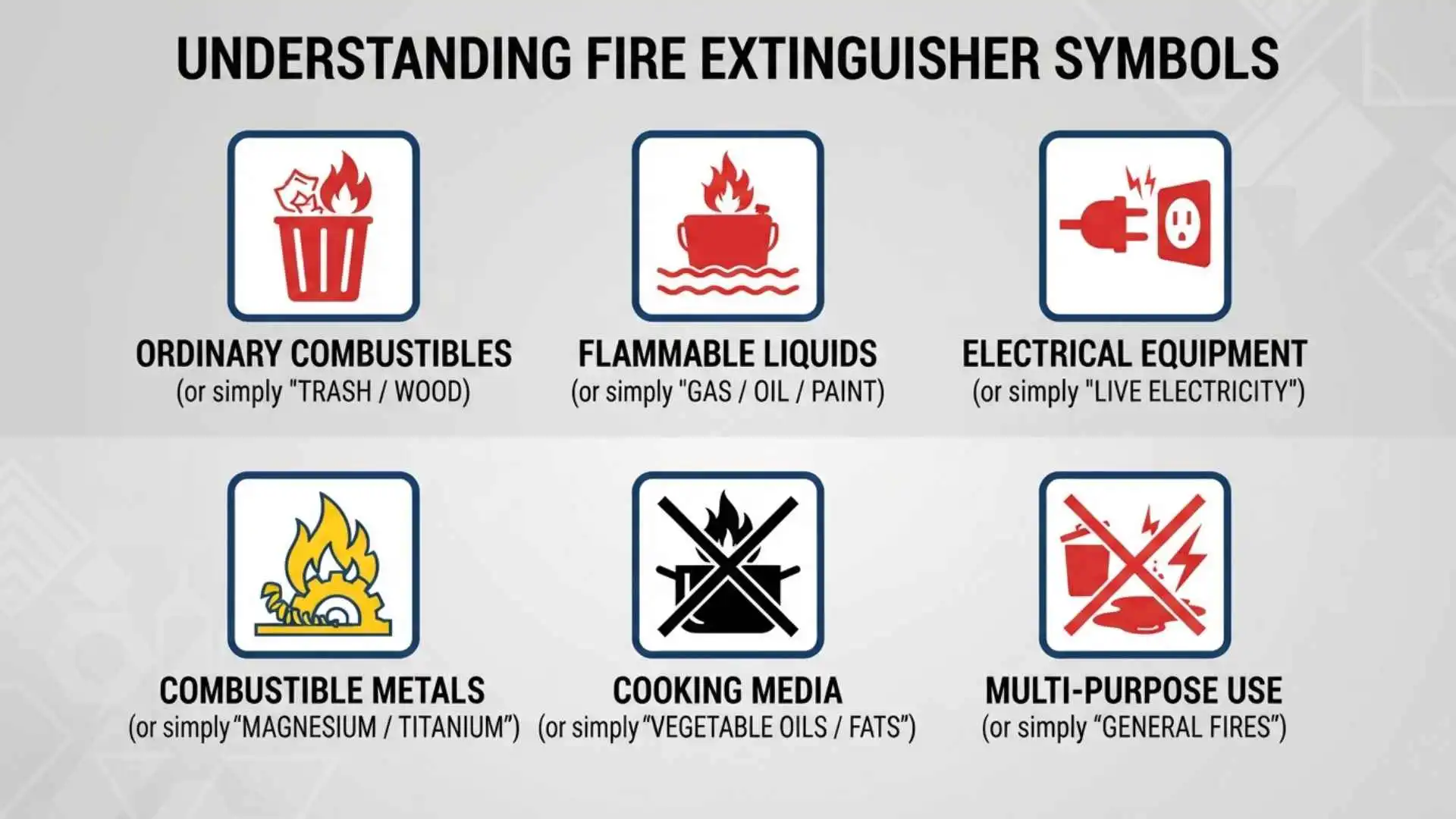
Fire extinguisher symbols tell you which types of fires an extinguisher can safely fight. These markings include letters, geometric shapes, pictograms, color codes, and numerical ratings. Each symbol provides important information about the extinguisher’s intended use.
For example, a green triangle with the letter A identifies an extinguisher suitable for ordinary combustible materials. A red square containing B indicates suitability for certain flammable liquid fires. Other symbols identify electrical hazards, combustible metals, and cooking oil fires.
Understanding fire extinguisher symbols and meanings helps you choose the correct equipment during an emergency. However, you must read the complete label because not every extinguisher works on every fire.
This guide explains fire extinguisher markings, fire extinguisher labels, fire extinguisher color codes, and fire extinguisher ratings. You’ll also learn how to identify different extinguisher types and understand their safety instructions.
What Do Symbols on a Fire Extinguisher Indicate?
Fire extinguisher symbols indicate the fire classes an extinguisher is designed and tested to fight. They help users match the extinguisher to the burning material or hazard.
In the United States, fire extinguishers commonly use five fire-class symbols: A, B, C, D, and K.
| Fire class | Common symbol | Fire type | Examples |
| Class A | Green triangle with A | Ordinary combustibles | Wood, paper, cloth |
| Class B | Red square with B | Flammable liquids | Gasoline, oil, paint |
| Class C | Blue circle with C | Energized electrical equipment | Live wiring, electrical panels |
| Class D | Yellow five-pointed star with D | Combustible metals | Magnesium, sodium |
| Class K | Black hexagon with K | Cooking oils and fats | Commercial fryers, cooking oil |
These symbols help identify the correct extinguisher quickly. An extinguisher may carry several class markings if it can handle multiple fire types.
For example, an ABC fire extinguisher can fight certain Class A, B, and C fires. However, it isn’t suitable for every combustible metal or commercial cooking oil fire.
Always check the extinguisher’s printed label before using it.
What Are Fire Extinguisher Symbols?
Fire extinguisher symbols are visual markings that communicate an extinguisher’s purpose, fire classification, and operating information. They make important safety details easier to recognize, especially when people must act quickly.
A typical extinguisher label may contain:
- Fire class letters and geometric symbols
- Fire hazard pictograms
- Extinguishing agent name
- Numerical fire ratings
- Operating instructions
- Safety warnings
- Manufacturer information
- Inspection or maintenance details
- Certification or listing marks
These markings serve different purposes. A fire class symbol identifies the hazard an extinguisher can fight. An agent label tells you what’s inside. A numerical rating describes tested extinguishing capability.
Fire Classes, Symbols, and Pictograms: What’s the Difference?
| Term | Meaning |
| Fire class | A category describing a type of fire hazard |
| Class symbol | A letter and shape representing a fire class |
| Pictogram | A picture showing a fire or material |
| Extinguisher rating | A measure of tested extinguishing performance |
| Agent label | Identifies the extinguishing substance |
For example, the letter B inside a red square represents Class B fires. A pictogram showing a burning fuel container may reinforce that meaning.
Fire Extinguisher Classes and Symbols Explained
The five common US fire classes identify different fire hazards. Understanding each class helps you recognize which extinguisher to use.
Class A Fire Extinguisher Symbol: Green Triangle
The Class A fire extinguisher symbol is a green triangle containing the letter A. It identifies fires involving ordinary combustible materials.
Common Class A materials include:
- Wood and firewood
- Paper and cardboard
- Cloth and textiles
- Many ordinary plastics
- Trash and other solid combustibles
These materials often leave ash or embers after burning. Class A extinguishers usually work by cooling the burning material and reducing its temperature below the point where combustion can continue.
Water extinguishers are commonly rated for Class A fires. Some foam and dry chemical extinguishers also carry Class A ratings.
Look for the green triangle or the letter A on the label. The marking confirms the extinguisher’s Class A suitability.
Class B Fire Extinguisher Symbol: Red Square
The Class B fire extinguisher symbol is a red square containing the letter B. It identifies fires involving flammable or combustible liquids.
Examples include:
- Gasoline
- Oil
- Paint
- Solvents
- Certain flammable liquids used in industrial settings
Some classification systems also include flammable gases within Class B hazards.
Burning liquids can spread quickly when fuel moves across a surface. The correct extinguisher must suppress the flames without spreading the burning material.
Foam, carbon dioxide, and certain dry chemical extinguishers may carry Class B ratings. However, their suitability depends on the specific product.
Never assume an ordinary water extinguisher can safely handle a burning liquid. Water can spread some liquid fuel fires and make the situation worse.
Class C Fire Extinguisher Symbol: Blue Circle
The Class C fire extinguisher symbol is a blue circle containing the letter C. In the US system, it identifies fires involving energized electrical equipment.
Examples include:
- Live electrical wiring
- Electrical panels
- Energized appliances
- Motors and electrical machinery
Class C does not describe a separate type of fuel. Instead, it identifies an electrical hazard that affects which extinguishing agents are safe to use.
A suitable Class C extinguisher uses an agent that does not conduct electricity under its approved conditions. Carbon dioxide and certain dry chemical extinguishers commonly carry Class C ratings.
Once someone safely disconnects the electrical power, the remaining fire may fall under another class. For example, burning insulation may present a Class A hazard after the electrical source is no longer energized.
Class D Fire Extinguisher Symbol: Yellow Star
The Class D fire extinguisher symbol is a yellow five-pointed star containing the letter D. It identifies fires involving combustible metals.
Examples include:
- Magnesium
- Sodium
- Potassium
- Certain metal powders and shavings
Combustible metal fires require special care. Some metals react dangerously with water or other common extinguishing agents.
Class D extinguishers contain specialized dry powder designed for particular metal hazards. The correct agent depends on the metal involved.
An ordinary ABC extinguisher isn’t a substitute for a suitable Class D extinguisher. If you work around combustible metals, follow the site’s specific fire response plan.
Class K Fire Extinguisher Symbol: Black Hexagon
The Class K fire extinguisher symbol is a black hexagon containing the letter K. It identifies fires involving cooking oils and fats, especially in commercial kitchens.
Common hazards include:
- Deep-fat fryers
- Commercial frying equipment
- Vegetable cooking oils
- Animal fats
- Large cooking surfaces with hot grease
Wet chemical extinguishers are commonly used for Class K fires. Their agent helps cool the cooking medium and form a layer that reduces the risk of re-ignition.
Cooking oil fires can reach very high temperatures. Never throw water onto burning cooking oil because it can cause a violent splatter and spread the fire.
In the United Kingdom, a similar cooking oil and fat hazard is classified as Class F rather than Class K.
Fire Extinguisher Pictograms and Their Meanings
Besides class letters, fire extinguisher pictograms use pictures to show suitable fire hazards. These illustrations help users understand an extinguisher’s purpose without reading every line.
Common pictograms include:
- Burning wood or trash for ordinary combustibles
- A burning fuel container for flammable liquids
- An electrical plug or lightning bolt for electrical hazards
- Burning metal for combustible metal fires
- A cooking pan for cooking oil and fat fires
Some labels use check marks or crossed-out symbols to show approved and prohibited uses. These markings can help prevent mistakes when several extinguisher types are available.
However, pictograms don’t replace the extinguisher’s written instructions. Always check the fire class and agent label together.
Fire Extinguisher Color Codes and Their Meanings
Fire extinguisher color codes can identify the extinguishing agent. However, color conventions vary between countries, so you should never rely on color alone.
Fire Extinguisher Color Codes in the United States
In the United States, portable extinguishers commonly have red cylinders. The label identifies the agent and the fire classes the unit can handle.
The familiar green, red, blue, yellow, and black class-symbol colors help identify fire hazards. They don’t necessarily identify the extinguishing agent inside the cylinder.
For example, a red extinguisher may contain water, dry chemical powder, or carbon dioxide. The label tells you which agent it contains.
Fire Extinguisher Color Codes in the United Kingdom
The UK commonly uses red extinguisher bodies with colored identification panels.
| Identification color | Extinguisher type | Common uses |
| Red | Water | Class A fires |
| Cream | Foam | Class A and B fires |
| Blue | Dry powder | Several fire classes, depending on the agent |
| Black | Carbon dioxide | Class B and electrical equipment |
| Yellow | Wet chemical | Class F cooking oil fires |
Modern UK extinguishers generally use a colored panel rather than a completely colored cylinder. Older equipment may have a body painted in the agent’s identification color.
The UK government’s fire safety guidance explains these identification conventions and their intended uses.
Why Fire Extinguisher Colors Can Be Confusing
Color codes differ because countries follow different standards and classification systems.
Keep these points in mind:
- A cylinder’s body color doesn’t always identify its contents.
- Class-symbol colors and agent-identification colors serve different purposes.
- Older extinguishers may use different color conventions.
- Similar colors don’t guarantee identical extinguishing agents.
The label is always more reliable than color alone.
Fire Extinguisher Types and Their Labels
The extinguishing agent determines how an extinguisher controls a fire. Its label identifies the agent and the fire classes for which the product has been approved.
Water Fire Extinguisher
Water extinguishers primarily handle Class A fires. They cool burning materials and reduce the heat that keeps the fire going.
They work well on suitable fires involving wood, paper, and cloth. However, ordinary water extinguishers aren’t suitable for energized electrical equipment or many burning liquid hazards.
Foam Fire Extinguisher
Foam extinguishers commonly carry Class A and B ratings.
Foam helps suppress flames by covering suitable burning liquids. It also helps separate the fuel from oxygen and can reduce the chance of re-ignition.
Check the label before using foam on electrical equipment or specialized liquid hazards.
Dry Chemical Fire Extinguisher
Dry chemical extinguishers contain powder that interrupts the fire’s chemical reaction.
Common formulations include:
- ABC powder: Suitable for certain Class A, B, and C fires
- BC powder: Suitable for certain Class B and C fires
- Specialized Class D powder: Designed for particular combustible metals
Not all dry powders work on the same fires. Always check the exact rating.
Carbon Dioxide Fire Extinguisher
Carbon dioxide, or CO₂, extinguishers commonly handle Class B and electrical equipment fires.
They release carbon dioxide, which helps suppress flames by reducing the oxygen available around the fire. The discharge also produces a cooling effect.
CO₂ extinguishers leave little solid residue. However, carbon dioxide can create a breathing hazard in confined spaces.
Wet Chemical Fire Extinguisher
Wet chemical extinguishers commonly handle Class K cooking oil fires in the United States.
The agent cools the hot cooking material and helps form a layer that suppresses flames. This action reduces the risk of re-ignition.
Some wet chemical extinguishers also carry a Class A rating.
Specialized Class D Fire Extinguisher
Class D extinguishers use specialized agents for combustible metal fires.
The correct agent depends on the metal involved. A powder suitable for one metal may not work safely on another.
Never assume a general-purpose extinguisher can handle a combustible metal fire.
What Do Fire Extinguisher Ratings Mean?
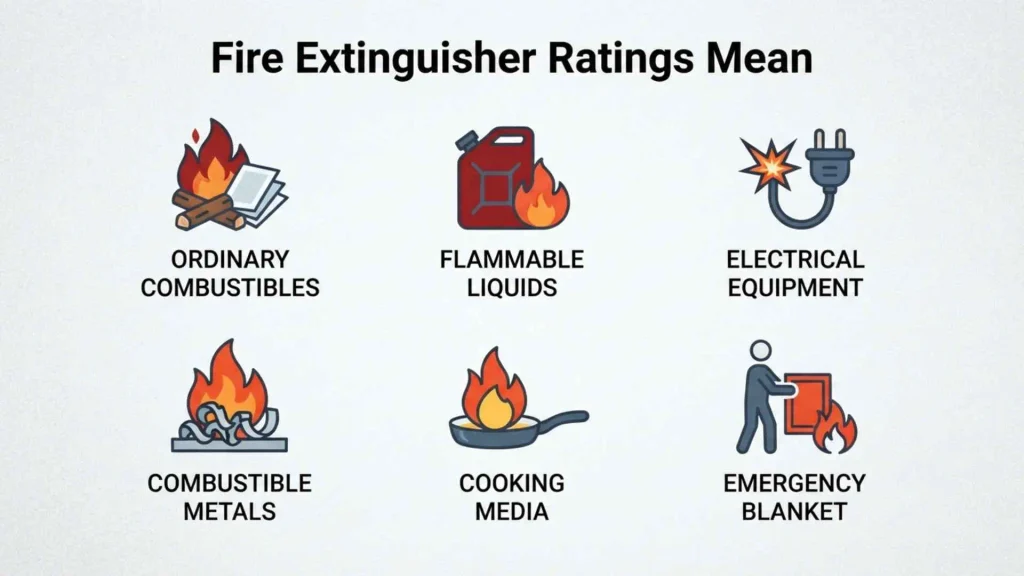
Fire extinguisher ratings describe tested extinguishing capability. They help users compare extinguishers within the same fire class.
A rating may include a number before the A or B. Class C indicates electrical suitability and doesn’t carry a numerical rating in the US system.
Class A Numerical Ratings
In the US rating system, each numerical unit before A represents the extinguishing capability equivalent to 1.25 gallons of water.
For example:
- 1-A represents a water-equivalent rating of 1.25 gallons.
- 2-A represents a water-equivalent rating of 2.5 gallons.
- 4-A represents a water-equivalent rating of 5 gallons.
This comparison describes tested performance. It doesn’t mean the extinguisher literally contains that amount of water.
Class B Numerical Ratings
The number before B relates to the size of a Class B fire that the extinguisher can handle under standardized testing.
For example, a 10-B rating indicates tested capability for a Class B fire of approximately 10 square feet under the rating system.
This isn’t a guarantee that the extinguisher will control every real-world fire of that size. Conditions such as wind, fuel type, and fire intensity can affect the outcome.
What Does a 2A:10B:C Rating Mean?
Consider an extinguisher marked 2A:10B:C.
| Marking | Meaning |
| 2A | Class A rating equivalent to 2.5 gallons of water |
| 10B | Tested Class B fire rating of 10 square feet |
| C | Suitable for energized electrical equipment |
The US Fire Administration and OSHA explain how these numerical ratings work.
U.S. Fire Administration+1
What Does the UL Mark Mean?
A UL mark indicates that a product has been evaluated under an applicable testing or certification program.
The US Fire Administration recommends looking for a UL Listed or ULC Listed label when choosing an extinguisher. OSHA also requires portable extinguishers covered by its workplace standard to receive approval from a nationally recognized testing laboratory.
U.S. Fire Administration+1
A certification mark doesn’t replace the fire class rating. You still need to confirm that the extinguisher suits the hazard.
How to Read a Fire Extinguisher Label
Reading the label before an emergency helps you recognize the correct equipment quickly.
Find the Fire Class Symbols
Look for the class letters and symbols. Identify whether the extinguisher carries an A, B, C, D, or K rating.
Some extinguishers carry multiple class markings. An ABC extinguisher, for example, covers several common fire hazards.
Identify the Extinguishing Agent
Read the agent name printed on the label.
It may identify water, foam, dry chemical, carbon dioxide, wet chemical, or a specialized metal-fire powder.
The agent matters because different substances control fires in different ways.
Check the Numerical Rating
Look for numerical ratings before A or B. These numbers describe tested extinguishing capability.
Compare ratings only within the relevant fire class. A higher number doesn’t automatically mean the extinguisher works better on every type of fire.
Read the Operating Instructions
The label usually shows how to operate the extinguisher.
Look for instructions covering:
- Safety pin
- Handle or lever
- Hose or nozzle
- Discharge direction
- Operating precautions
Some extinguishers have a discharge horn rather than a hose. Follow the instructions for that specific model.
Check the Inspection Information
Look for the inspection tag or maintenance record.
Check whether the extinguisher appears damaged, discharged, or improperly stored. A readable label and accessible equipment help support emergency readiness.
What Does the PASS Method Mean?
The PASS method is a common way to remember the basic steps for operating a portable fire extinguisher.
| Letter | Action | What to do |
| P | Pull | Pull the safety pin |
| A | Aim | Aim at the base of the fire |
| S | Squeeze | Squeeze the handle |
| S | Sweep | Sweep across the burning area |
Pull the Safety Pin
Pull the pin to release the handle’s safety mechanism. Some extinguishers also have a tamper seal that breaks during use.
Aim at the Base of the Fire
Aim the nozzle or hose toward the burning material rather than the flames.
The goal is to direct the extinguishing agent toward the fuel source.
Squeeze the Handle
Squeeze the lever to release the agent. Keep control of the extinguisher while directing the discharge.
Sweep Side to Side
Move the nozzle across the burning area. Watch for signs that the fire may re-ignite.
The PASS method doesn’t replace hands-on training or the manufacturer’s instructions.
Fire Extinguisher Safety Symbols and Warning Labels
Fire extinguisher labels may include warnings about pressure, temperature, electrical hazards, and prohibited uses.
Electrical Hazard Warnings
Check whether the extinguisher is rated for energized electrical equipment.
A Class C marking in the US indicates electrical suitability. Never assume an extinguisher is safe for electrical hazards simply because it contains a familiar agent.
High-Pressure Cylinder Warnings
Portable extinguishers contain pressurized contents. Handle them carefully and avoid damaging the cylinder.
Temperature and Storage Warnings
Extinguishers must remain within their approved temperature range.
Extreme heat or cold can affect certain extinguishers. Follow the storage instructions printed on the product.
Prohibited-Use Markings
Some labels show crossed-out fire symbols to indicate unsuitable applications.
These warnings help users avoid dangerous mistakes. A crossed-out symbol doesn’t mean the extinguisher is defective; it means that fire class isn’t an approved use.
Fire Extinguisher Inspection and Maintenance
A fire extinguisher must remain ready for use. Regular checks help identify damage or problems before an emergency occurs.
Look for these common warning signs:
- Missing safety pin
- Broken or missing tamper seal
- Damaged hose or nozzle
- Corroded cylinder
- Missing or unreadable label
- Leakage or visible damage
- Incorrect pressure indication on models with gauges
Inspection and maintenance requirements vary by extinguisher type and local regulations. Workplace equipment may require scheduled checks and professional servicing.
If an extinguisher appears damaged or unserviceable, arrange inspection or replacement by a qualified professional.
Common Misunderstandings About Fire Extinguisher Symbols
Does Every Red Fire Extinguisher Contain Water?
No. Red cylinders may contain different agents. Read the label to identify the contents.
Does Class C Mean a Combustible Material?
No. In the US system, Class C identifies energized electrical equipment. It doesn’t describe a separate fuel.
Can an ABC Extinguisher Put Out Every Fire?
No. ABC extinguishers handle many common fires but aren’t designed for every combustible metal or cooking oil hazard.
Does a Higher Rating Mean a Bigger Cylinder?
Not necessarily. The rating describes tested extinguishing capability rather than cylinder size alone.
Are Fire Extinguisher Symbols the Same Worldwide?
No. Countries may use different fire classes, letters, and color conventions. Check the local system and the extinguisher’s label.
Frequently Asked Questions About Fire Extinguisher Symbols
What do symbols on a fire extinguisher indicate?
They identify the fire classes an extinguisher is designed to fight. Symbols, letters, pictograms, and ratings help users select suitable equipment.
What does a square symbol mean on a fire extinguisher?
In the common US system, a red square containing B identifies Class B fires involving flammable liquids.
What does a green triangle mean on a fire extinguisher?
A green triangle containing A identifies Class A fires involving ordinary combustible materials such as wood, paper, and cloth.
What does the blue circle mean on a fire extinguisher?
A blue circle containing C identifies suitability for energized electrical equipment in the US classification system.
What does the yellow star mean on a fire extinguisher?
A yellow five-pointed star containing D identifies Class D fires involving combustible metals.
What does the black hexagon mean on a fire extinguisher?
A black hexagon containing K commonly identifies Class K cooking oil and fat fires in the US.
How can you identify the correct fire extinguisher?
Check the fire class, agent label, numerical rating, and operating instructions. Use only an extinguisher approved for the hazard.
Conclusion: Understand Fire Extinguisher Symbols Before an Emergency
Fire extinguisher symbols provide essential information about fire classes, extinguishing agents, and tested performance. The A, B, C, D, and K markings help users identify different fire hazards.However, symbols and colors can vary between countries. Always read the complete label and follow the manufacturer’s instructions.Learn the PASS method before you need it. Keep extinguishers accessible and properly maintained.Most importantly, use an extinguisher only when the fire is small, you have the proper equipment, and you can escape safely. If the fire grows or threatens your exit, evacuate immediately and call emergency services.

I am John Carter, a lifelong enthusiast of language and modern slang. I explore how words evolve and shape culture, and I enjoy uncovering the stories behind everyday expressions. I have authored “Slang and Society: The Language of Youth” and “Modern Words, Modern Worlds”, where I dive into how informal language impacts communication and identity. My goal is to make language accessible, fun, and insightful for everyone who loves words as much as I do.
 Lisa Reynolds