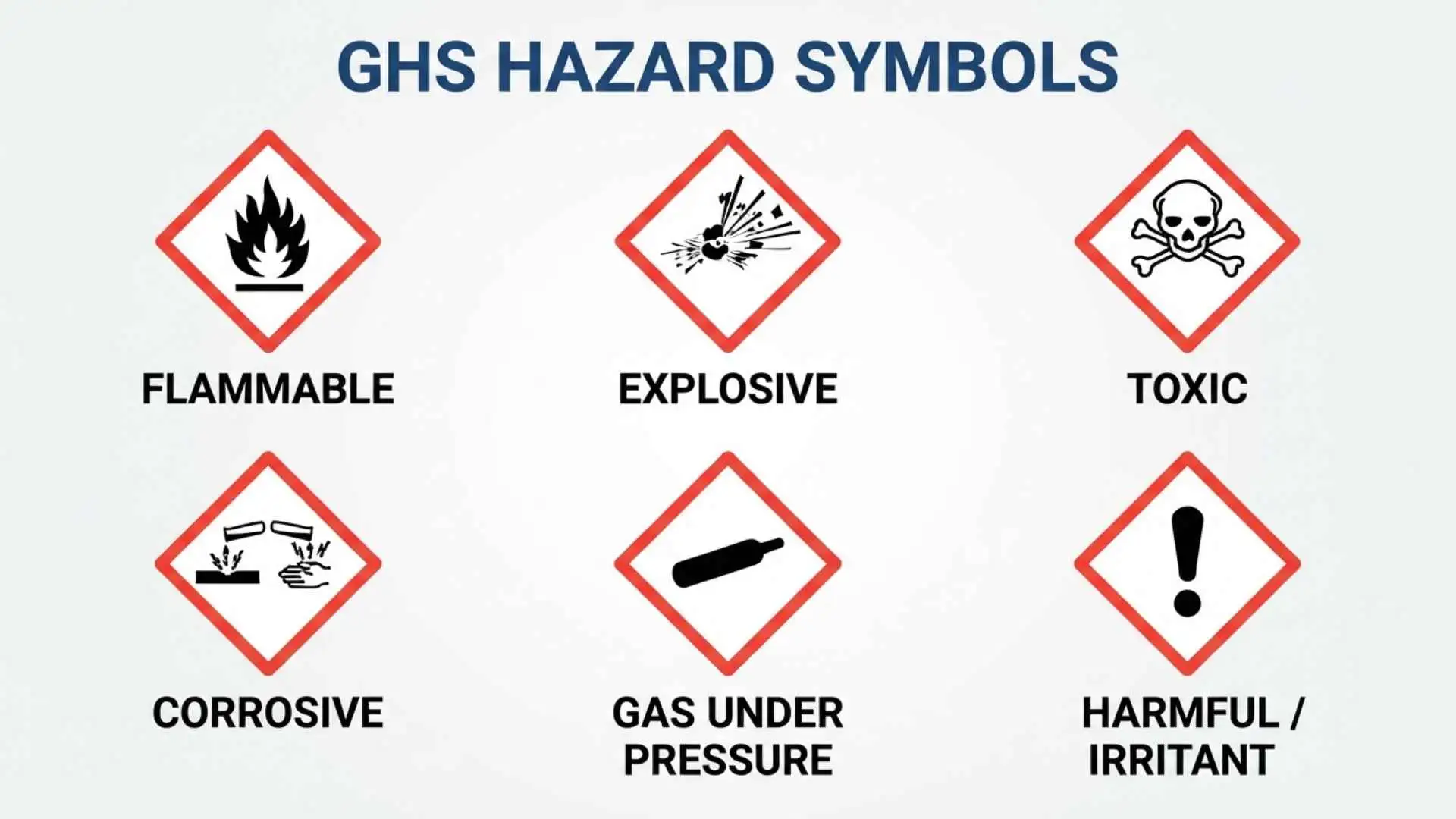
Chemical products often carry small symbols that communicate serious safety information. These symbols can warn you about fire, poisoning, chemical burns, or long-term health effects.
GHS pictograms help workers, consumers, and emergency responders recognize chemical hazards quickly. Each pictogram uses a black symbol inside a red diamond-shaped frame with a white background. Together, these symbols support clear chemical hazard communication across workplaces and industries.
The Globally Harmonized System of Classification and Labelling of Chemicals (GHS) establishes a common approach to classifying chemical hazards and communicating them through labels and Safety Data Sheets. The system includes nine GHS hazard symbols, each linked to specific hazard classes.
However, not every country adopts every GHS element in exactly the same way. In the United States, OSHA requires eight of the nine pictograms under its Hazard Communication Standard. The Environment pictogram remains part of the UN GHS system but isn’t mandatory under OSHA’s workplace labeling rules.
This guide explains all nine GHS pictograms and their meanings, the hazards they represent, and how to read them on chemical labels. You’ll also learn how these symbols relate to OSHA requirements, Safety Data Sheets, and everyday workplace chemical safety.
What Are GHS Pictograms?
GHS pictograms are standardized graphical symbols that communicate chemical hazards on labels and Safety Data Sheets (SDSs). They help people recognize risks before handling, storing, or transporting hazardous chemicals.
The Globally Harmonized System was developed through the United Nations to improve chemical classification and hazard communication. It provides shared criteria for identifying chemical hazards and presenting safety information.
Each GHS pictogram has three main visual features:
- A black hazard symbol
- A white background
- A red diamond-shaped frame
The pictogram code, such as GHS02, helps identify the symbol in technical references. However, the code itself isn’t part of the required pictogram artwork.
The system covers three broad hazard groups:
| Hazard group | What it covers |
| Physical hazards | Fire, explosion, pressure, and reactive chemicals |
| Health hazards | Poisoning, irritation, burns, and serious long-term effects |
| Environmental hazards | Harm to aquatic organisms and the environment |
A pictogram gives you a quick warning. It doesn’t tell you everything about a chemical’s risk, exposure level, or safe handling method.
For complete information, read the chemical label and its Safety Data Sheet (SDS).
The 9 GHS Pictograms and Their Meanings
The UN GHS framework contains nine chemical hazard pictograms. Each symbol represents specific hazard classes and categories.
The following chart provides a quick reference.
| Code | GHS pictogram | Main meaning |
| GHS01 | Exploding Bomb | Explosive or certain reactive hazards |
| GHS02 | Flame | Flammable or certain reactive substances |
| GHS03 | Flame Over Circle | Oxidizing substances |
| GHS04 | Gas Cylinder | Gases under pressure |
| GHS05 | Corrosion | Skin corrosion, eye damage, or metal corrosion |
| GHS06 | Skull and Crossbones | Severe acute toxicity |
| GHS07 | Exclamation Mark | Irritation or harmful effects |
| GHS08 | Health Hazard | Serious or chronic health hazards |
| GHS09 | Environment | Aquatic and environmental hazards |
Exploding Bomb Pictogram (GHS01)
The Exploding Bomb pictogram warns about explosive hazards and certain reactive chemicals. These substances may explode under specific conditions, such as heat, shock, friction, or chemical reactions.
The symbol applies to hazard classes such as:
- Explosives
- Certain self-reactive substances
- Certain organic peroxides
Explosive chemicals can release energy rapidly and cause pressure waves, heat, and flying fragments.
Don’t confuse this symbol with the Flame pictogram. A flammable liquid may ignite without meeting the classification criteria for an explosive.
Flame Pictogram (GHS02)
The Flame pictogram identifies chemicals that can ignite easily or create fire hazards.
It may appear on labels for:
- Flammable gases
- Flammable liquids
- Flammable solids
- Pyrophoric substances
- Self-heating substances
- Certain self-reactive chemicals
- Certain organic peroxides
- Chemicals that emit flammable gas
For example, acetone is a flammable liquid. Propane is a flammable gas. Both can carry the Flame pictogram when their classifications meet the applicable criteria.
Some chemicals can ignite spontaneously when exposed to air. These substances are called pyrophoric chemicals.
The Flame symbol doesn’t mean every chemical burns in the same way. Always check the hazard statement for the specific product.
Flame Over Circle Pictogram (GHS03)
The Flame Over Circle pictogram represents oxidizing substances.
Oxidizers can cause or intensify fires because they support combustion through their chemical properties. Some oxidizers release oxygen or promote oxidation reactions.
Common hazard classes include:
- Oxidizing gases
- Oxidizing liquids
- Oxidizing solids
Examples include certain hydrogen peroxide solutions and ammonium nitrate classifications.
An important distinction: oxidizers aren’t necessarily flammable themselves. However, they can make other materials burn more intensely or rapidly.
Keep oxidizers away from incompatible materials according to the chemical’s SDS and workplace storage procedures.
Gas Cylinder Pictogram (GHS04)
The Gas Cylinder pictogram warns that a chemical contains gas under pressure.
It applies to:
- Compressed gases
- Liquefied gases
- Refrigerated liquefied gases
- Dissolved gases
Examples include compressed nitrogen and acetylene cylinders.
Pressurized containers can rupture when heated. Some refrigerated gases can cause cold burns or frostbite. Certain gases also create oxygen-displacement or toxicity hazards.
The Gas Cylinder symbol doesn’t automatically mean a gas is toxic or flammable. A chemical may carry additional pictograms for those hazards.
Corrosion Pictogram (GHS05)
The Corrosion pictogram warns about substances that can cause serious chemical damage.
It represents hazards such as:
- Skin corrosion
- Serious eye damage
- Corrosion of metals
Strong acids and bases may cause severe chemical burns. Sodium hydroxide is one example of a corrosive substance when classified at the applicable concentration.
The symbol also applies to chemicals that can damage metal surfaces.
Don’t confuse skin irritation with skin corrosion. Irritation causes reversible skin effects under the classification criteria. Corrosion involves more severe tissue damage.
Skull and Crossbones Pictogram (GHS06)
The Skull and Crossbones pictogram identifies chemicals that meet the criteria for severe acute toxicity.
Acute toxicity means harmful effects can occur after a short exposure through routes such as:
- Swallowing
- Skin contact
- Inhalation
The symbol may indicate chemicals classified as fatal or toxic under the GHS acute toxicity categories.
Certain cyanide compounds and highly toxic pesticides may carry this pictogram depending on their classification.
This symbol does not describe every possible poisoning risk. Some chemicals cause serious long-term health effects without carrying the Skull and Crossbones pictogram.
Exclamation Mark Pictogram (GHS07)
The Exclamation Mark pictogram warns about several harmful or irritating effects.
It may represent:
- Skin irritation
- Eye irritation
- Skin sensitization
- Harmful acute toxicity
- Respiratory tract irritation
- Narcotic effects, such as drowsiness or dizziness
Some solvents can cause dizziness after inhalation. Other chemicals may irritate the skin or eyes.
The Exclamation Mark is not simply a symbol for minor danger. It communicates specific hazard classifications that still require proper precautions.
Read the hazard statements to understand the exact risk.
Health Hazard Pictogram (GHS08)
The Health Hazard pictogram represents serious health effects, including certain hazards that may develop after repeated or long-term exposure.
It can indicate:
- Carcinogenicity
- Germ cell mutagenicity
- Reproductive toxicity
- Respiratory sensitization
- Specific target organ toxicity
- Aspiration toxicity
For example, a chemical classified as a carcinogen may carry this pictogram. Certain substances that can damage organs after repeated exposure may also use it.
The symbol doesn’t mean every listed hazard applies to every chemical. Check the label and SDS for the specific classification.
Environment Pictogram (GHS09)
The Environment pictogram shows a dead tree and fish. It warns about chemicals that can harm aquatic organisms or the environment.
It may indicate:
- Acute aquatic toxicity
- Chronic aquatic toxicity
- Environmental hazards involving aquatic life
Some pesticides and industrial chemicals can harm fish, algae, or other aquatic organisms when released into water.
The Environment pictogram belongs to the UN GHS system. However, OSHA doesn’t require it under the US Hazard Communication Standard because environmental hazards fall outside OSHA’s workplace hazard jurisdiction.
Chemical suppliers may still include it as additional information.
GHS Hazard Classes and Categories Explained
GHS hazard classification determines which pictograms and other label elements a chemical needs.
The system separates hazards into classes. Many classes then divide into categories based on defined criteria.
Physical Hazard Classes
Physical hazards involve chemical properties that can create fire, explosion, pressure, or reaction risks.
| Hazard class | Example |
| Flammable liquids | Acetone |
| Flammable gases | Propane |
| Gases under pressure | Compressed nitrogen |
| Oxidizing substances | Certain hydrogen peroxide solutions |
| Explosives | Classified explosive materials |
| Pyrophoric substances | Chemicals that may ignite spontaneously |
| Self-reactive substances | Certain unstable reactive chemicals |
| Organic peroxides | Certain peroxide compounds |
| Corrosive to metals | Chemicals that damage metal surfaces |
A chemical may belong to more than one hazard class. Therefore, it may require multiple GHS symbols on its label.
Health Hazard Classes
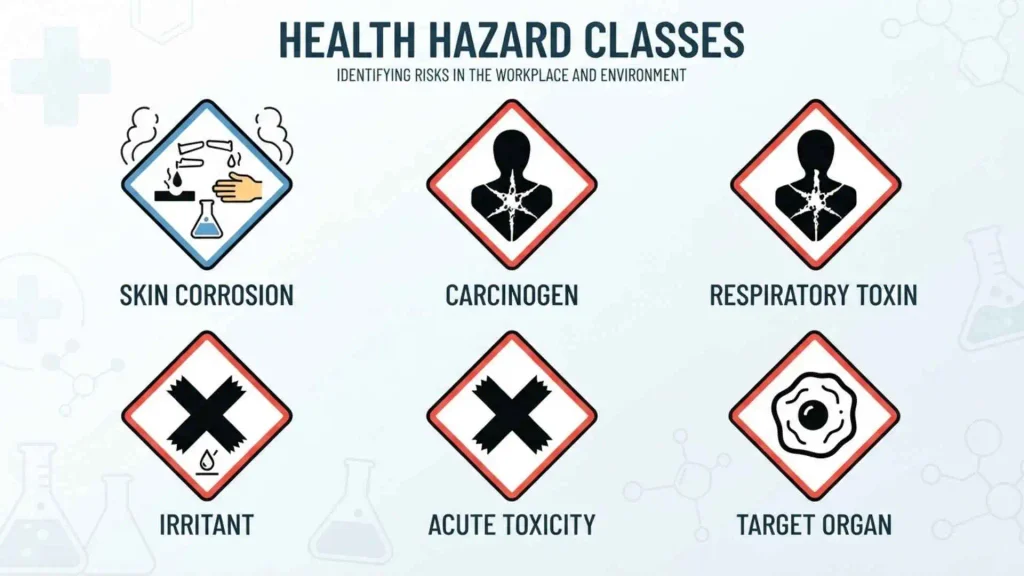
Health hazards describe how chemicals can affect the human body.
Important health hazard classification entities include:
- Acute toxicity
- Skin corrosion and irritation
- Serious eye damage and eye irritation
- Respiratory sensitization
- Skin sensitization
- Carcinogenicity
- Mutagenicity
- Reproductive toxicity
- Specific target organ toxicity
- Aspiration toxicity
Some hazards occur quickly after exposure. Others may develop after repeated exposure or over time.
Environmental Hazard Classes
The GHS environmental hazard group focuses mainly on aquatic toxicity.
It includes classifications for acute and chronic effects on aquatic organisms. The relevant pictogram is the Environment symbol.
Environmental classification doesn’t replace local environmental laws or chemical disposal requirements.
What Do GHS Hazard Categories Mean?
Hazard categories describe the severity or type of hazard within a class.
However, category numbers don’t follow one universal scale across all classes. For example, Category 1 may represent a more severe hazard in one class, while another class uses different criteria or category structures.
Never compare two chemicals using category numbers alone. Read the complete hazard classification.
GHS Pictograms and OSHA Hazard Communication Requirements
The Occupational Safety and Health Administration (OSHA) regulates workplace hazard communication in the United States. Its Hazard Communication Standard appears in 29 CFR 1910.1200.
OSHA revised its Hazard Communication Standard in 2012 to align with GHS Revision 3. The agency issued another update in 2024, primarily aligning the standard with GHS Revision 7.
Does OSHA Require All 9 GHS Pictograms?
No. OSHA requires eight of the nine GHS pictograms under its Hazard Communication Standard.
The Environment pictogram is the exception. OSHA doesn’t require it because environmental hazards fall outside the agency’s workplace safety jurisdiction.
However, chemical suppliers may include the Environment pictogram as supplementary information.
Read the official OSHA Hazard Communication Pictograms guide for the required symbols and downloadable artwork.
OSHA Chemical Labeling Requirements
Under OSHA’s chemical labeling rules, shipped hazardous chemical containers generally need these label elements:
- Product identifier: The chemical name or another identifier.
- Signal word: Danger or Warning.
- Hazard statements: Statements describing the chemical’s hazards.
- Pictograms: Applicable hazard symbols.
- Precautionary statements: Instructions for prevention, response, storage, and disposal.
- Supplier information: Name, address, and telephone number of the responsible supplier.
OSHA’s Appendix C explains how hazard classes and categories determine label elements. It also includes rules for pictogram allocation and precedence.
For complete details, see OSHA Appendix C: Allocation of Label Elements.
OSHA’s 2024 HazCom Update
OSHA’s 2024 final rule updated the Hazard Communication Standard to improve chemical hazard information. The rule took effect on July 19, 2024.
The update primarily aligns the standard with GHS Revision 7. It also revises certain hazard classification criteria, label requirements, and Safety Data Sheet provisions.
OSHA extended the compliance deadlines by four months in January 2026.
| Compliance deadline | Main requirement |
| May 19, 2026 | Manufacturers, importers, and distributors update substance labels and SDSs |
| November 20, 2026 | Employers update workplace labeling, programs, and training for substances |
| November 19, 2027 | Manufacturers, importers, and distributors update mixture labels and SDSs |
| May 19, 2028 | Employers update workplace labeling, programs, and training for mixtures |
These dates reflect OSHA’s January 2026 extension. Companies should review the rule and applicable requirements for their role and chemical products.
Where Do GHS Pictograms Appear?
GHS Pictograms on Chemical Container Labels
You may find GHS hazard symbols on chemical containers in laboratories, factories, warehouses, and other workplaces.
A label may show one pictogram or several. The number depends on the chemical’s hazard classification.
For example, a product with flammable and serious health hazards may display both the Flame and Health Hazard pictograms.
GHS Pictograms on Safety Data Sheets
A Safety Data Sheet (SDS) provides detailed information about a hazardous chemical.
GHS pictograms usually appear in SDS Section 2: Hazard Identification. This section also includes hazard statements, signal words, and other classification details.
An SDS follows a standardized 16-section format. Other sections explain chemical composition, handling, storage, exposure controls, first aid, and physical properties.
GHS Pictograms on Secondary Containers
Secondary containers are containers into which workers transfer chemicals from the original supplier packaging.
OSHA workplace labeling rules generally require chemical identity and appropriate hazard information. Employers may use compliant workplace labels or alternative labeling systems that meet the standard.
The immediate-use exception applies only under specific conditions. For example, a worker who transfers a chemical for immediate use may not need to label that container if the worker maintains control of it during use.
Don’t assume every small bottle or spray container qualifies for this exception.
How to Read a GHS Chemical Label
A chemical label provides more information than its pictograms alone.
Follow these steps when you encounter a hazardous chemical.
Identify the Chemical
Read the product identifier and match it to the correct SDS. This helps prevent confusion between similar products or chemical mixtures.
Recognize the Pictograms
Identify every pictogram on the label. Each symbol communicates a particular hazard classification.
A chemical may present fire, health, and pressure hazards at the same time.
Read the Signal Word
GHS labels use two signal words:
- Danger: Used for more severe hazard categories.
- Warning: Used for less severe hazard categories within the applicable classification.
A label generally uses only one signal word, even when the chemical has several hazards.
Read the Hazard Statements
Hazard statements describe the nature of the hazard and, where appropriate, its severity.
For example, a statement may identify a chemical as highly flammable or harmful if inhaled.
Follow the Precautionary Statements
Precautionary statements explain how to reduce risk.
They may cover:
- Prevention
- Emergency response
- Storage
- Disposal
Consult the Safety Data Sheet
The SDS provides information that a small container label cannot include.
Check it for exposure controls, PPE recommendations, first-aid instructions, storage conditions, and emergency procedures.
GHS Pictograms vs. NFPA 704 and HMIS
GHS, NFPA 704, and HMIS all communicate chemical hazards. However, they use different formats and serve different purposes.
| Feature | GHS | NFPA 704 | HMIS |
| Main purpose | Chemical classification and labeling | Emergency hazard identification | Workplace hazard communication |
| Visual format | Red diamond pictograms | Four-color diamond | Colored label fields |
| Hazard information | Hazard classes and categories | Numerical hazard ratings | Numerical hazard ratings |
| Main audience | Workers, consumers, suppliers | Emergency responders | Workers and safety personnel |
GHS vs. NFPA 704
The NFPA 704 diamond uses blue, red, yellow, and white sections. Its numerical ratings generally range from 0 to 4, with higher numbers indicating greater hazard severity within that rating system.
GHS uses standardized pictograms and written label elements instead of NFPA’s numerical diamond.
GHS vs. HMIS
The Hazardous Materials Identification System (HMIS) uses colored fields to communicate health, flammability, and physical hazard information. It may also include PPE guidance.
HMIS ratings don’t replace OSHA-required GHS label elements.
GHS vs. DOT Transportation Labels
The Department of Transportation uses separate hazard labels for chemicals shipped by road, rail, air, or water.
These transportation labels serve a different regulatory purpose. They don’t replace workplace chemical hazard communication requirements.
GHS Pictograms Around the World
The UN GHS provides a common framework for chemical hazard classification and labeling. Countries adopt the system through their own laws and regulations.
The United States uses OSHA’s Hazard Communication Standard. The European Union uses its Classification, Labelling and Packaging (CLP) Regulation.
Although the systems share GHS principles, their requirements may differ. Countries can adopt different GHS revisions or apply different rules to certain hazard classes.
This is why a chemical label in one country may not look exactly like a label in another.
For international chemical labeling, always check the requirements of the destination country.
Common Mistakes When Interpreting GHS Pictograms
People sometimes misunderstand chemical hazard symbols because they focus on the image alone.
Avoid these common mistakes:
- Assuming every chemical has one pictogram: A chemical may have several hazards and several symbols.
- Confusing Flame with Flame Over Circle: One represents flammability while the other represents oxidizing hazards.
- Treating the Exclamation Mark as harmless: It can indicate harmful acute toxicity or other important hazards.
- Confusing acute toxicity with chronic health hazards: Skull and Crossbones generally indicates severe acute toxicity. Health Hazard covers several serious health effects.
- Assuming OSHA requires the Environment pictogram: OSHA doesn’t require it under the Hazard Communication Standard.
- Ignoring hazard statements: Pictograms provide quick warnings but don’t explain every risk.
- Using pictograms as PPE instructions: PPE selection requires the SDS, task details, and workplace risk assessment.
How to Use GHS Pictograms for Workplace Chemical Safety
Chemical Hazard Identification
Workers should identify chemical hazards before handling a product.
Review the label and SDS. Include relevant hazards in workplace risk assessments and chemical inventory records.
Chemical Storage and Segregation
GHS pictograms can help workers recognize flammable, oxidizing, corrosive, and pressurized chemicals.
However, chemical storage and segregation decisions require more than pictograms. Check the SDS for incompatible materials and storage conditions.
PPE Selection and Chemical Handling
Pictograms help identify hazards that may require protective measures.
However, they don’t specify the exact gloves, respirator, or eye protection needed for every task. Use SDS exposure controls and workplace procedures to select appropriate personal protective equipment (PPE).
Spill Response and Emergency Preparedness
Pictograms can help emergency responders recognize potential chemical hazards.
Still, don’t decide how to handle a spill based on the symbol alone. Consult emergency procedures and the SDS, especially when the chemical is toxic, reactive, or corrosive.
Maintaining Accurate Chemical Labels
Employers should maintain readable and accurate workplace labels.
Replace damaged or faded labels. Update hazard information when required and keep chemical records consistent with current SDSs.
A missing pictogram can create confusion during routine handling or an emergency.
Frequently Asked Questions About GHS Pictograms
What are GHS pictograms?
GHS pictograms are standardized chemical hazard symbols used on labels and Safety Data Sheets. They help identify physical, health, and environmental hazards.
What are the 9 GHS pictograms?
The nine pictograms are Exploding Bomb, Flame, Flame Over Circle, Gas Cylinder, Corrosion, Skull and Crossbones, Exclamation Mark, Health Hazard, and Environment.
Does OSHA require all nine GHS pictograms?
No. OSHA requires eight pictograms under its Hazard Communication Standard. The Environment pictogram isn’t mandatory under OSHA’s workplace labeling rules.
Can a chemical have more than one GHS pictogram?
Yes. A chemical may have multiple hazard classifications. Its label can display several pictograms to communicate those hazards.
What is the difference between Flame and Flame Over Circle?
The Flame pictogram indicates flammable or certain reactive hazards. Flame Over Circle identifies oxidizing substances that can intensify combustion.
Where do GHS pictograms appear on an SDS?
They usually appear in Section 2: Hazard Identification. This section also includes the signal word, hazard statements, and other classification information.
What does the Skull and Crossbones pictogram mean?
It indicates severe acute toxicity. The chemical may cause fatal or toxic effects after short exposure through inhalation, swallowing, or skin contact.
What does the Health Hazard pictogram mean?
It represents serious health hazards such as carcinogenicity, reproductive toxicity, respiratory sensitization, and certain target organ effects.
Conclusion: Understand GHS Pictograms Before Handling Chemicals
The nine GHS pictograms provide a quick way to recognize chemical hazards. They help workers identify risks involving fire, explosions, poisoning, corrosion, pressure, and serious health effects.However, a pictogram tells only part of the story. You should always read the complete chemical label and consult the Safety Data Sheet before handling hazardous substances.For workplace compliance, follow OSHA’s Hazard Communication Standard and its applicable labeling requirements. Accurate labels, current SDSs, proper training, and safe handling procedures work together to reduce chemical exposure and prevent accidents.

I am Lisa Reynolds, a linguist fascinated by the ever-changing world of slang. I enjoy researching how slang reflects trends, technology, and social connections. I wrote “Text Talk: Understanding Digital Slang” and “From Street to Screen: Slang in Media”, exploring the influence of digital communication on language. I love sharing my discoveries in a way that feels like a conversation with friends, so you feel the culture and humor behind every phrase.
 John Carter