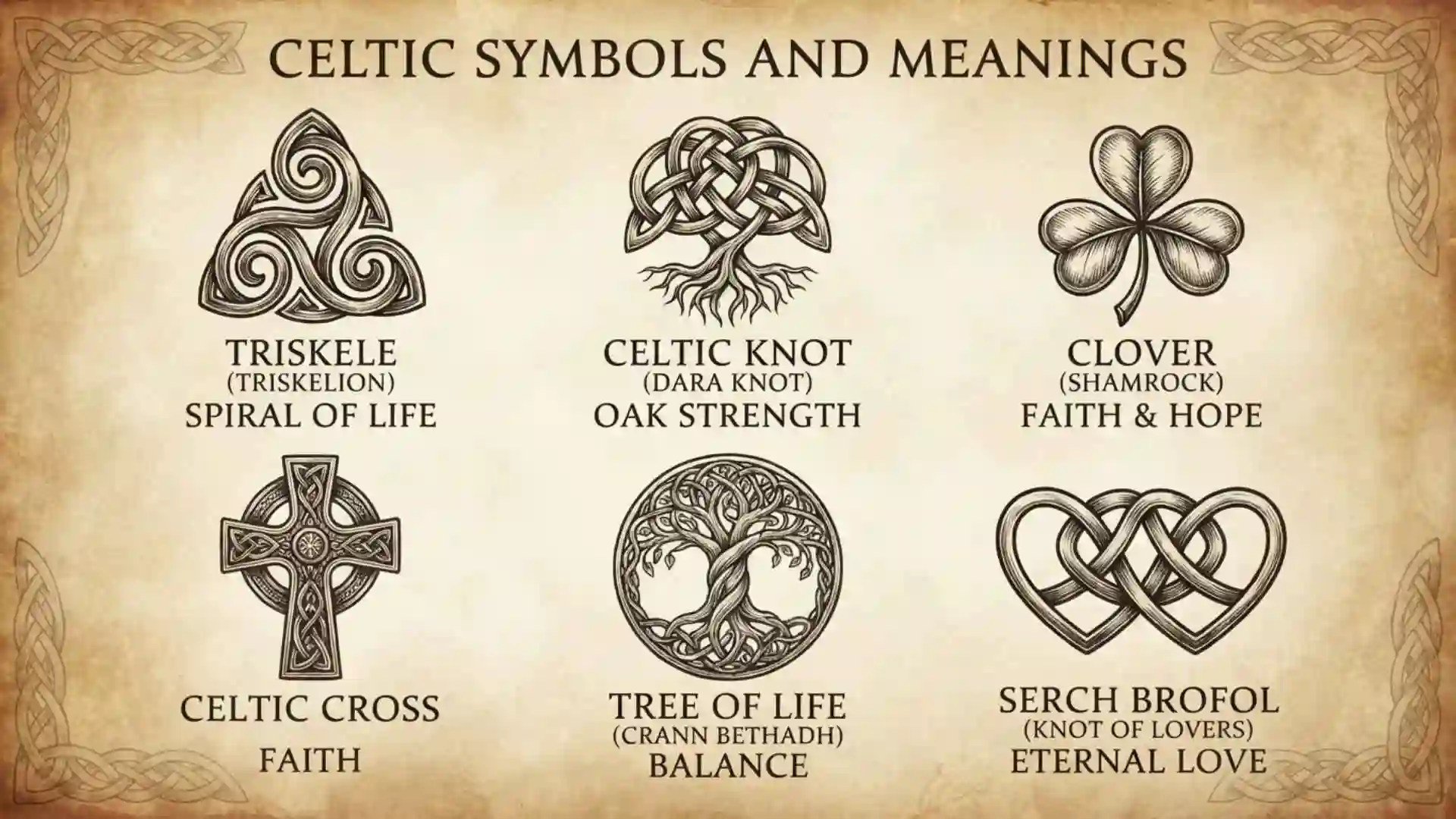
Scottish Celtic symbols carry centuries of history, artistic expression, spiritual beliefs, and cultural identity. From intricate Celtic knots and ancient stone carvings to the famous Celtic Cross, these designs offer a fascinating glimpse into Scotland’s past. Many remain popular today in jewelry, tattoos, traditional decorations, and Scottish heritage celebrations.
However, not every design commonly called a Celtic symbol originated in ancient Scotland. Some developed across different Celtic-speaking regions, while others appeared in early medieval Christian art. Understanding these distinctions helps you appreciate their historical importance and traditional interpretations.
Whether you’re researching Scottish Celtic symbols and their meanings, exploring your ancestry, or searching for a meaningful design, this guide covers their origins, symbolism, historical connections, and cultural significance.
What Are Scottish Celtic Symbols?
Scottish Celtic symbols are traditional designs, decorative motifs, and carved images associated with Scotland’s Celtic-speaking communities and early medieval artistic traditions. They appear in stone monuments, metalwork, religious manuscripts, jewelry, and other historical objects.
These symbols reflect several cultural influences, including ancient Celtic artistic traditions, Pictish craftsmanship, Gaelic heritage, and Celtic Christianity.
Some of the most recognizable designs include:
- Celtic Trinity Knot (Triquetra): Commonly associated with threefold connections, eternity, and Christian interpretations of the Holy Trinity.
- Celtic Cross: A Christian cross featuring a circular ring around its intersection.
- Triskelion: A three-part spiral design associated with movement and recurring patterns.
- Celtic Shield Knot: A modern decorative design commonly interpreted as a symbol of protection.
- Dara Knot: A contemporary Celtic-style design inspired by the oak tree.
- Sailor’s Knot: An interwoven design commonly associated with enduring relationships.
An important distinction exists between historical evidence and modern symbolism. Archaeologists can identify where certain designs appeared, but their original meanings aren’t always clear.
For example, Scotland’s Pictish stones feature distinctive geometric symbols whose precise meanings remain debated.
History and Origins of Celtic Symbols in Scotland
To understand Scottish Celtic symbolism, you first need to explore the people and artistic traditions behind it.
The Ancient Celtic People
The ancient Celts weren’t a single unified nation. They consisted of different communities across parts of Western and Central Europe.
Celtic-speaking groups developed distinctive languages, religious traditions, metalworking techniques, and artistic styles. Their cultural influence extended across regions that include modern-day France, Ireland, Britain, and parts of Central Europe.
The La Tène artistic tradition, which flourished during the later Iron Age, became particularly recognizable for its flowing curves, spirals, elaborate animal designs, and intricate ornamentation.
These artistic traditions influenced later decorative styles in Britain and Ireland.
The Scottish Celts and Picts
Scotland’s early history includes several communities with different cultural and linguistic backgrounds.
The Picts occupied much of northern and eastern Scotland during the early medieval period. Their carved stones remain among the country’s most distinctive historical artworks.
Pictish monuments feature:
- Crescent and V-rod designs.
- Double-disc symbols.
- Mirror and comb motifs.
- Animal figures.
- Geometric patterns.
- Elaborate Christian crosses.
Some designs appear repeatedly across different monuments. Researchers continue to investigate whether these symbols represented names, identities, social relationships, or another form of communication.
The Picts also developed connections with neighboring Gaelic-speaking communities and other peoples across Britain.
Celtic Christianity and Early Medieval Art
Christianity significantly influenced Scottish decorative traditions from approximately the sixth century onward.
Monastic communities developed elaborate artwork combining religious imagery with interlacing patterns, spirals, and geometric ornamentation.
Important cultural centers included Iona, where Christian communities produced influential religious artwork.
One remarkable example is the Kildalton Cross on Islay. Carved during the 700s, this impressive monument combines Christian imagery with intricate decorative designs. It stands approximately 2.65 meters high and remains in its original location.
The monument demonstrates how Celtic art, Christian beliefs, and local craftsmanship developed together.
Source: Historic Environment Scotland – Kildalton Cross
Most Popular Scottish Celtic Symbols and Their Meanings
Many Celtic designs have become recognizable worldwide. However, their historical origins and traditional interpretations vary considerably.
Here are some important symbols associated with Scottish and broader Celtic artistic traditions.
Celtic Trinity Knot (Triquetra)
The Celtic Trinity Knot, also called the Triquetra, consists of three interconnected loops forming a triangular design.
<image-placeholder></image-placeholder>
Its continuous lines create an appearance without an obvious beginning or ending.
Common symbolic interpretations include:
- Eternity and continuity.
- Three interconnected elements.
- Spiritual unity.
- Family connections.
- The Christian Holy Trinity.
- Life’s interconnected stages.
In Christian artwork, the Triquetra became associated with the Father, Son, and Holy Spirit.
Modern interpretations also connect it with the mind, body, and spirit. However, these meanings shouldn’t automatically be attributed to every historical example.
Celtic Cross
The Celtic Cross is one of Scotland’s most recognizable religious and historical symbols.
It features a Christian cross with a circular ring surrounding the intersection of its arms.
<image-placeholder></image-placeholder>
Early medieval Scottish stone crosses often combine Christian imagery with elaborate knotwork, spirals, and carved biblical scenes.
The circle is frequently interpreted in modern explanations as representing eternity, divine unity, or the connection between earthly and spiritual life.
However, the precise historical reasons for incorporating the ring aren’t completely established.
Common associations include:
- Christianity and faith.
- Eternal life.
- Spiritual devotion.
- Religious heritage.
- Scottish and Irish Christian traditions.
The Kildalton Cross on Islay provides an excellent historical example of this artistic tradition.
Triskelion (Triskele)
The Triskelion, sometimes called the Triskele, features three connected spirals or curved arms radiating from a central point.
<image-placeholder></image-placeholder>
Its rotational appearance creates a strong impression of movement and continuous energy.
The design belongs to a broader European tradition of three-part spiral motifs. It appears in different historical and artistic contexts.
Modern symbolic interpretations include:
- Movement and progress.
- Balance and harmony.
- Past, present, and future.
- Birth, life, and death.
- Three interconnected forces.
Although people frequently associate the Triskelion with Celtic spirituality, its exact meaning depended on its historical context.
Celtic Shield Knot
The Celtic Shield Knot is a geometric interlacing design with a compact, enclosed appearance.
<image-placeholder></image-placeholder>
Modern interpretations commonly associate it with protection, resilience, and strength.
Its shield-like appearance makes it especially popular in contemporary Celtic-inspired tattoos and jewelry.
Common associations include:
- Physical protection.
- Spiritual protection.
- Courage and resilience.
- Family security.
- Strength during difficult circumstances.
Unlike certain documented medieval carvings, the protective meaning of the modern Shield Knot isn’t established through definitive ancient Scottish evidence.
Dara Knot
The Dara Knot is a popular Celtic-inspired design based on the branching structure of an oak tree.
<image-placeholder></image-placeholder>
Its name is associated with the Irish word doire, meaning oak grove.
The oak tree holds important cultural associations across several European traditions. Its long life, sturdy trunk, and extensive roots make it a natural symbol of endurance.
Modern interpretations of the Dara Knot include:
- Inner strength.
- Wisdom.
- Stability.
- Family roots.
- Personal resilience.
- Connection with nature.
The design is especially popular among people seeking a symbol of strength and heritage.
Celtic Sailor’s Knot
The Celtic Sailor’s Knot features interwoven lines that create a continuous decorative pattern.
<image-placeholder></image-placeholder>
Today, people commonly associate this design with enduring love, friendship, loyalty, and family relationships.
Its interconnected appearance makes it a popular choice for matching jewelry and meaningful gifts.
Common interpretations include:
- Eternal love.
- Strong family bonds.
- Friendship and loyalty.
- Commitment.
- Lasting relationships.
However, the exact ancient origin of the modern Celtic Sailor’s Knot interpretation remains uncertain.
Celtic Spiral
The Celtic Spiral is a decorative motif found in different ancient European artistic traditions.
Spiral designs appear in prehistoric monuments, Iron Age artwork, and early medieval decorative objects.
Common modern interpretations include:
- Growth and transformation.
- Natural cycles.
- Movement and energy.
- Life’s continuous journey.
- Connection with nature.
Some spiral motifs appear in Scotland’s prehistoric archaeological record, although their presence doesn’t automatically establish a Celtic origin.
Celtic Symbols and Their Meanings: Quick Comparison
The following table summarizes common interpretations of recognizable Celtic-inspired designs.
| Symbol | Traditional or Modern Associations | Common Use Today |
| Trinity Knot | Eternity, threefold unity, Holy Trinity | Jewelry and tattoos |
| Celtic Cross | Christianity, faith, eternal life | Monuments and religious art |
| Triskelion | Movement, threefold patterns, progress | Tattoos and decorations |
| Shield Knot | Protection and resilience | Jewelry and tattoos |
| Dara Knot | Oak tree, strength, wisdom | Tattoos and pendants |
| Sailor’s Knot | Love, loyalty, friendship | Couples’ jewelry |
| Celtic Spiral | Growth, movement, natural cycles | Decorative artwork |
| Oak Tree | Endurance, stability, strength | Scottish-inspired designs |
Remember that these descriptions include modern interpretations. Archaeological evidence doesn’t establish every meaning as an original ancient belief.
Celtic Knotwork and Its Cultural Significance
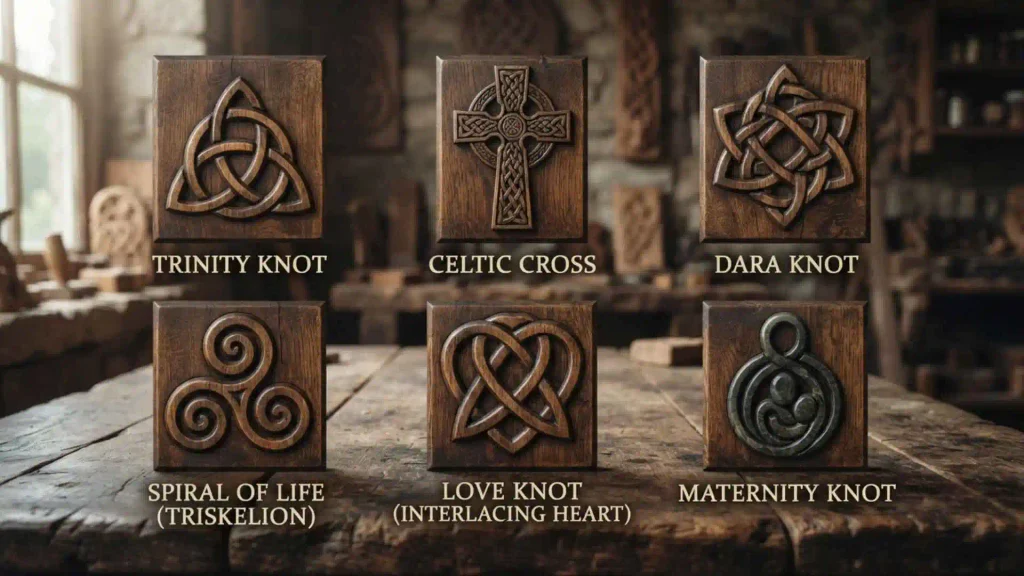
Celtic knotwork is among the most recognizable features of Celtic-inspired artwork.
These intricate patterns consist of interwoven lines that pass over and under one another. Their continuous appearance creates complex decorative designs.
Early medieval artists used interlacing patterns to decorate religious manuscripts, metal objects, and carved stone monuments.
Different Types of Celtic Knots
Several knotwork styles appear frequently in traditional and contemporary Celtic artwork.
Interlacing Knots: These designs feature continuous lines woven into complicated geometric patterns.
Three-Part Knots: These designs incorporate three interconnected sections, often interpreted through themes of unity and continuity.
Animal Interlace: Medieval artists incorporated animals into decorative knotwork. Their bodies and limbs often become part of the interwoven pattern.
Endless Knots: Modern decorative designs use continuous lines to suggest eternity and interconnectedness.
Geometric Knotwork: These patterns feature repeating shapes, symmetrical arrangements, and carefully arranged intersections.
The Book of Kells and Celtic Artwork
The Book of Kells is among the most celebrated examples of early medieval Insular manuscript art.
Created around the late eighth or early ninth century, this illuminated Gospel manuscript contains elaborate decorative initials, intricate interlace, animal figures, and Christian imagery.
Although associated with Ireland rather than Scotland specifically, it demonstrates the broader artistic tradition shared across early medieval Britain and Ireland.
The Lindisfarne Gospels provide another important example of this interconnected artistic heritage.
Pictish Symbols: Scotland’s Distinctive Ancient Carvings
While Celtic knots receive considerable attention, Scotland has another fascinating symbolic tradition: Pictish symbols.
These designs appear on carved stones and other objects associated with early medieval Pictish communities.
Researchers have identified approximately three dozen recurring designs, including recognizable objects and abstract geometric patterns.
Common Pictish Symbols
| Pictish Design | Appearance |
| Crescent and V-rod | Crescent shape combined with a V-shaped rod |
| Double-disc | Two circular forms connected by a central line |
| Mirror and comb | Objects resembling a mirror and comb |
| Z-rod | A zigzag or Z-shaped design |
| Pictish Beast | An unusual animal-like figure |
| Triple-disc | Three connected circular elements |
The exact meanings of many Pictish symbols remain uncertain.
Some researchers believe they may have functioned as a form of non-alphabetic writing or identification system. Other interpretations consider their possible religious, commemorative, and political roles.
The important point is that these designs represent a distinctive Scottish visual tradition rather than simply another collection of Celtic knots.
Source: National Committee on Carved Stones in Scotland
Scottish Celtic Symbols in Nature and Mythology
Nature played an important role in the religious traditions and cultural imagination of ancient Celtic-speaking communities.
Trees, animals, rivers, and other natural features appear throughout Celtic mythology and artistic traditions.
However, individual meanings varied across different communities and periods.
Oak Tree Symbol
The oak tree is commonly associated with strength, endurance, longevity, and wisdom.
Its strong trunk and extensive root system make it a powerful image of stability.
The Dara Knot draws inspiration from these characteristics.
Scottish Thistle
<image-placeholder></image-placeholder>
The Scottish thistle is one of Scotland’s best-known national emblems.
It represents Scottish identity, resilience, and national heritage.
Although people sometimes include it in discussions of Celtic symbolism, the thistle is more accurately described as a Scottish national symbol rather than an ancient Celtic knot.
Stag Symbol
<image-placeholder></image-placeholder>
The stag appears in Celtic-inspired artwork and broader European mythology.
Its impressive antlers and association with woodland landscapes make it a popular image of:
- Strength.
- Nobility.
- Nature.
- Renewal.
- Leadership.
The stag also appears in modern Scottish heritage designs.
Lion Symbol
<image-placeholder></image-placeholder>
The Lion Rampant is an important Scottish royal emblem.
It depicts a red lion standing upright against a gold background.
Its historical significance comes from Scottish royal heraldry rather than ancient Celtic religious symbolism.
Today, it represents Scottish sovereignty, royal heritage, and national identity.
Celtic Symbols in Scottish Clothing and Jewelry
Celtic-inspired designs remain popular in traditional Scottish accessories and contemporary fashion.
Their decorative appeal makes them suitable for formal occasions, weddings, cultural celebrations, and everyday wear.
Highland Dress and Celtic Accessories
Traditional Highland dress includes several distinctive clothing elements.
These include:
- Kilts.
- Sporrans.
- Kilt pins.
- Belts and buckles.
- Brooches.
- Plaid accessories.
- Traditional jackets.
Celtic-inspired knotwork sometimes appears on buckles, brooches, and decorative clothing accessories.
However, not every traditional Highland clothing element has an ancient Celtic origin.
Scottish and Celtic Jewelry
Celtic-inspired jewelry provides a popular way to celebrate Scottish heritage.
Common designs include:
| Jewelry | Popular Celtic Design |
| Necklaces | Trinity Knot and Celtic Cross |
| Rings | Interwoven knotwork |
| Bracelets | Endless knot patterns |
| Earrings | Spiral and triskelion designs |
| Brooches | Celtic interlace |
| Cufflinks | Geometric knotwork |
| Pendants | Dara Knot and Shield Knot |
Materials commonly used include sterling silver, gold, pewter, and other decorative metals.
Celtic Symbols in Scottish Weddings
Celtic-inspired jewelry and decorative designs frequently appear in Scottish wedding celebrations.
Couples may choose Trinity Knot rings, interwoven patterns, or Celtic Cross decorations to express commitment and shared heritage.
The Sailor’s Knot is another popular modern choice because people associate it with lasting relationships.
A meaningful design can make a wedding accessory more personal, particularly when it reflects family connections or cultural traditions.
Celtic Symbols in Modern Scottish Culture
Today, Celtic-inspired artwork remains an important part of Scotland’s cultural identity.
Artists, jewelry makers, tattoo designers, and heritage organizations continue to use traditional motifs in contemporary designs.
Popular applications include:
- Tattoos: Trinity Knots, Triskelions, and intricate interlacing patterns.
- Jewelry: Celtic pendants, wedding rings, and bracelets.
- Home decorations: Carved wooden ornaments and decorative wall art.
- Clothing: Embroidered patterns and heritage-inspired accessories.
- Cultural events: Artwork celebrating Scottish and Gaelic heritage.
- Memorial designs: Crosses and interwoven patterns commemorating loved ones.
The modern popularity of these designs reflects their visual appeal and their associations with identity, family, spirituality, and history.
However, understanding their historical background makes their use more meaningful.
How to Choose a Scottish Celtic Symbol
Choosing a Celtic symbol becomes easier when you understand the meaning you want to express.
Consider these popular options:
| Your Intended Meaning | Suitable Symbol |
| Eternal love | Trinity Knot |
| Family connections | Interwoven knotwork |
| Inner strength | Dara Knot |
| Protection | Celtic Shield Knot |
| Christian faith | Celtic Cross |
| Personal growth | Triskelion |
| Friendship and loyalty | Sailor’s Knot |
| Scottish national identity | Scottish Thistle |
| Royal Scottish heritage | Lion Rampant |
If historical accuracy matters to you, investigate the age and cultural origin of the particular design before choosing it.
A modern Celtic-inspired tattoo can still carry personal meaning. You simply shouldn’t confuse contemporary interpretations with proven ancient traditions.
Frequently Asked Questions About Scottish Celtic Symbols
What Is the Most Recognizable Scottish Celtic Symbol?
The Celtic Cross is among the most recognizable symbols associated with Scottish Christian heritage. The Trinity Knot and Triskelion are also widely recognized Celtic-inspired designs.
What Celtic Symbol Represents Strength?
The Dara Knot is commonly associated with inner strength, endurance, and wisdom. Its design draws inspiration from the oak tree.
Which Celtic Symbol Represents Eternal Love?
The Trinity Knot is frequently associated with eternal love and interconnectedness. The Sailor’s Knot also represents lasting relationships in modern Celtic-inspired symbolism.
What Is the Difference Between Celtic and Pictish Symbols?
Celtic symbols include artistic and decorative motifs associated with various Celtic-speaking communities. Pictish symbols are distinctive designs carved by early medieval communities in Scotland.
Their meanings remain uncertain in many cases.
Are Celtic Knots Originally Scottish?
No. Celtic knotwork developed across broader artistic traditions in Britain and Ireland. Scottish monuments later incorporated elaborate interlace designs alongside other regional artistic influences.
What Does the Celtic Cross Represent?
The Celtic Cross represents Christian faith and religious heritage. Its distinctive ring-headed design became an important feature of early medieval Christian monuments.
Did Druids Create Celtic Symbols?
There is no reliable evidence that Druids created all Celtic symbols or designed the familiar modern knot patterns. Druids were religious and learned figures in certain ancient Celtic societies, but much of their history comes from external written accounts.
Are Celtic Symbols Still Used in Scotland?
Yes. Celtic-inspired designs remain popular in Scottish jewelry, tattoos, clothing accessories, artwork, and heritage celebrations.
Conclusion
Scottish Celtic symbols connect Scotland’s artistic traditions with its fascinating cultural and religious history. From the Trinity Knot and Celtic Cross to distinctive Pictish carvings, these designs reveal how different communities expressed their identities and beliefs.Their meanings also deserve careful consideration. Some symbols have clear historical and religious associations, while others carry interpretations developed through modern Celtic-inspired art.Whether you appreciate the Dara Knot for its association with strength or the Celtic Cross for its Christian heritage, each design offers a meaningful way to explore Scotland’s past.Understanding the difference between documented history and modern symbolism allows you to appreciate these remarkable designs without losing sight of their origins.

I am John Carter, a lifelong enthusiast of language and modern slang. I explore how words evolve and shape culture, and I enjoy uncovering the stories behind everyday expressions. I have authored “Slang and Society: The Language of Youth” and “Modern Words, Modern Worlds”, where I dive into how informal language impacts communication and identity. My goal is to make language accessible, fun, and insightful for everyone who loves words as much as I do.
 Lisa Reynolds