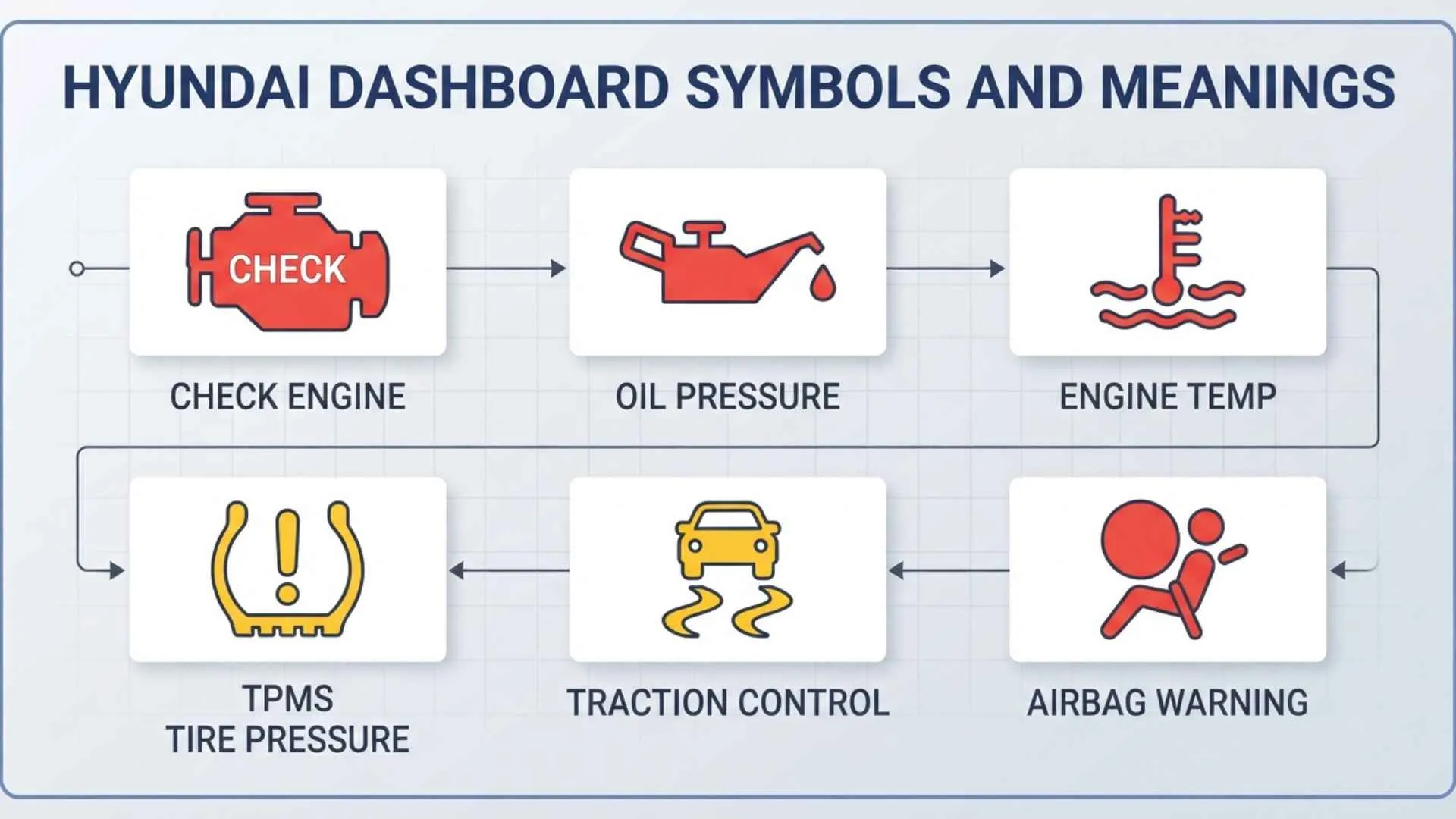
Your Hyundai dashboard does more than display your speed and fuel level. It also communicates important information about your vehicle’s condition through warning lights, symbols, and messages. Understanding Hyundai dashboard warning lights helps you recognize potential problems before they become expensive repairs or dangerous driving situations.
Some dashboard indicators simply show that a feature is working. Others warn you about low tire pressure, engine trouble, battery problems, or brake system failures. Knowing the difference can help you decide whether to continue driving, schedule an inspection, or stop immediately.
This guide explains common Hyundai dashboard symbols and meanings, including their appearance, possible causes, severity, and recommended actions. You’ll also learn how warning light colors work, how to troubleshoot common problems, and when professional diagnosis becomes necessary.
Understanding Hyundai Dashboard Warning Lights and Symbols
Hyundai dashboard warning lights are visual alerts that communicate information about your vehicle’s mechanical, electrical, and safety systems. Sensors and electronic control modules monitor different components and send information to the instrument cluster.
When a system detects an unusual condition, the corresponding warning light may illuminate. Some alerts also display a message explaining the problem.
For example, a tire-shaped symbol with an exclamation mark usually indicates low tire pressure. A red oil can symbol warns about potentially dangerous engine oil pressure.
Warning Lights vs. Dashboard Indicator Lights
Although drivers often use these terms interchangeably, warning lights and indicator lights serve different purposes.
- Warning lights: Identify potential faults or unsafe operating conditions.
- Indicator lights: Show when particular vehicle features are operating.
- Information messages: Provide maintenance reminders or additional instructions.
Some indicators illuminate briefly when you start your Hyundai. This self-check confirms that the instrument cluster and warning systems can illuminate properly.
Hyundai also explains that symbol appearance and placement can vary depending on vehicle specifications and software versions. Always consult the owner’s manual for your exact model and year.
Hyundai Dashboard Warning Light Colors and Their Meanings
The color of a dashboard light provides an initial clue about its importance. However, the symbol itself matters just as much.
| Light color | General meaning | What you should do |
| Red | Potentially serious warning | Stop safely when necessary and investigate immediately |
| Yellow or amber | Caution or detected fault | Check the manual and arrange inspection |
| Green | Active vehicle function | Usually informational |
| Blue | Active feature or operating condition | Understand the specific indicator |
| White | System status or information | Follow the displayed message |
Red Hyundai Dashboard Warning Lights
Red indicators usually demand immediate attention. Common examples include the oil pressure warning light, brake warning light, and engine overheating warning.
If a serious red warning appears while driving:
- Reduce your speed safely.
- Find a suitable place to stop.
- Switch off the engine when instructed.
- Check the owner’s manual.
- Arrange professional assistance if necessary.
Never ignore a red oil pressure warning. Continuing to operate the engine with insufficient oil pressure can cause severe internal damage.
Yellow and Amber Hyundai Warning Lights
Yellow and amber indicators generally signal caution. They may identify problems involving the engine, tire pressure, ABS, or electronic safety systems.
A steady check engine light, for example, may indicate an emissions-related fault. You might still drive cautiously depending on the symptoms. However, a flashing check engine light requires much faster attention.
Green, Blue, and White Hyundai Indicator Lights
These colors commonly identify active vehicle functions rather than mechanical failures.
- Green: Turn signals, active cruise control, and certain lighting indicators.
- Blue: High-beam headlights and certain temperature-related indicators.
- White: Informational messages and available driver assistance functions.
Some Hyundai systems use different colors to communicate operating status. For example, AUTO HOLD may display white when activated and green when holding the vehicle stationary. A yellow indication can signal a malfunction.
Common Hyundai Dashboard Warning Lights and Symbols Explained
The following Hyundai warning light meanings cover important indicators found across many Hyundai vehicles. Exact symbols and availability depend on model, trim, and powertrain.
Hyundai Check Engine Light
Symbol: Amber engine-shaped outline.
The Hyundai check engine light indicates that the onboard diagnostic system has detected a problem involving engine operation or emissions control.
Possible causes include:
- Loose or damaged gas cap.
- Faulty oxygen sensor.
- Malfunctioning mass airflow sensor.
- Worn spark plugs or ignition coils.
- Engine misfire.
- Catalytic converter problems.
- Fuel system faults.
A steady light generally indicates that the vehicle has stored a diagnostic fault. A flashing light can signal an active misfire that may damage the catalytic converter.
What should you do? If the light stays steady and your vehicle runs normally, arrange a diagnostic scan soon. If it flashes, the engine shakes, or power drops significantly, reduce engine load and stop driving when safe.
Hyundai Oil Pressure Warning Light
Symbol: Red oil can with a dripping drop.
The Hyundai oil pressure warning light indicates that engine oil pressure may have fallen below the required level.
Common causes include:
- Low engine oil level.
- Oil pump failure.
- Oil leakage.
- Blocked oil passages.
- Faulty pressure sensor.
Oil lubricates moving engine components and helps control friction and heat. Without sufficient pressure, critical parts can suffer serious damage.
What should you do? Stop safely and turn off the engine. Check the oil level using the dipstick when the vehicle is parked on level ground and the engine has cooled sufficiently. Adding oil may correct a low level but won’t fix a failing oil pump or another pressure problem. If the warning remains, don’t continue driving.
Hyundai Battery Warning Light
Symbol: Red battery outline with plus and minus signs.
The Hyundai battery warning light usually indicates a problem with the vehicle’s charging system rather than simply a weak battery.
Possible causes include:
- Failing alternator.
- Damaged serpentine belt.
- Loose battery cables.
- Corroded battery terminals.
- Charging system wiring faults.
When the alternator stops charging properly, the vehicle may rely on stored battery power. Eventually, electrical systems can stop working.
What should you do? Switch off unnecessary electrical accessories and find a safe place for inspection. Arrange charging system testing before the battery loses power completely.
Hyundai Tire Pressure Warning Light (TPMS)
Symbol: Tire-shaped outline containing an exclamation mark.
The Hyundai TPMS warning light indicates that one or more tires may have insufficient air pressure. Underinflated tires can affect handling, braking, fuel economy, and tire life.
Possible causes include:
- Tire puncture.
- Slow air leakage.
- Temperature-related pressure changes.
- Incorrect tire inflation.
- Faulty tire pressure sensor.
A flashing TPMS light that later remains illuminated generally indicates a monitoring system malfunction on applicable Hyundai models.
What should you do? Check all tires with a reliable pressure gauge when they’re cold. Follow the recommended pressure listed on the driver’s door-jamb label rather than the maximum pressure printed on the tire. Inspect for visible damage and inflate as needed.
Remember that TPMS cannot detect every sudden tire failure. If your vehicle becomes unstable, slow down gradually and move somewhere safe.
Hyundai Brake System Warning Light
Symbol: Red BRAKE lettering or an exclamation mark inside a circle.
The Hyundai brake warning light may indicate an engaged parking brake or a problem involving the braking system.
Possible causes include:
- Parking brake remains engaged.
- Low brake fluid.
- Brake fluid leakage.
- Hydraulic braking system malfunction.
First, check whether you released the parking brake completely. If the warning remains illuminated, inspect the situation carefully.
Important: If the brake pedal feels unusually soft, braking performance decreases, or fluid appears to be leaking, stop driving. Arrange professional assistance because your vehicle’s stopping ability may be compromised.
Hyundai ABS Warning Light
Symbol: ABS lettering inside a circular outline.
The Hyundai ABS warning light indicates a potential malfunction in the Anti-Lock Braking System.
Possible causes include damaged wheel speed sensors, wiring problems, or ABS control module faults.
ABS helps prevent wheel lockup during hard braking. If the system fails, conventional braking may remain available, but anti-lock functionality might not work.
Drive cautiously and avoid high speeds or sudden braking. If the red brake warning also illuminates, treat the situation as more serious and seek immediate inspection.
Hyundai Airbag or SRS Warning Light
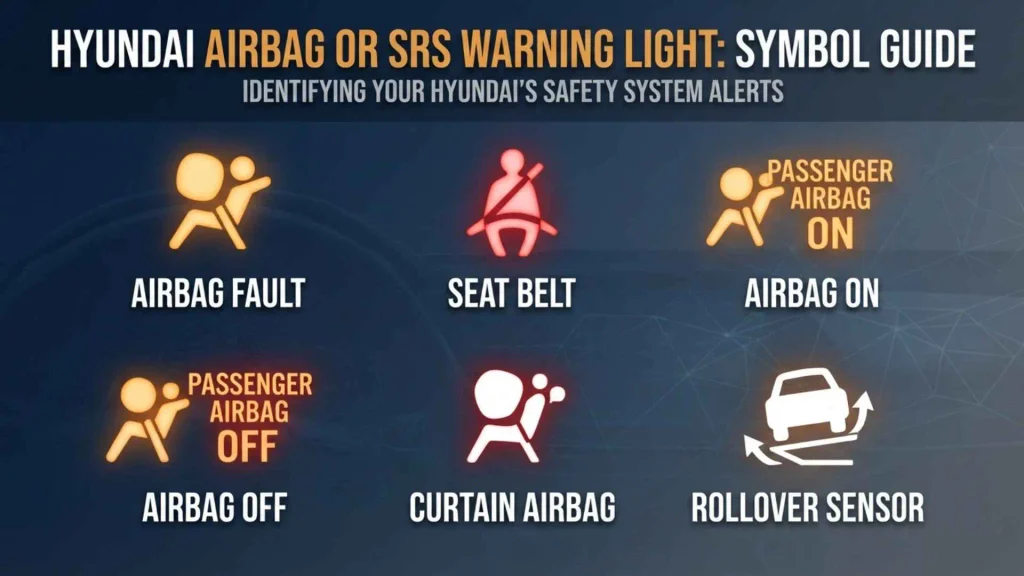
Symbol: Seated passenger with a circular airbag symbol.
The Hyundai airbag warning light identifies a potential problem with the Supplemental Restraint System (SRS).
Possible causes include:
- Faulty airbag sensors.
- Seat belt pretensioner problems.
- Damaged wiring connections.
- Occupant detection system faults.
- SRS control module problems.
An illuminated SRS warning may mean certain airbags or restraint features won’t operate correctly during a collision.
Arrange professional inspection promptly. Never attempt to repair airbag wiring or connectors without appropriate training.
Hyundai Traction Control and ESC Warning Lights
Symbol: Vehicle with wavy lines underneath.
The traction control warning light and Electronic Stability Control (ESC) indicator help drivers understand how vehicle stability systems operate.
These systems work together but perform different functions:
- Traction Control System (TCS): Helps reduce wheel spin during acceleration.
- Electronic Stability Control (ESC): Helps maintain directional stability when the vehicle begins losing control.
A flashing indicator may mean the system is actively correcting wheel slip. A steady warning can indicate that the system is switched off or has detected a malfunction.
If the warning stays illuminated unexpectedly, arrange a diagnostic inspection. Drive carefully on slippery roads until the system’s condition is confirmed.
Hyundai Low Fuel Warning Light
Symbol: Amber fuel pump icon.
The Hyundai low fuel warning light appears when the fuel level reaches a predetermined threshold.
Your remaining driving range depends on several factors:
- Current fuel level.
- Driving speed.
- Traffic conditions.
- Engine efficiency.
- Road elevation.
- Air conditioning use.
Refuel as soon as practical rather than relying on the estimated remaining range. The fuel pump symbol is a reminder, not a precise distance guarantee.
Hyundai Coolant Temperature Warning Light
Symbol: Thermometer above wavy liquid lines.
This warning indicates that engine coolant temperature may have reached a dangerous level.
Possible causes include coolant leakage, radiator problems, thermostat failure, cooling fan malfunction, or water pump issues.
What should you do?
- Pull over safely.
- Turn off the engine when safe.
- Allow the cooling system to cool.
- Look for visible coolant leakage.
- Arrange inspection if overheating continues.
Never open a hot radiator or pressurized coolant reservoir. Escaping hot coolant can cause serious burns.
Hyundai EPS Warning Light
Symbol: Steering wheel with an exclamation mark.
The Electric Power Steering (EPS) warning light indicates a potential fault involving the steering assistance system.
Possible causes include sensor faults, electrical connection problems, or steering control module issues.
You may notice heavier steering or unusual steering behavior. If steering becomes difficult, stop somewhere safe and arrange professional assistance.
Hyundai Washer Fluid Warning Light
Symbol: Windshield with water droplets or spray.
This indicator usually means the windshield washer fluid level is low.
Refill the reservoir with suitable washer fluid. During winter, choose a freeze-resistant formula that matches your local temperatures.
Proper washer fluid helps remove dust, insects, road salt, and grime. Clear visibility is essential for safe driving.
Other Hyundai Dashboard Indicator Lights You Should Recognize
Not every dashboard symbol indicates a fault. Several simply show that a vehicle feature is operating.
| Dashboard symbol or name | Meaning |
| Turn signal arrows | Left or right turn signal is active |
| Blue high-beam symbol | High-beam headlights are switched on |
| Cruise control | Cruise control system is active |
| AUTO HOLD | Automatic brake holding function is active |
| EPB | Electronic parking brake status |
| Seat belt symbol | Driver or passenger seat belt reminder |
| Door open symbol | A door or liftgate isn’t fully closed |
| Hood open symbol | Hood may not be securely latched |
| Lane Keeping Assist | Lane assistance status |
| Forward Collision-Avoidance Assist | Collision safety system status |
Hyundai’s newer models may also display driver attention alerts, blind-spot warnings, and Smart Cruise Control messages.
These indicators depend on available equipment. A green or white symbol often shows an active feature while yellow may indicate a fault or unavailable system.
Hyundai Hybrid and Electric Vehicle Warning Lights
Hyundai hybrid and electric vehicles use additional indicators because their powertrains contain specialized electrical components.
Important examples include:
- READY indicator: Shows that the vehicle is ready to drive.
- Hybrid system warning: Indicates a possible hybrid powertrain fault.
- High-voltage battery warning: Identifies a battery-related system problem.
- Charging indicator: Communicates battery charging status.
- Regenerative braking warning: Identifies a potential issue with regenerative braking.
- Power limited warning: Indicates reduced available vehicle power.
High-voltage battery systems require specialized diagnostic procedures. Don’t attempt to inspect or repair orange high-voltage cables yourself.
If a serious electrical or hybrid warning appears, follow the vehicle’s displayed instructions and owner’s manual. Arrange qualified service when necessary.
What to Do When a Hyundai Dashboard Warning Light Appears
Taking the correct steps can prevent further damage and reduce safety risks.
Follow this practical checklist:
- Identify the symbol: Check the instrument cluster and read any accompanying message.
- Check its color: Determine whether the indicator is red, amber, green, blue, or white.
- Notice its behavior: Determine whether it flashes or stays illuminated.
- Look for symptoms: Pay attention to unusual noises, smoke, vibration, overheating, or reduced power.
- Stop when necessary: Serious oil pressure, overheating, or brake warnings require immediate attention.
- Perform safe basic checks: Inspect tire pressure, oil level, and other accessible items when appropriate.
- Arrange diagnostics: Have persistent or serious warnings checked by a qualified technician.
How to Diagnose and Reset Hyundai Dashboard Warning Lights
Hyundai vehicles use an Onboard Diagnostic System (OBD-II) to monitor important engine and emissions functions.
When the system detects certain problems, it stores Diagnostic Trouble Codes (DTCs). A compatible scanner can retrieve these codes and help technicians investigate the underlying fault.
Common diagnostic code categories include:
- P codes: Powertrain-related problems.
- B codes: Body system problems.
- C codes: Chassis-related faults.
- U codes: Network communication problems.
However, a diagnostic code doesn’t automatically identify a failed component. For example, an oxygen sensor-related code may require additional testing before anyone replaces the sensor.
Can You Reset Hyundai Warning Lights Yourself?
Some maintenance reminders can be reset through the instrument cluster or infotainment settings. The exact procedure depends on your Hyundai model and year.
However, resetting a fault warning is different from repairing the problem.
- Maintenance reminders can be reset after completing the required service.
- TPMS warnings may clear after correcting tire pressure and completing the system’s required monitoring process.
- Check engine warnings require diagnosis and repair before clearing stored faults.
- ABS and SRS warnings may require specialized diagnostic equipment.
Never disconnect the battery or clear diagnostic codes simply to hide a warning. The underlying fault may remain and affect vehicle safety.
Why Are Multiple Hyundai Dashboard Warning Lights Coming On?
Several warning lights appearing together can indicate an issue affecting multiple vehicle systems.
Common explanations include:
- Weak battery: Low voltage can disrupt electronic control modules.
- Alternator failure: Charging problems may trigger several electrical warnings.
- Wheel speed sensor faults: ABS and ESC indicators may illuminate together.
- Damaged wiring: Electrical interruptions can affect connected systems.
- Communication problems: Vehicle control modules may struggle to exchange information.
Don’t assume that every illuminated warning represents a separate failed component. A single electrical or sensor fault can trigger several alerts.
A complete diagnostic scan can help identify the root cause.
Preventive Maintenance to Avoid Hyundai Dashboard Warning Lights
Regular maintenance helps reduce unexpected faults and keeps important vehicle systems working properly.
Follow these basic maintenance practices:
- Check engine oil according to the manufacturer’s recommendations.
- Inspect coolant and brake fluid levels.
- Maintain correct tire pressure.
- Rotate tires according to the maintenance schedule.
- Inspect battery terminals and charging performance.
- Replace worn brake components when necessary.
- Address unusual engine noises promptly.
- Follow normal or severe-service maintenance intervals as applicable.
Hyundai maintenance schedules vary by model, engine, and driving conditions. Consult your specific owner’s manual rather than relying on one universal oil change interval.
Where to Get Hyundai Dashboard Warning Lights Diagnosed in Topeka, KS
If your Hyundai displays a persistent warning light, professional diagnosis can help identify the underlying problem.
Topeka drivers can contact McCarthy Hyundai of Topeka for information about available vehicle diagnostic and maintenance services.
A qualified technician can investigate issues involving:
- Engine and emissions systems.
- Battery and charging systems.
- ABS and braking components.
- Tire pressure monitoring sensors.
- Airbag and restraint systems.
- Hybrid and electric vehicle components where supported.
Before scheduling an appointment, note your vehicle’s model, year, mileage, warning symbol, and any unusual symptoms.
McCarthy Hyundai of Topeka
- Address: 2920 S Kansas Ave, Topeka, KS 66611
- Phone: (785) 267-2800
- Website: Hyundai’s official dealership and owner resources
Contact the dealership directly to confirm current services, availability, and appointment options.
Frequently Asked Questions About Hyundai Dashboard Warning Lights
What Do Hyundai Dashboard Warning Lights Mean?
Hyundai dashboard warning lights communicate information about vehicle systems. They can indicate engine problems, low oil pressure, battery faults, tire pressure issues, brake malfunctions, or active safety features.
What Is the Most Serious Hyundai Dashboard Warning Light?
The red oil pressure warning is among the most serious indicators. It can signal insufficient engine lubrication and potential engine damage. Serious brake and overheating warnings also require immediate attention.
What Does a Yellow Warning Light Mean on a Hyundai?
A yellow warning light generally indicates a detected fault or condition requiring attention. Common examples include the check engine, ABS, and TPMS indicators. Check the owner’s manual for the appropriate response.
Is It Safe to Drive With the Hyundai Check Engine Light On?
A steady check engine light may allow cautious driving if the vehicle operates normally. However, a flashing light or accompanying engine problems requires immediate attention. Avoid unnecessary driving until the issue is diagnosed.
Why Is My Hyundai Battery Warning Light On While Driving?
The battery warning usually indicates a charging system problem. A faulty alternator, damaged belt, loose cable, or electrical fault may prevent the battery from charging properly.
What Does a Flashing TPMS Light Mean?
A flashing TPMS light often indicates a problem with the tire pressure monitoring system rather than simply low tire pressure. The exact behavior varies by model. Have the sensors and system inspected.
How Do I Reset Hyundai Dashboard Warning Lights?
The reset procedure depends on the warning and vehicle model. Correct the underlying problem first. Maintenance reminders may be reset through the instrument cluster, while certain system faults require professional diagnostic equipment.
Do Hyundai Dashboard Symbols Differ by Model Year?
Yes. Hyundai dashboard symbols can vary by model, trim, powertrain, and model year. Newer vehicles may include additional hybrid, electric, and driver assistance indicators.
Final Thoughts on Hyundai Dashboard Warning Lights and Symbols
Understanding Hyundai dashboard warning lights helps you recognize potential vehicle problems and respond appropriately. Red warnings involving oil pressure, braking, and engine overheating deserve immediate attention. Amber indicators generally require investigation while green, blue, and white lights often communicate normal operating information.Most importantly, never guess when an unfamiliar symbol appears. Check your Hyundai owner’s manual and pay attention to accompanying messages. If a warning persists or affects vehicle safety, arrange a professional diagnostic inspection before the problem becomes worse.

I am John Carter, a lifelong enthusiast of language and modern slang. I explore how words evolve and shape culture, and I enjoy uncovering the stories behind everyday expressions. I have authored “Slang and Society: The Language of Youth” and “Modern Words, Modern Worlds”, where I dive into how informal language impacts communication and identity. My goal is to make language accessible, fun, and insightful for everyone who loves words as much as I do.
 Lisa Reynolds