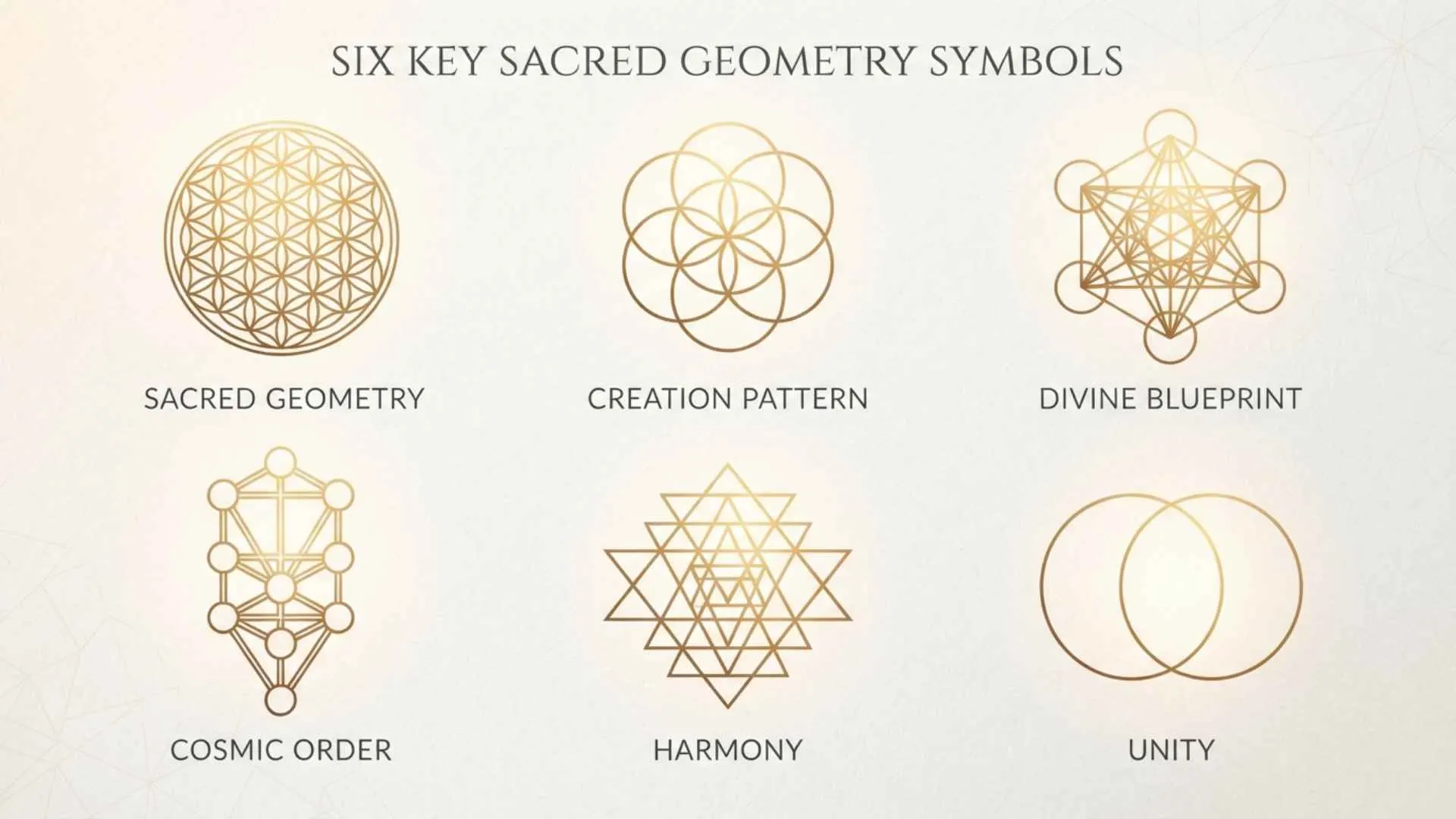
Sacred geometry explores the mathematical shapes and patterns that people have connected with nature, creation, spirituality, and the universe. From overlapping circles to intricate triangles, these designs appear in ancient temples, religious artwork, natural structures, and modern decorative art. Each pattern carries its own mathematical structure and cultural significance.
Sacred geometry symbols have fascinated mathematicians, philosophers, artists, and spiritual traditions for centuries. The Flower of Life represents interconnectedness in modern spiritual interpretations. The Sri Yantra holds an important place in Hindu Tantric traditions. Meanwhile, the five Platonic Solids connect ancient Greek philosophy with three-dimensional geometry.
But sacred geometry isn’t just about spiritual beliefs. It also involves measurable mathematical principles, including symmetry, proportions, geometric shapes, and the Golden Ratio. Understanding these foundations helps you separate historical facts from symbolic interpretations.
Let’s explore the most recognizable sacred geometry symbols and their meanings, including their structures, origins, spiritual associations, and appearances in nature and architecture.
What Is Sacred Geometry?
Sacred geometry refers to geometric shapes, patterns, and mathematical proportions that people associate with religious, philosophical, or spiritual meanings. It connects the study of geometry with ideas about creation, harmony, balance, and the structure of existence.
Ordinary geometry examines measurable properties such as angles, lines, circles, and dimensions. Sacred geometry adds another layer by interpreting certain forms as representations of spiritual or cultural ideas.
For example, a circle has a precise mathematical definition. However, different traditions also associate it with eternity, unity, completeness, and the cycles of life.
History and Origins of Sacred Geometry
Ancient civilizations developed geometric knowledge long before modern mathematics emerged. They used measurements, proportions, and geometric constructions to build temples, monuments, and ceremonial spaces.
Several historical traditions contributed to the development of ideas associated with sacred geometry:
- Ancient Egypt: Builders used practical geometry to plan pyramids, temples, and other monumental structures.
- Ancient Greece: Philosophers and mathematicians explored geometric proportions, symmetry, and regular solids.
- India: Hindu religious traditions developed yantras and geometric principles for temple construction.
- Buddhist traditions: Mandalas became important representations of spiritual teachings and cosmological structures.
- Islamic cultures: Artists developed sophisticated geometric patterns using circles, polygons, stars, and repeated arrangements.
These traditions didn’t necessarily share one universal system. They developed different mathematical methods and symbolic meanings.
Why Is Geometry Considered Sacred?
Geometry can express order through precise relationships between shapes and measurements. Many religious and philosophical traditions have used this order to represent ideas beyond the physical world.
Common symbolic associations include:
- Circle: Unity, eternity, and completeness.
- Triangle: Balance, transformation, and divine relationships.
- Square: Stability, structure, and the material world.
- Spiral: Growth, movement, and development.
- Symmetry: Balance, proportion, and harmony.
These meanings vary across cultures. A geometric shape doesn’t automatically carry one universal spiritual interpretation.
Most Important Sacred Geometry Symbols and Their Meanings
The following sacred geometry symbols combine distinctive mathematical structures with cultural, religious, and modern spiritual interpretations. Understanding their construction makes their symbolism easier to appreciate.
Flower of Life – Symbol of Creation and Interconnectedness
The Flower of Life is a circular pattern formed by multiple equally sized, overlapping circles. Its symmetrical arrangement creates repeated petal-like shapes around a central circle.
The design belongs to a broader family of circle-based geometric patterns. The Seed of Life is a simpler arrangement associated with its construction.
Flower of Life symbolism includes:
- Creation and new beginnings.
- Unity and interconnectedness.
- Balance and geometric harmony.
- The relationship between individual and collective existence.
- The structure of life in modern spiritual interpretations.
The Flower of Life appears in contemporary spiritual artwork, jewelry, tattoos, and decorative designs. Historical circular motifs exist in several cultures, but claims that every ancient example represents the same Flower of Life doctrine require caution.
Metatron’s Cube – Symbol of Geometric Order
Metatron’s Cube is a geometric design made by connecting points within a circle-based arrangement. Its familiar modern construction contains 13 circles connected by straight lines.
The resulting pattern is associated with the five Platonic Solids, which are fundamental regular three-dimensional shapes.
Its name connects the design with Archangel Metatron in Jewish mystical and later esoteric traditions. However, the familiar geometric diagram shouldn’t automatically be treated as an ancient religious symbol with one established historical origin.
Modern spiritual interpretations associate Metatron’s Cube with:
- Spiritual protection.
- Creation and universal order.
- Balance between different forms.
- Interconnectedness.
- The relationship between two-dimensional and three-dimensional geometry.
Seed of Life – Symbol of Creation and New Beginnings
The Seed of Life consists of seven equally sized circles arranged in a symmetrical pattern. One circle sits at the center while six surrounding circles overlap it.
Its structure creates a flower-like arrangement that can be extended into larger circle patterns.
The seven circles are sometimes associated with the seven days of creation in modern spiritual interpretations. However, this connection shouldn’t be confused with a universally established historical explanation.
Its common symbolic meanings include:
- Creation and beginnings.
- Growth and development.
- Unity and interconnectedness.
- Spiritual potential.
- The relationship between individual life and the universe.
Sri Yantra – Symbol of Cosmic Unity and Divine Balance
The Sri Yantra, also called Sri Chakra, is one of the most important geometric diagrams in Hindu Tantric traditions.
Its structure contains nine interlocking triangles arranged around a central point called the bindu. Five triangles point downward while four point upward. Their intersections create 43 smaller triangular regions in the standard construction.
The upward triangles are commonly associated with Shiva while downward triangles represent Shakti. Together, they express the union of complementary divine principles.
Important elements include:
- Bindu: The central point representing the source or ultimate reality.
- Nine triangles: Interconnected cosmic principles.
- Forty-three smaller triangles: The intricate geometric arrangement.
- Outer enclosures: Additional symbolic layers within the complete Sri Chakra.
People use the Sri Yantra in worship, meditation, and spiritual contemplation. Its meaning comes from specific Hindu religious traditions rather than general geometric symbolism alone.
Vesica Piscis – Symbol of Union and Creation
The Vesica Piscis forms when two equally sized circles overlap so that each circle’s center lies on the other’s circumference.
Their intersection creates an almond-shaped region. This simple construction has influenced mathematical diagrams, religious artwork, and geometric designs.
Its symbolic interpretations include:
- Union of two complementary forces.
- Creation and new beginnings.
- Balance between opposing principles.
- Spiritual and physical relationships.
- Unity emerging from duality.
The shape also appears in Christian artistic traditions, where some interpretations connect it with sacred imagery and religious symbolism.
Platonic Solids – Five Geometric Shapes Associated With Classical Elements
The Platonic Solids are five regular, convex three-dimensional polyhedra. Each has identical regular polygon faces, equal edges, and symmetrical vertices.
Ancient Greek philosopher Plato discussed these shapes in his dialogue Timaeus. He associated four solids with classical elements and connected the fifth with the cosmos.
| Platonic solid | Faces | Classical association |
| Tetrahedron | 4 triangles | Fire |
| Cube (hexahedron) | 6 squares | Earth |
| Octahedron | 8 triangles | Air |
| Dodecahedron | 12 pentagons | Cosmos |
| Icosahedron | 20 triangles | Water |
These shapes remain important in mathematics because of their symmetry and precise geometric properties.
Merkaba – Symbol of Light and Spiritual Transformation
The Merkaba is commonly represented in modern sacred geometry as a three-dimensional star tetrahedron. Its structure combines two interlocking tetrahedrons oriented in opposite directions.
The term has roots in Jewish mystical traditions, where merkavah refers to the divine chariot associated with Ezekiel’s vision.
Modern esoteric teachings often interpret the Merkaba as a vehicle of light or spiritual transformation. These interpretations connect it with the relationship between body, spirit, and consciousness.
Common modern symbolic meanings include:
- Spiritual awakening.
- Protection and transformation.
- Light and consciousness.
- Balance between opposing forces.
- Spiritual exploration.
It is important to distinguish these modern geometric interpretations from the historical religious meaning of Merkavah mysticism.
Sacred Spiral – Symbol of Growth and Evolution
A sacred spiral is a geometric pattern associated with growth, movement, and continuous development. Spirals appear in different mathematical forms, including logarithmic and Archimedean spirals.
Natural examples include certain shells, plant arrangements, and spiral galaxies.
Its spiritual interpretations often include:
- Personal growth and transformation.
- The journey toward self-understanding.
- Cycles of life and renewal.
- Movement and development.
- The relationship between beginnings and endings.
Not every natural spiral follows the Golden Ratio. Different biological and physical processes produce different spiral shapes.
Golden Ratio – Symbol of Proportion and Harmony
The Golden Ratio, represented by the Greek letter Phi (Φ), is an irrational mathematical constant approximately equal to 1.6180339887.
It appears when a line is divided into two parts so that the ratio of the whole length to the longer part equals the ratio of the longer part to the shorter part.
The Golden Ratio has several mathematical applications:
- Golden rectangles.
- Geometric constructions.
- Golden-angle relationships.
- Mathematical models of certain growth patterns.
- Art and architectural design experiments.
It also has strong symbolic associations with balance, beauty, and proportion. However, the claim that all beautiful artwork, human bodies, or famous buildings follow Phi is misleading.
Tree of Life – Symbol of Growth and Interconnectedness
The Tree of Life represents growth, connection, wisdom, and the relationship between different aspects of existence. Its familiar design features roots extending into the earth and branches reaching toward the sky.
However, the symbol has different meanings across religious and cultural traditions. In Kabbalah, the Kabbalistic Tree of Life contains ten sefirot, representing divine attributes and aspects of spiritual existence.
Its common symbolic associations include:
- Roots: Foundation, stability, and connection with the earth.
- Trunk: Strength, continuity, and personal development.
- Branches: Expansion, wisdom, and spiritual growth.
- Leaves: Renewal, vitality, and life.
Don’t confuse the Kabbalistic diagram with the general tree symbol found in mythology and religious artwork. They represent related ideas but have different structures and histories.
Fibonacci Sequence – Symbol of Mathematical Growth
The Fibonacci Sequence is a mathematical series in which each number equals the sum of the two preceding numbers.
It begins with:
0, 1, 1, 2, 3, 5, 8, 13, 21, 34, 55, 89, 144…
This sequence has an interesting relationship with the Golden Ratio. As consecutive Fibonacci numbers become larger, their ratios approach approximately 1.618.
For example:
| Consecutive numbers | Ratio |
| 5 and 8 | 1.600 |
| 8 and 13 | 1.625 |
| 13 and 21 | 1.615 |
| 21 and 34 | 1.619 |
| 34 and 55 | 1.618 |
Fibonacci-related arrangements appear in certain plants, including sunflower seed heads and pinecones. These patterns help scientists study phyllotaxis, the arrangement of leaves and other plant structures.
Circle – Symbol of Unity and Eternity
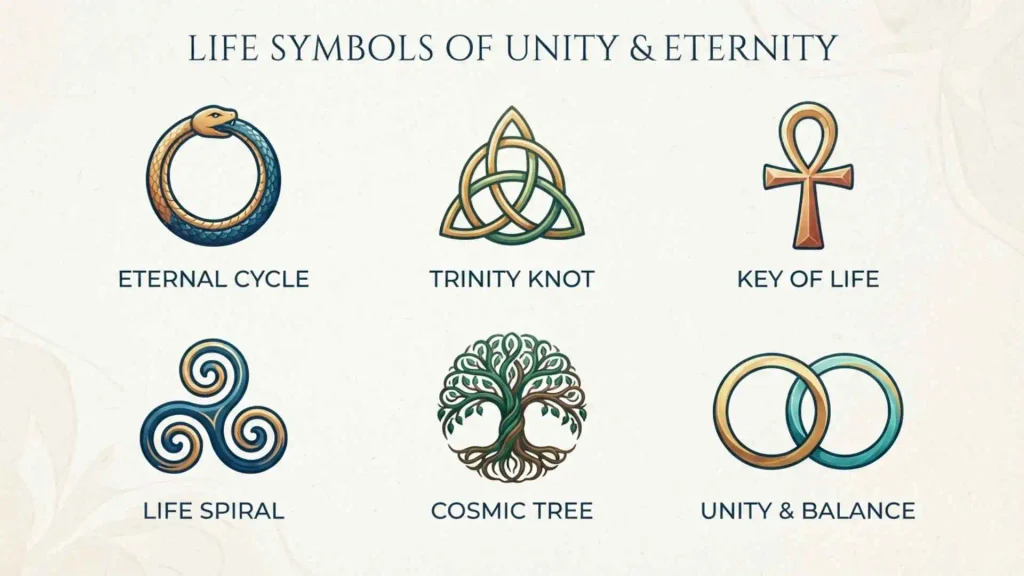
The circle is one of the simplest and most recognizable geometric shapes. Every point along its circumference sits at an equal distance from its center.
Its continuous, unbroken boundary makes it a common symbol of:
- Unity and completeness.
- Eternity and infinity.
- Cycles of life and renewal.
- Wholeness and balance.
- Connection and continuity.
Circles also form the foundation of several sacred geometric designs. The Seed of Life, Flower of Life, and Vesica Piscis all use overlapping or intersecting circles.
Mandala – Symbol of Wholeness and Spiritual Balance
A mandala is a structured geometric design that often uses circles, squares, and repeated symmetrical patterns. The Sanskrit word mandala means circle.
Mandalas hold important religious and spiritual roles in Hinduism and Buddhism. Traditional examples can represent sacred spaces, deities, cosmological structures, and stages of spiritual practice.
Their central features often include:
- Concentric circles.
- Four-sided geometric enclosures.
- Repeated triangular arrangements.
- Symmetrical patterns.
- A central point or symbolic figure.
Mandalas also appear in modern artwork, coloring books, and meditation activities. Their decorative versions don’t necessarily carry the same religious meaning as traditional ceremonial mandalas.
Basic Sacred Geometry Shapes and Their Spiritual Meanings
Many sacred geometric patterns begin with a small group of fundamental shapes. Their mathematical properties remain consistent, although their spiritual meanings change across cultures.
| Geometric shape | Mathematical structure | Common symbolic associations |
| Circle | Continuous curved boundary | Unity and eternity |
| Triangle | Three sides and three angles | Balance and transformation |
| Square | Four equal sides and right angles | Stability and structure |
| Pentagon | Five sides | Symmetry and proportion |
| Hexagon | Six sides | Organization and balance |
| Spiral | Curved, expanding or contracting path | Growth and movement |
Triangle – Symbol of Balance and Transformation
Triangles appear throughout sacred geometry, especially in the Sri Yantra and Merkaba. Their three sides create a stable geometric structure.
In Hindu symbolism, upward and downward triangles can represent Shiva and Shakti. In Christianity, triangular imagery can also represent the Holy Trinity.
Square – Symbol of Stability and Structure
A square has four equal sides and four right angles. Its regular structure makes it useful in architectural planning and geometric constructions.
Different traditions associate squares with the earth, stability, order, and the four cardinal directions.
Pentagon and Hexagon – Symbols of Symmetry
A regular pentagon contains five equal sides and five equal angles. Its diagonal relationships connect with the Golden Ratio.
A regular hexagon contains six equal sides and six equal angles. It also appears in honeycomb structures and numerous Islamic geometric patterns.
Sacred Geometry in Nature
Sacred geometry in nature refers to the study and interpretation of mathematical shapes, proportions, and repeating patterns found in natural structures. These patterns demonstrate how geometry helps describe the physical world.
Some notable examples include:
- Sunflowers: Seed arrangements often form intersecting spiral families related to Fibonacci numbers.
- Snowflakes: Water molecules create hexagonal crystal structures under suitable conditions.
- Honeycombs: Honeybees construct hexagonal cells that efficiently use available space.
- Seashells: Many shells grow in spiral forms that can be described mathematically.
- Galaxies: Spiral galaxies display curved arms around central regions.
- Pinecones: Their scales often follow recognizable spiral arrangements.
However, nature doesn’t follow one universal geometric formula. Environmental conditions, biological growth, and physical forces influence these structures.
Sacred Geometry in Ancient Cultures and Religious Traditions
Geometric patterns have appeared in religious buildings, manuscripts, artwork, and ceremonial objects across different civilizations.
Ancient Egypt and Sacred Architecture
Ancient Egyptian builders used practical geometry to construct pyramids, temples, and monuments. The Great Pyramid of Giza demonstrates the importance of accurate measurement and large-scale geometric planning.
Its square base and four triangular faces create a distinctive pyramidal structure. However, claims that its dimensions deliberately encode every popular sacred geometry ratio require reliable measurement evidence.
Ancient Greece and Platonic Philosophy
Greek philosophers explored mathematical relationships between shapes and the physical world.
In Timaeus, Plato connected four Platonic Solids with classical elements and associated the dodecahedron with the cosmos. Euclid later presented a rigorous mathematical treatment of regular solids in Elements.
Cambridge Assets+1
Hinduism and Buddhism
Hindu traditions use yantras as geometric representations associated with deities and spiritual practices. The Sri Yantra is among the best-known examples.
Buddhist traditions use mandalas to represent cosmological structures and support specific meditation practices. Their designs can include circles, squares, symbolic figures, and carefully arranged geometric patterns.
Islamic Art and Architecture
Islamic decorative art features intricate geometric patterns built from circles, polygons, stars, and repeated shapes.
Artists use rotational symmetry, reflection, and tessellation to create complex compositions. These designs appear on mosque walls, ceilings, tiles, manuscripts, and architectural surfaces.
Christianity and Judaism
Christian artwork uses circles, crosses, triangles, and other geometric arrangements to communicate religious ideas. Gothic cathedrals also feature elaborate rose windows with radial symmetry.
Jewish artistic and mystical traditions include the hexagram and the Kabbalistic Tree of Life. Their meanings depend on their specific religious and historical contexts.
Sacred Geometry in Architecture, Art, and Everyday Life
Sacred geometry in architecture often involves symmetry, proportion, and carefully arranged geometric patterns. Builders and artists have used these principles to create visually balanced spaces for centuries.
Examples include:
- Egyptian pyramids with square bases and triangular faces.
- Gothic cathedrals with symmetrical rose windows.
- Hindu temples with geometrically planned layouts.
- Islamic buildings decorated with repeating polygonal patterns.
- Traditional mandalas used in religious artwork.
Modern designers also use geometric principles in jewelry, tattoos, clothing, furniture, and graphic design.
The Flower of Life, Merkaba, and Golden Ratio are especially recognizable in contemporary decorative artwork.
Sacred Geometry and Spirituality
Many people explore sacred geometry and spirituality because geometric shapes provide visual ways to express abstract ideas. Circles, triangles, and symmetrical arrangements can represent concepts that different religious traditions describe through their own teachings.
Sacred Geometry and the Concept of Creation
The Seed of Life and Flower of Life often represent creation in modern spiritual teachings. Their expanding circular arrangements suggest how simple forms can develop into complex patterns.
These interpretations connect geometry with:
- The origin of existence.
- The relationship between unity and diversity.
- The development of life.
- The interconnectedness of living things.
- The symbolic order of the universe.
Sacred Geometry and Consciousness
Mandalas and yantras provide structured designs for contemplation. Their repeated patterns can help practitioners maintain visual attention during meditation.
Some modern spiritual teachings connect these designs with higher consciousness, personal transformation, and self-awareness. These are spiritual interpretations rather than scientifically established effects of geometric shapes.
Sacred Geometry and Energy
Certain esoteric traditions associate geometric patterns with spiritual energy and universal forces. The Merkaba, for example, represents light and transformation in modern spiritual interpretations.
However, spiritual energy shouldn’t be confused with measurable physical energy. Geometry alone doesn’t establish claims about healing, protection, or supernatural powers.
Mathematical Principles Behind Sacred Geometry
The mathematical foundation of sacred geometry includes several important concepts.
- Symmetry: Balanced arrangements around an axis or central point.
- Proportion: Relationships between different measurements.
- Ratios: Comparisons between two quantities.
- Tessellation: Repeated shapes that cover a surface without gaps or overlaps.
- Polyhedra: Three-dimensional solids with flat polygonal faces.
- Geometric construction: Creating shapes through defined mathematical steps.
These principles explain why geometric patterns appear throughout mathematics, architecture, and natural science.
Common Misconceptions About Sacred Geometry
Understanding the difference between mathematical facts and spiritual beliefs makes sacred geometry easier to explore.
| Common claim | More accurate explanation |
| Everything in nature follows the Golden Ratio. | Some natural patterns approximate related mathematical relationships, but many don’t. |
| Every ancient civilization used identical sacred symbols. | Different cultures developed distinct geometric and religious traditions. |
| Sacred geometry has scientifically proven healing powers. | Spiritual healing claims lack sufficient scientific evidence. |
| All geometric symbols have universal meanings. | Symbolic interpretations depend on cultural and historical context. |
| The Flower of Life explains the entire universe. | It is a geometric pattern with modern spiritual interpretations, not a proven scientific model. |
Frequently Asked Questions About Sacred Geometry
What Is the Most Powerful Sacred Geometry Symbol?
There isn’t one universally recognized most powerful symbol. The Flower of Life, Sri Yantra, and Metatron’s Cube are popular choices in modern spiritual practices.
Their significance depends on personal beliefs and cultural traditions.
What Are the Seven Main Sacred Geometry Symbols?
Seven commonly discussed sacred geometry symbols include:
- Flower of Life.
- Seed of Life.
- Metatron’s Cube.
- Sri Yantra.
- Vesica Piscis.
- Merkaba.
- Platonic Solids.
Each has a different geometric construction and symbolic background.
What Does Sacred Geometry Represent Spiritually?
Sacred geometry commonly represents unity, creation, harmony, balance, and interconnectedness. Different cultures interpret these ideas through their religious and philosophical traditions.
What Is the Oldest Sacred Geometry Symbol?
There isn’t enough evidence to identify one universally accepted oldest sacred geometry symbol. Ancient civilizations created geometric decorations and mathematical designs long before the modern term became popular.
How Is Sacred Geometry Found in Nature?
Natural geometric patterns appear in snowflakes, honeycombs, flowers, shells, and spiral galaxies. Examples include hexagonal symmetry, Fibonacci-related plant arrangements, and mathematical spiral structures.
What Is the Connection Between Sacred Geometry and the Universe?
Mathematics helps scientists describe natural structures, physical relationships, and patterns throughout the universe. Spiritual traditions sometimes interpret these mathematical relationships as expressions of divine order or cosmic harmony.
Can Sacred Geometry Be Used for Meditation?
Yes. Traditional mandalas and yantras serve as visual aids in particular Hindu and Buddhist practices. Their structured designs can provide a focus for contemplation.
What Is the Difference Between Sacred Geometry and Ordinary Geometry?
Ordinary geometry studies the mathematical properties of shapes, measurements, and spatial relationships. Sacred geometry combines geometric structures with cultural, philosophical, or spiritual interpretations.
Conclusion: Exploring the Meaning of Sacred Geometry
Sacred geometry symbols connect mathematical patterns with ideas about creation, nature, spirituality, and cultural identity. From the Flower of Life and Metatron’s Cube to the Sri Yantra and Platonic Solids, each design offers something different to explore.Some patterns have well-documented mathematical foundations. Others carry religious meanings rooted in specific historical traditions or modern spiritual interpretations.Understanding these differences makes the subject far more interesting. Whether you’re fascinated by ancient architecture, mathematical proportions, meditation, or symbolic artwork, sacred geometry offers a fascinating way to examine the relationship between shapes and human beliefs.The real beauty lies in exploring both sides: the mathematics behind the patterns and the meanings people have attached to them throughout history.

I am Lisa Reynolds, a linguist fascinated by the ever-changing world of slang. I enjoy researching how slang reflects trends, technology, and social connections. I wrote “Text Talk: Understanding Digital Slang” and “From Street to Screen: Slang in Media”, exploring the influence of digital communication on language. I love sharing my discoveries in a way that feels like a conversation with friends, so you feel the culture and humor behind every phrase.
 John Carter