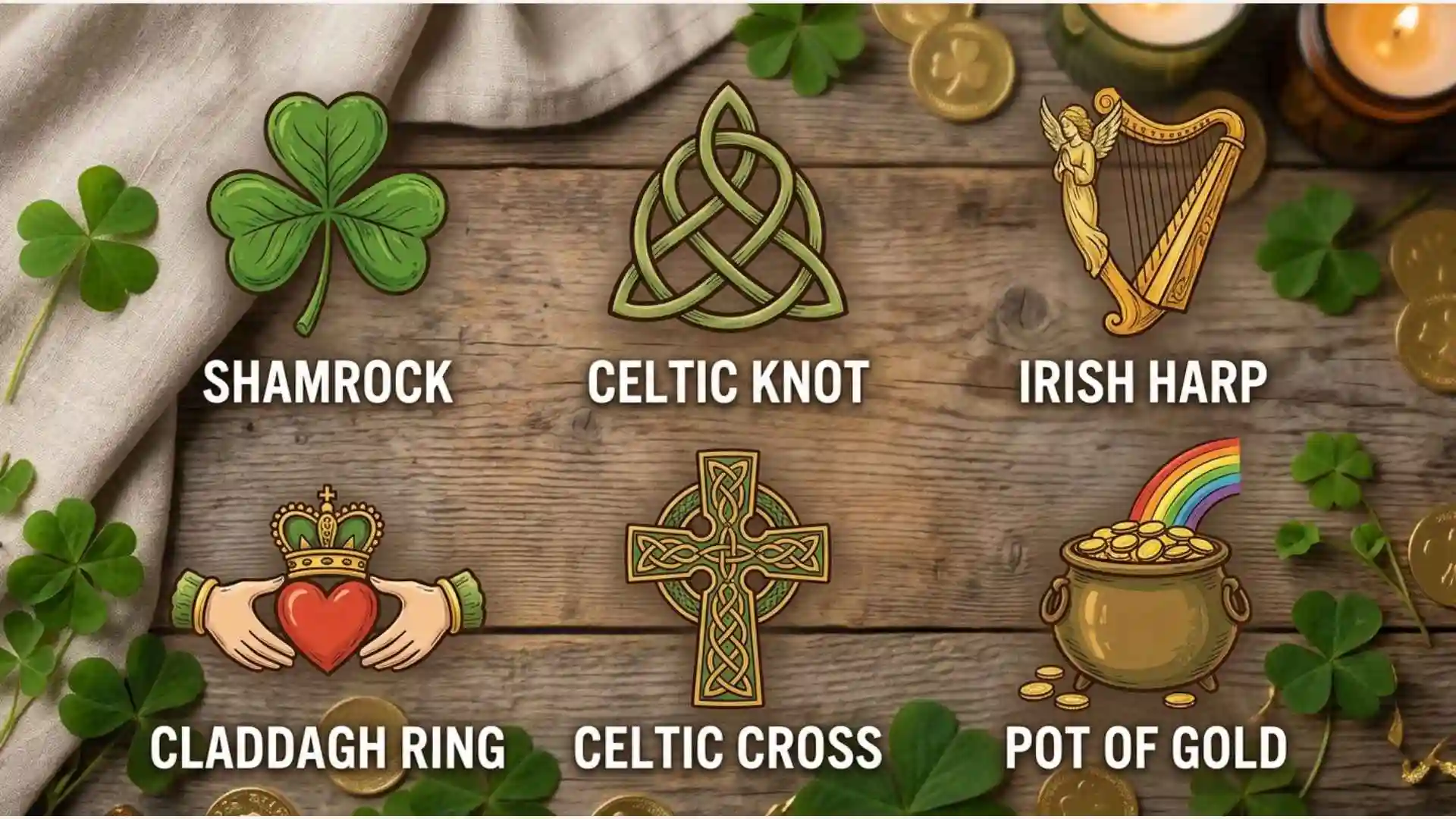
St. Patrick’s Day is celebrated on March 17 and is widely recognized for its green decorations, shamrocks, Irish flags, leprechauns, rainbows, and festive parades. But not every symbol associated with the holiday has the same origin. Some, such as the shamrock and Celtic cross, are connected with Ireland’s Christian and historical traditions, while others, including leprechauns and pots of gold, come primarily from Irish folklore and modern popular culture.
Understanding the meaning behind these St. Patrick’s Day symbols gives the celebration more context. It also helps explain why certain images appear repeatedly in decorations, clothing, crafts, greeting cards, and social media posts every March.
This guide explores the most recognizable St. Patrick’s Day symbols, where they come from, what they traditionally represent, and how they are used today.
What Is St. Patrick’s Day?
St. Patrick’s Day is observed each year on March 17. The date is traditionally associated with Saint Patrick, the patron saint of Ireland, and is believed to mark the anniversary of his death.
Saint Patrick lived during the fifth century and is associated with the spread of Christianity in Ireland. Over the centuries, March 17 developed from a religious feast day into a broader celebration of Irish culture and heritage.
Today, St. Patrick’s Day is celebrated in Ireland and by Irish communities and cultural groups around the world. Modern celebrations can include parades, music, traditional food, cultural events, green clothing, and Irish-themed decorations.
The symbols used during the holiday reflect this mixture of religion, Irish history, folklore, national identity, and modern celebration.
The Most Popular St. Patrick’s Day Symbols
Although many symbols are connected with St. Patrick’s Day, a few appear particularly often. These include the shamrock, the color green, the Irish harp, the Irish flag, leprechauns, pots of gold, rainbows, Celtic designs, and snakes.
Their meanings are not all equally historical. Some have documented connections to Ireland or Saint Patrick, while others became popular through folklore and later holiday traditions.
The Shamrock
The shamrock is probably the most important traditional symbol associated with St. Patrick’s Day.
A shamrock is a small three-leafed plant traditionally associated with Ireland. According to a long-standing tradition, Saint Patrick used the three leaves of the shamrock as a teaching illustration for the Christian concept of the Holy Trinity: the Father, the Son, and the Holy Spirit.
The story is widely associated with Saint Patrick, although the exact historical evidence for the teaching story is limited. Nevertheless, the shamrock became strongly connected with Saint Patrick and Irish identity.
What Does the Shamrock Symbolize?
The shamrock can represent:
- Saint Patrick
- Irish identity
- Christianity
- Faith
- Irish heritage
It is commonly used on St. Patrick’s Day clothing, jewelry, greeting cards, party decorations, crafts, and digital graphics.
Shamrock vs. Four-Leaf Clover
The shamrock should not be confused with a four-leaf clover.
A shamrock traditionally has three leaves, while a four-leaf clover is commonly associated with good luck. Both appear in St. Patrick’s Day imagery, but their cultural associations are different.
The Color Green
Green is one of the most recognizable visual symbols of St. Patrick’s Day.
Ireland is famously known as the Emerald Isle, a nickname connected with its green landscapes. Green has also played an important role in Irish national and cultural symbolism.
Today, wearing green is one of the most common St. Patrick’s Day traditions. Green shirts, hats, socks, jewelry, face paint, and accessories are especially popular.
What Does Green Represent?
In St. Patrick’s Day celebrations, green can be associated with:
- Ireland
- Irish heritage
- Irish identity
- Nature
- Spring
- Celebration
The history of green and St. Patrick’s Day is more complicated than the simple idea that green has always been the official color of the holiday. Blue has historical associations with Saint Patrick, while green became increasingly prominent in Irish national and cultural symbolism and later became strongly connected with the modern celebration.
The Irish Harp
The harp has a particularly important place in Irish history.
The harp is the national emblem of Ireland and has been associated with Irish identity for centuries. It also appears on the official coat of arms of Ireland and on Irish government symbols.
The instrument has deep connections with Irish musical traditions and historical culture.
What Does the Harp Symbolize?
The Irish harp can represent:
- Irish heritage
- Music
- National identity
- History
- Irish culture
Unlike some St. Patrick’s Day images that developed primarily through modern commercial culture, the harp has a substantial historical connection with Ireland itself.
The Irish Flag
The Irish tricolor is another important symbol of Irish identity.
The flag contains three vertical bands of green, white, and orange. The colors have historical and political associations connected with different traditions in Ireland. The white center is commonly understood as representing peace or the hope for peaceful relations between those traditions.
During St. Patrick’s Day celebrations, the Irish flag may appear on parade decorations, clothing, banners, buildings, and cultural displays.
Why Is the Irish Flag Used on St. Patrick’s Day?
St. Patrick’s Day has become an international celebration of Irish heritage, so the national flag naturally appears in events that highlight Irish identity.
However, the Irish flag is a national symbol, not a symbol created specifically for St. Patrick’s Day.
Leprechauns
The leprechaun is one of the most recognizable figures in Irish folklore.
Traditional Irish folklore describes leprechauns as supernatural beings associated with the fairy world. Modern illustrations often portray them as small figures wearing green clothing, a beard, and a distinctive hat.
The modern St. Patrick’s Day image of a leprechaun has been influenced by folklore, storytelling, illustrations, advertising, and popular culture.
What Do Leprechauns Symbolize?
In modern St. Patrick’s Day celebrations, leprechauns are associated with:
- Irish folklore
- Luck
- Mischief
- Hidden treasure
- Adventure
Leprechauns are especially popular in children’s activities, costumes, classroom decorations, party themes, and holiday crafts.
The Pot of Gold
The pot of gold is closely connected to the modern image of the leprechaun.
Popular folklore says that a leprechaun’s treasure can be found at the end of a rainbow. The idea of a hidden pot of gold has become one of the most familiar pieces of St. Patrick’s Day imagery.
The pot of gold can represent:
- Wealth
- Good fortune
- Treasure
- Success
- Something valuable waiting to be discovered
It is especially common in children’s St. Patrick’s Day crafts and decorations.
The Rainbow
The rainbow is frequently paired with the pot of gold.
The familiar phrase “pot of gold at the end of the rainbow” comes from folklore rather than historical traditions surrounding Saint Patrick. Nevertheless, it has become a major part of the modern visual language of St. Patrick’s Day.
Rainbows can symbolize ideas such as:
- Hope
- Luck
- Discovery
- Possibility
- Adventure
A rainbow combined with a leprechaun or pot of gold immediately creates a recognizable St. Patrick’s Day theme.
Celtic Knots
Celtic knots are intricate patterns made from interwoven lines. They are associated with Celtic art and appear in historical manuscripts, stone carvings, metalwork, and other forms of decorative art.
Their continuous patterns are often interpreted today as symbols of eternity, connection, continuity, or interconnectedness.
However, it is important not to treat every modern interpretation as an established ancient meaning. Many specific symbolic explanations commonly found online are modern interpretations rather than meanings that can be definitively attributed to ancient Celtic artists.
Celtic Knots in St. Patrick’s Day Designs
Today, Celtic knots are frequently used in:
- Jewelry
- Tattoos
- Wall art
- Clothing
- Greeting cards
- Irish-themed decorations
They add a historical and artistic connection to Irish and broader Celtic heritage.
The Celtic Cross
The Celtic cross combines a Christian cross with a circular ring around the intersection. It is strongly associated with Ireland and Celtic Christian art.
Historic high crosses can be found at several locations in Ireland, and they are important examples of medieval Irish religious art.
What Does the Celtic Cross Represent?
The Celtic cross can represent:
- Christianity
- Irish heritage
- Celtic art
- Religious history
- Spirituality
Its connection to Irish Christian history makes it especially relevant when discussing the religious background of St. Patrick’s Day.
Snakes and the Legend of Saint Patrick
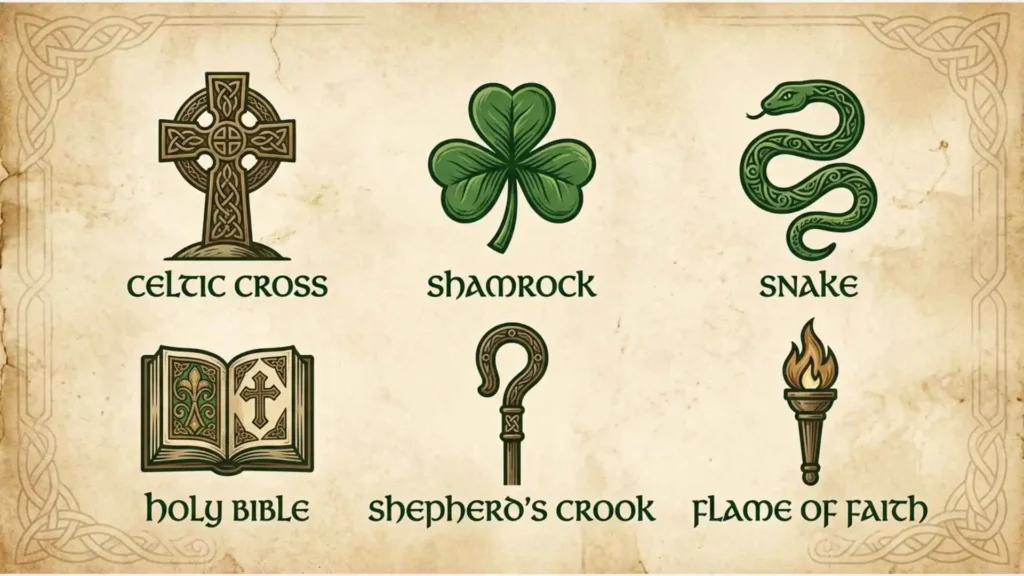
One of the best-known stories about Saint Patrick says that he drove snakes out of Ireland.
The story has become a popular part of St. Patrick’s Day folklore, but it should not be presented as a literal historical event. Ireland has no native population of snakes, and there is no reliable historical evidence that Saint Patrick physically removed snakes from the island.
What Does the Snake Story Mean?
The snake story is often interpreted symbolically. Some traditions connect it with Saint Patrick’s Christian mission and the rejection of pagan beliefs, although interpretations vary.
The important distinction is that the snake story is a legend associated with Saint Patrick, rather than documented evidence that he removed actual snakes from Ireland.
The Four-Leaf Clover
The four-leaf clover is another popular St. Patrick’s Day image.
Unlike the three-leaf shamrock, the four-leaf clover is primarily associated with good luck. Finding one is considered fortunate because four-leaf variations are much less common than the usual three-leaf clover.
The four leaves are often popularly associated with:
- Faith
- Hope
- Love
- Luck
These meanings are traditional associations rather than a direct symbol of Saint Patrick himself.
Irish Music and Traditional Instruments
Music is an important part of Irish cultural celebrations, and it naturally features in many St. Patrick’s Day events.
Traditional Irish music may include instruments such as the:
- Irish harp
- Fiddle
- Tin whistle
- Bodhrán
- Uilleann pipes
Music connects St. Patrick’s Day celebrations with Irish cultural heritage rather than simply functioning as holiday decoration.
Parades, cultural festivals, concerts, and community gatherings may all include Irish music.
Irish Pubs and Community Celebrations
Irish pubs have become closely associated with St. Patrick’s Day celebrations, particularly outside Ireland.
On March 17, many Irish pubs and Irish-themed venues hold special events featuring traditional music, food, decorations, and cultural activities.
However, pubs are better understood as a modern social symbol of St. Patrick’s Day rather than a historical symbol of Saint Patrick himself.
Why Do People Wear Green on St. Patrick’s Day?
Wearing green has become one of the most recognizable St. Patrick’s Day traditions.
The association developed through Irish cultural and national symbolism and became increasingly established in celebrations outside Ireland. Today, people wear green clothing, accessories, face paint, hats, and jewelry to participate in the holiday.
Green also works as a highly recognizable visual theme, which is why it appears so frequently in St. Patrick’s Day advertisements, decorations, and social media content.
St. Patrick’s Day Symbols and Their Meanings
| Symbol | Main Association | Historical or Cultural Connection |
| Shamrock | Saint Patrick and the Trinity | Christian tradition associated with Saint Patrick |
| Green | Ireland and Irish identity | Irish cultural and national symbolism |
| Harp | Music and Irish identity | Long-standing Irish national symbol |
| Irish flag | National identity | Symbol of the Irish state and people |
| Leprechaun | Folklore and luck | Irish folklore |
| Pot of gold | Treasure and fortune | Modern folklore |
| Rainbow | Luck and possibility | Modern St. Patrick’s Day folklore |
| Celtic knot | Continuity and connection | Celtic decorative art; modern interpretations vary |
| Celtic cross | Christianity and heritage | Irish/Celtic Christian art |
| Snake | Saint Patrick legend | Traditional folklore |
| Four-leaf clover | Good luck | Folklore and modern tradition |
| Irish music | Cultural heritage | Irish musical traditions |
St. Patrick’s Day Symbols for Decorations
If you are decorating for a St. Patrick’s Day party, several symbols can be combined to create a recognizable theme.
A traditional Irish-inspired decoration might focus on shamrocks, Irish flags, green elements, and Celtic designs. A more playful theme can include leprechauns, rainbows, pots of gold, and four-leaf clovers.
For a classroom or children’s party, rainbow crafts, shamrock cutouts, leprechaun hats, and pots of gold are easy options.
For a more historical or cultural theme, the Irish harp, Celtic cross, Irish flag, and traditional musical instruments provide stronger connections to Irish heritage.
St. Patrick’s Day Symbols for Crafts
St. Patrick’s Day symbols also work well for simple DIY crafts.
Shamrock Crafts
Cut shamrock shapes from green paper and use them to create banners, cards, wall decorations, or classroom displays.
Leprechaun Crafts
Paper leprechaun hats, beards, faces, and small treasure pots can be used for children’s activities.
Rainbow and Pot of Gold Crafts
A paper rainbow ending in a small black pot can create a simple representation of the popular leprechaun treasure legend.
Celtic Knot Designs
Older children and adults can experiment with Celtic knot patterns using paper, drawing tools, or digital design software.
The Difference Between Historical and Modern St. Patrick’s Day Symbols
One of the most useful ways to understand St. Patrick’s Day imagery is to separate historical symbols from modern holiday imagery.
The shamrock has a traditional association with Saint Patrick, while the harp has a long-standing connection with Irish national identity. The Celtic cross reflects Ireland’s Christian artistic heritage.
By comparison, leprechauns, rainbows, pots of gold, and four-leaf clovers are strongly connected with folklore and modern St. Patrick’s Day celebrations.
This distinction matters because the holiday has evolved considerably over time. Not every image seen on a modern St. Patrick’s Day card originated with Saint Patrick or medieval Ireland.
Frequently Asked Questions About St. Patrick’s Day Symbols
What is the main symbol of St. Patrick’s Day?
The shamrock is one of the main traditional symbols associated with St. Patrick’s Day. It is linked by tradition with Saint Patrick’s teaching about the Holy Trinity.
Why is green associated with St. Patrick’s Day?
Green became strongly associated with Irish identity and modern St. Patrick’s Day celebrations. Ireland’s green landscapes and the broader history of green in Irish cultural and national symbolism also contributed to the association.
What does the shamrock symbolize?
The shamrock is traditionally associated with Saint Patrick and the Christian concept of the Holy Trinity. It is also widely used as a symbol of Irish heritage.
What does the leprechaun symbolize?
The leprechaun represents Irish folklore and is commonly associated with luck, treasure, and mischief in modern St. Patrick’s Day imagery.
Why is there a pot of gold on St. Patrick’s Day?
The pot of gold comes from popular folklore surrounding leprechauns and the idea of treasure at the end of a rainbow. It is a modern cultural symbol rather than a historical symbol of Saint Patrick.
Is the four-leaf clover the same as a shamrock?
No. A shamrock traditionally has three leaves and has a specific association with Saint Patrick. A four-leaf clover is primarily associated with good luck.
What does the Irish harp symbolize?
The harp is a longstanding symbol of Irish identity, music, and national heritage. It is also the national emblem of Ireland.
Did Saint Patrick really drive snakes out of Ireland?
The story is a traditional legend rather than a documented historical event. Ireland did not have a native population of snakes that Saint Patrick could have literally driven out.
What does the Celtic knot mean?
Celtic knots are associated with Celtic decorative art. Modern interpretations often connect their continuous patterns with ideas such as eternity, continuity, and connection, although specific ancient meanings are not always known.
What does the Irish flag mean?
The Irish tricolor consists of green, white, and orange. Its colors have historical associations with different traditions in Ireland, with the white commonly interpreted as representing peace between them.
Final Thoughts
The symbols of St. Patrick’s Day reflect several layers of Irish culture rather than coming from a single tradition. The shamrock connects the holiday with Saint Patrick and Christian tradition, while the harp and Irish flag represent Irish cultural and national identity. Celtic crosses and Celtic designs connect modern celebrations with Ireland’s artistic and religious heritage.
Other familiar images, such as leprechauns, pots of gold, rainbows, and four-leaf clovers, come mainly from folklore and modern holiday culture. The green color brings many of these traditions together and has become the defining visual feature of the modern celebration.
Knowing the origins and meanings of these symbols makes St. Patrick’s Day more than a collection of green decorations. It reveals how a religious feast day developed into an international celebration of Irish heritage, history, folklore, music, and culture.

I am Marcus Lee, a cultural researcher and slang aficionado. I study the roots of informal language and how communities create meaning through words. My books “Slang Origins: A Journey Through Words” and “Words That Move Us: Slang Across Generations” focus on the history and psychology of slang. I enjoy guiding readers to understand not just the words, but the stories and attitudes they carry, so you can truly connect with language in daily life.
 Lisa Reynolds
 John Carter