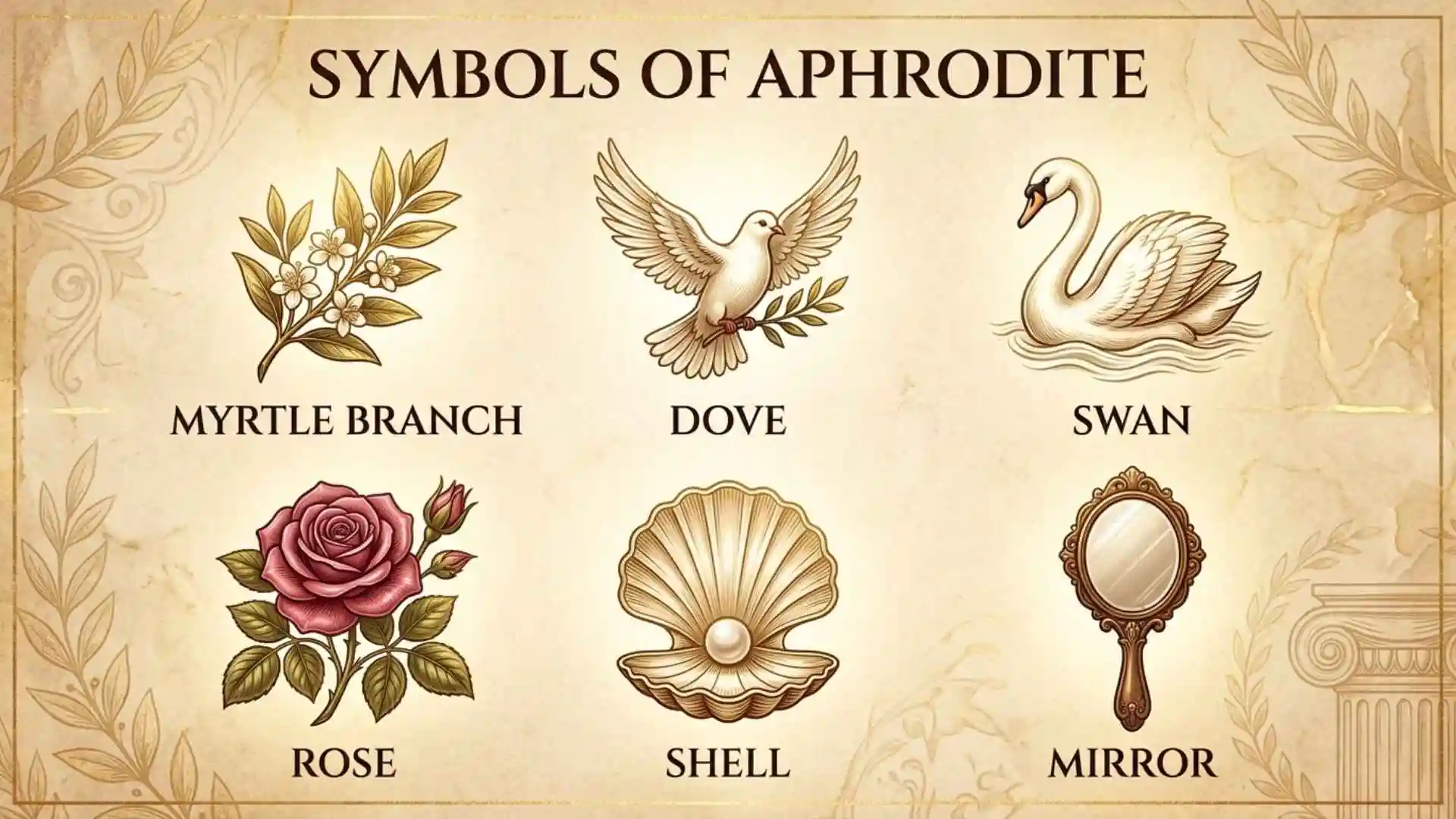
Aphrodite is one of the most recognizable goddesses in Greek mythology. She is primarily associated with love, beauty, desire, sexuality, fertility, and attraction. Because of these associations, ancient Greek mythology, art, and religious traditions connected her with a wide range of animals, plants, objects, and natural elements.
Some symbols of Aphrodite are strongly connected with ancient Greek traditions, while others became especially popular through later Roman, Renaissance, and modern art. The dove, myrtle, rose, seashell, apple, swan, sparrow, dolphin, and anemone are among the most recognizable examples.
Understanding these symbols is useful because each one represents a different aspect of Aphrodite. Some reflect romantic love and beauty, while others connect her with fertility, the sea, marriage, desire, or the tragic side of love.
What Are the Main Symbols of Aphrodite?
The most commonly associated symbols of Aphrodite include the dove, myrtle, rose, seashell, apple, golden apple, swan, sparrow, dolphin, anemone, pomegranate, mirror, and magical girdle.
However, these symbols do not all have exactly the same historical status. Some are documented in ancient Greek mythology and religious traditions, while others became strongly associated with Aphrodite through later artistic representations.
| Symbol | Main Meaning | Connection to Aphrodite |
| Dove | Love and affection | Associated with love and Aphrodite’s imagery |
| Myrtle | Love and marriage | Sacred plant connected with her worship |
| Rose | Beauty and passion | Connected with love and beauty |
| Seashell | Birth and beauty | Reflects her connection with the sea |
| Golden apple | Beauty and desire | Connected with the Judgment of Paris |
| Swan | Grace and beauty | Appears in artistic and mythological imagery |
| Sparrow | Desire and sexuality | Associated with Aphrodite in ancient poetry |
| Dolphin | Sea and divine connection | Reflects her marine associations |
| Anemone | Love and loss | Connected with the story of Adonis |
| Pomegranate | Fertility | Associated with fertility and sexuality |
| Mirror | Beauty and appearance | Especially prominent in later Venus imagery |
| Girdle | Attraction and seduction | Magical object associated with Aphrodite |
Dove: A Symbol of Love and Affection
The dove is one of the most familiar animals associated with Aphrodite. It represents love, affection, gentleness, and fertility, making it particularly appropriate for a goddess associated with romantic and sexual attraction.
Doves appear in ancient Greek artistic and literary traditions connected with Aphrodite. Their association with pairs and affectionate behavior also helped reinforce their symbolic relationship with love.
The dove is not exclusively an Aphrodite symbol. Other ancient cultures and deities also used the bird as a symbol. Nevertheless, its connection with Aphrodite became especially strong and continued into later European art.
What Does the Dove Symbolize?
In connection with Aphrodite, the dove can represent:
- Romantic love
- Affection
- Partnership
- Fertility
- Peace
- Gentleness
For this reason, the dove remains one of the simplest symbols to represent Aphrodite’s loving and affectionate side.
Myrtle: One of Aphrodite’s Important Sacred Plants
The myrtle has a particularly important connection with Aphrodite. Unlike some symbols that became popular much later, myrtle has strong roots in ancient Greek religious and cultural traditions.
Myrtle was associated with love, marriage, fertility, and beauty. These associations naturally connected it with Aphrodite, whose influence extended beyond romantic attraction to marriage and fertility.
The plant was also used in ancient Greek ceremonial contexts. Its connection with weddings and love helped strengthen its relationship with Aphrodite.
What Does Myrtle Symbolize?
Myrtle can represent:
- Love
- Marriage
- Fertility
- Beauty
- Devotion
- Romantic relationships
If someone is looking for an Aphrodite symbol with a strong ancient Greek connection, myrtle is one of the most meaningful choices.
Rose: A Symbol of Beauty and Passion
The rose is one of the most recognizable symbols of romantic love today, and it is also closely connected with Aphrodite in later traditions.
Its beauty and association with passion make it a natural symbol for the goddess of love. Roses can represent both the attractive and powerful aspects of desire.
The rose is especially useful as a modern symbol because its meaning is immediately understandable. A red rose, for example, is commonly associated with romantic passion.
What Does the Rose Represent?
In Aphrodite symbolism, the rose can represent:
- Love
- Passion
- Beauty
- Desire
- Romance
- Attraction
Although the modern symbolism of the rose developed over centuries, its association with Aphrodite fits naturally with her traditional role as a goddess of love and beauty.
Seashell: Aphrodite’s Connection With the Sea
The seashell is probably the most recognizable visual symbol associated with Aphrodite.
One ancient tradition describes Aphrodite as emerging from the sea. Hesiod’s Theogony presents a famous version of her birth in which she emerges from the sea foam. This connection between Aphrodite and the sea became extremely influential in later art.
The shell itself became especially famous through Renaissance representations of Venus, the Roman counterpart of Aphrodite. Sandro Botticelli’s The Birth of Venus is one of the best-known examples.
What Does the Seashell Symbolize?
The seashell can represent:
- Birth
- Beauty
- Femininity
- The sea
- Transformation
- Divine emergence
It is important to distinguish the ancient myth of Aphrodite’s sea birth from the later artistic convention of showing her standing on a shell. The shell became a powerful visual representation of the myth even though artistic traditions changed over time.
Golden Apple: Beauty, Choice, and Desire
The golden apple is connected with one of the most famous stories involving Aphrodite: the Judgment of Paris.
According to the myth, Eris, goddess of discord, presented a golden apple marked for the fairest goddess. Hera, Athena, and Aphrodite each wanted the prize. Paris was chosen to decide which goddess was the most beautiful.
Aphrodite promised Paris the love of Helen, who was already married to Menelaus. Paris selected Aphrodite, and the events that followed became part of the mythology surrounding the Trojan War.
What Does the Golden Apple Represent?
The golden apple represents:
- Beauty
- Desire
- Competition
- Choice
- Attraction
- Temptation
This makes the golden apple a particularly interesting Aphrodite symbol because it represents not only beauty but also the consequences that can follow from desire.
Apple: A Symbol of Beauty and Desire
The apple can be discussed separately from the specific golden apple of the Judgment of Paris.
In ancient Greek culture, apples could carry associations with love, fertility, and desire. Because Aphrodite was associated with these concepts, the fruit became part of the wider symbolism surrounding her.
The golden apple is the clearest mythological connection, while the broader apple symbolism developed through mythology, literature, and later artistic traditions.
Swan: Beauty and Grace
The swan is another animal associated with Aphrodite in mythology and art.
Its graceful appearance and elegant movement made it an appropriate symbol for a goddess associated with beauty. Swans are also connected with other figures in Greek mythology, so it would be inaccurate to describe the swan as exclusively belonging to Aphrodite.
Nevertheless, swans became part of the visual vocabulary used to represent divine beauty, elegance, and attraction.
What Does the Swan Symbolize?
The swan can represent:
- Grace
- Beauty
- Elegance
- Attraction
- Refinement
Its association with Aphrodite is especially noticeable in later artistic representations.
Sparrow: Desire and Sexuality
The sparrow has a more specific connection with Aphrodite than many people realize.
In ancient Greek poetry, sparrows can appear in contexts involving love and sexual desire. One notable example comes from Sappho’s poetry, where Aphrodite’s chariot is described as being drawn by sparrows.
This makes the sparrow particularly interesting for people researching the ancient symbols of Aphrodite, because its connection is rooted in ancient literary tradition rather than being solely a modern artistic invention.
What Does the Sparrow Represent?
The sparrow can symbolize:
- Desire
- Sexual attraction
- Love
- Passion
- Fertility
Dolphin: Aphrodite and the Sea
The dolphin is sometimes associated with Aphrodite because of her connection with the sea.
Dolphins were important creatures in ancient Greek mythology and art, although they were not exclusive to Aphrodite. They appear in connection with several gods, heroes, and maritime traditions.
For Aphrodite, the dolphin can therefore be understood as part of her broader marine imagery rather than as her single defining animal.
What Does the Dolphin Symbolize?
The dolphin can represent:
- The sea
- Movement
- Beauty
- Protection
- Divine connection
Anemone: Love, Grief, and Loss
The anemone has a more tragic connection with Aphrodite through the story of Adonis.
Adonis was a beautiful young man loved by Aphrodite. His death became one of the great tragic love stories of Greek mythology. In later versions of the story, the anemone is associated with his blood and the grief surrounding his death.
This gives the flower a meaning that is very different from the simple romantic symbolism of the rose.
What Does the Anemone Symbolize?
The anemone can represent:
- Passionate love
- Grief
- Loss
- Mortality
- Beauty
- Renewal
Because of this story, the anemone is particularly meaningful when studying the darker and tragic side of Aphrodite’s mythology.
Pomegranate: Fertility and Sexuality
The pomegranate was associated with fertility, abundance, sexuality, and the reproductive cycle in the ancient Mediterranean world.
Its symbolism overlaps with Aphrodite’s connection to fertility and sexuality. However, the pomegranate is also strongly associated with other Greek myths, particularly the story of Persephone.
Therefore, it is better understood as a broader fertility symbol that can relate to Aphrodite, rather than an exclusive symbol of the goddess.
Mirror: Beauty and Self-Admiration
The mirror is one of the most recognizable symbols associated with Aphrodite’s Roman counterpart, Venus, particularly in later European art.
A mirror represents beauty, appearance, self-admiration, and vanity. Artists often used it to emphasize Venus’s relationship with physical beauty.
However, the mirror should not be treated in exactly the same way as the ancient sacred symbols of Aphrodite. Its strongest association comes from later artistic traditions.
What Does the Mirror Symbolize?
The mirror can represent:
- Beauty
- Appearance
- Self-admiration
- Vanity
- Physical attractiveness
Aphrodite’s Magical Girdle
One of the most fascinating objects connected with Aphrodite is her girdle, sometimes described as a magical belt.
In Homer’s Iliad, Hera borrows Aphrodite’s special girdle because it has the power to make its wearer desirable and attractive.
The story demonstrates an important part of Aphrodite’s power: attraction was not simply physical beauty but a force capable of influencing emotions and relationships.
What Does the Girdle Symbolize?
The girdle represents:
- Attraction
- Seduction
- Desire
- Charisma
- Romantic influence
Aphrodite’s Sacred Animals
There is no single universally agreed list of Aphrodite’s sacred animals because Greek religious traditions varied across different places and periods.
However, animals commonly connected with her include:
Dove
Represents love, affection, fertility, and partnership.
Sparrow
Represents desire and sexual attraction and has a notable connection with Aphrodite in ancient poetry.
Swan
Represents grace, beauty, and elegance.
Dolphin
Reflects Aphrodite’s connection with the sea and marine imagery.
Goat and Hare
Both can appear in broader fertility and sexuality symbolism associated with Aphrodite, although their relationship with the goddess is less central than that of the dove.
Aphrodite’s Sacred Plants and Flowers
Aphrodite’s plant symbolism includes several flowers and plants associated with love, beauty, and fertility.
Myrtle
Myrtle has one of the strongest ancient religious associations with Aphrodite and is connected with love and marriage.
Rose
The rose represents romantic love, beauty, and passion, especially in later traditions.
Anemone
The anemone is connected with the tragic story of Aphrodite and Adonis.
Pomegranate
The pomegranate represents fertility and sexuality within the wider symbolic world of ancient Greek mythology.
These plants demonstrate that Aphrodite’s symbolism includes both joyful love and the painful consequences of desire.
Aphrodite Symbols in Greek Mythology
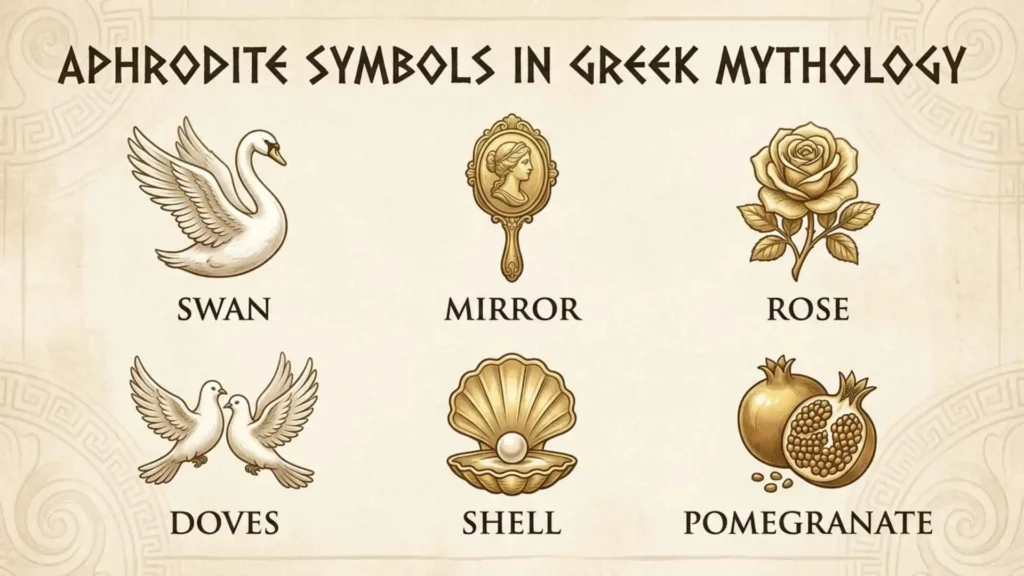
Aphrodite’s symbols become easier to understand when they are connected to her myths.
Her association with the sea and seashell relates to her famous birth story. Her connection with the golden apple comes from the Judgment of Paris. Her relationship with Adonis explains the symbolism of the anemone, while her girdle illustrates the power of attraction.
These stories show that Aphrodite was not simply a goddess representing romantic relationships. She represented the powerful and sometimes unpredictable forces of desire, beauty, sexuality, and attraction.
Aphrodite Symbols in Ancient Art
Ancient Greek artists represented Aphrodite in different ways depending on the period and artistic tradition.
The Aphrodite of Knidos, created by the sculptor Praxiteles, became one of the most famous representations of the goddess in ancient Greece. The sculpture was particularly important because it presented Aphrodite’s nude form as an ideal of divine beauty.
Later Roman artists continued this tradition through representations of Venus.
Renaissance artists then revived classical mythology and made symbols such as the seashell, rose, and mirror even more familiar to modern audiences
Aphrodite Symbols for Tattoos
People interested in Aphrodite symbols for tattoos often choose symbols based on the specific quality they want to represent.
A seashell can represent beauty, femininity, and Aphrodite’s connection with the sea. A rose can represent romantic love and passion. A dove can symbolize affection and peaceful love, while the golden apple can represent beauty, desire, and choice.
The myrtle branch can be particularly meaningful for someone interested in ancient Greek symbolism because of its association with love and marriage.
A tattoo based on Aphrodite symbolism does not have to show the goddess herself. A single symbolic object can communicate a connection with her mythology while leaving room for personal interpretation.
Aphrodite and Venus: Are Their Symbols the Same?
Aphrodite is the Greek goddess of love and beauty, while Venus is her Roman counterpart.
The two figures became closely connected, and many symbols associated with Aphrodite were carried into Roman representations of Venus. This is one reason why modern images of Aphrodite and Venus can look very similar.
However, the traditions are not completely identical. Greek and Roman cultures developed their own religious practices, stories, and artistic conventions.
When researching Aphrodite symbols, it is therefore useful to identify whether a particular symbol comes from ancient Greek mythology, Roman Venus traditions, or later European art.
Why Are Aphrodite’s Symbols Important?
The symbols of Aphrodite reveal different dimensions of love and beauty.
The dove represents affection, while the rose represents passion. The myrtle connects love with marriage, and the seashell reflects divine beauty and the sea. The golden apple represents desire and competition, while the anemone shows the tragic side of love.
Together, these symbols demonstrate that Aphrodite’s mythology was much broader than the modern idea of a simple “goddess of love.”
Her stories explore attraction, sexuality, fertility, beauty, jealousy, relationships, choice, and loss.
Frequently Asked Questions About Aphrodite Symbols
What are the 7 main symbols of Aphrodite?
Seven widely recognized symbols are the dove, myrtle, rose, seashell, golden apple, swan, and sparrow. Their associations developed through ancient mythology, literature, religious traditions, and later art.
What is Aphrodite’s sacred flower?
Myrtle has a particularly strong ancient association with Aphrodite. The rose and anemone are also commonly connected with her through later traditions and mythology.
What bird represents Aphrodite?
The dove is one of the best-known birds associated with Aphrodite. The sparrow also has a notable ancient literary connection with her, particularly through Sappho’s poetry.
What does the seashell symbolize for Aphrodite?
The seashell represents Aphrodite’s connection with the sea and her legendary birth from sea foam. It also became a powerful artistic symbol of beauty and femininity.
What does the rose symbolize for Aphrodite?
The rose represents love, passion, beauty, desire, and romance. Its association with Aphrodite fits her role as a goddess connected with love and attraction.
What is Aphrodite’s most famous symbol?
There is no single symbol that is universally considered her only or definitive symbol. The dove, myrtle, rose, seashell, and golden apple are among the most recognizable.
What does the golden apple represent?
The golden apple represents beauty, desire, competition, and choice. It is connected with the Judgment of Paris, in which Paris selected Aphrodite as the fairest goddess.
What symbolizes Aphrodite’s beauty?
The seashell, rose, swan, mirror, and golden apple can all represent different aspects of Aphrodite’s beauty in mythology and later art.
What animal is sacred to Aphrodite?
The dove has one of the strongest associations with Aphrodite. Sparrows, swans, and dolphins are also connected with her in different ancient and later traditions.
Is the mirror an ancient symbol of Aphrodite?
The mirror is strongly associated with Aphrodite’s Roman counterpart Venus and later European art. It should be distinguished from symbols such as myrtle that have stronger evidence in ancient Greek religious traditions.
Conclusion
The symbols of Aphrodite provide a fascinating way to understand Greek mythology. The dove represents love and affection, myrtle represents love and marriage, the rose represents beauty and passion, and the seashell represents Aphrodite’s connection with the sea and her legendary birth.
The golden apple connects her with the Judgment of Paris, while the sparrow, swan, and dolphin reveal different aspects of her relationship with desire, beauty, and the natural world. The anemone adds another dimension by connecting Aphrodite with grief and the tragic story of Adonis.
Not every symbol has the same historical origin or importance. Some come directly from ancient Greek mythology and worship, while others became popular through Roman traditions or later European art. Keeping these distinctions clear makes the study of Aphrodite’s symbolism more accurate and useful.
Ultimately, Aphrodite’s symbols reflect the many sides of love itself: beauty, attraction, passion, fertility, romance, desire, joy, and loss. That broad symbolism is one reason Aphrodite continues to influence art, literature, mythology, and popular culture thousands of years after the ancient Greek world.

I am Lisa Reynolds, a linguist fascinated by the ever-changing world of slang. I enjoy researching how slang reflects trends, technology, and social connections. I wrote “Text Talk: Understanding Digital Slang” and “From Street to Screen: Slang in Media”, exploring the influence of digital communication on language. I love sharing my discoveries in a way that feels like a conversation with friends, so you feel the culture and humor behind every phrase.
 Marcus Lee
 John Carter