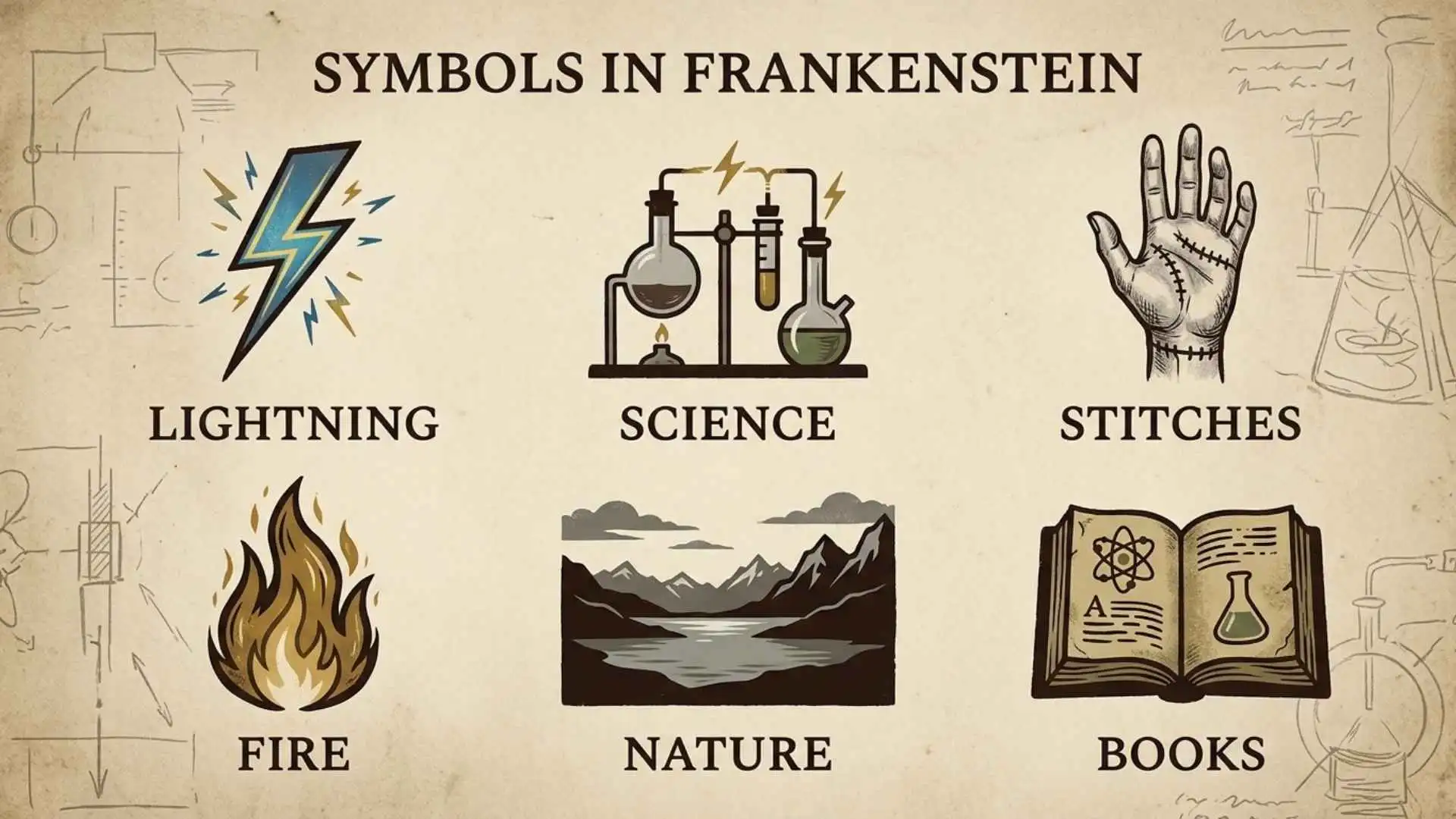
Mary Shelley’s Frankenstein; or, The Modern Prometheus is a Gothic novel filled with symbolism. The story of Victor Frankenstein and the creature he creates explores much more than horror and scientific experimentation. Shelley uses fire, light, darkness, lightning, ice, nature, books, the Arctic landscape, and the creature itself to explore ideas about knowledge, ambition, isolation, responsibility, prejudice, and the limits of human power.
Understanding the symbols in Frankenstein helps readers see how Shelley communicates deeper meanings through objects, settings, characters, and recurring images. Many of these symbols have more than one meaning. Fire, for example, can represent warmth and comfort, but it can also represent pain and destruction.
This article explains the major Frankenstein symbols and their meanings, shows where they appear in the novel, and explains how they connect to its major themes.
What Are the Main Symbols in Frankenstein?
The major symbols in Frankenstein include:
- Light and darkness
- Fire
- Lightning
- Ice and the Arctic
- Nature and the sublime
- The creature
- The creature’s appearance
- Books and education
- Victor’s laboratory
- The De Lacey cottage
- The moon
- Creation and the human body
- Prometheus
- The biblical creation story
These symbols often overlap with the novel’s motifs and themes. Together, they help Shelley explore the consequences of uncontrolled ambition and the responsibilities that come with creating or discovering something new.
Light and Darkness in Frankenstein
Light is one of the most important symbols in Frankenstein. It is strongly connected with knowledge, discovery, enlightenment, and ambition.
Victor Frankenstein wants to uncover the mysteries of life. His search for scientific knowledge initially appears exciting because he believes that discovering the secret of life will allow him to accomplish something extraordinary. Light therefore represents the attraction of knowledge and discovery.
However, Shelley does not present knowledge as automatically beneficial. Victor’s scientific enlightenment eventually leads to suffering. His discovery gives him power, but he is not prepared for the responsibility that comes with that power.
What Does Light Symbolize in Frankenstein?
Light can symbolize:
- Knowledge
- Scientific discovery
- Intellectual ambition
- Enlightenment
- Hope
- Dangerous curiosity
Darkness provides an important contrast. The more Victor becomes obsessed with his experiment, the more isolated and emotionally troubled he becomes.
The contrast between light and darkness suggests that knowledge can illuminate the world while also exposing frightening truths and creating new dangers.
Fire in Frankenstein
Fire is another central symbol in the novel. The creature discovers fire while living alone in the wilderness. At first, he is fascinated by its warmth and ability to make life more comfortable.
Soon, however, he learns that fire can also burn. The same thing that provides warmth can cause pain.
This makes fire a particularly effective symbol because it has two opposing functions.
Fire as Knowledge
The creature’s discovery of fire parallels his discovery of knowledge. He learns how the world works through observation and experience.
Knowledge improves his ability to survive, but it also makes him increasingly aware of his loneliness and rejection.
As he becomes more educated, he understands more clearly that he is different from other human beings.
Fire as Destruction
Fire also represents destruction. It can provide warmth, but it can quickly become dangerous.
This dual meaning reflects Victor’s scientific knowledge. His discovery of the secret of life gives him extraordinary power, but that power eventually contributes to tragedy.
Fire therefore represents the idea that knowledge can be both beneficial and destructive depending on how it is used.
Lightning in Frankenstein
Lightning is closely connected to Victor’s early fascination with natural science.
The famous lightning strike that destroys a tree helps Victor think about electricity and natural forces. This experience contributes to his growing interest in scientific discovery.
Lightning symbolizes the enormous and unpredictable power of nature.
Victor wants to understand and eventually control forces that appear beyond ordinary human power. His later experiment can therefore be viewed as an extension of this desire.
Why Is Lightning Important in Frankenstein?
Lightning represents:
- Natural power
- Scientific curiosity
- Discovery
- Destructive energy
- Humanity’s desire to control nature
The symbol also connects with the novel’s larger question about whether human beings should attempt to cross natural boundaries simply because science makes it possible.
Ice and the Arctic Landscape
The Arctic setting is important at both the beginning and the end of Frankenstein. Robert Walton travels toward the frozen North because he wants to discover unknown territory.
The frozen landscape represents isolation, danger, ambition, and the unknown.
Victor eventually follows the creature into this extreme environment. The Arctic therefore becomes the final stage of his obsessive pursuit.
Ice as a Symbol of Isolation
Ice is physically cold and emotionally suggestive of distance. Victor becomes increasingly separated from his family, friends, and society because of his obsession.
The creature experiences an even deeper form of isolation because society rejects him.
The frozen landscape therefore reflects the emotional condition of both characters.
Ice and Human Ambition
Walton and Victor share a desire to achieve something extraordinary. Both are willing to enter dangerous environments in pursuit of knowledge or revenge.
The Arctic can therefore symbolize what happens when ambition continues beyond reasonable limits.
Nature and the Sublime
Nature is one of the most powerful recurring symbols in Frankenstein. Shelley frequently describes mountains, glaciers, forests, lakes, storms, and valleys.
These natural environments often appear when characters experience intense emotions.
Victor sometimes finds temporary peace in nature after periods of suffering. The beauty of mountains and valleys gives him an emotional escape from his scientific obsession.
Nature as a Power Greater Than Humanity
Nature also reminds readers that human beings have limitations.
The enormous mountains and glaciers make Victor appear small. Their scale contrasts with his belief that he can control life and death.
This creates an important contrast between nature and science.
Victor attempts to control natural processes through scientific experimentation, while the natural world repeatedly demonstrates its enormous power.
Nature and the Sublime
Shelley’s descriptions of mountains, storms, and glaciers are examples of the Romantic idea of the sublime.
The sublime describes experiences that are beautiful but also overwhelming, frightening, or larger than human understanding.
Nature in Frankenstein therefore represents both beauty and power.
The Creature as a Symbol
The creature is perhaps the most complex symbol in the novel.
He can represent the consequences of irresponsible creation, social rejection, prejudice, loneliness, and the human desire for companionship.
Victor initially sees the creature as an achievement. Once the creature comes to life, however, Victor is horrified by his appearance and abandons him.
The creature is then forced to survive without guidance or companionship.
The Creature and Social Rejection
The creature’s violence develops alongside his repeated experiences of rejection.
He wants to communicate with human beings, but his appearance causes people to fear him.
Shelley therefore uses the creature to ask an important question: Does society create the monster it fears?
The novel does not make the creature’s later violence harmless or justified, but it does provide a history of rejection and suffering that helps readers understand how he reaches that point.
The Creature’s Appearance
The creature’s appearance symbolizes the human tendency to judge others based on external characteristics.
Victor rejects his creation almost immediately because the creature does not look beautiful or human enough to match Victor’s expectations.
Other people react similarly.
This creates a contrast between appearance and inner character. Before society repeatedly rejects him, the creature demonstrates curiosity, sensitivity, and a desire to help others.
Appearance and Prejudice
The creature’s physical appearance therefore represents prejudice.
Shelley encourages readers to consider how quickly people judge individuals who appear different.
The symbol also connects with the Romantic and Gothic concern with the relationship between beauty, ugliness, and morality.
Books and Education
Books are important to the creature’s development. While secretly observing the De Lacey family, he learns language and gradually educates himself.
Reading allows him to understand human history, emotions, society, and morality.
However, education also increases his awareness of his own situation.
Books as a Symbol of Knowledge
Books symbolize:
- Education
- Knowledge
- Self-discovery
- Human culture
- Intellectual development
The creature becomes more aware of himself through reading.
His education does not simply make him intelligent. It also teaches him what he lacks.
He learns about family and friendship while realizing that he has neither.
This makes education both empowering and painful.
Victor Frankenstein’s Laboratory
Victor’s laboratory represents scientific ambition and humanity’s attempt to control natural processes.
It is where Victor transforms his theoretical knowledge into action and creates life.
The laboratory is therefore more than a physical setting. It symbolizes the point where curiosity becomes experimentation and ambition becomes dangerous.
Science Without Responsibility
Victor concentrates on whether he can create life rather than carefully considering whether he should.
After succeeding, he immediately abandons his creation.
The laboratory therefore symbolizes the danger of separating scientific achievement from moral responsibility.
Shelley’s criticism is not simply that science is bad. Instead, the novel raises questions about how scientific power should be used and what responsibilities creators have toward their discoveries.
The De Lacey Cottage
The De Lacey cottage symbolizes family, community, companionship, and belonging.
The creature watches the family from a distance and learns from them.
He sees their relationships and hopes that he might eventually become part of their world.
The cottage represents the social life that the creature wants but cannot access.
The Cottage and Exclusion
When the creature finally approaches the family, his appearance causes fear and rejection.
This makes the cottage a symbol with two connected meanings:
- The possibility of belonging
- The pain of exclusion
The creature is physically close to human society but emotionally and socially separated from it.
The Moon
The moon often appears during the creature’s experiences outside human society.
Night provides him with a degree of protection because he can observe people without immediately being seen.
The moon can therefore symbolize solitude, secrecy, reflection, and the creature’s hidden existence.
Its presence also contributes to the Gothic atmosphere of the novel.
The Creature’s Reflection
The creature’s discovery of his own reflection is an important moment of self-awareness.
When he sees himself, he realizes that his appearance is different from that of the people he has been observing.
The reflection symbolizes identity and self-perception.
How Society Shapes Identity
The creature does not understand himself only through his own thoughts. He also learns about himself through the reactions of others.
When people repeatedly fear and reject him, he begins to see himself as an outsider.
The reflection therefore represents the relationship between identity and social judgment.
Creation and the Human Body
The creature’s body represents Victor’s attempt to overcome the boundary between life and death.
Victor gathers body parts and uses scientific knowledge to create a living being.
This process raises questions about the limits of human power.
Creation as a Symbol
Creation represents:
- Scientific ambition
- The power of knowledge
- Human curiosity
- The limits of natural boundaries
- Moral responsibility
Victor succeeds in creating life, but his success does not make him happy.
Instead, his creation becomes the beginning of a chain of suffering.
Shelley therefore separates achievement from wisdom. Being able to accomplish something does not necessarily mean that doing it is morally responsible.
Prometheus as a Symbol in Frankenstein
The subtitle of Shelley’s novel is The Modern Prometheus. This directly connects Victor Frankenstein with the Greek mythological figure Prometheus.
In Greek mythology, Prometheus is associated with giving fire to humanity. Fire provides humans with knowledge and power, but Prometheus is punished for his actions.
This connection is important because Victor also seeks knowledge and power that appear beyond ordinary human limits.
Victor as the Modern Prometheus
Victor’s scientific discovery gives him extraordinary power, but his achievement carries devastating consequences.
Like Prometheus, he crosses a boundary in pursuit of something powerful.
The Prometheus connection therefore reinforces the novel’s concern with ambition, knowledge, punishment, and responsibility.
Frankenstein and the Biblical Creation Story
The novel also contains important connections to the biblical story of creation.
The creature reads Paradise Lost and compares his situation with the relationship between God and Adam.
Victor becomes a creator, while the creature becomes his creation.
However, Victor does not behave like a responsible creator. Instead of caring for his creation, he abandons him.
Adam and the Creature
The creature’s desire for companionship resembles Adam’s desire for a companion.
But unlike Adam, the creature is created alone and without a supportive creator.
This symbolism emphasizes the creature’s loneliness and his desire to understand his place in the world.
It also strengthens one of the novel’s central questions:
What responsibility does a creator have toward what they create?
Symbols vs. Motifs in Frankenstein
It is useful to distinguish between symbols and motifs.
A symbol is an object, character, place, or image that represents a deeper idea.
A motif is a recurring element that contributes to a larger pattern or theme.
For example, fire can function as a symbol of knowledge and destruction. Repeated references to isolation, storytelling, letters, and books can work as motifs that reinforce the novel’s broader concerns.
Understanding this difference can make literary analysis more precise.
How Frankenstein’s Symbols Connect to Its Major Themes
The symbols in Frankenstein are closely connected to the novel’s major themes.
Knowledge and Ambition
Light, fire, lightning, books, and the laboratory all connect to knowledge.
Victor wants knowledge because he believes it will give him power. The novel then explores what happens when knowledge is pursued without sufficient responsibility.
Isolation
Ice, the Arctic landscape, darkness, the moon, and the creature’s physical separation from society reinforce the theme of isolation.
Both Victor and the creature experience loneliness, although their circumstances are different.
Nature vs. Science
Nature represents forces that are larger than human beings, while Victor’s laboratory represents his attempt to control those forces.
Shelley does not simply present science as evil. Instead, she explores the consequences of scientific power when it is separated from ethical responsibility.
Appearance and Prejudice
The creature’s appearance and the reactions of other people show how quickly society can judge someone based on physical characteristics.
His experiences reveal the damaging effects of rejection and prejudice.
Responsibility
The creation of the creature creates the novel’s strongest example of responsibility.
Victor brings a new life into the world but refuses to accept responsibility for it.
The consequences of that decision affect Victor, the creature, and many innocent people.
Quick Reference: Symbols in Frankenstein
| Symbol | Main Meaning | Related Theme |
| Light | Knowledge and discovery | Ambition |
| Darkness | Uncertainty and isolation | Loneliness |
| Fire | Knowledge, warmth, and destruction | Knowledge |
| Lightning | Natural power and scientific curiosity | Science |
| Ice | Isolation and danger | Ambition |
| Nature | Beauty and overwhelming power | Nature vs. science |
| Creature | Rejection and responsibility | Society |
| Creature’s appearance | Prejudice and judgment | Appearance |
| Books | Education and self-discovery | Knowledge |
| Laboratory | Scientific ambition | Responsibility |
| De Lacey cottage | Family and belonging | Isolation |
| Moon | Solitude and secrecy | Loneliness |
| Reflection | Identity and self-awareness | Prejudice |
| Creation | Power and responsibility | Science |
| Prometheus | Ambition and dangerous knowledge | Knowledge |
How to Use Frankenstein Symbols in an Essay
When writing an essay about symbolism, it is better to explain more than simply stating what a symbol means.
A strong paragraph can follow this structure:
Identify the Symbol
Begin by naming the object, setting, or character that functions symbolically.
Give the Context
Explain where and when the symbol appears in the story.
Explain Its Meaning
Discuss what idea the symbol represents in that particular context.
Connect It to a Theme
Show how the symbol supports a larger theme such as ambition, isolation, knowledge, or responsibility.
Explain Its Importance
Finish by explaining what the symbol helps readers understand about the novel as a whole.
For example, when discussing fire, an essay can explain how the creature first experiences fire as a source of warmth before discovering its destructive power. This supports the larger idea that knowledge can provide benefits while also creating unexpected dangers.
Frequently Asked Questions About Symbols in Frankenstein
What is the most important symbol in Frankenstein?
There is no single symbol that explains the entire novel. Light, fire, nature, the creature, ice, and Prometheus are particularly important because they connect with major ideas such as knowledge, ambition, isolation, and responsibility.
What does fire symbolize in Frankenstein?
Fire symbolizes both warmth and destruction. It also parallels knowledge because the creature gains useful knowledge from discovering fire but learns that the same discovery can cause pain.
What does light symbolize in Frankenstein?
Light commonly represents knowledge, discovery, enlightenment, and scientific ambition. Its meaning becomes more complicated because Victor’s pursuit of knowledge eventually contributes to suffering.
What does lightning symbolize in Frankenstein?
Lightning represents the power of nature and Victor’s fascination with scientific forces. It helps establish his interest in understanding and controlling forces that seem beyond ordinary human ability.
What does ice symbolize in Frankenstein?
Ice represents isolation, danger, emotional coldness, and extreme ambition. The Arctic landscape also reflects the physical and emotional distance experienced by Victor and the creature.
What does nature symbolize in Frankenstein?
Nature represents beauty, power, balance, and forces that humans cannot completely control. Shelley’s descriptions of mountains, glaciers, storms, and valleys also reflect the Romantic idea of the sublime.
What does the creature symbolize in Frankenstein?
The creature can symbolize social rejection, loneliness, prejudice, irresponsible creation, and the human desire for companionship. His character also raises questions about whether society contributes to the development of the monster it fears.
What does Prometheus symbolize in Frankenstein?
Prometheus symbolizes the pursuit of knowledge and power beyond ordinary human limits. The subtitle The Modern Prometheus connects Victor’s ambition with the myth of Prometheus and reinforces the novel’s warnings about dangerous ambition.
What do books symbolize in Frankenstein?
Books symbolize education, knowledge, self-discovery, and the development of identity. The creature’s education makes him more intelligent but also makes him more aware of his loneliness.
What does the laboratory symbolize in Frankenstein?
The laboratory symbolizes scientific ambition and humanity’s attempt to control nature. It also represents the ethical problems that arise when scientific achievement is separated from responsibility.
Conclusion
The symbols in Frankenstein give Mary Shelley’s novel much of its deeper meaning. Fire represents both warmth and destruction, while light and darkness explore knowledge and uncertainty. Lightning represents the power of nature and scientific curiosity, while ice and the Arctic landscape reinforce isolation and dangerous ambition.
Nature represents a power greater than humanity, while Victor’s laboratory represents his attempt to control natural processes. The creature symbolizes rejection, loneliness, prejudice, and the consequences of irresponsible creation. Books represent education and self-discovery, while the De Lacey cottage represents the companionship and belonging that the creature desperately wants.
The connection between Victor and Prometheus further develops the theme of dangerous ambition, while the biblical creation parallels raise questions about the responsibilities of a creator toward a creation.
Taken together, these symbols show that Frankenstein is not simply a story about a scientist and a monster. It is a story about what can happen when knowledge grows faster than responsibility. Shelley uses symbolism to encourage readers to think about the limits of ambition, the consequences of rejection, and the responsibilities that come with power and creation.

I am John Carter, a lifelong enthusiast of language and modern slang. I explore how words evolve and shape culture, and I enjoy uncovering the stories behind everyday expressions. I have authored “Slang and Society: The Language of Youth” and “Modern Words, Modern Worlds”, where I dive into how informal language impacts communication and identity. My goal is to make language accessible, fun, and insightful for everyone who loves words as much as I do.
 Marcus Lee
 Lisa Reynolds