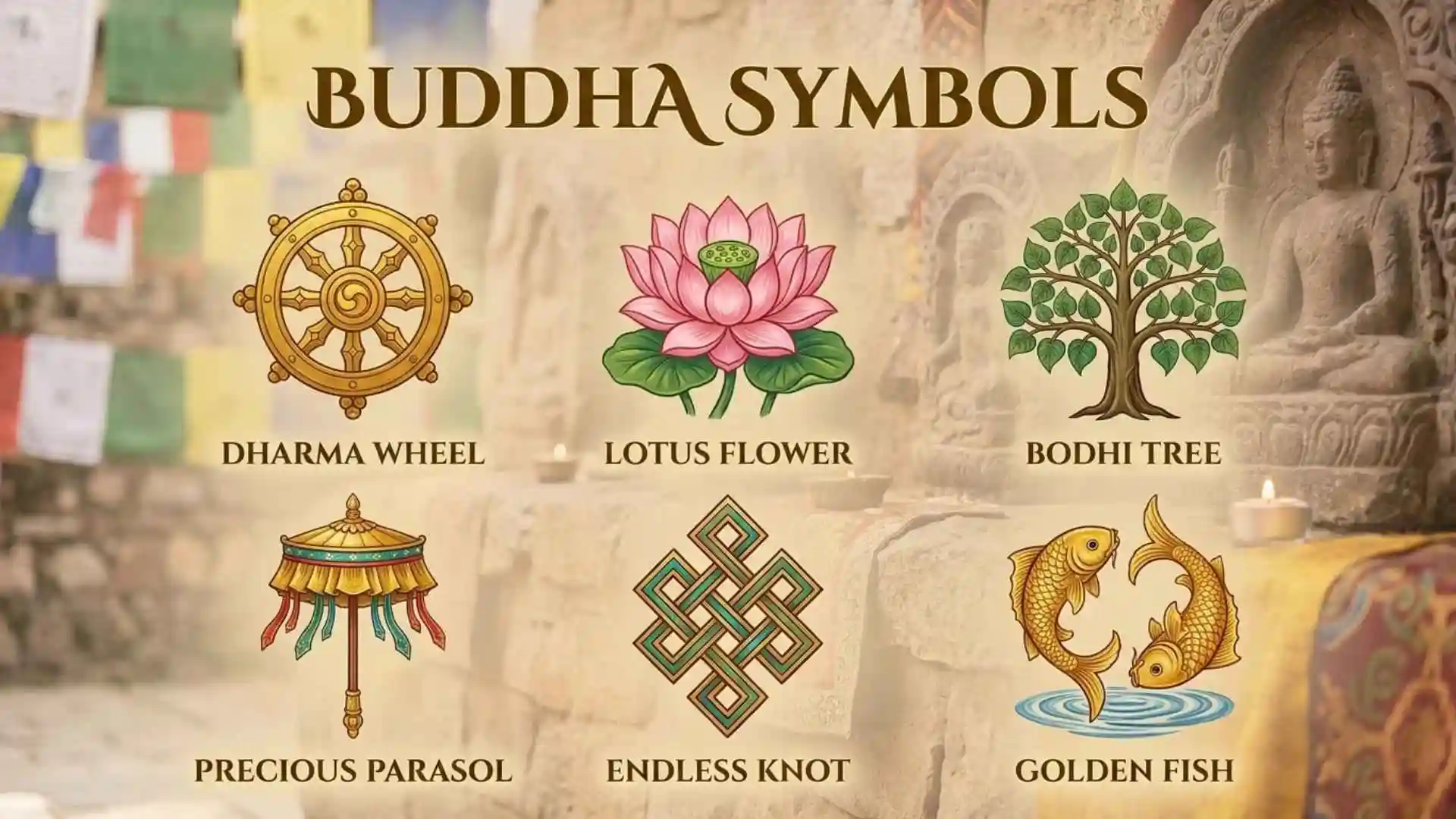
Buddhist symbols carry deep spiritual meanings that connect ancient teachings with everyday life. From the Dharma Wheel to the Lotus Flower, each symbol represents important ideas such as enlightenment, wisdom, compassion, purity, and freedom from suffering. These sacred images appear in Buddhist temples, monasteries, meditation practices, religious ceremonies, and traditional artwork.
The symbols of Buddhism also help explain teachings that can be difficult to express through words alone. Some represent the Buddha’s journey toward enlightenment while others communicate the importance of ethical living, mindfulness, and spiritual transformation. Their meanings vary across Theravada, Mahayana, and Vajrayana traditions.
Among the most recognized Buddhist symbols and their meanings are the Eight Auspicious Symbols, the Vajra, the Mandala, and the Buddha’s footprints. Understanding their origins and religious significance reveals how Buddhism uses visual imagery to communicate its central teachings.
What Are Buddhist Symbols?
Buddhist symbols are images, objects, gestures, and architectural forms that represent the Buddha’s teachings and important spiritual principles. They communicate ideas such as enlightenment, compassion, wisdom, mindfulness, and liberation through recognizable visual forms.
These symbols appear throughout Buddhist religious life. You can find them carved into temple walls, displayed on sacred altars, painted on traditional scrolls, and incorporated into meditation practices.
Rather than serving only as decorations, many Buddhist religious symbols help practitioners remember specific teachings and reflect on their spiritual development.
Buddhist symbolism developed over centuries as the religion spread from India throughout Asia. Different communities adopted local artistic styles while preserving important religious meanings.
Three major Buddhist traditions use distinctive symbolic imagery:
- Theravada Buddhism: Common symbols include the Dharma Wheel, Bodhi Tree, Buddha’s footprints, and stupas.
- Mahayana Buddhism: Lotus flowers, bodhisattvas, and images of Amitabha Buddha hold important positions.
- Vajrayana Buddhism: Vajras, bells, mandalas, and the Eight Auspicious Symbols feature prominently.
Although their artwork differs, these traditions share fundamental Buddhist teachings about suffering, wisdom, compassion, and awakening.
What Is the Main Symbol of Buddhism?
The Dharma Wheel (Dharmachakra) is widely recognized as the main symbol of Buddhism. It represents the Buddha’s teachings and the path toward spiritual liberation.
Its eight spokes correspond to the Noble Eightfold Path, which provides guidance for overcoming suffering and developing wisdom.
The eight elements are:
- Right Understanding
- Right Intention
- Right Speech
- Right Action
- Right Livelihood
- Right Effort
- Right Mindfulness
- Right Concentration
The wheel’s circular shape also suggests the continuity and completeness of the Buddha’s teachings.
The expression Turning the Wheel of Dharma refers to the Buddha teaching the path to enlightenment. His first sermon at Deer Park in Sarnath traditionally marks this important event.
The Dharma Wheel appears in Buddhist temples, sculptures, paintings, and religious flags. It also features prominently in the national flag of India, where the Ashoka Chakra represents law and righteous conduct.
11 Important Buddhist Symbols and Their Meanings
Buddhism features numerous sacred images, but certain symbols appear especially often in religious artwork and spiritual practices.
The following table introduces 11 important symbols of Buddhism and their traditional associations.
| Buddhist symbol | Traditional meaning |
| Dharma Wheel | Buddha’s teachings and the Eightfold Path |
| Lotus Flower | Purity and enlightenment |
| White Conch Shell | Proclamation of the Dharma |
| Precious Parasol | Protection from suffering |
| Endless Knot | Interdependence and interconnectedness |
| Victory Banner | Triumph over ignorance |
| Treasure Vase | Abundance and spiritual wealth |
| Golden Fish | Freedom and liberation |
| Vajra | Indestructible wisdom |
| Buddhist Mandala | Sacred order and meditation |
| Stupa | Buddha’s teachings and enlightened mind |
The first eight form the traditional Eight Auspicious Symbols (Ashtamangala), particularly prominent in Tibetan Buddhism. The Vajra, Mandala, and Stupa are important Buddhist symbols but belong to a separate grouping.
Dharma Wheel – Symbol of Buddha’s Teachings
The Dharma Wheel, also called Dharmachakra, represents the teachings of Gautama Buddha. It reminds practitioners to follow the path of wisdom, ethical conduct, and mental discipline.
Its eight spokes symbolize the Noble Eightfold Path. The wheel therefore communicates a complete approach to spiritual development rather than a single religious belief.
The wheel also connects with the Buddha’s first sermon, traditionally delivered at Sarnath after his enlightenment.
Buddhist artwork often depicts the Dharma Wheel between two deer. This imagery recalls Deer Park, where the Buddha first shared his teachings.
Key meanings:
- Enlightenment and spiritual awakening.
- Wisdom and ethical conduct.
- The Noble Eightfold Path.
- Freedom from suffering.
- Continuation of Buddhist teachings.
Lotus Flower – Symbol of Purity and Enlightenment
The Lotus Flower (Padma) is among the most recognizable Buddhist spiritual symbols. It represents purity, spiritual awakening, and the possibility of rising above difficult circumstances.
A lotus grows from muddy water yet produces a beautiful flower above the surface. Buddhist teachings use this natural process as an image of spiritual development.
People experience suffering, attachment, and ignorance. However, they can develop wisdom and compassion through practice.
Different lotus colors also carry traditional associations:
| Lotus color | Common Buddhist association |
| White | Purity and spiritual clarity |
| Pink | The historical Buddha |
| Red | Compassion and loving-kindness |
| Blue | Wisdom and knowledge |
| Purple | Spiritual mystery and sacred teachings |
The lotus frequently appears beneath Buddha and bodhisattva figures. Its presence suggests that enlightenment can emerge even within an imperfect world.
White Conch Shell – Symbol of the Buddhist Teachings
The White Conch Shell (Shankha) represents the powerful voice of the Dharma. Its sound traditionally symbolizes Buddhist teachings spreading throughout the world.
In Tibetan Buddhist traditions, the right-spiraling white conch holds particular importance. Monasteries may use conch shells during religious ceremonies and ritual occasions.
Its sound calls attention to spiritual teachings and encourages people to overcome ignorance.
Key meanings:
- Spreading the Dharma.
- Communication of wisdom.
- Awakening and awareness.
- The importance of hearing Buddhist teachings.
Precious Parasol – Symbol of Spiritual Protection
The Precious Parasol (Chattra) represents protection from harmful influences and suffering. Its traditional association with royalty also connects it with dignity and spiritual authority.
Just as an umbrella protects someone from harsh sunlight or rain, the parasol symbolizes the protective qualities of Buddhist teachings.
In Tibetan Buddhist artwork, it often appears with elaborate decorations and a distinctive canopy.
Its symbolism encourages practitioners to seek shelter through wisdom, ethical conduct, and spiritual discipline.
Endless Knot – Symbol of Interconnectedness
The Endless Knot features an intricate design of interwoven lines without an obvious beginning or end. It represents interconnectedness, continuity, and the relationship between different aspects of existence.
Its symbolism connects closely with dependent origination, a central Buddhist teaching explaining how phenomena arise through conditions and relationships.
The knot also represents the connection between wisdom and compassion. Neither quality develops fully in isolation from the other.
Buddhist artwork often includes this symbol on temple decorations, religious textiles, and ceremonial objects.
Victory Banner – Symbol of Triumph Over Ignorance
The Victory Banner (Dhvaja) represents victory over spiritual obstacles and destructive mental states. It reminds Buddhists that enlightenment requires overcoming ignorance, attachment, and hatred.
Traditional Buddhist interpretations connect the banner with the Buddha’s triumph over Mara, who represents temptation and obstacles to awakening.
The symbol therefore represents spiritual determination rather than victory over other people.
It frequently appears in Tibetan Buddhist temples and ceremonial decorations.
Treasure Vase – Symbol of Abundance and Spiritual Wealth
The Treasure Vase (Kalasha) represents inexhaustible abundance, good fortune, and beneficial spiritual qualities.
Its contents symbolize the wealth of Buddhist teachings, accumulated merit, wisdom, and positive qualities.
Although people sometimes associate the treasure vase with material prosperity, its deeper religious meaning extends beyond money and possessions.
It encourages the development of qualities that support spiritual growth and well-being.
Golden Fish – Symbol of Freedom and Liberation
The Golden Fish usually appears as a pair of fish swimming together. It represents freedom, fearlessness, and liberation from the difficulties of worldly existence.
Water gives fish freedom of movement. Buddhist symbolism connects this image with liberation from Samsara, the cycle of birth, death, and rebirth.
The pair also carries associations with happiness and spiritual confidence.
In Tibetan Buddhist art, golden fish often appear among the Eight Auspicious Symbols.
Vajra – Symbol of Indestructible Wisdom
The Vajra is a sacred ritual object particularly important in Vajrayana Buddhism. Its name carries associations with both a diamond and a thunderbolt.
A diamond represents indestructibility and clarity. A thunderbolt suggests powerful, immediate spiritual insight.
Together, these associations communicate wisdom that ignorance cannot destroy.
The Vajra also appears alongside a ritual bell. In many Vajrayana practices, the Vajra represents skillful means while the bell represents wisdom. Their combination expresses the importance of developing both qualities.
Key meanings:
- Indestructible wisdom.
- Spiritual strength.
- Clarity and insight.
- Overcoming ignorance.
- The union of wisdom and compassion.
Buddhist Mandala – Symbol of the Sacred Universe
A Buddhist Mandala is a carefully arranged geometric design used in meditation, visualization, and religious rituals.
Its circular patterns and organized structure often represent a sacred universe or an enlightened realm. Different mandalas contain specific arrangements of figures, colors, shapes, and symbolic elements.
Tibetan Buddhist monks create intricate sand mandalas using colored grains. These artworks can take days or weeks to complete.
Afterward, monks traditionally dismantle the finished mandala as part of a ritual demonstrating impermanence.
This practice reminds observers that physical creations are temporary. Spiritual understanding requires looking beyond attachment to material forms.
Stupa – Symbol of the Buddha’s Enlightened Mind
A Stupa is a Buddhist sacred monument traditionally associated with the Buddha, his relics, and his teachings.
Early stupas served as important structures for preserving relics and commemorating sacred events. Over time, their architectural forms developed different regional styles.
A traditional stupa may include a dome, square structure, central spire, and decorative elements.
Buddhists often walk clockwise around stupas in a devotional practice called circumambulation. This activity encourages mindfulness, respect, and reflection.
Stupas also represent the Buddha’s enlightened mind and the possibility of spiritual liberation.
Other Important Buddhist Symbols and Sacred Imagery
Beyond the 11 major symbols, Buddhism contains additional images and objects that communicate important teachings.
Buddha’s Footprint (Buddhapada)
The Buddha’s Footprint (Buddhapada) is an ancient Buddhist symbol representing the Buddha’s presence and spiritual legacy.
Early Buddhist artists sometimes represented the Buddha through footprints instead of human figures. These footprints often contain auspicious markings, including the Dharma Wheel.
The symbol carries two connected ideas: the Buddha once walked among people, and his physical presence has passed into Nirvana.
Footprints therefore remind practitioners to follow the path he taught.
Three Jewels of Buddhism (Triple Gem)
The Three Jewels of Buddhism, also called the Triple Gem, represent the foundation of Buddhist practice.
They include:
- Buddha: The awakened teacher who discovered and taught the path to liberation.
- Dharma: The Buddha’s teachings and the truth they communicate.
- Sangha: The Buddhist monastic community and, in broader interpretations, the spiritual community.
Taking refuge in these Three Jewels represents a commitment to Buddhist teachings and spiritual development.
They also provide guidance for ethical living, wisdom, and compassionate behavior.
Om Symbol in Buddhism
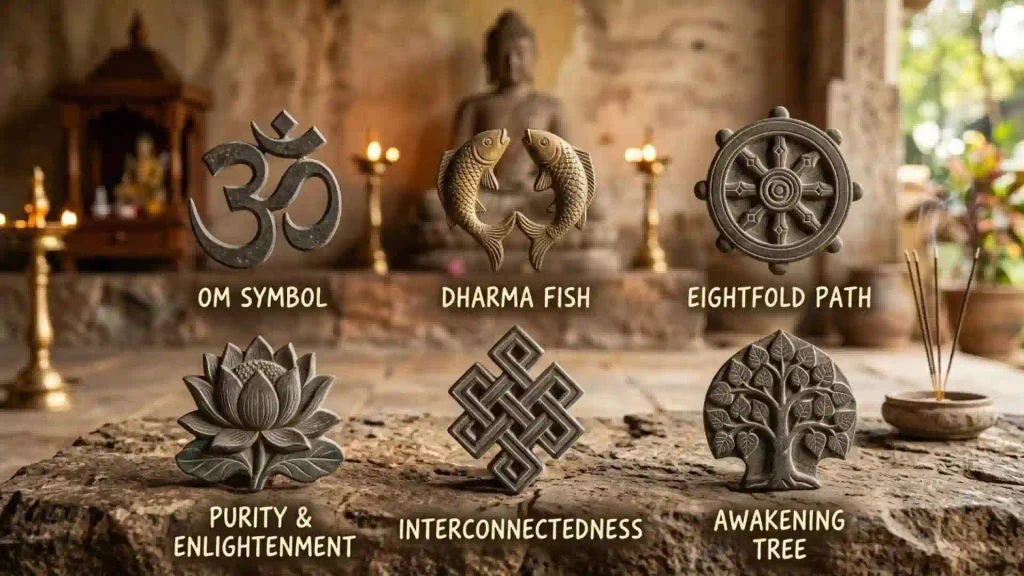
The Om Symbol represents a sacred sound originating in ancient Indian religious traditions. It has an important place in Hinduism and also appears in certain Buddhist practices.
One familiar Buddhist example is the mantra Om Mani Padme Hum, associated with Avalokiteshvara, the Bodhisattva of Compassion.
The mantra connects with compassion, wisdom, and the aspiration to overcome suffering.
However, Om isn’t exclusively Buddhist. Its religious meaning depends on the tradition and context in which practitioners use it.
Buddhist Swastika (Manji)
The Buddhist Swastika, known as manji in Japanese, is an ancient symbol associated with auspiciousness, eternity, and good fortune.
It appears in Buddhist temples, religious artwork, and historical texts across parts of Asia.
Its traditional Asian religious use predates the Nazi appropriation of the symbol by many centuries. The two contexts have very different histories and meanings.
In Japan, the manji also appears on some traditional maps to mark Buddhist temples.
Buddha Mudras (Sacred Hand Gestures)
Mudras are symbolic hand gestures that communicate specific teachings and spiritual qualities. They help viewers understand what a Buddha or bodhisattva represents.
The most common Buddhist mudras include:
| Mudra | Meaning |
| Dhyana Mudra | Meditation and concentration |
| Bhumisparsha Mudra | The Buddha’s enlightenment |
| Abhaya Mudra | Fearlessness and reassurance |
| Dharmachakra Mudra | Teaching the Dharma |
| Varada Mudra | Generosity and compassion |
For example, the Bhumisparsha Mudra shows the Buddha touching the earth with his right hand. It represents the moment he called the earth to witness his enlightenment beneath the Bodhi Tree.
These gestures provide valuable clues when identifying Buddha statues and understanding Buddhist iconography.
Buddha Figures and Their Symbolic Meanings
Buddhist figures represent different expressions of awakening, compassion, healing, and spiritual guidance.
Although people often call every sacred Buddhist figure a Buddha, some are bodhisattvas or other enlightened beings.
Gautama Buddha – The Historical Buddha
Gautama Buddha, also known as Siddhartha Gautama, was the historical teacher whose teachings formed the foundation of Buddhism.
According to traditional accounts, he renounced royal life to investigate the causes of human suffering. After years of spiritual practice, he attained enlightenment beneath the Bodhi Tree.
Buddhist statues commonly portray him meditating, teaching, or touching the earth.
These representations remind followers of his journey and the possibility of awakening through understanding and practice.
Amitabha Buddha – Symbol of Infinite Light
Amitabha Buddha is an important figure in Mahayana Buddhism, particularly within Pure Land traditions.
His name means Infinite Light. He is associated with Sukhavati, the Western Pure Land.
Amitabha represents compassion, wisdom, and the aspiration to attain rebirth in a realm conducive to enlightenment.
His images commonly show him seated in meditation or making symbolic hand gestures.
Medicine Buddha – Symbol of Healing
The Medicine Buddha, known as Bhaisajyaguru, represents healing and freedom from suffering.
Traditional artwork often depicts him with blue skin and a medicine bowl or medicinal plant.
His symbolism includes both physical healing and the deeper removal of mental afflictions.
Buddhist practitioners may recite Medicine Buddha mantras as part of devotional and healing practices.
Avalokiteshvara – The Bodhisattva of Compassion
Avalokiteshvara represents universal compassion and the commitment to help suffering beings.
As a major bodhisattva in Mahayana Buddhism, he embodies the aspiration to attain enlightenment for the benefit of others.
His Thousand-Armed form features numerous arms and eyes. The arms symbolize his ability to help many beings while the eyes represent awareness of suffering.
In Chinese Buddhism, Avalokiteshvara is widely revered in the feminine form of Guanyin.
Budai (Laughing Buddha) – Symbol of Contentment
The Laughing Buddha, commonly known as Budai, is based on a Chinese Buddhist monk who lived around the tenth century.
He is traditionally portrayed with a large belly, cheerful expression, and cloth sack.
Chinese Buddhist tradition associates Budai with Maitreya, the future Buddha. His image later became popular as a symbol of happiness, generosity, and good fortune.
However, Budai isn’t the historical Gautama Buddha.
Different Buddha Poses and Their Meanings
Buddha statues use body positions and hand gestures to communicate specific religious teachings.
| Buddha pose | Common meaning |
| Sitting Buddha | Meditation and enlightenment |
| Standing Buddha | Teaching and reassurance |
| Reclining Buddha | Parinirvana |
| Walking Buddha | Mindfulness and spiritual progress |
Sitting Buddha
The Sitting Buddha usually represents meditation, concentration, and spiritual discipline.
His hands may rest together in the Dhyana Mudra, showing deep contemplation.
Standing Buddha
The Standing Buddha often represents teaching, protection, or fearlessness.
Depending on his hand gestures, the figure may communicate reassurance or the willingness to guide others.
Reclining Buddha
The Reclining Buddha commonly represents the Buddha’s final passing into Parinirvana.
This image isn’t simply a sleeping Buddha. It represents liberation from the cycle of rebirth after the Buddha’s death.
Walking Buddha
The Walking Buddha represents movement, mindfulness, and spiritual progress.
This form is especially recognizable in Thai Buddhist art.
Sacred Animals in Buddhism and Their Meanings
Animals appear throughout Buddhist stories, religious paintings, and traditional teachings. Their meanings often connect with particular qualities or events.
| Animal | Buddhist symbolism |
| Elephant | Strength, wisdom, and mental discipline |
| Lion | Courage and the power of Dharma |
| Deer | Gentleness and peacefulness |
| Garuda | Protection and spiritual power |
| Peacock | Transformation and wisdom |
| Horse | Renunciation and spiritual determination |
Elephant – Symbol of Strength and Wisdom
The Elephant represents strength, patience, and mental discipline in Buddhist symbolism.
Traditional accounts describe a white elephant in Queen Maya’s dream before the birth of Siddhartha Gautama.
The animal also appears in Buddhist teachings as an image of a powerful mind that requires careful training.
Lion – Symbol of Courage
The Lion represents courage, authority, and the strength of Buddhist teachings.
The expression Lion’s Roar describes the confident proclamation of the Dharma.
It symbolizes the power of truth to challenge ignorance and misunderstanding.
Deer – Symbol of Peace and Gentleness
The Deer connects closely with Deer Park in Sarnath, where the Buddha delivered his first sermon.
It represents gentleness, peaceful conduct, and harmony.
Deer frequently appear alongside Dharma Wheels in Buddhist artwork.
Garuda – Symbol of Protection
Garuda is a powerful mythical bird originating in Indian religious traditions.
It appears in several Buddhist traditions, particularly in Himalayan religious art.
Its symbolism includes protection, strength, and the ability to overcome harmful forces.
Peacock – Symbol of Transformation
The Peacock appears in Buddhist stories and religious imagery as a symbol associated with transformation and wisdom.
Its traditional associations connect with overcoming poisonous emotions and developing spiritual understanding.
Buddhist Symbols and Their Meanings by Spiritual Quality
Different Buddhist symbols communicate related spiritual qualities. However, their meanings depend on religious context rather than a universal symbolic dictionary.
| Spiritual quality | Associated symbols |
| Enlightenment | Dharma Wheel, Lotus, Buddha |
| Wisdom | Vajra, Dharma Wheel |
| Compassion | Avalokiteshvara, Lotus |
| Purity | Lotus Flower |
| Inner peace | Meditation Buddha, Mandala |
| Protection | Precious Parasol, Vajra |
| Healing | Medicine Buddha |
| Freedom | Golden Fish |
| Interconnectedness | Endless Knot |
| Spiritual abundance | Treasure Vase |
Buddhist Symbols of Peace and Inner Calm
The Lotus Flower, meditation Buddha, and Mandala commonly represent peace and spiritual clarity.
They remind practitioners to develop mindfulness, concentration, and awareness.
Buddhist Symbols of Love and Compassion
Avalokiteshvara is among the clearest representations of compassion in Mahayana Buddhism.
The concepts of Metta (loving-kindness) and Karuna (compassion) also express the importance of treating all sentient beings with kindness.
Buddhist Symbols of Wisdom and Enlightenment
The Dharma Wheel and Vajra represent important aspects of wisdom and awakening.
The Lotus also symbolizes the potential to develop enlightenment despite difficult circumstances.
Buddhist Symbols of Happiness and Good Fortune
The Treasure Vase, Golden Fish, and Eight Auspicious Symbols carry traditional associations with good fortune.
Budai also became widely associated with happiness, generosity, and contentment.
How Buddhist Symbols Differ Across Buddhist Traditions
Buddhist symbols developed across different regions and religious communities. Their appearance and interpretations reflect these cultural influences.
| Tradition | Common symbols and imagery |
| Theravada | Dharma Wheel, Bodhi Tree, Buddha’s footprints, stupas |
| Mahayana | Lotus, bodhisattvas, Amitabha Buddha |
| Vajrayana | Vajra, bell, mandalas, Eight Auspicious Symbols |
| Zen Buddhism | Ensō circle, meditation imagery |
| Chinese Buddhism | Guanyin, Budai, lotus imagery |
These differences don’t mean the traditions follow entirely separate spiritual principles. They often use different visual approaches to communicate shared Buddhist teachings.
Buddhist Symbols vs. Symbols From Other Religious Traditions
Some symbols appear in several religions and cultural traditions. Understanding their origins prevents common misunderstandings.
Is the Hamsa Hand a Buddhist symbol?
The Hamsa Hand, also called the Hand of Fatima, is a protective symbol associated with Middle Eastern and North African traditions. It isn’t one of the traditional Eight Auspicious Symbols or a core Buddhist religious emblem.
Is Om a Buddhist or Hindu symbol?
Om has deep roots in Hindu religious traditions and also appears in some Buddhist mantras. Its use depends on the religious context.
What is the difference between the Dharma Wheel and the Wheel of Life?
The Dharma Wheel represents the Buddha’s teachings and the Eightfold Path. The Wheel of Life, or Bhavachakra, illustrates Samsara, including the cycle of birth, death, and rebirth.
What is the difference between Gautama Buddha and the Laughing Buddha?
Gautama Buddha was the historical founder of Buddhism. The Laughing Buddha represents Budai, a Chinese Buddhist monk traditionally associated with Maitreya.
Ancient History and Evolution of Buddhist Symbols
Early Buddhist art often represented the Buddha through symbols instead of human figures.
The Metropolitan Museum of Art documents examples of this early artistic tradition through footprints, empty thrones, stupas, and Dharma Wheels.
These representations communicated important events from the Buddha’s life.
For example:
- Bodhi Tree: Represented the Buddha’s enlightenment.
- Empty Throne: Represented his presence and place of awakening.
- Dharma Wheel: Represented his first sermon and teachings.
- Buddha’s Footprints: Represented his presence and spiritual legacy.
- Stupa: Represented sacred memory and Buddhist devotion.
Anthropomorphic Buddha images became established in Buddhist art around the early centuries of the Common Era. The artistic traditions of Gandhara and Mathura played important roles in this development.
As Buddhism spread across Asia, its symbols evolved through regional artistic influences. Tibetan, Chinese, Japanese, and Southeast Asian Buddhist communities developed distinctive visual traditions.
Where Are Buddhist Symbols Used Today?
Buddhist symbols continue to appear in religious practices, cultural traditions, and everyday environments.
Common uses include:
- Temples and monasteries: Dharma Wheels, stupas, lotus designs, and auspicious symbols decorate sacred spaces.
- Meditation: Mandalas support visualization and concentration practices.
- Religious ceremonies: Vajras, bells, conch shells, and other ritual objects serve specific purposes.
- Jewelry: Lotus pendants, Dharma Wheel necklaces, and Endless Knot bracelets represent spiritual interests.
- Artwork: Thangka paintings, sculptures, and religious textiles communicate Buddhist teachings.
- Tattoos: Some people choose lotus, Vajra, and mantra designs to represent spiritual commitments.
When using sacred imagery, it’s important to understand its original meaning and cultural significance. Some symbols and mantras have specific religious uses that deserve respectful treatment.
Frequently Asked Questions About Buddhist Symbols
What Are the 11 Main Symbols of Buddhism?
Eleven important Buddhist symbols include the Dharma Wheel, Lotus Flower, White Conch Shell, Precious Parasol, Endless Knot, Victory Banner, Treasure Vase, Golden Fish, Vajra, Mandala, and Stupa.
What Is the Most Powerful Symbol in Buddhism?
The Dharma Wheel is arguably the most recognizable Buddhist symbol. It represents the Buddha’s teachings and the Noble Eightfold Path. However, Buddhism doesn’t designate one universally most powerful symbol.
What Is the Buddhist Symbol for Peace?
The Lotus Flower and peaceful Buddha imagery commonly represent purity, mindfulness, and inner peace. Their meanings encourage spiritual development and freedom from destructive mental states.
What Does the Lotus Flower Mean in Buddhism?
The Lotus Flower represents purity, enlightenment, and spiritual awakening. Its growth above muddy water illustrates how people can develop wisdom despite difficult circumstances.
What Does the Vajra Represent in Buddhism?
The Vajra represents indestructible wisdom, spiritual strength, and insight. It plays an important role in Vajrayana Buddhist rituals and teachings.
What Are the Three Jewels of Buddhism?
The Three Jewels are Buddha, Dharma, and Sangha. They represent the awakened teacher, his teachings, and the Buddhist spiritual community.
Is the Hamsa Hand a Buddhist Symbol?
No. The Hamsa Hand belongs to broader Middle Eastern and North African religious and cultural traditions. Although some Buddhists may use it personally, it isn’t a traditional core Buddhist symbol.
What Does the Laughing Buddha Represent?
The Laughing Buddha represents Budai, a Chinese Buddhist monk traditionally associated with Maitreya. His image commonly symbolizes generosity, happiness, contentment, and good fortune.
What Animal Represents Wisdom in Buddhism?
The elephant commonly represents strength, patience, and mental discipline in Buddhist teachings. Other animals carry wisdom-related associations in particular Buddhist stories and traditions.
What Is the Lucky Number in Buddhism?
Buddhism doesn’t establish one universal lucky number. However, three and eight hold important religious significance through the Three Jewels and Noble Eightfold Path.
What Does the Buddha’s Footprint Symbolize?
The Buddha’s footprint represents his presence, teachings, and spiritual legacy. It also reflects an early Buddhist artistic tradition that represented the Buddha without depicting his human form.
Conclusion: Understanding the Meaning of Buddhist Symbols
The symbols of Buddhism offer a fascinating way to understand the religion’s teachings, history, and spiritual practices. Each image communicates important ideas about enlightenment, wisdom, compassion, mindfulness, and liberation.The Dharma Wheel represents the Buddha’s teachings while the Lotus Flower symbolizes purity and awakening. Meanwhile, the Vajra, Mandala, and Eight Auspicious Symbols communicate deeper principles within different Buddhist traditions.Understanding these Buddhist symbols and their meanings requires more than recognizing their appearance. Their historical origins, cultural settings, and religious purposes reveal why they remain important across Buddhist communities.Ultimately, these sacred symbols remind practitioners to cultivate wisdom, practice compassion, overcome ignorance, and follow the path toward enlightenment.

I am John Carter, a lifelong enthusiast of language and modern slang. I explore how words evolve and shape culture, and I enjoy uncovering the stories behind everyday expressions. I have authored “Slang and Society: The Language of Youth” and “Modern Words, Modern Worlds”, where I dive into how informal language impacts communication and identity. My goal is to make language accessible, fun, and insightful for everyone who loves words as much as I do.
 Lisa Reynolds