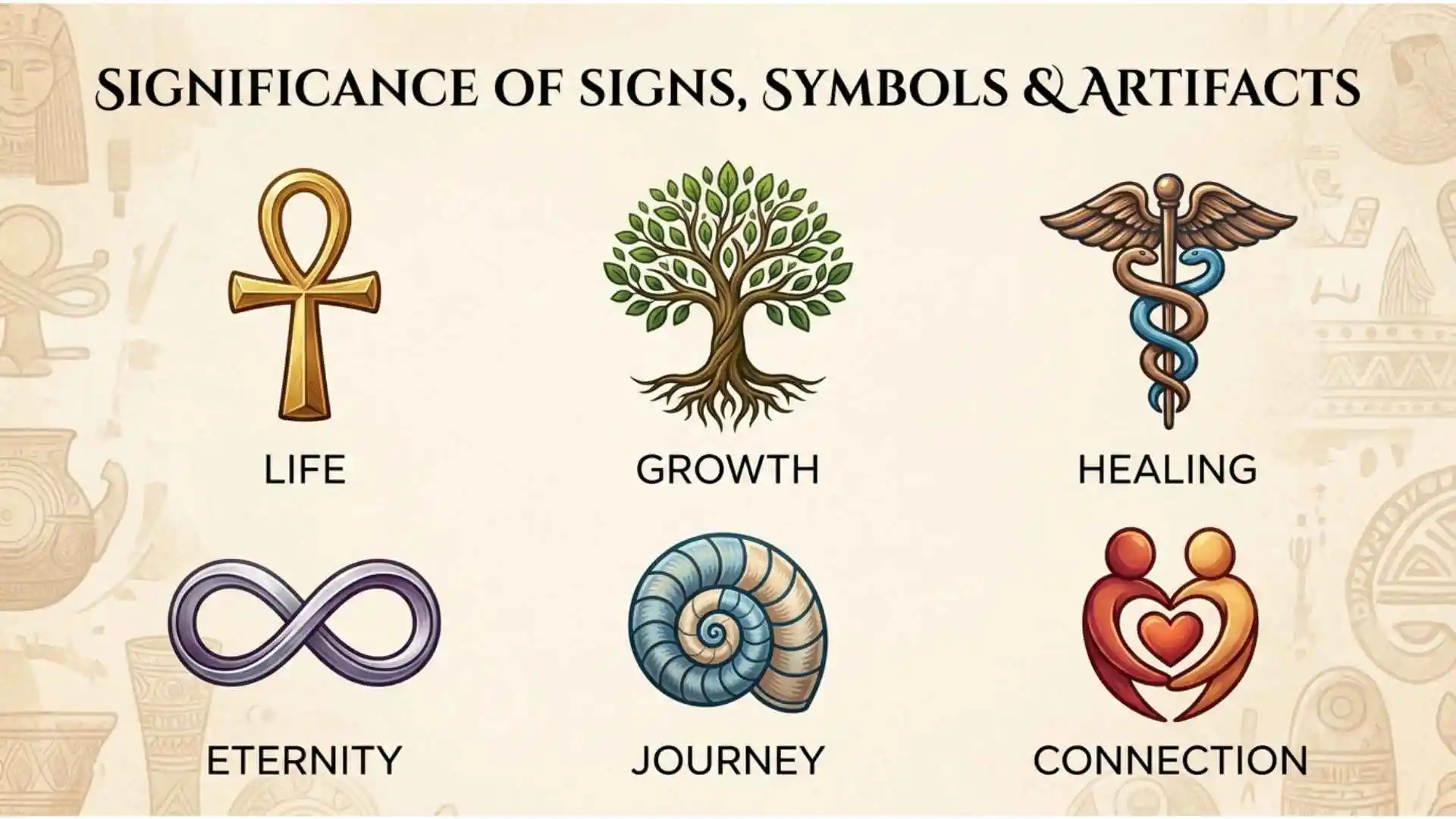
Signs, symbols, and artifacts have shaped human civilization for thousands of years. They help people communicate, express beliefs, preserve memories, and understand the world around them. From ancient cave paintings and religious objects to modern traffic signs and digital icons, these elements carry information that words alone cannot always express. They also reveal how societies developed their identities, traditions, technologies, and cultural values.
The significance of signs, symbols, and artifacts extends beyond communication. Signs provide directions and warnings, symbols represent abstract ideas and shared beliefs, and artifacts preserve physical evidence of human activity. Together, they create a valuable connection between the past and present. A national flag can express collective identity, a religious emblem can represent faith, and an ancient pottery fragment can reveal how people lived centuries ago.
Understanding these elements helps us recognize the relationship between visual communication, cultural identity, historical evidence, and material culture. Whether found in public spaces, museums, religious traditions, classrooms, or digital environments, signs, symbols, and artifacts continue to influence how people interact, learn, and remember their shared history.
What Are Signs, Symbols, and Artifacts?
Signs, symbols, and artifacts are three important elements of human communication and cultural expression. Although people sometimes use these terms interchangeably, each has a distinct meaning and purpose.
Signs communicate specific information or indicate something. Symbols represent ideas, emotions, beliefs, or identities through shared meanings. Artifacts are physical objects created or modified by humans that provide evidence of their activities, technologies, and traditions.
For example, a red traffic light tells drivers to stop. A dove commonly represents peace, while an ancient clay pot provides evidence of historical craftsmanship and daily life.
What Are Signs?
A sign is a visual, physical, or audible indicator that communicates information about something. People use signs to recognize situations, follow instructions, avoid danger, and navigate different environments.
Signs make communication faster and more accessible. A pedestrian crossing sign, for example, warns drivers about people crossing the road without requiring a lengthy written explanation.
Common examples include:
- Traffic signs and speed limit indicators.
- Emergency exit signs and fire warnings.
- Airport and railway direction markers.
- Workplace safety instructions.
- School signs and classroom labels.
- Weather indicators and warning signals.
These visual communication tools help people understand their surroundings and make informed decisions.
What Are Symbols?
A symbol is a visual representation, object, gesture, or sign that carries a meaning beyond its immediate physical appearance. Its meaning usually develops through cultural traditions, social agreements, religious beliefs, or shared experiences.
For example, a heart represents love and affection in many modern contexts. A national flag represents a country’s identity, history, and sovereignty.
Symbols can communicate complex ideas through simple visual forms. They appear in religion, mathematics, science, politics, advertising, art, and everyday communication.
Examples include:
- The peace symbol representing peace and opposition to conflict.
- A dove representing peace and hope in many traditions.
- Religious icons representing spiritual beliefs.
- Mathematical symbols expressing calculations and relationships.
- National emblems representing collective identity.
- Company logos communicating brand recognition.
What Are Artifacts?
Artifacts are physical objects made, modified, or used by humans. Archaeologists and historians examine them to understand past societies, technologies, lifestyles, and cultural practices.
Artifacts can range from simple stone tools to elaborate sculptures and ceremonial objects.
Common examples include:
- Ancient pottery and ceramic vessels.
- Coins, jewelry, and decorative objects.
- Weapons and farming tools.
- Traditional clothing and musical instruments.
- Religious objects and sacred books.
- Family heirlooms and historical photographs.
- Sculptures and architectural decorations.
According to the National Geographic Society, artifacts provide important clues about ancient cultures, particularly societies that left limited written records.
Difference Between Signs, Symbols, and Artifacts
Although signs, symbols, and artifacts often overlap, their primary functions differ. Understanding these distinctions makes their historical and cultural importance easier to recognize.
| Feature | Signs | Symbols | Artifacts |
| Basic meaning | Indicators of information | Representations of ideas | Human-made or modified objects |
| Main purpose | Inform, warn, or guide | Express meanings and beliefs | Preserve evidence of human activity |
| Common form | Visual, audible, or physical | Images, objects, gestures, or marks | Physical objects and remains |
| Meaning | Often direct or conventional | Often culturally established | Depends on use, history, and context |
| Examples | Stop signs, exit signs | Flags, hearts, religious emblems | Pottery, coins, tools |
| Main significance | Communication and safety | Identity and expression | Historical and cultural evidence |
How Signs and Symbols Overlap
A sign can also function as a symbol. For example, a national flag identifies a country while representing its history, independence, and shared identity.
Similarly, a heart-shaped image acts as a recognizable visual sign in digital communication. However, its symbolic meaning goes further by expressing affection or emotional connection.
The distinction depends on how people interpret and use a particular image or object.
How Artifacts Become Symbolic
An artifact can acquire symbolic significance through its history, ownership, cultural associations, or traditional use.
A simple wedding ring is a physical object. However, it also represents commitment, marriage, and a personal relationship.
Likewise, a ceremonial sword may serve a practical or decorative purpose while representing authority, honor, or historical heritage.
Significance of Signs, Symbols, and Artifacts in Human Civilization
Signs, symbols, and artifacts have played essential roles in the development of human societies. They allow people to exchange information, establish social relationships, preserve traditions, and transmit knowledge across generations.
Their importance becomes especially clear when we examine how communities communicate and maintain their cultural identities.
Supporting Human Communication
Communication is one of the most important reasons humans create and use signs and symbols. Visual indicators help people exchange information without depending entirely on spoken or written language.
For example, international travelers may not understand the local language at an airport. However, familiar restroom icons, baggage symbols, and directional arrows help them navigate the building.
Signs also support communication in emergencies. Fire exit indicators, hazard warnings, and evacuation instructions help people respond quickly when danger arises.
Their main communication benefits include:
- Making information easier to recognize.
- Reducing language barriers in shared spaces.
- Improving navigation and transportation.
- Supporting emergency responses.
- Helping people understand instructions quickly.
- Encouraging safer behavior in public environments.
Preserving Cultural Identity and Heritage
Cultural symbols connect people with their communities, traditions, and shared histories. National flags, traditional clothing, religious emblems, and cultural patterns often represent values that communities pass between generations.
For example, a national flag can remind citizens of independence movements, historical struggles, and important national events.
Traditional objects also preserve cultural knowledge. Handmade pottery, musical instruments, ceremonial clothing, and decorative crafts reveal the artistic skills and social practices of earlier generations.
UNESCO describes cultural heritage as a combination of physical objects, monuments, traditions, and practices passed between generations. Its cultural heritage overview explains the connection between tangible and intangible heritage.
Preserving Historical Knowledge
Artifacts provide physical evidence of human activity. Unlike written accounts, which may present only selected perspectives, material objects can reveal details about everyday life.
Archaeologists examine tools, pottery, coins, buildings, and personal belongings to understand ancient societies.
For example, pottery fragments can reveal information about food preparation, manufacturing methods, trade, and artistic styles. Ancient coins can help researchers investigate rulers, economic systems, and commercial relationships.
These discoveries make artifacts valuable sources of historical evidence and archaeological knowledge.
Expressing Beliefs and Emotions
Symbols allow people to communicate feelings and abstract ideas through recognizable forms.
A heart often represents affection, while a dove commonly communicates peace. Religious symbols may express faith, spiritual identity, devotion, or connections with sacred traditions.
These meanings can differ between communities. An image that represents hope in one cultural setting might carry a different historical or religious association elsewhere.
Therefore, understanding symbolic communication requires attention to cultural context.
Historical Significance of Signs and Symbols
The use of signs and symbols began long before modern writing systems developed. Early humans used visual markings, pigments, gestures, and objects to communicate information and express ideas.
Over time, these practices contributed to more complex forms of communication and cultural development.
Early Human Communication and Cave Paintings
Prehistoric cave paintings provide important evidence of early human visual expression. Ancient artists created images of animals, hunting scenes, human figures, and other recognizable forms on cave walls.
These paintings appear in archaeological locations such as Lascaux in France and other prehistoric sites around the world.
Their exact purposes remain debated. Researchers have suggested connections with storytelling, social practices, hunting traditions, and spiritual beliefs.
Rock markings also include petroglyphs and pictographs. Petroglyphs are images carved or engraved into rock surfaces, while pictographs use pigments to create painted designs.
The National Park Service explains that rock markings could communicate stories, mark trails, identify important places, or record cultural events.
Development of Written Language
As human societies became more complex, people developed systems for recording information through symbols.
Early writing systems allowed communities to document trade, administration, ownership, religious practices, and historical events.
Cuneiform emerged in ancient Mesopotamia and became one of the earliest known writing systems. Its wedge-shaped marks were impressed into clay tablets.
Ancient Egyptian hieroglyphs also combined visual signs with linguistic functions. Their characters represented sounds, objects, and concepts.
These developments transformed human communication by making it possible to preserve information beyond immediate conversations and personal memory.
Symbols in Ancient Civilizations
Ancient civilizations used symbols to communicate political authority, religious beliefs, social status, and cultural traditions.
For example:
- Ancient Egyptians used the ankh as a symbol associated with life.
- The Roman eagle represented imperial authority and military power.
- Ancient Greek pottery featured images connected with mythology and daily life.
- Mesopotamian cylinder seals carried distinctive images and inscriptions.
- Ancient coins displayed rulers, deities, and political messages.
These examples show how symbols became part of government, religion, commerce, and artistic expression.
Importance of Artifacts in Understanding History
Artifacts provide a direct connection to the material world of earlier societies. They help researchers investigate how people worked, traveled, traded, worshipped, created art, and organized communities.
Their importance extends beyond their age or appearance.
Revealing Ancient Lifestyles
Everyday objects often reveal more about ordinary people than grand monuments alone.
Cooking vessels, agricultural tools, clothing accessories, and household decorations provide clues about domestic activities and living conditions.
For instance, ancient farming tools can reveal agricultural practices. Pottery remains may indicate food storage and preparation methods.
Researchers also examine manufacturing techniques to understand technological development and available resources.
Understanding Trade and Economic Systems
Coins, weights, measuring tools, and imported goods help archaeologists reconstruct ancient commercial networks.
The materials used to create an artifact can also reveal where its raw materials originated.
For example, an object made from a material transported over long distances may suggest trade connections between distant communities.
Artifacts can therefore reveal:
- Commercial relationships between settlements.
- Ancient transportation routes.
- Manufacturing and craft industries.
- Economic differences between social groups.
- Access to valuable natural resources.
Preserving Personal and Collective Memories
Not all significant artifacts belong to ancient civilizations. Family photographs, inherited jewelry, handwritten letters, and personal belongings can carry considerable emotional and historical value.
A grandmother’s wedding necklace, for example, may represent family traditions and personal memories.
Similarly, photographs can preserve details about clothing, architecture, celebrations, and relationships that written records might overlook.
These objects connect individual experiences with broader collective memory and cultural identity.
Types of Signs, Symbols, and Artifacts With Real-World Examples
Signs, symbols, and artifacts appear in nearly every area of human life. Their forms and meanings change according to their purpose and cultural environment.
| Category | Examples | Main significance |
| Traffic signs | Stop signs, speed limits | Road safety and navigation |
| Emergency signs | Fire exits, evacuation arrows | Protection and emergency guidance |
| Cultural symbols | National flags, traditional patterns | Cultural identity and heritage |
| Religious symbols | Cross, crescent, Om | Faith and spiritual expression |
| Everyday symbols | Hearts, doves, restroom icons | Communication and recognition |
| Educational symbols | Mathematical signs, map symbols | Learning and information sharing |
| Digital symbols | Emojis, app icons, hashtags | Online communication |
| Commercial symbols | Brand logos, product marks | Business identity and recognition |
| Historical artifacts | Pottery, coins, ancient tools | Archaeological and historical evidence |
| Personal artifacts | Family photographs, heirlooms | Memories and family history |
| Ceremonial artifacts | Ritual objects, traditional instruments | Cultural and religious practices |
Role of Signs and Symbols in Modern Society

Although signs and symbols have ancient origins, they remain essential in modern communication systems. Technology, transportation, education, healthcare, and commercial industries all depend on recognizable visual information.
Digital Communication and Social Media
Digital platforms use icons and symbols to make complicated interfaces easier to understand.
A magnifying glass commonly represents search, a bell indicates notifications, and a shopping cart represents items selected for purchase.
Emojis also help people communicate emotions and reactions in text-based conversations.
For example, a smiling face can express happiness, while a heart emoji may communicate affection or appreciation.
Hashtags organize social media content around shared topics. Meanwhile, app icons help users recognize applications without reading their full names.
Education and Learning
Educational symbols make abstract information easier to understand.
Mathematical signs such as plus, minus, and equal symbols communicate relationships between numbers. Scientific diagrams represent processes that may be difficult to explain through text alone.
Maps use symbols to identify roads, buildings, rivers, boundaries, and geographical features.
Teachers also use visual labels, diagrams, and classroom signs to organize learning environments.
These methods support visual learning, information processing, observation skills, and problem-solving abilities.
Business, Branding, and Marketing
Businesses use logos, product symbols, and brand marks to establish recognizable identities.
A well-designed logo helps customers distinguish one company from another. Over time, people may associate its colors, shapes, and typography with particular products or experiences.
Brand symbols also communicate values and positioning. Some emphasize reliability, others suggest creativity, luxury, or environmental responsibility.
However, a logo’s meaning depends on brand reputation and public interpretation. Visual design alone cannot guarantee trust.
Public Safety and Navigation
Signs are essential for organizing transportation and public environments.
Traffic signals coordinate vehicles and pedestrians, while warning signs identify hazards. Airports, hospitals, schools, and workplaces use directional markers to guide visitors and employees.
Without consistent visual communication systems, public spaces would become harder to navigate and manage.
Psychological and Behavioral Significance of Symbols
Symbols influence how people recognize information, remember experiences, and respond to their surroundings.
A familiar visual indicator can communicate an idea faster than a detailed explanation. This makes symbols particularly useful in environments where people need to make quick decisions.
Supporting Memory and Recognition
People often associate particular images with familiar experiences and information.
For example, a school emblem may remind former students of their education and friendships. A family photograph can bring back memories of important occasions.
These emotional connections give certain objects and symbols personal significance.
Influencing Human Behavior
Signs can guide actions by communicating expectations and possible risks.
A slippery floor warning encourages people to walk carefully. A speed limit sign tells drivers the maximum permitted speed under the relevant road rules.
Symbols also influence social behavior through shared cultural expectations. Religious emblems, national flags, and ceremonial objects can encourage feelings of belonging and collective responsibility.
Creating Emotional Connections
Some artifacts hold value because of the memories and relationships attached to them.
A handwritten letter may have little financial worth but immense personal importance. Similarly, an inherited family object can connect younger generations with relatives they never met.
This emotional dimension explains why people preserve certain objects even when they no longer serve a practical purpose.
Cultural Differences in the Meaning of Signs and Symbols
Not every symbol carries the same meaning across cultures. Interpretation depends on historical experiences, religious traditions, social practices, and local conventions.
For example, color symbolism varies widely. White represents purity or weddings in some cultural settings, while it is associated with mourning in others.
Gestures can also carry different meanings depending on location. A movement considered friendly in one country may appear rude or inappropriate elsewhere.
Even familiar images require cultural understanding.
The Library of Congress recommends consulting multiple references when identifying unfamiliar symbols because interpretations can differ between sources.
When studying cultural symbols, consider:
- Their historical background.
- The community that created or adopted them.
- Their religious or traditional associations.
- Their original purpose.
- Changes in meaning over time.
- Differences between local and international interpretations.
This approach prevents misunderstandings and encourages greater cultural awareness.
Preservation of Signs, Symbols, and Historical Artifacts
Preserving cultural objects and symbolic traditions helps communities maintain connections with their past.
However, artifacts can deteriorate through exposure to moisture, sunlight, pollution, temperature changes, and careless handling.
Historical sites may also suffer damage from construction, natural disasters, conflict, and unauthorized excavation.
Importance of Museums and Archaeological Conservation
Museums preserve artifacts through controlled storage, careful handling, documentation, and restoration.
Archaeologists also record the exact location and surrounding conditions of discoveries. This information is essential because an artifact’s meaning depends heavily on its archaeological context.
The National Park Service’s explanation of archaeological context highlights how chronological, geographical, historical, and cultural information helps researchers interpret archaeological resources.
Preservation efforts include:
- Maintaining suitable temperature and humidity.
- Protecting objects from direct sunlight.
- Using appropriate cleaning and conservation methods.
- Recording archaeological discoveries accurately.
- Digitally documenting fragile objects.
- Protecting historical monuments and cultural sites.
- Respecting the rights and knowledge of descendant communities.
Protecting Living Cultural Traditions
Cultural preservation involves more than storing physical objects in museums.
Traditional crafts, ceremonies, languages, music, and symbolic practices also require protection.
Communities preserve these traditions through education, storytelling, cultural events, and intergenerational learning.
When communities actively maintain their traditions, they help ensure that cultural knowledge remains meaningful rather than becoming disconnected from everyday life.
Challenges in Understanding the Meaning of Signs, Symbols, and Artifacts
Interpreting historical and cultural objects is not always straightforward. Some objects have clear purposes, while others contain meanings that remain uncertain.
Archaeologists and historians must examine available evidence carefully rather than assume every object has one fixed interpretation.
Several challenges influence this process.
Loss of historical context: An object separated from its original location may lose important clues about its use and meaning.
Cultural differences: Modern researchers may misunderstand symbols created by societies with different beliefs and traditions.
Physical deterioration: Weather, pollution, and aging can damage inscriptions, images, and decorative features.
Incomplete historical records: Some communities left limited written documentation, making interpretation more difficult.
Changing meanings: Symbols can develop new associations as political, religious, and social conditions change.
For these reasons, responsible interpretation combines archaeological evidence, historical records, scientific analysis, and community knowledge.
Why Signs, Symbols, and Artifacts Matter Today
Signs, symbols, and artifacts remain important because they connect practical communication with cultural expression and historical understanding.
Their influence appears in everyday situations, from following a road sign to recognizing a national emblem or preserving a family heirloom.
They also help modern societies understand earlier generations. Historical artifacts reveal technological achievements, while cultural symbols preserve traditions and collective identities.
Their continuing importance can be summarized through several key contributions:
- Communication: Signs and symbols make information easier to share.
- Safety: Warning indicators help people recognize and avoid hazards.
- Identity: Cultural symbols express community and national belonging.
- History: Artifacts preserve physical evidence of human activity.
- Education: Visual representations simplify complex information.
- Memory: Personal and historical objects preserve important experiences.
- Technology: Digital icons make modern interfaces easier to navigate.
- Cultural preservation: Traditional objects and practices connect generations.
Ultimately, these elements help people understand both their immediate surroundings and the broader history of human civilization.
Frequently Asked Questions
What is the significance of signs, symbols, and artifacts?
Signs, symbols, and artifacts are important because they support communication, preserve cultural identity, and provide evidence of human history. Signs guide behavior, symbols represent shared ideas, and artifacts reveal how earlier societies lived and developed.
Why are signs and symbols important in human civilization?
Signs and symbols make communication easier and help people express information, beliefs, and emotions. They also support transportation, education, religious practices, social organization, and cultural identity.
What is the difference between signs and symbols?
Signs generally communicate information or indicate something specific. Symbols represent broader ideas, values, or concepts through shared cultural meanings. For example, a road warning sign indicates danger, while a dove commonly symbolizes peace.
Why are artifacts important in history?
Artifacts provide physical evidence of past human activities. Archaeologists examine pottery, coins, tools, clothing, and other objects to understand ancient technology, trade, lifestyles, and cultural traditions.
What are examples of symbolic artifacts?
Symbolic artifacts include national flags, religious objects, ceremonial clothing, traditional jewelry, family heirlooms, and commemorative monuments. These objects carry meanings connected with identity, beliefs, history, and personal memories.
How do signs and symbols influence everyday life?
They help people navigate public spaces, recognize information, follow instructions, and communicate emotions. Traffic signs, restroom icons, digital notifications, and product logos are common everyday examples.
How do museums preserve historical artifacts?
Museums preserve artifacts through careful handling, controlled storage environments, conservation treatments, documentation, and suitable display methods. These practices help protect objects for future research and public education.
Why do symbols have different meanings across cultures?
Symbols develop through local histories, religious beliefs, traditions, and social experiences. Consequently, the same color, gesture, or image may communicate different ideas in different cultural settings.
Conclusion
The significance of signs, symbols, and artifacts lies in their ability to connect communication, identity, history, and cultural heritage. Signs help people understand their surroundings, symbols express shared beliefs and abstract ideas, and artifacts preserve physical evidence of human achievements and experiences.
From prehistoric cave paintings to modern digital icons, these elements demonstrate how people have developed increasingly sophisticated ways to communicate and preserve knowledge. They also reveal the traditions, technologies, relationships, and values that have shaped different societies.
Protecting and understanding signs, symbols, and artifacts allows future generations to learn from the past while appreciating cultural diversity in the present. Their importance reaches far beyond their appearance because each one can carry information, memories, and meanings that help explain the human experience.

I am Lisa Reynolds, a linguist fascinated by the ever-changing world of slang. I enjoy researching how slang reflects trends, technology, and social connections. I wrote “Text Talk: Understanding Digital Slang” and “From Street to Screen: Slang in Media”, exploring the influence of digital communication on language. I love sharing my discoveries in a way that feels like a conversation with friends, so you feel the culture and humor behind every phrase.
 John Carter