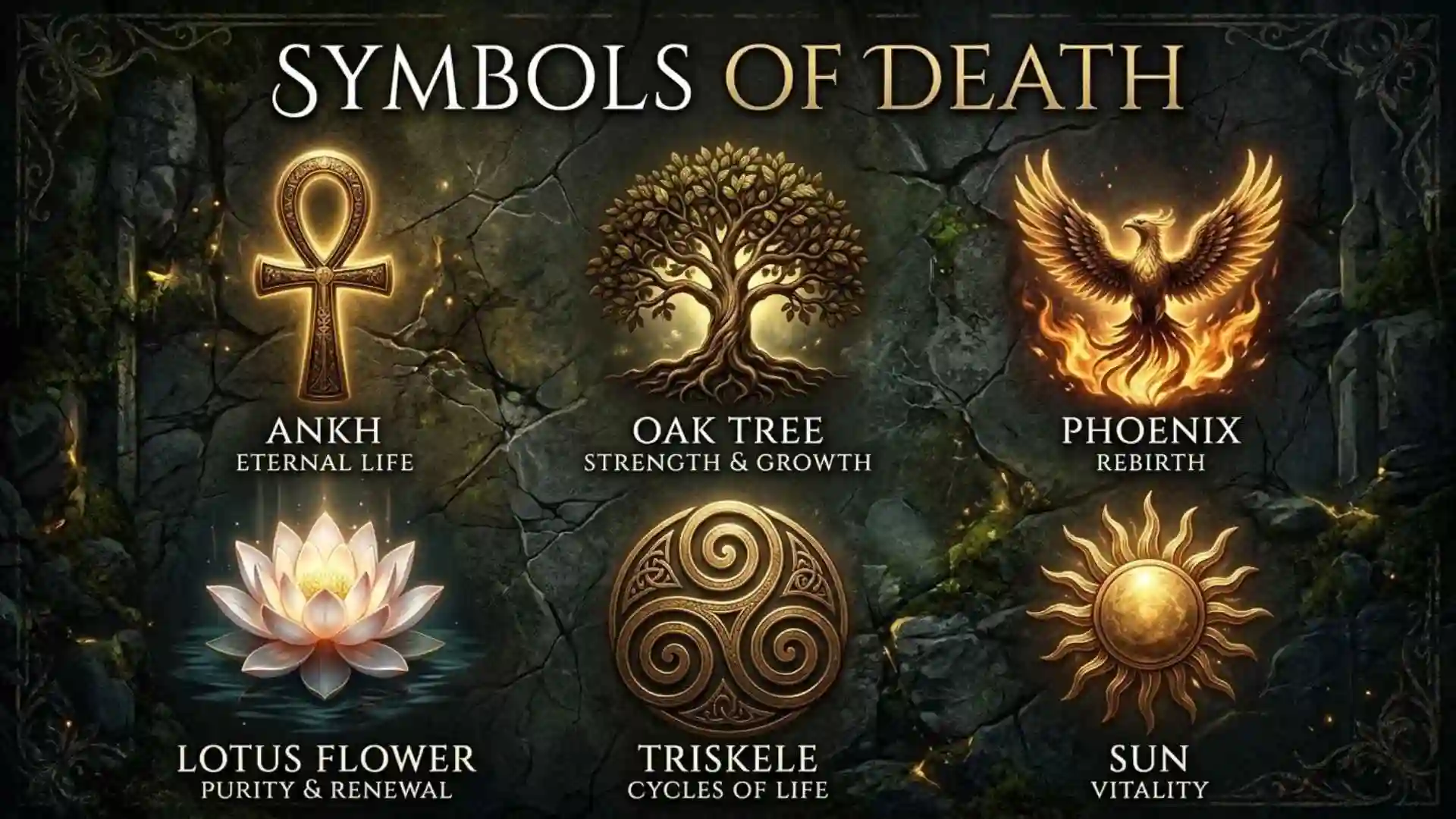
Death has fascinated, frightened, and inspired humanity for thousands of years. Across civilizations, people have used objects, animals, flowers, colors, and religious imagery to express what words often cannot. A skull may remind us of mortality while a white lily represents peace and remembrance. Meanwhile, an ancient Egyptian ankh points toward eternal life rather than death itself.
The symbols of death carry meanings that reach far beyond physical endings. Some represent grief and mourning. Others express spiritual journeys, resurrection, transformation, or the hope of an afterlife. Their meanings also change depending on cultural beliefs, religious traditions, and historical periods.
From the Grim Reaper and hourglass to ravens, marigolds, and ancient Egyptian symbols, each image tells a different story. Understanding these connections helps you recognize why certain symbols appear in funerals, memorials, artwork, tattoos, and traditional celebrations.
This guide explores more than 100 death symbols and their meanings, including their historical origins, cultural significance, spiritual associations, and modern interpretations. It also explains why no single symbol represents death in exactly the same way around the world.
What Are Symbols of Death?
Symbols of death are objects, images, colors, animals, flowers, or figures that represent mortality, dying, mourning, or beliefs about existence after death. People use them to communicate ideas about life’s temporary nature and the mysteries surrounding human existence.
Some symbols have direct connections to death. A coffin, grave, or human skull immediately suggests physical mortality. Others represent related ideas, such as remembrance, resurrection, spiritual transformation, or the passage of time.
For example, an hourglass represents the limited time available during life. A phoenix symbolizes destruction followed by renewal. Although both relate to mortality, they communicate very different messages.
Death symbolism generally falls into several categories:
- Mortality: Symbols that remind people that life eventually ends.
- Mourning: Images associated with grief, funerals, and personal loss.
- Remembrance: Objects used to honor deceased relatives, friends, or historical figures.
- Afterlife: Religious and spiritual representations of existence beyond physical death.
- Rebirth: Symbols representing renewal, resurrection, or transformation.
- Transition: Images suggesting movement from one stage of existence to another.
The same object can also represent multiple ideas. A candle, for instance, may symbolize a life that has ended, a prayer for the deceased, or hope for spiritual peace.
100+ Symbols of Death and Their Meanings
The following symbols represent different aspects of death across history, mythology, religion, nature, and modern culture. Their interpretations are not universal. Each explanation identifies the most relevant historical or cultural associations.
Objects and Images That Symbolize Death
Physical objects often provide the most recognizable images of death. From ancient burial objects to modern memorial decorations, these items help people express mortality and remember the deceased.
Human Skull
The human skull is among the most recognizable symbols of mortality. It represents physical death, human fragility, and the temporary nature of earthly life.
Historically, skulls appeared in religious paintings, philosophical artwork, and funeral objects. European artists frequently used them in memento mori imagery to remind viewers that wealth, beauty, and social status cannot prevent death.
Today, skulls also appear in tattoos, fashion, military insignia, and popular culture. Depending on the design, they may represent danger, courage, rebellion, or acceptance of mortality.
Skeleton
A skeleton represents the physical remains of a human body after death. Its exposed bones communicate the unavoidable reality that everyone shares the same basic human structure.
In medieval European artwork, skeletons often appeared in the Dance of Death, where figures from different social classes encountered death. The imagery reminded audiences that kings, merchants, farmers, and religious leaders faced the same fate.
Skeletons also appear in Halloween decorations and Gothic artwork. In these settings, they often represent mortality mixed with mystery or dark humor.
Grim Reaper
The Grim Reaper personifies death as a hooded figure carrying a scythe. Artists commonly depict him as a skeleton wearing a dark robe.
His appearance became especially recognizable through late medieval European death imagery. The Black Death and repeated outbreaks of plague made mortality a major subject in European art and literature.
The Grim Reaper represents:
- The inevitability of death.
- The end of human life.
- The passage from life to death.
- The uncertainty surrounding mortality.
- The equal power of death over different social classes.
He remains popular in horror films, video games, literature, tattoos, and Halloween decorations.
Scythe
A scythe is a traditional agricultural tool used to cut grass and harvest crops. In death imagery, it represents the Grim Reaper’s power to end human life.
The connection comes from an agricultural metaphor: just as a farmer harvests crops when they reach maturity, death eventually claims every human life.
The scythe therefore symbolizes mortality, endings, and the unavoidable passage of time.
Hourglass
An hourglass represents time passing and the limited duration of human life. As sand moves from the upper chamber to the lower one, it creates a visual reminder that time cannot be recovered.
In historical memento mori artwork, hourglasses frequently appeared alongside skulls, extinguished candles, and decaying objects.
A nearly empty hourglass can suggest approaching death. An hourglass tattoo may instead represent awareness of time, personal change, or the importance of living meaningfully.
Coffin
A coffin represents burial and the physical end of human life. It is one of the clearest death-related symbols because of its direct connection with funeral ceremonies.
Coffins appear in many burial traditions, although their designs and materials differ considerably. Some cultures use elaborate wooden coffins while others prefer simpler burial containers.
In artwork, coffins often communicate finality, loss, and the separation between the living and the deceased.
Tombstone
A tombstone represents death, remembrance, and the preservation of someone’s identity after life ends.
Traditional grave markers often include a person’s name, birth date, death date, religious imagery, and a short inscription. These details transform a physical marker into a lasting memorial.
Tombstones can also reflect social history. Their shapes, inscriptions, and decorations reveal religious beliefs, family relationships, artistic preferences, and changing funeral customs.
Grave
A grave symbolizes burial, mourning, and the physical resting place of a deceased person.
Beyond its practical purpose, a grave represents the connection between the living and those who have passed away. Families often visit graves to leave flowers, clean memorials, pray, or reflect on personal memories.
In literature and visual art, graves can also represent forgotten history, separation, and the temporary nature of human existence.
Funeral Bell
A funeral bell traditionally announces death or signals the beginning of a funeral service. In some Christian communities, church bells historically marked a person’s death and called the community together.
Its sound creates a solemn atmosphere associated with mourning and remembrance.
Funeral bells also appear in literature and music as reminders of mortality and the passing of human life.
Funeral Candle
A funeral candle symbolizes remembrance, prayer, spiritual guidance, and hope.
In Christian traditions, candles frequently appear during funeral services, memorial prayers, and religious ceremonies. Their light can represent Christ, faith, and hope beyond physical death.
In other settings, lighting a candle offers a personal way to remember someone who has died.
Ashes
Ashes represent physical remains, mortality, cremation, and transformation.
The phrase “ashes to ashes” appears in Christian funeral language and draws attention to the temporary nature of the human body. Ashes also carry religious significance in other traditions.
For example, Hindu cremation practices traditionally treat the body’s remains as part of a broader cycle of life, death, and spiritual existence.
Urn
An urn represents cremation, remembrance, and the preservation of human remains.
Families may keep cremated remains in decorative urns, place them in memorial spaces, or use specially designed containers for burial. The urn becomes both a physical vessel and a personal reminder of someone who has died.
Empty Chair
An empty chair symbolizes absence and the emotional space left behind after someone dies.
This image appears in photography, literature, memorial artwork, and personal remembrance. A chair that once belonged to a loved one can represent their absence more powerfully than elaborate funeral imagery.
Cemetery Gate
A cemetery gate can represent the boundary between the living world and the resting place of the dead.
Historical cemeteries sometimes feature gates with religious symbols, ironwork, angels, or inscriptions. In symbolic artwork, a gate may suggest separation, transition, or entry into an unknown spiritual realm.
Memento Mori
Memento mori is a Latin expression meaning “remember that you must die.”
It refers to artistic objects and philosophical reminders of human mortality. European artists used skulls, clocks, hourglasses, decaying flowers, and extinguished candles to communicate this idea.
The purpose wasn’t simply to create frightening images. Memento mori encouraged people to recognize life’s limitations and consider how they spent their time.
Today, the concept appears in jewelry, tattoos, paintings, books, and philosophical discussions about mortality.
Animals That Symbolize Death
Animals have played important roles in death symbolism across mythology, religion, and folklore. Some became associated with death because of their nighttime habits or scavenging behavior. Others gained symbolic meanings through religious stories and traditional beliefs.
Raven
The raven is associated with death, prophecy, wisdom, and mystery in several cultural traditions.
Its black feathers, scavenging behavior, and presence around battlefields contributed to its connection with mortality in European folklore.
However, ravens aren’t exclusively negative symbols. In Norse mythology, Odin’s ravens Huginn and Muninn represented thought and memory. In other traditions, ravens appear as creators, guides, or messengers.
Crow
The crow often represents death, mystery, transformation, and omens in folklore.
Its dark appearance and ability to survive in varied environments made it a common figure in supernatural stories. European literature frequently uses crows to create an atmosphere of uncertainty or impending danger.
However, crow symbolism differs significantly across cultures. A crow may represent intelligence, adaptability, or spiritual significance rather than death alone.
Owl
The owl symbolizes wisdom, darkness, mystery, and sometimes death.
In ancient Greek mythology, the owl was associated with Athena, the goddess of wisdom. By contrast, some folklore traditions connect nighttime owl calls with death omens or supernatural activity.
These differences demonstrate why animals associated with death should always be understood within their cultural settings.
Vulture
The vulture has an unusual relationship with death because it feeds on deceased animals.
Although this behavior can create negative associations, vultures also play an important ecological role. They remove carcasses and help limit the spread of certain diseases.
In some ancient religious traditions, vultures also carried positive meanings connected with protection, purification, and maternal care.
Jackal
The jackal has a strong connection with ancient Egyptian funerary symbolism.
Its association comes partly from the behavior of wild canids around desert burial grounds. Ancient Egyptians connected these animals with Anubis, a god associated with embalming and protection of the dead.
The jackal therefore represents funerary care and the protection of deceased people rather than simply destruction.
Black Cat
The black cat symbolizes mystery, superstition, witchcraft, and supernatural imagery in parts of European folklore.
During certain historical periods, people associated black cats with witches and misfortune. These beliefs contributed to their continued appearance in Halloween decorations and horror stories.
However, black cats also hold positive meanings in different cultures. They can symbolize good fortune, protection, or prosperity.
Serpent
The serpent represents death, rebirth, transformation, and renewal in many symbolic traditions.
Its ability to shed its skin makes it a natural image of regeneration. In religious and mythological stories, however, serpents can also represent danger, temptation, healing, wisdom, or destruction.
The serpent’s connection with both life and death makes it one of the most complex symbols of transition.
Bat
The bat is associated with nighttime, darkness, mystery, and supernatural folklore.
Its nocturnal habits and unusual appearance helped establish its connection with vampires, ghosts, and Gothic imagery in Western popular culture.
In Chinese symbolism, however, bats can represent good fortune and happiness. The meaning depends heavily on the cultural context.
Butterfly
A butterfly commonly represents transformation, renewal, and the soul.
Its life cycle provides a natural metaphor for change: a caterpillar becomes a chrysalis before emerging as a butterfly. Some religious and spiritual traditions interpret this transformation as an image of spiritual passage or life beyond death.
Butterflies are also used in memorial artwork to express love, remembrance, and hope.
Banshee
The banshee is a supernatural female figure in Irish folklore traditionally associated with death.
Stories describe her mournful cry as an announcement that someone from a particular family will soon die. The figure reflects traditional Irish beliefs about spirits, ancestry, and death omens.
The banshee is primarily a folklore figure rather than a universal symbol of death.
Flowers That Symbolize Death and Mourning
Flowers carry powerful meanings in funeral ceremonies and memorial traditions. Their colors, seasonal cycles, and cultural associations allow people to express grief, sympathy, love, and remembrance.
White Lily
The white lily represents purity, peace, innocence, and remembrance in many Christian and Western funeral traditions.
Its elegant appearance and association with spiritual purity make it a common funeral flower. White lilies often appear in sympathy arrangements and memorial services.
They can also represent hope and the belief in life beyond physical death.
Black Rose
The black rose symbolizes mourning, tragic love, loss, mystery, and endings in modern symbolic interpretations.
Naturally occurring roses don’t produce a true black color. Most commercially available black roses are extremely dark red or purple varieties, or flowers that have been dyed.
Black roses appear frequently in Gothic artwork, tattoos, poetry, and alternative fashion. Their meaning depends on the person using them.
Chrysanthemum
The chrysanthemum has important funeral and memorial associations in several countries.
In France, white chrysanthemums are strongly connected with All Saints’ Day and cemetery visits. In Japan, chrysanthemums have associations with death and funerary practices, although the flower also carries positive imperial and national symbolism.
This is an excellent example of how one flower can carry several meanings within the same culture.
Marigold
The marigold is one of the most recognizable flowers associated with Mexico’s Día de los Muertos.
Known in Spanish as cempasúchil, the flower is traditionally placed on ofrendas and around memorial spaces. Its bright orange and yellow colors create a welcoming atmosphere during remembrance celebrations.
Marigolds represent ancestral remembrance and the continuing connection between living family members and deceased relatives.
Red Poppy
The red poppy symbolizes remembrance and sacrifice, particularly in connection with military personnel who died during war.
Its association with World War I grew from the appearance of poppies across battlefields in Flanders. The flower became an enduring emblem of remembrance in countries including the United Kingdom, Canada, and Australia.
White Poppy
The white poppy represents peace and opposition to war.
Unlike the red poppy’s focus on remembrance of military sacrifice, the white poppy emphasizes nonviolence, peaceful conflict resolution, and the human cost of war.
Forget-Me-Not
The forget-me-not represents lasting love, memory, and remembrance.
Its name makes it especially meaningful in memorial artwork and sympathy arrangements. People often use it to express the desire to keep a deceased person’s memory alive.
Cypress Tree
The cypress tree has long-standing connections with mourning and cemeteries in Mediterranean and European traditions.
Its tall, evergreen form makes it a fitting symbol of endurance and remembrance. Cypress trees appear in historical burial grounds and cemetery landscapes across parts of Europe and the Mediterranean.
Colors Associated With Death and Mourning
Colors communicate powerful emotional and cultural meanings. However, death-related colors differ considerably between societies.
| Color | Common symbolic associations | Cultural context |
| Black | Death, mourning, grief, solemnity | Common in Western mourning traditions |
| White | Mourning, purity, spiritual transition | Used in several Asian funeral traditions |
| Gray | Sorrow, seriousness, loss | Modern artistic interpretations |
| Purple | Religious devotion, penitence, reflection | Christian religious settings |
| Red | Bloodshed, sacrifice, martyrdom | Religious and historical imagery |
| Dark blue | Sorrow, solemnity, reflection | Artistic and modern associations |
| Silver | Moonlight, mystery, spiritual imagery | Contemporary symbolic interpretations |
Black: The Traditional Color of Mourning
Black is one of the most widely recognized symbols of mourning in Western societies.
Its association with funeral clothing developed through changing European customs. During the Victorian period, mourning dress became especially formal, with detailed rules governing clothing and accessories.
Black remains common at funerals because it communicates seriousness, respect, and grief.
White: Purity and Mourning
White has a very different meaning in many Asian mourning traditions.
In countries such as China and Japan, white has historically appeared in funeral clothing and mourning practices. It can represent purity, spiritual transition, and the separation between earthly life and death.
In Western Christian traditions, white more commonly communicates purity, peace, and resurrection.
Purple: Spiritual Reflection
Purple carries religious associations with penitence, sacrifice, and solemn reflection.
In Christianity, purple appears during certain liturgical seasons, including Lent and Advent. It may also appear in religious mourning settings.
Its connection with death often comes through religious practice rather than a universal funeral custom.
Red: Blood and Sacrifice
Red represents blood, violence, sacrifice, and martyrdom in many religious and historical images.
It may appear in artwork depicting war, executions, or religious suffering. In some cultures, however, red represents happiness and prosperity.
Gray: Sorrow and Loss
Gray commonly communicates sadness, uncertainty, and emotional heaviness in modern artistic imagery.
It often appears in photography and paintings depicting cemeteries, abandoned places, and memories of loss.
Its connection with mourning is largely contextual rather than a fixed historical funeral tradition.
Religious and Spiritual Symbols of Death
Religious traditions use symbols to explain death, the soul, resurrection, and what may happen after physical life ends. Some focus on salvation and eternal life. Others emphasize rebirth, spiritual development, or the continuation of existence.
Christian Cross
The Christian cross represents the crucifixion of Jesus Christ, sacrifice, salvation, and the promise of resurrection.
Although the cross depicts an instrument of execution, Christianity gives it a deeper meaning through the belief that Jesus overcame death. Consequently, it represents both death and hope for eternal life.
You’ll commonly find crosses on:
- Christian gravestones.
- Funeral programs and memorial cards.
- Church monuments.
- Religious jewelry.
- Cemetery memorials.
Ankh
The ankh is an ancient Egyptian hieroglyph representing life. Its distinctive shape resembles a cross with an oval loop above the horizontal arms.
Although people sometimes classify it among ancient death symbols, its primary meaning concerns life, vitality, and eternal existence.
Ancient Egyptian artwork frequently shows gods holding ankhs or offering them to kings. The symbol also appears in funerary artwork, where it connects with the hope of continued life after death.
The ankh therefore represents the relationship between mortality and eternal life rather than death alone.
Egyptian Scarab
The scarab beetle symbolizes renewal, regeneration, and rebirth in ancient Egyptian religion.
Its association with the sun came from the beetle’s behavior of rolling balls of dung across the ground. Ancient Egyptians connected this movement with the sun’s daily journey across the sky.
Funerary scarab amulets sometimes carried protective religious inscriptions. Heart scarabs were especially important in burial practices because they related to the deceased person’s judgment in the afterlife.
The scarab represents the possibility of renewal after death.
Empty Tomb
The empty tomb is one of Christianity’s most important symbols of resurrection.
According to the New Testament, Jesus’ tomb was found empty after his crucifixion. Christians interpret this event as evidence of his resurrection and victory over death.
In Christian artwork, the empty tomb communicates:
- Resurrection.
- Eternal life.
- Victory over sin and death.
- Hope beyond physical existence.
- God’s promise of salvation.
Unlike a traditional grave, its symbolic message focuses on life after death.
Dove
The dove represents peace, hope, purity, and the Holy Spirit in Christian symbolism.
Although it isn’t primarily a death symbol, doves frequently appear in funeral artwork and memorial decorations. Their presence can communicate the hope that a deceased person has found peace.
A flying dove may also represent spiritual freedom or the soul’s journey in modern memorial imagery.
Angel
An angel symbolizes divine protection, spiritual guidance, and the relationship between heaven and humanity.
Cemetery sculptures often depict angels praying, holding trumpets, pointing toward heaven, or protecting graves. These images reflect religious beliefs about divine care and the afterlife.
An angel holding a trumpet may refer to resurrection and the final judgment in Christian tradition. A praying angel usually communicates devotion, mourning, and hope.
Praying Hands
Praying hands represent faith, devotion, spiritual comfort, and remembrance.
On gravestones and memorial monuments, they often communicate a family’s continuing prayers for someone who has died.
They can also symbolize acceptance, religious hope, and the belief that death does not end a person’s relationship with God.
Lotus Flower
The lotus flower represents spiritual purity, awakening, renewal, and enlightenment in Hindu and Buddhist traditions.
Its ability to grow from muddy water while producing a beautiful flower makes it a powerful image of spiritual development.
In Buddhist teachings, the lotus often represents the possibility of awakening despite suffering and impermanence. In Hindu traditions, it also appears in divine imagery associated with creation and spiritual purity.
The lotus can therefore symbolize transformation after suffering rather than physical death itself.
Wheel of Samsara
The Wheel of Samsara represents the continuing cycle of birth, death, and rebirth in Hinduism, Buddhism, and other Indian religious traditions.
The concept of samsara describes existence as a cycle shaped by karma and attachment. Beings experience repeated births and deaths until they achieve liberation according to their respective religious teachings.
In Buddhism, the Wheel of Life, or Bhavachakra, visually explains samsara and the forces that keep beings trapped in suffering.
This symbol represents death as part of a larger cycle rather than a final endpoint.
Yama
Yama is a deity associated with death and the afterlife in Hindu traditions. He also appears in Buddhist traditions in different roles and interpretations.
Hindu mythology commonly presents Yama as the ruler or judge of the dead. He is associated with moral responsibility and the consequences of human actions.
His image may include a buffalo, a noose, or a staff. These objects reinforce his authority over death and the journey of deceased souls.
Ancient Symbols Associated With Death and the Afterlife
Ancient civilizations developed elaborate beliefs about death and what followed it. Their burial objects, religious figures, and monuments reveal how they understood the human body, soul, and afterlife.
Anubis
Anubis was an ancient Egyptian deity associated with embalming, mummification, cemeteries, and the protection of the dead.
Artists typically portrayed him with a human body and a black jackal head. The jackal’s association with desert burial grounds helped establish this distinctive appearance.
Anubis played an important role in Egyptian funerary beliefs. He was associated with the weighing of the heart, a judgment scene in which the deceased person’s heart was compared with the feather of Ma’at.
His symbolism focuses on protecting the dead and preparing them for the afterlife.
Osiris
Osiris was an ancient Egyptian god associated with the dead, resurrection, fertility, and the underworld.
According to Egyptian mythology, Osiris was murdered by his brother Set and restored through the efforts of Isis. His story became an important model for ideas about death and renewal.
Egyptian funerary traditions connected Osiris with the hope that deceased people could experience renewed existence.
He represents resurrection, regeneration, and life beyond physical death.
Eye of Horus
The Eye of Horus is an ancient Egyptian symbol of protection, healing, restoration, and well-being.
According to mythology, Horus lost an eye during his conflict with Set. The eye was restored through divine intervention and became a powerful symbol of recovery.
The symbol sometimes appears in funerary objects and protective amulets. However, its primary meaning concerns protection and restoration rather than death.
Canopic Jars
Canopic jars were containers used during ancient Egyptian mummification to hold organs removed from the deceased.
Traditionally, four jars were associated with the sons of Horus:
- Imsety: Associated with the liver.
- Hapy: Associated with the lungs.
- Duamutef: Associated with the stomach.
- Qebehsenuef: Associated with the intestines.
Their presence in tombs reflected Egyptian beliefs about preserving the body and protecting the deceased for the afterlife.
Mummy
A mummy represents preservation, burial, and preparation for existence after death in ancient Egyptian culture.
Egyptians believed that preserving the physical body helped support the deceased person’s continued existence. Embalming and wrapping the body therefore became important parts of elite funerary practices.
Mummies are among the most recognizable representations of ancient Egyptian death symbolism. They also reveal how seriously ancient Egyptians treated burial rituals and the afterlife.
Obelisk
An obelisk is a tall, four-sided stone monument with a pyramid-shaped top.
Ancient Egyptians associated obelisks with the sun god Ra and solar power. Their religious meaning was therefore not limited to death.
However, obelisks later became popular in memorial architecture. They appear in cemeteries, public monuments, and military memorials as symbols of remembrance and lasting honor.
Greek Burial Coin
The Greek burial coin, traditionally called Charon’s obol, was an offering associated with the journey of the dead.
According to ancient Greek belief, Charon transported deceased souls across the rivers separating the world of the living from the underworld.
Some burials included a coin placed in the mouth or on the body of the deceased. This practice reflected beliefs about providing payment for passage.
Archaeological evidence shows variations in the placement and use of these coins. Not every ancient Greek burial followed the same custom.
Pomegranate
The pomegranate represents fertility, abundance, the underworld, and seasonal renewal in ancient Greek mythology.
Its strongest connection with death comes from the story of Persephone. After eating pomegranate seeds in the underworld, she became connected to Hades and the seasonal cycle of returning to the world above.
The fruit therefore symbolizes the relationship between life, death, separation, and renewal.
Mythological Figures Associated With Death
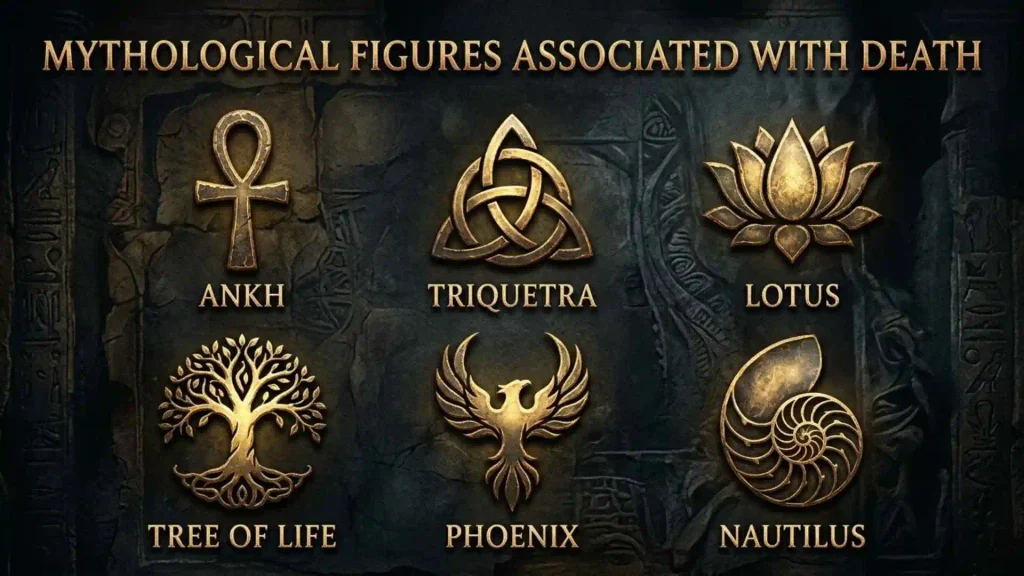
Mythologies often give death a recognizable face. Gods, guardians, and supernatural beings explain what happens to souls and how people cross the boundary between life and death.
Hades
Hades is the Greek god who rules the underworld.
He governs the realm of the dead rather than representing death itself. This distinction matters because Greek mythology treats Hades and Thanatos as separate figures.
His name also became associated with the underworld itself. Myths about Persephone, Cerberus, and Charon further develop his connection with the world of deceased souls.
Thanatos
Thanatos is the Greek personification of death.
Unlike Hades, who rules the underworld, Thanatos represents the actual experience or arrival of death. Ancient Greek literature sometimes describes him as a winged figure.
He symbolizes the final separation between physical life and death.
Charon
Charon is the ferryman who transports the dead across the underworld’s rivers.
He is one of the most recognizable figures in Greek afterlife mythology. His boat represents the passage from the living world into the realm of the dead.
The story of Charon also explains the traditional Greek burial coin.
Cerberus
Cerberus is the three-headed dog guarding the entrance to Hades’ underworld.
His job is to prevent the dead from leaving and the living from entering without permission.
Cerberus represents the boundary between life and death, the protection of the underworld, and the difficulty of crossing into another realm.
Valkyries
Valkyries are supernatural female figures in Norse mythology associated with fallen warriors.
They select certain warriors who die in battle and bring them to Odin’s hall, Valhalla. There, these warriors prepare for the events of Ragnarök.
Valkyries represent death in battle, honor, destiny, and the Norse warrior afterlife.
Shinigami
Shinigami are death-associated supernatural beings in Japanese folklore and modern popular culture.
The word combines shi, meaning death, and kami, meaning spirit or deity. Their representations vary across Japanese stories and artistic works.
Modern manga, anime, and video games have made Shinigami especially recognizable internationally.
They represent the relationship between death, supernatural forces, and the passage of human souls.
Hel
Hel is a figure in Norse mythology associated with the realm of the dead that shares her name.
She is often described as ruling over those who die from causes other than glorious battle. However, Norse sources contain different details about the afterlife and should not be reduced to one simple belief.
Hel represents the destination of certain deceased people within Norse cosmology.
Symbols of Death, Grief, and Remembrance
Not every symbol of death represents the moment someone dies. Many objects focus on the emotions and memories that remain afterward.
Black Mourning Ribbon
A black mourning ribbon represents grief, sympathy, and respect for someone who has died.
People sometimes wear black ribbons to show support for grieving families or acknowledge a public tragedy. The ribbon makes mourning visible without requiring words.
Memorial Candle
A memorial candle represents continuing remembrance and the emotional connection between living people and deceased loved ones.
Families may light candles during anniversaries, religious ceremonies, remembrance services, or personal moments of reflection.
Funeral Wreath
A funeral wreath represents remembrance, honor, and the continuing cycle of life.
Its circular shape has often been interpreted as an image of eternity and continuity. Funeral wreaths also provide a visible expression of sympathy and respect.
Memorial Portrait
A memorial portrait preserves the image and identity of someone who has died.
Families may display photographs during funeral ceremonies or place them on remembrance altars. These pictures help transform an abstract feeling of loss into a personal memory.
Gravestone Epitaph
A gravestone epitaph is an inscription placed on a grave marker to honor the deceased.
It may include a short religious passage, a personal message, a statement of love, or a description of the person’s life.
Epitaphs provide a lasting record of how families and communities wish to remember someone.
Memorial Poppy
The memorial poppy represents remembrance and respect for people who died during military conflicts.
Its connection with World War I makes it especially significant in British Commonwealth remembrance traditions.
Memorial Photograph
A photograph can become one of the most meaningful symbols of remembrance because it preserves a recognizable moment in someone’s life.
Unlike abstract symbols, personal photographs connect directly with individual memories, family relationships, and shared experiences.
Black Armband
A black armband communicates public mourning and respect.
People may wear one after the death of a public figure, during memorial events, or when honoring victims of tragedy.
Sports teams and public organizations sometimes use black armbands to acknowledge a loss.
Symbols of Death and Rebirth
Some symbols represent death as part of a larger process. They connect endings with renewal, transformation, and the possibility of beginning again.
Phoenix
The phoenix is a mythical bird associated with fire, destruction, rebirth, and renewal.
In familiar versions of the legend, the phoenix dies in flames and rises again from its ashes. This makes it one of the strongest symbols of death and rebirth.
The phoenix appears in literature, tattoos, jewelry, and artwork representing recovery after hardship.
Serpent Shedding Its Skin
A serpent shedding its skin represents transformation and renewal.
Because snakes periodically shed their outer skin, ancient cultures used them as images of regeneration and changing life stages.
The serpent also has more complicated meanings, including danger, wisdom, healing, and temptation.
Butterfly
The butterfly represents transformation and the transition from one form of existence to another.
Its life cycle makes it particularly meaningful in memorial art. Some people choose butterfly imagery to represent a loved one’s spiritual journey or their own experience of grief.
Scarab Beetle
The scarab symbolizes renewal and resurrection in ancient Egyptian religion.
Its association with the rising sun connects it with regeneration and the continuation of life. Funerary scarabs also served protective purposes in Egyptian burial practices.
Lotus
The lotus represents purity, enlightenment, and spiritual awakening.
Its growth from muddy water provides a metaphor for overcoming suffering and achieving a higher state of understanding.
In discussions of death and rebirth, it symbolizes the possibility of spiritual renewal.
Autumn Leaves
Falling autumn leaves represent aging, decline, endings, and natural cycles.
Their changing colors and eventual fall create a visual metaphor for the temporary nature of life. However, the seasonal return of new leaves also suggests continuity and renewal.
Symbols of Death in Cultural Traditions
Different cultures express death through their own rituals, objects, and artistic traditions. These symbols reflect beliefs about family, ancestry, spirituality, and the relationship between the living and deceased.
Sugar Skull
The sugar skull, known as calavera de azúcar, is a recognizable symbol of Mexico’s Día de los Muertos.
These decorative skulls often feature bright colors, flowers, patterns, and names. Families may place them on ofrendas to honor deceased relatives.
Their appearance is deliberately different from frightening horror imagery. They represent remembrance, affection, and the continuing presence of family memories.
Cempasúchil
Cempasúchil, commonly known as Mexican marigold, is an important flower during Día de los Muertos.
Families use its bright petals to decorate graves and build paths toward ofrendas. Traditional beliefs associate its color and scent with guiding the spirits of deceased loved ones.
The flower is a reminder that remembrance can be joyful as well as emotional.
Ofrenda
An ofrenda is a home or community altar created to honor deceased people during Día de los Muertos.
Families may include:
- Photographs of deceased relatives.
- Candles and incense.
- Marigold flowers.
- Favorite foods and drinks.
- Religious images.
- Personal belongings.
- Sugar skulls and decorative objects.
An ofrenda represents family connection and remembrance. It is not simply a grave decoration.
The Smithsonian explains that ofrendas use symbolic objects to honor loved ones and represent elements such as water, wind, earth, and fire.
Smithsonian Institution+1
Ancestor Tablets
Ancestor tablets appear in certain East Asian religious and family traditions.
They preserve the names of deceased relatives and provide a focus for remembrance, prayers, and offerings. Their use differs across Chinese, Japanese, Korean, and other communities.
These tablets symbolize family continuity and respect for previous generations.
White Funeral Clothing
White clothing has an important place in several Asian mourning traditions.
In traditional Chinese funeral customs, white has historically been associated with mourning and death. It can communicate solemnity, separation, and the temporary nature of human existence.
In Japan, white funeral clothing also has historical and religious associations. However, modern funeral practices differ by family and setting.
Celtic Samhain Symbols
Samhain is an ancient Gaelic seasonal festival marking the transition into winter.
It is traditionally associated with the end of the harvest season and the beginning of the darker part of the year. Historical and later folklore also connects Samhain with beliefs about spirits and the boundary between worlds.
Modern Halloween traditions developed through several historical influences. Samhain is an important part of that background, but Halloween should not be treated as a direct reproduction of one ancient Celtic festival.
Japanese Butsudan
A butsudan is a Buddhist household altar used for religious devotion and ancestor remembrance.
Families may place photographs, memorial tablets, incense, and offerings within it. The altar provides a dedicated space for honoring deceased relatives and practicing Buddhist traditions.
It symbolizes continuing family relationships and respect for ancestors.
Military Memorial Cross
A military memorial cross honors people who died during military service.
Its meaning combines sacrifice, remembrance, and respect. Depending on the memorial’s religious and national context, it may also communicate faith and hope.
Military memorials often use crosses alongside names, dates, inscriptions, and other national symbols.
What Do Death Symbols Mean in Different Cultures?
The meaning of death changes depending on religious beliefs, historical experiences, and cultural traditions. A symbol that represents grief in one society may communicate spiritual renewal in another.
Understanding these differences prevents common mistakes when interpreting cultural symbols of death.
Ancient Egyptian Death Symbolism
Ancient Egyptians developed some of history’s most elaborate beliefs about death and the afterlife.
They believed that death involved a transition rather than simply the disappearance of existence. Preserving the body and preparing the deceased for the afterlife became important religious practices.
Important symbols included:
- Anubis: Embalming, mummification, and protection of the dead.
- Osiris: Resurrection and the underworld.
- Ankh: Life and eternal existence.
- Scarab: Renewal and regeneration.
- Eye of Horus: Protection and healing.
- Canopic jars: Preservation of the deceased person’s organs.
The Book of the Dead also contained spells and illustrations intended to help deceased people navigate the afterlife.
One famous scene depicts the weighing of the heart. Anubis oversees the process while the heart is compared with the feather of Ma’at, representing truth and justice.
The ancient Egyptian approach to death combined religious devotion, physical preservation, and hopes for continued existence.
Ancient Greek Death Symbolism
Ancient Greek mythology described death through gods, supernatural guardians, and journeys into the underworld.
The underworld was ruled by Hades, while Thanatos personified death. Charon transported deceased souls across the river, and Cerberus guarded the entrance.
Important Greek death symbols included:
- Charon’s coin: Payment associated with passage into the underworld.
- Pomegranate: Connection with Persephone and the underworld.
- Cypress tree: Mourning and cemetery traditions.
- Funeral offerings: Respect for the deceased and traditional burial obligations.
- Black figures and mourning scenes: Representations of grief and mortality in ancient art.
Greek burial traditions also emphasized proper treatment of the dead. Funeral rites helped families honor deceased relatives and fulfill religious and social responsibilities.
Christian Death Symbolism
Christianity approaches death through the ideas of sacrifice, resurrection, salvation, and eternal life.
The crucifixion of Jesus provides the central image connecting death with spiritual hope. Christians believe that his resurrection represents victory over death.
Common Christian symbols include:
| Symbol | Religious meaning |
| Cross | Sacrifice, crucifixion, and salvation |
| Empty tomb | Resurrection and victory over death |
| Dove | Holy Spirit and peace |
| Angel | Divine protection and spiritual guidance |
| White lily | Purity and resurrection |
| Candle | Prayer, faith, and hope |
| Lamb | Innocence, sacrifice, and Christ |
Christian funeral ceremonies often include prayers, hymns, readings, and memorial rituals. These practices help families express grief while reflecting on religious beliefs about eternal life.
Mexican Death Symbolism
Mexican death symbolism is especially visible during Día de los Muertos, or Day of the Dead.
Celebrated on November 1 and 2, the tradition honors deceased relatives and loved ones. Families create ofrendas, visit cemeteries, share food, and display photographs.
Important symbols include:
- Sugar skulls: Remembrance and the acceptance of mortality.
- Marigolds: Traditional flowers used to welcome deceased loved ones.
- Ofrendas: Altars honoring deceased family members.
- Candles: Light and spiritual guidance.
- Photographs: Personal memories and family connections.
- Papel picado: Decorative paper banners representing wind and celebration.
Unlike many horror-themed representations, Día de los Muertos does not treat death simply as something frightening.
It emphasizes love, family, memory, and the continuing importance of deceased relatives.
Celtic and Norse Death Symbolism
Celtic and Norse traditions contain several important figures and beliefs associated with death.
In Gaelic traditions, Samhain marks the transition from the harvest season into winter. Traditional beliefs connected the festival with spirits and the boundary between the living and supernatural worlds.
Norse mythology developed a different set of death-related ideas.
Important Norse symbols and figures include:
- Valkyries: Selectors of warriors who die in battle.
- Hel: Ruler associated with a realm of the dead.
- Valhalla: Odin’s hall for certain fallen warriors.
- Ravens: Associated with Odin, thought, and memory.
- Yggdrasil: The world tree connecting different realms of Norse cosmology.
These traditions show that death could represent honor, destiny, seasonal change, or entry into another realm.
Japanese Death Symbolism
Japanese death symbolism reflects Buddhist traditions, Shinto practices, and long-standing family customs.
Some important symbols include:
- Shinigami: Supernatural figures associated with death.
- White clothing: Historical mourning and funeral associations.
- Butsudan: Household Buddhist altar for devotion and ancestor remembrance.
- Incense: Offerings and religious remembrance.
- Chrysanthemums: Flowers associated with funerals and memorials.
Japanese Buddhist traditions also emphasize impermanence, known as mujō. This concept teaches that all things change and nothing remains permanent.
It provides an important philosophical connection between human mortality and the nature of existence.
Chinese Death Symbolism
Chinese traditions contain distinctive symbols associated with mourning, ancestral remembrance, and funeral ceremonies.
White has historically served as a traditional mourning color. Chrysanthemums also appear in funeral arrangements and cemetery visits.
Other important elements include:
- Ancestor tablets: Names and memorial records of deceased relatives.
- Incense: Religious offerings and remembrance.
- Paper offerings: Objects burned in certain traditional funeral and ancestor rituals.
- Funeral clothing: Traditional garments associated with family mourning.
- Memorial ceremonies: Rituals honoring deceased generations.
These customs reflect the importance of family continuity and respect for ancestors.
What Are the Most Common Universal Symbols of Death?
Certain images have become widely recognizable because of their repeated appearance in art, literature, religion, and popular culture.
However, calling them completely universal would be misleading. No single symbol carries the same meaning across every civilization.
The following are among the most recognizable common symbols of death.
| Symbol | Main association | Why people recognize it |
| Skull | Human mortality | Represents the physical remains of the body |
| Skeleton | Physical death | Shows the human body’s bones |
| Grim Reaper | Inevitable death | Personifies death as a figure |
| Scythe | Endings | Associated with harvesting and the Grim Reaper |
| Hourglass | Passing time | Shows that time eventually runs out |
| Coffin | Burial | Directly connected with funeral practices |
| Grave | Death and remembrance | Marks a deceased person’s resting place |
| Black clothing | Mourning | Common in Western funeral traditions |
| Funeral candle | Remembrance | Represents prayer and continued memory |
| White lily | Peace and purity | Common in Christian funeral arrangements |
These symbols are useful starting points when researching what symbolizes death. Their specific meanings still depend on where and how people use them.
What Is the Difference Between Symbols of Death, Mourning, and the Afterlife?
Although these categories overlap, they don’t communicate exactly the same ideas.
Understanding the distinction makes death symbolism much easier to interpret.
| Category | Meaning | Examples |
| Death symbols | Physical death and mortality | Skull, skeleton, Grim Reaper |
| Mourning symbols | Grief and emotional loss | Black ribbon, funeral flowers |
| Afterlife symbols | Existence beyond physical death | Ankh, empty tomb |
| Remembrance symbols | Honoring deceased people | Memorial candles, photographs |
| Rebirth symbols | Renewal and transformation | Phoenix, scarab, lotus |
| Transition symbols | Movement between stages of existence | Hourglass, butterfly, cemetery gate |
For example, a skull represents mortality while a black ribbon communicates mourning. An ankh represents life and eternal existence in ancient Egyptian religion.
The differences matter because not every object found at a funeral is necessarily a symbol of death.
Some represent the life being remembered rather than the death itself.
How Have Death Symbols Changed Throughout History?
Death symbolism has evolved alongside religious beliefs, artistic movements, burial practices, and social experiences.
Ancient civilizations emphasized the afterlife and preservation. Medieval Europeans often depicted death as a skeleton. Modern societies use memorial art, photography, and personal tattoos.
Death Symbols in Ancient Civilizations
Ancient civilizations developed symbolic systems to explain mortality and the afterlife.
Ancient Egyptians used mummies, funerary amulets, religious texts, and protective objects. Their beliefs placed considerable importance on preserving the body and preparing for judgment.
Ancient Greeks developed stories about Hades, Charon, and the underworld. Their mythology described death as a journey into another realm.
Other civilizations also developed burial customs involving offerings, monuments, and memorial objects.
These practices reveal a common human concern: understanding what happens when physical life ends.
Death Symbols During Medieval Europe
Medieval Europe produced some of the most recognizable images of death in Western history.
Repeated outbreaks of plague, famine, and warfare made mortality a powerful subject in religious and artistic life.
The Dance of Death, also known as Danse Macabre, became especially influential.
These artworks showed skeletons or personifications of death interacting with people from different social classes. A pope, king, merchant, and ordinary worker could all appear in the same procession.
The message was simple: death eventually comes for everyone.
The University of Glasgow documents the development of this artistic tradition, including its early appearance in Paris around 1424–1425.
University of Glasgow+1
Death Symbols During the Renaissance
Renaissance and early modern artists developed more detailed ways to represent mortality.
One important artistic tradition was vanitas, a style of still-life painting that explored the temporary nature of human achievements and worldly pleasures.
Artists arranged objects such as:
- Human skulls.
- Hourglasses.
- Extinguished candles.
- Wilting flowers.
- Books and musical instruments.
- Watches and clocks.
- Fragile glass objects.
Each object communicated a different aspect of impermanence.
A skull represented death. An hourglass represented passing time. Wilting flowers showed the short life of beauty.
The National Gallery explains how vanitas paintings used symbolic objects to contrast temporary human achievements with lasting spiritual values.
National Gallery, London+1
Death Symbols in Modern Society
Modern society continues to use traditional death symbols, although their meanings have expanded.
Skulls appear in fashion and tattoo designs. Ravens feature in Gothic artwork. Hourglasses communicate time awareness, while memorial candles help families remember deceased loved ones.
Popular culture also uses death imagery in:
- Horror movies.
- Heavy metal artwork.
- Gothic fashion.
- Video games.
- Memorial photography.
- Military remembrance.
- Social media tributes.
- Contemporary paintings and sculptures.
Some modern uses preserve traditional meanings. Others give old symbols new interpretations.
What Does the Grim Reaper Symbolize?
The Grim Reaper symbolizes the inevitability of death and the end of human life.
His familiar appearance includes a dark hooded robe, skeletal face, and long scythe. Each element contributes to the image’s meaning.
The hooded robe hides the figure’s identity and creates an atmosphere of mystery.
The skeleton represents the physical remains of the human body.
The scythe connects death with harvesting. Just as farmers harvest crops when they mature, the Grim Reaper symbolically collects human lives.
The figure became especially recognizable in European art during and after the medieval period.
The Black Death and other widespread disasters helped make mortality a major artistic subject. However, the modern Grim Reaper developed through a longer history of personifications of death rather than one single historical event.
Today, people use the Grim Reaper in several ways:
- As a traditional image of inevitable death.
- As a Halloween character.
- As a figure in horror stories.
- As a symbol of accepting mortality.
- As a tattoo representing personal experiences with loss.
- As a dark humorous character in entertainment.
What Does a Skull Symbolize Beyond Death?
Although the human skull is strongly associated with death, its meaning extends beyond physical mortality.
Different communities use skull imagery to communicate ideas about courage, identity, danger, and remembrance.
Human Mortality
The skull reminds people that the human body is temporary. It appears frequently in memento mori artwork as a reminder that death affects everyone.
Courage and Strength
Some people use skull imagery to represent bravery and their willingness to face danger.
Military insignia, biker designs, and certain sports graphics use skulls to communicate toughness or fearlessness.
Rebellion and Individuality
Skulls appear in punk fashion, heavy metal artwork, and alternative culture.
In these settings, they can challenge traditional ideas about appearance, respectability, and social expectations.
Protection and Warning
Skulls and crossbones have become recognizable warning signs for poisonous or hazardous substances.
This association developed through historical warning imagery and remains common on chemical hazard labels.
Remembrance and Ancestors
Mexican sugar skulls demonstrate how skull imagery can celebrate family memory rather than simply communicate fear.
They help people remember deceased loved ones while acknowledging death as part of human existence.
What Do Death Symbols Mean in Tattoos and Modern Art?
Death-related tattoos allow people to express personal beliefs about mortality, grief, transformation, and remembrance.
Unlike traditional religious symbols, tattoo meanings often depend on the person wearing them.
Popular Death Symbol Tattoos
| Tattoo design | Common personal interpretation |
| Skull tattoo | Mortality, courage, or acceptance of death |
| Grim Reaper | Facing death or acknowledging life’s limits |
| Raven tattoo | Mystery, intelligence, remembrance, or mythology |
| Crow tattoo | Transformation, individuality, or folklore |
| Hourglass tattoo | Time, aging, and life’s temporary nature |
| Skeleton hand | Mortality, danger, or artistic expression |
| Skull and roses | Beauty, love, loss, and impermanence |
| Phoenix tattoo | Rebirth and recovery after hardship |
| Butterfly tattoo | Transformation and remembrance |
| Memorial tattoo | Personal connection with a deceased loved one |
Why People Choose Death-Related Tattoos
People choose these designs for many reasons.
Remembering someone who died: A memorial tattoo can preserve a name, date, portrait, or meaningful symbol.
Accepting mortality: Some people use memento mori imagery to acknowledge that life is temporary.
Representing transformation: Phoenixes, butterflies, and serpents can express personal growth after difficult experiences.
Expressing courage: Skulls and Grim Reaper designs sometimes represent fearlessness and strength.
Showing individuality: Gothic and alternative tattoo designs provide a way to communicate personal identity.
The most important consideration is personal meaning. A skull tattoo doesn’t automatically suggest that someone celebrates death or holds negative beliefs.
Death Symbolism in Gothic Fashion and Popular Culture
Gothic fashion frequently incorporates death-related imagery, including skulls, ravens, dark flowers, crosses, and skeletons.
These elements create a visual style influenced by Gothic literature, horror entertainment, historical mourning clothing, and alternative music.
Heavy metal culture also uses skulls and skeletons in album artwork and merchandise. These designs may represent rebellion, danger, mortality, or theatrical expression.
Halloween takes another approach. Its decorations often use skeletons, coffins, black cats, and Grim Reaper figures to create a playful atmosphere around traditionally frightening subjects.
Modern entertainment has therefore transformed many death representations into recognizable artistic and cultural expressions.
Why Do Humans Use Symbols to Represent Death?
Death is difficult to understand because it involves physical loss, emotional pain, and unanswered spiritual questions.
Symbols help people communicate these experiences without relying entirely on words.
Making an Abstract Subject Easier to Understand
Death is an unavoidable human experience, but its meaning can be difficult to explain.
A skull makes mortality visible. An hourglass illustrates passing time. A grave represents the physical reality of burial.
These objects turn complex ideas into recognizable images.
Expressing Grief and Emotional Loss
Symbols provide ways to express feelings that people may struggle to describe.
A black ribbon can communicate mourning. A memorial candle can represent continuing love. A photograph can preserve the memory of someone who has died.
These objects become especially meaningful during funeral ceremonies and anniversaries.
Preserving Memories
Memorial traditions help families maintain connections with deceased relatives.
Gravestones, photographs, flowers, and ancestral tablets provide physical reminders of people who shaped their lives.
In this way, symbols of remembrance preserve family history and personal identity.
Communicating Religious Beliefs
Religious symbols help communities explain their beliefs about the soul and the afterlife.
For example:
- Christians use the cross to represent sacrifice and resurrection.
- Ancient Egyptians used the ankh to represent life and eternal existence.
- Buddhists use the Wheel of Life to explain samsara.
- Hindu traditions include Yama as a figure associated with death and judgment.
Accepting Human Mortality
Some symbols encourage people to reflect on the limited nature of life.
Memento mori artwork offers a clear example. Instead of treating death as something to ignore, it encourages awareness of mortality.
This reflection can influence how people approach relationships, priorities, and everyday decisions.
Exploring Transformation and Renewal
Not every symbol focuses on loss.
The phoenix, butterfly, serpent, and lotus communicate change and renewal. They allow people to interpret endings as part of a larger process.
For someone experiencing grief, these images may offer a sense of hope without denying the reality of loss.
Are Death Symbols the Same Across Every Culture?
No. Death symbols are not universal in meaning, even when the same objects appear in different societies.
Cultural background, religious beliefs, and historical experiences shape how people interpret them.
Consider these examples:
| Symbol | One cultural association | Another interpretation |
| White color | Mourning in some Asian traditions | Purity and resurrection in Christian traditions |
| Raven | Death omens in some European folklore | Wisdom and memory in Norse mythology |
| Owl | Death omens in certain folklore | Wisdom associated with Athena in Greek mythology |
| Chrysanthemum | Funeral and memorial flower | Positive associations with longevity and imperial heritage in Japan |
| Skull | Mortality in Western artwork | Celebration and remembrance in Mexican traditions |
| Serpent | Danger or temptation in some religious stories | Renewal and transformation in other traditions |
| Black cat | Misfortune in some European superstitions | Good fortune in certain cultural traditions |
Several misunderstandings occur when people assume that one culture’s interpretation applies everywhere.
For example, a sugar skull shouldn’t automatically be treated as Gothic decoration. Its connection with Día de los Muertos carries specific family and cultural meanings.
Likewise, ankh jewelry shouldn’t be described only as a death symbol. Its ancient Egyptian meaning primarily concerns life.
Cultural respect matters. Understanding the original context helps people appreciate symbols without reducing meaningful traditions to decorative trends.
Frequently Asked Questions About Symbols of Death
What Are the Most Common Symbols of Death?
The most recognizable symbols of death include the human skull, skeleton, Grim Reaper, scythe, coffin, grave, and hourglass.
These objects represent physical mortality, burial, the passage of time, and the inevitability of death. Their meanings vary depending on cultural and historical context.
What Symbolizes Death Around the World?
Different cultures use different images to represent death.
Western traditions commonly use skulls, skeletons, black mourning clothing, and the Grim Reaper. Ancient Egyptians used funerary symbols such as Anubis and the scarab.
Mexican traditions use sugar skulls and marigolds to honor deceased relatives. Several Asian traditions use white mourning clothing and chrysanthemums.
What Animal Is Most Associated With Death?
The raven and crow are among the animals most frequently associated with death in European folklore and modern Gothic imagery.
Their dark feathers, scavenging behavior, and appearances in traditional stories contributed to these associations.
However, neither animal universally represents death. Both also carry positive meanings in different mythologies.
What Bird Is Considered a Symbol of Death?
The raven is one of the best-known birds associated with death.
It appears in European folklore, Norse mythology, and various literary traditions. Depending on the context, it can symbolize death, wisdom, memory, prophecy, or spiritual messages.
Owls and vultures also have important death-related associations.
What Flower Represents Death and Mourning?
The chrysanthemum is strongly associated with funerals and mourning in several countries.
White lilies also appear frequently in Western Christian funeral arrangements. Mexican marigolds are important during Día de los Muertos.
The specific meaning depends on local customs and religious traditions.
What Color Traditionally Represents Death?
Black is one of the most recognizable mourning colors in Western cultures.
However, white has historically served as a mourning color in several Asian traditions. Purple may communicate religious mourning or penitence, while red can represent bloodshed and sacrifice.
There is no single worldwide mourning color.
Why Is the Skull a Symbol of Mortality?
The skull represents mortality because it remains after the soft tissues of the human body decay.
Its appearance provides a direct reminder of physical death and human fragility. Artists have used skulls in memento mori paintings to encourage reflection on life’s temporary nature.
What Does the Grim Reaper Represent?
The Grim Reaper represents the inevitability of death.
His traditional appearance includes a hooded robe, skeletal face, and scythe. The scythe symbolizes the harvesting of human lives and the end of earthly existence.
What Does the Ankh Symbolize in Ancient Egypt?
The ankh primarily symbolizes life, vitality, and eternal existence.
Ancient Egyptian gods frequently appear holding the ankh in religious artwork. It also appears in funerary settings because of its connection with continued life after death.
What Symbolizes the Afterlife?
Several religious and mythological symbols represent the afterlife.
Examples include the ankh in ancient Egyptian religion, the empty tomb in Christianity, and the Wheel of Samsara in Indian religious traditions.
Greek mythology also uses Charon’s boat and Hades’ underworld to represent the journey of deceased souls.
What Are the Spiritual Symbols of Death and Rebirth?
The phoenix, scarab, serpent, lotus, and butterfly are important symbols of spiritual transformation and renewal.
The phoenix represents rebirth after destruction. The scarab represents regeneration in ancient Egyptian religion. The lotus symbolizes spiritual purity and awakening in Hindu and Buddhist traditions.
What Does a Raven Symbolize in Different Cultures?
Ravens have several meanings across different cultures.
In Norse mythology, Odin’s ravens Huginn and Muninn represent thought and memory. European folklore sometimes associates ravens with death and prophecy.
Other traditions connect them with creation, wisdom, and spiritual messages.
What Does a Black Rose Symbolize?
A black rose commonly represents mourning, tragic love, loss, mystery, and endings in modern symbolism.
It frequently appears in Gothic artwork, poetry, and tattoo designs. However, it doesn’t have one universally established historical meaning.
What Are the Mexican Symbols of Death?
Important Mexican death symbols include sugar skulls, marigolds, ofrendas, candles, photographs, and papel picado.
These objects are especially significant during Día de los Muertos. They help families honor deceased relatives and celebrate their memories.
What Is the Difference Between Death Symbols and Mourning Symbols?
Death symbols represent mortality, physical death, or the end of life. Examples include skulls, skeletons, and coffins.
Mourning symbols communicate grief, sympathy, and remembrance. Examples include black ribbons, funeral flowers, and memorial candles.
Some objects belong to both categories depending on how people use them.
Conclusion: Understanding the Meaning Behind Symbols of Death
The symbols of death reveal how different civilizations have understood mortality, grief, remembrance, and the afterlife.
A skull reminds us of life’s temporary nature. The Grim Reaper personifies the inevitability of death. An ancient Egyptian ankh represents eternal life, while a Mexican sugar skull celebrates family memories.
Flowers, animals, colors, religious objects, and mythological figures all contribute to this rich symbolic history.
However, their meanings depend on cultural and historical context. A raven may represent death in one tradition and wisdom in another. White may communicate mourning in one society and purity in another.
Understanding these differences makes death symbolism more meaningful. It also reveals something important about humanity: even when people face the same unavoidable reality, they find remarkably different ways to explain, remember, and honor life.

I am Lisa Reynolds, a linguist fascinated by the ever-changing world of slang. I enjoy researching how slang reflects trends, technology, and social connections. I wrote “Text Talk: Understanding Digital Slang” and “From Street to Screen: Slang in Media”, exploring the influence of digital communication on language. I love sharing my discoveries in a way that feels like a conversation with friends, so you feel the culture and humor behind every phrase.
 John Carter