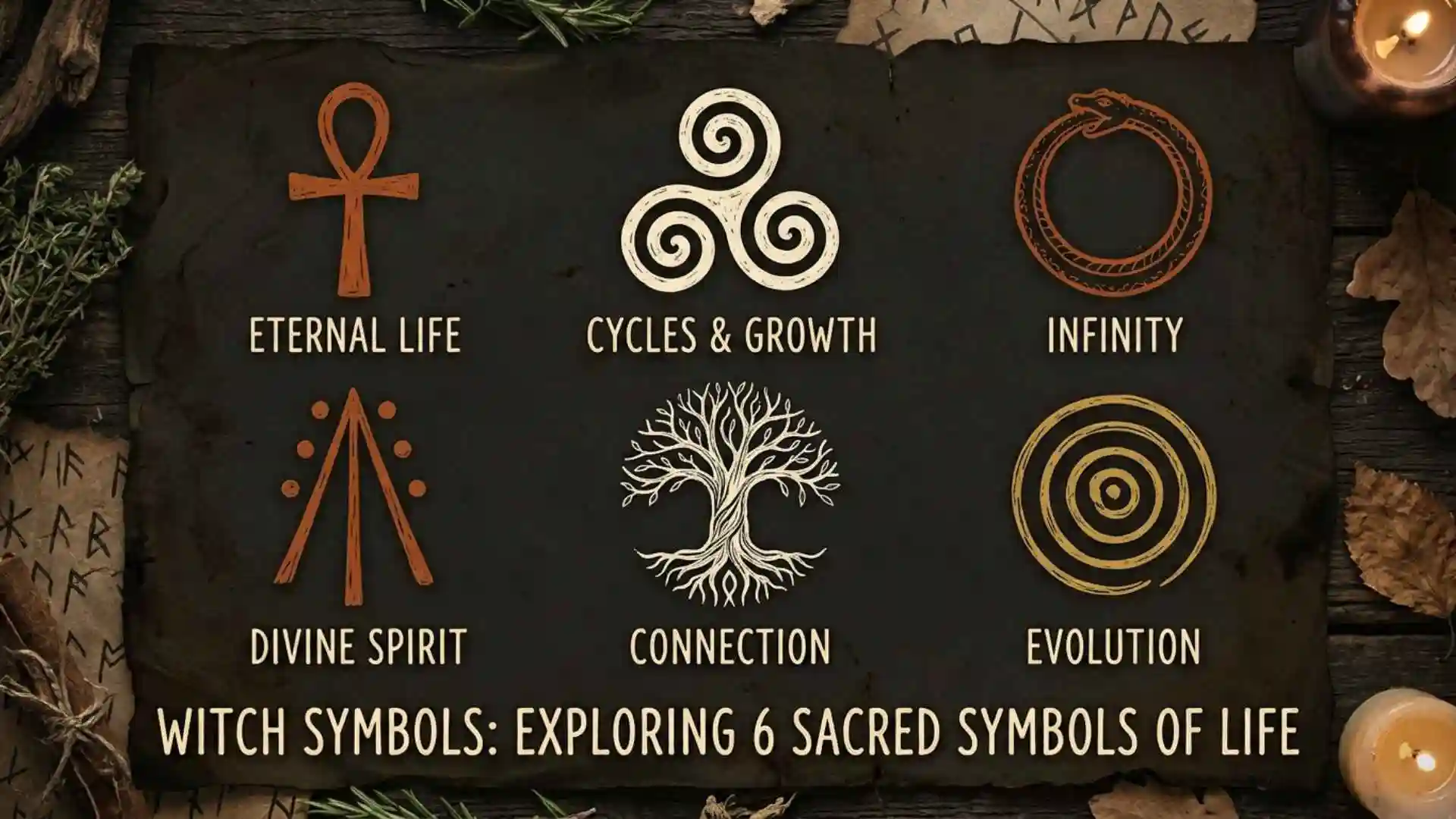
Witchcraft symbols carry fascinating meanings connected to protection, nature, spirituality, transformation, and ancient religious traditions. From the familiar five-pointed pentacle to the mysterious Triple Moon, these designs represent different beliefs and practices across cultures. Some have ancient historical origins while others became popular through modern Pagan and Wiccan movements.
Understanding witchcraft symbols and meanings helps you recognize their historical significance and spiritual associations. However, not every symbol associated with witches originated in witchcraft. Some come from ancient Egyptian religion, Celtic artwork, European folklore, and other spiritual traditions.
Whether you’re researching Wiccan symbols, exploring Pagan symbols, or looking for meaningful spiritual designs, this guide explains their origins, appearances, and interpretations.
What Are Witchcraft Symbols?
Witchcraft symbols are images, shapes, markings, and objects that represent spiritual beliefs, magical intentions, natural forces, or religious ideas. Practitioners may incorporate them into rituals, meditation, spellwork, personal jewelry, and sacred spaces.
These symbols don’t all belong to one religion. Witchcraft includes different traditions and approaches, so their meanings can change depending on the practitioner and cultural background.
For example:
- Wiccan symbols often represent the Goddess, God, five elements, and seasonal cycles.
- Pagan symbols may connect with nature, ancient deities, fertility, and traditional festivals.
- Occult symbols can represent esoteric teachings, spiritual principles, and philosophical ideas.
- Folk-magic symbols often relate to household protection, healing, and traditional charms.
- Modern witchcraft symbols may combine historical imagery with personal spiritual interpretations.
The same design can also carry different meanings. A pentagram, for instance, has appeared in several historical and religious contexts. Its interpretation depends on its setting rather than its shape alone.
Witchcraft Symbols and Their Meanings: Quick Reference Chart
The following table highlights recognizable witch symbols and their meanings, including their common spiritual associations.
| Witchcraft Symbol | Common Meaning | Main Association |
| Pentacle | Protection and balance | Wicca and Paganism |
| Pentagram | Fivefold symbolism | Ancient and occult traditions |
| Triple Moon | Lunar cycles and divine femininity | Wicca |
| Triquetra | Threefold connection | Celtic and Christian imagery |
| Witch’s Knot | Protection and warding | Folk magic |
| Wheel of the Year | Seasonal cycles | Modern Paganism |
| Earth Symbol | Stability and grounding | Elemental traditions |
| Air Symbol | Intellect and communication | Elemental traditions |
| Fire Symbol | Energy and transformation | Elemental traditions |
| Water Symbol | Emotion and intuition | Elemental traditions |
| Spiral | Growth and transformation | Ancient spiritual imagery |
| Ankh | Life and vitality | Ancient Egypt |
| Horned God | Nature and masculine divinity | Wicca |
| Goddess Symbol | Feminine divinity | Modern Paganism |
| Hecate’s Wheel | Devotion to Hecate | Modern Hellenic Paganism |
| Triskele | Movement and threefold patterns | Celtic-associated imagery |
| Eye of Horus | Protection and restoration | Ancient Egypt |
| Solar Cross | Solar and seasonal cycles | Historical symbolism |
| Crescent Moon | Lunar renewal | Various spiritual traditions |
| Ouroboros | Eternity and renewal | Ancient esoteric traditions |
| Labyrinth | Spiritual journey | Ancient and modern traditions |
| Cauldron | Transformation and creation | Folklore and witchcraft |
| Besom | Cleansing and protection | European folk traditions |
| Black Cat | Mystery and independence | European folklore |
These meanings describe common interpretations rather than universal religious definitions.
The Most Recognizable Witchcraft Symbols and Their Meanings
Pentacle Symbol: Protection, Balance, and the Five Elements
<escape> </escape>
The pentacle symbol features a five-pointed star enclosed within a circle. It remains one of the most recognizable images associated with modern witchcraft and Wicca.
Its five points commonly represent the five classical elements:
- Earth: Stability, grounding, and physical existence.
- Air: Knowledge, communication, and intellectual growth.
- Fire: Passion, courage, and transformation.
- Water: Emotion, intuition, and healing.
- Spirit: The connecting principle that unites the other elements.
The surrounding circle represents unity, wholeness, and the interconnected nature of existence in common modern interpretations.
Wiccans frequently use the pentacle as a ritual symbol and wear it as jewelry. Some practitioners also associate it with spiritual protection and elemental balance.
Pentacle vs. pentagram: A pentagram is a five-pointed star. A pentacle commonly refers to a pentagram enclosed within a circle, although historical usage varies.
An inverted pentagram also has different interpretations across traditions. It isn’t automatically Satanic in every context.
Triple Moon Symbol: The Goddess and Lunar Cycles
The Triple Moon symbol features three connected lunar shapes: a waxing crescent, a full moon, and a waning crescent.
<escape> </escape>
In modern Wiccan spirituality, these phases often represent the Triple Goddess and three symbolic stages of womanhood:
- Maiden: Youth, discovery, independence, and new beginnings.
- Mother: Creation, maturity, nurturing, and fertility.
- Crone: Wisdom, experience, reflection, and transformation.
The symbol also reflects the changing lunar cycle. The waxing moon grows toward fullness while the waning moon gradually disappears.
Many practitioners connect these phases with personal development, renewal, and the natural rhythm of life.
The Triple Moon appears frequently in Wiccan jewelry, altar decorations, spiritual artwork, and tattoos. Its meanings vary, and not every Pagan tradition follows the Maiden, Mother, and Crone interpretation.
Triquetra Symbol: Unity, Eternity, and Threefold Connection
The triquetra consists of three interlocking loops that create a continuous, symmetrical design.
<escape> </escape>
Its name comes from Latin and refers to a three-cornered shape. The design appears in historical artistic and religious contexts, including early medieval manuscript decoration.
Different traditions interpret the triquetra in different ways:
- In modern Paganism, it may represent life, death, and rebirth.
- In some spiritual interpretations, it symbolizes mind, body, and spirit.
- In Christianity, it can represent the Father, Son, and Holy Spirit.
- In broader symbolic interpretations, it expresses unity and interconnectedness.
The triquetra is often described as a Celtic knot. However, its appearance in Celtic-associated artwork doesn’t establish one universal ancient Celtic meaning.
Today, people commonly choose it for necklaces, rings, tattoos, and decorative spiritual designs.
Witch’s Knot Symbol: Protection and Warding Magic
The Witch’s Knot refers to interwoven knot designs associated with protective folk-magic traditions and modern witchcraft interpretations.
<escape> </escape>
Knot symbolism has a long history across different cultures. People have used cords, tied objects, and decorative knots in rituals, charms, and practical traditions.
In contemporary witchcraft, practitioners may associate the Witch’s Knot with:
- Spiritual protection.
- Warding against unwanted influences.
- Binding magical intentions.
- Preserving personal boundaries.
- Symbolic protection of homes and sacred spaces.
Some modern practitioners incorporate knotwork into protective charms or ritual objects.
However, the term Witch’s Knot doesn’t describe one universally standardized ancient design. Its appearance and interpretation can vary between traditions.
Wheel of the Year: Nature, Seasons, and Pagan Celebrations
The Wheel of the Year represents the annual seasonal cycle in many modern Pagan and Wiccan traditions.
<escape> </escape>
It contains eight seasonal celebrations known as Sabbats. These festivals follow the changing seasons and connect spiritual practice with agricultural and natural rhythms.
| Pagan Sabbat | Seasonal Connection | Common Meaning |
| Samhain | Autumn | Ancestors, remembrance, and endings |
| Yule | Winter solstice | Returning light and renewal |
| Imbolc | Late winter | Purification and emerging growth |
| Ostara | Spring equinox | Balance and new beginnings |
| Beltane | Late spring | Fertility and vitality |
| Litha | Summer solstice | Sunlight and abundance |
| Lammas (Lughnasadh) | Late summer | First harvest and gratitude |
| Mabon | Autumn equinox | Harvest and balance |
The eight festivals include four solar events and four seasonal cross-quarter celebrations.
Their modern arrangement developed through the growth of contemporary Paganism and Wicca. Historical research traces the familiar eightfold system to twentieth-century developments rather than one unchanged ancient calendar. Cambridge University Press.
Elemental Symbols: Earth, Air, Fire, and Water
The four elemental symbols represent classical natural forces used in Western esoteric and magical traditions.
<escape> </escape>
Their traditional geometric forms are based on triangles, sometimes modified with horizontal lines.
| Element | Traditional Symbol Description | Common Associations |
| Earth | Downward triangle with a horizontal line | Stability and grounding |
| Air | Upward triangle with a horizontal line | Knowledge and communication |
| Fire | Upward-pointing triangle | Energy and transformation |
| Water | Downward-pointing triangle | Emotion and intuition |
Practitioners may use these symbols to represent elemental correspondences during rituals and meditation.
For example, Earth may symbolize physical stability while Water represents emotional awareness. Fire often connects with passion and change while Air relates to thought and communication.
These elements also appear in the symbolism of the pentacle, where Spirit completes the fivefold arrangement.
Spiral Symbol: Growth, Transformation, and Spiritual Development
The spiral symbol features a curved line that winds inward or outward around a central point.
<escape> </escape>
Spiral designs appear in prehistoric artwork, ancient monuments, decorative objects, and natural patterns. Their historical meanings differ across archaeological sites and cultures.
In modern spiritual interpretations, spirals commonly represent:
- Personal growth and transformation.
- The continuous movement of life.
- Renewal and repeating cycles.
- Spiritual development.
- The relationship between beginnings and endings.
An outward spiral may suggest expansion and exploration. An inward spiral can represent reflection and deeper self-understanding.
Some modern Pagan practitioners incorporate spiral designs into meditation, ritual artwork, and personal spiritual jewelry.
Ankh Symbol: Life, Vitality, and Spiritual Continuity
The ankh is an ancient Egyptian hieroglyph shaped like a cross with a loop above its horizontal arms.
<escape> </escape>
Its original Egyptian meaning is life. Ancient Egyptians used the symbol in religious inscriptions, temple artwork, jewelry, and protective amulets.
Egyptian gods frequently appear holding an ankh in artistic representations. The symbol could communicate the gift or preservation of life.
The Metropolitan Museum of Art documents an ankh object from Egypt’s Eighteenth Dynasty, dating approximately 1396–1386 BCE. The Metropolitan Museum of Art.
Its common associations include:
- Life and vitality.
- Divine power.
- Continued existence.
- Protection.
- Life beyond death.
Although modern witches and spiritual practitioners sometimes use the ankh, it didn’t originate as a witchcraft symbol. Its primary historical roots belong to ancient Egyptian religious culture.
Other Important Witchcraft and Pagan Symbols
Beyond the eight central designs, several other symbols appear in modern witchcraft, Pagan spirituality, historical religion, and folklore.
Horned God Symbol: Nature and Masculine Divinity
The Horned God represents a masculine deity associated with nature, animals, wilderness, fertility, and seasonal renewal in many Wiccan traditions.
He often appears with antlers or horns, connecting him symbolically with wild animals and natural life.
In Wiccan theology, the Horned God frequently appears alongside the Goddess. Their relationship reflects complementary aspects of nature and divinity.
The Horned God shouldn’t automatically be confused with Satan. These figures belong to different religious and cultural frameworks.
Goddess Symbol: Feminine Divinity and Creation
The Goddess represents feminine divinity in many modern Pagan traditions.
She may symbolize creation, fertility, nature, nurturing, wisdom, and spiritual power.
Some Wiccans understand the Goddess through lunar imagery and the Triple Goddess concept. Others worship particular historical or reconstructed deities.
There isn’t one universal Goddess symbol. Representations vary between traditions.
Hecate’s Wheel: Crossroads and Spiritual Transition
Hecate is an ancient Greek goddess associated with crossroads, boundaries, and aspects of magic and the night.
The modern Hecate’s Wheel is associated with her worship in some contemporary Pagan communities.
It often appears as a circular design featuring a three-part or labyrinth-like pattern.
Its modern interpretations include:
- Crossroads and important decisions.
- Personal transformation.
- Spiritual exploration.
- Devotion to Hecate.
- Movement between different stages of life.
It’s important to distinguish modern devotional artwork from ancient historical objects. The familiar contemporary design shouldn’t automatically be treated as an unchanged ancient Greek artifact.
Triskele Symbol: Movement and Threefold Patterns
The triskele, also called a triskelion, features three connected spirals or curved arms radiating from a central point.
It appears in ancient Mediterranean and Celtic-associated artwork.
Modern interpretations connect it with movement, interconnectedness, natural cycles, and threefold concepts.
Although people sometimes confuse the triskele with the triquetra, their designs differ. The triskele features three spiraling arms while the triquetra uses three interlocking loops.
Eye of Horus: Protection and Restoration
The Eye of Horus comes from ancient Egyptian mythology and religious symbolism.
It represents the eye associated with Horus, whose mythological conflict with Seth involved injury and restoration.
Ancient Egyptians used the eye as a protective symbol in jewelry, amulets, and funerary objects.
Its common associations include protection, healing, restoration, and well-being.
The Eye of Horus and Eye of Ra aren’t identical symbols. They have different mythological associations despite their visual similarities.
Crescent Moon: Lunar Cycles and Renewal
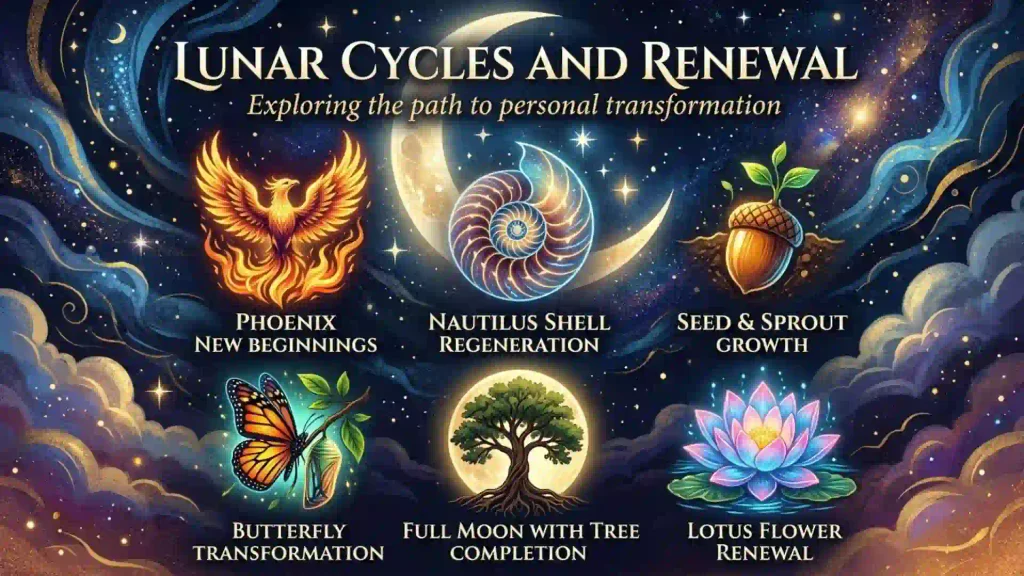
The crescent moon appears in numerous religious, cultural, and spiritual traditions.
In modern witchcraft, practitioners may associate it with lunar energy, intuition, renewal, and changing life circumstances.
Its meaning can depend on its phase. A waxing crescent often represents growth while a waning crescent may suggest release and reflection.
The crescent moon isn’t exclusive to witches or Wicca. It also has important historical and religious uses across different cultures.
Ouroboros: Eternity and Renewal
The Ouroboros depicts a serpent or dragon consuming its own tail.
<escape> </escape>
Its circular shape makes it a powerful image of continuity and cyclical existence.
Historical examples appear in ancient Egyptian and later Greek religious and philosophical traditions.
Modern esoteric interpretations associate it with eternity, renewal, self-reflection, and the relationship between endings and beginnings.
Solar Cross: The Sun and Seasonal Cycles
The solar cross consists of a circle divided by four intersecting arms.
It appears in prehistoric and historical artistic contexts across different regions.
Modern interpretations often connect it with the sun, seasonal divisions, and the four directions.
However, its precise meaning depends on the archaeological and cultural context. It shouldn’t automatically be labeled a witchcraft symbol.
Labyrinth: Spiritual Journey and Self-Discovery
A labyrinth is a winding path that leads toward a central point.
Unlike a conventional maze, a traditional labyrinth generally has one continuous route rather than multiple confusing choices.
Some modern spiritual practitioners use labyrinth walking for meditation, reflection, and personal exploration.
Its symbolism often involves patience, self-discovery, and the journey toward understanding.
Cauldron: Transformation and Magical Practice
The cauldron is a familiar object in historical household life and European folklore.
Its association with witches developed through folklore, literature, and popular cultural imagery.
In modern witchcraft, practitioners may use cauldrons as ritual containers or symbolic objects representing transformation, creation, and renewal.
Besom: Cleansing and Protection
A besom is a traditional broom, often associated with European folk customs and modern witchcraft.
Some Wiccans use a besom during ceremonies or handfastings. Others associate it with symbolic cleansing and household protection.
The broom also became a familiar part of witch imagery through European folklore and later popular culture.
Black Cat: Mystery and Witchcraft Folklore
Black cats have a complicated history in European folklore.
During periods of witchcraft persecution, people sometimes associated cats with witches and supernatural companions. These beliefs contributed to negative superstitions about black cats.
Today, black cats commonly appear in witchcraft imagery and Halloween decorations. Modern interpretations may associate them with independence, mystery, and intuition.
However, black cats aren’t inherently connected to witchcraft.
Witchcraft Symbols by Spiritual Tradition
Different spiritual traditions use different symbolic systems. Understanding these distinctions prevents confusion between historical religious symbols and modern witch imagery.
Wiccan Symbols
Wicca is a modern Pagan religion that emerged in twentieth-century Britain. Many Wiccan traditions emphasize nature, ritual, seasonal celebrations, and Goddess and God symbolism. History.com.
Common Wiccan symbols include:
- Pentacle.
- Triple Moon.
- Horned God imagery.
- Goddess imagery.
- Wheel of the Year.
- Four elemental symbols.
Not every Wiccan follows the same practices or interprets every symbol identically.
Pagan Symbols
Paganism includes many different religious and spiritual traditions.
Some contemporary Pagan practitioners use symbols associated with ancient mythology, nature, seasonal celebrations, and reconstructed historical religions.
Common examples include the triskele, spiral, solar imagery, and triquetra.
However, Paganism doesn’t have one universal symbol system.
Traditional Witchcraft Symbols
Traditional witchcraft covers varied practices influenced by regional folklore, historical folk magic, and contemporary interpretations of older customs.
Its symbolic objects may include:
- Protective knots.
- Besoms.
- Folk charms.
- Herbal imagery.
- Household protective markings.
These traditions differ considerably across geographical regions.
Modern Witchcraft Symbols
Modern witches often combine historical symbols with contemporary spiritual interpretations.
Some use traditional Wiccan imagery while others create personal sigils or adopt symbols connected with specific deities and spiritual paths.
This flexibility explains why modern witchcraft imagery can look different from one practitioner to another.
Witchcraft Protection Symbols and Their Meanings
Many witchcraft protection symbols represent safety, spiritual boundaries, and protection against unwanted influences.
Different traditions use different protective objects and designs. Some have documented historical uses while others gained protective meanings through modern spiritual practices.
| Protection Symbol | Common Protective Meaning |
| Pentacle | Spiritual protection and balance |
| Witch’s Knot | Warding and protective intentions |
| Eye of Horus | Protection and restoration |
| Hamsa | Protection against the evil eye |
| Evil Eye | Guarding against harmful envy |
| Besom | Symbolic household cleansing |
| Protective Sigils | Personal protective intentions |
The Hamsa deserves particular cultural attention. It appears in Jewish, Islamic, and other regional traditions and shouldn’t be treated as exclusively Pagan or witchcraft imagery.
Similarly, protective sigils often reflect individual magical practices. Their designs and interpretations depend on the person who creates or uses them.
Historical and Cultural Origins of Witchcraft Symbols
The history of ancient witchcraft symbols isn’t a single story. Many recognizable designs developed independently before modern witchcraft adopted or reinterpreted them.
Understanding their backgrounds helps separate historical evidence from contemporary spiritual beliefs.
Ancient Egyptian symbolism: The ankh and Eye of Horus originated within Egyptian religious culture. Both appeared in sacred artwork, amulets, and religious objects.
Celtic-associated artwork: Interlacing patterns, spirals, and threefold designs appear in historical European artwork. Their exact meanings vary according to period and location.
European folk traditions: Protective charms, household customs, knotwork, and herbal practices contributed to the imagery associated with traditional witchcraft.
Classical philosophy: The four classical elements became important in ancient Greek natural philosophy and later Western esoteric traditions. Modern magical systems adapted these elemental associations.
Modern Pagan movements: Twentieth-century Wicca brought together seasonal festivals, ritual symbolism, Goddess and God imagery, and selected older spiritual influences.
Historical context matters because a symbol’s present-day meaning may differ considerably from its original use.
Pentacle vs. Pentagram: What’s the Difference?
The pentacle and pentagram are closely related symbols, but their definitions aren’t always interchangeable.
| Feature | Pentacle | Pentagram |
| Design | Commonly a star enclosed in a circle | Five-pointed star |
| Circular border | Usually present | Not necessary |
| Common symbolism | Unity, protection, and elemental balance | Fivefold symbolism |
| Modern association | Wicca and Paganism | Occult and religious traditions |
| Orientation | Often upright | Upright or inverted |
A pentagram can appear without a surrounding circle. A pentacle commonly includes one, especially in modern Wiccan contexts.
Both designs have appeared in different historical and religious settings. Their meanings depend on the surrounding beliefs and traditions.
Is an Inverted Pentagram Always Satanic?
No. An inverted pentagram doesn’t have one universal meaning.
Some modern Satanic traditions use the inverted pentagram as an important emblem. Other historical and esoteric contexts have assigned different meanings to inverted star designs.
The surrounding imagery, religious affiliation, and intended symbolism help determine its interpretation.
Are Witchcraft Symbols Religious or Spiritual?
Some witchcraft symbols are religious, while others express personal spirituality, cultural identity, or magical intentions.
Wicca is a religion, but witchcraft itself doesn’t describe one unified religious system.
For example, a Wiccan practitioner might use a pentacle during religious ceremonies. Another witch might use a protective knot as part of a personal folk-magic practice without following Wicca.
Some people also use witchcraft-inspired symbols simply because they appreciate their historical or artistic significance.
The important distinction is that using a symbol doesn’t automatically establish someone’s religious beliefs.
Are Witchcraft Symbols Evil or Satanic?
Witchcraft symbols aren’t automatically evil or Satanic.
Many represent ordinary spiritual ideas such as nature, protection, fertility, wisdom, renewal, and the changing seasons.
Several misconceptions developed through historical witchcraft accusations, religious conflicts, folklore, and popular entertainment.
Consider these distinctions:
- Wicca: A modern Pagan religion with diverse traditions and practices.
- Paganism: A broad category covering multiple religious and spiritual paths.
- Witchcraft: A collection of magical, spiritual, and folk practices.
- Satanism: A separate religious or philosophical movement with different traditions and beliefs.
A pentacle worn by a Wiccan practitioner doesn’t automatically communicate Satanic beliefs. Likewise, an Egyptian ankh doesn’t become a witchcraft symbol simply because a modern witch wears it.
Understanding the original context prevents misleading assumptions.
How Are Witchcraft Symbols Used Today?
Modern practitioners use witchcraft imagery in different ways. Some incorporate symbols into religious ceremonies while others use them for personal expression or decoration.
Witchcraft Symbols in Jewelry and Necklaces
<escape> </escape>
Symbolic jewelry remains a popular way to display spiritual interests and personal beliefs.
Common designs include:
- Pentacle necklaces representing elemental balance.
- Triple Moon pendants associated with lunar spirituality.
- Ankh necklaces representing life and vitality.
- Triquetra rings symbolizing interconnectedness.
- Spiral pendants representing growth and transformation.
Before choosing a design, consider its cultural background and meaning.
Witchcraft Symbols in Tattoos
<escape> </escape>
Witchcraft tattoos often combine meaningful imagery with personal artistic choices.
Popular designs include pentacles, crescent moons, triquetras, elemental triangles, and spirals.
Some people choose these designs to express spiritual identity. Others appreciate their connection to nature, transformation, or historical symbolism.
Witchcraft Symbols on Altars
<escape> </escape>
An altar provides a dedicated space for spiritual activities in some Pagan and Wiccan traditions.
Practitioners may arrange symbols according to their beliefs and ritual preferences.
Common altar objects include:
- Pentacles representing elemental balance.
- Candles representing fire.
- Bowls of water representing the water element.
- Stones or soil representing Earth.
- Feathers representing Air in some modern correspondences.
- Seasonal decorations connected with the Wheel of the Year.
There isn’t one required altar arrangement for every witch.
Witchcraft Symbols in Spellwork and Rituals
Some practitioners incorporate symbols into spellwork to represent specific intentions.
For example, a protective symbol might represent personal boundaries while a spiral could express an intention for growth.
Others create sigils, which are personally designed symbolic marks associated with particular intentions.
These practices reflect spiritual beliefs rather than scientifically established supernatural effects.
How to Identify Witchcraft Symbols Correctly
Not every unusual design represents witchcraft. Stars, moons, spirals, and geometric patterns appear in countless cultural and religious traditions.
Use these guidelines when identifying an unfamiliar symbol:
- Examine its shape: Look for distinctive features such as five-pointed stars, interlocking loops, or lunar phases.
- Check its orientation: Upright and inverted designs may have different interpretations.
- Research its origins: Determine whether it comes from Egyptian religion, Celtic-associated artwork, European folklore, or modern Paganism.
- Consider its context: A symbol displayed on a Wiccan altar may have a different meaning from the same design in an archaeological artifact.
- Compare variations: Similar-looking symbols aren’t necessarily identical.
- Avoid assumptions: Don’t label every moon, star, knot, or animal as a witchcraft symbol.
Reliable identification requires more than recognizing a familiar shape. Historical background and cultural context matter just as much.
Frequently Asked Questions About Witchcraft Symbols
What Are the Most Common Witchcraft Symbols?
Some widely recognized witchcraft symbols include the pentacle, pentagram, Triple Moon, triquetra, Witch’s Knot, Wheel of the Year, elemental symbols, spiral, and ankh. Their meanings include protection, spiritual balance, nature, transformation, and lunar cycles.
What Is the Most Powerful Witchcraft Symbol?
There isn’t one universally recognized most powerful witchcraft symbol. Different traditions assign different meanings and spiritual importance to particular designs. Many Wiccans consider the pentacle especially significant because of its association with protection and the five elements.
What Does the Pentacle Symbolize in Witchcraft?
The pentacle commonly represents Earth, Air, Fire, Water, and Spirit. Its surrounding circle symbolizes unity and wholeness in many modern Wiccan interpretations. Practitioners also associate it with spiritual protection and balance.
Is a Pentacle the Same as a Pentagram?
No. A pentagram is a five-pointed star while a pentacle commonly features that star inside a circle. Both appear in historical and modern spiritual traditions.
What Does the Triple Moon Symbol Represent?
The Triple Moon represents the waxing crescent, full moon, and waning crescent. In many modern Wiccan interpretations, these phases connect with the Maiden, Mother, and Crone aspects of the Triple Goddess.
Is the Triquetra a Pagan Symbol?
The triquetra appears in historical Christian and Celtic-associated artwork. Modern Pagan practitioners also use it to represent interconnectedness, life cycles, and threefold spiritual concepts. It doesn’t belong exclusively to one religion.
What Does a Witch’s Knot Mean?
The Witch’s Knot commonly represents protection, warding, and binding intentions in modern witchcraft interpretations. Its exact appearance and historical associations vary across folk-magic and contemporary spiritual practices.
What Are the Eight Pagan Festivals?
The eight commonly celebrated Sabbats are Samhain, Yule, Imbolc, Ostara, Beltane, Litha, Lammas (Lughnasadh), and Mabon. Together, they form the modern Wheel of the Year.
What Are the Four Elemental Symbols?
The four classical elemental symbols are:
- Earth: Downward-pointing triangle with a horizontal line.
- Air: Upward-pointing triangle with a horizontal line.
- Fire: Upward-pointing triangle.
- Water: Downward-pointing triangle.
These geometric designs appear in Western esoteric and modern magical traditions.
What Does the Ankh Represent?
The ankh represents life in ancient Egyptian writing and religious imagery. Ancient Egyptians associated it with vitality and continued existence. Modern spiritual practitioners have also adopted it as a symbol of life and renewal.
Is the Ankh Originally a Witchcraft Symbol?
No. The ankh originated in ancient Egyptian culture as a hieroglyph meaning life. Its later use in modern witchcraft and spiritual practices doesn’t change its Egyptian historical origins.
Do All Witches Use the Same Symbols?
No. Symbolic practices vary according to religious beliefs, cultural backgrounds, and personal preferences. Wiccans, traditional witches, folk-magic practitioners, and secular witches may use entirely different designs.
Are Witchcraft Symbols Always Religious?
No. Some symbols serve religious purposes while others represent cultural traditions, personal intentions, artistic interests, or spiritual ideas. Their meaning depends on how individuals and communities use them.
Conclusion: Understanding the Meanings Behind Witchcraft Symbols
Witchcraft symbols represent a fascinating collection of spiritual ideas, historical traditions, and cultural influences. From the protective pentacle to the life-giving Egyptian ankh, each design carries its own background and interpretations.
Some symbols connect with ancient religious practices while others developed through modern Pagan and Wiccan movements. The Triple Moon, Wheel of the Year, elemental triangles, and Witch’s Knot illustrate the variety of imagery used in contemporary witchcraft.
Remember that no single meaning applies to every tradition. A symbol’s history, cultural setting, and intended use all influence its significance.
When exploring witch symbols and meanings, look beyond their appearance. Understanding their origins helps you appreciate their deeper spiritual, historical, and cultural value.

I am John Carter, a lifelong enthusiast of language and modern slang. I explore how words evolve and shape culture, and I enjoy uncovering the stories behind everyday expressions. I have authored “Slang and Society: The Language of Youth” and “Modern Words, Modern Worlds”, where I dive into how informal language impacts communication and identity. My goal is to make language accessible, fun, and insightful for everyone who loves words as much as I do.
 Lisa Reynolds