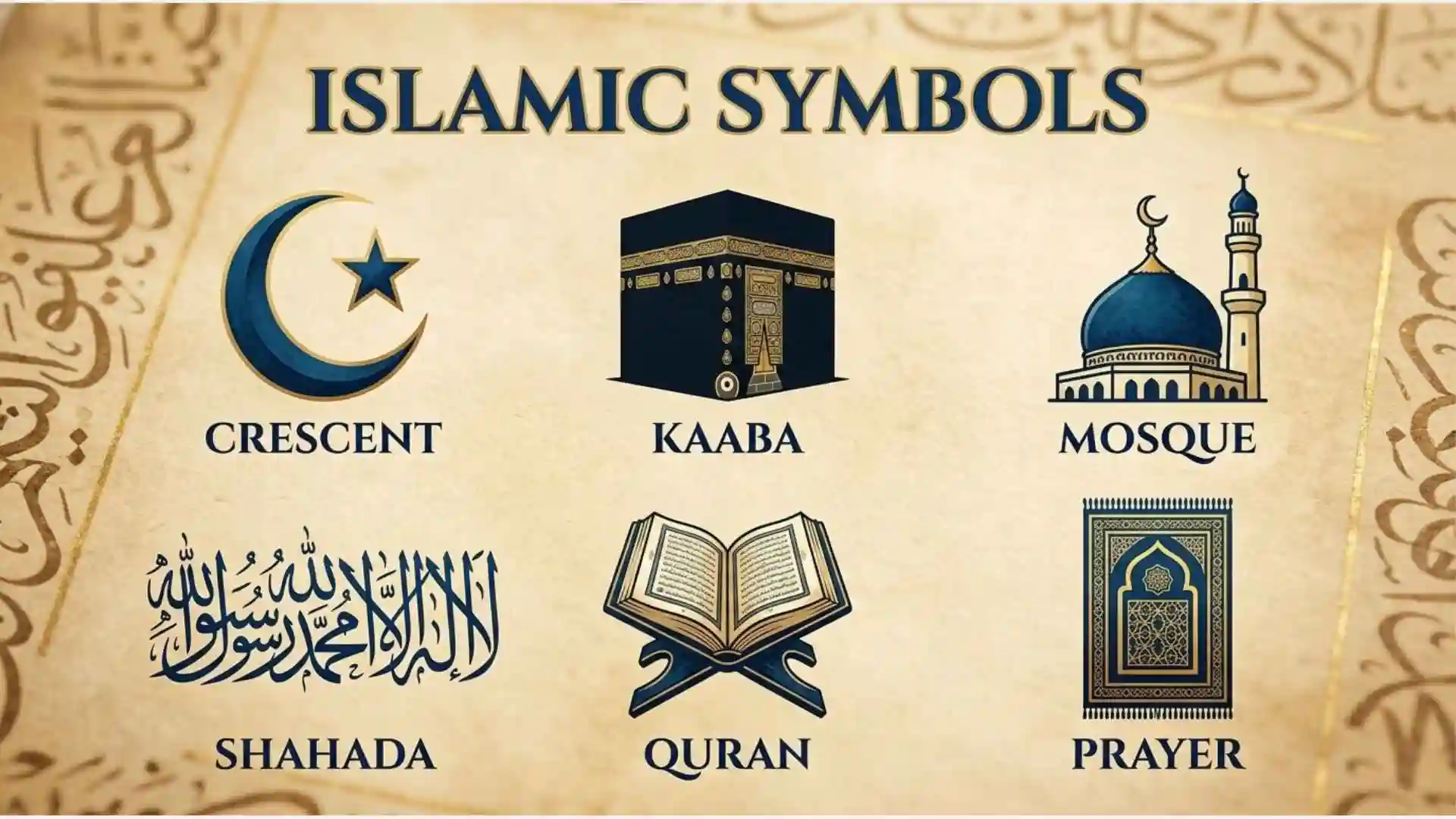
Islamic symbols are visual signs, Arabic expressions, artistic patterns, and cultural designs associated with Islam and Muslim communities. They appear in mosques, Islamic artwork, religious books, home decorations, social media profiles, and educational materials. Some represent important religious beliefs, while others are connected to Muslim history, architecture, or artistic traditions.
Common examples include the crescent and star, Arabic calligraphy, the Shahada, the Kaaba, mosque imagery, and geometric patterns. However, not every design commonly associated with Muslims is an official symbol of Islam. Understanding this difference helps readers appreciate Islamic symbols without confusing cultural traditions with religious teachings.
This guide explains popular Islamic symbols and their meanings, provides copy-and-paste characters, explores their historical and artistic significance, and answers common questions about their use.
Islamic Symbols Copy and Paste
If you are looking for Islamic symbols to use in a social media bio, caption, message, document, or design, the following collection provides a convenient starting point.
| Symbol or text | Name | Common association |
| ☪ | Crescent and star | Muslim identity and cultural heritage |
| ﷲ | Allah ligature | The name of God in Arabic |
| ﷺ | Salawat ligature | Blessings upon Prophet Muhammad |
| ﷻ | Honorific ligature | An expression of glorification of Allah |
| 🕌 | Mosque emoji | Mosque and Muslim worship |
| 🕋 | Kaaba emoji | The Kaaba in Makkah |
| ☝️ | Raised index finger emoji | Can represent pointing or, in some contexts, belief in one God |
| الله | Allah in Arabic | The name of God |
| محمد | Muhammad in Arabic | The name Muhammad |
| بسم الله | Bismillah | In the name of Allah |
| الحمد لله | Alhamdulillah | Praise belongs to Allah |
| سبحان الله | SubhanAllah | Glory be to Allah |
| إن شاء الله | InshaAllah | If Allah wills |
| ما شاء الله | MashaAllah | An expression of appreciation and acknowledgment of Allah’s will |
| السلام عليكم | Assalamu Alaikum | Peace be upon you |
These characters and expressions are not interchangeable. For example, the crescent-and-star character is a visual symbol, while Arabic expressions communicate specific words or religious meanings.
How to use them: Select the desired character or text, copy it, and paste it into your chosen application. Display can vary by font, device, and platform. Some ligatures may appear as connected Arabic calligraphy, while other devices may show individual Arabic letters or a different design.
Use religious expressions respectfully, especially when placing them on clothing, decorations, or other objects that may be handled casually.
Islamic Symbols and Their Meanings
Islamic symbols can be understood more clearly by separating religious expressions, recognizable cultural imagery, and artistic designs. The following examples explain their significance without suggesting that every symbol has a single universal meaning.
1. Crescent and Star Symbol ☪
The crescent and star is one of the most recognizable designs associated with Islam. It appears on certain national flags, public buildings, decorative items, and materials representing Muslim communities.
Its association with Islam developed historically rather than through a universal religious instruction. The symbol is particularly associated with the Ottoman Empire and later became familiar in many modern contexts.
The Quran does not establish the crescent and star as an official symbol of Islam. Some Muslims use it to express cultural identity, while others prefer not to treat it as a religious emblem.
Meaning: Muslim identity, cultural heritage, and historical association. Its interpretation depends on the context in which it appears.
2. Allah Symbol ﷲ
The Arabic word Allah (الله) is the name of God in Islam. Muslims use this name in prayer, Quranic recitation, religious writing, and everyday expressions of faith.
The ligature ﷲ is a typographic character that can display the word in a connected form. Arabic calligraphers also create artistic versions of the name using different scripts and compositions.
Unlike a decorative logo, the word itself has a specific linguistic and religious meaning. Its visual style may vary, but its reference to God remains central.
Meaning: God, the central focus of Islamic belief and worship.
3. Shahada
The Shahada is the Islamic declaration of faith:
لَا إِلَٰهَ إِلَّا اللَّهُ مُحَمَّدٌ رَسُولُ اللَّهِ
It is commonly translated as, “There is no god worthy of worship except Allah, and Muhammad is the Messenger of Allah.”
The declaration expresses two foundational beliefs: the oneness of God and the prophethood of Muhammad. It holds a central place in Muslim religious life and is often represented in Arabic calligraphy.
The Shahada may appear in religious artwork, manuscripts, flags, and educational materials. When reproduced, the wording should be checked carefully because changing Arabic letters can alter the text.
Meaning: Faith in the oneness of Allah and the prophethood of Muhammad.
4. Prophet Muhammad’s Honorific ﷺ
The character ﷺ is a typographic ligature representing a traditional Arabic blessing used after mentioning Prophet Muhammad. The expression is commonly written in full as:
صلى الله عليه وسلم
It means, “May Allah’s blessings and peace be upon him.”
Muslims commonly use this blessing in religious writing, articles, messages, and discussions about the Prophet. The ligature is a convenient way to display the expression in a compact form.
Meaning: A blessing and expression of respect for Prophet Muhammad.
5. Kaaba 🕋
The Kaaba is the sacred structure located within Masjid al-Haram in Makkah, Saudi Arabia. Muslims around the world face its direction during their daily prayers.
The Kaaba is also the central destination of the Hajj pilgrimage and is associated with Umrah. Its familiar cube-like appearance makes it a recognizable image in educational materials, travel information, and Islamic decorations.
An important distinction is that Muslims worship Allah, not the Kaaba. The Kaaba provides the direction toward which Muslims pray and has a central role in Islamic worship.
Meaning: The direction of Muslim prayer, pilgrimage, and an important sacred site in Islam.
6. Mosque Symbol 🕌
The mosque emoji and illustrations of mosques are widely used to represent Muslim places of worship. Mosques serve as locations for congregational prayer, religious learning, community activities, and other gatherings.
Mosque designs vary considerably across regions and historical periods. Some feature domes, minarets, courtyards, arches, or elaborate decorative work, while others have simpler architectural forms.
A dome or minaret is not a universal religious requirement for a mosque. These features are architectural traditions rather than standalone symbols prescribed for all Muslim places of worship.
Meaning: Muslim worship, community life, and religious gathering.
7. Islamic Geometric Patterns
Islamic geometric patterns are among the most recognizable features of Islamic art. They use shapes such as circles, squares, polygons, and stars, arranged through repetition, symmetry, and interlocking designs.
Artists have used these patterns to decorate walls, tiles, ceilings, manuscripts, textiles, ceramics, and many other objects. The designs can be highly complex, yet they often begin with simple geometric forms.
The Metropolitan Museum of Art explains how geometric decoration developed through the adaptation of earlier artistic traditions and became an important element of Islamic visual culture.
These patterns may suggest visual harmony, balance, and order. However, individual shapes should not automatically be assigned a fixed religious meaning without supporting historical evidence.
Meaning: Artistic expression, geometric balance, repetition, and visual harmony.
8. Arabic Calligraphy
Arabic calligraphy is the artistic practice of writing Arabic letters with attention to proportion, line, form, and composition. It is particularly significant in Islamic art because the Quran was revealed in Arabic.
Calligraphers create compositions featuring Quranic passages, the names of Allah, religious expressions, and other meaningful texts. These works appear in manuscripts, architecture, ceramics, metalwork, textiles, and framed artwork.
Different scripts have developed over time, each with distinctive visual characteristics. Some are formal and angular, while others are flowing and cursive.
Calligraphy is more than decoration: it communicates written language. When a religious inscription is used as artwork, its wording and presentation should be considered together.
Meaning: Written expression, religious devotion, and the artistic beauty of Arabic script.
9. Green Color
Green is often associated with Muslim cultures and appears in flags, mosque decorations, religious publications, and traditional artwork. Its use varies by country, community, and artistic context.
Some people connect green with paradise, growth, life, or renewal. However, these associations should not be treated as a universal code in which every green object has a specific religious meaning.
Green is neither a mandatory color for all Muslim buildings nor an official symbol required for every expression of Islamic identity.
Meaning: Depending on context, it may represent cultural identity, nature, life, or spiritual associations.
10. Prayer Rug
A prayer rug is a textile used by many Muslims to provide a clean surface for prayer. Its designs may include arches, borders, floral decoration, or geometric patterns.
Some rugs feature a mihrab-shaped design that visually suggests the direction of prayer. However, the rug itself is not an object of worship, and Muslims do not all use prayer rugs in every setting.
Prayer rugs also reflect regional craftsmanship. Materials, colors, weaving techniques, and motifs vary among communities.
Meaning: A practical aid for prayer and an expression of textile craftsmanship.
11. Tasbih or Prayer Beads
Tasbih beads are used by many Muslims to help count repeated phrases of remembrance and praise of Allah. They may consist of beads arranged on a cord or another counting aid.
Common devotional phrases include SubhanAllah, Alhamdulillah, and Allahu Akbar. Some people use physical beads, while others count on their fingers or use digital counters.
Practices differ among Muslims, so prayer beads should not be presented as compulsory for every believer. Their primary association is with remembrance and devotional practice.
Meaning: Counting devotional recitations and remembering Allah.
12. Eight-Pointed Star
Eight-pointed stars and similar geometric arrangements appear in Islamic architecture, tilework, manuscripts, and decorative objects. Artists create them by combining geometric shapes and repeating particular patterns.
These stars are part of a broad artistic tradition rather than one universally defined religious symbol. Their appearance and use can differ according to region, period, and medium.
A star-shaped design can be aesthetically significant without carrying a fixed theological message. Its meaning should be explained according to the specific artwork or historical setting.
Meaning: A geometric motif associated with Islamic decorative art.
Is There an Official Symbol of Islam?
There is no single visual emblem universally prescribed as the official symbol of Islam in the Quran. The crescent and star is widely recognized as an emblem associated with Muslim communities, but its historical and religious status should be distinguished from the foundational beliefs of Islam.
The Shahada expresses central Islamic beliefs, while Arabic calligraphy often communicates religious words and teachings. The Kaaba is a sacred site and the direction of prayer, not an object of worship. Geometric patterns, green decorations, and mosque imagery are also important in Muslim visual culture, but their meanings vary.
This distinction matters because a symbol can be culturally associated with a religion without being a religious requirement. For a historical discussion, the explain the diversity of calligraphy, geometric decoration, and other artistic traditions. For a discussion of the crescent and star’s religious status, readers can also consult, recognizing that religious interpretations should be considered carefully.
Islamic Symbols for WhatsApp, Instagram, and TikTok
Islamic characters and expressions can be used in social media profiles, captions, messages, and educational posts. The best choice depends on what you want to communicate.
Symbols for a Social Media Bio
These examples can be copied and adapted:
- ☪ Muslim identity
- الله
- الحمد لله
- ما شاء الله
- ﷺ
The crescent-and-star character is a decorative symbol, while the Arabic expressions have specific meanings. Choose wording that reflects your intended message rather than adding characters solely for appearance.
Symbols for Captions and Messages
Short Arabic expressions are often used to communicate gratitude, remembrance, or hope. For example:
- الحمد لله — Praise belongs to Allah.
- سبحان الله — Glory be to Allah.
- إن شاء الله — If Allah wills.
- ما شاء الله — An expression of appreciation and acknowledgment of Allah’s will.
- بسم الله — In the name of Allah.
Check spelling and context before publishing religious text, especially if it will appear in a permanent graphic or printed design.
Symbols for Graphics and Designs
For a poster, educational graphic, or Islamic-themed design, you might combine Arabic calligraphy with geometric borders or a mosque illustration. Keep the text readable, avoid distorting sacred wording, and ensure that decorative elements do not obscure the message.
Remember that Unicode characters may appear differently across devices. Preview the design on mobile and desktop before publishing it.
Islamic Symbols in Art and Architecture
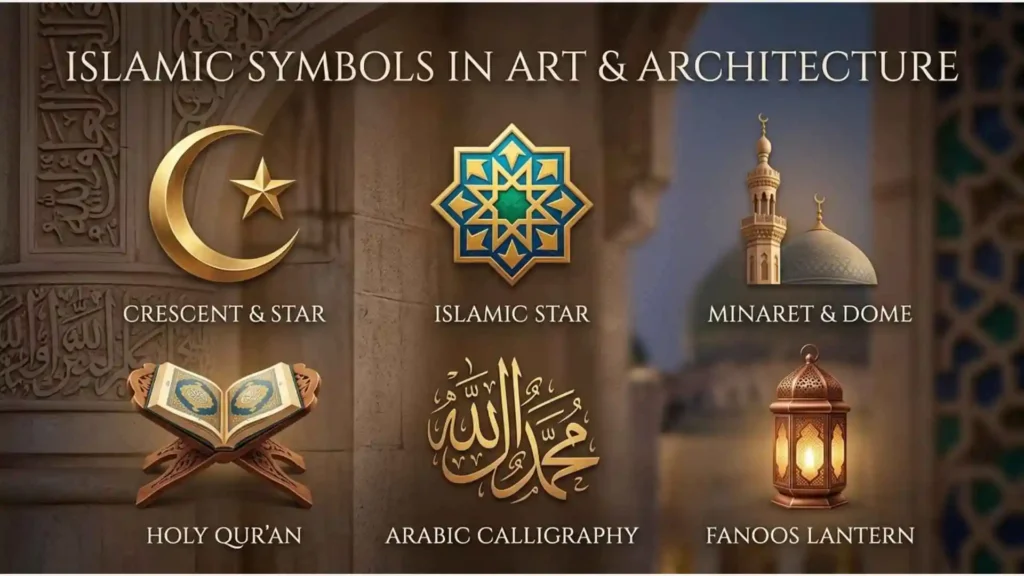
Islamic art developed across many regions, languages, and centuries. As a result, there is no single decorative style shared by every Muslim community.
Three important features of Islamic visual culture are calligraphy, geometric patterns, and vegetal ornament. These elements may appear separately or together, depending on the object and its historical context.
Calligraphic Decoration
Calligraphy can communicate Quranic passages, religious expressions, historical inscriptions, and other written messages. The form of the writing contributes to the artwork, but the words themselves remain important.
Geometric Decoration
Repeated shapes, symmetry, and carefully constructed patterns appear on architectural surfaces and decorative objects. Such designs demonstrate artistic skill and the use of mathematical principles in visual composition.
Floral and Vegetal Motifs
Leaves, vines, flowers, and stylized plant forms are also common in Islamic decorative traditions. These motifs can be combined with geometric designs or calligraphy to create complex surfaces.
The provides further historical context. Its explains the artistic and communicative importance of written Arabic.
Religious Symbols vs. Cultural Designs
Not every object or design associated with Muslims has the same status. The following table summarizes the main differences.
| Example | Type | Important distinction |
| Shahada | Religious declaration | Expresses foundational Islamic beliefs |
| Allah in Arabic | Religious wording | Names God in Arabic |
| ﷺ | Religious honorific | Represents a blessing upon Prophet Muhammad |
| Kaaba | Sacred site | Provides the direction of prayer |
| Crescent and star | Cultural and historical emblem | Widely associated with Islam but not universally prescribed |
| Green color | Cultural and artistic association | Does not have one compulsory meaning |
| Geometric patterns | Artistic tradition | Individual designs do not necessarily have fixed religious meanings |
| Mosque dome or minaret | Architectural feature | Not required for every mosque |
| Tasbih beads | Devotional aid | Used by some Muslims, but not universal |
This distinction helps avoid misleading claims. A symbol may be meaningful to a community, but its meaning should be explained through reliable historical, cultural, or religious evidence rather than assumption.
Frequently Asked Questions About Islamic Symbols
What is the main symbol of Islam?
The crescent and star is widely associated with Islam and Muslim communities. However, it is not established as a universal official symbol in the Quran. The Shahada is a central declaration of Islamic faith, although it is a statement of belief rather than simply a decorative logo.
What does ☪ mean?
The character ☪ represents the crescent and star. It is commonly associated with Muslim identity and Islamic cultural imagery. Its use does not mean that every Muslim considers it a religious symbol.
What is the Arabic symbol for Allah?
The name of Allah in Arabic is الله. The character ﷲ is a typographic ligature that displays the name in a connected form. Its appearance may vary depending on the font and device.
What does ﷺ mean?
The character ﷺ represents the Arabic blessing commonly written after mentioning Prophet Muhammad: صلى الله عليه وسلم. It means, “May Allah’s blessings and peace be upon him.”
Are geometric patterns religious symbols?
Geometric patterns are an important part of Islamic art, but not every pattern has a specific religious meaning. Their significance depends on the design, historical context, and way the artwork is used.
Can I use Islamic symbols in my social media bio?
Yes, you can use relevant characters and Arabic expressions in a bio or caption. Make sure the text is accurate and appropriate for the context. Also, check how the characters display on your chosen platform.
Is green the official color of Islam?
Green is commonly associated with Muslim cultures, but it is not a mandatory color for every Muslim community, mosque, or religious design. Its meaning varies according to cultural and historical context.
Are the Kaaba and mosque symbols the same?
No. The Kaaba is a specific sacred structure in Makkah, while a mosque is a place of Muslim worship. Both are associated with Islamic religious life, but they have different functions and meanings.
Conclusion
Islamic symbols include religious expressions, cultural emblems, sacred places, architectural imagery, and decorative art. The crescent and star, Arabic calligraphy, Shahada, Kaaba, geometric patterns, and mosque imagery are among the best-known examples, but they should not all be interpreted in the same way.
For readers who need symbols to copy and paste, Arabic expressions and Unicode characters offer convenient options for messages, bios, and designs. For those interested in history, Islamic art reveals a rich range of calligraphic, geometric, and vegetal traditions.
The most important principle is to understand the difference between religious teachings, cultural associations, and artistic decoration. This approach makes it easier to use Islamic symbols accurately, respectfully, and meaningfully.

I am Lisa Reynolds, a linguist fascinated by the ever-changing world of slang. I enjoy researching how slang reflects trends, technology, and social connections. I wrote “Text Talk: Understanding Digital Slang” and “From Street to Screen: Slang in Media”, exploring the influence of digital communication on language. I love sharing my discoveries in a way that feels like a conversation with friends, so you feel the culture and humor behind every phrase.
 John Carter
 Marcus Lee