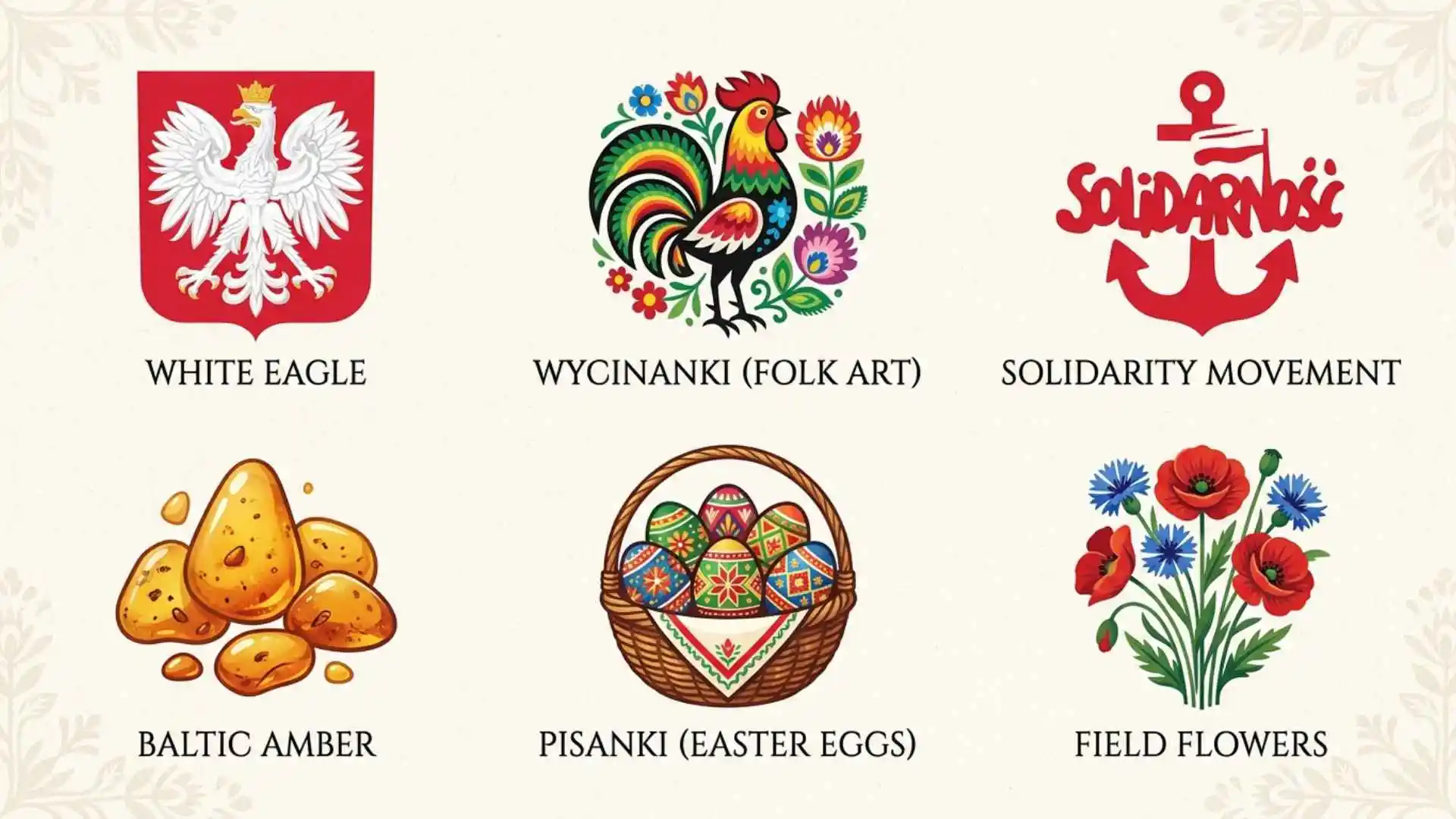
Polish symbols reflect the country’s national identity, history, traditions, and cultural heritage. From the white-and-red Polish flag to the crowned White Eagle, these symbols tell stories of independence, resilience, and pride.
Other important designs, including the Warsaw Mermaid, the Polish resistance anchor, and traditional folk art patterns, represent regional identity, historical struggles, and artistic traditions.
Understanding Polish symbols helps explain what makes Poland culturally distinctive. Some symbols are officially recognized by the Polish state, while others belong to folklore, religion, or particular historical periods. Whether you are researching the meaning of Polish symbols, exploring Polish heritage, or looking for inspiration for a tattoo, this guide explains their origins, meanings, and modern significance.
What Are the Main Polish Symbols?
Polish symbols are emblems, colors, images, and traditional designs associated with Poland and its people. The country’s three principal national symbols are the White Eagle, the white-and-red national colors, and the national anthem, Mazurek Dąbrowskiego. These symbols are formally recognized under Polish law.
Other well-known symbols include the Warsaw Mermaid, the Kotwica resistance emblem, and traditional Polish folk art. Although these symbols are culturally important, they do not all have the same official status.
| Polish symbol | Meaning or significance |
| White Eagle | Polish statehood, national identity, and sovereignty |
| White-and-red flag | National identity and unity |
| Mazurek Dąbrowskiego | Independence, hope, and national perseverance |
| Warsaw Mermaid | The identity and defense of Warsaw |
| Kotwica anchor | Resistance against Nazi occupation |
| Wycinanki folk art | Traditional craftsmanship and regional culture |
| Black Madonna of Częstochowa | Catholic devotion and religious heritage |
These symbols represent different aspects of Polish history and culture. Their meanings are best understood by examining their individual origins rather than treating every design as an official national emblem.
1. The Polish Flag and Its Meaning
The Polish flag is one of the most recognizable Polish national symbols. It consists of two equal horizontal stripes, with white on top and red underneath. Its simple design has deep historical roots in Polish heraldry.
The national colors are derived from the traditional white eagle on a red shield associated with Poland’s coat of arms. In this heraldic tradition, the white represents the eagle, while the red represents the shield’s background.
What Do the White and Red Colors Represent?
White is associated with the White Eagle and, in traditional heraldic interpretations, purity and peaceful qualities. Red is associated with the shield and commonly evokes courage, sacrifice, and the struggle for independence.
The colors were formally adopted as Polish national colors in the nineteenth century, and the flag’s design was established in law on August 1, 1919, following the restoration of Polish independence.
Poland celebrates Flag Day on May 2 each year. Established in 2004, the observance encourages respect for the national flag and awareness of Polish identity. The flag is displayed during national holidays, public ceremonies, sporting events, and celebrations among Polish communities abroad.
The official design has two equal horizontal stripes, white above red. It is important to distinguish this simple national flag from the separate state flag that includes the national coat of arms.
2. The White Eagle: Poland’s National Emblem
The White Eagle is one of the most significant Polish symbols. It appears on the country’s coat of arms as a white eagle with outstretched wings, a golden beak and talons, and a golden crown. The eagle stands against a red shield.
The emblem represents Polish statehood, sovereignty, and national identity. Its distinctive appearance makes it recognizable on official buildings, government documents, passports, and other state materials.
History of the Polish White Eagle
The eagle has been associated with Polish rulers and statehood for centuries. The crowned White Eagle became the emblem of the Kingdom of Poland under King Przemysł II in 1295. Its design evolved throughout Polish history, reflecting changes in political authority and national circumstances.
A popular legend connects the eagle with Lech, a legendary founder of the Polish nation. According to the story, Lech saw a white eagle against a red sunset and chose the location for his settlement. Although this tale is part of Polish folklore rather than established historical evidence, it remains a familiar explanation of the emblem’s legendary origins.
Today, the White Eagle is more than a decorative image. It connects modern Poland with earlier periods of its history and represents the continuity of Polish statehood.
What Does the Crown Symbolize?
The crown is an important element of the traditional Polish coat of arms. It reflects the country’s historical monarchy and its sovereign status.
During the communist period, the crown was removed from the national emblem. It was restored in 1989 as Poland moved away from communist rule, making it an important part of the modern emblem’s historical significance.
The crowned eagle is therefore associated with national independence, dignity, and the restoration of Poland’s sovereign identity.
3. The Polish National Anthem
Poland’s national anthem is called Mazurek Dąbrowskiego, commonly translated as “Dąbrowski’s Mazurka.” It is also widely known by its opening words, meaning “Poland Is Not Yet Lost.”
Józef Wybicki wrote the song in 1797, when Poland had been partitioned by neighboring powers and had disappeared as an independent state from the map of Europe. The song expressed the hope that the Polish nation would survive and regain its freedom.
Why Is the Anthem Important?
The anthem represents perseverance, patriotism, and the determination to preserve national identity during difficult times. Its message is especially meaningful because it emerged when Poland lacked an independent state.
Mazurek Dąbrowskiego became Poland’s official national anthem in 1927. Today, it is performed during official ceremonies, national celebrations, and international sporting competitions.
Alongside the White Eagle and the national colors, the anthem is one of the country’s three principal national symbols. It represents Poland through music and language rather than through a visual emblem.
4. The Warsaw Mermaid (Syrenka)
The Warsaw Mermaid, known in Polish as Syrenka, is a legendary figure and a major symbol of Poland’s capital city. She appears on Warsaw’s coat of arms and in statues, monuments, souvenirs, and public artwork.
The mermaid is generally depicted holding a sword and shield. These objects distinguish her from the familiar image of a mermaid associated only with the sea or fairy tales.
What Does the Warsaw Mermaid Mean?
The Syrenka represents Warsaw’s identity, its defense, and the courage associated with protecting the city. She is an enduring expression of local pride and belonging.
Several legends explain the mermaid’s connection to Warsaw, but their details vary. These stories form part of the city’s folklore rather than a single verified account of its founding.
The famous mermaid statue near the Vistula River is one of the city’s best-known landmarks. For residents and visitors, the Syrenka provides a recognizable connection to Warsaw’s history and cultural identity.
Unlike the White Eagle, which represents the Polish state as a whole, the Warsaw Mermaid is primarily a symbol of the capital.
5. The Kotwica: Polish Resistance Anchor
The Kotwica, meaning “anchor” in Polish, is a historical emblem associated with the Polish resistance during World War II. It combines the letters P and W, representing Polska Walcząca, or “Fighting Poland.”
The emblem was used by members of the Polish Underground State and resistance movement during the German occupation.
What Does the Kotwica Symbolize?
The Kotwica represents resistance, determination, and the struggle against occupation. Its anchor shape can also evoke hope and steadfastness, although its primary historical significance comes from its connection to the resistance movement.
The symbol remains visible on memorials, historical displays, commemorative artwork, and other materials related to Poland’s wartime history.
Because of this association, the Kotwica should not be confused with a general decorative anchor. It carries a specific historical meaning and is especially significant to people remembering the Polish resistance.
6. Polish Folk Art Symbols and Wycinanki
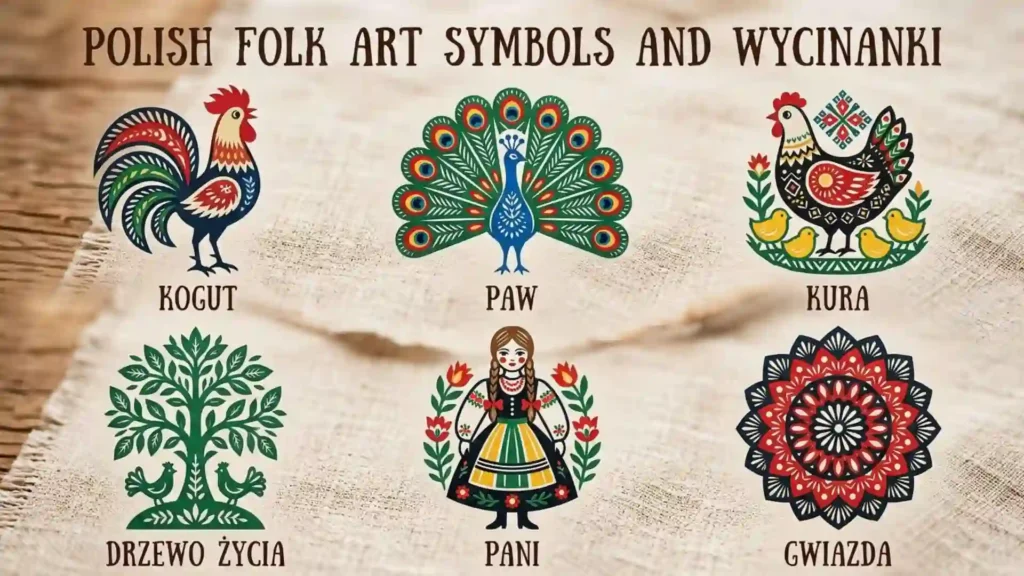
Polish folk art preserves traditional patterns, regional styles, and craftsmanship passed down through generations. It appears in clothing, embroidery, pottery, wooden decorations, paper art, and festive displays.
One of the best-known Polish folk art traditions is wycinanki, the practice of cutting decorative designs from paper.
What Do Wycinanki Patterns Represent?
Wycinanki designs often feature flowers, birds, roosters, trees, and symmetrical geometric shapes. Their colors, patterns, and techniques vary between regions.
In traditional settings, paper cutouts were used to decorate homes and celebrate special occasions. Today, wycinanki inspires contemporary illustrations, greeting cards, textiles, and home decorations.
Floral patterns may suggest nature, beauty, and renewal, while birds and other natural motifs reflect the importance of the countryside in traditional folk art. However, individual designs do not always have a fixed symbolic meaning.
The cultural importance of wycinanki lies partly in its regional diversity. It demonstrates how Polish communities developed distinct artistic identities while sharing broader cultural traditions.
7. Polish Floral and Embroidery Symbols
Flowers and natural motifs appear throughout Polish folk embroidery, traditional clothing, decorative textiles, and regional artwork. Their meanings depend on the design and context, so they should not be treated as a single universal system of symbolism.
Roses, poppies, cornflowers, leaves, and stylized garden flowers are common motifs in Polish-inspired decorative art.
Common Floral Motifs
Roses: Roses commonly represent love and beauty in European artistic traditions. In Polish-inspired designs, they may appear as decorative expressions of affection or elegance.
Poppies: Red poppies can evoke remembrance in historical and commemorative settings. They also appear as familiar flowers in landscapes and decorative artwork.
Cornflowers: Blue cornflowers are used in folk-inspired designs and may evoke countryside landscapes and natural beauty.
Floral wreaths: Wreaths and flower crowns appear in seasonal celebrations and traditional customs, with meanings that vary according to the occasion.
Polish embroidery combines these motifs with regional stitching techniques and color palettes. Such designs are useful for understanding traditional craftsmanship, but their interpretation should reflect the particular region or tradition rather than an invented universal meaning.
8. Polish Religious Symbols
Religious symbols are an important part of Poland’s cultural history, particularly because Roman Catholicism has played a major role in Polish religious and social life.
The cross, images of the Virgin Mary, and depictions of saints appear in churches, homes, religious art, and traditional celebrations.
The Black Madonna of Częstochowa
The Black Madonna of Częstochowa is a famous icon of the Virgin Mary housed at Jasna Góra Monastery in Częstochowa. It is one of the most important objects of devotion for Polish Catholics.
For many believers, the icon represents faith, hope, and spiritual protection. It also holds an important place in Poland’s religious and historical traditions.
The Black Madonna is a religious image rather than an official national emblem. Nevertheless, its influence on Polish religious culture and collective memory makes it an important symbol to understand when exploring Poland’s heritage.
9. Polish Symbols for Tattoos and Jewelry
Polish symbols can inspire tattoos, pendants, rings, bracelets, and other personal designs. The most suitable choice depends on whether you want to express family ancestry, national pride, cultural appreciation, or a connection to a particular historical event.
| Symbol | Possible tattoo or jewelry meaning |
| White Eagle | Polish ancestry, identity, and strength |
| White-and-red flag | National pride and connection to Poland |
| Warsaw Mermaid | Connection to Warsaw and local identity |
| Kotwica | Resistance, perseverance, and remembrance |
| Wycinanki patterns | Folk art and traditional craftsmanship |
| Floral motifs | Beauty, nature, and personal expression |
| Cross or religious icon | Christian faith and devotion |
A simple eagle outline or small red-and-white design may suit someone who prefers a minimal tattoo. A wycinanki-inspired pattern can provide a more decorative design, while the Warsaw Mermaid offers a distinctive option for people connected to the capital.
Before choosing a tattoo, research its history and context. In particular, the Kotwica is a wartime resistance emblem, and religious symbols can have personal significance to believers. Understanding these associations helps ensure that the design reflects your intended meaning.
10. Polish Symbols of Freedom and Independence
Freedom and independence are important themes in Polish history. Poland lost its independent statehood through the partitions of the late eighteenth century and regained independence in 1918 after World War I.
During the intervening period, Polish communities preserved elements of their language, traditions, and national identity. The national anthem, flag, and White Eagle became powerful ways of expressing continuity despite political change.
The Kotwica later became associated with resistance against German occupation during World War II. Although these symbols emerged in different historical contexts, they all help explain how visual emblems and shared traditions can become connected with national identity.
Poland celebrates National Independence Day on November 11. The date commemorates the restoration of Polish independence in 1918 and provides an opportunity to honor the people and historical events associated with that achievement.
11. Official Polish Symbols vs. Cultural Symbols
An important distinction when researching Polish symbols is the difference between official national emblems and other cultural designs.
Polish law identifies the White Eagle, white-and-red national colors, and Mazurek Dąbrowskiego as symbols of the Republic of Poland. These symbols receive particular legal protection and are used in official state contexts.
Other symbols have different roles. The Warsaw Mermaid represents the capital, wycinanki belongs to the folk art tradition, and the Kotwica is associated with wartime resistance. The Black Madonna of Częstochowa belongs primarily to Poland’s religious heritage.
Understanding these differences makes it easier to interpret each symbol accurately. It also prevents regional legends, decorative motifs, and historical emblems from being mistakenly described as official national symbols.
Frequently Asked Questions About Polish Symbols
What is the most famous Polish symbol?
The White Eagle and the white-and-red flag are among the most recognizable Polish symbols. The eagle represents Polish statehood, while the flag expresses national identity.
What do the colors of the Polish flag mean?
The white-and-red colors originate in Polish heraldic traditions. White corresponds to the White Eagle, while red comes from the background of the traditional coat of arms. They are also associated with broader values such as purity, courage, and sacrifice.
What animal represents Poland?
The White Eagle is Poland’s national emblematic animal. It appears on the country’s coat of arms and is associated with sovereignty, national identity, and historical continuity.
What is the Polish symbol for freedom?
There is no single symbol that represents every meaning of freedom in Poland. The flag, White Eagle, national anthem, and Kotwica each have distinct connections to national identity, independence, or resistance.
What does the Polish anchor symbol mean?
The Kotwica is an emblem of the Polish resistance during World War II. Its letters P and W stand for Polska Walcząca, meaning “Fighting Poland.”
What is the Polish mermaid symbol?
The Warsaw Mermaid, or Syrenka, is a legendary figure featured on Warsaw’s coat of arms. Carrying a sword and shield, she represents the city’s identity and defense.
What are traditional Polish folk symbols?
Polish folk art often features flowers, birds, roosters, trees, and geometric patterns. Wycinanki, a traditional paper-cutting art, is particularly recognizable for its intricate shapes and regional variations.
Are Polish symbols suitable for tattoos?
Yes. The White Eagle, Polish national colors, Warsaw Mermaid, and folk art patterns can all inspire meaningful designs. The Kotwica is another option, but its specific association with wartime resistance should be understood before using it.
Why are Polish symbols important?
Polish symbols connect people with the country’s history, statehood, regional traditions, and religious heritage. They preserve cultural memories and provide recognizable ways to express identity across generations.
Conclusion
Polish symbols offer a meaningful introduction to Poland’s history, national identity, and cultural traditions. The White Eagle, national flag, and anthem are the country’s principal national symbols, while the Warsaw Mermaid, Kotwica, religious icons, and folk art designs represent other important aspects of Polish life.
Each symbol has its own background and significance. Understanding those differences makes it easier to appreciate Poland’s heritage, whether you are studying its history, exploring your ancestry, researching traditional art, or choosing a meaningful tattoo design.

I am Lisa Reynolds, a linguist fascinated by the ever-changing world of slang. I enjoy researching how slang reflects trends, technology, and social connections. I wrote “Text Talk: Understanding Digital Slang” and “From Street to Screen: Slang in Media”, exploring the influence of digital communication on language. I love sharing my discoveries in a way that feels like a conversation with friends, so you feel the culture and humor behind every phrase.
 John Carter
 Marcus Lee