Annotation symbols are simple marks, letters, or signs that readers use to interact with a text. They help identify important ideas, confusing information, questions, evidence, connections, and personal reactions while reading. Instead of writing a long note beside every sentence, a reader can use a symbol to quickly record what a particular passage means or why it matters.
Annotation symbols are especially useful for students, teachers, researchers, and anyone practicing active or close reading. Common examples include a question mark (?) for something confusing, a star (★) for an important idea, an exclamation mark (!) for something surprising, and an arrow (→) for a connection or relationship.
There is no single universal system of annotation symbols. Teachers, schools, and readers may assign slightly different meanings to the same symbols. The most important rule is to choose clear meanings and use them consistently.
Annotation Symbols Quick Chart
The easiest way to understand annotation symbols is to see them together. The following chart provides a practical system that can be used for school reading, close reading, textbook study, and text analysis.
| Symbol | Meaning | When to Use It |
| ★ | Important | Mark a key idea, fact, or statement |
| ! | Interesting or surprising | Mark something unexpected or significant |
| ? | Question or confusion | Mark information you do not understand |
| ✓ | Agree or understand | Mark an idea you understand or support |
| X | Disagree or incorrect | Mark an idea you question or reject |
| → | Connection | Show a relationship between ideas |
| + | New information | Mark useful additional information |
| – | Less important or negative | Identify a weakness, disadvantage, or negative point |
| # | Main topic | Identify a central topic or theme |
| E | Evidence | Mark information that supports an argument |
| EX | Example | Identify an example supporting an idea |
| C | Connection | Connect the text with another idea or experience |
| R | Response | Record a personal response |
| D | Definition | Mark an important definition |
| CA | Cause | Identify the cause of an event |
| EF | Effect | Identify the result of an event |
This chart can be adapted according to the subject and purpose of your reading.
What Are Annotation Symbols?
Annotation symbols are shorthand marks used to make notes directly on or beside a text. They allow readers to record their thoughts without interrupting the flow of reading.
For example, imagine reading this sentence:
Plants use sunlight to produce energy through photosynthesis. ★
The star tells you that the statement is important.
If you read:
Scientists are still studying the exact reason for this change. ?
The question mark shows that you want to understand the reason or investigate it further.
Annotation therefore turns reading into an active process. Instead of simply looking at words on a page, you are asking questions, identifying important information, recognizing evidence, and making connections.
Why Are Annotation Symbols Important?
Annotation symbols make reading more organized and interactive. They can be especially helpful when a student needs to return to a text later for an exam, assignment, discussion, or research project.
They Make Important Information Easier to Find
A textbook may contain hundreds of sentences, but only a small number may be essential for an exam or assignment. Using a star or another symbol lets you locate those important points quickly.
They Improve Reading Comprehension
When you stop to question, explain, or connect an idea, you are processing the information more deeply. This can make it easier to understand and remember what you read.
They Save Time
A small symbol can replace a long note. Instead of writing “This is an important point that supports the author’s argument,” you can use ★ or E.
They Encourage Critical Thinking
Symbols such as ?, X, and → encourage readers to question information, identify contradictions, and connect different ideas.
They Make Revision Easier
When studying later, your annotations act as a visual guide. You can immediately see important ideas, questions, evidence, and examples without rereading every word.
Common Annotation Symbols and Their Meanings
Different annotation systems use different symbols, but several are particularly useful for active reading.
Star Symbol ★
The star is commonly used to mark something important.
Use ★ beside:
- A major idea
- An important fact
- A key argument
- A sentence likely to be useful later
- Information that summarizes the topic
For example:
The Industrial Revolution changed the way people lived and worked. ★
The star tells you that this statement deserves special attention.
Question Mark ?
The question mark indicates confusion, uncertainty, or a question.
Use it when:
- You do not understand a sentence.
- You want to research a claim.
- You disagree with an explanation.
- You need additional information.
Example:
The treaty resulted in several unexpected political changes. ?
You might want to find out exactly what those changes were.
Exclamation Mark !
The exclamation mark can identify something surprising, unusual, interesting, or especially significant.
Example:
The population increased by more than 50% in only ten years. !
The symbol reminds you that this information was unexpected or noteworthy.
Check Mark ✓
A check mark can indicate that you understand or agree with a statement.
Example:
Water freezes at 0°C under standard atmospheric pressure. ✓
The mark tells you that the information is understood or confirmed.
X Symbol
An X can indicate disagreement, an incorrect statement, a contradiction, or information that should be questioned.
Example:
The event happened in 1905. X
If another reliable source shows that the event happened in 1906, you can mark the statement with X and investigate further.
Arrow →
An arrow is useful for showing a relationship between two ideas.
It can represent:
- Cause and effect
- A logical connection
- A related idea
- A sequence
- A reference to another part of the text
Example:
Heavy rainfall → flooding
The arrow shows the relationship between the two ideas.
Annotation Symbols for Close Reading
Close reading means carefully examining a text to understand its meaning, structure, language, evidence, and purpose. Annotation symbols are particularly useful for this type of reading.
When doing a close reading, you can use symbols to identify:
- Main ideas
- Supporting evidence
- Arguments
- Examples
- Questions
- Repeated ideas
- Contradictions
- Important words
- Author’s purpose
- Connections between paragraphs
For example, if an author makes a claim and then provides evidence, you could mark the claim with ★ and the supporting evidence with E.
This makes the structure of the author’s argument easier to understand.
Annotation Symbols for Active Reading
Active reading means interacting with the material rather than simply reading it from beginning to end.
A simple active-reading system might use:
- ★ — Important
- ? — Confusing
- ! — Interesting
- → — Connection
- E — Evidence
- EX — Example
- R — Personal response
This system is simple enough for everyday reading while still providing enough information for deeper analysis.
Annotation Symbols for Students
Students can use annotation symbols across many subjects, including English, history, science, social studies, and literature.
English and Literature
In literature, students can mark:
- Themes
- Character development
- Important quotations
- Symbols and imagery
- Conflicts
- Evidence
- Questions about the story
For example:
★ for an important theme
E for evidence supporting a theme
? for confusing language
C for a connection to another part of the story
History
History students can use symbols to identify:
- Dates
- Causes
- Effects
- Important people
- Major events
- Evidence
- Contradictions
A useful system might be:
CA = Cause
EF = Effect
★ = Important event
E = Historical evidence
Science
In science texts, students can use annotation symbols to identify:
- Definitions
- Processes
- Causes
- Effects
- Examples
- Important terms
For example:
D can mark a definition, while CA and EF can identify cause-and-effect relationships.
How to Use Annotation Symbols Step by Step
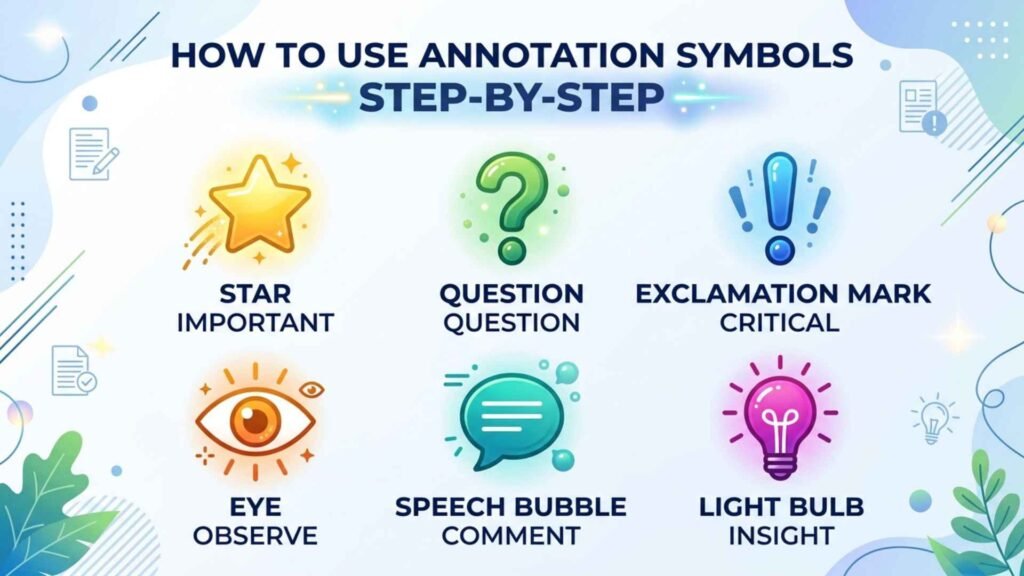
Creating an effective annotation system does not need to be complicated.
Step 1: Read the Text First
Before marking every sentence, understand the general topic. This helps you recognize which information is actually important.
Step 2: Choose Your Symbols
Select a small number of symbols based on your purpose.
For basic reading, four or five symbols may be enough:
- ★ Important
- ? Question
- ! Interesting
- → Connection
- E Evidence
Step 3: Mark Important Information
As you read, place symbols beside relevant sentences or paragraphs.
Do not mark everything. If every sentence has a symbol, the symbols stop being useful.
Step 4: Add Short Notes When Necessary
A symbol can show the general purpose of a passage, while a short note can explain your thinking.
For example:
★ Main argument
This is more useful than placing a star without knowing why you marked the sentence.
Step 5: Review Your Annotations
After finishing the text, look back at your symbols. Questions can become research topics, important points can become study notes, and evidence can be used in an assignment.
Examples of Annotation Symbols in a Text
Consider this short passage:
Many cities have experienced rapid population growth. This growth has increased pressure on housing and transportation systems. Governments are therefore looking for new ways to manage urban development.
You could annotate it like this:
★ Many cities have experienced rapid population growth.
CA Population growth causes increased pressure on housing and transportation.
→ Population growth → pressure on infrastructure.
? What solutions are governments using?
These annotations transform a simple paragraph into a set of useful study points.
Annotation Symbols for Identifying Evidence
Evidence is especially important when analyzing an argument or writing an essay.
Use E whenever the author provides information that supports a claim.
For example:
Claim: Exercise can improve overall health. ★
Evidence: Studies have linked regular physical activity with several health benefits. E
The symbols make the relationship between the claim and evidence easy to recognize.
Students can later use these marked passages when preparing essays, presentations, or exam answers.
Annotation Symbols for Questions and Confusing Information
Not every annotation needs to identify something important. Good readers also identify things they do not understand.
The ? symbol is useful for:
- Difficult vocabulary
- Unclear explanations
- Missing information
- Claims that need verification
- Questions that arise while reading
Instead of ignoring confusion, mark it and return to it later.
This is one of the main advantages of active reading: it turns confusion into something that can be investigated.
Annotation Symbols and Highlighting: What Is the Difference?
Highlighting and annotation are related, but they serve different purposes.
Highlighting draws attention to a specific part of the text. Annotation explains your reaction to that part.
For example, you might highlight a sentence and write:
★ Important evidence
The highlight identifies the passage, while the annotation explains why it matters.
Using both techniques can be useful, but excessive highlighting can make a page difficult to review. Annotation symbols can help you be more selective.
Are Annotation Symbols Universal?
No. Annotation symbols are not completely universal.
A teacher may use ★ to mean “important,” while another system could use it for a different purpose. Similarly, a check mark might mean “agree,” “understand,” or “correct.”
For this reason, always check the instructions provided by your teacher, school, textbook, or workplace.
If you create your own annotation system, write a small annotation key at the beginning of your notes so you remember what each symbol means.
How to Create an Annotation Key
An annotation key is a list explaining the symbols you use.
For example:
Basic Annotation Key
- ★ = Important idea
- ? = Question or confusion
- ! = Interesting or surprising
- → = Connection
- E = Evidence
- EX = Example
- D = Definition
- C = Connection to another idea
Keeping the key simple makes your system easier to remember.
Common Mistakes When Using Annotation Symbols
Annotation is most effective when it adds meaning. Several common mistakes can reduce its usefulness.
Using Too Many Symbols
A complicated system with 20 or 30 symbols can be difficult to remember. Start with a small set.
Marking Everything
If every sentence is marked as important, nothing stands out as especially important.
Using Symbols Without a Clear Meaning
Every symbol should have a purpose. Avoid adding random marks that you will not understand later.
Forgetting to Review Annotations
Annotations are most useful when you return to them. Review them before tests, assignments, or discussions.
Changing Meanings
Do not let a symbol mean one thing on one page and something completely different on another page.
Annotation Symbols Cheat Sheet
For a simple and practical system, use this cheat sheet:
| Symbol | Meaning |
| ★ | Important idea |
| ? | Question or confusion |
| ! | Interesting or surprising |
| ✓ | Understand or agree |
| X | Disagree or incorrect |
| → | Connection or cause/effect |
| E | Evidence |
| EX | Example |
| D | Definition |
| C | Connection |
| CA | Cause |
| EF | Effect |
This small collection is enough for most school reading and close-reading activities.
Frequently Asked Questions About Annotation Symbols
What are annotation symbols used for?
Annotation symbols are used to mark important information, questions, evidence, examples, connections, confusing ideas, and personal responses while reading.
What are the most common annotation symbols?
Some common symbols include ★ for important information, ? for questions, ! for interesting ideas, ✓ for understanding or agreement, X for disagreement, and → for connections or cause and effect.
What does ★ mean in annotation?
A star usually means that the information is important or deserves special attention.
What does ? mean in annotation?
A question mark usually identifies information that is confusing, unclear, questionable, or worth researching.
What does ! mean in annotation?
An exclamation mark commonly identifies something interesting, surprising, unusual, or significant.
What does E mean in annotation?
E can be used as shorthand for evidence, particularly when a passage supports an argument, claim, or idea.
What are annotation symbols used for in close reading?
They help readers identify important ideas, evidence, themes, questions, connections, arguments, and other details that contribute to the meaning of a text.
Can students create their own annotation symbols?
Yes. Students can create a personal system as long as the meanings are clear and used consistently. When working under teacher instructions, however, students should follow the required system.
Are annotation symbols the same as proofreading symbols?
No. Annotation symbols are generally used to analyze and interact with content, while proofreading symbols are specifically designed to identify and correct writing errors.
How many annotation symbols should I use?
There is no fixed number, but a small system of about five to ten symbols is usually easier to remember and use consistently.
Conclusion
Annotation symbols provide a simple way to turn passive reading into active reading. By using marks such as ★, ?, !, ✓, X, and →, readers can identify important information, record questions, recognize evidence, and connect ideas without writing lengthy notes beside every passage.
For students, annotation symbols are particularly useful for close reading, textbook study, literature analysis, research, and exam preparation. A simple annotation key can make the system even easier to understand and review.
The most effective approach is to keep your symbols simple, give each one a clear meaning, use them consistently, and avoid marking information unnecessarily. Remember that annotation symbols are not completely universal, so always follow the system required by your teacher or assignment when one is provided.
Whether you are annotating a novel, textbook, article, or academic passage, the right symbols can help you understand the material more deeply and find important information much faster.

I am Marcus Lee, a cultural researcher and slang aficionado. I study the roots of informal language and how communities create meaning through words. My books “Slang Origins: A Journey Through Words” and “Words That Move Us: Slang Across Generations” focus on the history and psychology of slang. I enjoy guiding readers to understand not just the words, but the stories and attitudes they carry, so you can truly connect with language in daily life.
 Lisa Reynolds
 John Carter