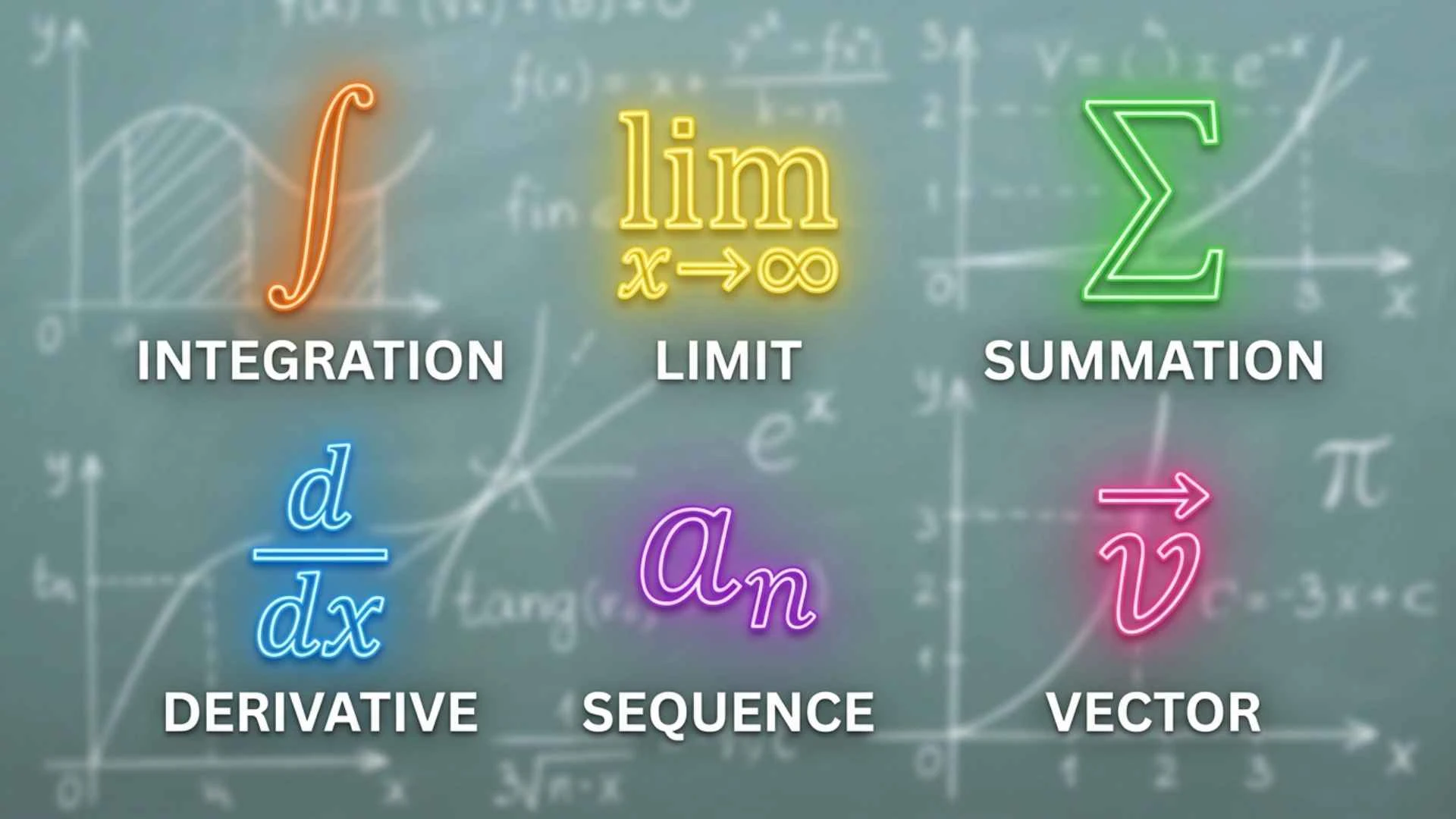
Calculus symbols are mathematical signs and notations used to represent important concepts such as limits, derivatives, integrals, rates of change, infinity, summation, and partial derivatives. Learning these symbols makes calculus formulas easier to read, understand, and solve.
Whether you are a beginner, high school student, college student, engineer, or someone reviewing calculus notation, having a complete list of calculus symbols can save time and make mathematical expressions much easier to understand.
This guide covers the most common calculus symbols and their meanings, along with formulas, examples, copy-and-paste symbols, LaTeX codes, and explanations of commonly confused notation.
Calculus Symbols Cheat Sheet
The following table provides a quick reference to the most commonly used calculus symbols.
| Symbol | Name | Meaning | Example |
| ∫ | Integral | Integration or accumulation | ∫x² dx |
| ∬ | Double integral | Integration over two variables | ∬f(x,y)dA |
| ∭ | Triple integral | Integration over three variables | ∭f(x,y,z)dV |
| ∮ | Contour integral | Integral around a closed path | ∮f(z)dz |
| d/dx | Derivative | Differentiation with respect to x | d(x²)/dx = 2x |
| dy/dx | Derivative | Rate of change of y with respect to x | dy/dx = 2x |
| ∂ | Partial derivative | Derivative involving multiple variables | ∂f/∂x |
| lim | Limit | Value approached by a function | lim x→a f(x) |
| ∞ | Infinity | Unbounded quantity | x → ∞ |
| Δ | Delta | Change or difference | Δx |
| Σ | Summation | Sum of multiple terms | Σi |
| ∏ | Product | Product of multiple terms | ∏i |
| ∇ | Nabla | Gradient or vector differential operator | ∇f |
| ′ | Prime | First derivative | f′(x) |
| ″ | Double prime | Second derivative | f″(x) |
| ≈ | Approximately equal | Nearly equal values | π ≈ 3.14 |
| → | Approaches | Tends toward a value | x → 0 |
| C | Constant | Constant of integration | x² + C |
| ∝ | Proportional to | Direct proportional relationship | y ∝ x |
| ∘ | Composition | Composition of functions | f ∘ g |
What Are Calculus Symbols?
Calculus symbols are standardized mathematical notations used to describe mathematical operations and relationships. Instead of writing a complete explanation every time, calculus uses short symbols to communicate complex ideas.
For example, the expression:
dy/dx
means the derivative of y with respect to x.
Similarly:
∫f(x)dx
represents the integral of a function with respect to x.
The notation limₓ→a f(x) represents the value that f(x) approaches as x gets closer to a.
These symbols form the basic language of differential calculus, integral calculus, and multivariable calculus.
Derivative Symbols
Derivatives measure how a quantity changes with respect to another quantity. They are among the most important concepts in calculus.
d/dx
The notation d/dx means “differentiate with respect to x.”
For example:
d/dx(x²) = 2x
This tells us that the derivative of x² is 2x.
dy/dx
The notation dy/dx represents the derivative of y with respect to x.
If:
y = x³
then:
dy/dx = 3x²
It can represent the instantaneous rate of change of y as x changes.
f′(x)
Another common way to write the first derivative is:
f′(x)
If:
f(x) = x² + 4x
then:
f′(x) = 2x + 4
The prime symbol is especially common when working with functions.
f″(x)
The double prime represents the second derivative.
If:
f(x) = x³
then:
f′(x) = 3x²
and:
f″(x) = 6x
The second derivative is useful for studying concavity, acceleration, and maximum or minimum points.
Higher Derivatives
Higher derivatives can be written in several ways.
For example:
f‴(x)
represents the third derivative.
Another notation is:
d³y/dx³
For the nth derivative, you may see:
f⁽ⁿ⁾(x)
or:
dⁿy/dxⁿ
Integral Symbols
Integration is another fundamental part of calculus. It is commonly used to find accumulated quantities, areas, volumes, and antiderivatives.
∫ — Integral
The symbol ∫ represents integration.
For example:
∫x² dx = x³/3 + C
The C represents an arbitrary constant of integration.
Definite Integral
A definite integral has upper and lower limits:
∫ₐᵇ f(x) dx
Here, a is the lower limit and b is the upper limit.
Definite integrals are commonly used to calculate the area under a curve or accumulated change over an interval.
∬ — Double Integral
The symbol ∬ represents a double integral.
It is commonly used in multivariable calculus to integrate a function over a two-dimensional region.
For example:
∬R f(x,y) dA
Here, R represents the region over which the function is integrated.
∭ — Triple Integral
The symbol ∭ represents a triple integral.
It is generally used for integration over a three-dimensional region.
For example:
∭V f(x,y,z) dV
Triple integrals are useful for finding quantities such as volume and mass when density varies throughout a three-dimensional object.
∮ — Contour or Closed-Line Integral
The symbol ∮ represents an integral taken around a closed path or curve.
It is frequently used in vector calculus and complex analysis.
Limit Symbols
Limits describe the value that a function approaches as its input gets closer to a particular value.
lim
The abbreviation lim represents a limit.
For example:
limₓ→2 (x + 3) = 5
This means that as x approaches 2, x + 3 approaches 5.
Limits are fundamental to the definition of derivatives and continuity.
→ — Approaches
The arrow → indicates that a value approaches or tends toward another value.
For example:
x → 0
means that x approaches zero.
A complete limit expression might look like:
limₓ→0 f(x)
One-Sided Limits
Calculus also uses notation for approaching a value from one particular side.
x → a⁺
means x approaches a from the right.
x → a⁻
means x approaches a from the left.
These symbols are especially useful when studying discontinuous or piecewise functions.
Infinity Symbol ∞
The symbol ∞ represents infinity.
Infinity is not an ordinary number. It is used to describe something that continues without a finite bound.
For example:
limₓ→∞ 1/x = 0
This means that as x becomes increasingly large, 1/x approaches zero.
Infinity appears frequently in limits, infinite series, sequences, and improper integrals.
Delta Symbols in Calculus
The Greek letter delta appears in several areas of calculus.
Δ — Change or Difference
The capital delta Δ commonly represents a finite change.
For example:
Δx
means the change in x.
Similarly:
Δy
means the change in y.
The average rate of change can be written as:
Δy/Δx
This idea provides an important foundation for understanding derivatives.
δ — Small Change or Variation
The lowercase delta δ can represent a small change, variation, or a particular mathematical quantity depending on the context.
It is important not to automatically assume that δ and Δ always mean the same thing. Their meanings depend on the mathematical context.
Partial Derivative Symbol ∂
The symbol ∂ is used for partial derivatives.
Partial derivatives are necessary when a function contains more than one independent variable.
For example:
f(x,y) = x² + y³
The partial derivative with respect to x is:
∂f/∂x = 2x
The partial derivative with respect to y is:
∂f/∂y = 3y²
Partial derivatives are important in multivariable calculus, physics, engineering, economics, and mathematical modeling.
Nabla Symbol ∇
The symbol ∇ is called nabla or del.
It is commonly used in vector calculus.
For a scalar function f, the expression:
∇f
represents the gradient of f.
The gradient provides information about the direction in which a function increases most rapidly.
The nabla operator is also used when discussing divergence and curl.
Summation Symbol Σ
The capital Greek letter Σ represents summation.
It tells you to add a sequence of terms together.
For example:
Σᵢ₌₁ⁿ i
means:
1 + 2 + 3 + … + n
Summation notation is useful in calculus when working with sequences, series, numerical approximations, and mathematical formulas.
Product Symbol ∏

The symbol ∏ represents a product of multiple terms.
It works similarly to the summation symbol, except that the terms are multiplied rather than added.
For example:
∏ᵢ₌₁ⁿ i
represents:
1 × 2 × 3 × … × n
Product notation is useful in sequences, series, probability, and advanced mathematical calculations.
Differential Symbols dx, dy, and dt
Differential notation appears throughout calculus.
dx
dx indicates a differential involving x.
For example:
∫f(x)dx
means that the function is integrated with respect to x.
dy
dy represents a differential involving y.
The expression:
dy/dx
represents the derivative of y with respect to x.
dt
dt is commonly used when time is the independent variable.
For example:
dx/dt
represents the rate at which x changes with respect to time.
Newton’s Dot Notation
Calculus and physics sometimes use dots above variables to represent derivatives with respect to time.
ẋ
The symbol ẋ represents the first derivative of x with respect to time.
It is equivalent to:
dx/dt
ẍ
The symbol ẍ represents the second derivative with respect to time.
It is equivalent to:
d²x/dt²
This notation is common in mechanics and physics.
Commonly Confused Calculus Symbols
Some calculus symbols look similar but have different meanings.
d vs ∂
d is generally used for ordinary derivatives.
∂ is used for partial derivatives.
For example:
dy/dx
is an ordinary derivative, while:
∂f/∂x
is a partial derivative.
Δ vs δ
Δ commonly represents a finite change or difference.
δ can represent a small variation or change depending on context.
They should not automatically be treated as interchangeable.
∫ vs ∬ vs ∭
These symbols represent different types of integration:
- ∫ — single integral
- ∬ — double integral
- ∭ — triple integral
The number of integral signs generally indicates the dimensional nature of the integration.
′ vs ″
The prime symbols indicate derivatives:
- f′(x) — first derivative
- f″(x) — second derivative
- f‴(x) — third derivative
Calculus Symbols Copy and Paste
If you need calculus symbols for notes, documents, websites, presentations, or social posts, you can copy them directly from this list:
∫ ∂ ∇ ∑ Σ ∏ ∞ Δ δ ε → ← ≈ ≠ ≤ ≥ ∝ ∘ ∬ ∭ ∮ ′ ″ ẋ ẍ
Common Copy-Paste Symbols
- Integral: ∫
- Partial derivative: ∂
- Nabla: ∇
- Summation: Σ
- Product: ∏
- Infinity: ∞
- Capital delta: Δ
- Lowercase delta: δ
- Epsilon: ε
- Approximately equal: ≈
- Not equal: ≠
- Less than or equal: ≤
- Greater than or equal: ≥
- Proportional to: ∝
- Approaches: →
- Double integral: ∬
- Triple integral: ∭
- Closed integral: ∮
Calculus Symbols in LaTeX
LaTeX is widely used for writing mathematical formulas digitally. Knowing basic LaTeX commands can make it easier to type calculus notation.
| Symbol | LaTeX Code |
| ∫ | \int |
| ∂ | \partial |
| ∇ | \nabla |
| ∞ | \infty |
| Σ | \sum |
| ∏ | \prod |
| → | \to |
| ≈ | \approx |
| ≤ | \leq |
| ≥ | \geq |
| ∝ | \propto |
| ∬ | \iint |
| ∭ | \iiint |
| ∮ | \oint |
Example of an Integral in LaTeX
The expression:
∫f(x)dx
can be written as:
\int f(x)\,dx
A definite integral can be written as:
\int_a^b f(x)\,dx
which represents:
∫ₐᵇ f(x) dx
Example of a Derivative in LaTeX
A derivative can be written as:
\frac{dy}{dx}
which produces:
dy/dx
A partial derivative can be written as:
\frac{\partial f}{\partial x}
which produces:
∂f/∂x
Calculus Notation Examples
Understanding symbols becomes easier when they are used in actual formulas.
Derivative Example
If:
f(x) = x⁴
then:
f′(x) = 4x³
Integral Example
If:
f(x) = x²
then:
∫x² dx = x³/3 + C
Limit Example
limₓ→3 (x + 2) = 5
The function approaches 5 as x approaches 3.
Partial Derivative Example
For:
f(x,y) = x²y + y³
the partial derivative with respect to x is:
∂f/∂x = 2xy
Second Derivative Example
For:
f(x) = x³
the first derivative is:
f′(x) = 3x²
and the second derivative is:
f″(x) = 6x
Common Calculus Symbols by Topic
Different branches of calculus use different groups of symbols.
Differential Calculus
Common symbols include:
- d/dx
- dy/dx
- f′(x)
- f″(x)
- Δx
- Δy
These are mainly related to derivatives and rates of change.
Integral Calculus
Common symbols include:
- ∫
- ∬
- ∭
- ∮
- dx
- dy
- dt
- C
These are used for integration and accumulation.
Multivariable Calculus
Common symbols include:
- ∂
- ∇
- ∬
- ∭
- dA
- dV
These symbols are used when functions involve multiple variables or higher-dimensional regions.
Series and Sequences
Common notation includes:
- Σ
- ∞
- n
- aₙ
- ∑ₙ₌₁∞
These symbols are commonly used to represent infinite sequences and series.
How to Learn Calculus Symbols
You do not need to memorize every calculus symbol in one day. Start with the symbols that appear most frequently.
First, learn:
lim, ∫, d/dx, dy/dx, f′(x), ∞, Δ, ∂, Σ, and ∇.
Then practice identifying each symbol in actual equations.
A useful method is to create a three-column study sheet:
| Symbol | Meaning | Example |
| ∫ | Integral | ∫x dx |
| d/dx | Derivative | d(x²)/dx |
| ∂ | Partial derivative | ∂f/∂x |
| lim | Limit | lim x→0 f(x) |
| ∞ | Infinity | x→∞ |
Repeatedly seeing a symbol together with its meaning and an example makes it easier to remember.
Frequently Asked Questions About Calculus Symbols
What are the main symbols used in calculus?
The most common calculus symbols include ∫, d/dx, dy/dx, ∂, lim, ∞, Δ, Σ, ∇, and ′. They represent integration, differentiation, partial derivatives, limits, infinity, change, summation, gradients, and derivatives.
What is the symbol for differentiation?
There is more than one way to represent differentiation. Common notation includes d/dx, dy/dx, and f′(x).
What is the symbol for integration?
The main symbol for integration is ∫. Definite integrals are written with upper and lower limits, such as ∫ₐᵇ f(x)dx.
What does ∂ mean in calculus?
∂ represents a partial derivative. It is used when a function has multiple variables.
What does dx mean in calculus?
dx represents a differential associated with x and indicates that differentiation or integration is being performed with respect to x, depending on the expression.
What does Δ mean in calculus?
Δ commonly represents a finite change or difference. For example, Δx means the change in x.
What does ∇ mean?
∇, called nabla or del, is an operator used in vector calculus. It is commonly associated with the gradient, divergence, and curl.
What does ∞ mean in calculus?
∞ represents infinity or an unbounded quantity. It is frequently used when studying limits, sequences, series, and improper integrals.
What does f′(x) mean?
f′(x) represents the first derivative of a function f(x). It measures the instantaneous rate of change of the function.
What is the difference between d and ∂?
d is generally used for ordinary derivatives, while ∂ is used for partial derivatives involving functions of multiple variables.
Can I copy and paste calculus symbols?
Yes. Common calculus symbols such as ∫, ∂, ∇, Σ, ∞, Δ, ∬, ∭, and ∮ can be copied and pasted directly into compatible documents and applications.
How do I type calculus symbols in LaTeX?
LaTeX provides commands for most calculus symbols. For example, use \int for ∫, \partial for ∂, \nabla for ∇, and \infty for ∞.
Conclusion
Calculus symbols provide a concise language for expressing derivatives, integrals, limits, rates of change, accumulation, and multivariable relationships. Symbols such as ∫, d/dx, ∂, lim, ∞, Δ, Σ, and ∇ are essential for understanding mathematical notation used throughout calculus.
For beginners, the easiest approach is to learn each symbol together with its name, meaning, and a simple example. Once the basic notation becomes familiar, more advanced concepts such as double integrals, partial derivatives, gradients, infinite series, and higher derivatives become much easier to understand.
Whether you need a quick calculus symbols cheat sheet, want to copy and paste mathematical symbols, or need to understand calculus notation and LaTeX codes, this reference provides the essential symbols and explanations in one place.

I am Lisa Reynolds, a linguist fascinated by the ever-changing world of slang. I enjoy researching how slang reflects trends, technology, and social connections. I wrote “Text Talk: Understanding Digital Slang” and “From Street to Screen: Slang in Media”, exploring the influence of digital communication on language. I love sharing my discoveries in a way that feels like a conversation with friends, so you feel the culture and humor behind every phrase.
 John Carter
 Marcus Lee