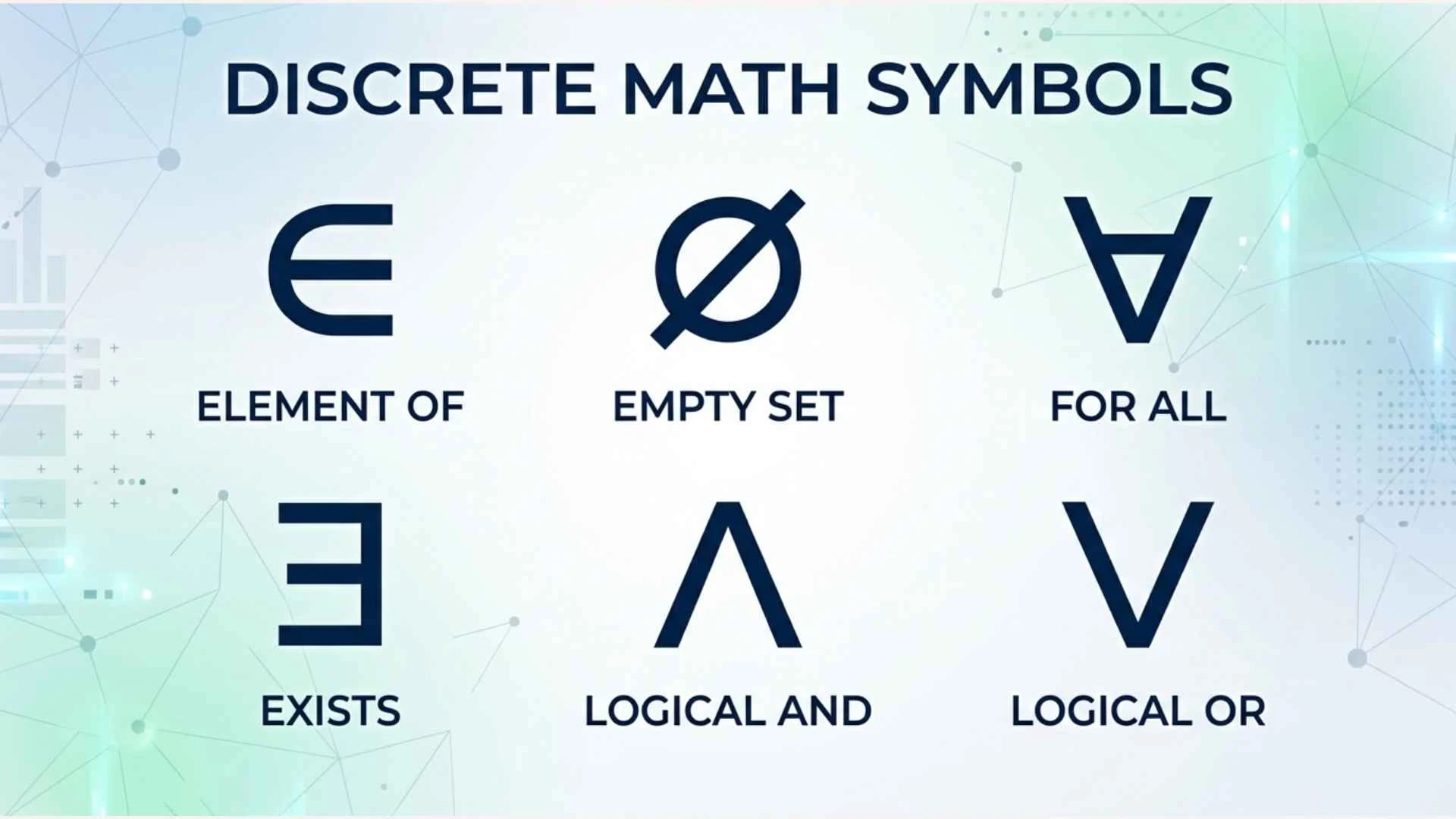
Discrete mathematics uses symbols to represent logical statements, sets, functions, relations, numbers, graphs, counting operations, and mathematical proofs. If you are studying discrete mathematics, computer science, information technology, or related subjects, understanding these symbols can make formulas and problems much easier to read.
Some symbols are familiar, such as =, <, and >, while others, including ∈, ⊆, ∀, ∃, ∧, and ⇒, may initially look confusing.
This guide provides a complete and beginner-friendly reference to discrete math symbols, including their meanings, how to read them, examples, and the differences between commonly confused symbols.
What Are Discrete Math Symbols?
Discrete math symbols are mathematical notations used to describe objects and relationships that can be treated as separate or distinct. Discrete mathematics includes topics such as logic, set theory, functions, relations, graph theory, combinatorics, number theory, sequences, and proofs.
For example:
- ∈ means is an element of
- ⊆ means is a subset of
- ∪ means union
- ∩ means intersection
- ¬ means not
- ∧ means and
- ∨ means or
- ∀ means for all
- ∃ means there exists
- ⇒ means implies
- ⇔ means if and only if
These symbols allow students and researchers to express mathematical ideas precisely without writing long sentences.
Discrete Math Symbols Cheat Sheet
The following table provides a quick reference for some of the most commonly used symbols.
| Symbol | Name | Meaning | Example |
| ∈ | Element of | Belongs to a set | 3 ∈ A |
| ∉ | Not an element of | Does not belong to a set | 5 ∉ A |
| ⊆ | Subset | Every element is contained in another set | A ⊆ B |
| ⊂ | Proper subset | Subset that is not equal to the other set | A ⊂ B |
| ⊇ | Superset | Contains another set | B ⊇ A |
| ∪ | Union | Elements in either set | A ∪ B |
| ∩ | Intersection | Elements common to both sets | A ∩ B |
| ∅ | Empty set | A set containing no elements | A = ∅ |
| ¬ | Negation | Not | ¬P |
| ∧ | Conjunction | And | P ∧ Q |
| ∨ | Disjunction | Or | P ∨ Q |
| ⇒ | Implication | Implies | P ⇒ Q |
| ⇔ | Biconditional | If and only if | P ⇔ Q |
| ∀ | Universal quantifier | For all | ∀x |
| ∃ | Existential quantifier | There exists | ∃x |
| = | Equality | Is equal to | x = 5 |
| ≠ | Inequality | Is not equal to | x ≠ 5 |
| < | Less than | Smaller than | x < 5 |
| > | Greater than | Larger than | x > 5 |
| ≤ | Less than or equal to | At most | x ≤ 5 |
| ≥ | Greater than or equal to | At least | x ≥ 5 |
| ∣ | Divides | Divides evenly | 3 ∣ 12 |
| ≡ | Congruent | Same remainder modulo n | 7 ≡ 1 (mod 3) |
| Σ | Summation | Adds terms | Σi |
| Π | Product | Multiplies terms | Πi |
| ! | Factorial | Product of positive integers up to a number | 5! = 120 |
| → | Mapping/function | Maps one object to another | f: A → B |
| ∘ | Composition | Composition of functions | f ∘ g |
Logical Symbols in Discrete Mathematics
Logic is one of the central areas of discrete mathematics. Logical symbols are used to construct propositions, compound statements, proofs, and mathematical arguments.
Negation Symbol: ¬
The symbol ¬ means not. It changes the truth value of a proposition.
If:
P = The computer is on.
then:
¬P = The computer is not on.
The symbol can be read as not P or the negation of P.
AND Symbol: ∧
The symbol ∧ means AND or conjunction.
P ∧ Q
is true only when both P and Q are true.
For example:
P = 2 is even
Q = 4 is even
Therefore:
P ∧ Q
is true.
OR Symbol: ∨
The symbol ∨ means OR or disjunction.
P ∨ Q
is true when at least one of P or Q is true.
In standard mathematical logic, this normally means inclusive OR, so it is also true when both P and Q are true.
Implication Symbol: ⇒
The symbol ⇒ means implies or if…then.
P ⇒ Q
can be read as:
If P, then Q.
For example:
x > 10 ⇒ x > 5
If x is greater than 10, then x must also be greater than 5.
Biconditional Symbol: ⇔
The symbol ⇔ means if and only if.
P ⇔ Q
means that P implies Q and Q implies P.
For example:
x is even ⇔ x is divisible by 2
This means the two conditions are equivalent.
Logical Equivalence: ≡
The symbol ≡ can represent logical equivalence in some contexts.
For example:
P ≡ Q
can mean that P and Q have the same truth value in every possible case.
The exact notation can vary between textbooks, so always check the convention being used in your course.
Quantifier Symbols
Quantifiers are particularly important when writing mathematical definitions and proofs.
Universal Quantifier: ∀
The symbol ∀ means for all, for every, or for each.
Example:
∀x ∈ ℝ, x² ≥ 0
This means:
For every real number x, x² is greater than or equal to zero.
Existential Quantifier: ∃
The symbol ∃ means there exists.
Example:
∃x ∈ ℤ such that x² = 9
This means:
There exists an integer x whose square is 9.
Both x = 3 and x = -3 satisfy this statement.
Unique Existential Quantifier: ∃!
The notation ∃! means there exists exactly one.
For example:
∃!x ∈ ℝ such that x + 2 = 5
There is exactly one solution:
x = 3
Set Theory Symbols
Set theory is one of the most important foundations of discrete mathematics. A set is a collection of distinct objects.
Element Symbol: ∈
The symbol ∈ means is an element of or belongs to.
If:
A = {1, 2, 3, 4}
then:
2 ∈ A
is true because 2 belongs to A.
Not an Element Symbol: ∉
The symbol ∉ means is not an element of.
For example:
7 ∉ {1, 2, 3, 4}
means that 7 is not an element of the set.
Subset Symbol: ⊆
The symbol ⊆ means is a subset of.
If:
A = {1, 2}
and:
B = {1, 2, 3}
then:
A ⊆ B
because every element of A is also an element of B.
Importantly, A ⊆ B allows A and B to be equal.
Proper Subset Symbol: ⊂
The symbol ⊂ is commonly used for a proper subset.
For example:
{1, 2} ⊂ {1, 2, 3}
The first set is contained in the second, but the two sets are not equal.
Some textbooks use ⊂ differently, so ⊊ is sometimes preferred when a strict/proper subset is intended.
Superset Symbol: ⊇
The symbol ⊇ means is a superset of.
If:
A ⊆ B
then:
B ⊇ A
Both statements describe the same containment relationship from opposite directions.
Union Symbol: ∪
The symbol ∪ means union.
If:
A = {1, 2, 3}
and:
B = {3, 4, 5}
then:
A ∪ B = {1, 2, 3, 4, 5}
The union contains every distinct element found in either set.
Intersection Symbol: ∩
The symbol ∩ means intersection.
Using the previous sets:
A ∩ B = {3}
The intersection contains only elements shared by both sets.
Empty Set Symbol: ∅
The symbol ∅ represents the empty set, which contains no elements.
For example:
A = ∅
means that A contains nothing.
The empty set is different from a set containing zero:
∅ ≠ {0}
The set {0} contains one element: zero.
Set Difference Symbol: ∖
The symbol ∖ represents set difference.
If:
A = {1, 2, 3, 4}
and:
B = {3, 4, 5}
then:
A ∖ B = {1, 2}
It means the elements in A that are not in B.
Complement Symbol: Aᶜ
The notation Aᶜ commonly represents the complement of A relative to a specified universal set.
If:
U = {1, 2, 3, 4, 5}
and:
A = {1, 2}
then:
Aᶜ = {3, 4, 5}
The exact complement depends on the universal set being considered.
Cartesian Product: ×
The symbol × can represent the Cartesian product of two sets.
If:
A = {1, 2}
and:
B = {a, b}
then:
A × B = {(1,a), (1,b), (2,a), (2,b)}
The Cartesian product creates ordered pairs from the two sets.
Number Symbols Used in Discrete Math
Discrete mathematics frequently works with different types of numbers.
| Symbol | Meaning |
| ℕ | Natural numbers |
| ℤ | Integers |
| ℚ | Rational numbers |
| ℝ | Real numbers |
| ℂ | Complex numbers |
Natural Numbers: ℕ
ℕ represents natural numbers.
Depending on the textbook, natural numbers may begin with 0 or 1. Therefore, always check the definition used by your course.
Integers: ℤ
ℤ represents all integers:
…, -3, -2, -1, 0, 1, 2, 3, …
Rational Numbers: ℚ
ℚ represents rational numbers that can be written as a ratio of two integers:
a/b
where b ≠ 0.
Examples include:
1/2, 3/4, and -5/2.
Real Numbers: ℝ
ℝ represents the set of real numbers, including integers, rational numbers, and irrational numbers.
Complex Numbers: ℂ
ℂ represents complex numbers, generally written in the form:
a + bi
where i² = -1.
Number Theory Symbols
Number theory is another area where discrete math notation is frequently used.
Divisibility Symbol: ∣
The symbol ∣ means divides.
For example:
3 ∣ 12
means that 3 divides 12 evenly.
This is true because:
12 = 3 × 4
By contrast:
5 ∤ 12
means 5 does not divide 12.
Congruence Symbol: ≡
The symbol ≡ is commonly used for congruence modulo n.
For example:
7 ≡ 1 (mod 3)
because both 7 and 1 leave the same remainder when divided by 3.
This notation is particularly important in modular arithmetic and areas such as cryptography.
Function Symbols
Functions describe mappings between sets.
A function can be written as:
f: A → B
This means f maps elements of A to elements of B.
For example:
f(x) = x + 2
Then:
f(3) = 5
Function Composition: ∘
The symbol ∘ represents composition.
(f ∘ g)(x) = f(g(x))
The important point is that g is applied first and f is applied afterward.
One-to-One Function
A one-to-one or injective function maps different inputs to different outputs.
The notation and definitions may vary, but conceptually:
f(a) = f(b) ⇒ a = b
Onto Function
A function is surjective or onto when every element in the target set is mapped to by at least one element of the domain.
Bijection
A bijective function is both injective and surjective. Bijections are particularly useful when comparing the sizes of sets.
Relation Symbols

A relation describes a connection between elements.
Relations can be represented using ordered pairs, such as:
R = {(1,2), (2,3), (3,4)}
The symbol ∼ is often used to say that two objects are related:
a ∼ b
The exact meaning depends on the relation being defined.
Discrete mathematics commonly studies properties such as:
- Reflexive
- Symmetric
- Antisymmetric
- Transitive
Relations can also form equivalence relations and partial orders.
Counting Symbols
Counting and combinatorics are major parts of discrete mathematics.
Factorial Symbol: !
The symbol ! represents factorial.
For a positive integer n:
n! = n(n-1)(n-2)…1
For example:
5! = 5 × 4 × 3 × 2 × 1 = 120
Factorials are used extensively in permutations and combinations.
Combination: C(n,r)
A combination counts selections where order does not matter.
The standard formula is:
C(n,r) = n! / [r!(n-r)!]
For example, selecting 2 students from a group of 5 can be calculated using:
C(5,2) = 10
Permutation: P(n,r)
A permutation counts arrangements where order matters.
The formula is:
P(n,r) = n!/(n-r)!
This distinction between combinations and permutations is important when solving counting problems.
Summation and Product Symbols
Summation Symbol: Σ
The capital Greek letter sigma, Σ, represents a sum.
For example:
Σᵢ₌₁⁵ i
means:
1 + 2 + 3 + 4 + 5
Therefore:
Σᵢ₌₁⁵ i = 15
Product Symbol: Π
The capital Greek letter pi, Π, represents a product.
For example:
Πᵢ₌₁³ i
means:
1 × 2 × 3
Therefore:
Πᵢ₌₁³ i = 6
Sequence and Recurrence Symbols
Sequences are important in discrete mathematics, especially when studying algorithms and recurrence relations.
A sequence can be written as:
a₁, a₂, a₃, …, aₙ
The symbol aₙ represents the nth term.
A recurrence relation defines one term using previous terms.
For example:
aₙ = aₙ₋₁ + 2
This says each term is two greater than the preceding term.
A famous example is the Fibonacci sequence:
Fₙ = Fₙ₋₁ + Fₙ₋₂
with appropriate starting values.
Graph Theory Symbols
Graph theory is a major component of discrete mathematics and computer science.
A graph is commonly represented as:
G = (V, E)
where:
- V is the set of vertices.
- E is the set of edges.
For example:
V = {A, B, C}
and:
E = {{A,B}, {B,C}}
describe a graph with three vertices and two edges.
Degree Symbol: deg(v)
deg(v) represents the degree of a vertex.
In an undirected graph, the degree tells you how many edges are connected to the vertex.
Vertex and Edge Count
The notation:
|V|
usually represents the number of vertices.
Similarly:
|E|
represents the number of edges.
The vertical bars can therefore represent cardinality when applied to a set.
Cardinality Symbols
Cardinality describes the number of elements in a set.
For example:
A = {2, 4, 6, 8}
Then:
|A| = 4
The same vertical-bar notation can have different meanings depending on context. For example:
- |A| can mean the cardinality of set A.
- |x| can mean the absolute value of x.
- |a| may refer to the length or magnitude of an object in some contexts.
Understanding the surrounding topic is therefore important.
Proof and Reasoning Symbols
Discrete mathematics relies heavily on mathematical proofs.
Therefore: ∴
The symbol ∴ means therefore.
It is sometimes used before a conclusion.
Because: ∵
The symbol ∵ means because or since.
End of Proof: □
A square, often written as □, may be used at the end of a proof to indicate that the proof is complete.
You may also see QED, which comes from the Latin phrase meaning “which was to be demonstrated.”
Boolean Algebra Symbols
Boolean algebra is especially important in computer science and digital logic.
The most common Boolean values are:
1 = True
0 = False
Common operators include:
| Symbol | Meaning |
| ∧ | AND |
| ∨ | OR |
| ¬ | NOT |
| ⊕ | XOR |
For example:
1 ∧ 1 = 1
but:
1 ∧ 0 = 0
For XOR:
1 ⊕ 0 = 1
while:
1 ⊕ 1 = 0
Commonly Confused Discrete Math Symbols
Some symbols look similar but have completely different meanings.
∈ vs ⊆
This is one of the most important distinctions.
∈ connects an element to a set:
3 ∈ {1,2,3}
⊆ connects one set to another set:
{3} ⊆ {1,2,3}
So remember:
Element → ∈
Set → ⊆
∪ vs ∩
∪ means union, while ∩ means intersection.
For:
A = {1,2,3}
and:
B = {3,4,5}
we get:
A ∪ B = {1,2,3,4,5}
but:
A ∩ B = {3}
∀ vs ∃
∀ means for all.
∃ means there exists.
Compare:
∀x, x ≥ 0
with:
∃x, x = 5
The first statement concerns every x, while the second only requires at least one suitable x.
→ vs ⇔
→ or ⇒ commonly represents implication:
P ⇒ Q
means if P, then Q.
⇔ represents a biconditional:
P ⇔ Q
means P if and only if Q.
How to Read Discrete Math Symbols
Learning the meaning of a symbol is only the first step. You also need to know how to read an entire mathematical expression.
Consider:
∀x ∈ A, P(x) ⇒ Q(x)
This can be read as:
For every x in A, if P(x) is true, then Q(x) is true.
Another example is:
A ∩ B ⊆ C
This means:
The intersection of A and B is a subset of C.
Breaking a complicated expression into individual symbols makes it much easier to understand.
How to Memorize Discrete Math Symbols
Trying to memorize every symbol at once can be overwhelming. A better approach is to learn them by category.
Start with the following groups:
- Logic: ¬, ∧, ∨, ⇒, ⇔
- Quantifiers: ∀, ∃, ∃!
- Sets: ∈, ∉, ⊆, ∪, ∩, ∅
- Numbers: ℕ, ℤ, ℚ, ℝ, ℂ
- Number theory: ∣, ∤, ≡
- Counting: !, C(n,r), P(n,r)
- Functions: →, ∘
- Graphs: G, V, E, deg(v)
- Sequences: aₙ, Σ
- Boolean algebra: ∧, ∨, ¬, ⊕
Then practice each symbol in an actual equation rather than memorizing a definition alone.
Why Are Discrete Math Symbols Important for Computer Science?
Discrete mathematics provides much of the mathematical language used in computer science. University courses commonly connect discrete mathematics with logic, sets, relations, functions, counting, graph theory, algorithms, and proof techniques.
For example, programmers and computer scientists use mathematical logic to reason about conditions, sets to model collections of data, graphs to represent networks, and combinatorics to analyze possible arrangements.
Understanding notation therefore helps with more than mathematics exams. It can make subjects such as algorithms, data structures, databases, cryptography, and theoretical computer science easier to understand.
Frequently Asked Questions About Discrete Math Symbols
What are the most common discrete math symbols?
Some of the most common symbols are ∈, ∉, ⊆, ∪, ∩, ∅, ¬, ∧, ∨, ⇒, ⇔, ∀, and ∃.
What does ∈ mean in discrete mathematics?
∈ means is an element of or belongs to. For example, 2 ∈ {1,2,3} means that 2 belongs to the set.
What does ⊆ mean?
⊆ means is a subset of. A ⊆ B means every element of A is also an element of B.
What is the difference between ∈ and ⊆?
∈ describes the relationship between an element and a set. ⊆ describes the relationship between two sets.
For example:
2 ∈ {1,2,3}
but:
{2} ⊆ {1,2,3}.
What does ∀ mean?
∀ means for all or for every. It is called the universal quantifier.
What does ∃ mean?
∃ means there exists. It is called the existential quantifier.
What does ∅ mean?
∅ means the empty set, a set containing no elements.
What do ∪ and ∩ mean?
∪ means union, while ∩ means intersection. Union collects elements from either set, while intersection contains elements common to both sets.
What does ⇒ mean?
⇒ means implies. The expression P ⇒ Q can be read as “if P, then Q.”
What does ⇔ mean?
⇔ means if and only if. It indicates that both directions of implication hold.
What is the symbol for factorial?
The symbol ! represents factorial. For example, 5! = 120.
What is the symbol for divisibility?
The symbol ∣ means divides. For example, 4 ∣ 20 means 4 divides 20 evenly.
What does ≡ mean in discrete mathematics?
≡ can represent logical equivalence or, in number theory, congruence modulo a number. Its exact meaning depends on the context.
Final Discrete Math Symbols Reference
For quick revision, remember these core symbols first:
Logic: ¬ = NOT, ∧ = AND, ∨ = OR, ⇒ = implies, ⇔ = if and only if.
Quantifiers: ∀ = for all, ∃ = there exists, ∃! = exactly one exists.
Sets: ∈ = element of, ∉ = not an element of, ⊆ = subset, ⊇ = superset, ∪ = union, ∩ = intersection, ∅ = empty set, ∖ = difference.
Numbers: ℕ = natural numbers, ℤ = integers, ℚ = rational numbers, ℝ = real numbers, ℂ = complex numbers.
Number theory: ∣ = divides, ∤ = does not divide, ≡ = congruent.
Counting: ! = factorial, C(n,r) = combination, P(n,r) = permutation.
Functions: → = mapping, ∘ = composition.
Sequences: aₙ = nth term, Σ = summation, Π = product.
Graphs: G = (V,E) = graph, deg(v) = degree of a vertex.
Conclusion
Learning discrete math symbols becomes much easier when the symbols are organized according to their purpose. Logic symbols help express statements and reasoning, set symbols describe collections and operations, quantifiers describe the scope of statements, and function and relation notation describes mathematical relationships.
For computer science students, symbols related to graphs, counting, number theory, Boolean algebra, sequences, and functions are also particularly useful. Instead of memorizing a long list without context, practice each symbol with a simple example and learn the differences between commonly confused notation such as ∈ and ⊆ or ∪ and ∩.
With regular practice, these symbols become a concise mathematical language rather than a collection of unfamiliar characters.

I am Lisa Reynolds, a linguist fascinated by the ever-changing world of slang. I enjoy researching how slang reflects trends, technology, and social connections. I wrote “Text Talk: Understanding Digital Slang” and “From Street to Screen: Slang in Media”, exploring the influence of digital communication on language. I love sharing my discoveries in a way that feels like a conversation with friends, so you feel the culture and humor behind every phrase.
 John Carter
 Marcus Lee