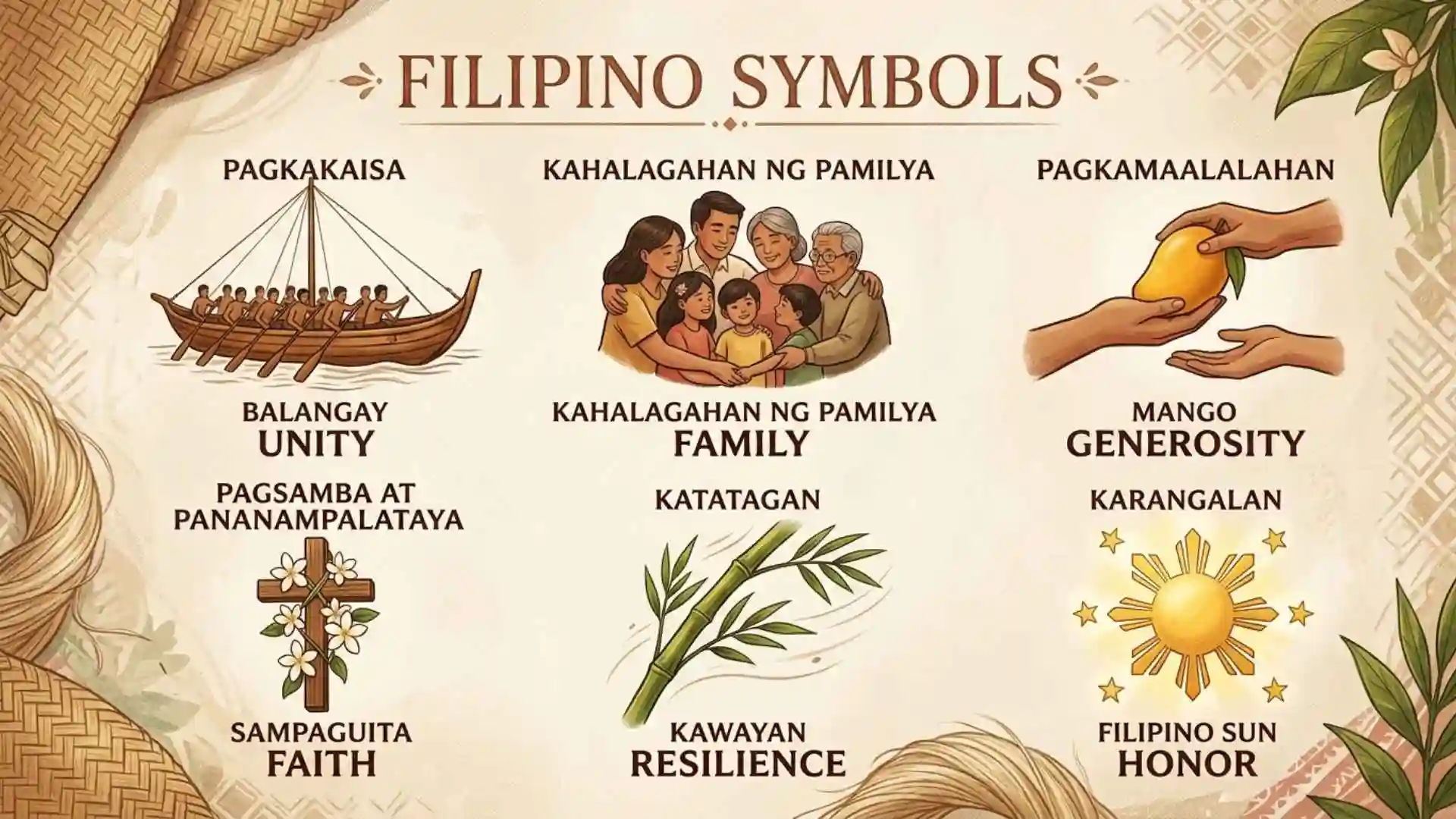
Filipino symbols are images, objects, designs, plants, animals, writing systems, and cultural traditions that represent the history, identity, values, and heritage of the Philippines. Some are official national symbols, while others are cultural symbols connected with particular communities, regions, or traditions.
The most recognizable symbols of the Philippines include the Philippine flag, its sun and three stars, the Philippine eagle, sampaguita, narra, carabao, jeepney, bahay kubo, sarimanok, and Baybayin. However, not every symbol has the same status or meaning. Some are officially recognized by the Philippine government, while others are widely associated with Filipino culture or belong specifically to an Indigenous or ethnolinguistic community.
Understanding this distinction is important when researching Filipino symbols and meanings, especially if you are looking for a meaningful tattoo, artwork, logo, jewelry design, or cultural reference.
Filipino Symbols and Meanings: Quick List
Here are some of the most recognizable Filipino and Philippine cultural symbols and what they represent:
| Symbol | Common meaning or significance |
| Philippine Flag | National identity, sovereignty, and independence |
| Philippine Sun | Freedom and the struggle for independence |
| Three Stars | Luzon, Visayas, and Mindanao |
| Philippine Eagle | National pride, wildlife, and strength |
| Sampaguita | Purity, simplicity, and devotion |
| Narra | Strength and natural heritage |
| Carabao | Hard work, agriculture, and rural life |
| Sarimanok | Maranao artistic and cultural heritage |
| Baybayin | Historical Philippine writing and cultural heritage |
| Jeepney | Filipino creativity, resourcefulness, and everyday life |
| Bahay Kubo | Traditional rural life and Filipino heritage |
| Traditional Weaving | Community identity, craftsmanship, and heritage |
| Philippine Coconut | Agriculture and tropical heritage |
| Bamboo | Resourcefulness, nature, and traditional life |
| Philippine Mountain Imagery | Nature and connection to the land |
The meaning of a symbol can change according to its historical or cultural context. In particular, Indigenous Filipino symbols should be identified by their specific community rather than treated as one universal system.
Official Philippine National Symbols
The Philippines has a number of officially recognized national symbols. These are different from cultural symbols that are simply popular or widely associated with Filipino identity.
Philippine Flag
The Philippine flag is perhaps the most important national symbol of the country. It consists of a blue field, a red field, a white triangle, a golden sun, and three golden stars.
The flag represents Philippine national identity and independence. Its design contains several historical references connected with the country’s struggle for freedom.
The white triangle contains the golden sun and three stars. The three stars represent Luzon, Visayas, and Mindanao, while the eight rays of the sun are connected with the provinces involved in the early Philippine Revolution.
The flag is used during national celebrations, government events, schools, sporting events, and other occasions that emphasize Filipino identity.
Philippine Sun
The Philippine sun is one of the most recognizable individual Filipino symbols.
Its eight rays have historical significance connected with the Philippine Revolution. Because the sun appears prominently on the national flag, it has become closely associated with freedom, independence, courage, and national identity.
Today, Philippine sun designs are also common in tattoos, clothing, jewelry, artwork, logos, and patriotic decorations.
Three Stars
The three golden stars on the Philippine flag represent the country’s three major island groups:
- Luzon
- Visayas
- Mindanao
Together, the stars symbolize the geographic unity of the Philippine archipelago.
Philippine Eagle
The Philippine eagle is an important national wildlife symbol and is widely associated with Philippine pride and conservation.
It is a large forest eagle native to the Philippines and is known for its distinctive appearance and powerful presence. Its symbolism often includes strength, freedom, resilience, and the importance of protecting Philippine biodiversity.
The Philippine eagle is particularly meaningful in environmental and conservation contexts because the species faces serious threats to its survival.
Sampaguita
Sampaguita is the national flower of the Philippines.
The small white flower is valued for its fragrance and appearance and is commonly associated with purity, simplicity, humility, and devotion.
Sampaguita garlands have also been used in Filipino social and religious settings, making the flower more than simply a botanical symbol.
Narra
Narra is recognized as the national tree of the Philippines.
The tree is valued for its strong and durable wood. Because of these qualities, it is commonly associated with strength and resilience.
The narra also represents the country’s natural heritage and reminds people of the importance of protecting Philippine forests.
Traditional Filipino Cultural Symbols
Not every important Filipino symbol is an official national symbol. Many images and objects have become culturally significant because of their connection with Filipino history and everyday life.
Carabao
The carabao, or water buffalo, is strongly connected with traditional agricultural life in the Philippines.
For generations, carabaos have been used in farming and have been particularly important in rural communities. Because of this role, the animal can symbolize hard work, patience, strength, and rural Filipino life.
The carabao is often featured in Filipino artwork, children’s stories, festivals, and cultural representations of the countryside.
Jeepney
The jeepney is one of the most recognizable modern symbols of Filipino culture.
Its history is connected with the adaptation of military jeeps for civilian transportation after World War II. Filipino builders and artists transformed these vehicles into distinctive public-transport vehicles decorated with bright colors, chrome, names, religious imagery, and personalized artwork.
The jeepney can represent Filipino creativity, adaptability, resourcefulness, and everyday community life.
Bahay Kubo
The bahay kubo is a traditional Filipino house associated especially with rural life.
Traditional versions commonly use locally available materials and are designed to suit the local environment. The bahay kubo has consequently become a cultural symbol of simplicity, rural heritage, family life, and connection with nature.
The term is also familiar through the Filipino folk song “Bahay Kubo,” which lists vegetables associated with a traditional home garden.
Filipino Weaving
Traditional Filipino weaving represents the skill, creativity, and cultural heritage of numerous communities across the country.
Different groups have their own materials, techniques, colors, patterns, and meanings. Examples of Philippine textile traditions include weaving practices associated with communities in Luzon and Mindanao.
Because these traditions are diverse, it is better to identify a particular textile tradition or community rather than describing every Philippine pattern as a single “Filipino symbol.”
Indigenous Filipino Symbols
The Philippines has many Indigenous peoples with distinct languages, traditions, artistic practices, and belief systems. Their symbols cannot accurately be reduced to one universal collection of “tribal symbols.”
Maranao Sarimanok
The sarimanok is a famous traditional bird motif associated with the Maranao people of Mindanao.
It is often represented with colorful and elaborate decorative features and appears in various forms of Maranao art, including carving, textiles, architecture, and other cultural expressions.
The sarimanok is closely connected with Maranao cultural identity and artistic heritage. It should therefore be understood within its Maranao context rather than being presented simply as a generic ancient Filipino symbol.
Indigenous Textile Motifs
Indigenous Philippine textile traditions contain many distinctive patterns and techniques.
These motifs can communicate identity, community, heritage, aesthetics, and sometimes social or ceremonial meanings. Their significance differs from one community to another.
When using an Indigenous-inspired design for a tattoo or artwork, identifying the community behind the motif is important. A pattern from one group should not automatically be assigned the meaning of another.
Traditional Tattooing
Traditional tattooing is another important part of Philippine Indigenous heritage.
The tattoo traditions of different communities have historically carried meanings related to identity, achievement, social status, protection, community, and other aspects of life.
The exact meaning depends on the specific community and historical period. Modern tattoos inspired by Philippine traditions may combine these motifs with contemporary artistic styles, but they should not automatically be described as identical to historical tattoo practices.
Baybayin: A Historical Filipino Writing Symbol
Baybayin is a historical Philippine writing system that has become an important symbol of Filipino heritage in modern times.
Unlike the modern Latin alphabet, Baybayin uses characters representing syllabic sounds. Historical evidence shows its use in parts of the Philippines before and during the early Spanish colonial period.
Today, Baybayin is commonly seen in:
- Tattoos
- Jewelry
- Calligraphy
- Graphic design
- Clothing
- Logos
- Cultural events
- Educational materials
Baybayin is often searched alongside terms such as ancient Filipino symbols and Filipino tattoo symbols. However, it is more accurate to describe it as a historical writing system rather than simply calling every Baybayin character a mystical or ancient symbol.
Ancient Filipino Symbols
People searching for ancient Filipino symbols are often looking for designs connected with precolonial Philippine history.
There was not one single symbolic system shared by every community across the Philippine archipelago. The Philippines has always contained diverse cultures and languages, so historical symbols and artistic traditions varied.
Some areas used Indigenous writing systems, while communities developed their own tattooing, weaving, carving, ornaments, religious practices, and visual traditions.
For this reason, terms such as “ancient Filipino symbol” should be used carefully. A design may be historically Filipino without being universal across the entire country.
Filipino Symbols for Tattoos
Filipino-inspired tattoos are popular among people who want to express cultural identity, family connections, heritage, or personal values.
Philippine Sun Tattoo
A Philippine sun tattoo can represent Filipino identity, independence, freedom, and national pride.
Because it is directly connected with the Philippine flag, it is one of the easiest Filipino-inspired designs for people to recognize.
Baybayin Tattoo
Baybayin tattoos are often chosen to represent Filipino heritage or a meaningful word written using a historical Philippine script.
Anyone considering a Baybayin tattoo should verify the spelling and character sequence carefully. Modern online examples sometimes contain inaccurate translations or incorrect character combinations.
Sarimanok Tattoo
A sarimanok tattoo can celebrate Maranao cultural heritage and Filipino artistic traditions.
Because the sarimanok is specifically associated with the Maranao people, people using the design should understand its cultural background rather than treating it as a generic decorative bird.
Indigenous-Inspired Tattoo Patterns
Traditional tattoo motifs can be meaningful, but they require additional cultural research.
If a tattoo comes from a particular Indigenous community, learn its origin and traditional meaning before using it. This is especially important when the original design had ceremonial, social, or community-specific significance.
Filipino Symbols of Strength
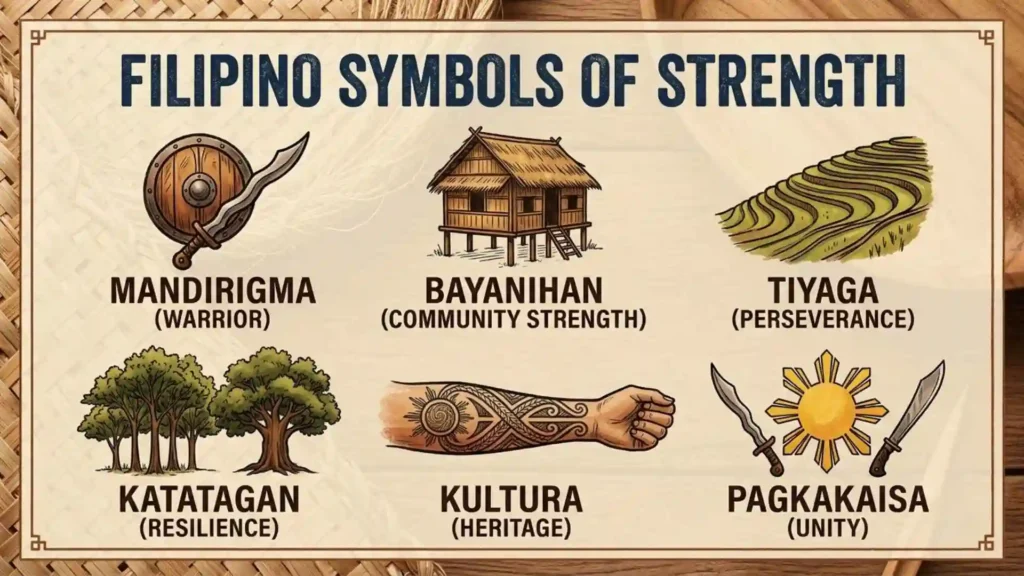
If you are searching for a Filipino symbol of strength, several images may fit depending on the meaning you want.
Philippine Eagle
The Philippine eagle can represent power, freedom, resilience, and pride.
Narra Tree
Narra is associated with strength because of the durability of its wood and its status as a national tree.
Carabao
The carabao can symbolize physical strength, patience, hard work, and agricultural life.
These meanings are useful for tattoos, artwork, logos, or personal designs, but they are not all equivalent official definitions.
Filipino Symbols of Love and Family
Family is an important theme in Filipino culture, so Filipino-inspired designs often focus on relationships and family heritage.
There is no single official Filipino symbol for love. Instead, flowers, family imagery, hearts, names written in Baybayin, and other personal designs can communicate affection.
Sampaguita can be particularly appropriate when the desired theme involves purity, devotion, or affection.
A personalized Filipino design can also combine a meaningful word, family name, Philippine sun, or other cultural element.
Filipino Symbols of Freedom
The Philippine sun and flag are among the strongest symbols associated with freedom.
The national flag emerged from the country’s history of revolution and independence, while the sun’s rays have historical associations with the provinces involved in the Philippine Revolution.
For this reason, a Philippine sun tattoo or flag-inspired design can communicate ideas such as:
- Freedom
- Independence
- Courage
- National pride
- Filipino identity
- Resilience
Filipino Symbols of Protection
There is no single universal Filipino protection symbol.
Protective beliefs and designs have existed within different Filipino and Indigenous traditions, but their meanings vary between communities.
This distinction matters because websites sometimes label generic designs as “ancient Filipino protection symbols” without explaining their historical source.
If protection is the desired meaning, it is better to research the specific community and tradition associated with a particular symbol rather than assuming that every Indigenous-looking design represents protection.
Filipino Symbols of Good Luck
Ideas about good fortune appear throughout Filipino culture, but there is no single symbol that universally represents good luck for all Filipinos.
Certain objects, colors, religious items, folk beliefs, and family traditions may be associated with luck or protection in particular contexts.
Modern Filipino artwork may also use the carabao, plants, flowers, or other cultural imagery as positive symbols, but these meanings should be described as cultural or personal interpretations rather than universal rules.
Filipino Symbols of Nature
Nature plays an important role in Philippine culture and identity.
The Philippine eagle represents the country’s wildlife, while the narra represents its forests and natural heritage. Sampaguita represents the country’s botanical heritage.
The carabao connects cultural identity with agriculture, while bamboo, coconut trees, mountains, rice fields, and tropical landscapes frequently appear in Filipino artwork.
These images can collectively represent the Philippines’ connection to land, agriculture, forests, and island environments.
Filipino Symbols and Their Meanings for Different Uses
Different symbols can work better depending on what you want to communicate.
| Purpose | Filipino symbol to consider |
| Filipino identity | Philippine flag |
| Freedom | Philippine sun |
| National unity | Three stars |
| Strength | Philippine eagle or narra |
| Hard work | Carabao |
| Filipino heritage | Baybayin |
| Maranao heritage | Sarimanok |
| Rural life | Bahay kubo |
| Everyday Filipino culture | Jeepney |
| Purity or devotion | Sampaguita |
| Nature | Narra, eagle, mountains, tropical plants |
| Indigenous heritage | Community-specific traditional motifs |
How to Choose the Right Filipino Symbol
Start by deciding what you want the design to communicate.
If you want a broad representation of Filipino identity, the Philippine flag or sun is a straightforward choice.
If you want to represent historical Filipino heritage, Baybayin may be appropriate after checking the accuracy of the text.
If your goal is to honor a particular Indigenous community, research that community’s specific symbols and traditions instead of choosing a generic “tribal” design.
For strength or resilience, the Philippine eagle, narra, or carabao can provide meaningful visual options.
Most importantly, learn the origin of a symbol before using it. Cultural context can make a design much more meaningful and can also help prevent inaccurate claims or inappropriate use of Indigenous imagery.
Frequently Asked Questions About Filipino Symbols
What are the most famous Filipino symbols?
Some of the most recognizable symbols include the Philippine flag, Philippine sun, three stars, Philippine eagle, sampaguita, narra, carabao, jeepney, bahay kubo, sarimanok, and Baybayin.
What symbolizes Filipino culture?
No single object represents all Filipino culture. The Philippine flag is the strongest national symbol, while the jeepney, bahay kubo, carabao, Baybayin, traditional textiles, and Indigenous art can represent different aspects of Filipino cultural heritage.
What is the traditional Filipino symbol?
There is no single universal traditional Filipino symbol. The Philippines contains many cultural communities, each with its own artistic and symbolic traditions.
What Filipino symbol represents strength?
The Philippine eagle, narra tree, and carabao can all represent strength in different contexts. The eagle is associated with power and national pride, narra with strength and resilience, and the carabao with physical labor and agricultural life.
What Filipino symbol represents freedom?
The Philippine sun and national flag are strongly associated with freedom and independence because of their connection to Philippine national history.
Is Baybayin an ancient Filipino symbol?
Baybayin is a historical Philippine writing system. Today it is also widely used as a symbol of Filipino heritage and cultural identity.
What Filipino symbol is good for a tattoo?
Popular choices include the Philippine sun, Baybayin, the Philippine eagle, sarimanok, and carefully researched Indigenous-inspired designs. The best choice depends on the meaning and cultural connection you want the tattoo to express.
What does the sarimanok symbolize?
The sarimanok is a traditional bird motif associated with Maranao culture and is an important expression of Maranao artistic and cultural heritage.
What does the Philippine flag symbolize?
The Philippine flag represents national identity and the country’s history of independence. Its sun, stars, colors, and geometric design carry historical and national meanings.
Are all Filipino symbols ancient?
No. Some Filipino symbols have historical or precolonial roots, while others are modern cultural symbols. The jeepney, for example, is a modern development, whereas Baybayin represents a historical writing tradition.
Final Thoughts
Filipino symbols are much more diverse than a simple list of “ancient symbols” might suggest. They include official national symbols, historical writing systems, Indigenous artistic traditions, wildlife, plants, architecture, transportation, and everyday cultural objects.
The Philippine flag, sun, and three stars provide some of the clearest representations of national identity. The Philippine eagle, sampaguita, and narra connect Filipino identity with the country’s natural heritage. The carabao, jeepney, and bahay kubo reflect everyday and rural Filipino life, while Baybayin and the sarimanok connect modern audiences with specific aspects of Philippine cultural heritage.
The most important point is that there is no single symbolic language shared by every Filipino community. Philippine culture is diverse, and symbols often have meanings tied to particular histories and communities.
Whether you are researching Filipino symbols and meanings, looking for a Filipino tattoo, studying Philippine heritage, or simply exploring the symbols of the Philippines, understanding the story and cultural context behind each design makes the symbol far more meaningful.

I am John Carter, a lifelong enthusiast of language and modern slang. I explore how words evolve and shape culture, and I enjoy uncovering the stories behind everyday expressions. I have authored “Slang and Society: The Language of Youth” and “Modern Words, Modern Worlds”, where I dive into how informal language impacts communication and identity. My goal is to make language accessible, fun, and insightful for everyone who loves words as much as I do.
 Lisa Reynolds
 Marcus Lee