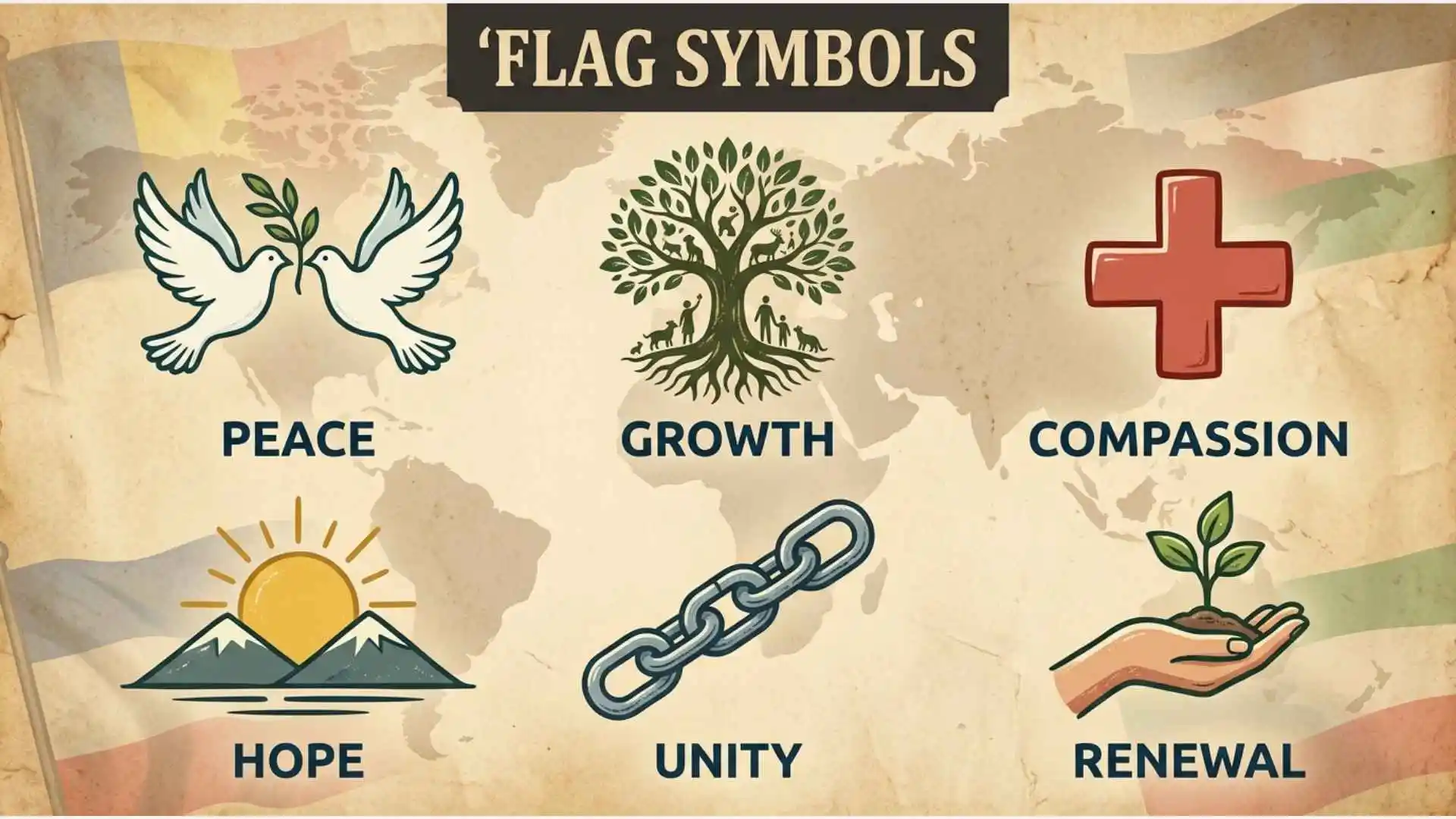
Flag symbols are visual elements used on flags to represent identity, history, culture, religion, values, geography, or political ideas. Stars, suns, moons, crosses, animals, plants, shields, stripes, and other designs can all carry symbolic meaning. Some symbols have been used for centuries, while others were created to represent modern national identities.
Understanding flag symbols can make it easier to recognize what a flag represents and why particular colors, shapes, and images were chosen. However, there is an important point to remember: a symbol does not always have one universal meaning. Its meaning can change depending on the country, historical period, culture, and official explanation of the flag.
This guide explains common flag symbols and their meanings, explores the symbolism of flag colors, and looks at how countries use visual elements to communicate national identity.
What Are Flag Symbols?
Flag symbols are recognizable visual elements incorporated into a flag’s design. They can be simple geometric shapes, celestial objects, animals, plants, religious imagery, or national emblems.
A flag may use a single symbol or combine several elements to communicate a more detailed story. For example, stars may represent political divisions or ideals, while an animal may represent courage, strength, or an important part of a country’s heritage.
Some flags have very simple designs, while others contain detailed coats of arms or emblems. Regardless of their complexity, the purpose is generally the same: to create a visual representation of a particular nation, group, community, or cause.
Common Flag Symbols and Their Meanings
Different symbols appear repeatedly on flags around the world. Their meanings are not identical everywhere, but they often have common associations.
Stars
Stars are among the most recognizable symbols used on flags. They can represent unity, states, provinces, territories, aspirations, or important ideals.
The number of stars may also have a specific meaning. A flag with several stars might use them to represent individual regions or political units. In other cases, a single star can symbolize independence, hope, or national unity.
Because star symbolism varies considerably, it is important to look at the history of the particular flag rather than assuming that every star has the same meaning.
Sun
The sun is a powerful symbol associated with light, life, energy, hope, and renewal. A rising sun can represent a new beginning or the emergence of a nation.
Sun symbols can also reflect a country’s geographic or cultural relationship with sunlight, warmth, or agriculture. Some flags use a detailed sun with rays, while others use a simple circular design.
The exact interpretation depends on the flag’s history and official symbolism.
Crescent Moon
The crescent is a recognizable symbol found on several national and historical flags. It is particularly associated with Islamic cultural and historical traditions, although the crescent itself is not exclusively a religious symbol.
In some contexts, the crescent can also represent growth, renewal, or the lunar cycle.
Its meaning should therefore be considered within the historical and cultural background of the specific flag on which it appears.
Cross
Crosses appear on numerous flags and can have religious, historical, political, or cultural significance.
For countries with strong Christian historical traditions, a cross may represent Christianity or religious heritage. However, cross-shaped designs can also have national or historical meanings that go beyond religion.
Different forms of crosses, including Scandinavian-style crosses and other traditional designs, can also help identify particular cultural or regional traditions.
Eagle
The eagle is commonly associated with strength, courage, freedom, independence, and power. Because eagles are capable of flying at great heights, they have also been used as symbols of ambition and liberty.
Eagles have appeared in national emblems, coats of arms, military standards, and flags throughout history. Their exact meaning varies between cultures and countries.
Lion
The lion is traditionally associated with courage, strength, leadership, authority, and royalty.
It has appeared in European heraldry and other historical traditions for centuries. A lion on a flag or national emblem can therefore connect a modern country with its historical heritage.
The position, color, and style of the lion may also have specific significance.
Shield
A shield usually suggests protection, defense, security, and heritage. It is particularly common when a flag incorporates a coat of arms or national emblem.
A shield can contain additional symbols, such as animals, weapons, plants, stars, or geographic references. As a result, understanding a shield often requires looking at the complete emblem rather than the shield shape alone.
Plants and Flowers
Plants, flowers, trees, and leaves can represent nature, agriculture, national heritage, or important natural resources.
A country may choose a particular plant because it is native to the region, culturally significant, economically important, or historically associated with the nation.
These symbols can communicate a connection between a country’s people and its natural environment.
Animals and Birds
Animals and birds can represent qualities such as courage, strength, freedom, endurance, or national heritage.
A national animal may also be important because it is native to the country’s landscape or has cultural significance. Birds are especially common because their ability to fly can be associated with freedom and independence.
However, the meaning should always be connected to the specific country’s history instead of relying only on general symbolism.
Flag Symbols at a Glance
The following table provides a quick overview of common symbols and their possible meanings:
| Flag Symbol | Common Associations |
| Star | Unity, ideals, regions, aspirations |
| Sun | Life, light, hope, renewal |
| Crescent | Cultural or historical traditions, lunar symbolism |
| Cross | Religious, cultural, or historical identity |
| Eagle | Freedom, strength, courage, power |
| Lion | Courage, leadership, strength, royalty |
| Shield | Protection, defense, heritage |
| Tree | Nature, growth, life, national heritage |
| Flower | Culture, beauty, nature, national identity |
| Bird | Freedom, independence, strength |
| Crown | Monarchy, authority, historical heritage |
| Sword | Defense, military history, courage |
| Mountain | Geography, strength, natural heritage |
| Waves | Water, seas, rivers, maritime identity |
These are general associations rather than universal definitions. A country’s official explanation may give a particular symbol a completely different or more specific meaning.
Flag Colors and Their Meanings
Colors are just as important as symbols in flag design. However, there is no universal rule stating that every color always represents the same idea.
The meaning of a color depends on the flag and its history.
Red
Red can be associated with courage, sacrifice, struggle, revolution, strength, or bloodshed. In some flags, it represents the sacrifices made during a country’s history.
In other cases, red may have religious, cultural, or historical significance.
White
White is often associated with peace, purity, honesty, unity, or innocence.
It can also simply be part of a traditional color combination with a meaning specific to the country.
Blue
Blue is frequently associated with peace, freedom, loyalty, the sky, or water.
For countries surrounded by seas or oceans, blue may reflect a geographic connection with water. In other cases, it may represent ideals such as peace or freedom.
Green
Green is commonly connected with nature, agriculture, fertility, growth, hope, and natural resources.
Green can also have religious or cultural significance depending on the country.
Black
Black can symbolize strength, determination, heritage, resistance, or historical struggles. In some flags, it has religious or political significance.
The interpretation varies greatly, so it should not be treated as a universal symbol of one particular idea.
Yellow and Gold
Yellow and gold may represent sunlight, wealth, prosperity, justice, or natural resources.
Gold can also be used to suggest importance, honor, or historical achievement.
Are Flag Colors Universal in Meaning?
No. One of the most important things to understand about flag symbolism is that colors do not have universal meanings.
For example, red might represent courage on one flag but sacrifice or a historical struggle on another. Green might refer to agriculture in one country and religious identity in another.
Therefore, articles about flag symbols should avoid presenting color meanings as fixed rules. The most accurate approach is to explain general associations and then examine the official meaning of each individual flag.
Religious Symbols on Flags
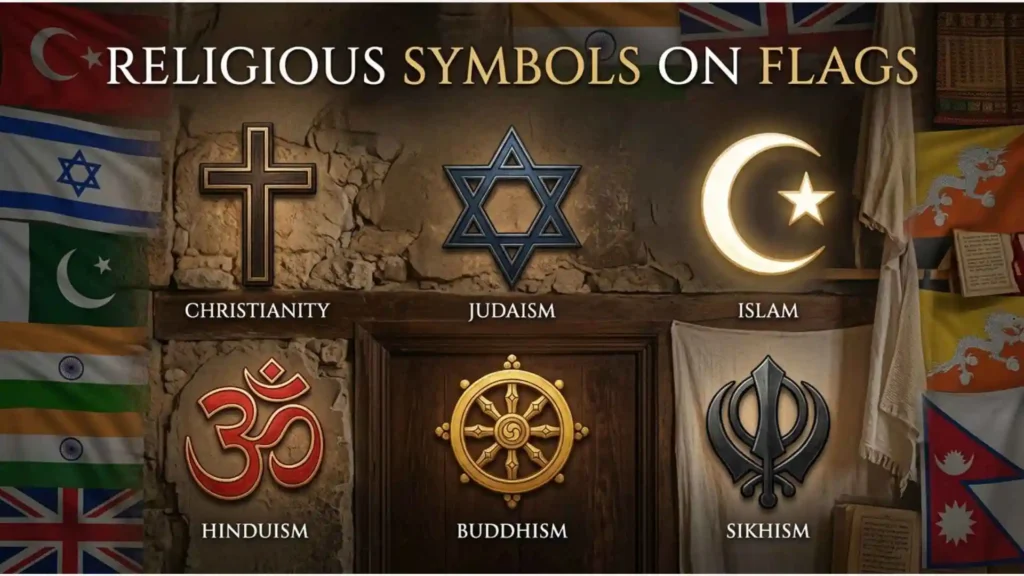
Religious symbols have played an important role in the history of flag design.
Crosses, crescents, stars, and other religiously connected imagery may appear because of a country’s historical development, cultural traditions, or religious heritage.
However, the presence of a symbol does not necessarily mean that the entire meaning of a flag is religious. A symbol can have several historical layers and may represent cultural identity as well as religious tradition.
Understanding the historical context is therefore essential when interpreting religious flag symbols.
National Symbols on Flags
Many countries use national symbols to make their flags distinctive. These symbols may include:
- National animals
- Birds
- Plants and flowers
- Historical weapons
- Crowns
- Shields
- Stars
- Celestial objects
- Mountains
- Rivers or seas
- Traditional cultural objects
A national emblem can combine several of these elements into one design. Such emblems often preserve historical information that would be difficult to communicate through colors alone.
Geographic Symbols on Flags
Some flags use symbols connected to the physical geography of a country.
Mountains
Mountains may represent important landscapes, natural strength, or a country’s geographic identity.
Water and Waves
Waves, seas, rivers, and other water-related designs can represent maritime geography, important waterways, or a country’s relationship with the ocean.
Plants and Natural Features
Trees, leaves, flowers, and other natural elements can represent native landscapes, agriculture, or natural resources.
Geographic symbols are especially useful because they connect a flag visually with the land and environment of the people it represents.
Historical Symbols on Flags
Many flag symbols have historical roots. Flags originally served practical purposes, particularly for identifying armies, rulers, ships, territories, and political groups.
As societies changed, older banners and heraldic designs influenced modern national flags.
Historical symbols can commemorate independence, military victories, important rulers, political movements, or the creation of a new state.
This means that a symbol that appears decorative at first glance may actually represent an important part of a country’s history.
Why Do Countries Use Symbols on Flags?
Countries use flag symbols for several reasons.
First, symbols help create a recognizable national identity. A distinctive design allows people to identify a country quickly.
Second, symbols can communicate important values or historical experiences. A flag can preserve memories of independence, struggle, unity, or cultural heritage.
Third, symbols can bring people together. Seeing a national flag at a sporting event, celebration, school, or international gathering can create a shared sense of identity.
Finally, symbols allow a complicated history to be represented visually. Instead of using a long written explanation, a flag can communicate ideas through a small number of carefully selected elements.
How to Identify a Flag Symbol
If you see an unfamiliar flag and want to understand its symbols, follow a few simple steps.
Look at the Main Shape
First, identify the major shapes. Check whether the flag contains circles, crosses, triangles, stripes, stars, or other geometric designs.
Identify Images
Look for animals, birds, plants, weapons, shields, crowns, celestial objects, or other recognizable images.
Count Repeated Symbols
If there are several stars, stripes, or other repeated elements, their number may have a specific meaning.
Examine the Colors
Note the main colors and how they are arranged. Do not assume their meaning immediately because colors can have different interpretations across countries.
Research the Flag’s History
The history of the flag is often the best way to understand its symbolism. Information from official government sources, national institutions, museums, and reputable historical references can provide more reliable explanations than generic symbolism lists.
Flag Symbols and National Identity
A flag is often one of the strongest visual representations of national identity. It can appear at government buildings, schools, sporting competitions, airports, embassies, international conferences, and public celebrations.
People may also use flags to express cultural or national connections online. Social media profiles, websites, messaging applications, and digital communities frequently use flag emojis to indicate nationality or cultural identity.
The emotional importance of a flag can be particularly strong during national celebrations or international sporting events.
Flag Symbols in Different Cultures
The same symbol can mean different things in different cultures.
For example, an animal associated with courage in one tradition may have a different cultural association elsewhere. Likewise, a color that represents prosperity in one country may represent mourning or another historical idea in a different culture.
This is why flag symbolism should be interpreted carefully.
Rather than asking only, “What does this symbol usually mean?” it is better to ask, “What does this symbol mean on this particular flag?”
That distinction produces a much more accurate understanding of flag symbols.
Flag Symbols vs. National Symbols
Flag symbols and national symbols are related, but they are not exactly the same.
A flag symbol is an element that appears within a particular flag design. A national symbol can be any object, animal, plant, monument, person, or design officially or culturally associated with a country.
For example, a national animal might be an important national symbol even if it does not appear on the country’s flag.
Understanding this difference helps prevent confusion when researching national identity and symbolism.
Why Flag Symbolism Matters
Flag symbolism matters because flags communicate information quickly and emotionally.
A well-designed flag can represent a nation’s history without using written language. It can remind citizens of shared traditions and help people recognize their country around the world.
For historians, flag symbols can also provide clues about political changes, cultural traditions, military history, and national development.
For students and researchers, studying flags can therefore be a useful way to learn about geography, history, culture, politics, and visual communication.
Frequently Asked Questions About Flag Symbols
What are the most common symbols on flags?
Stars, suns, crosses, crescents, animals, birds, shields, plants, crowns, and geometric shapes are among the common elements found on flags.
What do stars symbolize on flags?
Stars can represent unity, ideals, regions, states, territories, independence, or aspirations. Their exact meaning depends on the specific flag.
What does the sun symbolize on a flag?
The sun can represent life, light, hope, energy, renewal, or a new beginning. The exact meaning varies according to the flag’s history.
What does a crescent symbolize on a flag?
A crescent can have cultural, historical, religious, or lunar associations. Its meaning depends on the particular flag and the traditions connected to it.
What do colors mean on flags?
Colors can represent different ideas such as peace, courage, nature, sacrifice, freedom, or prosperity. However, there is no universal meaning for every color.
Why do countries put animals on their flags?
Animals can represent national heritage, strength, courage, freedom, natural wildlife, or important cultural traditions.
Are flag symbols the same everywhere?
No. The same symbol can have different meanings in different countries and cultures. Historical context is essential for understanding a flag accurately.
Why are flag symbols important?
Flag symbols help communicate national identity, history, culture, values, geography, and shared traditions through visual designs.
How to Learn More About a Specific Flag
If you want to understand the meaning of a particular national flag, start with its official history. Look for information from government institutions, national museums, official flag organizations, or reputable historical sources.
Pay attention to both the individual symbols and the way they work together. A star may have one meaning by itself, while its position, number, color, and relationship with other elements may provide additional information.
It is also useful to compare historical versions of the flag. A modern flag may have evolved from older banners, coats of arms, military standards, or political movements.
Conclusion
Flag symbols are visual representations of history, identity, culture, geography, values, and traditions. Stars, suns, crescents, crosses, animals, plants, shields, and other elements can make a flag meaningful and recognizable.
However, there is no universal dictionary in which every flag symbol has exactly one meaning. Colors and images must be understood in the context of the particular country, organization, culture, and historical period.
The best way to interpret a flag is to examine its colors, shapes, images, number of symbols, and historical background together. By doing so, a simple flag becomes more than a piece of fabric—it becomes a visual record of the identity and history it represents.

I am John Carter, a lifelong enthusiast of language and modern slang. I explore how words evolve and shape culture, and I enjoy uncovering the stories behind everyday expressions. I have authored “Slang and Society: The Language of Youth” and “Modern Words, Modern Worlds”, where I dive into how informal language impacts communication and identity. My goal is to make language accessible, fun, and insightful for everyone who loves words as much as I do.
 Lisa Reynolds
 Marcus Lee