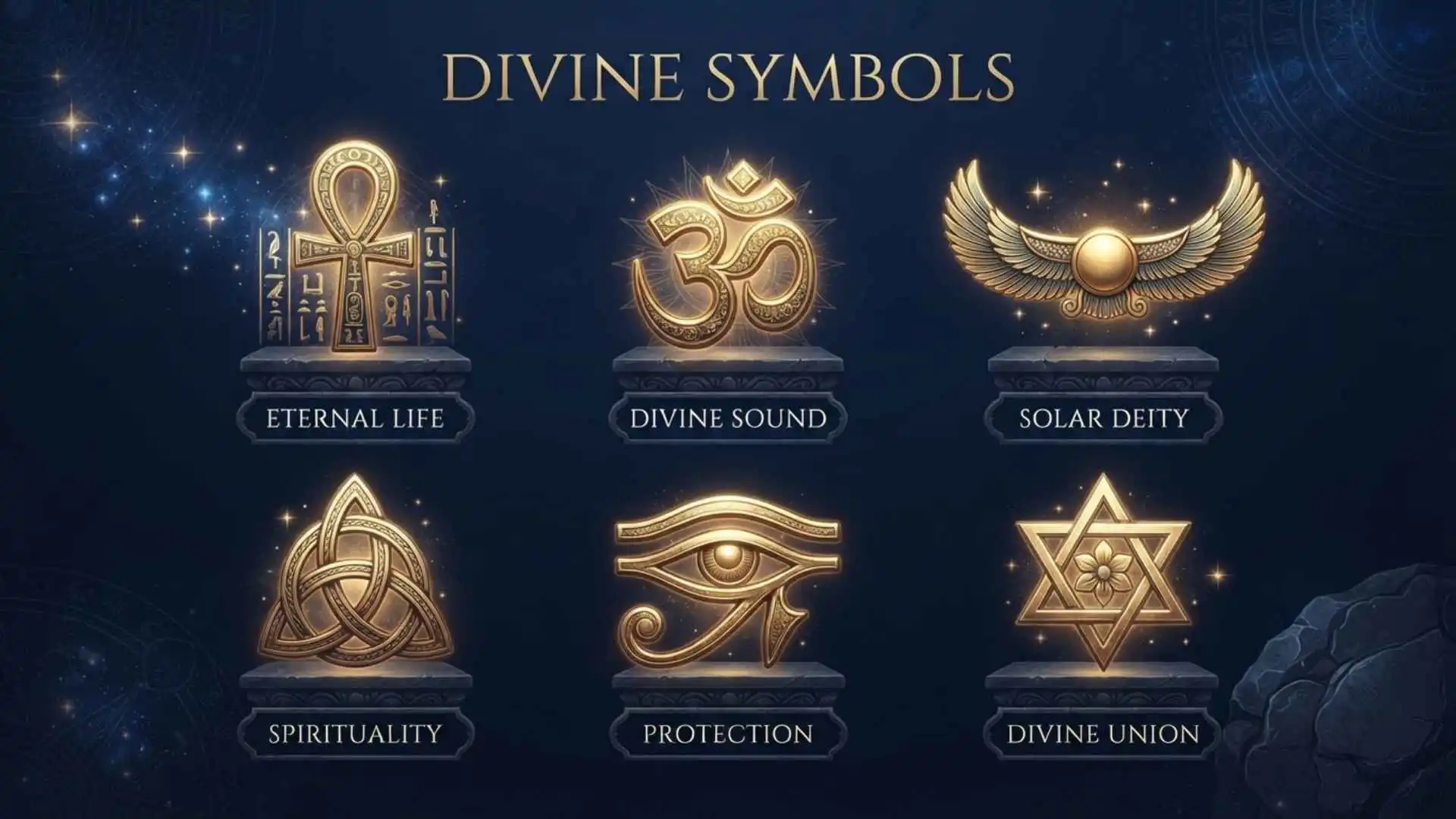
God symbols have been used for thousands of years to represent deities, divine power, protection, wisdom, creation, life, death, and spiritual beliefs. Different civilizations developed their own symbols to identify gods and communicate ideas about the divine. Egyptian, Greek, Roman, Norse, Hindu, Christian, Jewish, and other religious traditions all have distinctive forms of symbolism.
But there is no single universal symbol for God. The meaning of a god symbol depends on its religious, cultural, and historical context. A symbol associated with one deity may represent protection, while another may symbolize wisdom, strength, creation, or rebirth.
This guide explores 50+ god symbols, their meanings, origins, and the gods or religious traditions with which they are associated.
What Are God Symbols?
God symbols are objects, images, animals, signs, or designs associated with gods, goddesses, divine power, or religious ideas.
A god symbol can identify a particular deity or represent an attribute connected with that deity. For example, Zeus is traditionally associated with the thunderbolt, Poseidon with the trident, and Thor with Mjölnir.
The term god symbols can also be used more broadly for sacred symbols representing concepts such as life, protection, eternity, creation, wisdom, and spiritual power.
It is important to remember that not every religious symbol represents God directly. Some symbols represent a religion, a religious teaching, a deity’s attribute, or a particular cultural tradition.
God Symbols and Their Meanings
The following table provides a quick reference to some of the best-known symbols associated with gods and divine traditions.
| Symbol | Associated God or Tradition | Common Meaning |
| Eye of Horus | Horus, Ancient Egypt | Protection, healing |
| Ankh | Ancient Egypt | Life |
| Djed | Osiris, Ancient Egypt | Stability |
| Was Scepter | Egyptian gods | Power, authority |
| Scarab | Khepri, Ancient Egypt | Rebirth, renewal |
| Thunderbolt | Zeus | Divine power |
| Trident | Poseidon | Sea, authority |
| Owl | Athena | Wisdom |
| Lyre | Apollo | Music, arts |
| Caduceus | Hermes | Communication, travel |
| Rose | Aphrodite | Love, beauty |
| Mjölnir | Thor | Strength, protection |
| Raven | Odin | Knowledge, wisdom |
| Valknut | Norse tradition | Death, afterlife |
| Trishula | Shiva | Divine power |
| Conch | Vishnu | Creation, sacred sound |
| Lotus | Hindu and Buddhist traditions | Purity, spiritual growth |
| Om | Hindu traditions | Sacred reality, consciousness |
| Ganesha’s mouse | Ganesha | Humility, overcoming obstacles |
| Cross | Christianity | Sacrifice, salvation |
| Dove | Christianity | Holy Spirit, peace |
| Ichthys | Christianity | Christian faith |
| Menorah | Judaism | Jewish faith and tradition |
| Star of David | Judaism | Jewish identity |
| Allah calligraphy | Islam | Divine name |
| Crescent | Muslim cultures | Cultural and historical association |
| Sun disk | Ra | Sun, divine authority |
| Lioness | Sekhmet | Power, protection |
| Jackal | Anubis | Death, funerary protection |
| Ibis | Thoth | Wisdom, writing |
| Cat | Bastet | Protection, home |
| Peacock | Hera/Juno associations | Majesty, beauty |
| Eagle | Zeus/Jupiter associations | Power, sovereignty |
| Wolf | Roman and Norse traditions | Strength, mythology |
| Bull | Several ancient traditions | Fertility, strength |
| Serpent | Various traditions | Transformation, power |
| Sun | Various religions | Light, life, divinity |
| Moon | Various traditions | Cycles, mystery |
| Crown | Divine and royal traditions | Authority |
| Scepter | Ancient gods and rulers | Power |
| Sacred fire | Several traditions | Purification, divinity |
| Sacred tree | Various traditions | Life, connection |
| Lotus flower | Hinduism/Buddhism | Enlightenment |
| Wheel | Hindu and Buddhist traditions | Cosmic order, spiritual path |
| Dharma wheel | Buddhism | Teachings, spiritual path |
| Khanda | Sikh tradition | Faith, divine principles |
| Shofar | Judaism | Worship, religious tradition |
| Torah scroll | Judaism | Divine teaching |
| Sacred heart | Christianity | Divine love |
| Alpha and Omega | Christianity | Beginning and end |
The meanings above are simplified. A symbol can have multiple interpretations depending on the period and tradition in which it appears.
Ancient Egyptian God Symbols
Ancient Egypt is one of the richest sources of religious symbolism. Egyptian gods were represented through human forms, animals, crowns, objects, and combinations of these elements.
Eye of Horus
The Eye of Horus is one of the most recognizable symbols from ancient Egypt. It is associated with Horus and is traditionally connected with protection, healing, restoration, and well-being.
The symbol became especially important in funerary and protective contexts.
Today, the Eye of Horus is commonly seen in jewelry, artwork, tattoos, and modern designs inspired by Egyptian history.
Ankh
The ankh is often described as the Egyptian symbol of life. It appears frequently in Egyptian art, where gods and divine figures may be shown holding or presenting an ankh.
Its association with life made it one of the most recognizable symbols of ancient Egyptian religion.
Djed
The djed is a pillar-like symbol associated particularly with Osiris. It is commonly interpreted as representing stability, endurance, and strength.
The symbol was important in religious and funerary traditions.
Scarab
The scarab was associated with Khepri, a deity connected with the rising sun and transformation.
Because scarab beetles were connected symbolically with regeneration and renewal, the scarab became an important Egyptian symbol of rebirth.
Was Scepter
The was scepter is a staff-like symbol associated with power, authority, and dominion. It frequently appears in representations of Egyptian gods and rulers.
Greek God Symbols
Greek mythology contains many recognizable gods, each with distinctive objects, animals, and attributes.
Zeus and the Thunderbolt
Zeus was the chief Olympian god, and the thunderbolt became his most recognizable attribute.
It represents his authority and connection with the sky and divine power.
Poseidon and the Trident
Poseidon is associated with the sea, earthquakes, and horses. His trident is perhaps his most recognizable symbol.
The three-pronged weapon represents his authority over the sea.
Athena and the Owl
Athena was associated with wisdom, warfare, and strategic thinking. The owl became closely connected with her and is widely recognized as a symbol of wisdom.
Apollo and the Lyre
Apollo was associated with music, poetry, prophecy, healing, and several other areas. The lyre is one of his most recognizable attributes.
It represents his connection with music and the arts.
Aphrodite and the Rose
Aphrodite was the Greek goddess associated with love and beauty. The rose and other beautiful natural imagery have become associated with her in later artistic traditions.
Roman God Symbols
Roman religious symbolism overlaps with Greek mythology in many ways, although Roman gods developed within their own cultural and religious system.
Jupiter
Jupiter, the Roman counterpart of Zeus, is associated with the thunderbolt and eagle. These symbols reflect authority, sovereignty, and divine power.
Neptune
Neptune is the Roman god associated with the sea. Like Poseidon, he is traditionally represented with a trident.
Minerva
Minerva was associated with wisdom, strategic warfare, and crafts. The owl became one of the symbols associated with her.
Venus
Venus was associated with love, beauty, and fertility. The rose and other symbols of beauty are commonly connected with her.
Norse God Symbols
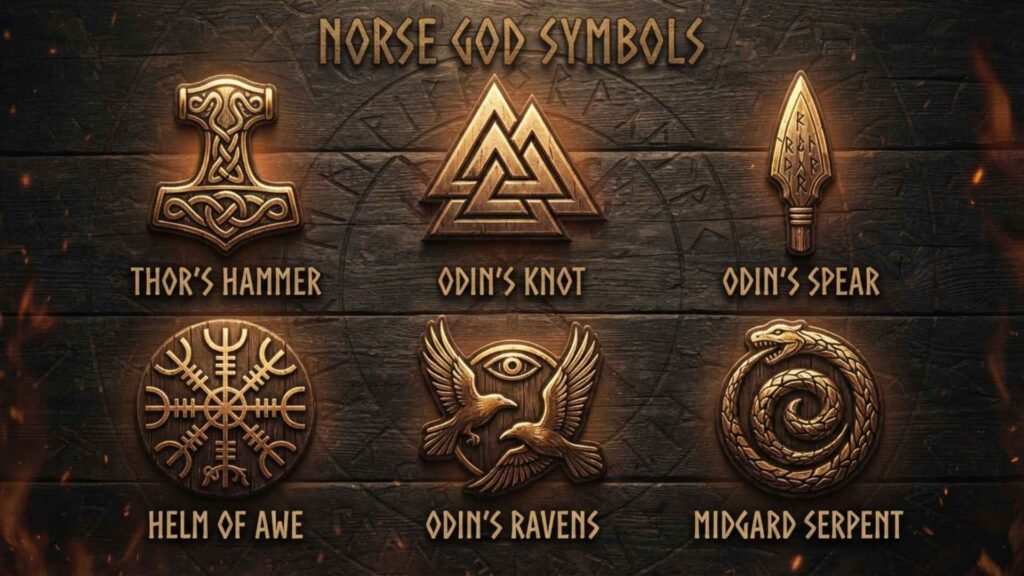
Norse mythology also contains a wide range of symbols connected with gods and supernatural beings.
Thor’s Mjölnir
Mjölnir is the hammer of Thor, the Norse god associated with thunder.
It has become a widely recognized symbol of strength and protection and was historically used in various forms of Norse cultural expression.
Odin’s Ravens
Odin is traditionally associated with two ravens, Huginn and Muninn. They are connected with thought and memory and reflect Odin’s association with knowledge and wisdom.
Valknut
The valknut is a distinctive symbol consisting of interlocking geometric forms. It appears in archaeological material associated with the Viking Age.
Its exact meaning remains debated, but it is often discussed in connection with death, Odin, and the afterlife.
Hindu God Symbols
Hindu religious traditions contain a vast range of symbols associated with gods, goddesses, philosophical concepts, and sacred practices.
Om
Om, written as ॐ, is one of the best-known sacred symbols associated with Hindu traditions.
It is connected with sacred sound, consciousness, and ultimate reality. It is used in prayer, meditation, religious artwork, and spiritual practices.
Shiva’s Trishula
The trishula, or trident, is strongly associated with Shiva.
It is commonly interpreted through multiple layers of Hindu symbolism and is one of the most recognizable attributes of Shiva.
Vishnu’s Conch
The conch shell, known as shankha, is one of the important attributes associated with Vishnu.
It has religious significance and is used in Hindu ritual contexts.
Lotus
The lotus is strongly associated with several Hindu deities, including Lakshmi and Saraswati in different artistic and religious contexts.
Because the lotus grows from muddy water while producing a clean flower, it is commonly associated with purity, spiritual development, and transcendence.
Ganesha
Ganesha is widely recognized through his elephant head. His mouse or rat companion is another distinctive part of his iconography.
Ganesha is traditionally associated with wisdom, beginnings, and the removal of obstacles.
Christian God Symbols
Christianity has developed a rich tradition of religious symbolism.
The Cross
The cross is the best-known Christian symbol. It represents the crucifixion of Jesus and is associated with sacrifice, redemption, faith, and salvation.
Different Christian denominations use different forms of the cross.
Ichthys
The ichthys, or fish symbol, became an important Christian symbol. It is associated with early Christianity and remains widely recognized today.
Dove
The dove is associated with the Holy Spirit in Christian tradition. It can also symbolize peace and purity in Christian artwork.
Alpha and Omega
Alpha and Omega are the first and last letters of the Greek alphabet. In Christian scripture and tradition, they are used to express ideas about God’s eternity and completeness.
Sacred Heart
The Sacred Heart is an important Christian devotional symbol representing divine love and the heart of Christ.
Jewish Religious Symbols
Judaism also has a rich tradition of sacred objects and symbols.
Menorah
The menorah is an ancient Jewish symbol with biblical origins. It has become a major representation of Jewish history and religious identity.
Star of David
The six-pointed Star of David is strongly associated with Judaism and Jewish identity in the modern world.
Its historical development is complex, and its widespread identification with Judaism developed over time.
Shofar
The shofar is a ram’s horn used in Jewish religious practice. It is particularly associated with Rosh Hashanah and other religious contexts.
Torah Scroll
The Torah scroll represents the central sacred teachings of Judaism and is treated with great religious respect.
Islamic Symbols and the Concept of God
Islam has an important distinction when discussing god symbols. Islamic theology emphasizes the oneness and transcendence of Allah, and Islamic tradition does not generally represent God through physical images.
Instead, Islamic art often expresses religious ideas through:
- Arabic calligraphy
- Qur’anic inscriptions
- Geometric patterns
- Mosque architecture
- Decorative motifs
- The names and attributes of Allah
Allah Calligraphy
Arabic calligraphy of the word Allah is widely used in Islamic art and architecture.
It is better understood as a written representation of God’s name rather than a visual depiction of God.
Crescent and Star
The crescent and star are widely associated with Muslim cultures and appear in the history and flags of several Muslim-majority societies.
However, the crescent and star are not a universal or required symbol of Islam. Their historical use developed through different political and cultural traditions.
Symbols of Gods for Protection
Protection is one of the most common themes associated with sacred symbols.
Examples include:
- Eye of Horus
- Christian cross
- Thor’s Mjölnir
- Protective Egyptian amulets
- Sacred inscriptions
- Religious calligraphy
The exact meaning depends on the tradition. A symbol may represent protection because of its association with a deity, a religious story, or a historical practice.
It is more accurate to say that these symbols are traditionally associated with protection rather than claiming that the object itself guarantees supernatural protection.
God Symbols for Strength and Power
If you are looking for symbols associated with strength, several ancient traditions offer recognizable examples.
Thunderbolt
The thunderbolt is strongly associated with Zeus and represents divine authority and power.
Trident
The trident is associated with Poseidon and Neptune and represents their authority over the sea.
Mjölnir
Thor’s hammer is associated with strength and protection in Norse mythology.
Lion
Lions have been associated with divine and royal power across multiple cultures. However, the exact meaning varies by tradition.
God Symbols for Life and Rebirth
Life and rebirth are also common themes in religious symbolism.
The Egyptian ankh is strongly associated with life. The scarab is associated with renewal and rebirth through its connection with Khepri.
The lotus has a different but related symbolic role in Hindu and Buddhist traditions, where it can represent spiritual growth, purity, and enlightenment.
God Symbols for Wisdom
Wisdom is frequently represented through animals and objects associated with particular deities.
The owl is strongly connected with Athena in Greek tradition. In ancient Egypt, the ibis and writing-related imagery were associated with Thoth, a deity connected with writing, knowledge, and wisdom.
Odin’s ravens also have strong associations with knowledge and thought in Norse mythology.
God Symbols for Tattoos
People often choose god symbols for tattoos because they want a design connected with a particular meaning, culture, deity, or personal belief.
Popular choices include:
- Eye of Horus for protection
- Ankh for life
- Mjölnir for strength
- Lotus for spiritual growth
- Om for sacred consciousness
- Cross for Christian faith
- Trident for power
- Owl for wisdom
Before getting a religious or cultural symbol tattooed, research its historical meaning carefully. Some symbols are sacred to particular communities, and using them respectfully requires understanding their origins.
Are God Symbols the Same as Religious Symbols?
No. Although the terms overlap, they are not identical.
A god symbol may be an object or image associated with a particular deity. A religious symbol can represent an entire religion, community, teaching, ritual, or belief.
For example, Zeus’s thunderbolt is associated with a particular Greek god, while the Christian cross is a broader religious symbol associated with Christianity.
This distinction is important because not every sacred symbol represents a god.
How to Choose a Meaningful God Symbol
If you want a god symbol for artwork, jewelry, a tattoo, decoration, or personal study, begin by identifying the meaning you want.
Consider whether you are looking for a symbol of:
- Protection
- Strength
- Wisdom
- Love
- Life
- Rebirth
- Spiritual growth
- Divine authority
- Peace
- Faith
Then research the symbol’s original cultural context.
A meaningful symbol is not necessarily the most visually attractive one. Understanding its history can make the design far more significant.
Frequently Asked Questions About God Symbols
What is the most famous god symbol?
There is no single universal god symbol. The cross is one of the world’s most recognizable religious symbols, while symbols such as the Eye of Horus, Om, Mjölnir, and Zeus’s thunderbolt are strongly associated with specific religious or mythological traditions.
What is the symbol of God?
Different religions have different ways of expressing the concept of God. Christianity commonly uses the cross as a central religious symbol, while Islam emphasizes the name and attributes of Allah rather than depicting God visually.
What are symbols of gods?
Symbols of gods are objects, animals, signs, weapons, plants, or other attributes associated with particular deities. Examples include Zeus’s thunderbolt, Athena’s owl, Poseidon’s trident, Thor’s hammer, and the Eye of Horus.
What are the oldest god symbols?
Some of the oldest surviving religious symbols come from ancient civilizations such as Egypt, Mesopotamia, and prehistoric societies. Egyptian symbols including the ankh and various divine emblems have thousands of years of history.
What is the symbol of Zeus?
Zeus is most famously associated with the thunderbolt. The eagle is also strongly associated with Zeus in Greek artistic and mythological traditions.
What is the symbol of Thor?
Thor is most famously associated with Mjölnir, his hammer. It is one of the best-known symbols of Norse mythology.
What is the symbol of protection?
There is no universal protection symbol. The Eye of Horus, Christian cross, and Mjölnir are examples of symbols that have traditional associations with protection in different cultures.
What symbol represents wisdom?
The owl is strongly associated with wisdom through its connection with Athena. Other traditions use different symbols for wisdom, knowledge, and learning.
What symbol represents life?
The Egyptian ankh is one of the most recognizable symbols associated with life. Other cultures have their own symbols representing life, creation, and renewal.
Are god symbols religious or mythological?
They can be either, depending on the tradition. Some symbols belong to living religions, while others come from ancient mythological and religious systems that are no longer widely practiced.
Final Thoughts
God symbols provide a fascinating way to understand how different civilizations have expressed ideas about divinity, power, protection, wisdom, life, and spiritual transformation. There is no single symbol that represents God across every culture.
The Eye of Horus, ankh, Zeus’s thunderbolt, Poseidon’s trident, Athena’s owl, Thor’s Mjölnir, Om, Shiva’s trishula, the Christian cross, and the Jewish menorah all come from different traditions and carry different meanings.
The most important thing when studying god symbols is to consider their original context. A symbol may have one meaning in ancient Egypt, another in Greek mythology, and an entirely different significance in a modern cultural setting.
Understanding the history behind each symbol makes these ancient and religious designs more than simple images—they become a way to explore the beliefs, stories, and values of the cultures that created them.

I am Lisa Reynolds, a linguist fascinated by the ever-changing world of slang. I enjoy researching how slang reflects trends, technology, and social connections. I wrote “Text Talk: Understanding Digital Slang” and “From Street to Screen: Slang in Media”, exploring the influence of digital communication on language. I love sharing my discoveries in a way that feels like a conversation with friends, so you feel the culture and humor behind every phrase.
 John Carter
 Marcus Lee