The Greek Goddess Hera was one of the most powerful deities in ancient Greek mythology. Known as the Queen of the Gods and wife of Zeus, she ruled beside the king of Mount Olympus. Ancient Greeks associated her with marriage, women, childbirth, motherhood, and family life. Her divine authority also made her an important figure in religious ceremonies and sacred traditions.
Hera’s mythology reveals a fascinating mixture of power, dignity, loyalty, jealousy, and vengeance. She protected the institution of marriage yet frequently clashed with Zeus because of his relationships with other women. Her anger often affected mortals and divine figures who became connected to her husband’s affairs. These stories reveal the complicated nature of relationships and authority in ancient Greek storytelling.
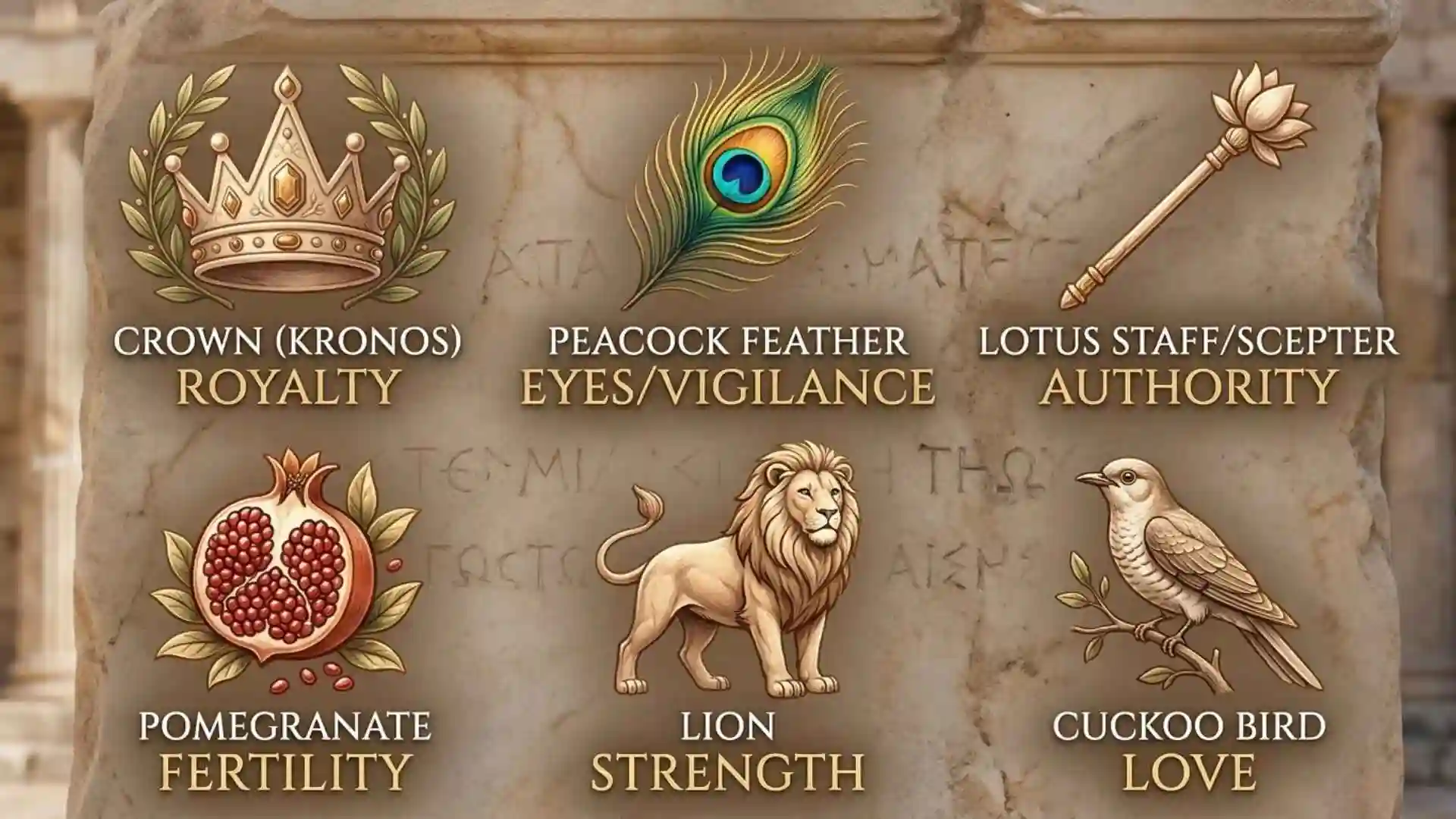
Several recognizable symbols represent Hera, especially the peacock, cow, pomegranate, diadem, and royal scepter. Each carries associations with her divine status, feminine authority, marriage, or sacred animals. Her temples and festivals also demonstrate how deeply ancient communities respected her.
Whether you’re exploring Hera’s meaning, her family tree, her supernatural abilities, or her most famous myths, understanding this goddess opens a fascinating window into ancient Greek culture.
Who Is Hera in Greek Mythology?
Hera was a daughter of the Titans Cronus and Rhea. She belonged to the generation of Olympian gods who replaced the Titans after a great divine conflict. Her marriage to Zeus established her position as the leading goddess of Mount Olympus.
In Greek mythology, Hera wasn’t simply a royal wife. She possessed her own authority, sacred traditions, worshippers, and religious identity. Her influence extended beyond her relationship with Zeus.
Hera’s Main Identity and Divine Roles
| Attribute | Details |
| Greek name | Hera (Ἥρα) |
| Roman equivalent | Juno |
| Parents | Cronus and Rhea |
| Husband | Zeus |
| Siblings | Zeus, Poseidon, Hades, Demeter, and Hestia |
| Children | Ares, Hebe, Eileithyia, and Hephaestus in major traditions |
| Divine status | One of the Twelve Olympians |
| Main domains | Marriage, married women, and women’s lives |
| Sacred animals | Peacock and cow |
| Other associated symbols | Pomegranate, diadem, scepter, and throne |
| Sacred locations | Argos, Samos, Olympia, and other Greek sanctuaries |
| Home | Mount Olympus |
Why Is Hera Called the Queen of the Gods?
Hera earned this title through her marriage to Zeus, the ruler of the Olympian gods. Together, they occupied the highest royal positions in the Greek divine hierarchy.
Her title reflected more than her marital relationship. Hera held an independent divine identity and received worship across numerous Greek communities.
Homer frequently presents her as a powerful goddess who can influence events among gods and mortals. In the Iliad, she actively participates in the Trojan War and challenges Zeus’s decisions.
Her position also reflects the importance ancient Greeks placed on marriage, legitimate family relationships, and royal authority.
Hera Meaning and What She Represents
The name Hera belongs to an ancient Greek religious tradition. Its exact linguistic origin remains debated among scholars. Rather than assigning it a definite modern translation, it’s more accurate to understand its meaning through her mythology and worship.
Hera represents several connected ideas:
- Marriage: She protects the institution of marriage and legitimate unions.
- Women: Her religious identity connects strongly with women’s lives.
- Motherhood: Her myths involve childbirth, children, and family relationships.
- Royal authority: Her position represents queenship and divine power.
- Loyalty: Her stories explore commitment and marital expectations.
- Protection: Her worship includes concerns surrounding marriage and family legitimacy.
- Jealousy and vengeance: Her conflicts reveal the emotional consequences of betrayal and divine rivalry.
Hera as a Symbol of Marriage and Fidelity
Marriage stands at the center of Hera’s religious identity. Ancient Greek communities honored her as a goddess associated with legitimate unions and married women.
Her relationship with Zeus makes this symbolism especially complicated. Although she represents marital commitment, Zeus repeatedly pursues other women. Their relationship becomes a source of conflict throughout Greek mythology.
This contradiction makes Hera particularly interesting. She embodies the ideals of marriage while experiencing the frustrations created by an unfaithful husband.
Hera as a Symbol of Feminine Power and Authority
Hera represents feminine authority through her independent status among the Olympian gods. She isn’t merely an extension of Zeus’s power.
She commands respect, participates in divine decisions, and sometimes openly opposes her husband. Her mythology also explores the tension between a woman’s authority and the restrictions surrounding her position.
Hera as a Symbol of Motherhood and Family
Hera’s association with motherhood connects her to childbirth, children, and legitimate family relationships. Her daughter Eileithyia holds a particularly important role as a goddess of childbirth.
However, Hera’s mythology doesn’t portray her as a universally gentle mother figure. Her treatment of Heracles and other figures reveals a much harsher side.
Her symbolism therefore includes both family protection and complicated family conflict.
Origin of Hera: Birth and Early Life
Hera’s origin begins with the Titans, an older generation of divine beings who ruled before the Olympians.
Who Were Hera’s Parents?
Hera was born to Cronus and Rhea, two important Titans in Greek mythology.
Cronus ruled the Titans after overthrowing his father, Uranus. However, a prophecy warned that one of his children would eventually overthrow him.
Fearing this prediction, Cronus swallowed each child immediately after birth. He swallowed Hestia, Demeter, Hera, Hades, and Poseidon.
When Rhea became pregnant with Zeus, she decided to protect her youngest child. She secretly gave birth to him and presented Cronus with a stone wrapped in clothing instead.
Cronus swallowed the stone without discovering the deception. Zeus eventually grew powerful enough to challenge his father.
How Hera Became Queen of Olympus
Zeus eventually forced Cronus to release his swallowed children. He then led the Olympian gods in a prolonged conflict against the Titans.
This legendary struggle became known as the Titanomachy.
After defeating the Titans, Zeus and his brothers established a new divine order. Zeus became ruler of the heavens while Poseidon received dominion over the sea. Hades became ruler of the Underworld.
Hera eventually became Zeus’s wife and queen. Their marriage established her position as the leading female deity among the Olympians.
Hera’s Role in the Greek Divine Hierarchy
The Twelve Olympians formed the central group of major deities associated with Mount Olympus. Hera held an important position within this divine community.
Her authority came from her royal status and religious responsibilities.
She interacted with other Olympians, influenced divine disputes, and participated in important mythological events.
Her position also differed from that of several other goddesses. Athena represented wisdom and strategic warfare while Artemis protected hunting and wilderness. Aphrodite governed love and sexual attraction.
Hera’s central concern remained marriage and the social relationships surrounding it.
Hera’s Symbols and Their Meanings
The Hera symbols found in Greek art and mythology communicate her royal status, religious identity, and connections with marriage.
Some symbols have strong ancient literary or artistic support. Others developed through later interpretations. Understanding that difference prevents modern symbolism from being mistaken for ancient religious fact.
Peacock: Beauty, Royalty, and Watchfulness
The peacock is Hera’s most recognizable symbolic animal. Artists frequently associate this magnificent bird with her royal appearance and divine dignity.
Its colorful feathers and distinctive eye-like patterns make it an especially memorable emblem.
The connection between Hera and the peacock also appears in the myth of Argus Panoptes.
Argus was a giant with numerous eyes who guarded Io. After Hermes killed him, Hera honored Argus by placing his eyes on the tail of her sacred bird in a popular version of the story.
This myth explains why peacock feathers became associated with watchfulness and protection.
The bird also communicates several symbolic ideas:
- Royal elegance and grandeur.
- Divine dignity and beauty.
- Watchfulness through its eye-like feather patterns.
- Sacred association with Hera.
- Majestic feminine authority.
Cow: Motherhood and Fertility
The cow was another important animal associated with Hera.
Ancient Greek literature describes her using the epithet Boopis, commonly translated as cow-eyed. Homer frequently uses this descriptive title in the Iliad.
The expression reflects an ancient poetic ideal of beautiful, large, expressive eyes. It shouldn’t be reduced to an insult or a literal description of animal features.
The cow also connects Hera with nurturing qualities and reproductive symbolism.
Her association with this animal reflects the importance of cattle in ancient Greek religious and agricultural life.
Pomegranate: Marriage and Fertility
The pomegranate appears in artistic and literary traditions associated with Hera.
One famous description comes from Pausanias, who describes the monumental statue of Hera at her sanctuary near Argos. The goddess holds a pomegranate in one hand and a scepter in the other.
Pomegranates carried associations with fertility, abundance, and reproduction in ancient Mediterranean cultures.
However, their symbolism wasn’t exclusive to Hera. The fruit also appears in myths involving Persephone and other deities.
When interpreting the pomegranate as a Hera symbol, its connection with marriage and fertility deserves attention without claiming that every ancient community assigned it the same meaning.
Diadem and Crown: Royal Authority
Hera frequently appears wearing a crown or diadem in ancient artistic representations.
These royal ornaments identify her as the queen of the Olympian gods. They communicate dignity, sovereignty, and high social status.
The diadem also distinguishes Hera from goddesses whose primary identities involve hunting, wisdom, or beauty.
Royal Scepter and Throne: Divine Power
The royal scepter represents authority and leadership. Hera’s scepter reinforces her position within the Olympian hierarchy.
Her throne carries a similar meaning. Artists often portray her seated in a majestic position beside Zeus.
These objects communicate her status as a ruler rather than simply a divine spouse.
Other Symbols and Sacred Attributes
Additional artistic attributes associated with Hera include:
- Peacock feathers: Connected with the goddess’s sacred bird.
- Royal garments: Representing queenship and dignity.
- Golden ornaments: Reflecting divine status.
- Throne: Communicating sovereignty.
- Sacred animals: Reinforcing her religious identity.
- Marriage imagery: Connecting her with legitimate unions.
An important distinction: Hera didn’t have one fixed visual appearance across every period and location. Artists identified her through different combinations of clothing, attributes, inscriptions, and mythological context.
What Is Hera the Goddess Of?
Hera’s religious responsibilities centered on marriage and married women. Her influence also extended into childbirth, women’s lives, and the legitimacy of family relationships.
| Divine domain | Hera’s association |
| Marriage | Guardian of legitimate marital unions |
| Married women | Divine figure connected with wives and marriage |
| Women | Protector associated with women’s religious lives |
| Childbirth | Connected with childbirth through her divine family and cult |
| Motherhood | Associated with children and legitimate family relationships |
| Fertility | Connected with reproductive and marital symbolism |
| Royal authority | Queen of the Olympian gods |
| Family structure | Defender of legitimate unions and family continuity |
Goddess of Marriage
Marriage was Hera’s most important religious domain. Greek communities honored her in ceremonies and festivals connected with marital relationships.
Her divine marriage to Zeus provided a mythological model for the union of powerful divine rulers.
However, their relationship wasn’t a simple picture of marital harmony. Zeus’s affairs repeatedly challenged the marriage and provoked Hera’s anger.
Goddess of Women and Childbirth
Hera’s worship had important connections with women and marriage. Her sanctuaries attracted worshippers seeking divine support for different stages of life.
Her daughter Eileithyia held a more specialized role in childbirth. This distinction matters because Greek mythology assigned overlapping but separate responsibilities to different goddesses.
Goddess of Family and Motherhood
Hera’s myths frequently examine parenthood, legitimacy, and relationships between divine families.
Her position makes her especially important when studying ancient Greek ideas about marriage and family structure.
Nevertheless, she wasn’t simply a universal mother goddess. Her specific religious identity focused more strongly on marriage and the legitimacy of family relationships.
Hera’s Powers and Abilities
As an immortal Olympian, Hera possessed supernatural abilities that allowed her to influence gods, mortals, and mythological events.
Her powers reflected her divine status rather than a standardized collection of abilities. Ancient Greek stories didn’t provide one official list of her supernatural skills.
Divine Authority and Olympian Status
Hera’s greatest power came from her position within the Olympian hierarchy.
She could participate in divine councils, challenge Zeus, and influence major mythological events.
Her authority sometimes brought her into direct conflict with other gods. These disputes reveal that Olympus wasn’t always a peaceful or harmonious place.
Power Over Marriage and Women
Hera’s religious identity gave her a special connection with marriage and women’s lives.
Worshippers approached her through prayers, offerings, and rituals. They sought divine favor for marriage and related concerns.
Her power also appears in myths where she influences the relationships between gods and mortals.
Divine Transformation and Punishment
Hera sometimes uses supernatural influence to punish figures connected with Zeus’s affairs.
Her treatment of Io provides a famous example. Heracles also experiences her hostility because of his connection to Zeus and Alcmene.
These stories demonstrate how divine jealousy could create serious consequences for mortal characters.
Immortality and Supernatural Strength
Hera belongs to the immortal Olympian generation. She possesses divine strength and doesn’t experience ordinary human aging.
However, immortality doesn’t make her all-powerful. Greek mythology frequently shows gods facing limits, rivalries, and consequences.
Even Hera must negotiate power struggles within Olympus.
Hera’s Family Tree and Relationships
Hera’s family connects her to nearly every major figure in Greek mythology. Her parents belonged to the Titans while her siblings and children became influential Olympian deities.
Hera’s Parents: Cronus and Rhea
Cronus was a Titan associated with time and divine rule. He overthrew his father, Uranus, before becoming the ruler of the Titans.
Rhea was a Titaness associated with motherhood and the generation of Olympian gods. She protected Zeus from Cronus’s destructive prophecy.
Their children eventually became the leading gods of the Olympian world.
Hera’s Siblings
Hera had five siblings in the traditional genealogy of the Olympian gods.
| Sibling | Divine role |
| Zeus | King of the gods and ruler of the sky |
| Poseidon | God of the sea, earthquakes, and horses |
| Hades | Ruler of the Underworld |
| Demeter | Goddess of agriculture and harvest |
| Hestia | Goddess of the hearth and home |
Zeus became her husband while the other siblings occupied important positions within the divine family.
Hera and Zeus: Marriage of the Olympian Rulers
The relationship between Hera and Zeus is among the most important partnerships in Greek mythology.
Zeus ruled the Olympian gods while Hera held the position of queen. Their marriage represented divine kingship and the sacred institution of marriage.
However, their relationship was far from peaceful.
Zeus frequently pursued goddesses and mortal women. These relationships produced numerous children and triggered conflicts throughout Greek mythology.
Hera responded with anger and revenge. She often directed her punishment toward Zeus’s lovers or their children rather than confronting Zeus alone.
Their relationship reveals several important mythological themes:
- The struggle between authority and independence.
- The expectations surrounding marriage and fidelity.
- Jealousy and betrayal.
- Divine power and family conflict.
- The consequences of unequal relationships.
Hera’s anger wasn’t simply a personality trait. It also reflected the repeated violation of the marital order she represented.
Who Were Hera’s Children?
Hera’s children included several important Olympian and mythological figures.
| Child | Divine identity | Main association |
| Ares | God of war | Violence and battlefield conflict |
| Hebe | Goddess of youth | Youth and renewal |
| Eileithyia | Goddess of childbirth | Labor and delivery |
| Hephaestus | God of fire and craftsmanship | Metalworking, invention, and blacksmithing |
Ancient sources disagree about Hephaestus’s parentage. Hesiod describes Hera bearing him without Zeus while other traditions identify Zeus as his father.
Ares, Hebe, and Eileithyia are particularly important in understanding Hera’s divine family.
Ares represents the violent side of warfare. Hebe personifies youth and later becomes associated with Heracles after his elevation to Olympus. Eileithyia holds a specialized role in childbirth.
Hera’s Other Divine Relationships
Hera’s relationships extended beyond her immediate family.
She interacted with Athena, Aphrodite, Artemis, Apollo, and other Olympian figures. These relationships often involved disagreements, alliances, and competition.
Her connection with Zeus’s lovers also shaped many famous myths.
For example, Hera’s hostility toward Leto affected the circumstances surrounding Apollo and Artemis’s births. Her involvement in Io’s story created another famous example of divine rivalry.
Hera’s Personality and Character Traits
Hera’s personality combines admirable qualities with difficult and sometimes destructive behavior. Ancient writers didn’t portray her as a simple symbol of kindness or cruelty.
Her character changes depending on the myth and its purpose.
Positive Personality Traits of Hera
Hera demonstrates several qualities that contribute to her powerful image.
Powerful and authoritative: Her position as Queen of Olympus gives her considerable influence over divine affairs.
Majestic and dignified: Ancient artists frequently portray her wearing royal garments and ornaments.
Determined and persistent: Hera rarely abandons a conflict once she becomes involved.
Protective of marriage: Her religious identity centers on legitimate unions and marital relationships.
Resilient: Despite repeated conflicts with Zeus, she maintains her position as an important Olympian goddess.
Influential: Her decisions affect gods, heroes, and mortals throughout Greek mythology.
Negative Personality Traits of Hera
Her mythology also reveals less admirable characteristics.
- Jealousy: Zeus’s relationships with other women frequently provoke her anger.
- Vengeance: She sometimes punishes individuals who have little control over their circumstances.
- Possessiveness: Her relationship with Zeus often involves disputes over loyalty.
- Harshness: Several myths portray her directing severe punishments toward innocent or vulnerable figures.
- Confrontational behavior: She regularly challenges Zeus and other divine figures.
Understanding Hera’s Complex Character
Why does Greek mythology portray Hera as jealous and vengeful?
Much of her anger develops from Zeus’s repeated infidelity. Her husband holds enormous authority yet frequently disregards their marriage.
Hera’s response often becomes excessive and cruel. However, her stories also expose the unequal power relationships within the Olympian family.
She represents a complicated combination of royal dignity and personal frustration.
Her mythology offers an interesting perspective on how ancient storytellers explored marriage, authority, gender expectations, and betrayal.
Famous Myths and Legends About Hera
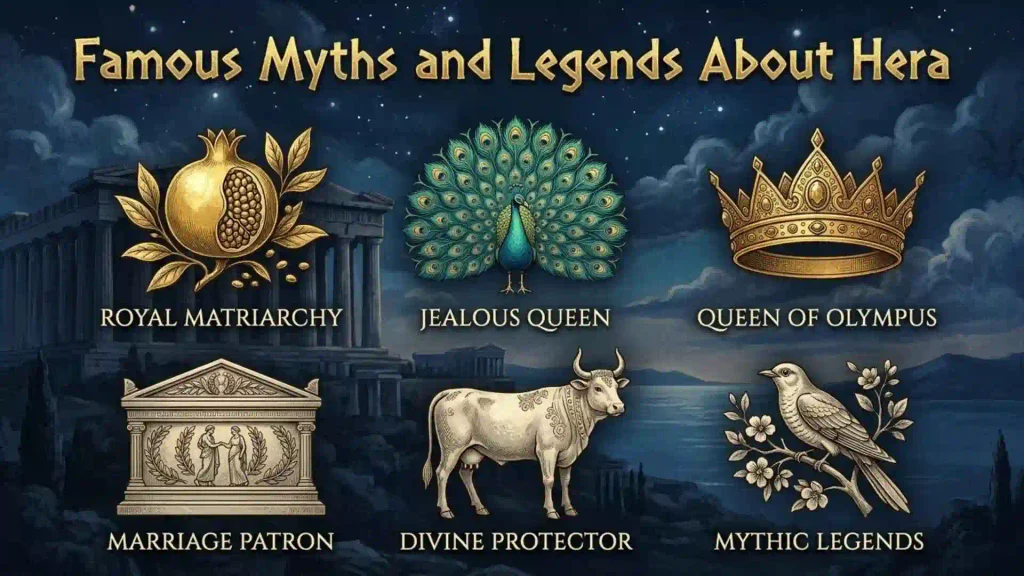
Hera appears in numerous Greek myths involving gods, heroes, and mortals. These stories explain her reputation and reveal how her divine influence shaped ancient Greek storytelling.
Hera and Zeus: The Complicated Marriage
The marriage between Hera and Zeus is one of Greek mythology’s most famous divine relationships.
Although Zeus and Hera ruled Olympus together, their relationship experienced repeated conflict.
Zeus pursued numerous women, including goddesses and mortals. Some of these relationships produced children who later became major mythological figures.
Hera often responded with anger and punishment. Her actions affected figures such as Io, Leto, and Heracles.
Their marriage illustrates an important contradiction. Hera protects marriage as a sacred institution while her own relationship remains troubled by infidelity.
Hera and Leto: The Birth of Apollo and Artemis
The story of Hera and Leto explains one of the most famous examples of Hera’s jealousy.
Leto was a Titaness who became pregnant with Zeus’s children, Apollo and Artemis.
When Hera learned about the pregnancy, she became hostile toward Leto. According to the Homeric Hymn to Apollo, Hera even prevented Eileithyia from helping with Leto’s labor.
Leto struggled to find a suitable place to give birth. Many locations feared welcoming her because they worried about Hera’s anger.
Eventually, she reached the island of Delos.
In the hymn’s account, Delos agreed to receive her after obtaining a promise that Apollo would honor the island. Leto then gave birth to Artemis and Apollo.
The island subsequently became an important sacred center associated with Apollo.
Important details from the myth:
- Leto was the mother of Apollo and Artemis.
- Zeus was their father.
- Hera opposed Leto’s pregnancy.
- Delos became the birthplace of Apollo in the tradition.
- Eileithyia’s delayed assistance prolonged Leto’s labor.
The story demonstrates Hera’s influence over divine relationships and childbirth traditions.
Hera and Io: The Transformation Into a Cow
The myth of Hera and Io offers another famous example of jealousy and divine punishment.
Io was a mortal woman associated with the city of Argos. Some traditions describe her as a priestess of Hera.
Zeus became interested in Io and pursued her. In a familiar version of the story, he transformed her into a white heifer to conceal their relationship.
Hera suspected the deception and requested the animal as a gift.
She then placed Io under the guard of Argus Panoptes, a giant famous for his many eyes.
Zeus eventually sent Hermes to rescue Io. Hermes lulled Argus to sleep and killed him.
Hera responded by sending a gadfly to torment Io. The insect drove her across distant lands until her suffering eventually ended.
In some traditions, Io regained her human form in Egypt and became associated with Egyptian religious traditions.
Why is the Io myth important?
- It explains the mythological connection between Hera and Argus.
- It contributes to the association between Hera and peacock feathers.
- It demonstrates Zeus’s attempts to conceal his affairs.
- It illustrates Hera’s use of punishment against Zeus’s lovers.
- It connects Greek mythology with traditions about Io’s travels.
Hera and the Trojan War: The Judgment of Paris
Hera played an important role in the events leading to the Trojan War.
The story begins with the wedding of Peleus and Thetis. Eris, the goddess of discord, wasn’t invited and became angry.
She threw a golden apple into the gathering. The inscription described it as a prize for the fairest goddess.
Hera, Athena, and Aphrodite each claimed the apple.
Zeus avoided choosing between them and appointed Paris of Troy as the judge.
The three goddesses attempted to influence his decision through different promises.
| Goddess | Promise or offer |
| Hera | Royal power and political authority |
| Athena | Wisdom and success in warfare |
| Aphrodite | The love of the most beautiful woman |
Paris selected Aphrodite, who promised him Helen of Sparta.
This decision angered Hera and Athena. Their hostility toward Troy became an important part of the conflict.
During the Trojan War, Hera supported the Greeks and opposed the Trojans.
Her involvement appears prominently in Homer’s Iliad, where she uses her influence to support the Greek side.
The myth connects Hera with divine competition, royal ambition, and the origins of the Trojan War.
Hera and Heracles: The Hero She Opposed
Heracles, known as Hercules in Roman mythology, was the son of Zeus and the mortal woman Alcmene.
His birth resulted from another of Zeus’s relationships outside his marriage to Hera.
Naturally, Hera became hostile toward the child.
One famous story describes Hera sending two serpents to attack Heracles while he was still an infant. However, the child demonstrated extraordinary strength by strangling both snakes.
Hera continued to oppose him throughout his life.
Her hostility contributed to the madness that caused Heracles to kill his family in one famous tradition. He later undertook the Twelve Labors as part of his purification.
These labors included:
- Defeating the Nemean Lion.
- Killing the Lernaean Hydra.
- Capturing the Ceryneian Hind.
- Capturing the Erymanthian Boar.
- Cleaning the Augean stables.
- Capturing the Cretan Bull.
- Obtaining the horses of Diomedes.
- Retrieving the belt of Hippolyta.
- Capturing the cattle of Geryon.
- Bringing back the golden apples of the Hesperides.
- Capturing Cerberus from the Underworld.
Ancient traditions differ about Hera’s involvement in individual labors and her eventual relationship with Heracles.
In some accounts, Heracles eventually reconciles with Hera and becomes an immortal Olympian.
Hera and the Giants: The Gigantomachy
The Gigantomachy describes the legendary battle between the Olympian gods and the Giants.
The Giants challenged the authority of Zeus and the Olympian divine order.
Hera participated in this broader conflict alongside the other gods.
The battle represented the struggle to maintain divine sovereignty against powerful enemies.
Different ancient sources provide different details about the participants and events. Therefore, Hera’s exact role shouldn’t be treated as identical across every version.
Hera’s Worship in Ancient Greece
Hera wasn’t merely a character in ancient stories. She received widespread religious worship throughout the Greek world.
Her sanctuaries, offerings, and festivals demonstrate the importance of her cult in ancient Greek society.
The Cult of Hera
The cult of Hera developed through local religious traditions across ancient Greece.
Her worship was particularly important in the Peloponnese and on the island of Samos.
The goddess received offerings and sacrifices from communities seeking divine favor.
Her worship also connected with marriage ceremonies and women’s religious activities.
Interestingly, Hera’s cult had ancient roots. Her name appears on Mycenaean Linear B tablets from Thebes and Pylos, showing that her religious identity existed before the classical period.
OUP Academic+1
Major Temples and Sanctuaries Dedicated to Hera
Several important religious centers honored Hera.
Heraion of Samos
The Heraion of Samos was one of the most important sanctuaries dedicated to Hera.
Its religious history extended back to the early Greek period. The sanctuary became famous for its monumental architecture and religious importance.
Herodotus even commented on the magnificence of its great temple.
Heraion of Argos
The Heraion of Argos stood in the Argive region between Argos and Mycenae.
It became one of the most significant centers of Hera’s worship.
Ancient traditions connected the sanctuary with the goddess’s relationship to marriage and the local identity of Argos.
Sanctuary of Hera at Olympia
Hera also had an important sanctuary at Olympia.
Her temple was part of the broader religious landscape of Olympia, which later became internationally famous for its athletic competitions.
Other sanctuaries
Hera received worship at several other Greek locations, including:
- Corinth.
- Sparta.
- Perachora.
- Tiryns.
- Delos.
- Sicyon.
The importance of these locations demonstrates that Hera’s worship wasn’t restricted to one city or region.
OUP Academic+2
Religious Offerings and Rituals
Ancient worshippers honored Hera through different religious practices.
These included:
- Animal sacrifices: Ritual offerings made during religious ceremonies.
- Votive offerings: Objects dedicated to the goddess as expressions of devotion.
- Prayers: Requests for divine favor and protection.
- Public ceremonies: Religious activities organized by local communities.
- Processions: Ceremonial movement between sacred locations.
- Marriage-related rituals: Practices connected with legitimate unions and family life.
The exact rituals varied by location and historical period.
Hera’s worship also reflected the importance of religious participation in everyday Greek community life.
Heraia Festival and Ancient Greek Athletics
The Heraia was a religious festival associated with Hera and women’s athletic competitions at Olympia.
Its best-known feature was a series of footraces for young women.
Competitors participated in different age groups. Their races took place in a shortened version of the Olympic running track.
The festival had both athletic and religious importance.
It honored Hera while giving young women an opportunity to participate in organized athletic competition.
The Heraia shouldn’t be confused with the men’s Olympic Games. They were distinct competitions with their own traditions and religious significance.
At Argos, the name Heraia was also used for a festival associated with the goddess. Local festivals and competitions varied across Greek communities.
Wiley Online Library+1
Hera in Ancient Greek Art and Literature
Ancient artists and writers helped preserve Hera’s identity for later generations.
Her image appears in sculpture, pottery, epic poetry, and religious monuments.
Hera in Ancient Greek Sculpture
Greek sculptors frequently represented Hera as a majestic and mature goddess.
Her common visual features included:
- Royal clothing.
- A diadem or crown.
- A scepter.
- A seated royal posture.
- A solemn facial expression.
- Association with Zeus and other Olympian gods.
One famous representation was the monumental statue at the Heraion of Argos.
Pausanias described the statue as a work by Polykleitos made from gold and ivory. He also mentioned its crown, pomegranate, and scepter.
This description provides valuable evidence about how ancient Greeks imagined Hera’s divine appearance.
theoi.com+1
Hera in Greek Pottery and Paintings
Greek pottery frequently depicted mythological scenes involving Hera.
These images included her relationships with Zeus, her role in divine ceremonies, and her participation in the Judgment of Paris.
Artists sometimes portrayed her with other Olympians to communicate her position within the divine family.
Her recognizable royal appearance helped distinguish her in many mythological scenes.
Hera in Classical Literature
Several important ancient works preserve Hera’s stories.
| Ancient work | Author or tradition | Hera’s significance |
| Iliad | Homer | Hera participates in the Trojan War |
| Theogony | Hesiod | Explains Hera’s genealogy and divine family |
| Homeric Hymn to Apollo | Anonymous ancient poet | Describes Hera’s opposition to Leto’s childbirth |
| Library | Pseudo-Apollodorus | Preserves myths involving Hera, Io, and Heracles |
| Description of Greece | Pausanias | Describes Hera’s sanctuaries and religious traditions |
These texts don’t always present identical versions of a myth.
That difference is important. Greek mythology developed through centuries of oral storytelling, local worship, and written literature.
Hera’s Roman Equivalent and Cultural Influence
The Roman equivalent of Hera was Juno, one of the most important goddesses in ancient Roman religion.
Although Greek and Roman traditions shared many religious ideas, Hera and Juno weren’t simply identical figures with different names.
Hera and Juno: Similarities and Differences
| Feature | Hera (Greek) | Juno (Roman) |
| Religious tradition | Ancient Greek religion | Ancient Roman religion |
| Divine position | Queen of the Olympian gods | Queen of the Roman gods |
| Husband | Zeus | Jupiter |
| Main associations | Marriage and married women | Marriage, women, and the Roman state |
| Sacred animal | Peacock and cow | Peacock and goose in Roman traditions |
| Divine family | Olympian gods | Roman gods |
Juno held a major position in Roman public religion. She formed part of the Capitoline Triad alongside Jupiter and Minerva.
Her responsibilities included marriage, women’s lives, and aspects of Roman civic identity.
The Greek goddess Hera influenced Roman representations of Juno. However, Roman worship developed its own traditions, festivals, and religious practices.
Hera’s Legacy and Representation in Modern Culture
Hera continues to appear in modern interpretations of Greek mythology. Her recognizable symbols and complicated personality make her an important figure in books, films, television, and popular culture.
Hera in Modern Books and Literature
Modern writers frequently revisit Hera’s mythology through retellings of ancient Greek stories.
Some portray her as a jealous wife who punishes Zeus’s lovers. Others explore her royal authority, emotional struggles, and position within a male-dominated divine hierarchy.
These interpretations often focus on questions that ancient mythology already raised:
- What does marital loyalty mean?
- How should power operate within a relationship?
- Why do powerful individuals sometimes punish innocent people?
- Can someone protect an institution while struggling within it?
- How do personal emotions influence public authority?
Contemporary retellings sometimes give Hera a more sympathetic perspective. However, these interpretations should remain distinct from the details preserved in ancient sources.
Hera in Films and Television
Hera appears in mythology-inspired entertainment, animation, and adaptations of classical literature.
Her character often serves as a powerful queen, Zeus’s wife, or an antagonist who challenges heroes.
Modern adaptations sometimes simplify her mythology to make stories easier to follow.
For example, her relationship with Heracles may receive more attention than her religious importance as a goddess of marriage.
Hera in Modern Symbolism and Popular Culture
Hera’s visual identity continues to influence modern artwork and symbolic designs.
Her most recognizable associations include:
- Peacock feathers: Royal elegance and watchfulness.
- Pomegranate: Fertility and abundance.
- Crown: Leadership and authority.
- Scepter: Sovereignty and power.
- Marriage imagery: Commitment and marital relationships.
- Royal throne: Divine status and dignity.
People also interpret Hera as a symbol of feminine strength and independence.
These modern interpretations can be meaningful. However, they’re not always direct representations of ancient Greek religious beliefs.
Interesting Facts About the Greek Goddess Hera
Hera’s mythology contains many fascinating details beyond her famous conflicts with Zeus.
Here are some important Hera facts worth knowing.
- Hera was the daughter of Cronus and Rhea. Her parents belonged to the ancient generation of Titans.
- She was both Zeus’s sister and wife. Their relationship followed the traditional Olympian family genealogy.
- Hera was one of the Twelve Olympians. She held a leading position among the gods of Mount Olympus.
- Her Roman counterpart was Juno. Roman religion developed its own traditions around this goddess.
- The peacock became her best-known sacred animal. Its eye-like feathers became associated with the myth of Argus.
- The cow was another sacred animal. Homer used the epithet Boopis to describe Hera.
- Her daughter Eileithyia governed childbirth. She held a more specialized role in labor and delivery.
- Hera’s children included Ares and Hebe. Eileithyia and Hephaestus also appear in major genealogical traditions.
- The Heraion of Samos was a major sanctuary. It became famous for its monumental religious architecture.
- Argos was especially important to her worship. Homer mentions Argos, Sparta, and Mycenae among Hera’s favored cities.
- The Heraia included women’s footraces. These athletic competitions honored the goddess at Olympia.
- Hera opposed Leto’s pregnancy. Her actions complicated the births of Apollo and Artemis.
- She played a major role in the Trojan War. Hera supported the Greek side against Troy.
- Heracles experienced her hostility. His connection with Zeus and Alcmene made him a target in several myths.
- Hera appears in Homer’s Iliad. Her involvement demonstrates her importance in classical Greek literature.
Frequently Asked Questions About Hera
Who Is Hera in Greek Mythology?
Hera is the Greek goddess of marriage and one of the Twelve Olympians. She is the wife of Zeus and the Queen of the Gods. Ancient Greeks also associated her with women, childbirth, and legitimate family relationships.
What Is Hera the Goddess Of?
Hera is primarily the goddess of marriage and married women. Her religious responsibilities also connect her with women’s lives, childbirth, motherhood, and family legitimacy.
What Does Hera Symbolize?
Hera symbolizes marriage, royal authority, feminine power, and family relationships. Her mythology also explores jealousy, vengeance, loyalty, and the consequences of betrayal.
What Are Hera’s Sacred Animals?
The peacock and cow are Hera’s most recognizable sacred animals. The peacock represents her connection with royal beauty and watchfulness while the cow appears in ancient literature and religious symbolism.
Why Is the Peacock Associated With Hera?
The peacock is associated with Hera through the myth of Argus Panoptes. After Hermes killed Argus, Hera placed his eyes on the peacock’s feathers in a popular version of the story.
Who Are Hera’s Parents and Siblings?
Hera’s parents were Cronus and Rhea. Her siblings were Zeus, Poseidon, Hades, Demeter, and Hestia.
Is Hera Zeus’s Sister and Wife?
Yes. Hera and Zeus were siblings and spouses according to Greek mythology. Both were children of Cronus and Rhea. Their marriage made Hera the Queen of Olympus.
Who Are Hera’s Children?
Hera’s children in major mythological traditions include Ares, Hebe, Eileithyia, and Hephaestus. Ancient accounts differ about whether Zeus fathered Hephaestus or Hera produced him independently.
What Are Hera’s Powers?
Hera possesses immortality, divine strength, and supernatural authority as an Olympian goddess. Her influence extends to marriage, women’s lives, and divine relationships. She also uses supernatural punishment in several famous myths.
Why Did Hera Hate Zeus’s Lovers?
Hera became angry because Zeus repeatedly pursued other women despite their marriage. Her anger often extended to his lovers and their children. The myths portray her reactions as part of the conflict surrounding marital fidelity and divine authority.
What Happened Between Hera and Leto?
Hera opposed Leto after she became pregnant with Zeus’s children. Leto struggled to find a place to give birth to Apollo and Artemis. She eventually received refuge on Delos, where both children were born.
Why Did Hera Punish Io?
Io attracted Zeus’s attention and became involved in one of his relationships outside marriage. Hera suspected Zeus and became involved in Io’s transformation and suffering. In a popular version, she also sent a gadfly to torment Io.
What Was Hera’s Role in the Trojan War?
Hera supported the Greeks during the Trojan War. Her hostility toward Paris developed after he selected Aphrodite as the fairest goddess in the Judgment of Paris. She consequently opposed the Trojans in several episodes of the Iliad.
What Is Hera’s Roman Name?
Hera’s Roman counterpart is Juno. Both goddesses held important positions as divine queens and were associated with marriage and women’s lives.
Where Was Hera Worshipped in Ancient Greece?
Hera received worship in Argos, Samos, Olympia, Sparta, Corinth, and several other Greek locations. Her most important sanctuaries included the Heraion of Argos and the Heraion of Samos.
Conclusion: Hera’s Meaning and Lasting Legacy
The Greek Goddess Hera remains one of the most influential figures in ancient Greek mythology. As the Queen of Olympus, she represented marriage, women, family relationships, and royal authority.Her recognizable symbols tell another part of her story. The peacock reflects her association with divine grandeur while the cow connects her with ancient religious imagery. The pomegranate, diadem, and scepter further reinforce her connections with fertility, queenship, and authority.However, Hera’s mythology extends far beyond her symbols. Her relationships with Zeus, Leto, Io, and Heracles reveal a complicated personality shaped by jealousy, determination, vengeance, and power.Her temples at Argos and Samos demonstrate her importance in ancient Greek religion. Her influence also survived through Roman mythology, classical literature, and modern cultural interpretations.Ultimately, Hera represents both the authority of divine queenship and the complicated nature of marriage. Her stories continue to offer valuable insights into ancient Greek beliefs about relationships, family, loyalty, and power.

I am John Carter, a lifelong enthusiast of language and modern slang. I explore how words evolve and shape culture, and I enjoy uncovering the stories behind everyday expressions. I have authored “Slang and Society: The Language of Youth” and “Modern Words, Modern Worlds”, where I dive into how informal language impacts communication and identity. My goal is to make language accessible, fun, and insightful for everyone who loves words as much as I do.
 Lisa Reynolds