Music has its own language. Instead of ordinary letters and sentences, musicians use notes, rests, lines, shapes, and special markings to communicate sounds. These visual instructions make it possible to write down a melody and reproduce it accurately, even years after its composition.
Musical symbols are the building blocks of this written language. They tell you which notes to play, how long to hold them, when to pause, how loudly to perform, and how quickly a composition should move. From the familiar treble clef to tiny articulation marks, every symbol serves a purpose.
Whether you’re learning piano, playing guitar, studying music theory, or simply trying to understand sheet music, recognizing these markings makes a tremendous difference. Some symbols identify pitch while others control rhythm, dynamics, tempo, and musical expression.
This comprehensive guide explains the most common music symbols and their meanings, including their appearance, functions, and practical uses. You’ll also discover how musical notation developed, how different instruments use specialized markings, and how beginners can learn to read written music with confidence.
What Are Musical Symbols?
Musical symbols are written signs used to represent musical information in a composition. They communicate instructions about pitch, rhythm, duration, silence, volume, speed, and playing techniques.
Composers arrange these symbols on a musical staff to create written music. Musicians then interpret the notation and turn it into actual sounds through singing or playing instruments.
For example, a quarter note tells a musician how long to perform a sound relative to the musical beat. A sharp sign raises a note by one semitone while a rest indicates silence.
Together, these markings create a shared musical language that musicians can understand across different countries and musical traditions.
What Do Musical Symbols Represent?
Different symbols communicate different types of musical information.
| Category | What It Represents | Examples |
| Notes | Musical pitch and duration | Whole note, quarter note |
| Rests | Periods of silence | Half rest, eighth rest |
| Clefs | Pitch positions on the staff | Treble clef, bass clef |
| Accidentals | Changes in pitch | Sharp, flat, natural |
| Key signatures | Sharps or flats associated with a musical key | G major, F major |
| Time signatures | Beat organization and meter | 3/4, 4/4, 6/8 |
| Dynamics | Sound intensity | Piano, forte |
| Articulation | How notes should sound | Staccato, legato |
| Tempo | Speed of performance | Adagio, Allegro |
| Expression | Musical interpretation | Fermata, trill, breath mark |
Why Are Musical Symbols Important?
Without musical notation, musicians would rely heavily on memory, spoken instructions, or recordings. Written symbols provide a more precise way to preserve and communicate musical ideas.
They help musicians:
- Read sheet music: Identify pitches, rhythms, and musical patterns.
- Understand composition: Recognize how notes form melodies, harmonies, and chords.
- Maintain rhythm: Follow beats, measures, and rhythmic patterns.
- Control dynamics: Perform passages softly, loudly, or with gradual changes.
- Interpret music: Understand the composer’s performance instructions.
- Play together: Coordinate with other musicians during rehearsals and performances.
- Preserve musical works: Record compositions for future generations.
Basic Musical Symbols and Their Meanings
Before exploring individual categories, it’s helpful to recognize the most frequently encountered musical notation symbols.
The following table provides a quick reference to common symbols used in traditional Western music notation.
| Symbol | Name | Meaning |
| 𝄞 | Treble clef | Establishes G4 on the second staff line |
| 𝄢 | Bass clef | Establishes F3 on the fourth staff line |
| 𝅝 | Whole note | Four quarter-note values |
| 𝅗𝅥 | Half note | Two quarter-note values |
| ♩ | Quarter note | One quarter-note value |
| ♪ | Eighth note | Half a quarter-note value |
| ♬ | Sixteenth-note pair | Two connected sixteenth notes in suitable notation |
| 𝄽 | Quarter rest | Silence equal to a quarter-note value |
| ♯ | Sharp | Raises a pitch by one semitone |
| ♭ | Flat | Lowers a pitch by one semitone |
| ♮ | Natural | Cancels an applicable accidental |
| 𝄐 | Fermata | Holds a note or rest longer |
| 𝄴 | Common time | Indicates 4/4 meter |
| 𝄵 | Cut time | Indicates 2/2 meter |
Note: Some musical symbols may display differently across fonts, devices, and applications. Their meaning comes from their notation context.
Musical Note Symbols and Their Values
Musical notes represent sounds with specific pitches and durations. Their appearance tells musicians how long to sustain each sound relative to other notes.
A standard note contains three possible visual elements:
- Notehead: The oval-shaped part that identifies the written pitch.
- Stem: The vertical line attached to the notehead.
- Flag or beam: The curved or horizontal marking that indicates a shorter rhythmic value.
The combination of these elements determines the note’s rhythmic value.
Whole Note
SYMBOL: 𝅝
A whole note has an open oval notehead without a stem. It represents four quarter-note values.
In common time (4/4), a whole note fills an entire measure. However, its actual duration in seconds depends on the tempo.
For example, if the quarter-note beat occurs at 60 beats per minute, a whole note lasts approximately four seconds.
Important characteristics:
- Open, hollow notehead.
- No stem or flag.
- Four quarter-note values.
- Commonly fills one measure in 4/4 time.
Half Note
SYMBOL: 𝅗𝅥
A half note contains an open notehead with a vertical stem. It lasts twice as long as a quarter note.
In 4/4 time, two half notes can fill one complete measure.
Musicians often encounter half notes in slower melodies, sustained harmonies, and passages that require longer sounds.
Quarter Note
SYMBOL: ♩
A quarter note has a filled notehead and a single stem. It serves as a common reference value for counting rhythm.
In 4/4 time, one quarter note receives one beat. Four quarter notes therefore fill a complete measure.
You’ll find this note throughout piano music, guitar arrangements, vocal scores, and countless other compositions.
Eighth Note
SYMBOL: ♪
An eighth note has a filled notehead, a stem, and one flag. It lasts half as long as a quarter note.
Two eighth notes equal one quarter note in duration.
When several eighth notes appear together, composers usually connect their stems with a horizontal beam rather than drawing separate flags.
Sixteenth Note
A sixteenth note has a filled notehead, a stem, and two flags or beams.
It lasts half as long as an eighth note. Four sixteenth notes equal one quarter note.
These notes frequently appear in fast passages, rhythmic patterns, instrumental runs, and detailed melodic passages.
Thirty-Second and Sixty-Fourth Notes
More advanced compositions sometimes use even shorter note values.
| Note Type | Flags | Duration Compared With a Quarter Note |
| Whole note | 0 | 4 times |
| Half note | 0 | 2 times |
| Quarter note | 0 | 1 time |
| Eighth note | 1 | 1/2 |
| Sixteenth note | 2 | 1/4 |
| Thirty-second note | 3 | 1/8 |
| Sixty-fourth note | 4 | 1/16 |
These values describe the standard undotted note relationships.
Dotted Notes and Double-Dotted Notes
A dot placed immediately after a note increases its duration by half its original value.
For example:
- Dotted half note = 3 quarter-note values.
- Dotted quarter note = 1.5 quarter-note values.
- Dotted eighth note = 0.75 quarter-note values.
A double-dotted note adds another quarter of the original note’s value after the first dot.
For example, a double-dotted half note lasts 3.5 quarter-note values.
Dotted rhythms appear frequently in marches, classical compositions, jazz, and many popular songs.
Tied Notes
A tie is a curved line connecting two notes with the same pitch. It combines their durations into one continuous sound.
For example, a half note tied to a quarter note lasts three quarter-note values.
Ties are especially useful when a sound needs to continue across a bar line without interruption.
Musical Rest Symbols and Their Meanings
Music isn’t only about producing sounds. Silence plays an equally important role in rhythm and musical expression.
Musical rests indicate periods when performers should remain silent. Each rest has a specific duration that corresponds to a note value.
| Rest Symbol | Name | Duration |
| 𝄻 | Whole rest | Four quarter-note values |
| 𝄼 | Half rest | Two quarter-note values |
| 𝄽 | Quarter rest | One quarter-note value |
| 𝄾 | Eighth rest | Half a quarter-note value |
| 𝄿 | Sixteenth rest | One-quarter of a quarter-note value |
Whole Rest
A whole rest looks like a small rectangle hanging below the fourth line of the staff.
It represents a silence equal to four quarter-note values. In 4/4 time, it commonly indicates a complete measure of silence.
Half Rest
A half rest resembles a small rectangle sitting above the third staff line.
It represents two quarter-note values. Musicians use it when a passage requires a shorter period of silence than a whole rest.
Quarter Rest
The quarter rest has a distinctive zigzag appearance. It represents one quarter-note value.
Unlike whole and half rests, its shape doesn’t resemble a simple horizontal rectangle.
Eighth and Sixteenth Rests
An eighth rest contains one flag-like marking. A sixteenth rest contains two.
Shorter rests allow composers to create more detailed rhythmic patterns and precise pauses.
Multiple-Measure Rests
A multiple-measure rest indicates that a musician should remain silent for several consecutive measures.
Composers and music editors often use a horizontal bar with a number above it to show the number of silent measures.
This notation makes orchestral and ensemble scores easier to read.
Musical Clef Symbols and Their Meanings
A clef identifies the pitch represented by each line and space on a musical staff.
Without a clef, musicians wouldn’t know which specific notes the staff represents.
Traditional Western notation primarily uses treble, bass, alto, and tenor clefs.
Treble Clef (G Clef)
SYMBOL: 𝄞
The treble clef is one of the most recognizable musical symbols. Its spiral circles the second line from the bottom, establishing that line as G4.
It commonly appears in music written for instruments with higher pitch ranges.
Treble clef staff notes:
| Position | Note |
| Bottom line | E4 |
| Second line | G4 |
| Third line | B4 |
| Fourth line | D5 |
| Top line | F5 |
| First space | F4 |
| Second space | A4 |
| Third space | C5 |
| Fourth space | E5 |
A useful memory aid for the lines is Every Good Boy Does Fine.
The spaces spell F-A-C-E from bottom to top.
Common instruments using treble clef include:
- Violin
- Flute
- Trumpet
- Clarinet
- Guitar
- Right hand of piano music
Bass Clef (F Clef)
SYMBOL: 𝄢
The bass clef identifies F3 on the fourth line from the bottom. Its two dots appear above and below this reference line.
It commonly appears in music for lower-pitched instruments.
Bass clef staff notes:
| Position | Note |
| Bottom line | G2 |
| Second line | B2 |
| Third line | D3 |
| Fourth line | F3 |
| Top line | A3 |
| First space | A2 |
| Second space | C3 |
| Third space | E3 |
| Fourth space | G3 |
A useful phrase for remembering the lines is Good Boys Do Fine Always.
The spaces spell A-C-E-G from bottom to top.
Common bass clef instruments include:
- Cello
- Double bass
- Bassoon
- Tuba
- Trombone
- Left hand of piano music
Alto Clef
The alto clef is a type of C clef. Its center identifies middle C (C4) on the third line of the staff.
Viola music commonly uses this clef because it places many of the instrument’s notes comfortably within the staff.
Tenor Clef
The tenor clef is another C clef. It places middle C on the fourth staff line.
You may encounter it in higher passages for cello, bassoon, trombone, and other lower-register instruments.
Grand Staff
The grand staff combines treble and bass staves with a brace on the left side.
Piano and keyboard music commonly use this arrangement. The upper staff generally represents the right hand while the lower staff represents the left hand.
Both staves work together to represent a wider range of pitches.
Musical Staff Symbols, Lines, and Spaces
The musical staff provides the foundation for traditional music notation. It consists of five horizontal lines and four spaces.
Notes appear either directly on the lines or inside the spaces. Their vertical positions identify their pitches according to the clef.
The Five-Line Staff
Musicians read staff positions from bottom to top.
In treble clef, the bottom line represents E4 while the top line represents F5.
In bass clef, the bottom line represents G2 while the top line represents A3.
Ledger Lines
Ledger lines extend the staff when notes fall outside its five regular lines.
For example, middle C (C4) appears on a ledger line below the treble staff. It also appears on a ledger line above the bass staff.
These additional lines allow composers to write higher or lower pitches without changing clefs constantly.
Bar Lines and Measure Symbols
Bar lines divide a musical staff into smaller sections called measures or bars.
Common types include:
- Single bar line: Separates individual measures.
- Double bar line: Marks a major section or structural division.
- Final bar line: Indicates the end of a composition or movement.
- Dotted bar line: May separate specific rhythmic or structural groupings.
Repeat Signs
Repeat signs tell musicians to perform a particular section again.
A standard repeat marking uses two dots beside a heavy bar line. Musicians follow the surrounding notation to identify the repeated passage.
First and second endings provide different endings when a section repeats.
For example, a performer may play the first ending during the initial pass and skip it when returning for the second ending.
Accidentals and Musical Pitch Symbols
Accidentals are symbols placed before notes to change their pitch. They help composers write chromatic passages and express musical ideas outside the notes naturally associated with a key signature.
The three main accidentals are sharps, flats, and naturals.
Sharp Symbol (♯)
A sharp raises a note by one semitone.
For example, F becomes F-sharp (F♯). On a piano, F♯ is the black key immediately to the right of F.
Flat Symbol (♭)
A flat lowers a note by one semitone.
For example, B becomes B-flat (B♭). On a piano, B♭ is the black key immediately to the left of B.
Natural Symbol (♮)
A natural cancels an applicable sharp or flat.
For example, if a measure contains F-sharp through the key signature, a natural sign before F changes that occurrence to F-natural.
Double Sharp (𝄪)
A double sharp raises a note by two semitones.
For example, C double-sharp sounds at the same pitch as D in standard twelve-tone equal temperament.
Double Flat (𝄫)
A double flat lowers a note by two semitones.
For example, B double-flat sounds at the same pitch as A in standard twelve-tone equal temperament.
How Accidentals Work
In standard notation, an accidental generally applies to the same written pitch within the same octave for the remainder of its measure. A bar line resets that measure-level effect unless another accidental appears.
Remember these basic distinctions:
| Symbol | Function | Example |
| ♯ | Raises one semitone | F → F♯ |
| ♭ | Lowers one semitone | B → B♭ |
| ♮ | Cancels an applicable alteration | F♯ → F♮ |
| 𝄪 | Raises two semitones | C → C𝄪 |
| 𝄫 | Lowers two semitones | B → B𝄫 |
Key Signature Symbols and Their Meanings
A key signature appears immediately after the clef. It shows which notes are consistently sharpened or flattened throughout a musical passage unless an accidental changes them.
Key signatures help musicians identify tonal centers and understand the pitch organization of a composition.
Major Key Signatures
Major keys follow a recognizable pattern of sharps or flats.
| Major Key | Number of Sharps or Flats |
| C major | 0 |
| G major | 1 sharp |
| D major | 2 sharps |
| A major | 3 sharps |
| E major | 4 sharps |
| B major | 5 sharps |
| F major | 1 flat |
| B-flat major | 2 flats |
| E-flat major | 3 flats |
| A-flat major | 4 flats |
| D-flat major | 5 flats |
| G-flat major | 6 flats |
| C-flat major | 7 flats |
Minor Key Signatures
Every major key has a relative minor key that shares its key signature.
For example:
- C major and A minor have no sharps or flats.
- G major and E minor share one sharp.
- F major and D minor share one flat.
- D major and B minor share two sharps.
Although relative major and minor keys share the same key signature, their tonal centers differ.
Circle of Fifths
The circle of fifths is a visual tool that organizes major and minor keys according to their relationships.
Moving clockwise adds sharps while moving counterclockwise adds flats.
Musicians use it to understand:
- Key signatures.
- Relative major and minor keys.
- Chord relationships.
- Common harmonic progressions.
- Modulation between keys.
Time Signature Symbols and Musical Meter
A time signature appears after the clef and key signature. It tells musicians how beats are grouped within each measure.
It usually contains two numbers arranged vertically.
- Top number: Indicates how many beat units appear in a measure.
- Bottom number: Identifies the note value used as the unit.
For example, 4/4 indicates four quarter-note beats per measure.
Common Time (4/4)
Common time uses four quarter-note beats in each measure.
It is widely used in popular music, rock, classical compositions, and many other musical styles.
Its special symbol is 𝄴.
Cut Time (2/2)
Cut time contains two half-note beats per measure.
Its symbol is 𝄵. Musicians often use it for passages with a broad two-beat feeling.
Simple Time Signatures
Simple meters divide each beat into two equal parts.
Common examples include:
| Time Signature | Beats Per Measure | Typical Grouping |
| 2/4 | 2 quarter-note beats | 1 + 1 |
| 3/4 | 3 quarter-note beats | 1 + 1 + 1 |
| 4/4 | 4 quarter-note beats | 1 + 1 + 1 + 1 |
Waltzes commonly use 3/4 time while many popular songs use 4/4.
Compound Time Signatures
Compound meters divide each main beat into three equal parts.
Examples include:
- 6/8: Two main beats, each divided into three eighth notes.
- 9/8: Three main beats, each divided into three eighth notes.
- 12/8: Four main beats, each divided into three eighth notes.
These meters frequently create a flowing or lilting rhythmic feel.
Irregular and Asymmetric Time Signatures
Some compositions use unusual beat groupings.
For example, 5/4 may group beats as 3 + 2 or 2 + 3. Similarly, 7/8 may group eighth-note units as 2 + 2 + 3.
These patterns appear in progressive rock, jazz, contemporary classical music, and various folk traditions.
Musical Dynamics Symbols and Their Meanings
Musical dynamics indicate how loudly or softly performers should play. They influence the intensity, contrast, and emotional character of music.
Most traditional dynamic markings use Italian terms or their abbreviations.
| Symbol | Italian Term | Meaning |
| ppp | Pianississimo | Extremely soft |
| pp | Pianissimo | Very soft |
| p | Piano | Soft |
| mp | Mezzo piano | Moderately soft |
| mf | Mezzo forte | Moderately loud |
| f | Forte | Loud |
| ff | Fortissimo | Very loud |
| fff | Fortississimo | Extremely loud |
These markings provide relative instructions rather than fixed decibel levels.
Piano (p)
The letter p stands for piano. It tells performers to play softly.
Pianissimo (pp)
Pianissimo means very soft. It creates a quieter sound than ordinary piano dynamics.
Mezzo Piano (mp)
Mezzo piano means moderately soft. It sits between piano and mezzo forte.
Mezzo Forte (mf)
Mezzo forte means moderately loud. It provides a balanced dynamic level.
Forte (f)
Forte means loud. Performers use more sound intensity than they would with mezzo forte.
Fortissimo (ff)
Fortissimo indicates a very loud performance. Composers often use it during powerful musical passages.
Crescendo
A crescendo means gradually increasing volume.
It may appear as the Italian abbreviation cresc. or as a hairpin that opens toward the right.
Diminuendo and Decrescendo
A diminuendo or decrescendo means gradually decreasing volume.
The corresponding hairpin closes toward the right.
Sforzando and Other Dynamic Markings
Several additional markings indicate sudden emphasis or changes in intensity.
- sf or sfz: Sforzando, a sudden strong emphasis.
- fp: Fortepiano, a loud attack followed immediately by a softer dynamic.
- rfz: Rinforzando, a reinforced or strengthened emphasis.
These markings help performers create contrast rather than playing every note at the same intensity.
Musical Articulation Symbols and Their Meanings
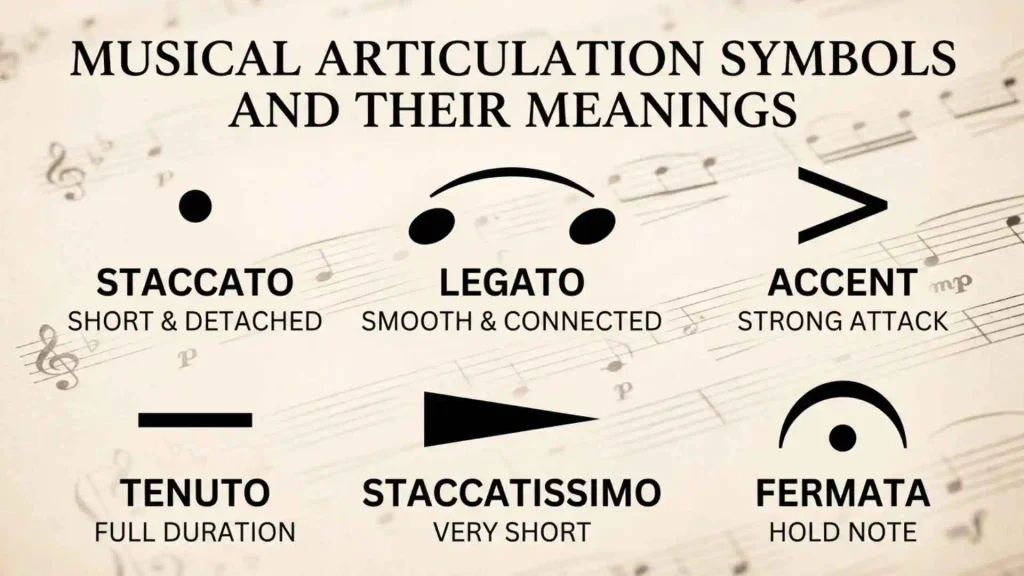
Articulation symbols tell performers how to begin, sustain, connect, or separate individual notes. They affect the character of a melody without necessarily changing its written pitch or basic rhythmic value.
For example, two quarter notes may have identical pitches and durations. However, staccato makes them sound detached while legato connects them smoothly.
Staccato
A staccato marking appears as a small dot above or below a notehead.
It tells performers to play the note in a short, detached manner. The exact shortening depends on the musical context and performance style.
Staccato appears frequently in piano pieces, orchestral passages, marches, and energetic melodies.
Staccatissimo
Staccatissimo indicates an even shorter and more sharply detached articulation than ordinary staccato.
It may appear as a small wedge or vertical marking above or below the notehead. Its precise appearance can vary between notation traditions.
Legato
Legato means playing notes smoothly and connecting them without noticeable breaks.
Composers often use a curved slur over or under several notes to communicate this instruction.
String players may connect notes through continuous bow movement while singers maintain smooth vocal phrasing.
Tenuto
A tenuto marking looks like a short horizontal line above or below a note.
It generally tells performers to sustain the note for its full written value. Depending on the musical context, it may also suggest slight emphasis.
Accent
An accent symbol (>) indicates that a note should receive stronger emphasis than surrounding notes.
It changes the note’s expressive intensity and helps establish rhythmic character.
Marcato
Marcato means marked or strongly emphasized.
Its symbol often resembles a small wedge (^) above or below a note. Performers give the marked note a more pronounced attack.
Fermata
SYMBOL: 𝄐
A fermata resembles an arc with a dot underneath or inside it.
It tells performers to hold a note or rest longer than its normal written duration. The composer or conductor generally determines the appropriate length.
Fermatas commonly appear at musical endings, dramatic pauses, and important phrase boundaries.
Tempo Symbols and Musical Speed Markings
Tempo markings tell musicians how quickly or slowly to perform a composition. They establish the speed of the beat and influence the overall character of a musical passage.
Traditional tempo instructions frequently use Italian words because Italian became an established language of musical terminology in European classical music.
Common Tempo Markings
| Tempo Marking | General Meaning | Approximate BPM |
| Grave | Very slow and solemn | 25–45 |
| Largo | Broad and slow | 40–60 |
| Lento | Slow | 45–60 |
| Adagio | Slow and relaxed | 55–75 |
| Andante | At a walking pace | 73–100 |
| Moderato | Moderate speed | 108–120 |
| Allegretto | Moderately fast | 98–120 |
| Allegro | Fast and lively | 120–156 |
| Vivace | Lively and brisk | 140–176 |
| Presto | Very fast | 168–200 |
| Prestissimo | Extremely fast | 200 and above |
These BPM figures are approximate teaching ranges, not universal rules. Actual interpretations vary by composer, period, genre, and musical context.
Metronome Markings
A metronome marking provides a numerical tempo instruction.
For example:
♩ = 120
This means the quarter note receives 120 beats per minute.
A metronome produces regular clicks at the selected speed. Musicians use it to develop consistent timing and practice difficult rhythmic passages.
Tempo Change Symbols and Terms
Composers sometimes change the speed during a composition.
Common instructions include:
- Accelerando (accel.): Gradually increase the tempo.
- Ritardando (rit.): Gradually slow down.
- Rallentando (rall.): Gradually slow the music, often with a broader or more relaxed feeling.
- A tempo: Return to the previous or established tempo.
- Tempo primo: Return to the original tempo.
- Rubato: Allow expressive flexibility in timing.
These instructions help musicians shape a composition rather than maintaining one mechanical speed throughout.
Musical Expression and Performance Markings
Beyond pitch, rhythm, and volume, expression markings communicate how musicians should interpret a composition.
They help performers understand phrasing, breathing, ornamentation, and other details that influence musical character.
Slur
A slur is a curved line connecting two or more notes of different pitches.
It generally indicates smooth phrasing or connected articulation. Instrument-specific techniques determine exactly how the performer produces that connection.
For example, a violinist may play several slurred notes within one bow stroke.
Tie
A tie connects two notes of the same written pitch.
Unlike a slur, it combines their durations into one sustained sound. The performer doesn’t attack the second note again.
Breath Mark
A breath mark indicates where singers or wind players may take a breath.
It often appears as a small comma-like marking above the musical staff.
Composers use breath marks to organize vocal phrases and allow performers to manage breathing naturally.
Caesura
A caesura indicates a brief interruption or noticeable break in the music.
Its symbol commonly resembles two diagonal lines (//).
Conductors and performers interpret its duration according to the composition and performance context.
Trill
A trill is an ornament that creates a rapid alternation between a written note and its neighboring pitch.
It often appears with the abbreviation tr above a note.
The exact execution depends on the musical period, surrounding notes, and performance tradition.
Mordent
A mordent is a short ornament involving the principal note and a neighboring note.
Two common forms include:
- Upper mordent: Brief movement from the main note to the note above and back.
- Lower mordent: Brief movement from the main note to the note below and back.
Turn
A turn is an ornament that surrounds the main note with neighboring pitches.
Its symbol generally resembles a sideways curved figure. Depending on the notation, a turn may include the note above, the principal note, the note below, and a return.
Arpeggio
An arpeggio marking often appears as a vertical wavy line beside a chord.
It tells the performer to play the chord’s notes successively rather than striking every note simultaneously.
Piano, harp, and guitar compositions frequently use arpeggios.
Glissando and Portamento
A glissando indicates a continuous or rapid movement between pitches.
A portamento describes a smoother, expressive slide between notes.
Both techniques create pitch movement, although their execution depends on the instrument and musical tradition.
Piano Pedal Markings
Pedal markings guide pianists when using the sustain pedal.
Common instructions include:
- Ped.: Press the sustain pedal.
- Asterisk (*): Release the pedal.
- Pedal line: Shows how long the pedal remains engaged.
Some modern scores use more detailed pedal diagrams to indicate partial releases and changes.
Instrument-Specific Musical Symbols
Although many music notation symbols work across different instruments, certain markings belong to particular playing techniques.
Understanding these differences helps you read specialized sheet music without confusing instrument instructions.
Piano and Keyboard Symbols
Piano notation commonly uses a grand staff with treble and bass clefs.
The right hand generally plays the upper staff while the left hand plays the lower staff. However, composers can assign either hand to either staff when necessary.
Common piano markings include:
- Sustain pedal instructions.
- Octave signs.
- Arpeggio markings.
- Finger numbers.
- Hand-crossing instructions.
- Chord symbols.
- Dynamic and articulation markings.
Piano scores can also include multiple voices on one staff, allowing independent musical lines to appear together.
Guitar Symbols
Guitar music may use standard staff notation, tablature, or both.
Guitar tablature, commonly called TAB, uses six horizontal lines representing the instrument’s six strings. Numbers indicate which frets the guitarist should press.
| Guitar Symbol or Marking | Meaning |
| h | Hammer-on |
| p | Pull-off |
| / | Slide upward |
| \ | Slide downward |
| b | Bend the string |
| r | Release a bend |
| ~ | Vibrato |
| PM | Palm muting |
| x | Muted or percussive note, depending on context |
For example, a guitarist may see 7h9 in tablature. This means playing the seventh fret and hammering onto the ninth fret without picking the second note.
Drum and Percussion Symbols
Percussion notation represents different instruments and playing techniques through note positions, notehead shapes, and staff arrangements.
A drum kit score may include:
- Bass drum.
- Snare drum.
- Closed hi-hat.
- Open hi-hat.
- Ride cymbal.
- Crash cymbal.
- Toms.
Cross-shaped noteheads often represent cymbals or other percussion sounds. However, the exact mapping depends on the percussion notation key.
Unlike conventional pitched notation, many percussion instruments produce sounds without a clearly defined musical pitch.
Vocal and Choral Symbols
Vocal scores use ordinary musical notes alongside lyrics and performance instructions.
The notation aligns syllables with individual notes so singers know which words to sing.
Common vocal markings include:
- Breath marks.
- Slurs.
- Phrase markings.
- Dynamic instructions.
- Voice-part labels such as soprano, alto, tenor, and bass.
- Vowel and consonant pronunciation instructions.
Choir music may also place several vocal parts on separate staves.
String Instrument Symbols
String instruments use additional markings to explain bowing and sound production.
| Marking | Meaning |
| Arco | Play with the bow |
| Pizzicato | Pluck the strings |
| Col legno | Play using the wood of the bow |
| Tremolo | Rapid repetition or alternation of sound |
| Harmonics | Produce high, bell-like tones |
| Up-bow | Move the bow upward |
| Down-bow | Move the bow downward |
These instructions are especially important for violin, viola, cello, and double bass players.
Advanced and Special Musical Notation Symbols
Advanced compositions sometimes require symbols beyond conventional notes, rests, and dynamics.
These special musical symbols communicate unusual pitch ranges, instrumental techniques, and experimental performance instructions.
Octave Signs
Octave signs allow composers to write notes an octave or more above or below their normal staff positions.
| Symbol | Meaning |
| 8va | Play one octave higher |
| 8vb | Play one octave lower |
| 15ma | Play two octaves higher |
| 15mb | Play two octaves lower |
These markings simplify notation by reducing the number of ledger lines.
Natural and Artificial Harmonics
Harmonics produce higher, bell-like sounds by dividing a vibrating string into smaller sections.
String players use specific finger placements and bowing techniques to produce natural or artificial harmonics.
Composers may represent these pitches with diamond-shaped noteheads or additional instructions.
Tremolo
Tremolo indicates rapid repetition or alternation of sounds.
It can appear as repeated notes, beams across stems, or special notation depending on the instrument.
String players often use rapid bow movements to create tremolo effects.
Microtonal Symbols
Traditional Western equal-tempered music divides an octave into twelve equal semitones.
Microtonal notation represents pitch intervals smaller than a conventional semitone or other pitch divisions outside that system.
For example, a quarter-tone raises or lowers a pitch by approximately half a semitone in a common quarter-tone system.
Microtones appear in contemporary classical compositions and various musical traditions around the world.
Percussion and Indefinite-Pitch Notation
Some percussion instruments produce sounds without a stable, identifiable pitch.
Composers may use:
- Cross-shaped noteheads.
- Alternative notehead shapes.
- Percussion clefs.
- Different staff positions.
- Written instrument names.
These markings allow musicians to distinguish sounds such as cymbal crashes, snare hits, and other percussion effects.
Contemporary Music Notation
Contemporary composers sometimes use graphic or unconventional notation to describe sounds that traditional notation cannot represent easily.
Examples include:
- Graphic symbols.
- Proportional notation.
- Unusual notehead shapes.
- Free rhythmic notation.
- Extended instrumental techniques.
- Aleatoric instructions.
In aleatoric music, certain performance decisions involve chance or performer choice.
Not every experimental symbol has one universal meaning. Composers often include a notation key that explains their specific instructions.
How to Read Musical Symbols on Sheet Music
Reading sheet music symbols becomes easier when you follow a consistent sequence. Instead of trying to understand every marking simultaneously, identify the major elements first.
Start With the Clef
Look at the beginning of the staff.
Determine whether the composition uses treble, bass, alto, or tenor clef. This establishes the pitch names associated with each staff position.
Read the Key Signature
Next, identify the sharps or flats immediately after the clef.
These markings tell you which notes normally receive pitch alterations throughout the composition.
For example, G major has one sharp: F-sharp.
Check the Time Signature
Look for the two numbers at the beginning of the musical passage.
A 3/4 time signature indicates three quarter-note beats per measure. A 6/8 signature generally organizes six eighth-note units into two main beats.
Identify Notes and Rests
Read each note’s position on the staff to identify its pitch.
Then examine its notehead, stem, and flags to determine its duration.
Remember that rests represent silence rather than sounds.
Follow Tempo and Dynamics
Check the tempo marking to understand the intended speed.
Then identify dynamic instructions such as piano, forte, crescendo, and diminuendo.
These markings help you reproduce the composer’s intended intensity and pacing.
Recognize Articulation and Expression
Look for staccato dots, slurs, accents, ties, and other performance instructions.
These markings explain how notes should connect, separate, or receive emphasis.
Follow Bar Lines and Repeats
Finally, track the measures and identify repeat signs.
Watch for first and second endings, codas, and other navigation instructions that determine the order of performance.
History and Evolution of Musical Symbols
Musical notation didn’t develop overnight. It evolved over centuries as musicians searched for better ways to record melodies, rhythms, and performance instructions.
The history of musical notation reveals how written music developed from simple melodic reminders into a detailed system capable of representing complex compositions.
Ancient Greek Musical Notation
Ancient Greek musicians developed systems that used letters and other signs to represent musical pitches.
These systems provided written representations of melodies and helped preserve musical knowledge.
One notable surviving example is the Seikilos Epitaph, an ancient Greek musical inscription that combines lyrics with musical notation.
Greek music theory also influenced later thinking about intervals, scales, and musical relationships.
Early Christian and Medieval Notation
During the early Middle Ages, musicians developed neumatic notation to record Gregorian chant and other forms of sacred music.
Neumes were symbols placed above written lyrics. They indicated melodic movement and helped singers remember familiar chants.
However, early neumes didn’t always identify exact pitches. Singers often needed previous knowledge of the melody.
The Library of Congress documents how these early markings gradually developed into more precise forms of written music.
Library of Congress+1
Guido of Arezzo and the Development of Staff Notation
HISTORICAL FIGURE
Guido of Arezzo played an important role in developing practical staff notation during the eleventh century.
He helped musicians identify pitches more accurately by placing neumes on ruled lines.
His teaching methods made it easier for singers to learn unfamiliar melodies through written notation.
His contributions also helped establish the foundations of modern sight-singing education.
Development of the Five-Line Staff
Early musical manuscripts used different staff arrangements, including systems with fewer than five lines.
Over time, the five-line staff became the standard for much Western written music.
This system gave composers a practical way to represent pitches through their vertical positions.
The development of more precise rhythmic notation also allowed musicians to distinguish note durations more clearly.
OpenLearn+2
Musical Notation During the Renaissance and Baroque Periods
During the Renaissance, printed music became increasingly important.
The development of music printing helped composers distribute their works more widely. Musicians could also study compositions without relying entirely on handwritten copies.
During the Baroque period, composers expanded instrumental music and developed increasingly detailed performance instructions.
Notation became more useful for expressing rhythm, harmony, ornamentation, and instrumental techniques.
Modern and Contemporary Music Notation
Modern Western notation developed into a highly organized system with standardized staff positions, note values, accidentals, and performance markings.
However, contemporary composers continue to explore new ways of representing sound.
Graphic notation, microtonal symbols, and extended techniques allow musicians to communicate musical ideas that traditional notation sometimes struggles to express.
How Musical Symbols Help in Music Composition and Performance
Musical symbols do more than identify notes. They help transform a composer’s ideas into instructions that performers can interpret and reproduce.
Every category contributes something different to a composition.
Communicating Pitch and Rhythm
Notes and clefs establish pitch while note values and rests organize musical timing.
Together, these elements allow performers to reproduce melodies and rhythmic patterns accurately.
Preserving Musical Compositions
Written scores preserve musical works beyond the lifetime of their composers.
Historical manuscripts and printed compositions allow musicians to study music created centuries ago.
Guiding Instrumental and Vocal Performances
Performance markings explain how musicians should approach individual passages.
For example, a composer may use staccato to create a playful sound or legato to produce a smooth melody.
Expressing Musical Emotion
Dynamics, tempo changes, articulation, and phrasing help create emotional contrast.
A gradual crescendo can build excitement while a sudden pianissimo passage may introduce a quiet and reflective moment.
Supporting Musical Collaboration
Orchestras, choirs, bands, and chamber ensembles depend on shared notation.
Each musician reads their own part while following the same musical structure.
This coordination makes complex performances possible without relying on constant verbal instructions.
Digital Music Notation and Music Symbol Recognition
Technology has changed how musicians create, edit, share, and study written music.
Digital music notation allows composers to produce professional scores using specialized software instead of writing every note by hand.
Music Notation Software
Several applications help musicians create and edit digital sheet music.
| Software | Main Purpose |
| MuseScore Studio | Creating, editing, and playing back sheet music |
| Sibelius | Professional score writing and music publishing |
| Dorico | Advanced notation and score production |
These applications allow users to:
- Add notes and rests.
- Create key and time signatures.
- Insert dynamic and articulation markings.
- Arrange multiple instruments.
- Edit musical passages.
- Export printable scores.
- Play back written compositions.
Optical Music Recognition (OMR)
Optical Music Recognition (OMR) is technology that identifies musical symbols from images of printed or handwritten scores.
It works somewhat like optical character recognition, which identifies letters and words in scanned documents.
An OMR system attempts to recognize:
- Musical staff lines.
- Noteheads and stems.
- Clefs.
- Accidentals.
- Rests.
- Bar lines.
- Other notation markings.
The software can then convert the recognized information into editable musical notation.
However, handwritten scores, overlapping symbols, faded manuscripts, and unusual notation can make recognition difficult.
MIDI and Symbolic Music Data
MIDI (Musical Instrument Digital Interface) is a standard for communicating musical performance information between electronic instruments and software.
MIDI can represent musical events such as:
- Note-on and note-off messages.
- Pitch.
- Timing.
- Velocity.
- Instrument program selections.
- Controller information.
MIDI and sheet music are related but different.
A printed score visually represents musical notation while MIDI records performance-related events in digital form.
Software can use MIDI information to create notation, although additional interpretation may be necessary.
How to Learn and Memorize Musical Symbols
Learning every musical symbol at once can feel overwhelming. Fortunately, you don’t need to memorize the entire notation system immediately.
Start with the fundamentals and gradually introduce more advanced markings.
Start With Basic Music Notation
Begin by learning the five-line staff and the two most common clefs.
Focus on:
- Treble clef.
- Bass clef.
- Note names.
- Whole, half, quarter, and eighth notes.
- Basic rests.
- Sharps, flats, and naturals.
Once you understand these elements, simple sheet music becomes much easier to read.
Use Musical Symbol Charts
Printable music notation charts provide a quick reference while practicing.
Create separate charts for:
- Musical notes and their values.
- Rest symbols and durations.
- Clefs and staff positions.
- Accidentals and key signatures.
- Dynamics and articulation.
- Tempo markings.
Keep the charts somewhere visible while practicing your instrument.
Practice Reading Sheet Music
Regular practice builds recognition and reading speed.
Try these exercises:
- Identify five notes on a treble staff.
- Name five notes on a bass staff.
- Recognize different note and rest values.
- Identify the key signature of a short passage.
- Count the beats in each measure.
- Identify dynamic and articulation markings.
- Read a simple melody from beginning to end.
Start slowly. Accuracy matters more than speed when you’re learning.
Use Online Music Theory Resources
Several educational websites offer useful lessons and exercises.
- MusicTheory.net provides lessons on notation, rhythm, intervals, and other music theory concepts. Visit MusicTheory.net.
- Open Music Theory offers detailed explanations of musical notation and theory. Visit Open Music Theory.
- OpenLearn provides an introductory music theory course. Visit OpenLearn.
These resources can help beginners build their music reading skills at their own pace.
Practice With Musical Instruments
Reading a note becomes easier when you connect its written position with an actual sound.
For example, play middle C on a piano and locate the same note in sheet music.
Repeat the process with different pitches and rhythmic values.
This practical connection develops pitch recognition, rhythmic accuracy, and confidence.
Common Mistakes When Reading Musical Symbols
Even experienced beginners sometimes misinterpret written music. Understanding common mistakes helps you avoid unnecessary confusion.
| Common Mistake | Correct Understanding |
| Assuming every quarter note always equals one beat | Its beat value depends on the meter |
| Confusing treble and bass clefs | Each clef establishes different pitch positions |
| Ignoring the key signature | Key signatures affect recurring notes throughout the score |
| Confusing ties with slurs | Ties combine identical pitches while slurs generally connect phrasing |
| Treating rests as optional pauses | Rests have specific rhythmic durations |
| Confusing staccato with tenuto | Staccato separates notes while tenuto generally sustains them |
| Ignoring tempo instructions | Tempo markings establish the intended speed |
| Misreading repeat signs | Repeat markings change the order of performance |
| Assuming every dynamic has a fixed volume | Dynamics describe relative sound intensity |
| Treating guitar tablature as ordinary staff notation | Tablature uses string and fret positions |
The best way to avoid these mistakes is to understand what each symbol communicates rather than memorizing its appearance alone.
Frequently Asked Questions About Musical Symbols
What Do Different Musical Symbols Mean?
Different musical symbols communicate different musical instructions.
Notes represent pitch and duration while rests indicate silence. Clefs identify pitch positions and time signatures organize beats. Dynamics communicate volume while articulation and tempo markings guide musical performance.
What Are the Most Common Musical Symbols?
The most common symbols include:
- Treble clef.
- Bass clef.
- Whole note.
- Half note.
- Quarter note.
- Eighth note.
- Whole and half rests.
- Sharp.
- Flat.
- Natural.
- Time signature.
- Key signature.
- Piano and forte markings.
- Staccato and legato.
These symbols appear frequently in beginner and intermediate sheet music.
How Do You Read Musical Symbols on Sheet Music?
Start by identifying the clef, key signature, and time signature.
Next, read the notes according to their positions on the staff. Check their rhythmic values and recognize any rests.
Finally, follow the tempo, dynamics, articulation, and other performance instructions.
What Are the Five Basic Music Symbols?
Five essential categories of musical symbols include:
- Notes: Represent musical sounds and their durations.
- Rests: Represent silence.
- Clefs: Establish pitch positions.
- Accidentals: Change written pitches.
- Time signatures: Organize rhythmic beats into measures.
These categories provide a useful foundation for learning music notation.
What Is the Difference Between a Musical Note and a Rest?
A musical note represents a sound with a specific pitch and duration.
A rest represents silence for a particular duration.
Both are essential for creating rhythmic patterns and organizing musical compositions.
How Many Beats Does a Quarter Note Have?
A quarter note receives one beat in common time (4/4).
However, the number of beats depends on the time signature. In 6/8, for example, the main beats are generally dotted quarter notes rather than individual quarter notes.
What Is the Difference Between Treble Clef and Bass Clef?
The treble clef identifies G4 on the second staff line from the bottom.
The bass clef identifies F3 on the fourth staff line from the bottom.
Treble clef commonly appears in higher-register instrumental music while bass clef commonly appears in lower-register parts.
What Do Sharps, Flats, and Naturals Mean?
These three symbols change musical pitch.
- Sharp (♯): Raises a note by one semitone.
- Flat (♭): Lowers a note by one semitone.
- Natural (♮): Cancels an applicable sharp or flat.
They help composers represent different scales, keys, and melodic movements.
What Do Dynamics Symbols Mean in Music?
Dynamics symbols indicate the relative loudness or softness of a musical passage.
For example, piano (p) means soft while forte (f) means loud. Crescendo indicates gradually increasing volume while diminuendo indicates gradually decreasing volume.
What Is the Difference Between Staccato and Legato?
Staccato produces short, detached notes while legato creates smooth, connected notes.
Both markings influence articulation and help musicians shape the character of a melody.
What Does a Time Signature Tell You?
A time signature explains how beats are organized within each measure.
Its top number identifies the number of beat units while its bottom number identifies the note value used as the unit.
For example, 4/4 indicates four quarter-note beats per measure.
How Can Beginners Learn Musical Symbols?
Beginners should start with clefs, staff positions, basic notes, rests, and time signatures.
Printable notation charts, music theory lessons, and simple sheet music provide useful practice. Learning an instrument also helps connect written symbols with actual sounds.
How Have Musical Symbols Changed Over Time?
Western musical notation developed from early systems such as neumes into more precise staff-based notation.
Medieval musicians gradually adopted lines and spaces to identify pitches. Later developments introduced clearer rhythmic values, accidentals, key signatures, and performance markings.
Modern notation also includes digital scores, graphic notation, and symbols for contemporary instrumental techniques.
Conclusion: Understanding Musical Symbols and Their Meanings
Musical symbols make written music understandable, organized, and reproducible. They communicate everything from individual pitches and rhythmic durations to expressive details that shape a performance.Learning the basics starts with recognizing notes, rests, clefs, accidentals, and time signatures. Once you understand these elements, dynamics, articulation, tempo, and advanced performance markings become easier to interpret.The most effective approach is to practice regularly with simple sheet music. Identify each symbol, understand its purpose, and connect it with the sound it represents.Over time, those unfamiliar marks become recognizable instructions rather than confusing shapes. Whether you want to play an instrument, compose music, or understand musical notation, mastering these symbols gives you a strong foundation.

I am Lisa Reynolds, a linguist fascinated by the ever-changing world of slang. I enjoy researching how slang reflects trends, technology, and social connections. I wrote “Text Talk: Understanding Digital Slang” and “From Street to Screen: Slang in Media”, exploring the influence of digital communication on language. I love sharing my discoveries in a way that feels like a conversation with friends, so you feel the culture and humor behind every phrase.
 John Carter