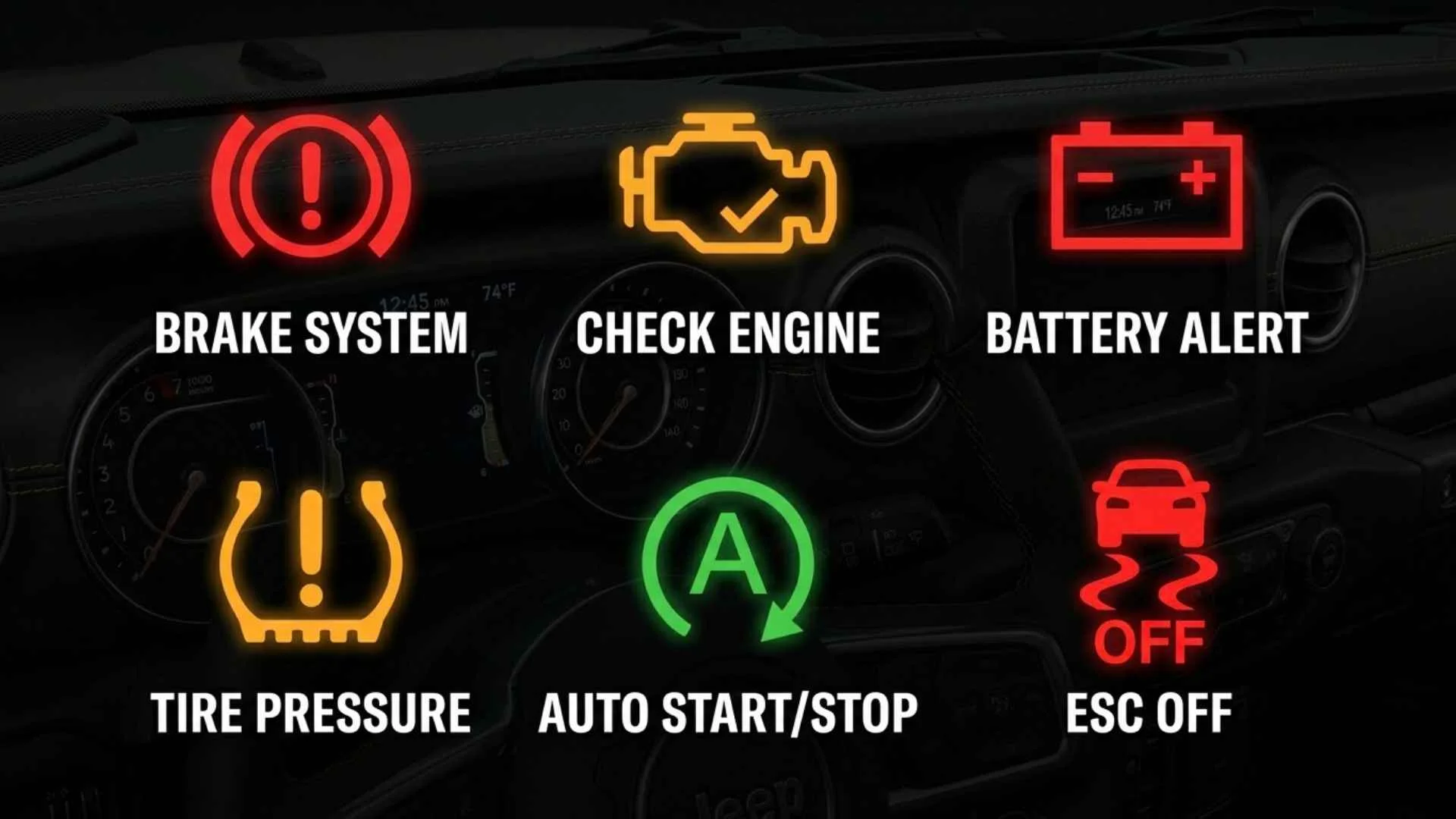
Understanding Jeep dashboard symbols and meanings is important because these lights tell you what is happening inside your vehicle. Some dashboard indicators simply show that a feature is operating, while others warn you about a problem that may require immediate attention.
Jeep dashboard lights can indicate issues involving the engine, brakes, tires, battery, oil pressure, temperature, airbags, traction control, four-wheel drive, and driver-assistance systems. The exact symbols can vary depending on the Jeep model, model year, trim level, and optional equipment.
This guide explains the most common Jeep dashboard symbols, what their colors mean, what you should do when they appear, and when it may be unsafe to continue driving.
Jeep Dashboard Warning Lights at a Glance
The following table provides a quick reference for some of the most common Jeep dashboard symbols.
| Dashboard Symbol | Common Color | Meaning | What to Do |
| Check engine | Yellow/Amber | Engine or emissions fault detected | Have the vehicle diagnosed |
| Oil pressure | Red | Low engine oil pressure | Stop safely and switch off engine |
| Battery | Red | Charging system problem | Have the charging system checked |
| Tire pressure | Yellow/Amber | Low tire pressure or TPMS issue | Check and adjust tire pressure |
| ABS | Yellow/Amber | ABS system fault | Drive cautiously and have it inspected |
| Brake | Red | Brake system or parking brake warning | Check immediately |
| Airbag | Yellow/Amber | Airbag/SRS system fault | Arrange inspection |
| Coolant temperature | Red | Engine overheating | Stop safely and allow engine to cool |
| ESC | Yellow/Amber | Stability-control system active or fault | Check system if light remains on |
| Traction control | Yellow/Amber | Traction-control activity or fault | Check owner’s manual |
| 4WD | Various | Four-wheel-drive system status or fault | Check selected 4WD mode |
| High beam | Blue | High beams are active | Switch off when appropriate |
| Turn signal | Green | Turn signal is active | Normal operation |
| Cruise control | Green/White | Cruise control is active/ready | Normal operation |
What Do Jeep Dashboard Light Colors Mean?
The color of a dashboard light gives you an important clue about how urgently you should respond.
Red Jeep Dashboard Lights
Red warning lights generally indicate a condition that can require immediate attention. Examples include the oil pressure warning, brake warning, and high engine temperature warning.
A red light does not always mean the vehicle must be abandoned immediately, but it should never be ignored. Read the message or symbol and follow the instructions in your Jeep owner’s manual.
Yellow or Amber Jeep Dashboard Lights
Yellow or amber lights generally indicate a warning, malfunction, or condition that needs attention.
Examples include the check engine light, ABS warning, TPMS warning, and certain electronic stability-control warnings.
The vehicle may still be driveable, but the correct response depends on the specific warning.
Green Jeep Dashboard Lights
Green indicators are generally informational. They commonly show that a feature is operating.
Turn signals and some cruise-control indicators can appear green.
Blue Jeep Dashboard Lights
Blue indicators are commonly associated with lighting functions. The high-beam indicator is a familiar example.
These lights normally indicate operation rather than a mechanical problem.
Common Jeep Dashboard Symbols and Meanings
Jeep Check Engine Light
The check engine light usually looks like an outline of an engine and is one of the most recognizable warning symbols.
It can illuminate when the engine computer detects a problem involving the engine, emissions system, sensors, fuel system, or another monitored component.
A steady light should be diagnosed rather than ignored. A flashing check engine light can indicate a more serious condition and may require stopping the vehicle when it is safe to do so.
Can you drive with the check engine light on?
If the light is steady and the Jeep is operating normally, the vehicle may remain driveable for a limited period, but it should be checked as soon as practical.
If the light is flashing, the engine is running roughly, power has dropped significantly, or other serious symptoms appear, stop driving when it is safe and seek professional assistance.
Jeep Oil Pressure Warning Light
The oil pressure warning symbol generally looks like an oil can with a drop.
It can indicate that engine oil pressure is too low. Adequate oil pressure is essential for engine lubrication, so this warning deserves immediate attention.
What should you do?
Safely pull over and turn the engine off. If appropriate, check the engine oil level according to the owner’s manual. If the warning remains on or the oil level is normal, professional diagnosis is recommended.
Do not continue driving simply because the engine still appears to be running normally.
Jeep Battery Warning Light
The battery-shaped warning light can indicate a problem with the vehicle’s charging system.
Although it looks like a battery warning, the issue may involve the alternator, battery, wiring, charging circuit, or another electrical component.
If it remains illuminated while the engine is running, the vehicle should be inspected because the engine may eventually stop if the charging system cannot maintain electrical power.
Jeep Tire Pressure Warning Light
The TPMS warning symbol usually looks like a horseshoe or tire outline containing an exclamation mark.
It generally indicates that one or more tires have low pressure.
Check all four tires and inflate them to the pressure specified for your Jeep. Do not use the maximum pressure printed on the tire sidewall as a substitute for the vehicle manufacturer’s recommended pressure.
If the light remains on after correcting tire pressure, the TPMS system may need to be checked.
Jeep Brake Warning Light
The brake warning light can appear as an exclamation mark inside a circle or another brake-related symbol.
Depending on the Jeep, it can indicate that the parking brake is engaged or that a brake-system condition has been detected.
If the light remains on after releasing the parking brake, check the owner’s manual and have the braking system inspected.
Can you drive with the brake warning light on?
If the warning remains illuminated unexpectedly, do not assume it is harmless. If braking feels abnormal, the pedal feels unusually soft, or stopping performance changes, stop driving and obtain professional assistance.
Jeep ABS Warning Light
The ABS warning symbol normally displays the letters ABS.
ABS stands for Anti-lock Braking System. It helps prevent the wheels from locking under certain hard-braking conditions.
If the ABS light remains on, the anti-lock system may have a fault.
Normal braking may still be available, but the ABS function may not operate as intended. Have the system diagnosed rather than assuming the warning will disappear on its own.
Jeep Airbag Warning Light
The airbag warning symbol generally shows a person seated in front of an inflated airbag.
This warning can indicate a fault in the Supplemental Restraint System, which includes airbags and associated safety components.
Because airbags are important safety equipment, an illuminated airbag warning should be inspected promptly.
Jeep Seat Belt Warning Light
The seat belt warning indicator normally shows a person wearing a seat belt.
It can illuminate when the vehicle detects that a required seat belt has not been fastened. An audible warning may accompany the light.
Fasten the seat belt properly before driving.
Jeep Coolant Temperature Warning Light
The engine temperature symbol usually resembles a thermometer over waves.
It can indicate that the engine coolant temperature is too high.
What should you do if the Jeep overheats?
Safely stop the vehicle and turn the engine off if the warning indicates overheating. Allow the engine to cool.
Never open a hot radiator or coolant reservoir if the system is pressurized. Hot coolant and steam can cause serious burns.
Jeep Electronic Throttle Control Light
Some Jeep vehicles have an Electronic Throttle Control warning indicator.
The ETC system manages throttle operation electronically. A fault can sometimes be accompanied by reduced engine performance, unusual acceleration behavior, or other drivability symptoms.
Follow the instructions in the owner’s manual and have the system diagnosed if the warning remains illuminated.
Jeep Electronic Stability Control Light
The ESC symbol commonly resembles a vehicle with curved or slipping lines underneath it.
A flashing ESC indicator can mean the system is actively helping maintain vehicle stability.
If the light stays illuminated, the system may have been switched off or a fault may have been detected, depending on the Jeep model.
Jeep Traction Control Symbol
The traction-control indicator commonly depicts a vehicle with slipping wheels.
A flashing symbol can indicate that traction control is actively working to maintain traction.
If it stays illuminated, the system may be disabled or there may be a fault.
Jeep 4WD Warning Light
Four-wheel-drive Jeeps can have several different 4WD symbols depending on the model and drivetrain.
A 4WD indicator may show that four-wheel drive has been selected, that a particular drive mode is active, or that a fault has been detected.
Some Jeep models can display separate indicators for functions such as 4WD Lock, 4WD Low, Neutral, or Service 4WD.
Always check the owner’s manual for the exact symbol because 4WD systems differ between Jeep models.
Jeep Dashboard Symbols for Safety and Driver Assistance
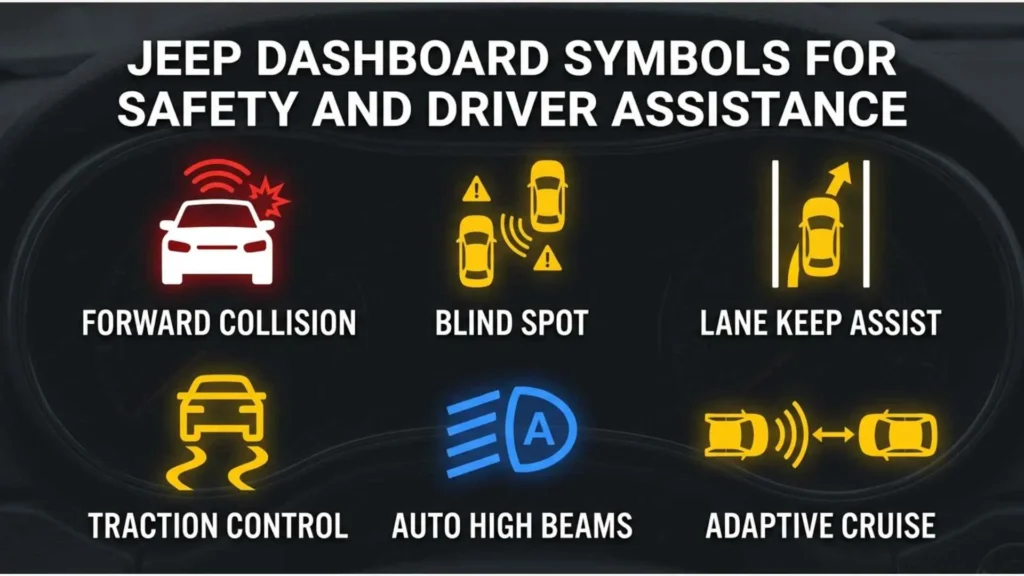
Modern Jeep vehicles may have additional indicators for advanced driver-assistance systems.
LaneSense Symbol
LaneSense-related indicators can show the status of the lane departure warning or lane-keeping-related system.
Depending on the vehicle, the indicator may show whether lane markings have been detected, whether the system is active, or whether an alert has been triggered.
Blind Spot Monitoring Symbol
Some Jeep models have indicators associated with blind-spot monitoring.
These warnings can appear in the side mirrors or instrument cluster depending on the vehicle’s equipment.
They are designed to alert the driver when another vehicle is detected in a monitored blind-spot area.
Forward Collision Warning
Certain Jeep vehicles use forward-collision warning technology.
A warning may appear when the system detects a potential forward collision or when the system is unavailable.
Because driver-assistance systems have limitations, drivers should continue to monitor traffic and operate the vehicle themselves.
Adaptive Cruise Control
Jeep models equipped with adaptive cruise control may display symbols showing that the system is ready, active, or temporarily unavailable.
The exact appearance varies by model and instrument cluster.
Jeep 4WD and Off-Road Dashboard Symbols
One of the areas that makes Jeep dashboards different from many other vehicles is the variety of four-wheel-drive and off-road systems.
4WD Lock
A 4WD Lock indicator generally means that the relevant four-wheel-drive locking function has been selected.
The exact operation depends on the Jeep’s drivetrain and model.
4WD Low
A 4WD Low indicator generally shows that the low-range four-wheel-drive mode has been selected.
This mode is intended for situations where additional low-speed control and torque are needed, depending on the Jeep’s specific system.
Selec-Terrain Indicators
Some Jeep models feature Selec-Terrain or similar terrain-management systems.
The dashboard can display the selected terrain mode, such as settings designed for snow, sand, mud, rock, or normal road conditions.
Available modes vary by model.
Service 4WD Warning
A Service 4WD warning indicates that the vehicle’s four-wheel-drive system has detected a condition that requires attention.
If the warning remains illuminated, consult the owner’s manual and arrange an inspection.
Jeep Dashboard Symbols by Model
Dashboard symbols are not identical across the Jeep lineup.
Jeep Wrangler Dashboard Symbols
The Wrangler can display standard warnings such as check engine, oil pressure, ABS, TPMS, brake, and temperature warnings. Four-wheel-drive and off-road indicators are particularly important on Wrangler models equipped with advanced 4WD systems.
Jeep Grand Cherokee Dashboard Symbols
The Grand Cherokee can include standard warning lights as well as indicators for driver-assistance, adaptive cruise control, lane-related systems, parking assistance, and available 4WD features.
Jeep Gladiator Dashboard Symbols
The Gladiator shares several systems with other Jeep vehicles but can also have specific 4WD and off-road indicators.
Jeep Compass Dashboard Symbols
The Compass can display standard engine, brake, tire-pressure, and safety-system warnings. Depending on the model year and trim, it can also feature several driver-assistance and 4WD-related indicators.
Jeep Cherokee Dashboard Symbols
Cherokee dashboards can vary by model year and equipment. Standard warning lights may be combined with indicators for traction control, stability control, safety systems, and available four-wheel-drive functions.
Jeep Renegade Dashboard Symbols
The Renegade can feature common engine, brake, tire-pressure, and electronic-system warnings along with indicators specific to its available drivetrain and safety equipment.
Steady vs. Flashing Jeep Dashboard Lights
The way a warning light behaves can be just as important as its color.
A steady light generally means the vehicle has detected a condition that is currently present or stored.
A flashing light can indicate a more urgent condition, depending on the symbol.
The check engine light is a good example. A steady light can indicate a fault requiring diagnosis, while a flashing light can indicate a condition that may cause additional engine or emissions-system damage.
Always check the specific warning in the owner’s manual rather than assuming every flashing light has the same meaning.
Can You Drive With a Jeep Warning Light On?
Whether you can safely drive depends on the warning.
A green or blue indicator usually represents normal operation.
A yellow or amber warning generally means you should investigate the issue and arrange service when necessary.
A red warning can require immediate attention, especially when it involves oil pressure, engine temperature, braking, or another critical system.
You should also consider how the Jeep is behaving. Strange noises, overheating, loss of power, unusual braking, smoke, burning smells, or other serious symptoms can make continued driving unsafe even if the dashboard light itself does not look severe.
Why Won’t My Jeep Dashboard Warning Light Go Off?
There are several possible reasons a warning light may remain illuminated.
The problem that triggered the warning may still exist, the vehicle may need to complete a drive cycle, or the system may need diagnostic testing.
For some warnings, correcting the underlying issue may allow the light to turn off automatically. Others may require a diagnostic scan or repair before the warning disappears.
Do not repeatedly reset a warning light without determining why it appeared.
Why Are Several Jeep Dashboard Lights On at Once?
Seeing several warning lights at the same time can be alarming.
Sometimes multiple systems can report warnings because they share electrical power, sensors, or communication networks. A weak battery or charging-system problem, for example, can sometimes cause multiple electronic warnings.
If several lights appear together, especially red warnings, read the vehicle’s messages and owner’s manual and have the Jeep inspected if the warnings persist.
Can a Jeep Warning Light Be Reset?
Some warning lights may disappear after the underlying problem has been corrected.
Others require a diagnostic scan or specific reset procedure.
A warning light should not simply be reset to hide the problem. If the underlying fault remains, the warning can return.
An OBD-II diagnostic scanner can help identify certain engine and emissions-related fault codes, but it does not replace professional diagnosis for every Jeep system.
What to Do When a Jeep Dashboard Warning Light Appears
Follow these basic steps:
1. Identify the Symbol
Look closely at the dashboard and determine which warning or indicator is illuminated.
2. Check the Color
Determine whether it is red, amber/yellow, green, or blue.
3. Look for a Message
Modern Jeep instrument clusters can display additional text explaining the warning.
4. Check How the Jeep Is Behaving
Pay attention to overheating, unusual noises, loss of power, poor braking, smoke, or other unusual symptoms.
5. Consult the Owner’s Manual
Use the manual for your exact Jeep model and model year because symbols and system behavior can vary.
6. Get Professional Help When Necessary
If the warning indicates a serious mechanical or safety issue, have the vehicle inspected rather than continuing to drive.
Frequently Asked Questions About Jeep Dashboard Symbols
What does the red lightning bolt mean on a Jeep?
On applicable Jeep models, a red lightning-bolt symbol can be associated with the Electronic Throttle Control system. If it appears, check the owner’s manual and have the vehicle inspected if the warning remains or drivability changes.
What does the yellow exclamation mark mean on a Jeep?
The meaning depends on the shape around the exclamation mark. A tire-shaped symbol commonly indicates low tire pressure, while an exclamation mark inside a brake-related circle can indicate a brake warning.
What does the Jeep 4WD light mean?
It can indicate that a four-wheel-drive mode has been selected or that the 4WD system has detected a problem. The exact meaning depends on the Jeep model and drivetrain.
What does the Jeep ESC light mean?
The ESC indicator relates to Electronic Stability Control. A flashing light can indicate system intervention, while a continuously illuminated light may indicate that the system is disabled or has detected a fault.
Why is my Jeep dashboard lit up like a Christmas tree?
Multiple warning lights can appear because of a shared electrical problem, low battery voltage, a charging-system issue, or faults affecting multiple vehicle systems. The vehicle should be checked if the warnings remain.
What does the A with a circle mean on a Jeep?
On models equipped with an automatic engine Stop/Start system, an A-related indicator can show the status of that function. The exact symbol and meaning vary by model and system status.
Are Jeep dashboard symbols the same on every model?
No. Dashboard symbols can vary by model, model year, trim, drivetrain, and optional equipment. The owner’s manual for the exact Jeep is the most reliable reference.
Final Thoughts
Learning Jeep dashboard symbols and meanings can help you understand your vehicle before a small warning becomes a bigger problem. Common symbols can provide information about engine operation, oil pressure, battery charging, tire pressure, brakes, ABS, airbags, temperature, traction control, stability control, four-wheel drive, and driver-assistance systems.
The most important thing is not to judge a warning only by its appearance. Consider its color, whether it is steady or flashing, any accompanying message, and how the Jeep is behaving.
Because Jeep models use different systems and dashboard layouts, always use the owner’s manual for your specific model and year when a symbol is unfamiliar. For red warnings or serious changes in braking, engine temperature, oil pressure, or vehicle performance, take appropriate safety precautions and seek professional assistance.

I am John Carter, a lifelong enthusiast of language and modern slang. I explore how words evolve and shape culture, and I enjoy uncovering the stories behind everyday expressions. I have authored “Slang and Society: The Language of Youth” and “Modern Words, Modern Worlds”, where I dive into how informal language impacts communication and identity. My goal is to make language accessible, fun, and insightful for everyone who loves words as much as I do.
 Lisa Reynolds
 Marcus Lee