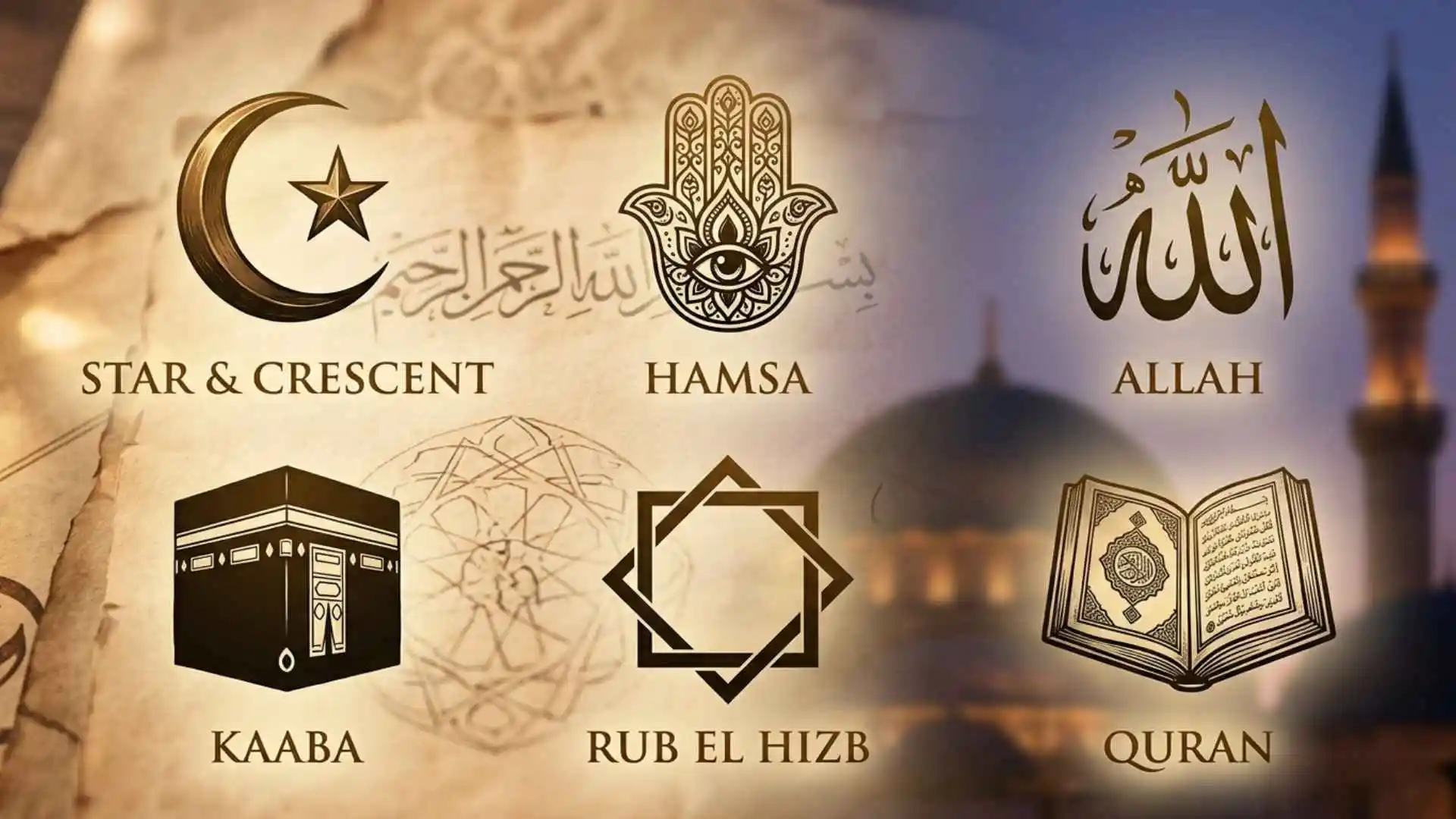
Muslim symbols are images, designs, words, objects, and architectural elements that are commonly associated with Islam and Muslim communities. Some have a direct connection with Islamic beliefs and practices, while others developed through Muslim history, art, architecture, and culture.
The most recognizable Muslim symbols include the crescent and star, Shahada, Kaaba, Islamic calligraphy, prayer beads, Rub el Hizb, geometric patterns, and mosque architecture. However, there is an important distinction to understand: Islam does not have one official universal symbol prescribed by the Quran or established by the Prophet Muhammad.
The crescent and star, for example, is widely recognized around the world as a symbol associated with Muslims, but its use developed historically rather than being established as an official symbol of Islam.
Muslim Symbols and Their Meanings
The following are some of the most common symbols and visual elements associated with Muslim faith and culture.
| Symbol | Common Meaning or Association |
| Crescent and Star | Historical and cultural association with Muslim communities |
| Shahada | Declaration of Islamic faith |
| Kaaba | Sacred center toward which Muslims pray |
| Islamic Calligraphy | Expression of Quranic and Islamic words through art |
| Misbaha/Tasbih | Used by many Muslims for counting dhikr |
| Rub el Hizb | Eight-pointed symbol used in Islamic manuscripts and design |
| Green | Historically and culturally associated with Muslim communities |
| Geometric Patterns | Major tradition of Islamic art |
| Mosque | Place of Muslim worship and community |
| Mihrab | Indicates the direction of prayer |
| Minaret | Traditional architectural feature of many mosques |
These symbols do not all have the same religious status. Some are religious expressions, while others are cultural or artistic representations.
The Crescent and Star
The crescent and star is probably the most recognizable symbol associated with Islam and Muslim communities.
It appears on flags, mosque decorations, artwork, jewelry, clothing, posters, and other designs. Several Muslim-majority countries have historically used the crescent and star or variations of the crescent in their national imagery.
Despite its popularity, the crescent and star is not an official symbol of Islam established by the Quran. Its association with Muslim societies developed through history, particularly through powerful Muslim empires such as the Ottoman Empire.
What Does the Crescent Mean?
The crescent has a natural connection with the lunar calendar. The Islamic calendar is based on the cycles of the Moon, and the sighting of the crescent has traditionally been important for determining the beginning of Islamic months.
This is particularly noticeable during Ramadan and Shawwal, when moon sighting has traditionally been used to determine the beginning and ending of important periods.
The star is commonly shown alongside the crescent, although it does not have one universally accepted Islamic meaning.
The Shahada
The Shahada is fundamentally different from decorative symbols because it is a central declaration of Islamic faith.
It expresses the belief that there is no deity worthy of worship except Allah and that Muhammad is His Messenger.
The Shahada is frequently represented through Arabic calligraphy and can be found in Islamic artwork, manuscripts, architecture, and other religious contexts.
Why Is the Shahada Important?
For Muslims, the Shahada expresses a fundamental belief of Islam. It is therefore more directly connected with Islamic faith than symbols such as the crescent and star.
When the Shahada is used in artwork or design, it should be treated respectfully because it contains sacred religious wording.
The Kaaba
The Kaaba, located in the Masjid al-Haram in Mecca, is one of the most important places in Islam and one of the most recognizable images associated with Muslims.
Muslims around the world face toward the Kaaba during their daily prayers. This direction is known as the qiblah.
The Kaaba is also central to the rituals of Hajj and Umrah. Millions of Muslims visit Mecca throughout the year, and Hajj is one of the Five Pillars of Islam.
Is the Kaaba Worshipped?
No. Muslims do not worship the Kaaba.
The Kaaba serves as the direction toward which Muslims pray and has a central place in Islamic religious history. Muslims worship Allah alone.
Islamic Calligraphy
Islamic calligraphy is one of the most important artistic traditions associated with Muslim culture.
Arabic calligraphy developed into highly sophisticated styles because Arabic is the language of the Quran. Artists have historically used calligraphy to present Quranic verses, religious phrases, the name of Allah, the Shahada, and other important expressions.
Common Forms of Islamic Calligraphy
Islamic calligraphy has many historical styles, including:
- Kufic
- Naskh
- Thuluth
- Diwani
- Nastaliq
- Muhaqqaq
Different regions and historical periods developed their own preferences and techniques.
Islamic calligraphy can be found on mosque walls, manuscripts, ceramics, tiles, textiles, doors, coins, and modern artwork.
Misbaha and Tasbih Prayer Beads
Misbaha, also called tasbih, are prayer beads used by many Muslims to count repetitions during dhikr, or remembrance of Allah.
They are commonly made from wood, stone, glass, plastic, or other materials.
What Do Muslim Prayer Beads Mean?
The beads themselves are not worshipped. They are a practical counting tool that some Muslims use during remembrance and supplication.
Different traditions use different numbers of beads, with 33 and 99 being common arrangements.
The practice and form of prayer beads can vary among Muslim communities.
The Rub el Hizb
The Rub el Hizb is an eight-pointed geometric symbol formed by two overlapping squares.
It is especially associated with the organization of Quranic text and appears in Islamic manuscripts and other forms of Islamic design.
The symbol has also become popular in modern Islamic graphics and decorative artwork.
What Does the Rub el Hizb Represent?
The term hizb refers to a division or portion. The symbol has historically been used in connection with the division of Quranic text.
Its exact use and visual presentation can vary, but it remains a recognizable element of Islamic geometric design.
Islamic Geometric Patterns
Geometric patterns are one of the defining features of Islamic art.
Artists throughout Muslim history developed highly complex patterns using circles, squares, polygons, stars, and repeating shapes.
These designs can be found in:
- Mosques
- Palaces
- Manuscripts
- Ceramic tiles
- Carpets
- Woodwork
- Metalwork
- Textiles
Why Are Geometric Patterns Common in Islamic Art?
Islamic artistic traditions vary greatly between regions, so there is no single explanation for every geometric design.
However, geometry provided artists with a way to create symmetry, repetition, balance, and intricate decoration.
Geometric patterns should not automatically be treated as religious symbols. Many are primarily artistic traditions.
The Eight-Pointed Star
The eight-pointed star is a recurring shape in Islamic architecture and decorative art.
It can be found in tiles, carpets, manuscripts, architectural decorations, and other objects.
Its meaning can vary depending on the culture and historical period in which it appears. Therefore, it is more accurate to describe it as an important element of Islamic art rather than assigning it one fixed religious meaning.
Green and Its Association With Muslim Culture
Green is often associated with Muslim communities and Islamic culture.
It can be seen in mosque decoration, flags, clothing, calligraphy, religious artwork, and other cultural settings.
The association also has historical and religious connections. Green appears in Quranic descriptions involving clothing and gardens associated with Paradise.
However, green is not an official color of Islam. Muslims around the world use many different colors in their religious and cultural traditions.
Mosques as Symbols of Muslim Faith
A mosque is a place where Muslims gather for prayer, worship, learning, and community activities.
Because mosques are closely connected with Muslim life, their architecture is frequently used as a visual symbol of Islam.
Common mosque features include:
- Domes
- Minarets
- Arches
- Prayer halls
- Courtyards
- Mihrabs
- Islamic calligraphy
- Geometric decoration
There is no single architectural style shared by every mosque. Mosques in Turkey, Pakistan, Egypt, Morocco, Indonesia, Iran, and other regions can look very different.
The Mihrab
The mihrab is a niche in a mosque wall that indicates the direction of the qiblah.
It helps worshippers identify the direction toward the Kaaba in Mecca.
Mihrabs are often decorated with tilework, calligraphy, geometric designs, stonework, or other forms of Islamic art.
Although the mihrab is an important mosque feature, it is not an object of worship.
The Minaret
A minaret is a tower associated with many mosques.
Historically, minarets became connected with the call to prayer, or adhan. Their shape and function have varied significantly across different Muslim cultures.
Today, the minaret remains one of the most recognizable architectural features associated with mosques and Muslim communities.
Muslim Symbols vs. Islamic Symbols
The phrases “Muslim symbols” and “Islamic symbols” are often used to mean the same thing online, but there is a useful distinction.
A Muslim symbol can refer to something commonly associated with Muslim people or Muslim culture.
An Islamic symbol can refer to something connected specifically with Islamic religion, traditions, art, history, or practices.
For example, a crescent may be strongly associated with Muslim-majority countries and Muslim culture, while the Shahada has a direct connection with Islamic belief.
This distinction helps explain why some popular “Muslim symbols” are cultural rather than officially religious.
Is There an Official Symbol of Islam?
There is no single official universal symbol of Islam prescribed by the Quran.
The crescent and star is widely recognized internationally, but it developed as a historical and cultural association rather than being established as Islam’s official symbol.
Likewise, Islamic geometric patterns, mosque images, green colors, and calligraphy can represent Islamic culture or faith without being official symbols.
This is an important point for anyone researching Muslim symbols because popular imagery does not always have the same status as religious teachings.
Muslim Symbols in Different Cultures
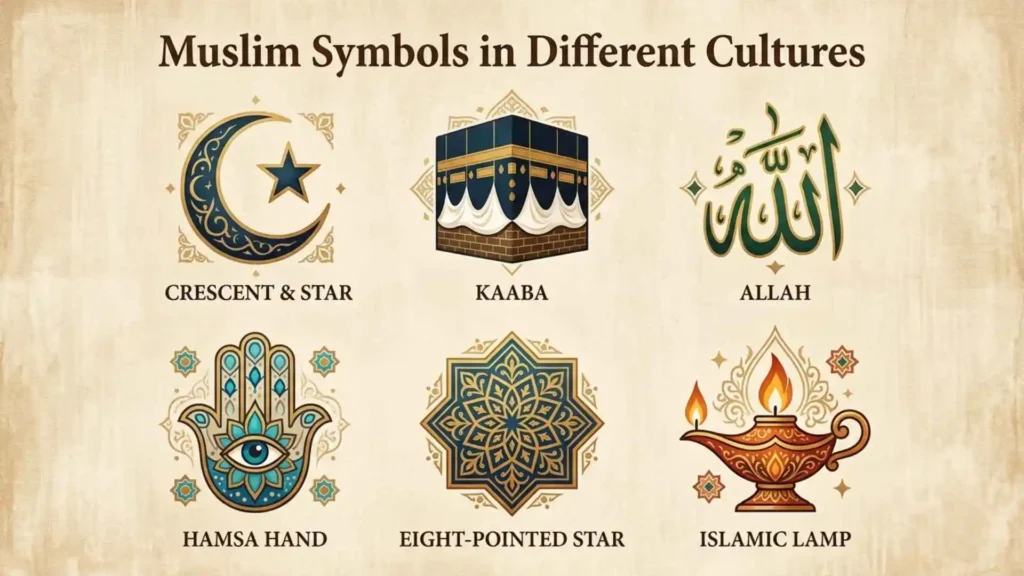
Islam is practiced across a large part of the world, including Asia, Africa, the Middle East, Europe, and North America.
As a result, Muslim symbolism and Islamic art differ from one region to another.
South Asian Muslim Culture
Countries such as Pakistan, India, and Bangladesh have developed distinctive Islamic artistic traditions influenced by Persian, Central Asian, Mughal, and local cultures.
Calligraphy, mosque architecture, geometric designs, and floral patterns are particularly common.
Middle Eastern Muslim Culture
The Middle East contains some of Islam’s most important historical and religious sites. Arabic calligraphy, mosque architecture, geometric decoration, and traditional Islamic designs are especially prominent.
North African Muslim Culture
Moroccan, Egyptian, Tunisian, Algerian, and other North African traditions have produced distinctive forms of Islamic architecture and decoration.
Zellige tilework, geometric patterns, arches, and Arabic calligraphy are common examples.
Southeast Asian Muslim Culture
Muslim communities in countries such as Indonesia and Malaysia have developed Islamic designs that combine Islamic traditions with local artistic and architectural influences.
This diversity shows why there is no single visual style that represents every Muslim.
Muslim Symbols in Art, Jewelry, and Modern Design
Muslim and Islamic symbols are commonly used in modern graphic design, jewelry, clothing, home decoration, websites, posters, and social media content.
Popular designs may include:
- Crescent necklaces
- Arabic calligraphy
- Islamic geometric patterns
- Mosque silhouettes
- Eight-pointed stars
- Quranic phrases
- Names written in Arabic
The meaning depends on the specific design and context.
Using Islamic Symbols Respectfully
Sacred words and Quranic verses should be treated with care. Designers should understand what Arabic religious text means before using it as decoration.
A design that looks attractive may contain sacred wording, so checking the translation and context is important.
Why Are Muslim Symbols Important?
Muslim symbols can represent several different things, including:
- Religious faith
- Muslim identity
- Islamic history
- Cultural heritage
- Community
- Architecture
- Artistic tradition
- Religious practices
Their importance varies from one symbol and community to another.
The Kaaba, for example, has profound religious significance, while a geometric pattern may primarily have artistic significance.
Understanding this difference prevents common misunderstandings about Islamic symbolism.
Common Misunderstandings About Muslim Symbols
One common misconception is that the crescent and star is the official symbol of Islam. It is more accurate to describe it as a widely recognized historical and cultural symbol associated with Muslim communities.
Another misconception is that every geometric design in Islamic art has a specific religious meaning. Many geometric patterns are artistic and decorative rather than symbolic in a strict religious sense.
It is also incorrect to assume that all Muslims use the same symbols. Muslim communities are culturally and historically diverse.
Frequently Asked Questions About Muslim Symbols
What are the main Muslim symbols?
Commonly associated Muslim symbols include the crescent and star, Shahada, Kaaba, Islamic calligraphy, misbaha or tasbih prayer beads, Rub el Hizb, geometric patterns, mosques, mihrabs, and minarets.
What is the most famous Muslim symbol?
The crescent and star is probably the most recognizable symbol associated with Muslims worldwide. However, it is not an official universal symbol of Islam.
What is the symbol of Islam?
Islam does not have one official universal symbol prescribed by the Quran. The crescent and star is widely associated with Islam, but its association developed historically and culturally.
What does the crescent moon mean in Islam?
The crescent is associated with the lunar calendar used by Muslims. Moon sighting has traditionally played an important role in determining the beginning of Islamic months such as Ramadan and Shawwal.
Is the crescent and star a religious symbol?
The crescent and star is commonly associated with Islam and Muslim communities, but it is more accurately described as a historical and cultural symbol rather than an officially prescribed Islamic symbol.
What symbol represents Allah?
Islam does not teach that Allah should be represented by an image or physical symbol. Arabic calligraphy of the word “Allah” is commonly used in Islamic art, but the calligraphy itself is not worshipped.
What are Islamic symbols and their meanings?
Islamic symbols and associated elements include the Shahada as a declaration of faith, the Kaaba as the central direction of Muslim prayer, calligraphy as an artistic expression of Islamic text, and the misbaha as a tool used by many Muslims for counting dhikr.
What are five symbols of Islam?
Five commonly associated symbols or visual elements are the crescent and star, Shahada, Kaaba, Islamic calligraphy, and Rub el Hizb. Their religious and cultural significance is different, so they should not all be considered official symbols.
Why is green associated with Muslims?
Green has historical and cultural associations with Muslim communities and appears in Quranic descriptions related to Paradise. Nevertheless, green is not an official color of Islam.
Are Islamic geometric patterns religious symbols?
Not necessarily. Geometric patterns are an important tradition of Islamic art, but many are primarily decorative and artistic rather than symbols with one specific religious meaning.
Final Thoughts
Muslim symbols are much more diverse than a single crescent-and-star image. They include religious expressions such as the Shahada, important places such as the Kaaba, artistic traditions such as Arabic calligraphy and geometric patterns, and cultural associations such as the crescent and star.
The most important point is that Islam has no single official universal symbol prescribed by the Quran. Different symbols have developed through Islamic history, Muslim cultures, architecture, art, and religious practice.
By understanding the history and meaning behind each symbol, it becomes easier to distinguish between genuine religious expressions, cultural traditions, and modern representations of Muslim identity. This broader perspective also shows the incredible diversity of Muslim communities and the rich artistic traditions that have developed across the Islamic world.

I am Lisa Reynolds, a linguist fascinated by the ever-changing world of slang. I enjoy researching how slang reflects trends, technology, and social connections. I wrote “Text Talk: Understanding Digital Slang” and “From Street to Screen: Slang in Media”, exploring the influence of digital communication on language. I love sharing my discoveries in a way that feels like a conversation with friends, so you feel the culture and humor behind every phrase.
 John Carter
 Marcus Lee