Planet symbols are recognizable signs that represent planets and other important celestial bodies. From the familiar Venus symbol (♀) to the distinctive Neptune trident (♆), each planetary glyph has a fascinating history. Some designs reflect ancient mythology while others developed through centuries of astronomical and astrological traditions.
Understanding planet symbols and their meanings helps you recognize celestial objects in astronomy charts, historical manuscripts, educational diagrams, and astrological illustrations. These symbols also reveal connections between ancient gods, cultural beliefs, and humanity’s observations of the night sky.
This guide explores the symbols of all eight planets, along with the Sun, Moon, and Pluto. You’ll discover their visual designs, historical origins, mythological associations, and scientific significance.
Planet Symbols Chart: All Planet Names and Their Symbols
The Solar System contains eight officially recognized planets. Each has a traditional astronomical glyph that represents its name and historical identity.
The Sun, Moon, and Pluto also have widely recognized symbols. However, the Sun is a star, the Moon is Earth’s natural satellite, and Pluto is classified as a dwarf planet.
| Celestial Body | Symbol | Common Description |
| Sun | ☉ | Circle with a central dot |
| Moon | ☾ | Crescent shape |
| Mercury | ☿ | Circle, crescent, and cross |
| Venus | ♀ | Circle above a cross |
| Earth | ♁ | Globe divided by crossing lines |
| Mars | ♂ | Circle with an upward arrow |
| Jupiter | ♃ | Traditional curved planetary glyph |
| Saturn | ♄ | Curved glyph resembling a sickle |
| Uranus | ♅ | Traditional Uranus glyph |
| Neptune | ♆ | Three-pronged trident |
| Pluto | ♇ | P-L monogram |
These astronomical planet symbols have historical connections to astronomy and astrology. NASA documents their traditional designs and associated interpretations. The International Astronomical Union (IAU) discourages unexplained special planetary symbols in scientific publications.
What Are Planet Symbols in Astronomy?
Planet symbols, also called planetary glyphs, are traditional graphic signs representing planets and certain other celestial bodies.
Astronomers, astrologers, historians, and astronomy enthusiasts encounter these signs in different contexts. Their purposes have changed throughout history.
Definition of Planetary Symbols
A planetary glyph is a compact visual representation of a celestial object. Instead of writing an entire planet name, a person can use its recognizable symbol.
For example, ♀ represents Venus while ♂ represents Mars. Both symbols also have meanings outside planetary notation.
These astronomical symbols developed through historical traditions rather than one universal scientific design system.
Astronomical Symbols vs. Planetary Glyphs
Although people often use these terms interchangeably, their applications can differ.
- Planetary glyphs: Traditional signs representing individual planets.
- Astronomical notation: Standardized methods of identifying and describing celestial objects.
- Astrological symbols: Glyphs used to represent planets, zodiac signs, and other chart elements.
- Scientific abbreviations: Shortened names used in astronomical research and technical publications.
Modern astronomy generally favors standardized names and scientific notation. Traditional glyphs remain especially familiar in historical references and astrology charts.
Why Do Planets Have Individual Symbols?
Most traditional planetary symbols reflect a combination of mythology, historical conventions, and recognizable visual forms.
Ancient observers noticed that certain bright objects moved against the background of fixed stars. They eventually associated these wandering lights with powerful mythological figures.
As astronomical traditions developed, recognizable symbols emerged for individual celestial bodies.
Sun and Moon Symbols and Their Meanings
The Sun and Moon occupy special positions in traditional Solar System symbols. Although neither belongs to the planetary category, both have recognizable astronomical glyphs.
Sun Symbol (☉)
The Sun symbol consists of a circle with a small dot in its center. It is one of the most recognizable signs in traditional astronomy.
<blockquote> ☉ The Sun symbol represents the solar body through a simple circular design with a central point. </blockquote>
The circle provides a visual representation of the Sun. Its central dot creates a distinctive design that separates it from an ordinary circle.
The Sun is the central star of our Solar System. Its gravitational influence holds the planetary system together.
Traditional solar symbols also appear in ancient cultural artwork and historical astronomical manuscripts.
Moon Symbol (☾)
The Moon symbol uses a crescent shape to represent Earth’s natural satellite.
Its curved appearance resembles the illuminated portion of the Moon during certain lunar phases. However, the glyph does not represent one specific phase in every context.
The Moon passes through several recognizable stages:
- New Moon
- Waxing Crescent
- First Quarter
- Waxing Gibbous
- Full Moon
- Waning Gibbous
- Last Quarter
- Waning Crescent
The traditional crescent glyph remains a common representation of the Moon in astronomy-related illustrations and cultural symbolism.
Mercury Symbol (☿): Meaning, Design, and Mythological Origin
The Mercury symbol (☿) combines three visual elements: a circle, an upper crescent, and a lower cross.
Its distinctive shape connects the planet with Mercury, the Roman god associated with commerce, communication, and travel.
What Does the Mercury Symbol Look Like?
The Mercury glyph has a small circle in the center. A crescent appears above it while a cross extends underneath.
NASA describes its traditional design as the head and winged cap of Mercury positioned above his caduceus.
The caduceus is a staff associated with Mercury’s mythological identity.
What Does the Mercury Symbol Represent?
Mercury takes its name from the Roman messenger god. His Greek counterpart is Hermes.
In mythology, Mercury traveled between the worlds of gods and humans. He also served as a patron of merchants, travelers, and communication.
His traditional attributes include:
- Winged sandals
- Winged helmet
- Caduceus staff
- Messenger responsibilities
- Commercial and travel associations
These mythological connections help explain the traditional interpretation of the Mercury planetary glyph.
Venus Symbol (♀): Meaning, Design, and Origin
The Venus symbol (♀) consists of a circle positioned above a small cross.
People widely recognize this design as the female symbol. Its traditional planetary meaning comes from Venus, the Roman goddess associated with love and beauty.
What Does the Venus Symbol Look Like?
The Venus glyph resembles a small hand mirror with a circular head and handle.
This interpretation connects the design with the goddess Venus and her traditional associations with beauty.
The symbol also became a widely recognized representation of the female sex.
What Does the Venus Symbol Represent?
Venus represents the Roman goddess of love, beauty, and fertility.
Her Greek counterpart is Aphrodite. Ancient mythology connects both goddesses with attraction, beauty, and romantic relationships.
The Venus glyph therefore carries several historical associations:
- Love and beauty
- Femininity
- Fertility
- The female symbol
- Roman mythology
Its use extends beyond astronomy into biology, gender-related notation, and cultural artwork.
Earth Symbol (♁): Meaning and Astronomical Representation
The Earth symbol (♁) features a circle divided by crossing lines. Its design resembles a simplified representation of a globe.
Unlike Venus and Mars, Earth does not take its traditional symbol directly from a Roman deity.
What Does the Earth Symbol Look Like?
The Earth glyph appears as a circle with horizontal and vertical divisions.
These lines create four sections within the circular outline. The design suggests Earth’s spherical shape and geographical divisions.
NASA describes the traditional Earth symbol as a globe divided by meridian lines into four quarters. The four sections are also associated with the cardinal directions.
What Does the Earth Symbol Represent?
The Earth symbol represents our home planet and its geographical structure.
Its visual elements commonly suggest:
- A spherical Earth
- Equatorial and meridian divisions
- North, South, East, and West
- Global geography
- The planet’s place in the Solar System
The symbol should not be confused with the Christian orb and cross. Although their designs may appear similar, they have different historical and cultural uses.
Mars Symbol (♂): Meaning, Design, and Mythology
The Mars symbol (♂) consists of a circle with an arrow pointing diagonally upward and right.
This familiar planetary glyph also serves as the traditional male symbol. Its mythological interpretation connects it with Mars, the Roman god of war.
What Does the Mars Symbol Look Like?
The Mars glyph contains two simple elements:
- A circular shape representing the main body.
- An upward-pointing arrow extending from its upper-right side.
Traditional interpretations associate the arrow with a spear and the circle with a shield.
What Does the Mars Symbol Represent?
Mars was the Roman god of war and military strength. His Greek counterpart was Ares.
Ancient Roman traditions associated Mars with warfare, protection, and military power.
The planetary symbol reflects these mythological connections through its traditional weapon-like appearance.
The male symbol also became widely recognized in biological and scientific notation.
Jupiter Symbol (♃): Meaning, Design, and Mythology
The Jupiter symbol (♃) represents the largest planet in our Solar System.
Its distinctive shape differs from the simple circle-and-cross designs associated with Venus and Earth.
What Does the Jupiter Symbol Look Like?
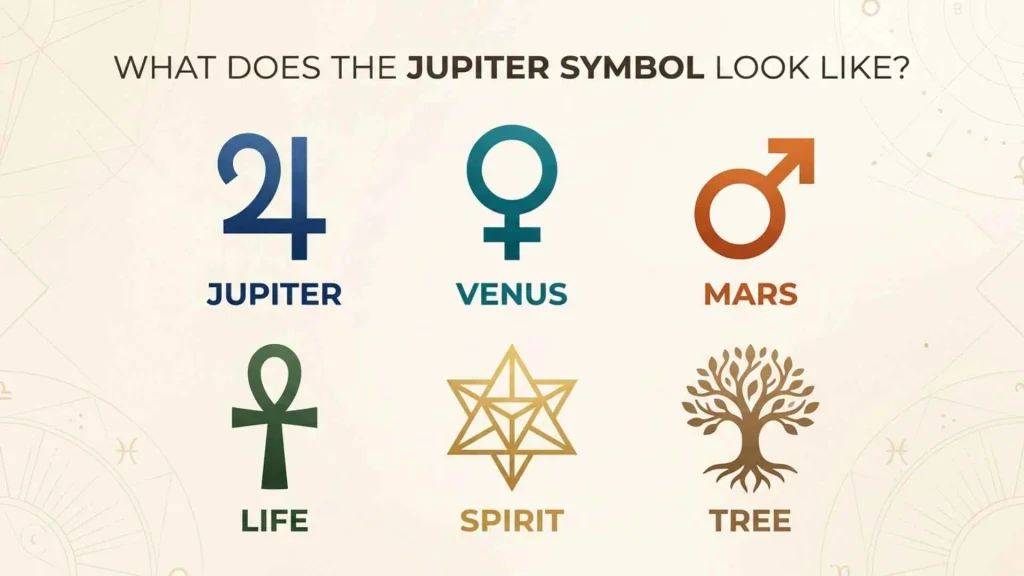
The Jupiter glyph has a traditional curved form with a distinctive horizontal and lower extension.
Historical explanations offer different interpretations of its design. NASA notes that some traditions associate it with an eagle, the bird of Jove, while others connect it with an abbreviated form of Zeus.
These explanations should be understood as historical interpretations rather than a single confirmed origin.
What Does the Jupiter Symbol Represent?
Jupiter takes its name from the chief Roman god.
His Greek equivalent is Zeus, the ruler of the Olympian gods.
Traditional mythology associates Jupiter with:
- Divine authority
- Thunder and lightning
- The sky
- Kingship
- The eagle
The planet’s name and glyph preserve these historical mythological connections.
Saturn Symbol (♄): Meaning, Design, and Mythological Origin
The Saturn symbol (♄) features a curved design with a cross-like extension. Traditional interpretations connect its shape with a sickle or harvesting tool.
Saturn was an important Roman agricultural deity.
What Does the Saturn Symbol Look Like?
The Saturn glyph resembles a curved blade attached to a supporting handle.
Its shape differs from other planetary symbols because it does not use a simple circle or arrow as its central feature.
What Does the Saturn Symbol Represent?
Roman mythology associates Saturn with agriculture, seed-sowing, and cultivation.
His Greek counterpart is Cronus, a Titan connected with the ancient Greek mythological tradition.
The sickle interpretation reflects the agricultural symbolism associated with Saturn.
Saturn’s planetary glyph therefore connects astronomy with ancient ideas about farming, harvests, and divine power.
Uranus Symbol (♅): Meaning, Design, and Origin
The Uranus symbol (♅) represents the seventh planet from the Sun.
Its traditional glyph has a distinctive structure. Unlike several other planetary signs, Uranus has more than one historical representation.
What Does the Uranus Symbol Look Like?
The commonly recognized Uranus glyph combines a central circular element with a cross-like structure and side extensions.
Another historical design uses a letter-like arrangement associated with the planet’s discoverer, William Herschel.
These different forms reflect the development of planetary notation over time.
What Does the Uranus Symbol Represent?
Uranus takes its name from the Greek primordial god of the sky.
In Greek mythology, Uranus represents the heavens and the sky itself.
The traditional glyph also has a mythological interpretation connecting the Sun with the spear of Mars.
This association reflects historical symbolism rather than a literal scientific description of the planet.
Neptune Symbol (♆): Meaning, Design, and Mythology
The Neptune symbol (♆) features a three-pronged trident.
This distinctive design represents Neptune, the Roman god of the sea.
What Does the Neptune Symbol Look Like?
The Neptune glyph resembles a traditional trident with three pointed extensions.
A central shaft supports the three prongs. The resulting design is easy to recognize in planetary charts.
What Does the Neptune Symbol Represent?
Neptune was the Roman god associated with the sea and water.
His Greek counterpart was Poseidon.
In classical mythology, the trident served as Poseidon’s traditional weapon and symbol of authority over the oceans.
The planetary glyph preserves this connection through its unmistakable three-pronged shape.
Pluto Symbol (♇): Meaning, Design, and Historical Origin
The Pluto symbol (♇) is a monogram combining the letters P and L.
It represents the dwarf planet discovered in 1930 at Lowell Observatory.
What Does the Pluto Symbol Look Like?
The Pluto glyph combines the first letters of its name into one compact design.
The same initials also honor Percival Lowell, the astronomer who predicted the existence of an undiscovered planet beyond Neptune.
This connection makes the Pluto glyph particularly interesting among traditional planetary signs.
Who Discovered Pluto?
Clyde Tombaugh discovered Pluto on February 18, 1930, while working at Lowell Observatory in Arizona.
The discovery followed years of searching for a hypothetical object called Planet X.
Percival Lowell had proposed that an undiscovered planet might explain irregularities in the orbits of Uranus and Neptune. His calculations helped inspire the search, although Pluto did not ultimately account for the predicted orbital effects.
Why Is Pluto Classified as a Dwarf Planet?
In August 2006, the International Astronomical Union established a formal definition of a planet.
According to this definition, a Solar System planet must:
- Orbit the Sun.
- Have enough mass for gravity to produce an approximately round shape.
- Clear the neighborhood around its orbit.
Pluto satisfies the first two conditions but does not meet the third.
Consequently, the IAU classified Pluto as a dwarf planet. Its familiar symbol remains widely used in traditional planetary charts.
Dwarf Planet Symbols and Their Meanings
Dwarf planets occupy an important place in modern planetary astronomy.
NASA recognizes five officially recognized dwarf planets in our Solar System: Ceres, Pluto, Haumea, Makemake, and Eris.
However, not every dwarf planet has an equally established or widely used traditional glyph.
Ceres Symbol
Ceres is the largest object in the asteroid belt and the only officially recognized dwarf planet located in the inner Solar System.
Its traditional symbol is ⚳, a sickle-like design associated with Ceres, the Roman goddess of agriculture.
The name reflects its historical connection with farming and harvests.
Pluto Symbol
Pluto uses the traditional P-L monogram (♇).
Its design honors both the dwarf planet’s name and Percival Lowell’s initials.
Haumea
Haumea takes its name from a Hawaiian goddess associated with fertility and childbirth.
It is an elongated dwarf planet located beyond Neptune. Its official name reflects its connection with Hawaiian mythology.
Makemake
Makemake takes its name from a creator deity in the mythology of Rapa Nui, the Indigenous people of Easter Island.
The name connects the dwarf planet with the cultural traditions of the Pacific region.
Eris
Eris takes its name from the Greek goddess of discord and strife.
Its discovery helped intensify the debate about Pluto’s classification. This discussion eventually contributed to the IAU’s 2006 planetary definition.
For accuracy, distinguish official astronomical names from traditional glyphs and unofficial decorative designs.
History and Origins of Planetary Symbols
The history of planet symbols stretches across ancient astronomical and mythological traditions.
People observed the movements of bright celestial objects long before modern telescopes existed.
Planetary Symbols in Ancient Astronomy
Ancient civilizations carefully observed the Sun, Moon, and visible planets.
They recorded celestial movements to develop calendars, predict seasonal changes, and study astronomical patterns.
The five planets visible to the naked eye were Mercury, Venus, Mars, Jupiter, and Saturn.
Their movements appeared different from those of distant stars. Ancient observers therefore described them as wandering celestial objects.
The Greek word planētēs means wanderer, which eventually gave us the modern word planet.
How Mythology Influenced Planetary Symbols
Greek and Roman mythology influenced the names and traditional identities of several planets.
For example:
| Planet | Roman Deity | Greek Equivalent |
| Mercury | Mercury | Hermes |
| Venus | Venus | Aphrodite |
| Mars | Mars | Ares |
| Jupiter | Jupiter | Zeus |
| Saturn | Saturn | Cronus |
| Uranus | Uranus | Ouranos |
| Neptune | Neptune | Poseidon |
| Pluto | Pluto | Hades |
These mythological relationships explain many traditional planetary associations.
However, the visual origin of every glyph isn’t equally well documented. Avoid assuming that each design directly depicts its associated deity.
Development of Modern Planetary Glyphs
Planetary signs gradually became familiar through astronomical manuscripts, printed materials, and astrological charts.
Their recognizable designs made them convenient for representing celestial bodies without repeatedly writing their full names.
The discovery of Uranus in 1781 and Neptune in 1846 introduced additional planetary symbols.
Pluto received its own traditional glyph following its discovery in 1930.
Astronomical Symbols vs. Astrological Planet Symbols
Astronomy and astrology use several of the same planetary glyphs. However, their purposes differ considerably.
Astronomy studies celestial objects through observation, mathematics, physics, and scientific research.
Astrology interprets celestial positions through traditional symbolic systems.
| Feature | Astronomy | Astrology |
| Main purpose | Scientific study of space | Interpretation of celestial positions |
| Planet glyphs | Historical and illustrative notation | Common chart notation |
| Planet meanings | Physical properties and orbital behavior | Traditional symbolic associations |
| Sun | A star | Astrological luminary |
| Moon | Natural satellite | Astrological luminary |
| Pluto | Dwarf planet | Retains its traditional glyph |
Planet Symbols in Astronomy
Astronomers use planetary names, standardized identifiers, and scientific notation to describe celestial bodies.
Traditional glyphs may appear in historical materials or educational illustrations. However, scientific publications generally favor clear written identification.
Planet Symbols in Astrology
Astrologers use planetary glyphs in natal charts and other astrological diagrams.
For example, Venus represents one planetary position while Mars represents another.
The Sun and Moon also appear as important chart elements despite their different astronomical classifications.
Remember that astrological interpretations belong to a traditional belief system rather than an established scientific explanation of planetary behavior.
Common Planet Symbols and Their Symbolic Associations
Several astronomical signs share visual patterns or historical associations.
Understanding these similarities makes planetary glyphs easier to recognize.
Female and Male Planetary Symbols
Venus and Mars have especially recognizable designs.
- ♀ Venus: Traditionally associated with the female symbol.
- ♂ Mars: Traditionally associated with the male symbol.
Both signs appear in astronomy-related notation and biological contexts.
Their historical associations connect the planets with Roman mythology and traditional representations of gender.
Planet Symbols Based on Tools and Objects
Some planetary glyphs resemble familiar objects.
| Planet | Traditional Object | Associated Meaning |
| Mercury | Winged helmet and staff | Communication and commerce |
| Venus | Hand mirror | Beauty and femininity |
| Mars | Spear and shield | Warfare and strength |
| Saturn | Sickle | Agriculture and harvesting |
| Neptune | Trident | Sea and maritime power |
These interpretations help explain the traditional visual language of planetary symbols.
How to Read and Use Planetary Symbols
You can encounter planetary symbols in astronomy books, educational materials, historical charts, and digital illustrations.
Learning their shapes makes these references easier to understand.
Recognizing Planet Glyphs in Astronomical Charts
Start by identifying familiar symbols such as Venus, Mars, and Neptune.
Then compare less familiar designs against a reliable planetary symbol chart.
Pay attention to the surrounding labels because some historical symbols have multiple interpretations.
Finding Planet Symbols on Keyboards and Devices
Many planetary glyphs belong to the Unicode character standard.
You can copy and paste commonly used symbols directly:
Sun: ☉
Moon: ☾
Mercury: ☿
Venus: ♀
Earth: ♁
Mars: ♂
Jupiter: ♃
Saturn: ♄
Uranus: ♅
Neptune: ♆
Pluto: ♇
Keep in mind that symbol appearance can vary between fonts, browsers, operating systems, and applications.
Using Planet Symbols in Educational Content
Planetary glyphs work well in school projects, astronomy presentations, and educational illustrations.
For accurate communication:
- Include the planet’s written name beside its glyph.
- Use consistent symbols throughout your diagram.
- Explain unusual or historical representations.
- Distinguish dwarf planets from the eight recognized planets.
- Check font compatibility before publishing digital materials.
Frequently Asked Questions About Planet Symbols
What Are the Symbols for All Eight Planets?
The eight planetary symbols are Mercury (☿), Venus (♀), Earth (♁), Mars (♂), Jupiter (♃), Saturn (♄), Uranus (♅), and Neptune (♆). These traditional glyphs appear in astronomical history, educational materials, and astrology charts.
What Is the Difference Between Planet Symbols and Astronomical Symbols?
Planet symbols are traditional glyphs representing individual planets. Astronomical symbols cover a broader category of signs used to represent celestial objects and astronomical phenomena. Planetary glyphs are therefore one type of astronomical symbol.
Why Do Venus and Mars Have Female and Male Symbols?
The Venus glyph became associated with the female symbol through its traditional mirror-like design and connection to the Roman goddess Venus. Mars’s glyph resembles a spear and shield and became associated with the male symbol through its mythological connection to the Roman god of war.
Are Planetary Symbols Based on Greek and Roman Mythology?
Many traditional planetary symbols have connections to Greek and Roman mythology. Mercury’s staff, Neptune’s trident, and Saturn’s sickle reflect familiar mythological attributes. However, not every glyph has a fully established mythological origin.
What Is the Symbol for the Sun and Moon?
The traditional Sun symbol is ☉, a circle with a central dot. The Moon symbol is ☾, a crescent shape. Both are important celestial symbols, although neither is classified as a planet.
Why Does Earth Have Different Planetary Symbols?
Earth has several representations because different historical and technical traditions use different conventions. The traditional Earth glyph is ♁. Other illustrations may use globes, crossed lines, or alternative scientific notation.
Why Does Pluto Still Have a Planet Symbol?
Pluto retains its traditional symbol (♇) because the glyph represents its historical identity. Although the IAU reclassified Pluto as a dwarf planet in 2006, the established symbol remains useful in educational and historical contexts.
Do Dwarf Planets Have Official Astronomical Symbols?
Some dwarf planets have traditional or historical glyphs, including Pluto and Ceres. However, there isn’t an equally established symbol for every recognized dwarf planet. Written names remain the clearest scientific identifiers.
What Is the Difference Between Astronomical and Astrological Planet Symbols?
Astronomy uses scientific observations to study planets and their physical properties. Astrology uses planetary glyphs to interpret celestial positions within traditional belief systems. Both may display the same symbols, but their purposes differ.
Where Can You Copy and Paste Planetary Symbols?
You can copy planetary glyphs from Unicode-compatible websites, symbol libraries, and educational references. Common examples include ☿, ♀, ♂, ♃, ♄, ♅, and ♆. Their appearance may change depending on the font and device.
Conclusion: Understanding Planet Symbols and Their Meanings
Planet symbols combine astronomy, history, mythology, and traditional visual language. Their recognizable shapes help identify celestial bodies while preserving centuries of cultural and scientific history.From Mercury’s winged staff to Neptune’s trident, each glyph carries distinctive historical associations. Venus and Mars also demonstrate how planetary signs became widely recognized symbols beyond astronomy.Remember that the Solar System has eight officially recognized planets. The Sun and Moon have their own traditional glyphs while Pluto remains an important dwarf planet.Whether you’re studying astronomical planet symbols, researching mythology, or exploring planetary charts, understanding these signs gives you a clearer picture of humanity’s relationship with the cosmos.

I am John Carter, a lifelong enthusiast of language and modern slang. I explore how words evolve and shape culture, and I enjoy uncovering the stories behind everyday expressions. I have authored “Slang and Society: The Language of Youth” and “Modern Words, Modern Worlds”, where I dive into how informal language impacts communication and identity. My goal is to make language accessible, fun, and insightful for everyone who loves words as much as I do.
 Lisa Reynolds