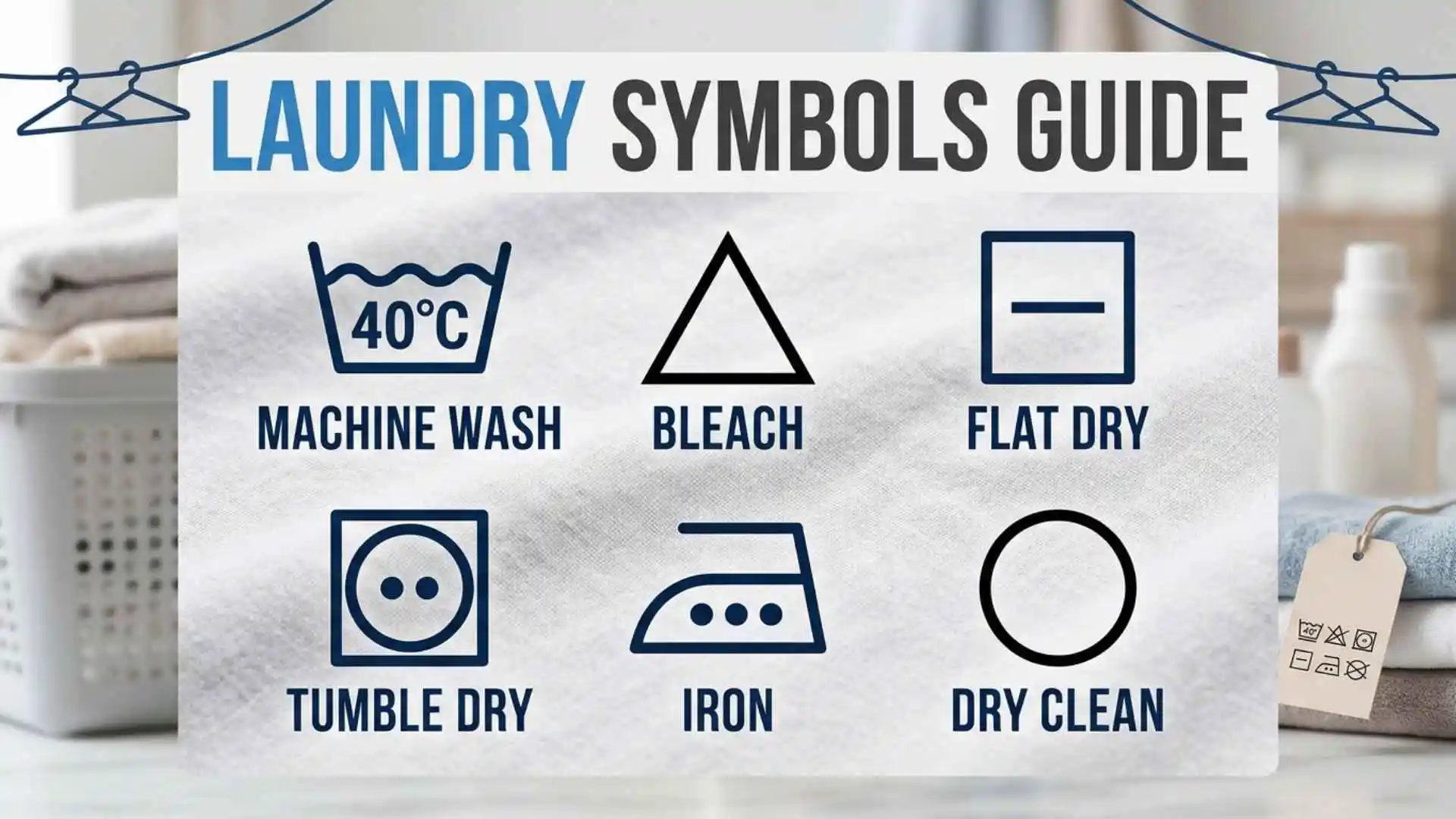
Laundry symbols tell you exactly how to wash, dry, bleach, iron, and clean your clothes without damaging them. These small pictures on clothing tags may look confusing at first, but each one communicates a specific care instruction. Once you understand them, you can choose the right washing temperature, avoid fabric shrinkage, and keep your favorite garments looking newer for longer.
Laundry symbols, also called clothing care symbols or fabric care symbols, appear on garment labels to explain how manufacturers recommend caring for different materials. A washtub indicates washing instructions, a triangle represents bleaching, a square provides drying guidance, an iron communicates heat restrictions, and a circle identifies professional cleaning instructions.
However, recognizing the basic shapes is only the beginning. Dots, lines, letters, and crossed-out markings add important details that determine how you should treat each garment.
This comprehensive guide explains laundry symbols and their meanings, including washing, drying, bleaching, ironing, and dry-cleaning instructions. You’ll also learn how to read international care labels, understand fabric-specific requirements, and avoid common laundry mistakes.
What Are Laundry Symbols?
Laundry symbols are standardized pictograms printed on clothing labels to communicate garment-care instructions. They help you understand which cleaning methods are suitable for particular fabrics.
Instead of relying entirely on written directions, manufacturers use simple pictures that people can recognize across different languages. For example, a crossed-out triangle communicates a bleaching restriction without requiring a written explanation.
These symbols provide guidance for five main garment-care processes:
- Washing: Explains whether you can machine-wash or hand-wash a garment and identifies temperature and cycle restrictions.
- Bleaching: Shows whether chlorine or non-chlorine bleach is permitted.
- Drying: Explains whether you can tumble dry, line dry, drip dry, or dry an item flat.
- Ironing: Identifies suitable ironing temperatures and steam restrictions.
- Professional cleaning: Communicates dry-cleaning and professional wet-cleaning requirements.
Why Do Clothing Labels Have Laundry Symbols?
Different fabrics react differently to water, heat, detergents, and mechanical movement. Cotton may tolerate ordinary machine washing, while silk can lose its appearance through rough handling.
Manufacturers include laundry care labels to help consumers select suitable cleaning methods.
These instructions can help you:
- Prevent unnecessary fabric shrinkage.
- Reduce color fading and dye transfer.
- Protect delicate fibers from excessive agitation.
- Avoid heat damage during drying and ironing.
- Preserve garment shape and texture.
- Reduce premature wear and tear.
- Maintain the appearance of clothing for longer.
A useful rule: Always check the care label before washing a new garment, especially when it contains delicate or blended fibers.
Where Can You Find Clothing Care Labels?
Most manufacturers sew care labels into an inconspicuous area of clothing.
Common locations include:
- Inside the back neckline of shirts and dresses.
- Along the side seam of T-shirts and tops.
- Inside the waistband of pants and skirts.
- Along the inner seam of jackets and coats.
- Inside the lining of certain delicate garments.
A clothing label may also contain the garment’s fiber composition, manufacturer’s information, country of origin, and other textile details.
Keep these details separate. Fiber-content information identifies the material, while care symbols explain how to clean and maintain it.
Laundry Symbols Chart: All Clothing Care Symbols and Their Meanings
A laundry symbols chart makes it easier to identify unfamiliar pictures before starting a wash cycle.
The following reference table covers the five main symbol families used in common international textile care-label systems.
| Symbol appearance | Category | Meaning |
| Washtub with a number | Washing | Maximum recommended washing temperature |
| Washtub with one underline | Washing | Permanent press or reduced-agitation process |
| Washtub with two underlines | Washing | Very gentle washing process |
| Hand inside a washtub | Washing | Hand wash |
| Crossed-out washtub | Washing | Do not wash |
| Empty triangle | Bleaching | Bleaching permitted |
| Triangle with diagonal lines | Bleaching | Non-chlorine oxygen bleach only |
| Crossed-out triangle | Bleaching | Do not bleach |
| Square with a circle | Drying | Tumble dry |
| Square with a circle and one dot | Drying | Low-temperature tumble drying |
| Square with a circle and two dots | Drying | Medium-temperature tumble drying |
| Square with a circle and three dots | Drying | High-temperature tumble drying |
| Crossed-out square with a circle | Drying | Do not tumble dry |
| Square with a curved line | Drying | Line dry |
| Square with vertical lines | Drying | Drip dry |
| Square with a horizontal line | Drying | Dry flat |
| Iron with one dot | Ironing | Low-temperature ironing |
| Iron with two dots | Ironing | Medium-temperature ironing |
| Iron with three dots | Ironing | High-temperature ironing |
| Crossed-out iron | Ironing | Do not iron |
| Circle | Professional cleaning | Dry cleaning instructions |
| Circle with P or F | Professional cleaning | Specific solvent-cleaning instructions |
| Crossed-out circle | Professional cleaning | Do not dry clean |
Note: This chart summarizes common ISO-style care symbols. Exact markings and conventions can vary between regional labeling systems. Always follow the complete garment label.
The five shapes provide a simple way to remember the main categories:
- Washtub = washing.
- Triangle = bleaching.
- Square = drying.
- Iron = ironing.
- Circle = professional cleaning.
The additional markings determine the specific restrictions within each category.
Washing Symbols and Their Meanings
Washing symbols appear as small washtubs on clothing labels. They tell you whether a garment can handle machine washing, hand washing, or no washing at all.
The markings inside and beneath the tub provide additional instructions. They can specify water temperature, washing intensity, and restrictions on mechanical movement.
Washtub Symbol: Machine Washing Instructions
Normal icon for machine wash isolated on white background
The washtub symbol represents washing in water. It generally indicates that domestic washing is permitted, either by machine or by hand, depending on additional markings.
A plain washtub without an underline usually permits a normal washing process within the indicated temperature limit.
When you see this symbol:
- Check the number inside the tub.
- Look for horizontal lines underneath it.
- Choose an appropriate washing machine program.
- Follow any additional detergent or fabric restrictions.
For example, a cotton shirt with a washtub marked 40 can generally be washed at temperatures up to 40°C.
However, a 40°C label doesn’t mean you must use that exact temperature. A lower temperature is usually acceptable when it cleans the garment effectively.
Washing Temperature Symbols: One, Two, and Three Dots
Temperature markings require careful attention because different symbol systems use different conventions.
In the common international ISO system, numbers inside the washing tub indicate the maximum washing temperature in Celsius. These include 30°C, 40°C, 50°C, and 60°C.
Some regional or appliance-related systems use dots to communicate temperature settings.
| Temperature marking | General interpretation |
| 30°C | Cool or low-temperature washing |
| 40°C | Moderate-temperature washing |
| 50°C | Warmer washing |
| 60°C | Hotter washing |
| One dot on an applicable temperature symbol | Low temperature |
| Two dots on an applicable temperature symbol | Medium temperature |
| Three dots on an applicable temperature symbol | High temperature |
Important: Never assume that dots mean the same thing across every symbol category. A dot inside an iron, for example, refers to ironing heat rather than washing temperature.
Numbers Inside the Washing Tub
How To Do Laundry (The ULTIMATE Guide!) – Expert Home Tips
Numbers inside a washing tub indicate the maximum water temperature recommended for the garment.
Here are some common examples:
| Temperature | Common laundry application | Important consideration |
| 20°C | Cold or very cool washing | Helps reduce energy use |
| 30°C | Delicate and lightly soiled clothing | Suitable for many everyday garments |
| 40°C | Many washable cotton and synthetic items | Useful for ordinary household laundry |
| 50°C | Certain more robust textiles | Follow the manufacturer’s limit |
| 60°C | Suitable for selected durable fabrics | Can increase shrinkage and color-fading risks |
The correct setting depends on fabric construction, dye stability, finishing treatments, and the manufacturer’s testing.
Don’t automatically choose the hottest setting. Higher temperatures can damage elastic fibers, weaken certain dyes, and cause shrinkage.
Lines Beneath the Washtub: Washing Cycle Instructions
What do the washing symbols on clothing labels mean? | Cleanipedia
Horizontal lines beneath a washing tub indicate that the garment needs reduced mechanical action.
This detail matters because washing machines use agitation and spinning to remove dirt. Delicate textiles may not tolerate the same movement as heavy cotton towels.
| Washtub marking | Washing process | What it means |
| No underline | Normal process | Ordinary mechanical action |
| One underline | Mild process | Reduced agitation and gentler handling |
| Two underlines | Very mild process | Very limited mechanical action |
A single underline often corresponds to permanent-press or easy-care treatment. Two underlines indicate a very gentle process commonly used for woolens and mechanically sensitive fabrics.
When washing garments with these markings:
- Reduce the laundry load.
- Select a suitable gentle or delicate program.
- Avoid aggressive spinning.
- Use an appropriate detergent.
- Keep delicate items separate from heavy garments.
Hand Wash Symbol
Washing instruction symbols explained | Woolmark
The hand wash symbol shows a hand inside a washing tub. It means you should wash the garment manually rather than using an ordinary machine-washing process.
This instruction commonly appears on delicate clothing that needs careful handling.
Silk blouses, fine knitwear, decorated garments, and certain wool items may carry hand-washing instructions.
Follow these steps:
- Fill a clean basin with water at the recommended temperature.
- Dissolve a suitable mild detergent in the water.
- Submerge the garment gently.
- Move it carefully without rubbing or twisting.
- Rinse thoroughly with clean water.
- Press out excess water without wringing.
- Reshape the garment and follow its drying instructions.
Avoid twisting delicate clothing to remove water. Excessive pressure can stretch fibers and distort the garment’s original shape.
Some modern washing machines include dedicated hand-wash programs. However, use one only when the garment manufacturer permits machine washing.
Do Not Wash Symbol
Waschsymbole einfach erklärt: DAS bedeuten die Wäsche-Zeichen auf eurer Kleidung!
A crossed-out washtub indicates do not wash. The garment shouldn’t undergo ordinary household washing.
Certain materials, coatings, adhesives, decorations, and structural components may react poorly to water.
This restriction can appear on:
- Structured garments with delicate internal components.
- Clothing containing sensitive decorative details.
- Certain leather or specialty-finished textiles.
- Items whose construction cannot tolerate ordinary wet treatment.
Don’t confuse this marking with hand washing. A hand-wash symbol permits careful washing in water, while a crossed-out tub prohibits it.
If the garment also carries professional cleaning instructions, take it to a qualified cleaner.
Bleaching Symbols and Their Meanings
Bleaching symbols appear as triangles on garment labels. They indicate whether a textile can tolerate bleaching agents used during laundry.
Bleach helps remove certain stains and brighten fabrics. However, unsuitable products can destroy dyes, weaken fibers, or leave permanent discoloration.
Three main triangle markings communicate bleaching instructions.
Empty Triangle: Bleaching Allowed
Any bleach may be used, vector illustration, flat design
An empty triangle indicates that the garment can tolerate bleaching.
Under the international ISO-style system, this marking permits chlorine-based and oxygen-based bleaching agents, provided you use them correctly.
However, bleaching permission doesn’t mean every bleach product is suitable for every stain or washing situation.
Before using bleach:
- Check the product instructions.
- Follow the recommended dilution.
- Avoid excessive exposure.
- Test colorfastness when appropriate.
- Never mix different household cleaning chemicals.
Triangle With Two Diagonal Lines: Non-Chlorine Bleach Only
Understanding Laundry Symbols | Souther Birch Boutique – Southern Birch Boutique
A triangle containing two diagonal lines means only oxygen-based or non-chlorine bleach is permitted.
These products often contain ingredients such as hydrogen peroxide or sodium percarbonate.
Oxygen bleach can help remove stains and brighten suitable fabrics without relying on chlorine-based bleaching chemistry.
It’s commonly used for:
- Colored clothing labeled bleach-safe.
- Certain cotton garments.
- Washable synthetic fabrics.
- Some household textiles.
Nevertheless, always check the bleach manufacturer’s instructions and the garment’s care label.
Crossed-Out Triangle: Do Not Bleach
What Do Laundry Symbols Mean? | Clorox™
A crossed-out triangle means do not bleach.
Avoid chlorine bleach and oxygen-based bleaching products on garments carrying this restriction.
Bleaching agents may cause:
- Permanent color loss.
- Uneven patches.
- Fiber weakening.
- Surface damage.
- Changes in fabric appearance.
If a garment has stubborn stains, use a compatible stain remover instead. Check its ingredients and test it according to the product directions.
How to Choose the Right Bleach for Your Clothes
The two main household bleaching categories work differently.
| Bleach type | Main ingredient or chemistry | Typical use |
| Chlorine bleach | Sodium hypochlorite | Whitening and disinfection of compatible washable items |
| Oxygen bleach | Hydrogen peroxide or sodium percarbonate-based chemistry | Stain removal and brightening |
| Color-safe bleach | Usually oxygen-based chemistry | Cleaning compatible colored fabrics |
Never assume color-safe bleach is suitable for every textile. The care label remains your primary guide.
Safety tip: Never mix chlorine bleach with ammonia, acids, vinegar, or other cleaning products. Dangerous gases can form.
Drying Symbols and Their Meanings
Drying symbols use squares to explain how to remove moisture from washed clothing. Some contain circles, lines, or dots to identify specific drying methods.
Drying deserves as much attention as washing. Excessive heat can shrink fabric, damage elastic, and weaken delicate fibers.
Square With a Circle: Tumble Dry Instructions
Wasch- & Pflegesymbole einfach erklärt | Witt
A square containing a circle represents tumble drying.
It indicates that the garment can be dried in a rotating dryer, subject to any additional temperature markings.
A tumble dryer removes moisture by combining warm air with mechanical movement.
Before using one:
- Check the dots inside the circle.
- Remove excess water when appropriate.
- Avoid overcrowding the dryer.
- Separate delicate garments from heavy items.
- Follow any additional cycle restrictions.
Some garments tolerate tumble drying but still require low temperatures.
Tumble Dry Temperature Symbols
What Is Tumble Dry? Learn How to Tumble Dry | Whirlpool
Dots inside the tumble-drying symbol indicate the permitted drying temperature.
| Symbol marking | Drying instruction | General guidance |
| Empty circle inside square | Normal tumble drying | Standard permitted drying process |
| One dot | Low heat | Reduced-temperature drying |
| Two dots | Medium heat | Moderate-temperature drying |
| Three dots | High heat | Higher-temperature drying |
| Crossed-out symbol | Do not tumble dry | Use an approved alternative |
These markings are particularly important for garments containing elastane, delicate synthetic fibers, and heat-sensitive finishes.
For example, excessive dryer heat can damage elastic components in athletic clothing and underwear.
Crossed-Out Tumble Dryer Symbol
Outdoorteppich Tenerife Plus, Olivgrün, Boho, rechteckig, 160×220 cm, ISO 9001, Bsci, Oeko-Tex® Standard 100, für Fußbodenheizung geeignet, in verschiedenen Größen erhältlich, pflegeleicht, leicht zusammenrollbar, Teppiche & Böden, Teppiche, Outdoorteppiche ab 72,75 € (Mai 2026) | moebel.de
A crossed-out square containing a circle means do not tumble dry.
The garment needs another permitted drying method.
Manufacturers may use this instruction because heat or repeated mechanical movement could damage the textile.
Instead, follow the natural-drying instructions on the label. These might include line drying, drip drying, or drying flat.
Square With a Horizontal Line: Dry Flat
The Do’s and Don’ts of Drying: Everything You Need to Know About ‘Dry
A horizontal line inside a square indicates dry flat.
This method involves laying a garment horizontally on a suitable drying surface.
Flat drying helps prevent heavy wet fabrics from stretching under their own weight.
It’s especially useful for:
- Wool sweaters.
- Certain knitted garments.
- Delicate knitwear.
- Shape-sensitive clothing.
- Some hand-wash-only items.
To dry a garment properly, place it on a clean drying rack or absorbent towel. Restore its original shape before leaving it to dry.
Avoid hanging heavy wet knitwear unless its label specifically permits hanging.
Square With a Curved Line: Line Dry
Line dry Icons, Logos, Symbols – Free Download PNG, SVG
A curved line across the upper part of a square represents line drying.
It means you can hang the garment to dry naturally.
A clothesline, hanger, or suitable drying rack may work, depending on the garment’s construction and label instructions.
Line drying offers several advantages:
- Uses no tumble-dryer heat.
- Reduces mechanical wear.
- Requires little equipment.
- Helps avoid unnecessary dryer energy consumption.
However, heavy garments may stretch when wet. Follow any additional flat-drying restrictions.
Square With Vertical Lines: Drip Dry
How to wash clothes using a washing machine | Vanish IN
Vertical lines inside a square indicate drip drying.
The garment should hang while excess water drains naturally.
This method generally avoids wringing or vigorous spinning. It can help protect materials that become distorted under pressure.
Drip drying may be suitable for certain delicate textiles and garments that retain considerable moisture after washing.
Place a suitable protective surface underneath if water may drip onto the floor.
Square With Horizontal and Vertical Lines: Drying in the Shade
A square with diagonal lines in the corner. Dry in the shade. A square with two diagonal lines in the upper left corner. Avoid direct sunlight. Information on the garment label.
Additional diagonal lines in a drying symbol indicate shade-drying instructions.
These markings tell you to keep the garment away from direct sunlight while using the specified drying method.
For example, a square with vertical lines and a diagonal corner marking indicates drip drying in the shade.
Shade drying can help protect some dyes and heat-sensitive materials from excessive sunlight exposure.
Understanding Combined Natural-Drying Symbols
Natural-drying symbols combine the square with different line arrangements.
| Marking inside square | Meaning |
| Curved line | Line dry |
| Three vertical lines | Drip dry |
| Horizontal line | Dry flat |
| Diagonal corner markings | Dry in the shade |
| Vertical lines with shade marking | Drip dry in the shade |
| Horizontal line with shade marking | Dry flat in the shade |
These distinctions matter when a garment needs a particular position and environment.
For instance, a wool sweater may require flat drying in the shade rather than ordinary hanging.
Ironing Symbols and Their Meanings
Ironing symbols look like traditional clothes irons. They indicate the maximum ironing temperature suitable for a garment.
Heat helps remove wrinkles and restore a neat appearance. However, excessive temperatures can scorch fibers, melt synthetic materials, or damage decorative finishes.
The dots inside the iron communicate temperature restrictions.
Iron Symbol With One Dot: Low-Temperature Ironing
Guide: Finn det rette strykejernet | Elkjøp
One dot inside an iron indicates low-temperature ironing.
This marking commonly appears on heat-sensitive materials such as certain synthetic fabrics.
When using this setting:
- Choose the lowest suitable iron temperature.
- Avoid prolonged contact with one area.
- Check whether steam is permitted.
- Iron delicate garments inside out when appropriate.
Iron Symbol With Two Dots: Medium-Temperature Ironing
Care Guide — House of Quinn
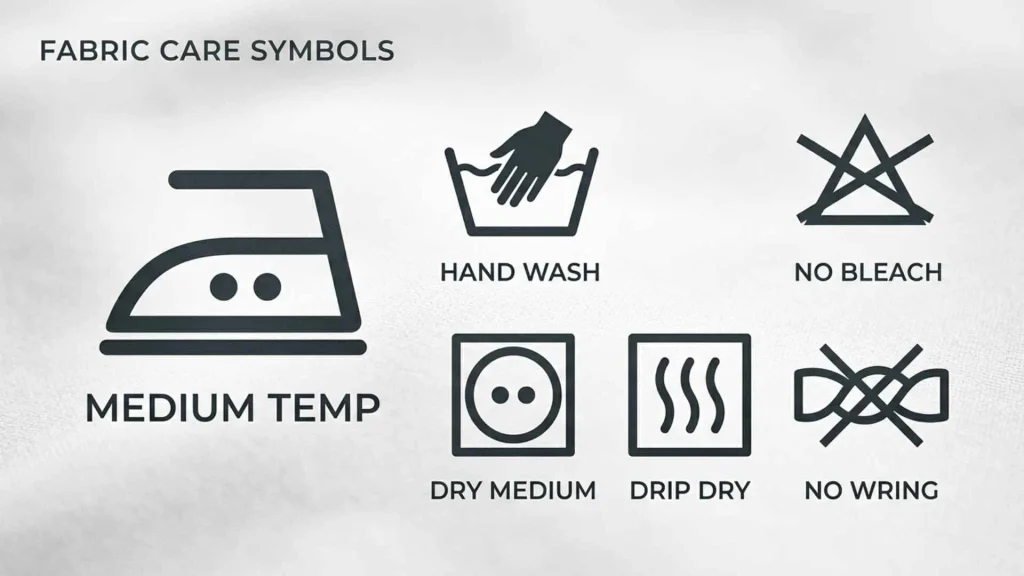
Two dots indicate medium-temperature ironing.
This setting permits more heat than the one-dot category.
Some cotton-blend and synthetic garments may carry this marking. However, fiber composition alone doesn’t determine the correct temperature.
Always follow the garment’s actual care label.
Iron Symbol With Three Dots: High-Temperature Ironing
Washing indication icon, Iron hot, up to 200°C
Three dots indicate high-temperature ironing.
This setting is generally intended for more heat-resistant textiles.
Certain durable cotton and linen garments may carry this instruction.
Even when high heat is permitted, avoid leaving the iron stationary for too long. Excessive pressure and heat can still cause damage.
Crossed-Out Iron: Do Not Iron
Wasch- & Pflegesymbole einfach erklärt | Witt
A crossed-out iron means do not iron.
Some materials can melt, lose their texture, or develop permanent marks when exposed to direct heat.
If the garment wrinkles easily, consider an approved alternative:
- Hang it properly after washing.
- Smooth the fabric gently while damp.
- Use a suitable wrinkle-release product.
- Allow natural drying to finish without folding.
Don’t use a hot iron simply because a wrinkle looks difficult to remove.
Iron Symbol With Crossed-Out Steam
Comprehensive Guide to Care Label Icons: Understanding & Using Them Effectively
A crossed-out steam marking indicates that steam ironing isn’t permitted.
This instruction differs from a crossed-out iron. The latter prohibits ironing altogether, while a no-steam marking restricts the use of steam.
When dry ironing is permitted, use the temperature shown on the iron symbol.
Some garments also benefit from pressing through a suitable protective cloth. Follow the manufacturer’s instructions before trying this method.
Dry Cleaning Symbols and Their Meanings
Dry cleaning symbols use circles to communicate professional textile-cleaning instructions.
Despite its name, dry cleaning isn’t necessarily a completely dry process. Professional cleaners use liquid solvents rather than ordinary household washing in water.
The circle markings identify the cleaning process and restrictions.
Plain Circle: Professional Dry Cleaning
Simboli di lavaggio in lavatrice sulle etichette dei capi
A plain circle represents professional textile-care instructions in the international system.
It indicates that professional cleaning is relevant, but additional markings may be necessary to identify the permitted process.
Don’t assume every plain circle communicates the same solvent requirements.
Check for letters, underlines, or other markings inside or beneath the circle.
Circle With Letters: Cleaning Solvent Instructions
An essential guide to laundry symbols | Homes and Gardens
Letters inside professional-cleaning symbols communicate information about suitable cleaning processes and solvents.
Two important examples are P and F.
| Letter | General professional cleaning instruction |
| P | Professional cleaning using specified permitted solvents in the P category |
| F | Professional cleaning using specified permitted hydrocarbon solvents |
These letters help professional cleaners choose an appropriate cleaning process.
They aren’t instructions for home cleaning. Don’t attempt to interpret them as ordinary washing temperatures or detergent codes.
Circle With an A: Professional Cleaning Instructions
Some older or regional references include an A marking in dry-cleaning discussions.
However, A should not be treated as a standard current ISO 3758:2023 consumer care-label instruction.
Modern care-label interpretation should follow the actual standard and symbol set used by the manufacturer.
When a label contains an unfamiliar letter, show it to a professional cleaner rather than guessing.
Crossed-Out Circle: Do Not Dry Clean
Simboli di lavaggio in lavatrice sulle etichette dei capi
A crossed-out circle means do not dry clean.
Certain fabrics, finishes, coatings, and decorative components may react badly to professional solvent cleaning.
If this symbol appears, don’t assume dry cleaning is acceptable simply because the garment looks expensive or delicate.
Check the remaining care instructions for an approved cleaning method.
Professional Wet Cleaning Symbols
Professional wet cleaning is different from household hand washing or machine washing.
It uses specialized commercial equipment, controlled water-based cleaning processes, suitable detergents, and careful finishing techniques.
Professional cleaners can adjust:
- Mechanical action.
- Water temperature.
- Detergent selection.
- Moisture levels.
- Extraction intensity.
- Drying and finishing procedures.
This method can provide an alternative for certain garments that cannot tolerate conventional dry cleaning.
ISO 3758:2023 covers both professional dry cleaning and professional wet cleaning within its textile-care framework.
Care labelling code using symbols+1
What Do Dots, Lines, Letters, and Crosses Mean on Laundry Symbols?
The main shapes identify the cleaning category. Additional markings explain the restrictions.
Understanding these small details makes laundry labels much easier to interpret.
What Do Dots Mean on Laundry Symbols?
Dots communicate temperature levels in applicable symbol families.
Their meaning depends on the shape surrounding them.
| Symbol family | What dots indicate |
| Tumble drying | Permitted dryer temperature |
| Ironing | Permitted ironing temperature |
| Other regional systems | Temperature category according to the applicable convention |
For example, one dot inside an iron means low-temperature ironing. One dot inside a tumble-dryer symbol means low-temperature machine drying.
Don’t automatically apply this dot system to every washing tub. International ISO washing symbols commonly use numbers to show maximum water temperature.
What Do Lines Beneath Laundry Symbols Mean?
Horizontal lines usually indicate reduced mechanical action.
The more lines beneath an international washing tub, the gentler the recommended process.
- No line: Normal washing.
- One line: Mild washing.
- Two lines: Very mild washing.
These markings matter for delicate garments that can lose shape through excessive agitation.
What Do Crossed-Out Laundry Symbols Mean?
A cross over a care symbol means the represented treatment isn’t permitted.
Common examples include:
- Crossed-out washtub: Do not wash.
- Crossed-out triangle: Do not bleach.
- Crossed-out square with circle: Do not tumble dry.
- Crossed-out iron: Do not iron.
- Crossed-out circle: Do not dry clean.
Never ignore these restrictions simply because a garment appears durable.
What Do Letters Inside Laundry Symbols Mean?
Letters mainly appear in professional textile-care symbols.
They tell professional cleaners which solvent categories and cleaning processes are appropriate.
For example:
- P: A specified professional dry-cleaning solvent category.
- F: A specified hydrocarbon-solvent cleaning category.
These instructions help cleaners avoid unsuitable chemicals and excessive mechanical treatment.
How to Read Laundry Symbols on Clothes Correctly
Reading an entire care label becomes simple when you follow the symbols in order.
The international ISO system organizes the five main care categories into a consistent sequence: washing, bleaching, drying, ironing, and professional textile care.
GINETEX+1
Step 1: Identify the Five Main Symbol Categories
Start by recognizing the main shapes.
- Washtub means washing.
- Triangle means bleaching.
- Square means drying.
- Iron means ironing.
- Circle means professional cleaning.
Once you identify these shapes, you can understand the basic purpose of each instruction.
Step 2: Check the Washing Temperature and Cycle
Look inside the washing tub for a number.
Then check underneath it for horizontal lines.
For example, a tub marked 30 with two underlines means a maximum washing temperature of 30°C with a very gentle process.
Choose a suitable washing machine program and avoid aggressive spinning.
Step 3: Check Bleaching Restrictions
Look for the triangle.
An empty triangle permits bleaching, while two diagonal lines restrict bleaching to oxygen-based products.
A crossed-out triangle prohibits bleaching altogether.
Never choose bleach based solely on the garment’s color.
Step 4: Follow the Recommended Drying Method
Check whether the label permits tumble drying.
If it does, inspect the dots for temperature restrictions.
Otherwise, look for natural-drying instructions such as line drying, drip drying, or flat drying.
Step 5: Check Ironing and Professional Cleaning Instructions
Look for dots inside the iron to determine the permitted heat level.
Also check for steam restrictions.
Finally, inspect the professional-cleaning symbol for letters and other markings.
If the garment requires professional care, share the complete label with the cleaner.
Step 6: Follow the Most Restrictive Care Instruction
A garment may have several different care requirements.
For example, a delicate blouse might permit hand washing but prohibit tumble drying and ironing.
You must follow all three instructions.
Never choose one convenient instruction while ignoring another restriction on the same label.
Laundry Symbols by Fabric Type: How to Care for Different Materials
Different textiles respond differently to washing, heat, detergents, and drying methods. Understanding the material helps you apply the care-label instructions correctly.
However, never replace the manufacturer’s instructions with general fabric-care advice. A cotton shirt and a cotton-blend shirt may require different treatment because their construction and finishes differ.
Cotton
Cotton is a natural fiber used in T-shirts, shirts, jeans, towels, bedding, and everyday clothing.
Many cotton garments tolerate machine washing. However, their permitted temperature depends on the dye, fabric construction, and finishing treatments.
Cotton care recommendations:
- Check the maximum washing temperature.
- Separate dark and light-colored garments.
- Use a suitable laundry detergent.
- Avoid excessive dryer heat.
- Check whether ironing is permitted.
- Remove stains before they become difficult to clean.
Cotton can shrink when exposed to unsuitable washing or drying conditions. Pre-shrunk cotton may resist shrinkage better, but it still needs appropriate care.
Wool
Wool fibers have a natural structure that can become distorted through heat, moisture, and mechanical agitation.
Some wool garments tolerate machine washing on a specialized wool cycle. Others require hand washing or professional cleaning.
Wool care recommendations:
- Follow the wool-specific washing instructions.
- Use detergent formulated for wool when appropriate.
- Avoid vigorous rubbing and wringing.
- Use a very gentle washing process when permitted.
- Reshape wet garments carefully.
- Dry flat when instructed.
Never assume every wool garment is machine washable. Construction, yarn treatment, and fabric finishing can change its care requirements.
Silk
Silk is a natural protein fiber known for its smooth texture and delicate appearance.
Its surface and color can suffer from harsh detergents, excessive agitation, and unsuitable heat.
Silk care recommendations:
- Check whether hand washing is permitted.
- Use a suitable silk detergent.
- Avoid harsh bleaching agents.
- Handle wet silk carefully.
- Follow the drying instructions.
- Use only the permitted ironing temperature.
Some silk garments require professional cleaning. Don’t experiment with home washing when the label prohibits it.
Polyester and Synthetic Fabrics
Polyester is a widely used synthetic fiber found in sportswear, jackets, dresses, shirts, and blended fabrics.
It generally resists wrinkles better than many natural fibers. However, excessive heat can damage its structure or affect garment finishes.
Synthetic fabric care recommendations:
- Follow the recommended washing temperature.
- Avoid excessive tumble-dryer heat.
- Use suitable detergent.
- Check ironing restrictions.
- Avoid direct high heat on printed or coated surfaces.
Other synthetic fibers, including nylon and acrylic, have their own characteristics. Always check the garment’s care label.
Lace and Delicate Fabrics
Lace contains openwork structures that can snag or lose shape during washing.
Decorative threads, embroidery, beads, and attached details create additional cleaning challenges.
Delicate fabric care recommendations:
- Use hand washing when instructed.
- Place machine-washable items in mesh laundry bags.
- Avoid washing them with zippers or rough fabrics.
- Never twist or wring delicate materials aggressively.
- Dry according to the label.
- Store garments where decorative details won’t snag.
A mesh bag helps reduce friction, but it doesn’t override a do-not-wash instruction.
Knitwear and Blended Fabrics
Knitwear often stretches more easily than tightly woven fabrics.
Blended textiles combine different fibers to achieve specific properties such as stretch, softness, durability, or wrinkle resistance.
For example, a cotton-polyester blend may behave differently from pure cotton. Adding elastane can also change the garment’s response to heat.
When caring for knitwear and blended fabrics:
- Follow the complete care label.
- Avoid excessive agitation.
- Use a gentle cycle when permitted.
- Reshape garments after washing.
- Dry flat when instructed.
- Avoid unnecessary heat exposure.
European vs. American Laundry Symbols: Are They Different?
Laundry symbols are designed to communicate garment-care instructions across language barriers. However, different countries and regions may use different labeling conventions.
The international ISO system provides a standardized framework for textile-care symbols. The current fourth edition is ISO 3758:2023, published in December 2023.
Care labelling code using symbols+1
International ISO Laundry Symbols
ISO 3758 covers five main categories:
- Washing.
- Bleaching.
- Drying.
- Ironing.
- Professional textile care.
The standard describes graphic symbols that communicate the most severe treatments a textile can tolerate without irreversible damage under the specified care process.
This distinction matters. A care label doesn’t promise that every stain will disappear. Instead, it identifies suitable treatment limits.
You can consult the official ISO 3758:2023 standard for its scope and technical details.
European Care Symbols
European care labels commonly follow the ISO-based system associated with GINETEX.
The five main shapes communicate the cleaning categories without relying on written language.
GINETEX also manages licensing and correct use of its protected care-symbol trademarks. Its official care symbols guide provides explanations and symbol variations.
North American Care Labels
North American clothing labels commonly use care instructions regulated or guided by regional requirements.
In the United States, the Federal Trade Commission’s Care Labeling Rule requires manufacturers and importers to provide care instructions for covered textile wearing apparel.
The instructions may use words, symbols, or a combination depending on applicable requirements.
American consumers may encounter labels with written instructions such as:
- Machine wash cold.
- Tumble dry low.
- Do not bleach.
- Cool iron.
- Dry clean only.
These instructions are easy to understand even when the accompanying pictograms differ from international examples.
For further information, consult the FTC’s Care Labeling Rule.
Japanese Laundry Symbols
Japanese clothing labels may include care instructions based on Japan’s domestic textile-labeling system.
The symbols have undergone changes over time. Older garments may therefore display different markings from newer clothing.
Japanese care labels can also include written Japanese instructions alongside pictograms.
If you purchase clothing from Japan, don’t assume an unfamiliar marking is decorative. Check the label’s full instructions before washing.
Are Laundry Symbols Universal?
Laundry symbols are widely standardized, but they aren’t completely identical everywhere.
ISO 3758 provides an international framework, while regional regulations and labeling conventions can affect how manufacturers communicate care instructions.
For international clothing purchases, check:
- The main symbol shapes.
- Temperature numbers or markings.
- Lines beneath washing symbols.
- Additional written instructions.
- Professional cleaning restrictions.
The safest approach is to interpret the complete label rather than relying on one symbol alone.
Common Laundry Symbol Mistakes That Can Damage Clothes
Even experienced people make laundry mistakes when they overlook small details on garment labels.
A single incorrect setting can cause shrinkage, color loss, or permanent damage.
Here are common mistakes worth avoiding.
Assuming Every Garment Can Handle Machine Washing
A garment that looks sturdy may still contain delicate components.
Embroidery, decorative attachments, coatings, and internal structures can make ordinary machine washing unsuitable.
Always check the washtub symbol before loading the washing machine.
Confusing Washing and Drying Temperature Dots
Dots appear in multiple symbol families.
However, they don’t communicate the same treatment.
One dot inside an iron indicates low ironing heat. One dot inside a tumble-drying symbol indicates low dryer heat.
Meanwhile, international washing tubs commonly use Celsius numbers rather than dots.
Ignoring Lines Beneath Washing Symbols
An underline changes the recommended washing process.
Ignoring it can expose delicate clothing to excessive agitation and spinning.
Choose a suitable mild or very mild washing program when the label requires one.
Using Chlorine Bleach on Incompatible Fabrics
Chlorine bleach can damage dyes and certain fibers.
A triangle with diagonal lines restricts bleaching to oxygen-based products. A crossed-out triangle prohibits bleaching.
Check these markings before adding bleach to your laundry.
Putting Non-Tumble-Dry Garments in the Dryer
A dryer can generate heat and mechanical movement that damage unsuitable fabrics.
Follow the natural-drying instructions instead.
Use a drying rack, clothesline, or flat surface as directed by the label.
Ironing Clothes at Excessively High Temperatures
High heat can leave shiny patches, scorch fabric, or melt certain synthetic fibers.
Check the dots inside the iron before selecting a temperature.
When permitted, start with a lower setting and adjust cautiously.
Confusing Dry Cleaning With Professional Wet Cleaning
These are two different professional cleaning processes.
Dry cleaning uses suitable non-water solvents, while professional wet cleaning uses controlled water-based treatment.
Don’t assume a dry-cleaning instruction automatically permits professional wet cleaning.
Treating All Delicate Fabrics the Same Way
Silk, wool, lace, and synthetic blends have different care requirements.
A method suitable for one fabric may damage another.
Use the garment’s actual care instructions rather than applying one universal delicate-clothing routine.
What Should You Do If You Don’t Recognize a Laundry Symbol?
Unfamiliar symbols can make clothing care confusing, especially when you purchase garments from international brands.
Fortunately, you don’t have to guess.
Use these practical steps to identify the correct instructions.
Check the manufacturer’s website. Many clothing brands publish garment-care guidance online. Search using the product name or identification code.
Read the complete label. Additional words or symbols may explain an unfamiliar marking.
Identify the main shape. Determine whether you’re looking at washing, bleaching, drying, ironing, or professional cleaning instructions.
Avoid aggressive cleaning methods. Until you understand the label, avoid high temperatures, strong bleach, and excessive mechanical movement.
Consult a professional cleaner. Valuable, structured, or unusually delicate garments deserve expert attention.
Check the fabric composition. Fiber information can help explain why a manufacturer recommends a particular cleaning method.
One important distinction: an unfamiliar symbol doesn’t automatically mean the garment is delicate or washable. Identify the marking before choosing a cleaning method.
Practical Tips for Following Laundry Care Instructions
Understanding laundry symbols is only useful when you apply their instructions correctly.
A few simple habits can help preserve your clothing and reduce avoidable damage.
Sort Clothes by Color and Fabric Type
Separate whites, darks, and bright colors before washing.
Also consider fabric weight and construction.
For example, washing delicate silk with heavy denim can increase friction and snagging.
Choose the Correct Washing Temperature
Follow the maximum temperature printed inside the washing tub.
Lower temperatures may help protect sensitive dyes and reduce energy use.
However, heavily soiled items may need an appropriate cleaning process to remove dirt effectively.
Use Suitable Laundry Detergent
Different detergents suit different washing needs.
Consider using:
- Mild detergent for suitable delicate fabrics.
- Wool detergent for compatible wool garments.
- Color-care detergent for colored clothing.
- Standard laundry detergent for appropriate everyday garments.
Always check detergent instructions and fabric compatibility.
Use Mesh Laundry Bags
Mesh bags help protect machine-washable delicate items from friction and snagging.
They’re particularly useful for lingerie, lightweight garments, and clothing with small decorative details.
However, they don’t make unsuitable garments machine washable.
Reshape Delicate Garments
Wet knitwear can lose its shape when handled carelessly.
Gently restore the garment’s original dimensions before flat drying when the label requires this method.
Avoid pulling sleeves, necklines, or hems into an unnatural shape.
Avoid Excessive Heat
High temperatures can damage more than just the fabric surface.
They may affect elastic components, printed designs, coatings, and decorative attachments.
Follow the drying and ironing restrictions rather than choosing heat based on convenience.
Keep Clothes Away From Direct Sunlight When Required
Some dyes and sensitive materials can fade after prolonged sunlight exposure.
When the care label specifies shade drying, use a shaded location with suitable airflow.
Store Clean Garments Properly
Good storage also contributes to garment maintenance.
- Store completely dry clothing.
- Fold heavy knitwear instead of hanging it.
- Use suitable hangers for structured garments.
- Keep delicate items away from rough surfaces.
- Follow any special storage guidance for valuable textiles.
These habits support better fabric protection, help maintain garment shape, and reduce unnecessary wear.
Frequently Asked Questions About Laundry Symbols
What Do Laundry Symbols on Clothes Mean?
Laundry symbols explain how to wash, bleach, dry, iron, and professionally clean clothing. They use simple pictograms to communicate suitable cleaning methods and restrictions.
The washtub represents washing, the triangle represents bleaching, the square represents drying, the iron represents ironing, and the circle represents professional textile care.
Are Laundry Symbols Universal?
Laundry symbols follow internationally recognized conventions, particularly ISO 3758. However, regional labeling systems and national requirements can differ.
European garments commonly use ISO-based pictograms, while American clothing labels may include written instructions alongside symbols.
What Do the Dots on Washing Symbols Mean?
Dots indicate temperature levels in symbol systems that use them.
For example, one dot inside an iron represents low-temperature ironing. Two dots indicate medium heat, while three dots indicate high heat.
In the common international washing-symbol system, numbers inside the washtub indicate maximum washing temperatures in Celsius.
What Does a Crossed-Out Washing Tub Mean?
A crossed-out washtub means do not wash.
The garment shouldn’t undergo ordinary household washing in water. It may require professional cleaning or another manufacturer-approved treatment.
Check the remaining care instructions before attempting to clean it.
What Does a Triangle Mean on Clothing Labels?
A triangle represents bleaching instructions.
- Empty triangle: Bleaching permitted.
- Triangle with two diagonal lines: Oxygen-based, non-chlorine bleach only.
- Crossed-out triangle: Do not bleach.
Always check the complete symbol before using a bleaching product.
What Does a Square With a Circle Mean?
A square containing a circle represents tumble drying.
Dots inside the circle indicate the permitted dryer temperature. One dot means low heat, two dots mean medium heat, and three dots mean high heat.
A crossed-out version means the garment shouldn’t go into a tumble dryer.
What Does a Crossed-Out Circle Mean?
A crossed-out circle means do not dry clean.
Avoid professional dry-cleaning treatments for garments carrying this restriction. Follow the other permitted cleaning instructions instead.
How Do I Know If Clothes Are Safe to Tumble Dry?
Look for a square containing a circle on the garment’s care label.
If the symbol has no cross, tumble drying is generally permitted. Check the dots inside the circle to determine the recommended temperature.
A crossed-out symbol means you should choose another approved drying method.
What Does Professional Wet Cleaning Mean?
Professional wet cleaning is a specialized commercial cleaning process that uses water, controlled mechanical action, and suitable detergents.
It differs from ordinary household washing because professional equipment and techniques help protect sensitive garments.
Qualified cleaners use this process for textiles that need careful water-based treatment.
Can I Wash Clothes That Say Dry Clean Only?
A dry-clean-only instruction means the manufacturer recommends professional dry cleaning rather than ordinary household washing.
Some garments may tolerate alternative cleaning methods, but you shouldn’t assume home washing is safe.
Water can damage certain dyes, finishes, linings, and garment structures.
What Happens If I Ignore Laundry Symbols?
Ignoring care-label instructions can cause permanent garment damage.
Common problems include:
- Fabric shrinkage.
- Color fading.
- Dye transfer.
- Stretched knitwear.
- Damaged elastic fibers.
- Scorched or melted materials.
- Distorted garment shapes.
Following the recommended cleaning methods helps prevent these problems.
Where Can I Find Laundry Symbols on Clothing?
You can usually find laundry symbols on sewn-in care labels.
Common locations include shirt side seams, trouser waistbands, dress seams, jacket linings, and the inside neckline of certain garments.
Look for a label containing washing, drying, ironing, and other care instructions.
Conclusion: Understand Laundry Symbols to Protect Your Clothes
Laundry symbols make clothing care easier by turning complicated cleaning instructions into recognizable pictures. Once you understand their meanings, you can choose suitable washing temperatures, identify bleaching restrictions, and select the correct drying and ironing methods.
Remember the five main shapes: washtub for washing, triangle for bleaching, square for drying, iron for ironing, and circle for professional cleaning.
Pay attention to the smaller details too. Dots indicate temperature levels in applicable symbols, horizontal lines restrict washing intensity, and crossed-out markings prohibit particular treatments.
Most importantly, check the complete care label before cleaning a garment. A few seconds of attention can prevent unnecessary shrinkage, fading, and fabric damage.
Proper garment care isn’t complicated. Learn the symbols, follow their instructions, and give your clothes the treatment they need to last longer.

I am John Carter, a lifelong enthusiast of language and modern slang. I explore how words evolve and shape culture, and I enjoy uncovering the stories behind everyday expressions. I have authored “Slang and Society: The Language of Youth” and “Modern Words, Modern Worlds”, where I dive into how informal language impacts communication and identity. My goal is to make language accessible, fun, and insightful for everyone who loves words as much as I do.
 Lisa Reynolds