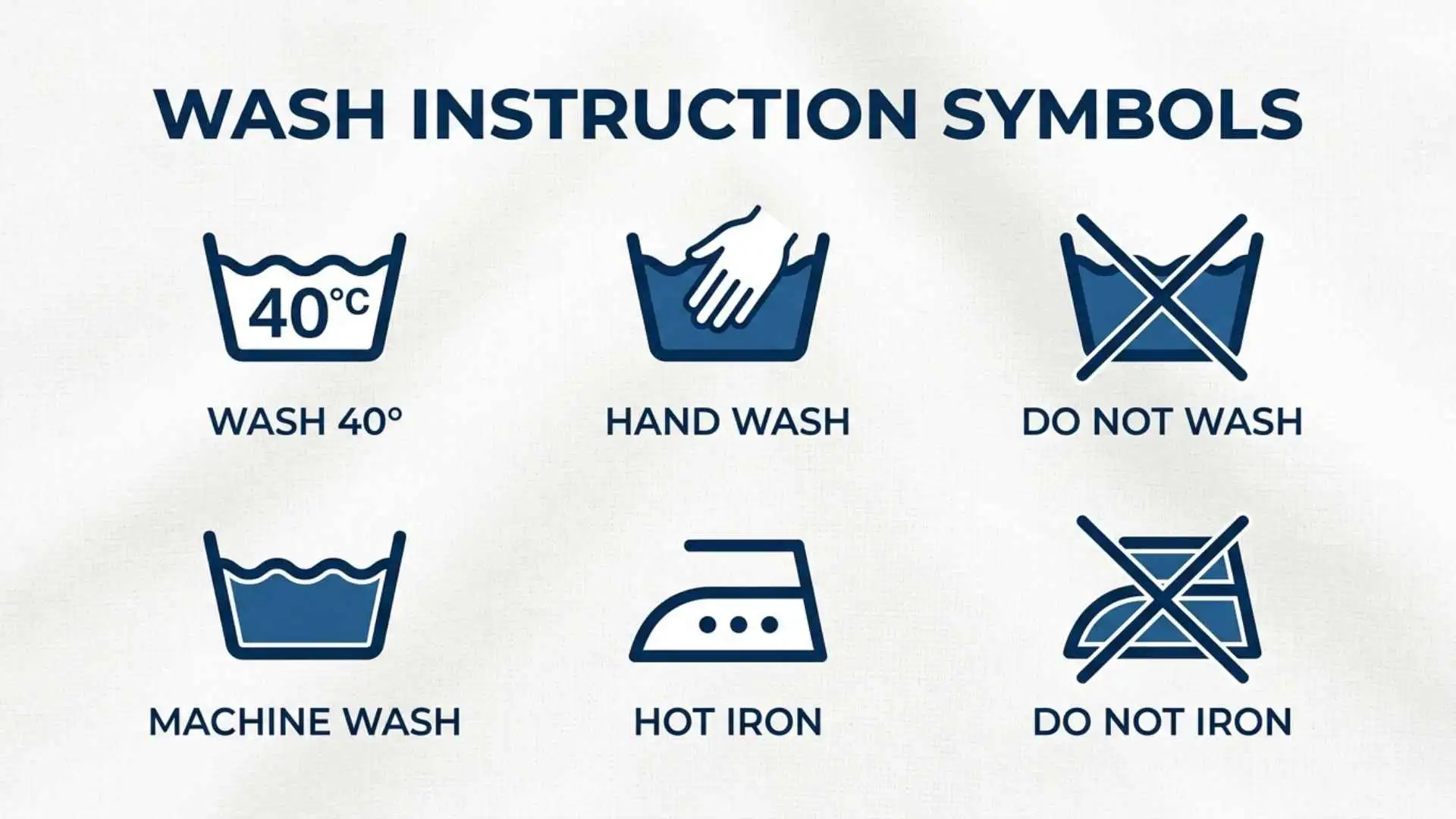
Have you ever looked at the small symbols on a clothing label and wondered what they mean? Wash instruction symbols are designed to make clothing care easier by showing you how an item should be washed, dried, bleached, ironed, or professionally cleaned.
These symbols are especially useful because different fabrics react differently to water, heat, detergent, and mechanical movement. A cotton shirt may tolerate a regular wash, while a wool sweater may require a gentle cycle or hand washing. Similarly, some clothes can safely go into a tumble dryer, while others may shrink or become damaged when exposed to high heat.
Understanding the symbols on your care label can help you avoid common laundry mistakes and keep your clothes looking better for longer. This guide explains the most important wash instruction symbols, what they mean, and what you should actually do when you see them.
Wash Instruction Symbols Chart
The easiest way to understand clothing care symbols is to see their meanings at a glance.
| Symbol | Meaning | What You Should Do |
| Tub with 30 | Wash at maximum 30°C | Use a 30°C wash or cooler |
| Tub with 40 | Wash at maximum 40°C | Use a 40°C wash or cooler |
| Tub with 60 | Wash at maximum 60°C | Use a 60°C wash or cooler |
| Hand in tub | Hand wash | Wash gently by hand |
| Crossed-out tub | Do not wash | Avoid washing with water |
| Tub with one line | Mild wash | Use a gentler cycle |
| Tub with two lines | Very gentle wash | Use a delicate or special cycle |
| Triangle | Bleaching allowed | Use bleach only when appropriate |
| Crossed-out triangle | Do not bleach | Do not use bleach |
| Square with circle | Tumble dry | Dryer can be used according to temperature |
| Crossed-out dryer | Do not tumble dry | Air dry instead |
| Square with horizontal line | Dry flat | Lay the item flat to dry |
| Iron with one dot | Low heat | Iron using low temperature |
| Iron with two dots | Medium heat | Use medium temperature |
| Iron with three dots | High heat | Use high temperature only if suitable |
| Crossed-out iron | Do not iron | Avoid ironing |
| Circle | Professional cleaning | Follow professional cleaner instructions |
| Crossed-out circle | Do not dry clean | Avoid dry cleaning |
This chart is useful when you need a quick answer, but understanding each symbol in detail will help you make better laundry decisions.
What Are Wash Instruction Symbols?
Wash instruction symbols are visual signs printed on clothing and textile care labels. They provide instructions about how a product should be cleaned and maintained.
Instead of writing detailed instructions in several languages, manufacturers can use standardized symbols that communicate the basic care requirements quickly.
The main groups include:
- Washing symbols
- Bleaching symbols
- Drying symbols
- Ironing symbols
- Professional cleaning symbols
The complete care label may contain several of these symbols together. You should read the entire label rather than relying on only one symbol.
Why Are Wash Instruction Symbols Important?
Clothing can be damaged when it is washed, dried, or ironed incorrectly. Following the care label helps reduce the risk of shrinking, fading, stretching, discoloration, and heat damage.
Wash instruction symbols can help you:
- Choose the correct washing temperature
- Select the appropriate washing cycle
- Know whether hand washing is necessary
- Avoid unsuitable bleach
- Choose the correct drying method
- Prevent heat damage
- Use the right ironing temperature
- Know when professional cleaning is required
The care label is essentially the manufacturer’s recommended method for maintaining the garment.
Washing Symbols Explained
The washing symbol is normally represented by a tub filled with water. It provides information about whether the garment can be washed and, in many cases, the maximum temperature.
30°C Washing Symbol
A tub containing 30 means the garment can generally be washed at a maximum temperature of 30°C.
A 30°C wash is commonly suitable for lightly soiled clothing and many colored or delicate garments.
What to do: Select a 30°C cycle or a cooler wash if appropriate.
40°C Washing Symbol
A tub containing 40 indicates a maximum washing temperature of 40°C.
This is a common temperature for everyday clothing, depending on the fabric and manufacturer’s instructions.
What to do: Use a washing-machine cycle at 40°C or lower.
60°C Washing Symbol
A tub containing 60 indicates that the garment can be washed at temperatures up to 60°C.
Some durable textiles, towels, and bedding may carry this instruction.
What to do: Use 60°C only when the care label allows it. Higher temperatures are not automatically better.
Hand Wash Symbol
A hand inside the washing tub means the garment should generally be hand washed.
This symbol is often used for delicate fabrics that could be damaged by the mechanical action of a standard washing-machine cycle.
What to do: Wash gently by hand using the recommended water temperature. Avoid aggressive rubbing, twisting, or wringing.
Do Not Wash Symbol
A crossed-out washing tub means do not wash.
This means you should not clean the garment using a normal water-washing process.
What to do: Check the other symbols for instructions about professional cleaning or alternative care methods.
One Line Under the Washing Tub
A single line under the tub indicates a gentler washing process than a normal cycle.
What to do: Choose a mild, permanent-press, or similar gentle cycle depending on your washing machine.
Two Lines Under the Washing Tub
Two lines indicate an even more delicate washing process.
What to do: Use a very gentle or delicate cycle and minimize mechanical action where possible.
How to Know If Clothes Are Machine Washable
One of the most common reasons people search for wash instruction symbols is to determine whether an item can safely go into a washing machine.
Look at the washing tub symbol.
- Normal tub: Machine washing is generally permitted.
- Tub with temperature: Machine wash at or below the stated temperature.
- One line: Use a gentle cycle.
- Two lines: Use a very gentle cycle.
- Hand symbol: Hand wash instead of using a normal machine cycle.
- Crossed-out tub: Do not wash.
When in doubt, follow the most restrictive instruction on the label.
Bleaching Symbols Explained
Bleaching instructions are represented by a triangle. These symbols tell you whether bleach can safely be used on the garment.
Empty Triangle
An empty triangle generally indicates that bleaching is permitted.
However, you should still use the appropriate type and amount of bleach for the fabric.
Triangle With Diagonal Lines
A triangle with two diagonal lines generally indicates that only certain non-chlorine or oxygen-based bleaching methods may be appropriate.
What to do: Check the bleach product instructions and avoid chlorine bleach unless specifically permitted.
Crossed-Out Triangle
A crossed-out triangle means do not bleach.
What to do: Avoid bleach products because they may cause discoloration or damage the fibers.
Drying Symbols Explained
Drying symbols are generally represented by a square. If the square contains a circle, it relates specifically to tumble drying.
Square With Circle
A square containing a circle indicates that tumble drying is permitted.
Dots inside the circle provide information about the appropriate heat level.
One Dot Inside the Dryer Symbol
One dot indicates a low-temperature drying setting.
What to do: Use a low-heat or delicate dryer setting.
Two Dots Inside the Dryer Symbol
Two dots generally indicate a medium-temperature setting.
What to do: Use a medium heat setting where available.
Three Dots Inside the Dryer Symbol
Three dots indicate a higher-temperature drying setting.
What to do: Use higher heat only when the garment’s care label specifically permits it.
Crossed-Out Tumble Dryer
A crossed-out square with a circle means do not tumble dry.
What to do: Use another recommended drying method, such as line drying or drying flat.
Natural Drying Symbols
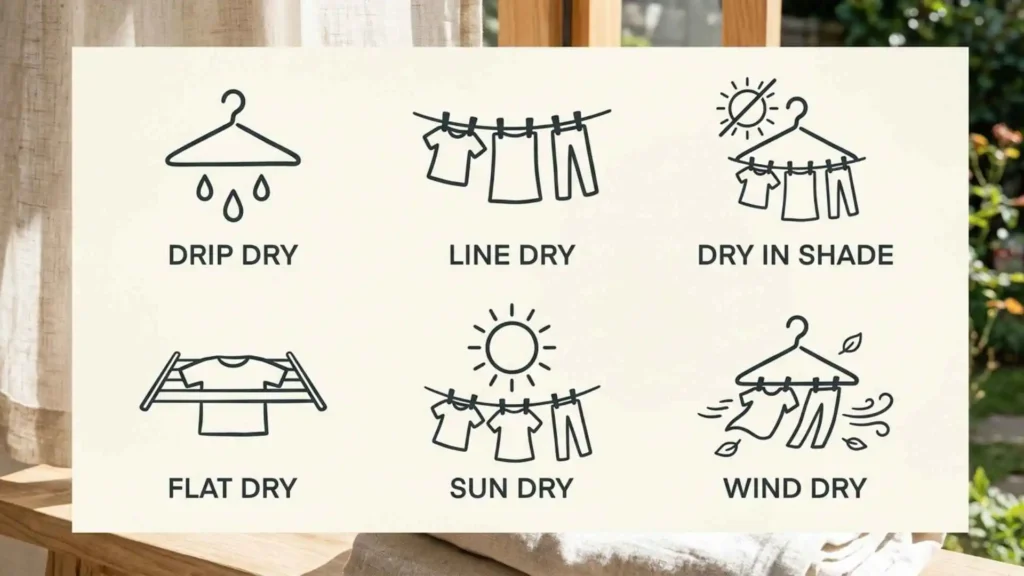
Some garments should be dried naturally rather than in a machine.
Line Dry
A line-drying symbol indicates that the garment should be hung or placed on a line to dry.
Drip Dry
Drip drying means the garment should be allowed to dry while wet without aggressive wringing.
Dry Flat
A horizontal line inside a square can indicate that the garment should be dried flat.
This is particularly important for some knitted garments because hanging them while wet can stretch their shape.
Dry in the Shade
A symbol indicating shade drying means the garment should be protected from direct sunlight while drying.
This can be particularly helpful for colored or sensitive fabrics.
Ironing Symbols Explained
The ironing symbol looks like an iron. Dots inside it indicate the recommended temperature.
One Dot on the Iron
One dot means low-temperature ironing.
This is commonly used for heat-sensitive materials.
Two Dots on the Iron
Two dots indicate a medium ironing temperature.
Three Dots on the Iron
Three dots indicate a higher ironing temperature.
Always make sure the fabric is suitable for high heat before using the highest setting.
Crossed-Out Iron
A crossed-out iron means do not iron.
What to do: Avoid direct ironing because heat may damage or melt the fabric.
Dry-Cleaning Symbols Explained
Professional cleaning instructions are generally represented by a circle.
Empty Circle
An empty circle generally means professional cleaning is permitted.
Circle With a Letter
Letters inside the circle provide technical information to professional cleaners about the appropriate cleaning process.
Consumers generally do not need to memorize every letter because professional cleaners use these markings to select the appropriate process.
Crossed-Out Circle
A crossed-out circle means do not dry clean.
How to Read a Complete Clothing Care Label
A clothing label often contains several symbols together.
For example, imagine a label showing:
40°C wash → Do not bleach → Tumble dry low → Iron low → Do not dry clean
This means:
- Wash the garment at a maximum of 40°C.
- Do not use bleach.
- Tumble drying is permitted at low temperature.
- Iron using low heat.
- Do not dry clean the garment.
Reading the symbols together is important because one garment can have different restrictions for washing, drying, ironing, and cleaning.
Wash Instruction Symbols by Fabric Type
Different fabrics often have different care requirements.
Cotton
Cotton is generally durable, but some cotton garments can shrink when exposed to high temperatures.
Always follow the temperature shown on the care label instead of assuming that cotton can tolerate any wash.
Wool
Wool often requires gentle washing, hand washing, or a dedicated wool cycle. Some wool garments should also be dried flat.
Avoid high heat unless the label specifically permits it.
Silk
Silk is a delicate material that can be affected by heat, friction, and harsh detergents.
Follow the care label carefully and use the recommended gentle cleaning method.
Polyester
Polyester is generally durable, but excessive heat can still damage some polyester garments.
Pay particular attention to tumble-drying and ironing temperatures.
Linen
Linen can usually be washed according to the manufacturer’s instructions but tends to wrinkle easily.
Correct drying and ironing can help maintain its appearance.
What Happens If You Ignore Wash Instruction Symbols?
Ignoring care instructions can result in permanent damage.
Shrinking
High temperatures can cause some fabrics to shrink.
Color Fading
Excessive heat, unsuitable detergents, bleach, and strong sunlight can affect colors.
Stretching
Some knitted garments can lose their shape when they are hung while wet instead of being dried flat.
Fabric Damage
Aggressive washing can damage delicate fibers.
Heat Damage
Excessive dryer or ironing heat can weaken, melt, scorch, or permanently mark certain fabrics.
Common Laundry Mistakes to Avoid
Even when people understand individual symbols, they can still make mistakes during laundry.
Washing Everything at the Same Temperature
Different garments have different temperature limits. Do not automatically use the hottest setting.
Ignoring Gentle-Cycle Instructions
A garment with one or two lines under the washing tub may need significantly gentler treatment than a normal wash.
Using Bleach Without Checking the Triangle
Always check the bleaching symbol before using bleach.
Putting Everything in the Dryer
Some garments should never be tumble dried. Check the drying symbol first.
Ironing at Maximum Heat
More heat does not mean better results. Use the temperature indicated by the iron symbol.
Ignoring the Care Label After Buying Clothes
The best time to check the label is before the first wash. Do not wait until the garment has already been damaged.
Are Wash Instruction Symbols Universal?
Many clothing-care symbols are based on standardized systems and are designed to communicate care instructions internationally. However, labeling requirements and specific conventions can vary between countries and manufacturers.
This means you should always read the complete label rather than relying on assumptions.
Some garments may also contain written instructions in addition to symbols. When written instructions and your assumptions seem different, follow the manufacturer’s specific directions.
Wash Instruction Symbols vs. Laundry Symbols
The terms wash instruction symbols, washing symbols, and laundry symbols are often used interchangeably.
There is a slight difference in how people use them:
- Wash instruction symbols can refer specifically to instructions for washing.
- Washing symbols usually describe the tub symbols.
- Laundry symbols is a broader term that can include washing, drying, ironing, bleaching, and professional cleaning.
For example, the washing tub is a washing symbol, while the triangle is a bleaching symbol. Together, they can be considered part of the garment’s overall laundry care symbols.
How to Protect Clothes While Washing
Following the symbols is the first step, but a few additional habits can improve clothing care.
- Read the care label before the first wash.
- Separate colors when necessary.
- Do not overload the washing machine.
- Use the correct detergent.
- Select the appropriate temperature.
- Use gentle cycles for delicate garments.
- Check the bleach symbol before using bleach.
- Check the dryer symbol before tumble drying.
- Remove clothes from the dryer promptly when appropriate.
- Dry knitted items flat when instructed.
- Use the recommended ironing temperature.
Frequently Asked Questions About Wash Instruction Symbols
What is the most important wash instruction symbol?
The washing tub symbol is one of the most important because it tells you whether and how the garment can be washed. However, you should read the complete care label because drying, bleaching, ironing, and cleaning instructions are also important.
What does the number inside a washing symbol mean?
A number inside the washing tub generally indicates the maximum recommended washing temperature, such as 30°C, 40°C, or 60°C.
What does the hand wash symbol mean?
A hand inside the washing tub means the garment should generally be hand washed rather than put through a normal machine-washing cycle.
What does a crossed-out washing tub mean?
It means the garment should not be washed using a normal water-washing process. Check the rest of the label for alternative cleaning instructions.
What does the triangle symbol mean?
The triangle relates to bleaching. An empty triangle generally indicates bleaching is permitted, while a crossed-out triangle means do not bleach.
What does a square with a circle mean?
It is the symbol for tumble drying. Dots inside the circle indicate the recommended temperature level.
What does a crossed-out dryer symbol mean?
It means the garment should not be tumble dried. Use the natural drying method recommended on the care label.
What does one dot on an iron mean?
One dot indicates that the garment should be ironed at a low temperature.
What does a crossed-out iron mean?
It means the garment should not be ironed because heat may damage the fabric.
What does a circle on a clothing label mean?
A circle generally represents professional cleaning. Additional markings inside or around the circle can provide technical instructions for professional cleaners.
Can I wash clothes without following the symbols?
You can physically wash many garments without checking their labels, but doing so increases the risk of shrinking, fading, stretching, or damaging the fabric. Following the manufacturer’s instructions is the safer approach.
Are 30°C and 40°C washing symbols different?
Yes. A 30°C symbol indicates a maximum washing temperature of 30°C, while a 40°C symbol permits a maximum temperature of 40°C. Always use the temperature specified on the garment.
Final Thoughts
Understanding wash instruction symbols makes laundry easier and helps protect your clothes from unnecessary damage. The most useful symbols to recognize are the washing tub, triangle, square, iron, and circle. These represent washing, bleaching, drying, ironing, and professional cleaning.
When you see a number inside the washing tub, pay attention to the maximum temperature. Lines under the tub indicate gentler washing, while a hand means hand washing. Crossed-out symbols are equally important because they tell you what not to do.
The best approach is to read the complete care label before washing a garment. A few seconds spent checking the symbols can prevent shrinking, fading, stretching, and heat damage and can help your clothes maintain their appearance for much longer.

I am Lisa Reynolds, a linguist fascinated by the ever-changing world of slang. I enjoy researching how slang reflects trends, technology, and social connections. I wrote “Text Talk: Understanding Digital Slang” and “From Street to Screen: Slang in Media”, exploring the influence of digital communication on language. I love sharing my discoveries in a way that feels like a conversation with friends, so you feel the culture and humor behind every phrase.
 John Carter
 Marcus Lee