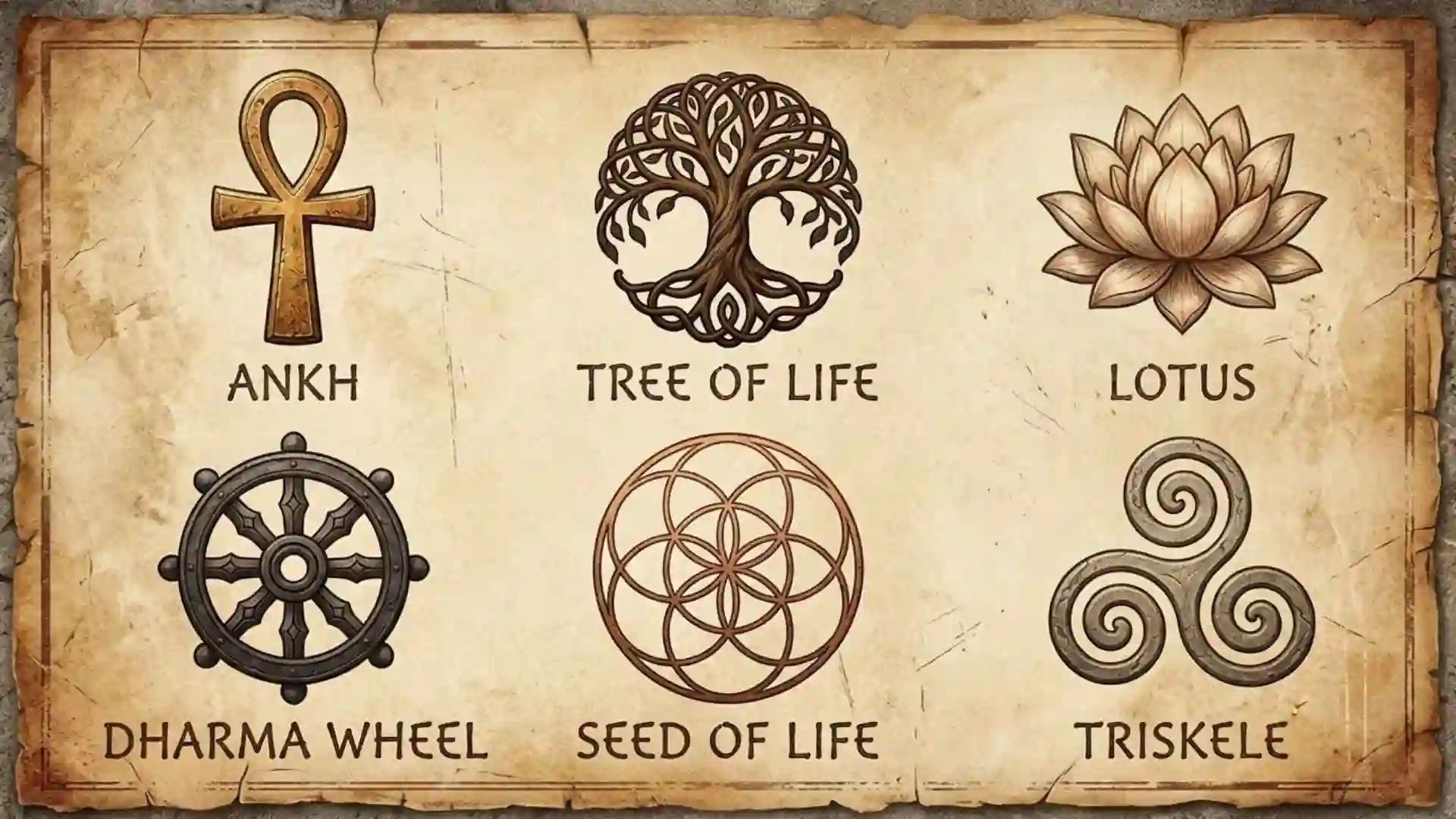
Ancient symbols tell fascinating stories about how people understood the world long before modern technology. Carved into stone, painted on cave walls, woven into textiles, or engraved on jewelry, these designs helped communities express beliefs, record experiences, and represent ideas that words could not always capture.
From the spirals and solar wheels of prehistoric Europe to Viking symbols such as Mjölnir and the Valknut, each design offers a glimpse into a particular time and culture. Some symbols have meanings supported by historical texts and archaeological discoveries. Others remain mysterious because the people who created them left no written explanations.
Understanding ancient symbols and their meanings requires more than memorizing a list of shapes. You also need to consider where a symbol appeared, when someone created it, and how people used it. A circle on one artifact might represent the sun, while a similar shape elsewhere might serve a decorative or practical purpose.
This guide explores common ancient symbols, their historical origins, their cultural associations, and their modern uses. It also separates documented evidence from popular interpretations so you can understand what historians and archaeologists know—and what remains uncertain.
What Are Ancient Symbols?
Ancient symbols are visual signs, patterns, images, or objects that carried meaning within historical and prehistoric societies. They appeared on tools, pottery, monuments, buildings, weapons, clothing, jewelry, and ceremonial objects.
Some symbols represented recognizable things, such as animals or celestial bodies. Others communicated ideas about power, religion, identity, nature, or death.
Symbols also existed long before many societies developed writing systems. Archaeological discoveries show that prehistoric people created complex visual art thousands of years before recorded history.
Why Did Ancient Cultures Use Symbols?
Ancient communities used symbolic imagery for several practical and cultural purposes.
- Communication: Visual marks could identify objects, convey messages, or distinguish one group from another.
- Religion: Images represented deities, sacred places, ritual practices, and mythological stories.
- Community identity: Repeated motifs helped express shared traditions and cultural connections.
- Decoration: Geometric patterns made pottery, textiles, weapons, and jewelry visually distinctive.
- Commemoration: Carvings and inscriptions preserved names, events, journeys, and memories.
- Burial practices: Objects and images placed in graves provide clues about social status, beliefs, and funerary customs.
- Recordkeeping: Inscriptions and markings sometimes recorded ownership, names, transactions, or other information.
Not every ancient mark had a spiritual purpose. A pattern might have served a decorative function, identified an object, or carried several meanings at once.
How Do Archaeologists Interpret Ancient Symbols?
Archaeologists study symbols alongside the objects, locations, and historical records connected to them. They rarely rely on shape alone.
For example, a three-triangle design found near a ship and figures associated with a burial scene may invite an interpretation involving death or religious belief. However, the surrounding imagery does not automatically prove the design’s exact meaning.
Researchers consider several kinds of evidence:
- The artifact’s age and geographic origin.
- Other objects discovered at the same site.
- Similar designs from the same cultural period.
- Written sources and inscriptions, when available.
- Changes in a symbol’s appearance over time.
The Swedish History Museum explains that knowledge of Viking Age religion comes from archaeological discoveries, written accounts, and place-names, all of which have limitations. See its guide to Norse religion in the Viking Age.
Common Ancient Symbols and Their Meanings
Many ancient designs appear simple, yet their interpretations can be surprisingly complex. The following table introduces frequently discussed motifs and explains what historians can reasonably say about them.
| Symbol | Common associations | Historical context |
| Circle | Cycles, wholeness, celestial imagery | Meaning depends on the artifact and culture |
| Spiral | Movement, recurring patterns, transformation | Appears in prehistoric art across different regions |
| Triangle | Geometric order, decorative patterns | Specific spiritual meanings require evidence |
| Cross | Intersecting directions, religious imagery | Found in multiple cultures and historical periods |
| Square | Boundaries, structure, organized space | May be decorative or practical |
| Diamond or rhombus | Geometric decoration; sometimes proposed fertility associations | Interpretations vary across artifacts |
| Solar wheel | Sun imagery and cyclical movement | Solar meanings depend on the particular design |
| Triskele | Three-part rotational pattern | Prominent in certain prehistoric and Celtic-associated art |
| Triquetra | Interlaced three-part design | Used in medieval Christian art and other decorative contexts |
| Pentagram | Five-pointed star | Has different meanings across historical traditions |
| Tree of Life | Growth, life, cosmological connections | Appears in several distinct cultural traditions |
| Heart | Varies by period and culture | The familiar romantic heart is not a universal ancient meaning |
| Ship | Travel, trade, warfare, or funerary imagery | Scandinavian examples occur in rock art and picture stones |
| Raven | Bird imagery, sometimes linked with wisdom or prophecy | Huginn and Muninn are associated with Odin in Norse mythology |
| Mjölnir | Thor, Norse religion, and hammer imagery | Supported by Viking Age pendants and other evidence |
| Valknut | Three interlocking triangles | The design is historically attested, but its exact meaning remains debated |
These associations are starting points rather than universal definitions. Historical context matters more than a modern symbol chart.
Ancient Geometric Symbols and Their Meanings
Geometric designs are among the most recognizable forms of ancient symbolic art. Circles, spirals, triangles, and intersecting lines appear on prehistoric monuments, pottery, metalwork, and textiles.
However, a shape does not always represent a particular idea. Repeated patterns may have conveyed meaning, served decorative purposes, or reflected the techniques available to the artist.
Circle, Ring, and Cupmark Symbols
Common forms: circular carvings, rings, disks, and small cup-shaped depressions.
The circle symbol meaning often relates to wholeness, repetition, or celestial imagery in modern interpretations. Circular designs also appear in historical representations of the sun and other heavenly bodies.
A ring can have a different role depending on its material and use. A metal ring might function as jewelry, while a circular motif on pottery could be decorative.
Cupmarks, also called cupules, are small rounded depressions carved or pecked into rock surfaces. Archaeologists have documented them at prehistoric sites, sometimes alongside grooves, circles, or other carvings.
Their original functions remain uncertain in many cases. Researchers have proposed ritual, practical, and decorative explanations, but a single explanation does not fit every site.
Spiral and Triskele Symbols
Common forms: single spirals, double spirals, triple spirals, and three-armed rotational designs.
The spiral symbol meaning often attracts interpretations involving growth, movement, change, and recurring cycles. Spirals appear in prehistoric European art and in many later decorative traditions.
One famous example is the spiral artwork at Newgrange in Ireland, a prehistoric passage tomb built around 3200 BCE. Its carved stone surfaces demonstrate the sophisticated visual traditions of Neolithic communities.
The triskele, or triple-spiral motif, features three connected or rotating arms. It is strongly associated with certain prehistoric monuments and later Celtic-associated artwork.
Modern explanations often connect the three arms with life, death, rebirth, or interconnected forces. These interpretations may be meaningful today, but archaeologists cannot automatically confirm that prehistoric artists understood the design in those exact terms.
Triangle and Diamond Symbols
Triangles and diamond-shaped motifs appear in ancient pottery, rock art, textiles, and metalwork.
Modern symbol guides frequently associate triangles with fire, fertility, rebirth, or divine power. Yet these meanings are not universal, and many ancient triangles may simply form part of a larger decorative pattern.
Diamond-shaped designs, also called rhombuses, sometimes receive fertility-related interpretations. Such claims require supporting evidence from the artifact’s context, nearby imagery, or relevant historical sources.
Repeated geometric patterns may also reflect weaving techniques, artistic conventions, or the need to fill a surface evenly.
Cross, X, and Line Symbols
Cross-shaped designs existed in many societies before Christianity became widespread. Their presence alone does not establish a Christian meaning.
An X-shaped mark might represent an intersection, a decorative element, or a sign whose original meaning is now lost. Vertical and horizontal lines may appear in counting marks, patterned decoration, or more complex compositions.
The solar cross is a particular design featuring a circle divided by a cross. It is often associated with solar imagery, although researchers must evaluate each example within its historical setting.
Pentagram, Octagram, and Other Geometric Designs
A pentagram is a five-pointed star, while an octagram has eight points. Star-shaped motifs appear in different religious, artistic, and mathematical traditions.
Their meanings changed over time. A design used decoratively in one period might acquire a religious or protective interpretation in another.
The same caution applies to looped squares, eight-pointed stars, and other patterns sometimes labeled ancient sacred geometry. A modern spiritual meaning should not be presented as an established prehistoric belief without reliable evidence.
Swastika and Ancient Sunwheel Designs
The swastika is an ancient geometric motif that appeared in multiple cultures long before the twentieth century. It has held religious and auspicious meanings in traditions including Hinduism, Buddhism, and Jainism.
However, Nazi Germany appropriated the symbol and turned it into an emblem of racist ideology, antisemitism, and genocide. That history profoundly affects how many people interpret it today.
Its meaning therefore depends on historical and cultural context. An ancient religious artifact, a contemporary Hindu temple, and Nazi propaganda do not represent the same use of the design.
Researchers must also distinguish swastika motifs from other wheel-shaped or cross-like patterns rather than treating every similar shape as identical.
Ancient Symbols of Nature, Plants, and Fertility
Nature shaped everyday life in ancient societies. People depended on sunlight, water, fertile soil, animals, and seasonal changes for survival. As a result, natural imagery became an important part of art, religion, and folklore.
Still, ancient nature symbols did not share one universal meaning. The same plant or animal could represent different ideas in different communities.
Tree Symbol and Tree of Life
Trees provide food, shelter, fuel, and materials for building. Their seasonal changes also offer a visible reminder of growth, decline, and renewal.
The Tree of Life is a broad motif found in different cultural traditions. Depending on the context, it can represent life, fertility, continuity, or connections between different parts of the universe.
In Norse mythology, Yggdrasil is a great tree associated with the structure of the cosmos. Medieval Icelandic texts describe its relationship to various beings and locations within Norse cosmology.
However, Yggdrasil should not be treated as identical to every other culture’s Tree of Life. Similar imagery can develop independently and carry different meanings.
Apple and Flower Symbols
Apples appear in several mythological traditions. Their meanings depend on the specific story rather than a universal symbolic rule.
In Norse mythology, the goddess Iðunn is associated with apples that help preserve the gods’ youth. This association connects apples with renewal and continued vitality within that particular narrative.
Flowers also appear in ancient art and religious settings. They may represent plants, seasonal beauty, offerings, or decorative traditions. Specific meanings require evidence from the culture and period in question.
Sun, Moon, and Solar Cross Symbols
The sun provided light, warmth, and a dependable marker of seasonal change. Ancient communities observed its movement to help organize agricultural activities, ceremonies, and calendars.
Solar imagery appears in prehistoric rock art and later European artifacts. Wheel-like designs, disks, and circular motifs sometimes have credible connections to solar representation.
The moon also influenced timekeeping and cultural traditions. Lunar phases are visible and predictable, making them useful for tracking recurring periods.
However, not every circle represents the sun, and not every crescent represents a moon deity. A convincing interpretation requires more than visual resemblance.
Ancient Fertility Symbols and Their Meanings
Fertility was important to farming societies because successful harvests and healthy livestock supported survival. Human reproduction also shaped family continuity and community life.
Some ancient artifacts contain imagery that researchers interpret as reproductive or fertility-related. Other interpretations remain disputed because the objects lack inscriptions or clear contextual evidence.
Common subjects in discussions of ancient fertility symbols include:
- Plant shoots, seeds, and growing vegetation.
- Human figures with emphasized reproductive features.
- Animals associated with breeding or agricultural wealth.
- Seasonal imagery connected with planting and harvesting.
- Deities whose stories involve reproduction or prosperity.
These categories can guide research, but they should not become automatic definitions. A stylized figure or plant pattern may have served several purposes, including decoration.
Ancient Animal Symbols and Their Cultural Meanings
Animals supplied food, clothing, transportation, and protection. They also appeared in myths, rituals, and artistic traditions, making ancient animal symbolism an important subject for understanding historical cultures.
Raven Symbolism
Ravens appear prominently in Norse mythology through Huginn and Muninn, the two ravens associated with Odin.
Their names are commonly translated as “Thought” and “Memory.” In the mythological tradition, they travel throughout the world and report information to Odin.
This connection makes ravens useful examples of how animals can acquire specific symbolic roles within a culture’s mythology.
Elsewhere, ravens and other corvids appear in stories and artistic traditions with different associations. Their presence in an ancient image does not automatically indicate Odin or Norse religious beliefs.
Wolf and Bear Symbolism
Wolves and bears held practical and cultural importance across parts of Europe. Both animals could threaten people and livestock, yet they also inspired stories about strength, danger, and relationships between humans and the natural world.
In Norse mythology, wolves appear in major stories involving Odin and Ragnarök. Fenrir, a monstrous wolf, plays a central role in the mythological account of the world’s destruction and renewal.
Bears also appear in discussions of northern European warrior traditions. However, claims that every bear image represents a berserker or warrior cult need specific evidence.
Horse, Elk, Deer, and Moose Symbols
Horses transformed transportation, agriculture, and warfare in many societies. Their depictions may therefore relate to travel, wealth, status, or military activity.
In Norse mythology, Sleipnir is Odin’s extraordinary eight-legged horse. Its mythological role differs from the practical importance of ordinary horses in historical communities.
Elk, deer, and moose appear in prehistoric rock art across northern regions. Antlers and animal bodies may reflect hunting practices, artistic traditions, or culturally meaningful imagery.
Some Scandinavian picture stones show horsemen in scenes interpreted as journeys to the world of the dead. The interpretation depends on the surrounding figures and imagery rather than on the horse alone.
Boar and Other Animal Motifs
Boars appear in Germanic and Norse cultural contexts, including mythological stories and decorative art. Their associations can involve warfare, strength, status, or divine connections.
Animal imagery also appears on weapons, helmets, jewelry, and ceremonial objects. Such designs might express identity or authority without necessarily serving as religious symbols.
To understand an animal motif, examine the object itself. Its location, date, materials, and accompanying images often reveal more than a modern list of symbolic meanings.
Viking and Norse Symbols and Their Meanings
Viking symbols attract particular interest because archaeological discoveries and Norse mythology preserve vivid examples of ancient Scandinavian visual culture.
The Viking Age is generally dated to approximately 793–1066 CE, although cultural changes occurred over longer periods. Norse religious practices also varied by region and changed as Christianity spread.
The Swedish History Museum’s guide to Norse religion explains how researchers combine material discoveries with medieval written sources to study these beliefs.
Valknut Symbol
The Valknut is a modern name commonly used for a design featuring three interlocking triangles. Related motifs appear on Viking Age picture stones and other objects.
Some examples occur near imagery associated with death, sacrifices, or mythological scenes. This context has encouraged theories connecting the design with Odin and the afterlife.
However, its original name and exact meaning remain uncertain. The historical evidence supports the existence of the motif more strongly than any single explanation of its purpose.
For further context, consult the Gotlands Museum’s research on the Lillbjärs picture stones.
Yggdrasil: The Norse World Tree
Yggdrasil occupies an important place in Norse mythology. Medieval Icelandic sources describe a great tree associated with the cosmos and the beings who inhabit it.
The tree is often called the Norse Tree of Life in modern explanations. It provides a useful comparison with other cosmological tree motifs, although the traditions should remain distinct.
Yggdrasil’s meaning comes primarily from Norse literary descriptions rather than one universally accepted ancient symbol drawing. Modern illustrations vary in their details because they interpret written accounts through later artistic conventions.
Mjölnir: Thor’s Hammer
Historical context: Viking Age Scandinavia and related cultural regions.
Mjölnir is the hammer wielded by Thor, the Norse god associated with thunder. In mythology, Thor uses it against giants and other threats to the divine order.
Archaeologists have discovered numerous hammer-shaped pendants associated with the Viking Age. These artifacts provide strong evidence that Thor’s hammer imagery mattered in Scandinavian material culture.
Modern interpretations often emphasize strength, protection, and religious identity. Such associations fit the broader mythological context, but the precise significance of an individual pendant may not be recoverable.
Gungnir: Odin’s Spear
Gungnir is the spear associated with Odin in Norse mythology. Stories connect Odin with wisdom, warfare, sacrifice, and the pursuit of knowledge.
Gungnir is best understood as a mythological object described in literary sources. It should not be confused with a single standardized archaeological symbol that ancient Scandinavians necessarily displayed in the same way.
Huginn and Muninn: Odin’s Ravens
Huginn and Muninn accompany Odin in Norse mythology. Their names refer to thought and memory, while their travels allow them to gather information from the wider world.
Their story offers a clear example of mythological symbolism supported by surviving texts. It also shows why literary evidence can be more useful than guesswork when interpreting an animal’s cultural role.
Web of Wyrd and Norse Fate Symbols
The Web of Wyrd is a modern design associated with fate and interconnected events. Its familiar graphic should not be presented as a securely established Viking Age artifact.
The Norns, by contrast, are figures in Norse mythology associated with destiny. Medieval literature provides evidence for their place in Norse cosmological stories.
This distinction matters because a modern design can draw inspiration from an ancient concept without itself being ancient.
Trollknot and Thunderbloom
Trollknot and Thunderbloom appear in some modern lists of protective symbols. Their claimed ancient origins and historical meanings require careful verification.
Do not assume that an unfamiliar name proves a design comes from the Viking Age. Before describing either motif as ancient, look for dated artifacts, reliable historical records, or specialist research establishing its origin.
Norse Runes and Their Historical Uses
Runes were a writing system used by Germanic-speaking peoples. In Scandinavia, they appeared centuries before the Viking Age and remained important during it.
The Swedish History Museum’s introduction to runes explains that runic inscriptions appeared on stone, wood, horn, weapons, and personal belongings.
Two major runic systems are especially relevant:
- Elder Futhark: An early runic alphabet containing 24 characters.
- Younger Futhark: A later Scandinavian system reduced to 16 characters and widely used during the Viking Age.
Runes could record names, memorial messages, ownership, and other information. Some historical and literary evidence also connects runes with special powers or ritual practices.
However, individual runes should not automatically be assigned fixed meanings such as protection, prosperity, or destiny. Their linguistic value, historical use, and modern spiritual interpretations are separate subjects.
Celtic Symbols and Their Meanings
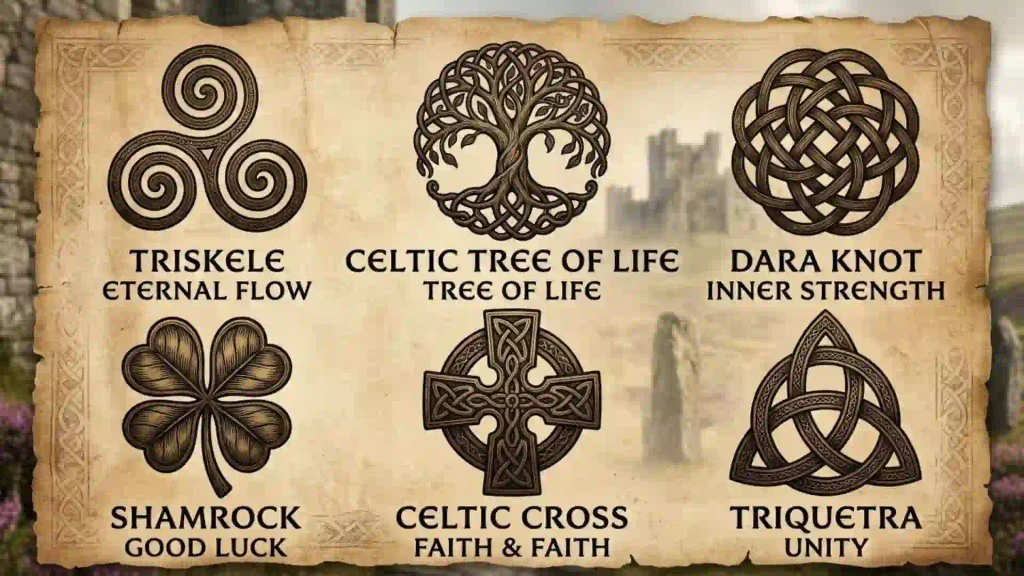
Celtic symbolism encompasses a wide range of historical periods and artistic traditions. The term “Celtic” can refer to different linguistic, cultural, and historical contexts, so it should not be used as a universal label for every ancient European motif.
Triskele and Triple-Spiral Motifs
The triskele features three connected or rotating arms. Triple-spiral designs appear in prehistoric monuments, including Newgrange, which dates to approximately 3200 BCE.
These motifs are frequently associated with Celtic symbolism today. However, Newgrange predates the historical period usually associated with Celtic-speaking communities in Ireland by thousands of years.
Modern interpretations sometimes connect the three arms with cycles of life, death, and rebirth. These ideas can be explored as contemporary symbolism, but they should not be presented as proven explanations of the prehistoric carvings.
Triquetra and Interlaced Patterns
The triquetra is a three-part interlaced design found in medieval art. It became particularly familiar through Insular Christian art and later decorative traditions.
In Christian settings, the motif can represent the Trinity. It also appears in modern spiritual art, jewelry, and Celtic-inspired designs.
Its long history demonstrates how symbols can change meaning as they move between cultures and periods.
Celtic Cross and Solar Imagery
The Celtic cross is associated especially with medieval Christian monuments in Ireland and Britain. Its distinctive ringed form appears on historic high crosses and other Christian artwork.
Although people sometimes interpret the ring as an ancient solar symbol, the cross’s historical Christian context must remain central when discussing its medieval use.
Celtic Nature and Protection Symbols
Celtic-associated art features elaborate knotwork, animal forms, plants, and interlaced patterns. These designs appear in manuscripts, metalwork, stone monuments, and other objects.
Some modern guides assign each knot a specific meaning involving eternity, protection, or unity. Such meanings should be identified as traditional, interpretive, or modern unless reliable evidence establishes their historical use.
Ancient Germanic and Other Northern European Symbols
Northern Europe contains a rich archaeological record of carved stones, runic inscriptions, metalwork, and religious objects. Yet Germanic, Norse, Finnish, Estonian, and Celtic traditions should not be treated as interchangeable.
Germanic Symbols and Their Historical Context
Germanic-speaking communities lived across northern and central Europe during different historical periods. Their material culture included weapons, jewelry, inscriptions, and decorative motifs.
Some symbols spread between communities through trade, migration, warfare, and cultural exchange. Others developed within particular regional traditions.
The best approach is to identify the artifact’s origin and date before connecting it to a particular belief system.
Snoldelev Runestone and Other Runic Monuments
Runestones provide valuable evidence of ancient Scandinavian writing and commemorative practices. Their inscriptions can preserve names, family relationships, journeys, and historical events.
The Snoldelev runestone in Denmark is an important example of an early Viking Age monument with runic writing and other carved imagery. Its inscription helps researchers study language and cultural identity.
Sweden also has a large collection of runestones. The Swedish History Museum reports approximately 2,500 discovered runestones in the country, with roughly 1,300 in Uppland. These monuments demonstrate how widespread runic writing became in parts of Viking Age Scandinavia. Source: Swedish History Museum.
Finnish and Estonian Traditions
Finnish and Estonian traditions include distinct languages, folklore, and historical religious practices. Figures such as Ukko in Finnish mythology and Taara in Estonian tradition belong to their respective cultural contexts.
Their stories may involve thunder, the natural world, or divine power. However, surviving sources do not always provide enough evidence to reconstruct the symbols used in earlier religious practices.
Avoid assigning these figures a single universal emblem unless a reliable historical source supports the connection.
Symbols in the Överhogdal Tapestries
The Överhogdal textiles from Sweden contain striking animal figures, people, and other imagery. They are important examples of medieval Scandinavian textile art.
Researchers have proposed several interpretations of their scenes, including connections with Norse mythology and Christian traditions. Some theories link particular images to Ragnarök, the mythological end of the world.
These interpretations remain debated. The textiles are genuine historical objects, but the meaning of every figure and pattern is not settled.
Ancient Symbols of Death, Fate, and the Afterlife
Death and the afterlife appear frequently in discussions of ancient religious symbolism. Archaeological evidence can reveal how communities treated their dead, although it rarely provides a complete account of what people believed happened after death.
Ship Symbols and Burial Traditions
Ships appear in Scandinavian rock art, picture stones, and burial contexts. They could reflect practical seafaring, warfare, travel, status, or religious ideas.
A ship carved on a picture stone may carry symbolic meaning, especially when it appears beside other figures or ritual imagery. However, the ship’s presence alone does not prove that it represents a journey to the afterlife.
Burial ships and ship-shaped grave settings provide additional evidence for the importance of maritime imagery in some Scandinavian funerary traditions.
Valknut and Death-Related Imagery
The Valknut frequently appears in modern discussions of death and Norse mythology. Some historical examples occur near scenes interpreted as funerary or sacrificial.
These connections make an association with death or Odin plausible enough to investigate. They do not establish a definitive meaning.
When explaining the Valknut, distinguish the documented design from modern claims about its symbolism.
Tree of Life and Connections Between Worlds
Cosmological trees appear in multiple mythological traditions. Their branches, trunks, and roots can provide a way to imagine relationships between different parts of the universe.
Yggdrasil is a Norse example supported by medieval literary sources. Other traditions have their own tree motifs and cosmological explanations.
The similarities can be fascinating, but they do not prove that every Tree of Life design shares one origin or meaning.
Ancient Burial Symbols and Ritual Objects
Burial sites preserve objects that can help archaeologists reconstruct aspects of ancient life. Weapons, jewelry, tools, and imported goods may reveal social status, trade connections, and funerary customs.
Researchers also compare burial arrangements and repeated patterns across sites. These comparisons can suggest shared practices or regional differences.
However, grave goods do not provide a simple dictionary of afterlife beliefs. An object might reflect the deceased’s social identity, family connections, practical needs, or ritual traditions.
Ancient Symbols in Rock Art, Cave Paintings, and Tapestries
Some of the most intriguing prehistoric symbols survive as paintings and carvings rather than written descriptions. These artworks provide direct evidence of ancient visual traditions, although their original purposes can be difficult to establish.
Prehistoric Symbols and Cave Paintings
Cave paintings include animal figures, abstract signs, hand stencils, and other visual forms. Many examples date back tens of thousands of years.
The famous cave art at Lascaux in France dates to roughly 17,000 years ago. Its paintings include large animals and complex compositions, demonstrating the artistic skill of prehistoric communities.
Researchers study pigments, cave conditions, overlapping images, and archaeological context to investigate when and how these works were created. Their exact meanings remain uncertain in many cases.
Petroglyphs and Ancient Rock Carvings
Petroglyphs are images made by removing or marking part of a rock surface. Artists created them through techniques such as pecking, scratching, or engraving.
Common subjects include:
- Animals and human figures.
- Boats and other recognizable objects.
- Spirals, circles, and geometric patterns.
- Cupmarks and grooves.
- Scenes involving people, animals, or possible rituals.
Rock art can reveal artistic conventions, environmental knowledge, and aspects of cultural life. Still, researchers must avoid assigning a fixed meaning to every carving.
Symbols on Runestones and Ancient Artifacts
Runestones combine writing with visual imagery. Some commemorate the dead, record journeys, or identify people and relationships.
Other artifacts feature motifs without inscriptions. Jewelry, weapons, pottery, and tools may carry decorative designs or symbols that researchers interpret through comparisons with similar finds.
An inscription can provide clearer evidence than an isolated image because it may identify a person, describe an event, or supply other historical information.
Tapestry Symbols and the Överhogdal Textiles
Textiles preserve visual information about medieval clothing, artistic techniques, and cultural traditions. Repeated patterns may also help researchers identify regional styles.
The Överhogdal textiles contain complex scenes that scholars interpret in different ways. Their imagery shows how historical artworks can preserve multiple layers of cultural influence.
Rather than forcing every figure into a single mythological explanation, researchers compare the textiles with other contemporary evidence.
How Ancient Symbols Were Used in Daily Life
Ancient symbols did not exist only in temples or sacred ceremonies. They also appeared on ordinary objects that people handled, wore, traded, or displayed.
Symbols in Homes, Farms, and Communities
Household objects and agricultural tools sometimes feature decorative marks or inscriptions. These may identify ownership, communicate information, or reflect local artistic traditions.
Repeated motifs can help researchers compare objects from different settlements. However, not every mark represents a family emblem or magical sign.
Symbols in Sacred Spaces and Religious Practices
Ancient religious practices took place in many settings, including buildings, outdoor sites, groves, and designated ritual areas.
Archaeologists examine offerings, figurines, animal remains, and other discoveries to investigate these activities. Written accounts and place-names can provide additional evidence when they survive.
Even so, the function of a particular site may remain uncertain. A building with unusual objects is not automatically a temple.
Symbols on Jewelry, Weapons, and Clothing
Pendants, brooches, engraved weapons, and decorated clothing could express wealth, identity, status, or religious affiliation.
Thor’s hammer pendants offer a useful Norse example. Their archaeological presence demonstrates that hammer imagery was important in Viking Age material culture, although individual wearers may have understood the pendants differently.
Some objects also traveled long distances through trade. Their designs can reveal contact between communities that otherwise seem geographically distant.
Symbols in Burial Rituals and Commemorative Art
Gravestones and burial objects help preserve memories of individuals and communities. They may also reflect social hierarchies and religious traditions.
Inscriptions can provide names or relationships, while images may suggest cultural affiliations. However, the interpretation of any object depends on its archaeological context and the wider evidence.
Ancient Symbols Across Different Cultures: Similarities and Differences
A symbol can look familiar across two cultures without carrying the same meaning. Comparing historical context helps explain why.
Celtic vs. Norse Symbols
Celtic-associated art includes elaborate interlacing, spirals, and other decorative traditions. Norse material culture includes runic inscriptions, hammer pendants, picture stones, and imagery associated with Norse mythology.
There can be similarities between their visual designs because communities interacted and artists shared techniques. However, a similar-looking pattern does not automatically prove a shared religious meaning.
The historical period also matters. A prehistoric triple spiral and a medieval interlaced Christian motif may look related while belonging to different artistic and cultural settings.
Norse vs. Wider Germanic Symbols
Norse traditions developed within the broader history of Germanic-speaking societies. Some visual motifs and religious concepts overlap across regions and periods.
However, the Viking Age represents a particular historical context rather than the entirety of Germanic history. Researchers must account for differences in language, geography, chronology, and archaeological evidence.
European vs. Other Ancient Symbol Traditions
Similar geometric designs appear in societies separated by great distances. These similarities can arise through cultural contact or independent invention.
A circle, spiral, or star is a relatively simple shape that different communities can create without borrowing it from one another.
To establish a historical connection, researchers look for stronger evidence, such as shared artistic details, trade links, dated artifacts, or related written traditions.
How to Identify an Ancient Symbol and Research Its Meaning
Finding a symbol online is easy. Discovering what it meant historically takes more work. If you want to understand an unfamiliar design, use a few basic research steps before accepting popular explanations.
Identify the Symbol’s Shape and Variations
Start by recording the design’s visible features. Note the number of lines, points, loops, or figures, along with how the elements connect.
Compare the design with historical examples. Two symbols may look similar at first but differ in important details.
Establish Its Historical Period and Geographic Origin
Look for information about where the object was discovered and when researchers believe it was created.
A symbol on a Bronze Age artifact has a different historical context from a motif in a medieval manuscript. The date of the original object also matters more than the date of a modern reproduction.
Compare Archaeological and Historical Sources
Use reliable resources to check an interpretation. Good starting points include:
- The British Museum for archaeological objects and collection research.
- The Metropolitan Museum of Art for historical art and cultural context.
- The Swedish History Museum for Scandinavian archaeology, runes, and Viking Age religion.
- UNESCO World Heritage Centre for information about important archaeological sites.
- The Archaeology Data Service for archaeological reports and research materials.
Whenever possible, compare multiple credible sources rather than relying on one symbol website.
Recognize Common Symbol Interpretation Mistakes
Watch for these common errors:
- Assuming every symbol has one universal meaning.
- Treating all geometric designs as sacred or magical.
- Confusing modern spiritual interpretations with ancient beliefs.
- Accepting unsupported claims about protection against evil spirits.
- Calling a design ancient without evidence of its historical origin.
- Assuming a symbol’s presence near a burial proves its exact meaning.
- Treating Norse, Celtic, Germanic, and other European traditions as identical.
A careful interpretation is more useful than a confident but unsupported answer.
Ancient Symbols in Modern Culture, Tattoos, and Jewelry
Ancient imagery continues to influence tattoos, jewelry, clothing, and decorative art. Many people choose these designs because they appreciate their history or find their modern interpretations personally meaningful.
However, a symbol’s modern meaning may differ from its historical meaning. Understanding that distinction helps you make informed choices.
Ancient Symbols Used in Modern Tattoos
Some popular designs include:
- Mjölnir: Thor’s hammer, rooted in Norse mythology and Viking Age material culture.
- Yggdrasil: The great tree described in Norse mythological sources.
- Valknut: A historically attested three-triangle motif with an uncertain original meaning.
- Triskele: A three-armed rotational design found in ancient and later artistic traditions.
- Triquetra: An interlaced three-part motif used in medieval art and modern designs.
- Runic inscriptions: Historical writing that may represent names, words, or memorial messages.
Before choosing a tattoo, research the particular design rather than relying on a broad label such as “ancient protection symbol.”
Ancient Symbols in Jewelry and Decorative Art
Historical pendants and ornaments inspire many modern reproductions. Thor’s hammer pendants are a well-known example of a design based on archaeological discoveries.
Other contemporary pieces use Celtic-style knotwork, spirals, and runic lettering. Some reproduce historical objects closely, while others combine several traditions into new designs.
If historical accuracy matters to you, check whether the design comes from a documented artifact or a modern artist’s interpretation.
Ancient Symbols and Cultural Respect
Symbols can hold religious or cultural importance for living communities. Their use may therefore carry meanings beyond their appearance.
A respectful approach involves learning the symbol’s origins, understanding its present-day associations, and avoiding unsupported claims about its meaning.
Historical research does not prevent personal interpretation. It simply helps distinguish your own connection to a design from what the available evidence tells us about its past.
Frequently Asked Questions About Ancient Symbols and Their Meanings
What Are the Most Common Ancient Symbols?
Commonly discussed examples include circles, spirals, crosses, solar wheels, animal figures, trees, and geometric patterns. Norse symbols such as Mjölnir and the Valknut are also popular subjects of historical research.
Their meanings depend on the culture, time period, and object where they appear.
What Do Ancient Symbols Mean?
Ancient symbols could communicate religious beliefs, cultural identity, social status, practical information, or artistic ideas. Some represented recognizable objects, while others had meanings that researchers can no longer determine with confidence.
The most reliable interpretations consider archaeological evidence and historical context.
What Are the Oldest Known Ancient Symbols?
There is no single oldest symbol because researchers distinguish between marks, recognizable images, and symbols with a demonstrable meaning.
Prehistoric geometric markings and animal images date back tens of thousands of years. For example, the cave paintings at Lascaux are approximately 17,000 years old, while Newgrange’s famous carved stones date to around 3200 BCE.
These examples demonstrate the antiquity of symbolic art without establishing the meaning of every design.
Which Ancient Symbols Represent Life, Creation, and Rebirth?
Trees, plants, seeds, and certain animal or reproductive images sometimes appear in discussions of life and fertility. Yggdrasil represents a cosmic tree in Norse mythology, while Iðunn’s apples relate to the gods’ continued youth.
However, no single symbol represents life or rebirth in every ancient culture.
Which Ancient Symbols Are Associated With Protection?
Mjölnir pendants provide an important example of historically attested Norse religious imagery. Other cultures also used amulets and objects believed to provide protection.
The historical evidence varies from one artifact to another. Claims about a symbol’s protective power should be distinguished from evidence about how people used or understood it.
What Do Viking Symbols Mean?
Viking Age symbols and images had different roles. Runic inscriptions conveyed written information, hammer pendants reflected Norse religious culture, and picture stones preserved elaborate visual scenes.
The Valknut is a recognized modern name for a historical three-triangle motif, but its original meaning remains uncertain. Not every design marketed as a Viking symbol has a documented Viking Age origin.
What Is the Difference Between Celtic and Norse Symbols?
Celtic-associated art includes distinctive interlacing patterns, spirals, and other motifs. Norse material culture includes runic inscriptions, hammer pendants, and imagery connected with Norse mythology.
The traditions sometimes share visual features, but they have different historical contexts. A similar design does not automatically establish a common origin.
How Do Archaeologists Interpret Ancient Rock Art?
Researchers examine the carving’s location, date, technique, surrounding images, and relationship to other discoveries. They also compare it with historical records and similar archaeological sites.
Some interpretations are well supported, while others remain debated. Archaeologists acknowledge uncertainty when the available evidence cannot establish a clear meaning.
Did All Ancient Symbols Have Religious Meanings?
No. Ancient marks could serve decorative, practical, commemorative, linguistic, or religious purposes.
A pattern on pottery might be decorative, while an inscription on a memorial stone could record a person’s name. Context helps researchers determine which explanations are plausible.
Are Modern Norse Symbols Historically Authentic?
Some are based on documented Viking Age objects, while others developed later or were created in modern times.
Mjölnir pendants and runic inscriptions have strong archaeological foundations. The Web of Wyrd’s familiar modern design, by contrast, should not be presented as a securely documented Viking Age symbol.
Always check a design’s historical origin before describing it as ancient.
Why Do Ancient Symbols Have Different Interpretations?
Symbols can change meaning as cultures evolve, religions spread, and artistic traditions influence one another. Different communities may also use similar shapes for unrelated purposes.
In addition, researchers sometimes disagree because the available evidence is incomplete. Modern interpretations can add further layers of meaning.
How Can You Research the Origin of an Ancient Symbol?
Begin with the symbol’s name, visual form, and claimed cultural origin. Then search museum catalogs, archaeological publications, historical inscriptions, and specialist research.
Check the artifact’s date and distinguish its documented history from later interpretations. This approach helps you avoid repeating unsupported claims.
Conclusion: Understanding Ancient Symbols and Their Meanings
Ancient symbols and their meanings offer a fascinating window into human history. From prehistoric spirals and cave paintings to Norse hammer pendants and medieval Celtic-inspired artwork, these designs reveal how people represented their surroundings, beliefs, identities, and experiences.
Yet their stories are rarely as simple as a list of definitions suggests. A circle might have a practical, decorative, or religious role. A three-triangle motif may be historically authentic even when its original meaning remains unknown.
The best way to understand historical symbols is to examine their origins, cultural settings, and archaeological evidence. Separate documented facts from modern interpretations, and avoid assuming that similar designs always share the same meaning.
When you approach ancient artwork with curiosity and care, every symbol becomes an opportunity to explore the people who created it—and the world they lived in.

I am Lisa Reynolds, a linguist fascinated by the ever-changing world of slang. I enjoy researching how slang reflects trends, technology, and social connections. I wrote “Text Talk: Understanding Digital Slang” and “From Street to Screen: Slang in Media”, exploring the influence of digital communication on language. I love sharing my discoveries in a way that feels like a conversation with friends, so you feel the culture and humor behind every phrase.
 John Carter