The American Revolution symbols tell the story of a people who challenged British rule and fought to establish an independent nation. From the rattlesnake on revolutionary flags to the Liberty Bell in Philadelphia, these images and objects carried powerful messages about freedom, resistance, unity, and self-government.
During the eighteenth century, American colonists used flags, political cartoons, public gathering places, and other recognizable emblems to express their political beliefs. These symbols helped people communicate across the thirteen colonies, where communities had different interests but increasingly shared grievances against British policies.
Some symbols emerged during protests against taxation. Others became important during the Revolutionary War or gained national significance after independence. Understanding their origins reveals how the American independence movement developed and how the new country built its national identity.
The five most recognizable symbols discussed here are the rattlesnake, Liberty Bell, Liberty Tree, Stars and Stripes, and bald eagle. Each has a distinct history, and not every familiar story about these symbols is historically proven.
What Were the Symbols of the American Revolution?
American Revolution symbols were images, objects, flags, and public landmarks that communicated political ideas during the struggle for independence from Great Britain. They helped colonists express opposition to British policies, encourage cooperation, and represent the emerging American cause.
These Revolutionary War symbols included both unofficial emblems used by protesters and formal symbols adopted by the new government. Their meanings often changed as the conflict developed.
For example, Benjamin Franklin’s Join, or Die cartoon first appeared in 1754 during the French and Indian War. More than a decade later, colonists revived its message of unity as resistance to British policies intensified.
Three broad purposes explain why these symbols mattered:
- Resistance: Images such as the rattlesnake communicated a willingness to defend colonial rights.
- Unity: Divided snakes, shared flags, and common meeting places encouraged cooperation among colonies.
- Independence: National emblems helped distinguish the emerging United States from the British Empire.
Symbols also made political arguments easier to understand. A newspaper cartoon could communicate the danger of disunity faster than a lengthy political essay. A flag could represent an army, while a tree or pole could become a recognizable gathering place for protesters.
However, not every symbol began as an independence emblem. Some originated before the Revolution, while others became associated with freedom decades later.
What Did American Revolutionary Symbols Represent?
The meanings of American Revolutionary symbols developed through political events, public demonstrations, military campaigns, and later historical memory. Understanding their original contexts helps separate documented history from popular interpretations.
Freedom and Liberty
Liberty was a central idea in the colonial dispute with Britain. Many colonists objected to taxation and government decisions imposed without adequate colonial representation.
The Liberty Bell eventually became closely associated with freedom, while the Liberty Tree represented organized resistance to unpopular policies. Both symbols later acquired meanings that extended beyond their original settings.
Colonial Unity and Collective Resistance
The thirteen colonies did not always agree on political goals. Their economies, religious traditions, and local interests varied considerably.
Symbols of colonial unity encouraged people to recognize common interests. Franklin’s Join, or Die cartoon made this argument visually by depicting a snake divided into separate sections.
During the independence movement, shared symbols helped communicate a common cause despite regional differences.
Independence and American Identity
The Declaration of Independence in 1776 marked a decisive political break with Great Britain. The new nation needed recognizable symbols to represent its sovereignty.
The Stars and Stripes, adopted by the Continental Congress in 1777, became an important national emblem. The Great Seal, adopted in 1782, added another official representation of the United States.
Together, these symbols of American independence helped establish a distinct national identity.
The Rattlesnake: A Symbol of Colonial Unity and Self-Defense
The American rattlesnake symbol became one of the most recognizable images associated with colonial resistance. Its warning rattle and defensive reputation made it a useful metaphor for colonists who wanted to protect their rights against perceived threats.
The snake appeared in political cartoons, newspapers, and military flags. However, its different uses carried distinct meanings. The divided snake represented unity, while the coiled rattlesnake on the Gadsden Flag warned outsiders against aggression.
Benjamin Franklin’s Join, or Die Cartoon
Benjamin Franklin published the famous Join, or Die cartoon in the Pennsylvania Gazette on May 9, 1754. The image showed a snake divided into sections, each representing a British American colony or regional grouping.
Franklin published it during the French and Indian War, when he wanted the colonies to cooperate in their defense. The cartoon therefore predates the American Revolution by more than twenty years.
Its central message was simple: separate colonies would struggle to defend their interests without cooperation.
When tensions with Britain intensified during the 1760s and 1770s, colonists reused the image to support political unity. Its meaning shifted with the circumstances, making it an enduring example of American revolutionary propaganda and visual political communication.
Paul Revere’s Snake-and-Dragon Cartoon
In 1774, Paul Revere created a political illustration published in the Massachusetts Spy. It depicted a snake confronting a dragon, imagery associated with the growing conflict between Britain and the American colonies.
The illustration demonstrates how revolutionary-era printers adapted animal imagery to express political arguments. Readers familiar with earlier snake cartoons could recognize the broader message of resistance and collective action.
Such images circulated political ideas among people who might not read lengthy essays or formal political documents.
The Gadsden Flag and “Don’t Tread on Me”
The Gadsden Flag features a coiled rattlesnake on a yellow background beneath the words “Don’t Tread on Me.”
The flag is associated with Christopher Gadsden, a South Carolina political and military leader who presented the design during the Revolutionary era. In 1775, rattlesnake imagery became part of the emerging Continental Navy’s visual identity.
The flag’s message emphasized vigilance, self-defense, and resistance to coercion. Its snake did not represent a desire to attack every opponent. Instead, the warning suggested that aggression would provoke a response.
The flag remains recognizable today, although its modern political interpretations vary by group and context.
What Does the Rattlesnake Symbolize?
The rattlesnake represented several related ideas during the independence movement:
- Colonial unity: The divided snake warned that separation weakened the colonies.
- Self-defense: The animal’s defensive behavior suggested readiness to protect colonial rights.
- Resistance: The snake became a recognizable emblem of opposition to British authority.
- American identity: Its use helped establish imagery distinct from traditional British royal symbols.
The key distinction is that the rattlesnake did not have one fixed meaning. Its symbolism depended on the particular cartoon, flag, or political argument in which it appeared.
The Liberty Bell: A Symbol of Freedom and Independence
The Liberty Bell is one of America’s best-known historical symbols. Located in Philadelphia, Pennsylvania, it represents liberty, independence, civil rights, and the enduring struggle to make American ideals a reality.
However, the bell did not begin its life as a national symbol. It originally served a practical purpose at the Pennsylvania State House, now known as Independence Hall. Its transformation into an emblem of freedom happened gradually.
The Liberty Bell’s Colonial History
In 1751, the Pennsylvania Assembly ordered a bell for the State House. London founders initially cast it, but the bell cracked during testing after arriving in Philadelphia. Local founders John Pass and John Stow recast it in 1753.
The bell weighs approximately 2,080 pounds and contains a bronze alloy made primarily from copper and tin. Its most famous feature is the inscription around its upper portion:
“Proclaim Liberty Throughout All the Land Unto All the Inhabitants Thereof.”
The words come from Leviticus 25:10 in the Bible. They originally reflected the bell’s civic setting and Pennsylvania’s historical ideas about liberty.
During the colonial period, the bell summoned lawmakers and residents for important announcements. It also rang during public events connected to the Stamp Act crisis and the act’s repeal in 1766. These associations helped connect the bell with political liberty before it became a national icon. National Park Service: Liberty Bell history.
Did the Liberty Bell Ring on July 4, 1776?
The story that the Liberty Bell rang to announce the Declaration of Independence is famous, but historical evidence does not confirm it.
Congress approved the Declaration on July 4, 1776. On July 8, Colonel John Nixon delivered the first public reading of the document in Philadelphia’s State House Yard.
The bell may have rung to summon people for the reading. However, the National Park Service explains that no evidence establishes that it rang on July 4 or July 8, 1776. Read the National Park Service account.
This distinction matters because the Liberty Bell’s symbolism developed over time. The connection between the bell and the Declaration became especially popular during the nineteenth century.
Why Does the Liberty Bell Have a Crack?
The bell’s crack is one of its most recognizable features. Yet it did not become famous simply because it broke.
The bell suffered damage during its early history and underwent repairs. Its distinctive crack eventually became part of its identity as a historical artifact.
Over time, Americans came to associate the damaged bell with the imperfect but continuing pursuit of freedom. That interpretation reflects its later cultural meaning rather than a proven intention behind the original damage.
The Liberty Bell During the Revolutionary War
When British forces threatened Philadelphia in 1777, officials removed the Liberty Bell and other bells from the city. They transported them to Allentown, Pennsylvania, where they were hidden to prevent British troops from melting them down for ammunition.
The bell later returned to Philadelphia. Its reputation continued to grow, especially as Americans looked for objects that could represent the nation’s founding.
The name Liberty Bell itself gained prominence later. Abolitionists adopted the bell as a symbol of freedom during the nineteenth century, linking its inscription to the movement against slavery. National Park Service: The Liberty Bell’s transformation into an icon.
What Does the Liberty Bell Symbolize?
The bell carries several connected meanings:
- Liberty: Its inscription directly proclaims freedom.
- Independence: Its later history links it to America’s founding.
- Civil rights: Abolitionists used the bell to highlight the gap between American ideals and slavery.
- Historical memory: The bell preserves public connections to the colonial and revolutionary periods.
The Liberty Bell is therefore more than a reminder of independence. It also represents the ongoing effort to extend freedom to people who were excluded from it.
The Liberty Tree: A Symbol of Colonial Resistance
Before American colonists declared independence, they needed places where they could gather, protest, and organize. Boston’s Liberty Tree became one of the most important physical landmarks associated with that resistance.
The tree stood in Boston, Massachusetts, and became a gathering place for people opposing British policies. Its importance grew during the controversy surrounding the Stamp Act of 1765.
Unlike a flag or political cartoon, the Liberty Tree was a real location. People could meet beneath it, display political messages, and turn their opposition into a public event.
The Liberty Tree and the Stamp Act of 1765
The British Parliament passed the Stamp Act in 1765. It required many printed materials in the American colonies to carry a tax stamp, including newspapers, legal documents, and other paper products.
Many colonists viewed the tax as an attack on their political rights. They argued that Parliament should not tax them without adequate representation.
On August 14, 1765, protesters in Boston targeted Andrew Oliver, the official responsible for implementing the Stamp Act in Massachusetts. They displayed an effigy of Oliver and organized demonstrations against the policy.
The Liberty Tree became a focal point for these protests. Its branches and surrounding area offered a recognizable setting for public opposition.
The protests contributed to a broader colonial resistance movement that included boycotts, petitions, political writing, and organized demonstrations.
The Sons of Liberty and Colonial Protest
The Sons of Liberty were a network of colonial activists who opposed British taxation and defended what they considered their constitutional rights.
The Liberty Tree became associated with their activities in Boston. Public meetings at the site helped transform individual complaints into collective political action.
These gatherings also made resistance visible. British officials and other colonists could see that opposition to the Stamp Act extended beyond private conversations.
The Stamp Act was repealed in 1766, prompting celebrations among colonists. However, Parliament continued to assert its authority over the colonies, and disputes over taxation and political control persisted.
The Liberty Tree therefore became a symbol of resistance that outlasted the specific tax that helped make it famous.
What Happened to Boston’s Liberty Tree?
In August 1775, during the growing conflict around Boston, British troops and loyalists destroyed the tree. By then, the political struggle had developed into armed conflict.
Its destruction did not end the use of liberty-themed gathering places. Liberty Poles and other public landmarks continued to serve as sites for demonstrations and expressions of opposition.
Liberty Poles were tall posts that colonists sometimes decorated with flags, banners, or symbolic objects. Raising a pole could signal resistance and provide a rallying point for a community.
What Did the Liberty Tree Symbolize?
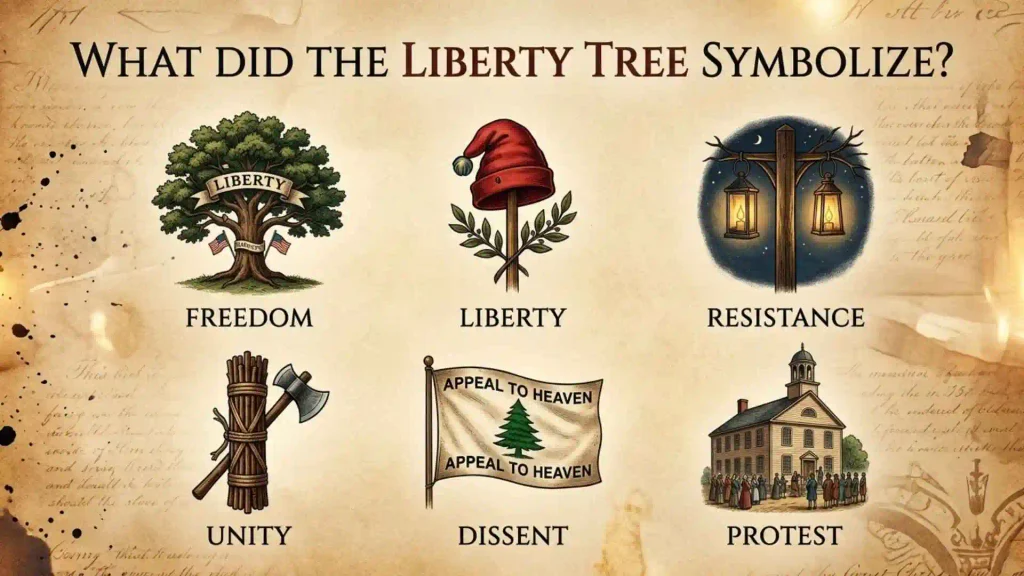
The Liberty Tree represented several important ideas:
- Political resistance: Colonists used the site to oppose British policies.
- Public solidarity: Gatherings showed that protesters shared common grievances.
- Freedom and self-government: The tree became associated with defending colonial rights.
- Community action: Its location helped people organize and communicate.
The Liberty Tree illustrates how an ordinary place can become a powerful political symbol. Its meaning came from what people did there, not merely from the tree itself.
The Stars and Stripes: The Flag of American Independence
The Stars and Stripes became the most enduring national symbol to emerge from the American Revolution. Its design represented the union of the thirteen states and helped distinguish the new country from Great Britain.
Before independence, colonial forces used several flags and banners. The adoption of a national flag gave the emerging United States a shared emblem for military service, public ceremonies, and international recognition.
The Flag Resolution of June 14, 1777
On June 14, 1777, the Second Continental Congress adopted the first official national flag resolution.
The resolution stated:
“Resolved, That the flag of the thirteen United States be thirteen stripes, alternate red and white; that the union be thirteen stars, white in a blue field, representing a new constellation.”
The design contained thirteen alternating red and white stripes and thirteen white stars on a blue field. The stars represented the thirteen states, while the stripes reflected the original union.
Importantly, the resolution did not specify how the stars had to be arranged. Early versions therefore appeared in different patterns.
The adoption of the flag marked an important step in creating a distinct national identity. It gave the United States an official design that could appear on ships, military installations, and other public settings. National Archives: Flag Day and the 1777 resolution.
What Did the Thirteen Stars and Stripes Represent?
The original flag’s most important feature was its number of stars and stripes. Both reflected the thirteen states that formed the new nation.
- Thirteen stars: Represented the thirteen states united under the new government.
- Thirteen stripes: Represented the original states and their shared political identity.
- Blue field: Provided the background for the stars.
- Red and white stripes: Created the flag’s distinctive alternating pattern.
Popular explanations often assign specific moral meanings to the colors, such as courage, purity, and justice. Those interpretations became part of later American traditions, but they should not be confused with the wording of the 1777 resolution itself.
The original design also changed as the country expanded. Congress established the practice of adding stars as new states entered the Union, while keeping thirteen stripes to honor the original states.
Who Designed the First American Flag?
The Betsy Ross story is one of the best-known American flag traditions. According to the familiar account, Ross, a Philadelphia upholsterer, sewed the first flag after receiving a request from George Washington and other revolutionary leaders.
However, conclusive contemporary evidence establishing Ross as the designer of the first official flag has not survived. The story became widely known decades after the Revolution.
That does not mean Ross played no role in making early American flags. It means the specific claim that she designed the first official flag remains unproven.
The strongest documented starting point for the national flag is the congressional resolution of June 14, 1777.
Revolutionary War Flags and Early American Designs
The Stars and Stripes was not the only flag used during the Revolutionary War. Military units, naval forces, and local groups used different banners to identify themselves and communicate allegiance.
Some flags reflected older British colonial traditions. Others displayed slogans, military emblems, or symbols of resistance.
The Cowpens Flag, associated with the Battle of Cowpens in January 1781, belongs to the broader history of Revolutionary War military colors. Specific claims about individual surviving flags should be checked against museum records and historical documentation.
These varied designs show that American identity did not emerge from a single image overnight. It developed through a mix of regional traditions, military symbols, and national emblems.
What Do the Stars and Stripes Symbolize Today?
The flag now represents much more than the original thirteen states. Its symbolism includes:
- National unity: The union of states under one national government.
- Independence: The country’s separation from British rule.
- Sovereignty: The United States’ status as an independent nation.
- Shared heritage: A continuing connection to the founding era.
The Stars and Stripes remains the clearest example of a Revolutionary-era symbol that developed into a lasting national emblem.
The Bald Eagle: A Symbol of American Strength and Freedom
The bald eagle is one of the most recognizable American national symbols. Its impressive appearance, powerful wings, and association with strength made it a fitting emblem for a country seeking to establish its place among the world’s nations.
However, the eagle’s history differs from that of the rattlesnake and Liberty Tree. It became a central national emblem through the development of American government rather than through colonial protests alone.
The Great Seal of the United States
The Great Seal of the United States is one of the most important official emblems of the American founding era. Congress adopted its final design on June 20, 1782, after several years of proposals and revisions.
The seal’s front features a bald eagle with a shield across its chest. The eagle holds an olive branch in one talon and a bundle of arrows in the other. Above its head, a constellation of thirteen stars appears against a field of rays and clouds.
Each element contributes to the seal’s visual message.
- Bald eagle: Represents the United States as a distinct nation.
- Shield: Features thirteen red and white stripes beneath a blue chief.
- Olive branch: Represents peace.
- Thirteen arrows: Represent the nation’s capacity to defend itself.
- Thirteen stars: Connect the design to the original thirteen states.
- E pluribus unum: The Latin motto means “Out of many, one,” expressing unity among the states.
The seal authenticates official federal documents and appears on important government materials. Its adoption in 1782 came after the Declaration of Independence, demonstrating how American national symbols continued to develop during and after the Revolutionary War.
What Do the Olive Branch and Thirteen Arrows Mean?
The olive branch and arrows create a deliberate contrast between peace and military strength.
The eagle holds the olive branch in one talon and arrows in the other. Together, they communicate that the United States seeks peace but retains the ability to defend its sovereignty.
This combination made sense for a new nation that had fought a long war for independence. The country wanted recognition as a peaceful republic, yet it also needed to protect itself against potential threats.
The symbolism remains relevant because diplomacy and national defense continue to be important parts of American foreign policy.
Why Does the Eagle Face the Olive Branch?
In the current Great Seal design, the eagle’s head faces toward the olive branch. Many popular explanations interpret this direction as a preference for peace over war.
That reading fits the seal’s combination of peaceful and defensive imagery. However, claims about every detail of the eagle’s orientation should be distinguished from documented design history.
The strongest interpretation comes from considering the complete emblem rather than treating the eagle’s head direction as a separate, definitive historical statement.
When Did the Bald Eagle Become America’s National Bird?
The bald eagle appeared on the Great Seal in 1782 and became an enduring national emblem long before its formal designation as the national bird.
On December 24, 2024, President Joe Biden signed legislation officially designating the bald eagle as the national bird of the United States.
This distinction is important for historical accuracy. The eagle served as an American symbol during the founding era, but its formal designation as the national bird came more than two centuries later.
What Does the Bald Eagle Symbolize?
The bald eagle is associated with several national ideals:
- Strength: Its powerful appearance conveys resilience.
- Freedom: Its ability to fly has long supported associations with liberty.
- Independence: Its use on the Great Seal identifies the United States as a sovereign nation.
- Peace and defense: The olive branch and arrows express a balance between diplomacy and military readiness.
- Patriotism: Its presence on government buildings, official documents, and national emblems reinforces American identity.
The eagle’s story shows how a symbol can grow from an official government emblem into a widely recognized expression of national character.
Other Important Symbols of the American Revolution
The rattlesnake, Liberty Bell, Liberty Tree, Stars and Stripes, and bald eagle are central examples, but they do not tell the whole story. Several additional American revolutionary emblems help explain how colonists expressed political beliefs and military identity.
The Liberty Pole
liveauctioneers.com
A Liberty Pole was a tall post used as a gathering point or political statement during periods of colonial resistance. Protesters sometimes decorated these poles with flags, banners, or other signs of opposition.
Liberty Poles became associated with resistance to British authority, particularly during disputes over taxation and colonial rights.
Their importance lay in their public visibility. Raising a pole could signal that a community supported the protest movement, while gatherings around it created opportunities to exchange news and organize demonstrations.
Liberty Poles also helped continue the tradition established by Boston’s Liberty Tree after the tree’s destruction.
The First Navy Jack
The First Navy Jack is associated with the history of the United States Navy and its early use of distinctive flags. The name often refers to a naval jack featuring a rattlesnake and the motto “Don’t Tread on Me.”
Its history requires careful treatment because naval flags and their later reproductions have changed over time. Not every modern version reflects an identical, continuously documented design from the Revolutionary period.
The rattlesnake imagery nevertheless connects the naval tradition to the wider revolutionary message of vigilance and self-defense.
The Cowpens Flag
The Cowpens Flag belongs to the history of Revolutionary War military flags and is associated with the Battle of Cowpens, fought in South Carolina on January 17, 1781.
The battle was an important American victory during the southern campaign. Military flags helped identify units, represent allegiance, and create a visible focus for soldiers in battle.
Claims about the exact appearance, ownership, and survival of individual Revolutionary flags should rely on reliable museum or archival evidence. Historical names alone do not establish every detail of a flag’s original design.
Colonial Flags and Political Cartoons
Colonial flags and political cartoons served different but complementary purposes.
Flags helped identify military units and communicate allegiance. Political cartoons used recognizable images to express complicated political arguments in a compact form.
For example, Franklin’s Join, or Die cartoon transformed the abstract problem of colonial disunity into a divided snake. Its message could be understood quickly, even by readers who did not follow every detail of colonial politics.
Printers, newspapers, and pamphleteers helped these images travel between communities. This made revolutionary-era imagery an important part of the political debate.
How Revolutionary Symbols Helped Unite the Colonies
The American independence movement depended on more than battles and political declarations. It also depended on communication. Symbols of colonial unity helped people recognize shared interests and rally around common causes.
During the eighteenth century, newspapers and pamphlets circulated political arguments throughout the colonies. Public demonstrations gave those arguments a visible presence, while flags and emblems made them easier to recognize.
Different symbols served different roles.
- The Join, or Die cartoon argued for unity among colonies.
- The rattlesnake communicated resistance and self-defense.
- The Liberty Tree provided a physical gathering place for protesters.
- The Liberty Bell later became a prominent emblem of liberty.
- The Stars and Stripes represented the emerging national government.
- The Great Seal expressed the identity and authority of the new United States.
These symbols did not automatically unite every colonist. Loyalists continued to support the Crown, and colonists disagreed about independence, government, and the future of slavery.
Nevertheless, revolutionary imagery helped supporters communicate their aims. It turned abstract political ideas into recognizable pictures, objects, and places.
The meanings of these symbols also changed after the war. The Liberty Bell, for instance, became closely associated with abolitionism during the nineteenth century. The American flag developed as new states joined the Union, and the bald eagle became an increasingly prominent national emblem.
This evolution explains why American Revolution symbolism remains important today. These images preserve the history of the independence movement while reflecting later debates about American freedom and identity.
American Revolution Symbols and Their Meanings at a Glance
The following table summarizes the most important symbols and their historical associations.
| Symbol | Historical connection | Main meaning |
| Rattlesnake | Colonial political imagery and Revolutionary-era flags | Resistance, vigilance, and self-defense |
| Join, or Die cartoon | Benjamin Franklin’s 1754 publication | Colonial unity |
| Gadsden Flag | Revolutionary-era military and naval history | Defiance and self-defense |
| Liberty Bell | Pennsylvania State House and later national memory | Liberty and civil rights |
| Liberty Tree | Boston’s Stamp Act protests | Resistance and public solidarity |
| Stars and Stripes | Flag Resolution of 1777 | Union and national sovereignty |
| Bald eagle | Great Seal adopted in 1782 | National identity and strength |
| Liberty Pole | Colonial protest gatherings | Political resistance |
| First Navy Jack | American naval history | Naval identity and revolutionary defiance |
| Cowpens Flag | Battle of Cowpens, 1781 | Revolutionary military identity |
| Great Seal | Officially adopted in 1782 | Sovereignty, peace, and defense |
Frequently Asked Questions About American Revolution Symbols
What Are the Most Important Symbols of the American Revolution?
The most important examples include the rattlesnake, Liberty Bell, Liberty Tree, Stars and Stripes, and bald eagle. The Join, or Die cartoon and Gadsden Flag are also significant because they communicated colonial unity and resistance.
These symbols did not all originate at the same time. Some began as protest imagery, while others became national emblems during or after the Revolutionary War.
What Symbol Represented Freedom During the American Revolution?
The Liberty Bell is now one of America’s best-known symbols of freedom. Its inscription calls for liberty throughout the land, and abolitionists later used it to support the struggle against slavery.
The Liberty Tree also represented freedom by providing a gathering place for colonists protesting British policies.
Why Did American Colonists Use the Rattlesnake as a Symbol?
Colonists used the rattlesnake to communicate vigilance, resistance, and self-defense. Its warning rattle suggested that Americans would defend themselves against threats.
The divided snake in Join, or Die conveyed a related but distinct message: the colonies needed to cooperate rather than remain politically divided.
What Did the Liberty Tree Represent?
Boston’s Liberty Tree represented resistance to British taxation and support for colonial rights. Protesters gathered there during the Stamp Act crisis of 1765.
The tree became a recognizable landmark for the Sons of Liberty and other opponents of British policies. Its destruction in 1775 did not end the use of liberty-themed gathering places.
What Did the Thirteen Stars on the First American Flag Represent?
The thirteen stars represented the thirteen states that formed the United States. The Flag Resolution of June 14, 1777, placed them in a blue field above thirteen alternating red and white stripes.
The resolution did not specify the stars’ arrangement, so early versions used different patterns.
Was the Bald Eagle an Official Symbol During the Revolution?
The bald eagle became an official American emblem when Congress adopted the Great Seal in 1782. This occurred after the Declaration of Independence in 1776 but before the Revolutionary War formally ended in 1783.
The eagle was officially designated the national bird much later, in December 2024.
Did the Liberty Bell Ring on July 4, 1776?
Historical evidence does not establish that the Liberty Bell rang on July 4, 1776. Congress approved the Declaration that day, while the first public reading in Philadelphia occurred on July 8.
The bell may have rung to summon people for the reading, but the claim remains unconfirmed.
What Is the Difference Between Revolutionary Symbols and Modern American Symbols?
Revolutionary symbols emerged during the colonial struggle, while modern national symbols include emblems that gained prominence or formal status later.
The Liberty Tree was closely connected to colonial protest. The Stars and Stripes became the national flag in 1777, while the Great Seal was adopted in 1782. The bald eagle received formal designation as the national bird in 2024.
Some symbols retain their original associations, while others have acquired new meanings through later historical events.
Conclusion: The Lasting Legacy of American Revolution Symbols
The American Revolution symbols tell a story of resistance, political cooperation, and the creation of a new nation. The rattlesnake communicated self-defense, the Liberty Tree provided a gathering place for protesters, and the Liberty Bell eventually became an enduring emblem of freedom.
The Stars and Stripes and Great Seal helped establish the identity of the United States, while the bald eagle grew into one of its most recognizable national emblems.
Understanding these symbols requires looking beyond familiar images. Their origins, historical uses, and later interpretations reveal how Americans have expressed and debated the meaning of liberty.
Some symbols emerged from specific protests, while others developed into national traditions. Together, they preserve an important part of the American founding story and remind us that the meanings of freedom and unity have continued to evolve.
Historical Sources and Further Reading
For reliable information about the origins and meanings of American Revolutionary symbols, consult these historical resources:
These sources help distinguish documented events from popular traditions and provide a stronger foundation for understanding the symbols of the American Revolution.

I am John Carter, a lifelong enthusiast of language and modern slang. I explore how words evolve and shape culture, and I enjoy uncovering the stories behind everyday expressions. I have authored “Slang and Society: The Language of Youth” and “Modern Words, Modern Worlds”, where I dive into how informal language impacts communication and identity. My goal is to make language accessible, fun, and insightful for everyone who loves words as much as I do.
 Lisa Reynolds