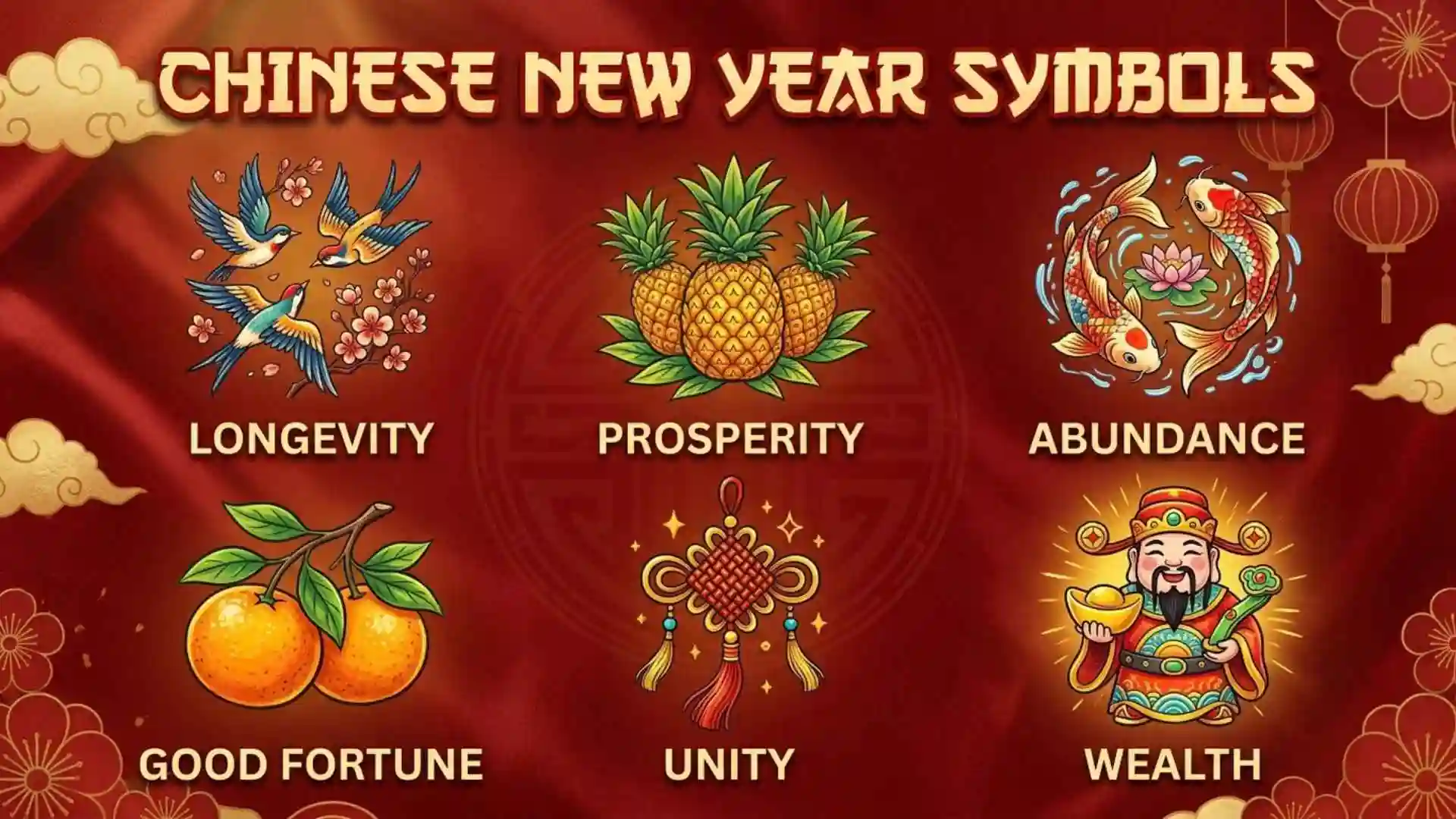
Chinese New Year, also called the Lunar New Year or Spring Festival, is celebrated with a wide range of traditional symbols, decorations, foods, colors, flowers, and animals. These symbols are more than festive decorations. Many of them represent wishes for good luck, happiness, wealth, prosperity, longevity, health, family harmony, and a successful year ahead.
Some of the most recognizable Chinese New Year symbols include the color red, red envelopes, the 福 (Fú) character, lanterns, dragons, lions, fish, dumplings, oranges, flowers, and Chinese zodiac animals. Their meanings can vary according to region, language, family tradition, and context, so they are best understood as common cultural associations rather than universal rules.
This guide explains the most important Chinese New Year symbols and their meanings, including traditional decorations, foods, animals, flowers, colors, characters, and symbols of luck and prosperity.
What Are Chinese New Year Symbols?
Chinese New Year symbols are traditional objects, images, colors, foods, characters, and customs associated with Lunar New Year celebrations. They are commonly used in homes, businesses, temples, streets, greeting cards, gifts, clothing, and festival performances.
Many symbols express a particular hope for the coming year. For example, fish are commonly associated with abundance, dumplings with wealth, long noodles with longevity, and the color red with happiness and good fortune.
Not every symbol has exactly the same meaning everywhere. Chinese New Year traditions have developed across different regions and communities, including mainland China, Hong Kong, Taiwan, Singapore, Malaysia, and Chinese communities around the world.
Quick List of Chinese New Year Symbols and Meanings
Here are some of the most common Chinese New Year symbols at a glance:
| Symbol | Chinese Name | Common Meaning |
| Red | 红色 (Hóngsè) | Happiness, celebration, good fortune |
| 福 | Fú | Fortune, blessing, good luck |
| Red envelope | 红包 (Hóngbāo) | Good wishes and blessings |
| Lantern | 灯笼 (Dēnglóng) | Celebration, brightness |
| Dragon | 龙 (Lóng) | Strength, power, auspiciousness |
| Lion | 狮 (Shī) | Protection and good fortune |
| Fish | 鱼 (Yú) | Abundance and surplus |
| Dumplings | 饺子 (Jiǎozi) | Wealth and prosperity |
| Mandarin oranges | 橘子 / 柑 | Good fortune and prosperity |
| Nian gao | 年糕 | Progress and growth |
| Long noodles | 长寿面 | Longevity |
| Plum blossom | 梅花 | Renewal and resilience |
| Peony | 牡丹 | Wealth, beauty, honor |
| Chinese knot | 中国结 | Unity and continuity |
| Spring couplets | 春联 | New Year blessings |
| Zodiac animals | 生肖 | Annual cultural symbolism |
| Gold | 金色 | Wealth and prosperity |
| Firecrackers | 鞭炮 | Celebration and traditional protection |
Chinese New Year Symbols and Their Meanings
Red Color
Red is one of the most recognizable colors associated with Chinese New Year. It appears on lanterns, banners, envelopes, paper decorations, clothing, gift packaging, and traditional artwork.
Red is commonly associated with happiness, celebration, vitality, good fortune, and positive energy. It is therefore especially prominent during a festival centered on welcoming a new year and expressing good wishes.
Homes and businesses may use red decorations to create a festive atmosphere and communicate wishes for a fortunate year.
福 (Fú) Character
The Chinese character 福 (fú) is one of the most important Chinese New Year symbols. It is generally associated with fortune, blessings, happiness, and good luck.
During the New Year period, 福 is often displayed on red paper and placed on doors, walls, windows, or other visible areas. It can appear by itself or as part of decorative artwork.
Why Is Fu Sometimes Upside Down?
One famous New Year tradition involves displaying 福 upside down. The Chinese word for “upside down” is pronounced dào, while the word for “arrive” can also be pronounced dào. This creates a traditional wordplay that can be understood as suggesting that fortune has arrived.
The practice is a cultural tradition rather than a universal requirement, and placement customs can vary.
Red Envelopes
Red envelopes, called 红包 (hóngbāo), are traditionally used to give money during Chinese New Year and other important occasions.
The money is not simply a financial gift. The red envelope and the act of giving it can express good wishes, blessings, prosperity, and care for family members and younger generations.
Today, red envelopes may also be exchanged digitally through mobile payment platforms in some communities.
Chinese New Year Lanterns
Lanterns are another familiar Lunar New Year decoration. Red lanterns can be seen hanging outside homes, businesses, streets, temples, and festival venues.
Lanterns are associated with celebration, brightness, and a festive atmosphere. They are particularly prominent during the Lantern Festival, which traditionally follows the New Year celebrations.
Spring Festival Couplets
Spring Festival couplets, known as 春联 (chūnlián), are pairs of poetic phrases written on red paper and placed around doors.
They traditionally express positive wishes for the household, such as prosperity, happiness, peace, success, and good fortune.
Because the phrases are usually carefully composed and culturally meaningful, spring couplets are more than ordinary decorations. They combine language, calligraphy, symbolism, and New Year wishes.
Chinese Knots
Chinese knots, or 中国结 (Zhōngguó jié), are decorative knots created by repeatedly weaving and tying cord.
They are often associated with unity, continuity, togetherness, and good fortune. During festive occasions, they may be used as hanging decorations or incorporated into gifts and ornaments.
Firecrackers
Firecrackers are strongly associated with traditional Chinese New Year celebrations.
Historically, loud sounds and fireworks became connected with New Year customs and stories about driving away harmful or frightening forces. In modern celebrations, firecrackers and fireworks are also strongly associated with festivity, excitement, and welcoming the New Year.
Their use varies considerably by location because of safety and local regulations.
Chinese New Year Animals and Their Meanings
Dragon
The dragon is one of the most important creatures in traditional Chinese culture. It is commonly associated with strength, power, vitality, auspiciousness, and success.
Dragon imagery is common in New Year decorations, artwork, performances, and especially dragon dances.
A dragon dance features performers moving a long dragon costume in coordinated patterns, often accompanied by drums and other instruments. The performance is an important part of many Lunar New Year celebrations.
Lion
Lion dances are another famous feature of Lunar New Year festivities.
The lion is commonly associated with protection, courage, good fortune, and prosperity. Performances may take place in front of homes, businesses, temples, and public spaces.
Although the lion is not one of the 12 Chinese zodiac animals, it has an important place in traditional festive culture.
Fish
Fish, written 鱼 (yú) in Chinese, is a particularly interesting New Year symbol because of a traditional word association.
The pronunciation yú is similar to a word associated with surplus or abundance. As a result, fish can represent the wish to have more than enough in the coming year.
Fish dishes are therefore common at many New Year meals, although preparation and customs differ between regions and families.
Chinese Zodiac Animals
The Chinese zodiac contains 12 animals arranged in a repeating cycle:
- Rat
- Ox
- Tiger
- Rabbit
- Dragon
- Snake
- Horse
- Goat
- Monkey
- Rooster
- Dog
- Pig
Each Lunar New Year is traditionally associated with one animal. The animal of the year often becomes a major theme for decorations, greeting cards, gifts, clothing, toys, and festival artwork.
The zodiac is one part of Chinese New Year symbolism, but it should not be treated as the only defining feature of the celebration.
Chinese New Year Foods as Symbols
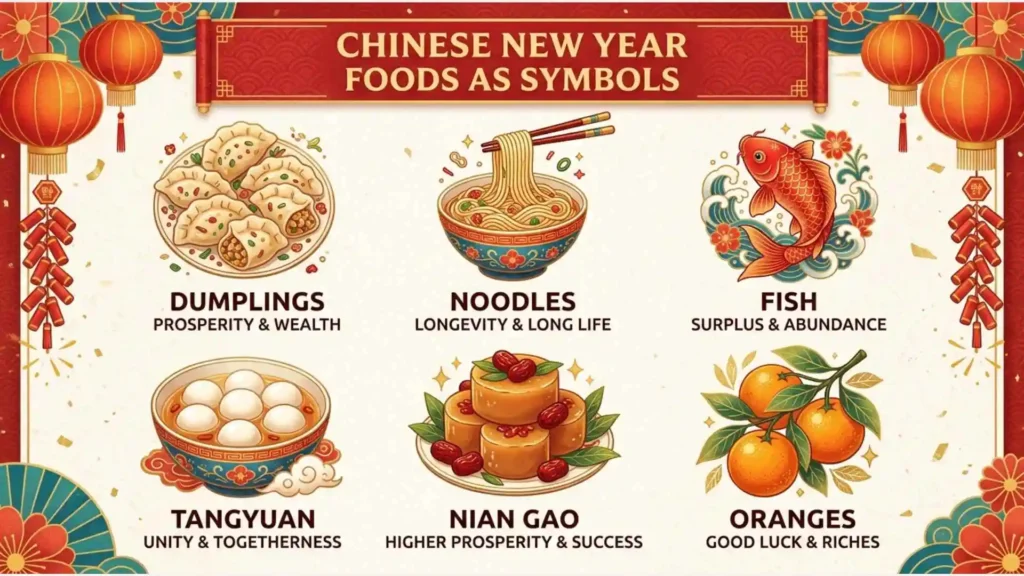
Food is an important part of Lunar New Year because many dishes carry traditional associations with prosperity, longevity, family, or good fortune.
Dumplings
Dumplings, known as 饺子 (jiǎozi), are especially associated with prosperity.
Their traditional shape can resemble ancient Chinese gold or silver ingots. For this reason, dumplings are commonly connected with wealth and financial prosperity during New Year celebrations.
Preparing dumplings can also be a family activity, making them a symbol of togetherness as well as prosperity.
Nian Gao
Nian gao (年糕) is a traditional sticky rice cake.
The name has a linguistic association with the idea of becoming higher or progressing year after year. Because of this, nian gao is often connected with growth, progress, improvement, and success.
Long Noodles
Long noodles are traditionally associated with longevity.
Their length represents a long life, so they are often served during celebrations when people wish for a long and prosperous life.
In some traditions, people avoid cutting the noodles because keeping them long preserves the symbolic connection with longevity.
Tangyuan
Tangyuan (汤圆) are round glutinous rice balls that are commonly associated with family togetherness.
Their round shape can symbolize wholeness, reunion, and family unity. They are especially associated with the Lantern Festival in many Chinese traditions, although food customs vary between regions.
Spring Rolls
Spring rolls are traditionally associated with the arrival of spring and, in some contexts, prosperity.
Their golden color and shape can also evoke associations with gold. They are particularly common in certain regional Lunar New Year food traditions.
Chinese New Year Symbols for Good Luck
People looking specifically for Chinese New Year symbols for good luck will commonly encounter:
- 福 (Fú)
- Red decorations
- Red envelopes
- Mandarin oranges
- Fish
- Dragon imagery
- Lanterns
- Chinese knots
- Auspicious characters
- Certain flowers and plants
These symbols are used to communicate positive wishes rather than guaranteeing good fortune.
Chinese New Year Symbols for Wealth and Prosperity
Several traditional symbols are particularly connected with wealth and abundance.
Dumplings are associated with wealth because of their resemblance to traditional ingots.
Fish represent abundance or surplus through a traditional word association.
Mandarin oranges and tangerines are commonly associated with good fortune and prosperity.
Gold-colored decorations naturally evoke wealth and abundance.
The combination of red and gold is therefore particularly common in New Year decorations.
Chinese New Year Symbols for Longevity and Health
Longevity is another important theme in Chinese cultural symbolism.
Long Noodles
Long noodles are one of the clearest food symbols associated with long life.
Peaches
Peaches have longstanding associations with longevity in Chinese mythology and traditional art. Peach imagery can therefore appear in artwork and festive decorations connected with wishes for long life.
Pine Trees
Pine trees can symbolize endurance and longevity because of their ability to remain green throughout the year.
Cranes
Cranes have also been associated with longevity in traditional Chinese art and symbolism.
These associations can vary depending on artistic and cultural context.
Chinese New Year Flowers and Plants
Flowers and plants are often used to bring color and symbolic meaning into New Year celebrations.
Plum Blossom
The plum blossom is associated with resilience, renewal, hope, and the arrival of spring.
Its ability to bloom in cold conditions makes it an especially meaningful image of endurance and new beginnings.
Peony
The peony has traditionally been associated with wealth, beauty, honor, and prosperity.
It is frequently represented in Chinese art and decorative designs.
Peach Blossom
Peach blossoms are particularly associated with spring and can symbolize renewal and fresh beginnings.
Narcissus
Narcissus flowers are used in some Lunar New Year traditions and can be associated with good fortune and prosperity.
Bamboo
Bamboo is associated with strength, flexibility, resilience, and growth. Its rapid growth and evergreen appearance contribute to its symbolic importance.
Kumquat
Kumquat plants are popular in some New Year traditions because their fruit can symbolize good fortune, prosperity, and abundance. Their bright color also contributes to their festive appearance.
Chinese New Year Colors and Their Meanings
Color plays an important role in New Year decorations.
Red
Commonly associated with happiness, celebration, good fortune, and positive energy.
Gold
Often associated with wealth, prosperity, success, and abundance.
Yellow
Historically significant in Chinese culture and sometimes associated with royalty, prestige, and prosperity depending on context.
Green
Can be associated with life, renewal, growth, and nature, although its meaning depends heavily on context.
It is important not to assume that every color has one fixed meaning in every Chinese tradition.
Chinese New Year Symbols for Happiness and Family
Some symbols are especially relevant to family celebrations.
Round Foods
Round foods such as tangyuan can symbolize wholeness and family reunion.
Reunion Dinner
The New Year’s Eve reunion dinner itself is an important cultural tradition. Families gather to share food and spend time together, making the meal a symbol of family connection and togetherness.
Chinese Knots
Chinese knots can also represent connection and continuity, making them suitable decorations for family-centered celebrations.
Regional Differences in Chinese New Year Symbols
Chinese New Year traditions are not identical across all Chinese communities.
Food, decorations, languages, rituals, and symbolic meanings can differ between northern and southern regions of China. Hong Kong and Cantonese traditions may have different customs from those found in northern China. Chinese communities in Singapore, Malaysia, Taiwan, and other countries have also developed their own variations.
For example, certain foods and flowers may be especially popular in one region while being less common in another.
Therefore, it is more accurate to say that a symbol is commonly associated with a particular meaning rather than claiming that every Chinese family uses or interprets it in exactly the same way.
Chinese New Year Zodiac Symbol for 2026
The zodiac animal changes each Lunar New Year according to the traditional 12-animal cycle.
For a current-year article, it is useful to identify the relevant zodiac animal separately rather than treating the zodiac as a permanent symbol of Chinese New Year.
This section can also be updated each year so readers can quickly find the zodiac animal associated with the current Lunar New Year.
Chinese New Year Symbols Chart
The following chart provides a quick reference for common symbols and their traditional associations:
| Symbol | Meaning | Commonly Seen In |
| Red | Happiness and good fortune | Decorations, clothing |
| 福 | Fortune and blessings | Doors, walls |
| Red envelope | Good wishes and prosperity | Gifts |
| Lantern | Celebration and brightness | Streets, homes |
| Dragon | Strength and auspiciousness | Dances, artwork |
| Lion | Protection and good fortune | Lion dances |
| Fish | Abundance | New Year meals |
| Dumplings | Wealth | Family meals |
| Nian gao | Progress and growth | New Year meals |
| Long noodles | Longevity | Festive meals |
| Tangerines | Good fortune | Gifts and displays |
| Plum blossom | Renewal and resilience | Art and decorations |
| Peony | Wealth and beauty | Artwork, flowers |
| Bamboo | Strength and growth | Decorations, artwork |
| Chinese knot | Unity and continuity | Decorations |
| Spring couplets | Blessings and good wishes | Doors |
| Firecrackers | Celebration | Festivals |
| Zodiac animals | Annual symbolism | Decorations and gifts |
Frequently Asked Questions About Chinese New Year Symbols
What are the main Chinese New Year symbols?
Some of the most recognizable symbols are red decorations, the 福 character, red envelopes, lanterns, dragons, lions, fish, dumplings, oranges, flowers, Chinese knots, spring couplets, and zodiac animals.
What is the luckiest symbol for Chinese New Year?
There is no single symbol that is universally considered the “luckiest.” The 福 character, red decorations, red envelopes, oranges, fish, and other auspicious symbols are commonly connected with good fortune.
What Chinese symbol means good fortune?
The character 福 (fú) is one of the most widely recognized symbols for fortune, blessings, and good luck.
What represents wealth during Chinese New Year?
Dumplings, fish, oranges, gold-colored decorations, and certain auspicious characters are commonly associated with wealth, prosperity, or abundance.
Why is red used for Chinese New Year?
Red is traditionally associated with happiness, celebration, good fortune, and protection, which is why it is widely used during Lunar New Year celebrations.
What does the Chinese New Year dragon symbolize?
The dragon is commonly associated with strength, power, vitality, success, and auspiciousness. Dragon dances are also an important festive tradition in many communities.
What does fish symbolize in Chinese New Year?
Fish is traditionally associated with abundance or surplus because of a Chinese word association involving the pronunciation of fish.
What do dumplings symbolize during Chinese New Year?
Dumplings are commonly associated with wealth and prosperity because their traditional shape resembles ancient Chinese ingots.
What does the upside-down Fu symbol mean?
The upside-down 福 character is connected with a Chinese wordplay involving the idea that fortune has “arrived.” The custom is traditional but is not practiced identically by every family or community.
What flowers symbolize Chinese New Year?
Common examples include plum blossoms, peach blossoms, peonies, narcissus, and other flowers or plants used in different regional traditions. Their meanings can include renewal, prosperity, beauty, good fortune, and longevity.
What food symbolizes longevity during Chinese New Year?
Long noodles are one of the best-known foods associated with longevity. Their length represents the wish for a long life.
Are Chinese New Year symbols the same everywhere?
No. Chinese New Year customs vary by region, family, language, and community. Traditions in mainland China can differ from those in Hong Kong, Taiwan, Singapore, Malaysia, and other Chinese communities.
Final Thoughts
Chinese New Year symbols bring together culture, language, food, art, family traditions, and hopes for the future. From the red color and 福 character to dragons, lions, lanterns, fish, dumplings, flowers, and zodiac animals, each symbol carries its own traditional associations.
Some symbols focus on good fortune, while others represent wealth, abundance, longevity, family unity, renewal, or success. Understanding these meanings makes New Year decorations and traditions easier to appreciate.
At the same time, Chinese New Year is celebrated differently across regions and communities. The meaning of a particular symbol can depend on local customs and family traditions. For that reason, the best way to understand these symbols is to view them as part of a diverse and evolving cultural tradition rather than as a fixed list of universal meanings.

I am Marcus Lee, a cultural researcher and slang aficionado. I study the roots of informal language and how communities create meaning through words. My books “Slang Origins: A Journey Through Words” and “Words That Move Us: Slang Across Generations” focus on the history and psychology of slang. I enjoy guiding readers to understand not just the words, but the stories and attitudes they carry, so you can truly connect with language in daily life.
 Lisa Reynolds
 John Carter