Family crests have been used for centuries to represent identity, heritage, status, achievements, and family history. From lions and eagles to roses, swords, crowns, and shields, the symbols found in heraldry can make a design instantly recognizable. But what do these symbols actually mean?
The answer is more complicated than simply saying that every symbol has one fixed meaning. The meaning of a symbol can depend on the historical coat of arms, country, heraldic tradition, and the person or family associated with it. Many popular online lists provide general symbolic associations, but these should not automatically be treated as historical facts.
In this guide, we explore common family crest symbols and meanings, explain the symbolism of animals, plants, colors, weapons, and other heraldic elements, and show how to research whether a particular coat of arms genuinely belongs to your family.
What Is a Family Crest?
A family crest is a heraldic emblem traditionally associated with a person or family. In everyday conversation, people often use “family crest” to describe an entire coat of arms. Technically, however, the crest is only one part of a complete heraldic achievement.
A traditional coat of arms may include a shield, helmet, crest, mantling, supporters, motto, and other elements. The shield is usually the central feature and contains the main heraldic symbols.
The crest itself appears above the helmet. It can feature an animal, bird, object, plant, or other figure.
Because the terms are often confused, it is useful to remember:
- Coat of arms: The broader heraldic design.
- Shield: The central surface containing heraldic charges.
- Crest: The figure positioned above the helmet.
- Motto: Words associated with the arms.
- Supporters: Figures positioned on either side of the shield in some heraldic achievements.
Family Crest Symbols and Meanings
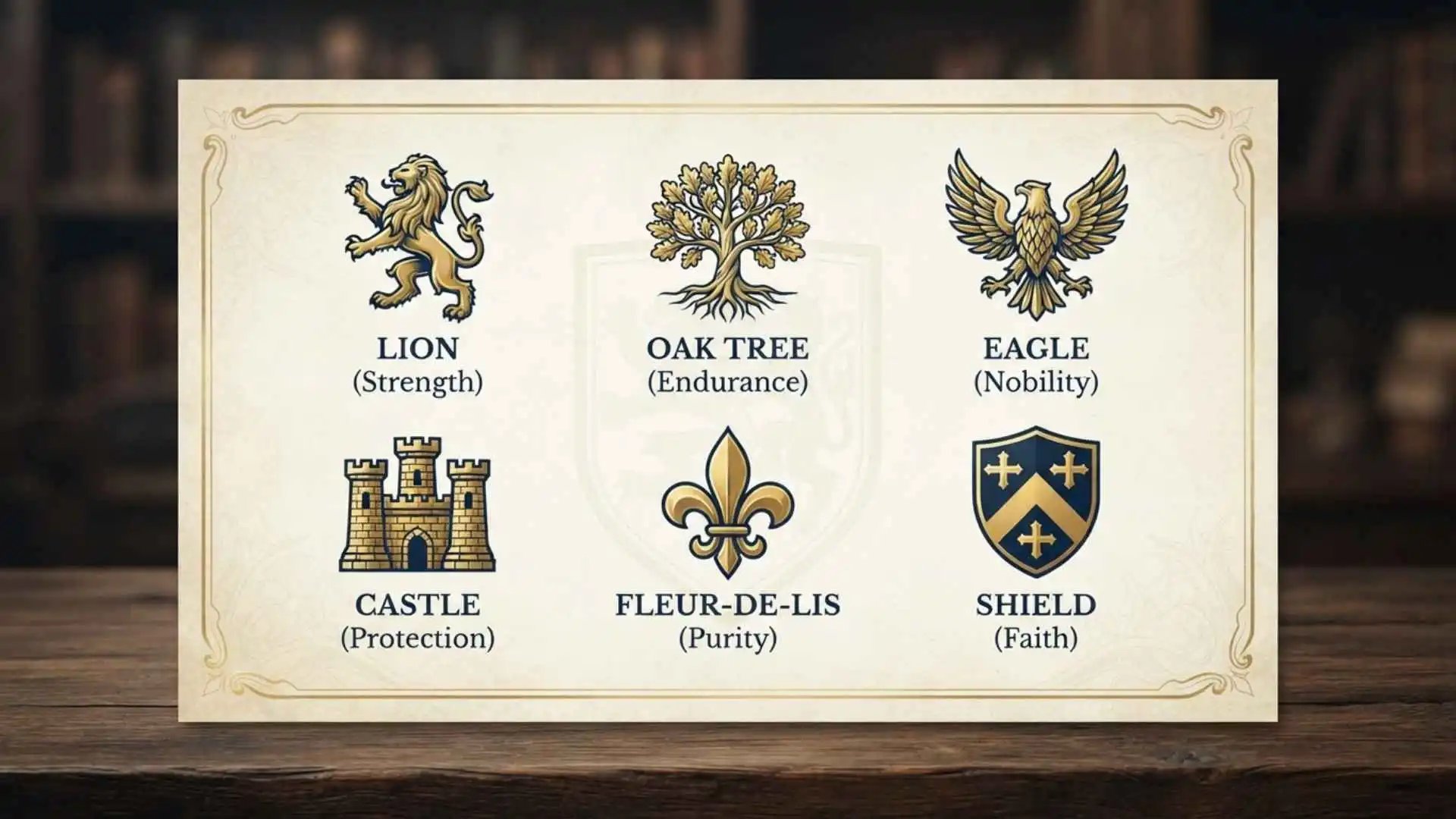
Heraldic symbols can represent qualities such as courage, loyalty, strength, wisdom, protection, faith, honor, or achievement. However, there is no universal dictionary in which every symbol always has exactly one meaning.
The table below gives common traditional or popular associations that can help readers understand heraldic imagery.
| Symbol | Common association |
| Lion | Courage, bravery, strength, authority |
| Eagle | Power, courage, vision, high aspirations |
| Wolf | Perseverance, guardianship, courage |
| Bear | Strength, protection, determination |
| Stag | Peace, wisdom, harmony |
| Horse | Strength, speed, courage |
| Falcon | Leadership, determination, hunting |
| Dove | Peace and gentleness |
| Raven | Wisdom, vigilance, mystery |
| Dragon | Strength, protection, power |
| Griffin | Courage, guardianship, strength |
| Fish | Abundance, generosity, connection to water |
| Bee | Industry, diligence, hard work |
| Rose | Beauty, honor, love |
| Oak | Strength, endurance, longevity |
| Laurel | Victory, achievement, honor |
| Fleur-de-lis | Purity, nobility, French royal association |
| Sword | Courage, justice, authority |
| Shield | Protection and defense |
| Crown | Sovereignty, authority, rank |
| Anchor | Stability, hope, steadfastness |
| Star | Guidance, aspiration, distinction |
| Sun | Glory, vitality, life |
| Moon | Serenity, change, or celestial symbolism |
| Cross | Faith and religious association |
| Key | Authority, responsibility, guardianship |
These associations are useful for understanding designs, but a historical coat of arms should always be interpreted in its specific context.
Animal Symbols in Family Crests
Animals are among the most recognizable elements in heraldry. They can make a coat of arms visually powerful while suggesting characteristics traditionally associated with the animal.
Lion
The lion is one of the most famous heraldic animals. It is commonly associated with courage, bravery, strength, authority, and leadership.
Different positions of a lion can have specific heraldic names. For example, a lion standing upright is commonly described as “rampant,” while a walking lion can be described as “passant.”
Because lions were associated with royalty and power in many cultures, they became especially prominent in European heraldry.
Eagle
The eagle is commonly associated with strength, courage, vision, power, and ambition. Its ability to fly high has made it a natural symbol of aspiration and freedom.
Eagles appear in many heraldic traditions, although the specific design and historical meaning can vary considerably.
Wolf
The wolf is often associated with courage, perseverance, guardianship, and loyalty. Its social nature can also make it an appealing symbol for family unity.
However, the presence of a wolf on historical arms does not automatically mean the original bearer selected it specifically to represent loyalty. The symbol could have a geographical, historical, or personal connection.
Bear
A bear can suggest strength, protection, courage, and determination. Its powerful appearance makes it particularly suitable for designs intended to communicate resilience.
Stag or Deer
A stag may be associated with peace, wisdom, grace, harmony, and strength. Deer imagery is common in European heraldic traditions and can have additional local or historical meanings.
Horse
The horse can symbolize strength, speed, courage, energy, and readiness. Horses were especially important to medieval society because of their roles in transportation, agriculture, warfare, and status.
Dragon and Griffin
The dragon is often used as a symbol of strength, power, protection, and courage. Dragons are particularly important in some national and regional traditions.
The griffin, a legendary creature combining features of an eagle and a lion, is commonly associated with courage, guardianship, strength, and vigilance.
Birds and Their Meanings
Birds are another major category of heraldic imagery.
Falcon
The falcon is associated with determination, speed, leadership, and hunting. Falconry was historically connected with the upper classes and nobility, making birds of prey particularly appropriate in heraldic designs.
Dove
The dove is widely recognized as a symbol of peace, gentleness, hope, and purity. Its use may also have religious associations.
Raven
The raven can be associated with wisdom, vigilance, intelligence, and mystery. In different cultures, however, ravens have very different symbolic traditions, so their meaning should not be assumed without considering the historical context.
Flowers and Plant Symbols
Plants and flowers can add symbolic and historical significance to a family emblem.
Rose
The rose is commonly associated with beauty, love, honor, and hope. It also has important historical connections in English heraldry, particularly through the Wars of the Roses.
Fleur-de-Lis
The fleur-de-lis is one of the most recognizable symbols in European heraldry. It has strong historical associations with French monarchy, while also being interpreted in broader contexts as representing purity and nobility.
Oak
The oak is often associated with strength, stability, endurance, and longevity. Because oak trees can live for many years, they naturally became a symbol of lasting strength.
Laurel
Laurel is traditionally connected with victory, achievement, honor, and distinction. Laurel wreaths have long been associated with triumph and recognition.
Thistle
The thistle is strongly connected with Scotland and is commonly associated with strength, resilience, and defense. Its importance is particularly evident in Scottish national symbolism.
Colors in Family Crests and Heraldry
Color is another important part of heraldic design. Traditional heraldry uses specific terms for its colors, known as tinctures.
Gold and Yellow
Gold, or or, is commonly associated with generosity, wealth, honor, and elevated status.
Silver and White
Silver, or argent, is traditionally connected with qualities such as peace, sincerity, purity, and truth.
Red
Red, or gules, is commonly associated with courage, strength, bravery, and military qualities.
Blue
Blue, or azure, is often associated with loyalty, truth, devotion, and justice.
Green
Green, or vert, can be associated with hope, renewal, joy, nature, and growth.
Black
Black, or sable, may be associated with prudence, wisdom, determination, or seriousness.
Purple
Purple, or purpure, is traditionally connected with dignity, sovereignty, and elevated status.
These associations can help with interpretation, but color meanings should not be treated as universal rules applying to every coat of arms.
Weapons and Objects in Family Crests
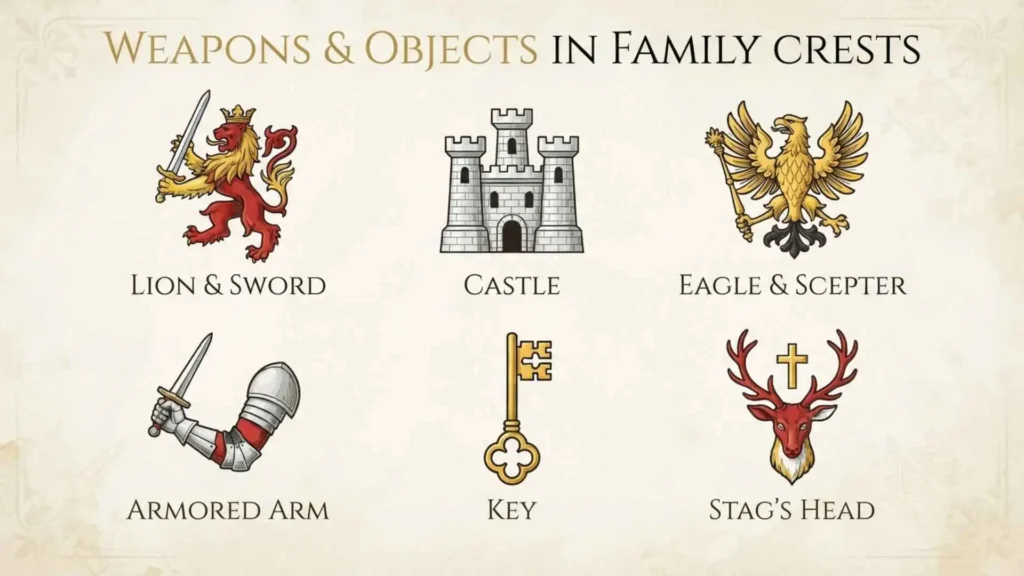
Heraldic designs can include weapons and everyday objects. These may represent military service, occupations, achievements, local history, or other associations.
Sword
A sword is commonly associated with courage, justice, authority, defense, and readiness.
Spear
A spear can suggest warrior qualities, defense, courage, and military readiness.
Arrow
An arrow may be associated with speed, determination, direction, or military skill.
Anchor
An anchor commonly represents stability, hope, security, and steadfastness. It can be especially appropriate for families with maritime connections.
Key
A key can symbolize authority, guardianship, responsibility, access, or stewardship.
Book
A book may represent knowledge, learning, education, wisdom, or scholarship.
Scales
Scales can represent justice, balance, fairness, and law.
What Does a Shield Represent?
The shield is one of the most important elements in heraldry. Historically, shields were practical pieces of protective equipment, but they also became a central surface for displaying identifying designs.
In symbolic terms, a shield is commonly understood as representing protection, defense, courage, and family identity.
The shapes, colors, divisions, and charges on a shield can all contribute to its overall appearance.
What Does a Family Motto Mean?
A motto is a short phrase associated with a family or coat of arms. It can communicate a value, principle, aspiration, religious belief, or historical sentiment.
Common themes include:
- Courage
- Loyalty
- Honor
- Faith
- Perseverance
- Family unity
- Justice
- Service
- Strength
A motto is often more direct than a symbol because it communicates its message through words rather than imagery.
Family Crest vs. Coat of Arms: What’s the Difference?
The terms “family crest” and “coat of arms” are frequently used as if they mean exactly the same thing, but they do not.
A coat of arms refers to the broader heraldic design, particularly the shield and associated elements.
A crest is specifically the emblem positioned above the helmet.
For example, a historical coat of arms might have a shield containing three lions while the crest above the helmet features an eagle. The entire design is the coat of arms, while the eagle is the crest.
Understanding this distinction is useful when researching family history because historical records may describe the different parts separately.
Does Every Surname Have a Family Crest?
No. Having a particular surname does not automatically mean that everyone with that surname shares one coat of arms.
This is one of the most important things to understand when researching family heraldry.
Historically, coats of arms were associated with particular individuals, families, or lineages according to the rules of the relevant heraldic system. They were not simply assigned to every person who happened to have the same last name.
As a result, a website displaying a coat of arms beside your surname does not by itself prove that the design belonged to your ancestors.
How to Find Your Actual Family Coat of Arms
If you want to discover whether your ancestors genuinely had a coat of arms, genealogical research is more reliable than searching only for your surname.
1. Start With Your Family Tree
Record your parents, grandparents, great-grandparents, and earlier generations as far back as reliable records allow.
2. Identify Your Family’s Region
Find out where the relevant ancestors lived. Heraldic traditions differ between countries and regions, so location can be extremely important.
3. Identify a Specific Ancestor
Instead of searching only for a surname, look for a specific historical person who may have been entitled to arms.
4. Check Historical Heraldic Records
Depending on the country, official or historical heraldic records may provide information about grants and recognized arms.
5. Compare Genealogical Evidence
A genuine connection requires more than finding the same surname. You need evidence connecting your family line to the individual or lineage associated with the arms.
This process takes more effort than purchasing a surname crest, but it provides a much stronger historical connection.
Family Crest Symbols by Meaning
Sometimes people are not looking for a particular animal or object. Instead, they want a symbol representing a specific family value.
Symbols of Courage
Commonly associated imagery includes:
- Lion
- Eagle
- Sword
- Dragon
- Griffin
- Bear
Symbols of Strength
Popular choices include:
- Lion
- Oak
- Bear
- Horse
- Dragon
- Griffin
Symbols of Loyalty
Potentially relevant imagery includes:
- Dog
- Wolf
- Blue coloring
- Heart
- Anchor
Symbols of Wisdom
Common associations include:
- Owl
- Raven
- Book
- Tree
- Certain classical symbols
Symbols of Protection
Common choices include:
- Shield
- Lion
- Bear
- Griffin
- Sword
- Tower
These are useful as design inspirations, but the historical meaning of a particular heraldic charge should always be considered separately.
Heraldic Traditions Can Differ by Country
There is no single worldwide system of heraldry.
English, Scottish, Irish, French, German, Spanish, and other heraldic traditions developed under different historical circumstances. Rules concerning inheritance, design, titles, supporters, crests, and registration can therefore differ.
This is another reason why a general internet list of “family crest meanings” should not be treated as a definitive historical source.
If you are researching an actual coat of arms, start with the country and heraldic authority relevant to your ancestor.
Can You Create Your Own Family Crest?
You can certainly create a modern family emblem inspired by heraldic traditions. However, it is important to distinguish a newly designed emblem from historically granted arms.
When creating a modern design, begin with your family’s real values, history, interests, and traditions.
For example, a design featuring an oak tree, shield, and blue field could communicate ideas of stability, protection, and loyalty. A lion combined with a sword could create a stronger theme of courage and defense.
A meaningful design does not need dozens of symbols. A few carefully chosen elements can tell a clearer story.
Frequently Asked Questions
What is the most common family crest symbol?
The lion is among the most recognizable figures in heraldry. It is commonly associated with courage, bravery, strength, and authority.
What does a lion mean on a family crest?
A lion is commonly associated with courage, strength, bravery, leadership, and authority. The exact historical significance depends on the particular coat of arms.
What does an eagle mean on a family crest?
An eagle is often associated with power, courage, vision, freedom, and high aspirations.
What does blue mean on a coat of arms?
Blue, known as azure in heraldry, is commonly associated with loyalty, truth, devotion, and related virtues.
What does a rose symbolize in heraldry?
A rose may represent beauty, love, honor, hope, or a particular historical or regional association.
Does my last name have a family crest?
Your surname may be associated with historical coats of arms, but a surname alone does not prove that a particular crest or coat of arms belongs to your family.
Are family crest symbols historically accurate?
Some symbolic interpretations are based on genuine heraldic traditions, while others come from modern popular interpretations. Historical accuracy requires examining the specific arms and their documented history.
What is the difference between a family crest and a coat of arms?
A coat of arms is the broader heraldic achievement, while the crest is one specific element positioned above the helmet.
Can I design my own family crest?
You can create a modern family emblem using heraldic inspiration. If you intend to represent it as historically granted arms, however, you should research the relevant heraldic rules and records.
Final Thoughts
Understanding family crest symbols and meanings can make heraldic designs much more interesting. Lions can suggest courage, eagles can evoke strength and vision, oak can represent endurance, roses can suggest honor, and shields can communicate protection.
But the most important lesson is that there is no universal meaning attached to every heraldic symbol. A symbol’s actual historical significance depends on the specific coat of arms, its origin, and the person or family associated with it.
If you are researching your own heritage, do not stop at a surname and a picture found online. Build your family tree, identify your ancestors, investigate the appropriate heraldic records, and verify the connection.
That approach turns a decorative “family crest” into something much more valuable: a documented piece of family history.

I am John Carter, a lifelong enthusiast of language and modern slang. I explore how words evolve and shape culture, and I enjoy uncovering the stories behind everyday expressions. I have authored “Slang and Society: The Language of Youth” and “Modern Words, Modern Worlds”, where I dive into how informal language impacts communication and identity. My goal is to make language accessible, fun, and insightful for everyone who loves words as much as I do.
 Lisa Reynolds
 Marcus Lee