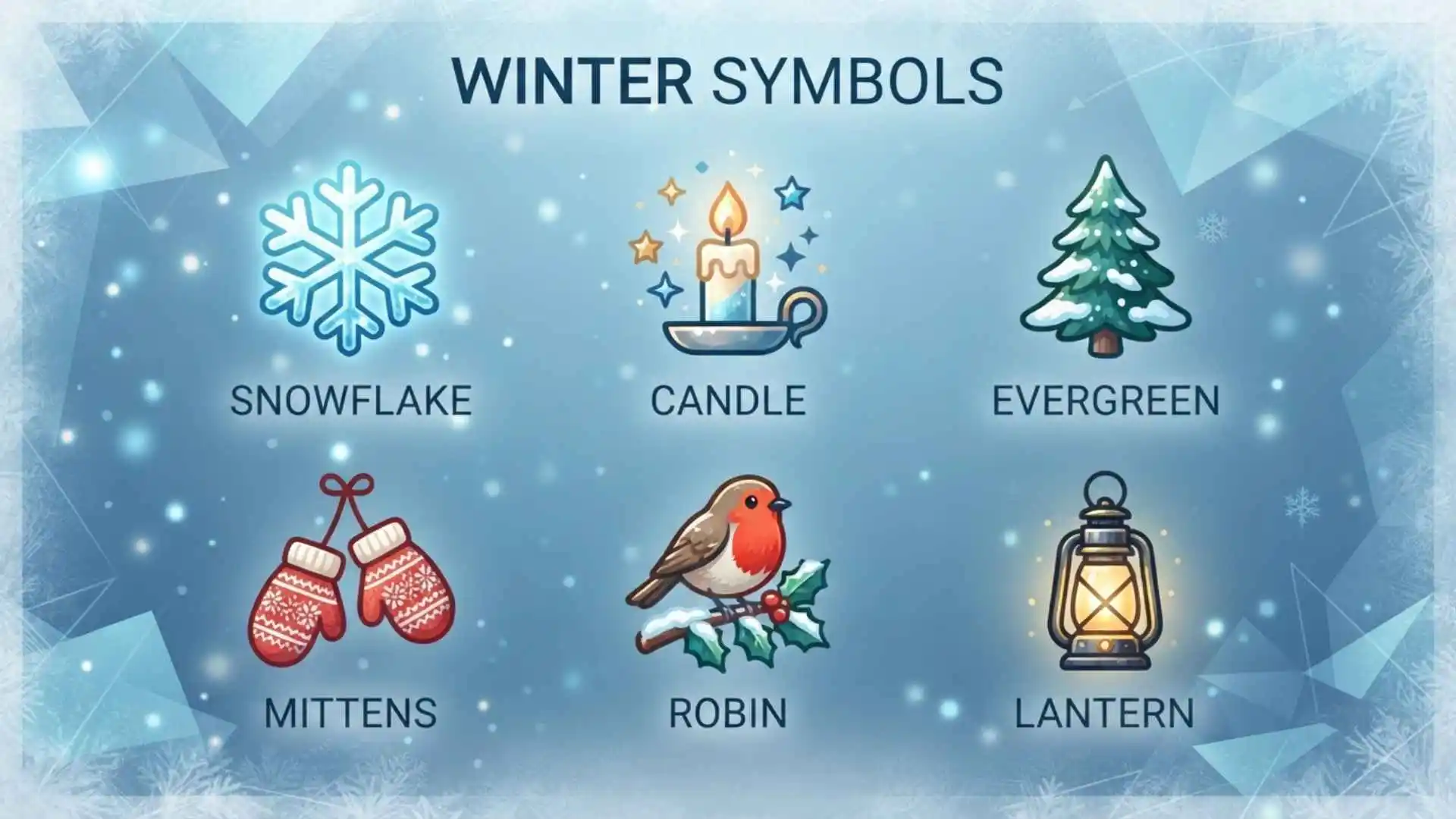
Winter is a season associated with cold weather, shorter days, snow, ice, and quiet landscapes. But beyond its physical characteristics, winter has many symbolic meanings. Winter symbols can represent peace, purity, strength, survival, loneliness, transformation, hope, and new beginnings.
Some winter symbols come directly from nature, such as snowflakes, evergreen trees, frost, and bare branches. Others come from cultural traditions, seasonal celebrations, literature, and art. The meaning of a winter symbol can also change depending on how it is used.
For example, snow can represent purity and peace, but it can also symbolize isolation or emotional coldness. An evergreen tree can represent endurance because it stays green throughout the winter, while a candle can symbolize hope and light during the darkest part of the year.
What Are Winter Symbols?
Winter symbols are objects, natural elements, colors, animals, plants, or seasonal traditions that are commonly associated with winter or represent ideas connected with the season.
Some symbols represent the physical characteristics of winter, such as ice and snow. Others represent deeper ideas associated with the season, including rest, hardship, survival, reflection, and renewal.
Common winter symbols include:
- Snow
- Snowflakes
- Ice
- Icicles
- Evergreen trees
- Pinecones
- Holly
- Bare trees
- Frost
- Fireplaces
- Candles
- Winter moons
- Snowmen
- Polar bears
- Reindeer
- Arctic foxes
- Wolves
- Owls
- Winter stars
- Winter solstice
- Snowdrops
- Frozen lakes
- Mountains
- White
- Icy blue
These symbols can have both positive and negative meanings depending on the context.
25 Winter Symbols and Their Meanings
1. Snow
Snow is perhaps the most recognizable symbol of winter. It transforms ordinary landscapes into white, quiet scenes and is strongly connected with cold weather.
Symbolically, snow can represent purity, peace, silence, innocence, and new beginnings. Fresh snow can look like a blank page, which makes it a useful symbol for starting over.
In literature and poetry, however, snow can also represent loneliness, isolation, emotional distance, or temporary beauty.
2. Snowflake
A snowflake is one of the most popular winter symbols because every snowflake has a unique structure.
For this reason, snowflakes often symbolize individuality, uniqueness, beauty, and fragility. They can also represent the temporary nature of life because snowflakes eventually melt.
A snowflake is particularly meaningful when someone wants a symbol that represents being different while still being part of something larger.
3. Ice
Ice represents the extreme cold associated with winter. Symbolically, it can represent stillness, emotional distance, strength, or something that has temporarily stopped moving.
In writing, phrases such as “an icy heart” use ice as a metaphor for a person who seems emotionally cold or distant.
At the same time, ice can represent beauty and clarity because frozen water can create striking natural formations.
4. Icicle
Icicles form when water freezes and gradually builds up in cold temperatures. Their sharp, delicate appearance makes them a distinctive winter image.
An icicle can symbolize coldness, fragility, stillness, and the passage of time. Because it slowly grows and eventually melts, it can also represent temporary states and gradual change.
5. Evergreen Tree
Evergreen trees are among the strongest symbols of winter and endurance. Unlike many deciduous trees, evergreens remain green during the cold months.
They can therefore symbolize:
- Strength
- Endurance
- Survival
- Hope
- Eternal life
- Resilience
The evergreen is particularly meaningful because it shows that life continues even when the surrounding landscape appears dormant.
6. Pinecone
Pinecones are closely associated with evergreen forests and winter decorations. They can symbolize growth, potential, regeneration, and the continuation of life.
Because pinecones contain seeds, they can represent the possibility of future growth. This makes the pinecone a useful symbol of hope and new beginnings.
7. Holly
Holly is an evergreen plant with distinctive green leaves and red berries. Because it stays alive and colorful during winter, it has become an important seasonal symbol.
Holly can represent life, protection, endurance, and hope. Its red and green colors are also strongly connected with winter holiday traditions.
8. Bare Tree
A bare tree is a powerful visual representation of winter. When trees lose their leaves, their branches become exposed against the winter sky.
Bare trees can symbolize loss, loneliness, dormancy, rest, aging, and the end of one stage.
However, they can also represent patience. The tree may look empty during winter, but it is preparing for new growth in spring.
9. Frost
Frost is created when moisture freezes on surfaces during cold temperatures. It is one of the most delicate forms of winter imagery.
Frost can symbolize coldness, silence, fragility, and temporary beauty. A layer of frost may disappear quickly when temperatures rise, making it a reminder that some beautiful moments are temporary.
10. Fireplace
A fireplace represents the opposite of winter’s coldness. It provides warmth, comfort, shelter, and a place for people to gather.
As a winter symbol, fire can represent:
- Warmth
- Family
- Home
- Safety
- Love
- Comfort
- Protection
A fireplace surrounded by family members is often used in winter imagery to represent togetherness.
11. Candle
A candle can symbolize light during darkness. This makes it especially meaningful during winter, when nights are longer and daylight is limited.
Candles can represent hope, faith, guidance, peace, and renewal.
A single candle glowing in a dark winter setting can communicate the idea that even a small amount of light can overcome darkness.
12. Winter Moon
The winter moon often appears in poetry, photography, and artwork as a symbol of mystery, reflection, solitude, and quietness.
A moon shining over a snowy landscape creates a peaceful but sometimes lonely atmosphere.
For this reason, the winter moon can represent both inner reflection and emotional solitude.
13. Snowman
A snowman is one of the more playful symbols of winter. Unlike many winter symbols that represent hardship or silence, the snowman is associated with fun, childhood, creativity, and seasonal celebration.
It can symbolize joy, playfulness, family traditions, and the simple pleasures of winter.
14. Polar Bear
The polar bear is a powerful animal symbol of winter because it survives in one of the coldest environments on Earth.
It can represent strength, endurance, courage, adaptation, and survival.
A polar bear can therefore be used as a winter symbol when the intended meaning is not simply coldness but the ability to remain strong in difficult conditions.
15. Reindeer
Reindeer are strongly connected with winter traditions and snowy landscapes.
They can symbolize endurance, travel, nature, companionship, and seasonal celebration.
Because reindeer are commonly associated with winter holiday imagery, they are also among the most recognizable animals connected with the season.
16. Arctic Fox
The Arctic fox is another strong symbol of winter survival. Its ability to live in extremely cold environments makes it a natural representation of adaptability and resilience.
As a symbol, the Arctic fox can represent intelligence, flexibility, survival, and the ability to adjust to difficult circumstances.
17. Wolf
Wolves are often associated with snowy forests and winter landscapes. In symbolism, they can represent strength, independence, loyalty, instinct, and survival.
A wolf in a winter setting can also create a sense of mystery and wilderness.
18. Owl
Owls are associated with darkness, nighttime, silence, and wisdom. These qualities make them a natural fit for winter symbolism.
An owl can represent wisdom, mystery, observation, and quiet strength. In winter artwork, an owl sitting on a bare branch can create a particularly strong atmosphere of solitude.
19. Winter Stars
Clear winter nights often provide striking views of the stars. As symbols, winter stars can represent guidance, hope, dreams, mystery, and eternity.
Stars can be especially meaningful when combined with darkness because they represent points of light in an otherwise dark environment.
20. Winter Solstice
The winter solstice is one of the most meaningful seasonal symbols. In the Northern Hemisphere, it marks the shortest day and longest night of the year.
After the winter solstice, daylight gradually begins to increase.
For this reason, the winter solstice can symbolize:
- Hope
- Renewal
- Rebirth
- Transformation
- The return of light
- New beginnings
It is an especially powerful symbol for people who view winter as a period of transition rather than simply a season of cold.
21. Snowdrop
The snowdrop is a small flowering plant that can appear during late winter or early spring. Because it can emerge while cold weather is still present, it is often associated with hope and renewal.
It can symbolize resilience, new beginnings, purity, and the arrival of a better season.
22. Frozen Lake
A frozen lake represents stillness and silence. Water that normally moves becomes solid and motionless.
As a symbol, a frozen lake can represent reflection, emotional stillness, patience, isolation, or a temporary pause.
It can also symbolize transformation because water has changed from a liquid into a solid state.
23. Mountain
Snow-covered mountains are a classic winter image. Mountains can symbolize strength, stability, endurance, ambition, and challenges.
When covered in snow, they combine the symbolism of winter with the symbolism of something powerful and permanent.
24. White
White is one of the main colors associated with winter.
It can represent purity, peace, innocence, simplicity, cleanliness, and a fresh start. A completely white winter landscape can also communicate silence and emptiness.
The meaning of white depends on the context. It can represent peacefulness in one image and loneliness in another.
25. Icy Blue
Icy blue is strongly connected with frozen landscapes, winter skies, and cold temperatures.
It can symbolize calmness, coldness, distance, clarity, and tranquility.
In graphic design and photography, icy blue is often used to create an unmistakable winter atmosphere.
Winter Symbols and What They Represent
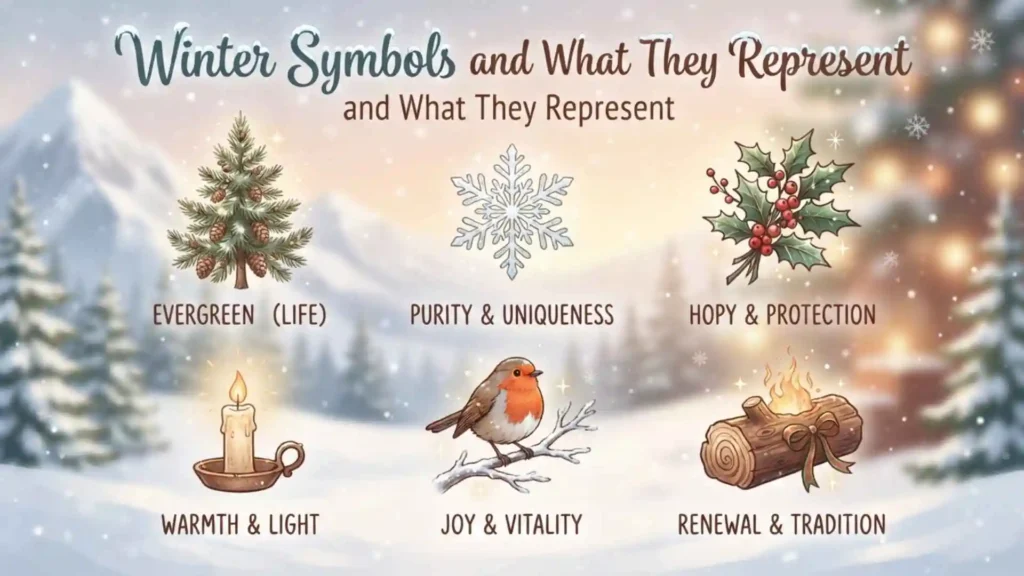
Different winter symbols can represent very different ideas. Grouping them by meaning makes it easier to choose the right symbol for artwork, writing, tattoos, or personal expression.
Symbols of Peace and Calm
If you want a symbol representing peace, consider:
- Snow
- Snowflakes
- Winter moon
- Winter stars
- Frozen lake
- Candle
These symbols create a quiet and peaceful winter atmosphere.
Symbols of Strength and Resilience
For strength and survival, some of the best choices are:
- Evergreen tree
- Polar bear
- Arctic fox
- Wolf
- Mountain
- Pinecone
These symbols emphasize endurance and the ability to survive difficult conditions.
Symbols of Hope and New Beginnings
Winter does not always represent darkness or endings. Several winter symbols represent hope and renewal.
These include:
- Winter solstice
- Evergreen tree
- Candle
- Snowdrop
- Snow
- Winter stars
The winter solstice is particularly powerful because it represents the gradual return of daylight.
Symbols of Loneliness and Reflection
Winter is often used to communicate solitude or emotional reflection.
Common examples include:
- Bare trees
- Winter moon
- Frozen lake
- Snow-covered forests
- Ice
- Empty snowy landscapes
These symbols are especially common in poetry, literature, photography, and emotional artwork.
Winter Symbols in Literature
Winter has a long history of symbolic use in literature. Writers often use the season to represent more than weather.
Winter may represent death, old age, loneliness, emotional coldness, hardship, or the end of a particular period.
At the same time, winter can symbolize waiting and preparation. Nature appears quiet, but spring is approaching beneath the surface.
This contrast makes winter particularly useful as a literary symbol. A character may experience a “winter” in their life before reaching a period of growth or renewal.
Winter Symbols in Different Cultures
Winter symbolism differs across cultures, but certain themes appear repeatedly.
Evergreen plants have traditionally been important because they remain green when many other plants lose their leaves. This quality has made them symbols of life and endurance in different seasonal traditions.
The winter solstice has also been significant in various cultures because it marks an important turning point in the amount of daylight.
Winter celebrations often include candles, fire, greenery, stars, food, and gatherings. These elements commonly represent light, warmth, community, hope, and the continuation of life through the cold season.
Winter Symbols for Tattoos
Winter symbols can make meaningful tattoo designs because many have simple shapes and strong symbolism.
Popular winter tattoo ideas include:
- Snowflake for individuality
- Evergreen tree for endurance
- Pinecone for growth
- Mountain for strength
- Winter moon for reflection
- Wolf for independence
- Polar bear for resilience
- Snowdrop for new beginnings
- Candle for hope
The best symbol depends on the personal meaning behind the tattoo rather than simply its appearance.
Winter Symbols for Art and Design
Winter imagery is widely used in paintings, photography, graphic design, home decoration, and social media content.
Snow, ice, bare trees, evergreen branches, candles, fireplaces, and winter skies can immediately establish a seasonal atmosphere.
For a peaceful winter design, white, soft blue, snowflakes, and candles work well.
For a dramatic winter design, dark skies, bare trees, mountains, wolves, and icy landscapes can create a stronger feeling of mystery and isolation.
What Symbolizes Winter and New Beginnings?
Several symbols can represent both winter and new beginnings.
Snow can represent a blank slate.
The winter solstice represents the return of increasing daylight.
Evergreen trees represent life continuing through difficult conditions.
Snowdrops represent new growth emerging from the cold.
Candles represent hope and light during darkness.
Together, these symbols communicate an important idea: a difficult season can be the beginning of something new.
Winter Symbols vs. Spring Symbols
Winter and spring are often used as symbolic opposites.
Winter commonly represents:
- Rest
- Stillness
- Reflection
- Endings
- Hardship
- Dormancy
Spring commonly represents:
- Growth
- Movement
- Renewal
- New beginnings
- Life
- Transformation
However, winter itself can contain the beginning of spring. The season can represent preparation rather than simply an ending.
Frequently Asked Questions About Winter Symbols
What are the most common symbols of winter?
The most common symbols of winter include snow, snowflakes, ice, icicles, evergreen trees, pinecones, holly, bare trees, fireplaces, candles, winter animals, and the winter moon.
What is the main symbol of winter?
Snow is arguably the main symbol of winter because it is strongly associated with cold temperatures, snowy landscapes, silence, and the winter season itself.
What symbolizes winter besides snow?
Evergreen trees, ice, icicles, frost, bare trees, pinecones, winter animals, fireplaces, candles, and the winter moon can all symbolize winter without using snow.
What symbolizes winter and new beginnings?
The winter solstice, snow, evergreen trees, snowdrops, and candles can symbolize winter and new beginnings. They represent ideas such as hope, renewal, continued life, and the return of light.
What does winter symbolize in literature?
In literature, winter can symbolize loneliness, death, old age, hardship, emotional coldness, stillness, or the end of a chapter. It can also symbolize patience, transformation, and preparation for renewal.
What animal symbolizes winter?
Polar bears, reindeer, Arctic foxes, wolves, and owls are commonly used as winter animals and symbols. Polar bears and Arctic foxes are especially strong symbols of survival and adaptation.
What color represents winter?
White and icy blue are the colors most strongly associated with winter. White can represent snow, purity, peace, and simplicity, while blue can represent coldness, calmness, and frozen landscapes.
What flower represents winter?
Snowdrops are commonly associated with winter and the transition toward spring. Their ability to appear during cold weather makes them a symbol of hope, resilience, and new beginnings.
What symbolizes winter strength?
Evergreen trees, polar bears, wolves, mountains, and Arctic foxes can symbolize winter strength. They represent endurance, survival, resilience, and adaptation.
What is the spiritual meaning of winter?
Winter can spiritually represent rest, reflection, transformation, patience, and preparation for renewal. It can be viewed as a quiet period before a new stage of growth.
Final Thoughts on Winter Symbols
Winter symbols are powerful because they can represent both the visible characteristics of the season and deeper human experiences. Snow can mean purity or loneliness, an evergreen tree can represent endurance, and a candle can represent hope in darkness.
The strongest winter symbolism often comes from this contrast. Winter can represent endings, but it can also represent preparation for new beginnings. It can feel silent and empty while life continues beneath the surface.
Whether you are looking for symbols of winter for a tattoo, artwork, poem, story, design, or personal meaning, there is a wide range of imagery to choose from. Snowflakes, evergreen trees, winter animals, candles, the winter solstice, and snowdrops can each communicate a different message.
Ultimately, winter reminds us that stillness is not always the end. Sometimes it is simply the quiet stage before transformation, growth, and the return of light.

I am Lisa Reynolds, a linguist fascinated by the ever-changing world of slang. I enjoy researching how slang reflects trends, technology, and social connections. I wrote “Text Talk: Understanding Digital Slang” and “From Street to Screen: Slang in Media”, exploring the influence of digital communication on language. I love sharing my discoveries in a way that feels like a conversation with friends, so you feel the culture and humor behind every phrase.
 John Carter
 Marcus Lee