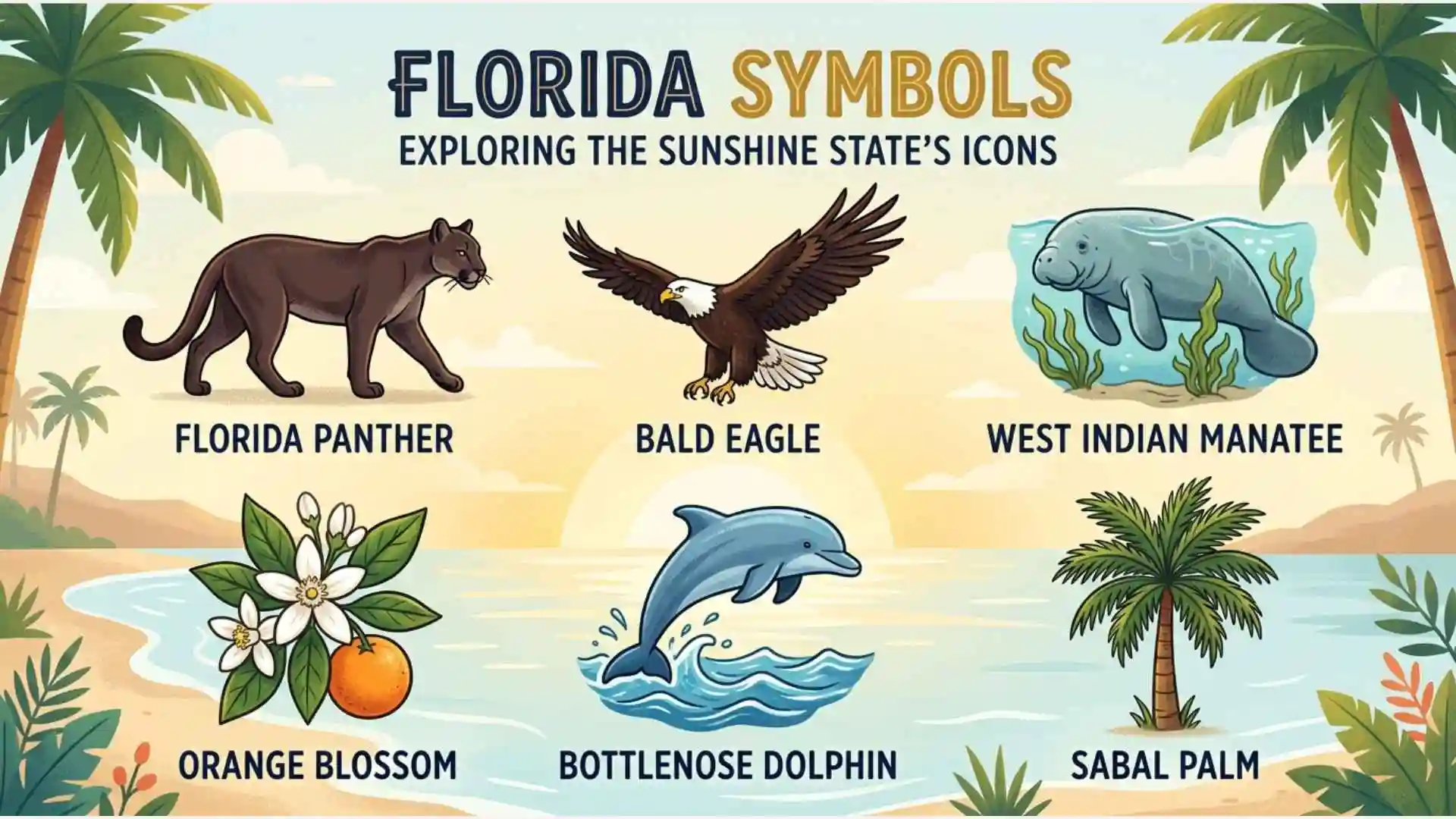
Florida, often called the Sunshine State, is known for its beautiful beaches, warm weather, diverse wildlife, and rich agricultural heritage. However, its identity is also represented through a collection of official state symbols that highlight its history, natural resources, traditions, and culture. These symbols help explain what makes Florida unique and provide a meaningful connection between the state’s past and present.
Florida symbols include animals, birds, reptiles, flowers, trees, marine life, gemstones, and important cultural emblems. Some of the most recognizable examples are the Florida panther, American alligator, mockingbird, orange blossom, and sabal palm. The state also recognizes official symbols such as its flag, seal, motto, song, anthem, and traditional foods.
Each symbol has a different story and significance. Some represent Florida’s natural environment, while others celebrate its agricultural industry or historical development. In this guide, you will discover the official Florida symbols, their meanings, adoption dates, and interesting facts about the Sunshine State.
What Are Florida Symbols?
Florida symbols are officially recognized animals, plants, natural resources, and cultural elements that represent the state’s identity. Many are established through legislation and documented in Chapter 15 of the Florida Statutes.
These designations help preserve Florida’s natural and cultural heritage while giving residents and visitors a better understanding of the state’s characteristics.
Florida symbols can be divided into several categories:
- Wildlife symbols: The Florida panther, mockingbird, American alligator, and manatee.
- Plant symbols: The orange blossom, sabal palm, and coreopsis.
- Marine symbols: The Atlantic sailfish, horse conch, and loggerhead turtle.
- Natural resource symbols: Moonstone, agatized coral, and Myakka fine sand.
- Cultural symbols: The state flag, seal, motto, song, and anthem.
- Agricultural symbols: The orange, orange juice, Florida Cracker Horse, and Cracker Cattle.
The Florida Department of State maintains an official directory of these symbols, making it a useful reference for students, researchers, and anyone interested in Florida’s heritage.
Complete List of Official Florida State Symbols
The following table provides a quick overview of Florida’s major officially recognized symbols.
| Category | Official Symbol |
| State Bird | Mockingbird |
| State Flower | Orange Blossom |
| State Tree | Sabal Palm |
| State Animal | Florida Panther |
| State Reptile | American Alligator |
| State Butterfly | Zebra Longwing |
| State Marine Mammal | Manatee |
| State Saltwater Mammal | Porpoise (Dolphin) |
| State Saltwater Fish | Atlantic Sailfish |
| State Freshwater Fish | Florida Largemouth Bass |
| State Fruit | Orange |
| State Beverage | Orange Juice |
| State Wildflower | Coreopsis |
| State Shell | Horse Conch |
| State Stone | Agatized Coral |
| State Gem | Moonstone |
| State Soil | Myakka Fine Sand |
| State Saltwater Reptile | Loggerhead Turtle |
| State Tortoise | Gopher Tortoise |
| State Horse | Florida Cracker Horse |
| State Heritage Cattle Breed | Florida Cracker Cattle |
| State Song | Old Folks at Home |
| State Anthem | Florida, Where the Sawgrass Meets the Sky |
| State Motto | In God We Trust |
| State Play | Cross and Sword |
| State Pie | Key Lime Pie |
| State Honey | Tupelo Honey |
| State Dessert | Strawberry Shortcake with Natural Florida Dairy Topping |
Florida also recognizes additional official cultural, historical, and environmental designations. These are discussed separately below to distinguish them from conventional state symbols.
Florida’s Official State Emblems
Florida State Flag
The Florida state flag features a white background, red diagonal bars forming an X-shaped cross, and the Great Seal of Florida in the center. The diagonal cross is known as a saltire or St. Andrew’s cross.
The current flag design was adopted in 1900 after Florida voters approved a constitutional amendment adding the red diagonal bars. Before that change, the flag featured a white background with the state seal in the center.
The flag represents Florida’s official identity and connects its history with its government. Its distinctive design makes it one of the state’s most recognizable emblems.
Florida State Seal
The Great Seal of Florida is another important state symbol. Its design includes sunlight, a distant landscape, a sabal palm, a steamboat on water, and a Seminole woman scattering flowers.
The seal’s original design was established by the Florida Legislature in 1868. It was revised in 1985 to correct historical and visual inaccuracies, including the representation of the woman and the steamboat.
The sabal palm replaced the cocoa palm in the official design after the Legislature updated the description in 1970. Today, the seal represents Florida’s history, natural environment, and governmental identity.
Florida State Motto
Florida’s official state motto is “In God We Trust.” It reflects wording that appeared on the state’s Great Seal and has historical significance dating back to 1868.
Although the phrase was associated with the seal for many years, it was formally designated as Florida’s official state motto in 2006.
The motto is an important part of the state’s official identity and appears in its state emblem.
Florida State Animals and Wildlife Symbols
Florida is home to a wide variety of wildlife, including mammals, reptiles, birds, fish, and butterflies. Several native species have received official recognition because of their importance to the state’s natural environment.
Florida State Animal: Florida Panther
The Florida panther is the official state animal. It is a large wild cat with a long tail, powerful body, and pale brown fur.
This animal is native to Florida and is particularly associated with natural habitats in South Florida. Its designation in 1982 followed a statewide vote involving students.
The Florida panther is also an important conservation symbol because habitat loss and human development have affected its population. Protecting suitable natural habitats is essential to its continued survival.
Florida State Bird: Mockingbird
The mockingbird is Florida’s official state bird. It is known for its ability to imitate the songs and sounds of other birds.
Mockingbirds usually have gray upper feathers, white undersides, and noticeable white patches on their wings and tails. They can be found in gardens, parks, residential areas, and open landscapes.
Florida officially designated the mockingbird as its state bird in 1927. Its beautiful singing ability and widespread presence make it a familiar part of Florida’s wildlife.
Florida State Reptile: American Alligator
The American alligator is the official state reptile of Florida. It lives in freshwater environments such as lakes, rivers, marshes, and wetlands.
Alligators have powerful jaws, armored bodies, and strong tails that help them move through water. They also play an important role in wetland ecosystems by influencing the populations of other animals.
The Florida Legislature officially recognized the American alligator as the state reptile in 1987.
Florida State Butterfly: Zebra Longwing
The zebra longwing is Florida’s official state butterfly. It has long, narrow wings decorated with distinctive black and yellow stripes.
This butterfly is commonly found in gardens, woodland areas, and tropical environments. It feeds on flower nectar and pollen and is an important part of the local pollinator community.
Its official designation in 1996 celebrates Florida’s colorful insect life and biodiversity.
Florida State Marine Mammal: Manatee
The manatee, commonly called the sea cow, is Florida’s official state marine mammal.
It is a large aquatic mammal that lives in coastal waters, rivers, and freshwater springs. Manatees feed mainly on aquatic vegetation and are recognized by their rounded bodies and slow swimming movements.
Florida’s warm-water environments provide important habitats for these animals, especially during colder weather.
The manatee became an official state symbol in 1975 and represents Florida’s marine wildlife and coastal ecosystems.
Florida State Saltwater Mammal: Porpoise or Dolphin
Florida’s official state saltwater mammal is legally designated as the porpoise, commonly known as the dolphin.
Dolphins are intelligent marine mammals that live in groups and communicate through sounds, whistles, and body movements. They can be found in Florida’s coastal waters and are frequently observed by visitors during marine wildlife tours.
This designation highlights the state’s connection to ocean environments and marine biodiversity.
Florida State Fish: Atlantic Sailfish and Florida Largemouth Bass
Florida recognizes two official state fish, representing its saltwater and freshwater environments.
The Atlantic sailfish is the official saltwater fish. It is recognized by its pointed bill, impressive swimming ability, and large sail-like dorsal fin. It is also popular among sport fishermen.
The Florida largemouth bass is the official freshwater fish. It lives in freshwater lakes, rivers, and other suitable habitats. Its size and fighting ability make it a popular target for recreational fishing.
Both fish represent Florida’s extensive aquatic resources and fishing traditions.
Other Florida Wildlife Symbols
Florida also recognizes the loggerhead turtle as its official saltwater reptile and the gopher tortoise as its official state tortoise.
The loggerhead turtle is a large marine reptile known for its broad head and reddish-brown shell. Florida’s beaches provide important nesting locations for this species.
The gopher tortoise lives in sandy habitats and digs underground burrows. These burrows provide shelter for numerous other wildlife species, making the tortoise important to the state’s ecosystems.
Florida State Plants and Agricultural Symbols
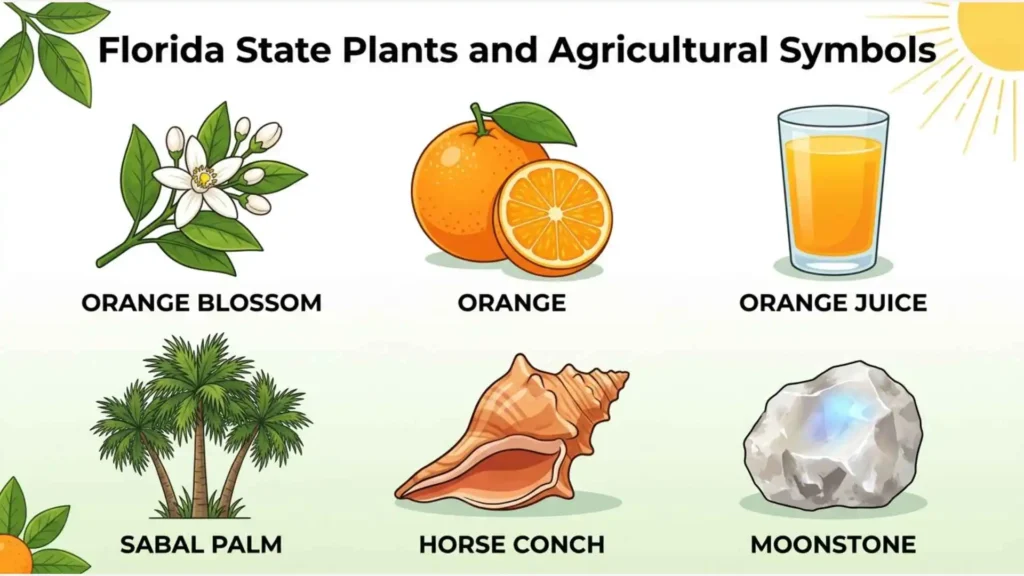
Florida’s climate and agricultural traditions are reflected in several official plant and food symbols. Citrus production, native vegetation, and beautiful flowering plants all contribute to the state’s identity.
Florida State Flower: Orange Blossom
The orange blossom is Florida’s official state flower. It grows on orange trees and is recognized for its small white petals and pleasant fragrance.
Orange blossoms are closely connected to Florida’s citrus industry because they develop into oranges after pollination. Their appearance during the flowering season also adds natural beauty to citrus-growing areas.
The flower represents Florida’s agricultural heritage and its long-standing association with orange production.
Florida State Tree: Sabal Palm
The sabal palm, scientifically known as Sabal palmetto, is Florida’s official state tree. It is also called the cabbage palm or cabbage palmetto.
This native palm grows in different soil conditions and is widely distributed throughout the state. It is commonly used in landscaping and has several traditional and practical uses.
The Florida Legislature designated the sabal palm as the state tree in 1953. It also appears on the Great Seal, connecting Florida’s natural environment with its official identity.
Florida State Wildflower: Coreopsis
Coreopsis is Florida’s official state wildflower. It is recognized for its bright yellow flowers and attractive appearance.
Different species of coreopsis grow throughout the state, particularly in open fields, roadsides, and natural landscapes.
These flowers also attract bees and butterflies, supporting local pollination. Florida officially recognized coreopsis as its state wildflower in 1991.
Florida State Fruit: Orange
The orange is Florida’s official state fruit. It has a strong connection to the state’s agricultural industry and is one of its most recognizable products.
Florida oranges are used for fresh consumption and juice production. They are valued for their flavor and nutritional content, including vitamin C.
The orange became the official state fruit in 2005, recognizing its importance to Florida’s agricultural heritage.
Florida State Beverage: Orange Juice
Orange juice is Florida’s official state beverage. It is made from mature oranges and reflects the state’s long association with citrus production.
Florida’s orange-growing industry has helped make orange juice an important part of its agricultural identity.
The beverage received official recognition in 1967 and remains one of the most familiar products associated with the Sunshine State.
Florida State Geological and Natural Symbols
Florida’s natural identity also includes geological materials and soil types that reflect its environmental history.
Florida State Shell: Horse Conch
The horse conch is Florida’s official state shell. It is a large marine shell native to the waters surrounding the state.
Its impressive size and distinctive shape make it an interesting part of Florida’s coastal environment.
The horse conch became the official state shell in 1969 and represents the state’s connection to marine ecosystems.
Florida State Stone: Agatized Coral
Agatized coral is Florida’s official state stone. It forms when ancient coral material is replaced by silica, creating attractive geological structures.
These formations can contain agate and quartz patterns and are valued by collectors because of their distinctive appearance.
Agatized coral represents Florida’s geological history and the ancient marine environments that existed in the region.
Florida State Gem: Moonstone
Moonstone is Florida’s official state gem. It is a type of feldspar mineral known for its pearly or opalescent appearance.
Although moonstone is not a naturally distinctive product of Florida’s geology, it holds an official symbolic designation.
Its attractive appearance makes it popular in jewelry and gemstone collections. Florida officially designated moonstone as its state gem in 1970.
Florida State Soil: Myakka Fine Sand
Myakka fine sand is Florida’s official state soil. It is widely associated with the state’s sandy landscapes and plays an important role in understanding its natural environment.
Soil characteristics influence drainage, vegetation, agriculture, and land management. Myakka soil is especially relevant to Florida’s ecosystems because of its relationship with local environmental conditions.
It became the official state soil in 1989.
Florida’s Cultural and Historical Symbols
Beyond its natural resources, Florida recognizes several cultural symbols that celebrate its music, traditions, food, and historical development.
Florida State Song: Old Folks at Home
“Old Folks at Home,” also known as “Swanee River,” is Florida’s official state song. It was written by American songwriter Stephen Foster.
The song became part of Florida’s cultural heritage and was officially designated in 2008 with revised lyrics.
It represents an important connection between music and the state’s historical identity.
Florida State Anthem: Florida, Where the Sawgrass Meets the Sky
Florida’s official state anthem is titled “Florida, Where the Sawgrass Meets the Sky.” It was written by Jan Hinton and officially adopted in 2008.
The anthem celebrates the state’s landscapes, particularly its wetlands and distinctive natural scenery.
It complements the official state song while providing another musical expression of Florida’s identity.
Florida State Play: Cross and Sword
“Cross and Sword” is Florida’s official state play. Written by Paul Green, this historical pageant presents aspects of Florida’s early history.
The production is associated with St. Augustine and highlights the historical development of the region.
It was officially designated as the state play in 1973.
Florida State Horse: Florida Cracker Horse
The Florida Cracker Horse is the official state horse. It is a historic breed associated with traditional ranching and cattle-herding activities.
These horses are known for their agility, endurance, and ability to work in challenging conditions.
The breed represents Florida’s rural heritage and its connection to traditional livestock farming.
Florida State Heritage Cattle Breed: Florida Cracker Cattle
Florida Cracker Cattle is the official state heritage cattle breed. These animals are historically connected to Florida’s early cattle industry.
They developed characteristics that helped them adapt to the state’s climate and natural conditions.
Their recognition helps preserve an important part of Florida’s agricultural history.
Florida State Pie: Key Lime Pie
Key lime pie is Florida’s official state pie. It is a popular dessert made using key lime juice, sweetened condensed milk, and a crust.
The dessert is particularly associated with the Florida Keys and is recognized for its distinctive citrus flavor.
It became the official state pie in 2006.
Florida State Honey: Tupelo Honey
Tupelo honey is Florida’s official state honey. It is produced from the nectar of tupelo trees and is known for its distinctive flavor.
Its recognition highlights Florida’s natural vegetation and beekeeping traditions. It became the official state honey in 2016.
Florida State Dessert: Strawberry Shortcake
Strawberry shortcake with natural Florida dairy topping is the official state dessert.
It combines strawberries, cake, and a creamy topping, reflecting the importance of strawberry farming and agricultural products in Florida.
The dessert was officially designated in 2022.
Why Is Florida Called the Sunshine State?
Florida is widely known by the nickname “The Sunshine State.” The name reflects its warm climate, abundant sunshine, and popularity as a destination for outdoor recreation.
Sunshine is closely associated with Florida’s beaches, coastal communities, parks, and agricultural areas. The nickname also contributes to the state’s tourism identity and public image.
However, it is important to distinguish the Sunshine State nickname from legally designated symbols. Florida’s official state symbols are established through specific designations, while the nickname is a widely recognized description of the state.
Other Official Florida Designations
Florida’s official designations extend beyond traditional symbols such as animals, flowers, and trees. Chapter 15 of the Florida Statutes also recognizes several cultural, historical, educational, and environmental institutions and activities.
Examples include:
- Florida Citrus Archives: Located at Florida Southern College in Lakeland, this institution is recognized as the official citrus archive.
- Official State Rodeo: Florida recognizes an official state rodeo through its legislation.
- Official State Festival: The state has an officially designated festival.
- Official State Band: The St. Johns River City Band is recognized as an official Florida state band.
- Official State Fiddle Contest: The annual contest held by the Florida State Fiddlers’ Association has official recognition.
- Official State History Museum: Florida recognizes an official state history museum.
- Official State Flagship: The state also has an officially designated flagship.
- Official Litter Control Symbol: This designation represents an environmental awareness initiative.
- Official State Renaissance Festival: Florida recognizes an official Renaissance festival.
- Official State Sports Hall of Fame: The Florida Sports Hall of Fame has an official designation.
These examples show that Florida’s official designations cover much more than natural objects and wildlife. They also recognize important cultural activities, institutions, and traditions.
Why Are Florida Symbols Important?
Florida symbols help preserve the state’s identity by connecting its people with their history, environment, and cultural traditions.
There are several reasons these symbols matter:
- Historical preservation: The state seal, flag, and official songs help maintain connections with Florida’s past.
- Wildlife awareness: Symbols such as the Florida panther and manatee highlight the importance of protecting native species.
- Agricultural recognition: The orange, orange blossom, and orange juice celebrate the state’s citrus industry.
- Environmental education: Native plants, animals, and geological materials help people understand Florida’s natural resources.
- Cultural identity: Official music, food, and historical productions represent the state’s traditions.
- Educational value: These symbols provide useful learning material for students and teachers studying Florida.
Together, these designations create a broader picture of Florida and explain why its natural and cultural heritage is worth preserving.
Frequently Asked Questions About Florida Symbols
How many official symbols does Florida have?
Florida has numerous official symbols and designations covering wildlife, plants, geological resources, food, music, and culture. The exact total depends on whether additional official institutions, events, and programs are included in the count.
What is Florida’s most recognizable state symbol?
The Florida flag, American alligator, orange blossom, and Florida panther are among its most recognizable symbols. Each represents a different part of the state’s identity.
What is Florida’s state animal?
The Florida panther is the official state animal. It is a native wild cat associated with South Florida’s natural habitats.
What is Florida’s state bird?
The mockingbird is Florida’s official state bird. It is known for its ability to imitate the sounds of other birds.
What is Florida’s state flower?
The orange blossom is Florida’s official state flower. It represents the state’s citrus-growing traditions and agricultural heritage.
What is Florida’s state tree?
The sabal palm, also called the cabbage palm, is Florida’s official state tree. It was designated in 1953.
What is Florida’s state fruit?
The orange is the official state fruit. It represents Florida’s important citrus-growing industry.
What is Florida’s state reptile?
The American alligator is Florida’s official state reptile. It is commonly found in freshwater lakes, rivers, and wetlands.
What is Florida’s state motto?
Florida’s official state motto is “In God We Trust.” It was formally designated in 2006.
What is Florida’s state marine mammal?
The manatee is Florida’s official state marine mammal. It is also commonly known as the sea cow.
What is Florida’s state butterfly?
The zebra longwing is Florida’s official state butterfly. It is recognized by its distinctive black and yellow striped wings.
What is Florida’s state gemstone?
Moonstone is Florida’s official state gem. It is known for its pearly appearance and attractive optical effects.
What is Florida’s state pie?
Key lime pie is the official state pie. It is a popular dessert associated with the Florida Keys.
When was the Florida state flag adopted?
The current design of the Florida state flag was adopted in 1900. It features red diagonal bars and the state seal on a white background.
Why are Florida symbols important for students?
Florida symbols help students learn about the state’s history, wildlife, plants, agriculture, and cultural traditions. They also provide useful examples of how states preserve their identities through official designations.
Conclusion
Florida symbols represent the state’s natural beauty, historical development, agricultural heritage, and cultural traditions. From the Florida panther and American alligator to the orange blossom and sabal palm, each symbol highlights a different aspect of the Sunshine State.
The state flag, Great Seal, motto, song, and anthem provide additional connections to Florida’s history and identity. Other designations, including Key lime pie, tupelo honey, and the Florida Cracker Horse, celebrate its food and rural traditions.
Understanding these official symbols provides a clearer picture of what makes Florida distinctive. Whether you are researching state emblems, completing a school assignment, or exploring American state history, Florida’s symbols offer an interesting way to discover the state’s heritage.

I am Lisa Reynolds, a linguist fascinated by the ever-changing world of slang. I enjoy researching how slang reflects trends, technology, and social connections. I wrote “Text Talk: Understanding Digital Slang” and “From Street to Screen: Slang in Media”, exploring the influence of digital communication on language. I love sharing my discoveries in a way that feels like a conversation with friends, so you feel the culture and humor behind every phrase.
 John Carter
 Marcus Lee