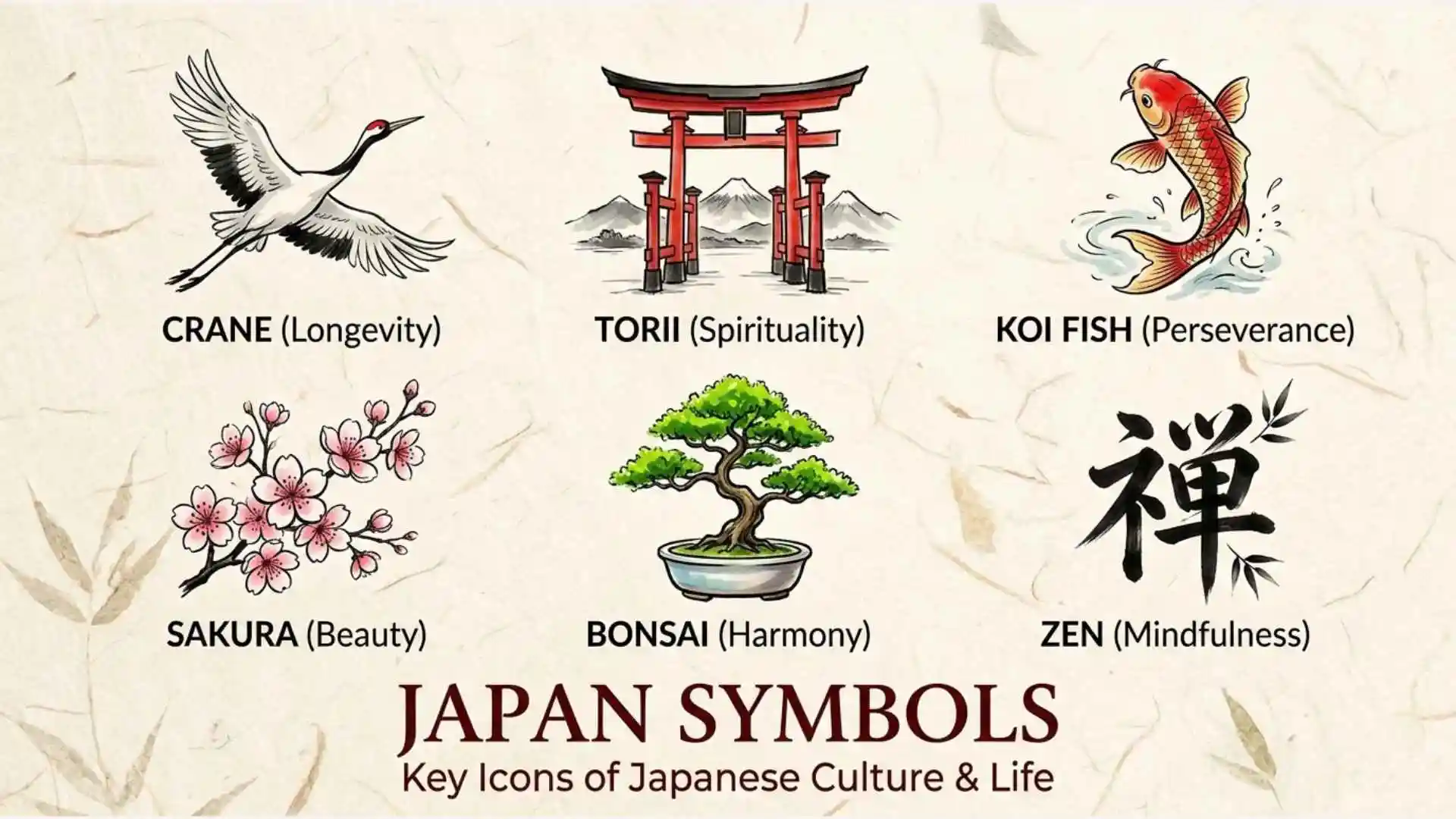
Japan is known for a rich culture filled with symbols that express history, spirituality, nature, identity, and tradition. From the rising sun and cherry blossoms to torii gates, koi fish, cranes, and traditional patterns, Japanese symbols often carry meanings that go far beyond their visual appearance. Many of these symbols have been shaped by Shinto, Buddhism, folklore, art, and centuries of cultural traditions.
Understanding Japanese symbols and their meanings can give you a deeper look into how Japanese people have connected everyday objects, animals, plants, colors, and designs with important ideas such as good fortune, protection, purity, strength, peace, and renewal. Some symbols are closely associated with religious practices, while others have become familiar parts of Japanese art, architecture, clothing, festivals, and modern culture.
In this guide, you’ll discover 40+ Japanese symbols, along with their meanings, historical backgrounds, and cultural significance. Whether you’re researching Japan’s traditions, looking for a meaningful symbol, studying Japanese culture, or simply curious about the stories behind these designs, this list will help you understand what each symbol represents and why it remains important.
What Are Japan Symbols?
Japan symbols are visual designs, written characters, objects, patterns, and traditional images that communicate cultural, historical, spiritual, or personal meanings. They can represent important Japanese values, religious beliefs, natural elements, and national identity.
Some Japanese symbols come from Shintoism and Buddhism, while others are inspired by animals, flowers, mountains, and traditional folklore. For example, cherry blossoms represent the temporary beauty of life, cranes are associated with longevity, and koi fish symbolize perseverance.
Japanese symbols appear in many aspects of everyday life, including traditional clothing, architecture, festivals, paintings, gardens, tattoos, and religious ceremonies. Understanding their original context helps explain why these designs remain meaningful in modern Japanese culture.
Most Popular Japanese Symbols and Their Meanings
Japan has numerous traditional and modern symbols, each with its own cultural background. Here are some of the most recognizable examples.
1. Cherry Blossom (Sakura)
The cherry blossom, known as Sakura, is one of Japan’s most recognizable cultural symbols. Its delicate pink and white flowers bloom during spring and are celebrated throughout the country.
Sakura represents beauty, renewal, new beginnings, and the temporary nature of life. Because cherry blossoms remain on the trees for a relatively short period, they remind people to appreciate beautiful moments before they pass.
The Japanese tradition of enjoying cherry blossoms is called Hanami. Families and friends gather under flowering trees to enjoy the scenery, food, and changing season.
2. Japanese Red Sun (Hinomaru)
The Japanese national flag features a red circle on a white background. Known as Hinomaru, this design represents the sun and is closely connected to Japan’s identity as the Land of the Rising Sun.
The red disc is a recognizable national emblem, while the white background creates a simple and distinctive design. The sun also has an important place in Japanese mythology and Shinto traditions, particularly through Amaterasu, the sun goddess.
3. Japanese Crane (Tsuru)
The crane, called Tsuru in Japanese, is traditionally associated with longevity, happiness, peace, and good fortune.
Cranes appear in Japanese paintings, wedding decorations, traditional clothing, and paper-folding art. One particularly famous example is the origami crane.
The tradition of folding 1,000 paper cranes is known as Senbazuru. It is associated with wishes for healing, peace, and good fortune. The crane also appears in Japanese folklore as a symbol of a long and prosperous life.
4. Koi Fish
Koi fish are colorful ornamental carp commonly found in Japanese gardens and ponds. They are associated with courage, determination, perseverance, and success.
Their ability to swim against strong currents has made them a popular representation of overcoming difficulties. Koi designs are frequently featured in Japanese paintings, decorative artwork, and traditional tattoos.
Different koi colors and patterns may carry different meanings in modern decorative traditions, although these interpretations are not universal.
5. Japanese Torii Gate
A Torii is a traditional gate commonly found at the entrance of a Shinto shrine. It marks the transition between ordinary surroundings and a sacred space associated with kami, or sacred presences in Shinto belief.
Many Torii gates are painted vermilion, although wooden, stone, and other variations also exist.
The Torii represents spirituality, sacredness, and the connection between the human and spiritual worlds. The famous Torii gate at Itsukushima Shrine is particularly recognizable because it appears to float above the water during high tide.
6. Japanese Dragon (Ryu)
The Japanese dragon, known as Ryu, is a mythical creature traditionally connected with water, wisdom, strength, and protection.
Unlike many Western dragon traditions, Japanese dragons are often depicted as powerful but benevolent beings associated with rain, rivers, oceans, and natural forces.
They commonly appear in traditional Japanese paintings, temple decorations, folklore, and tattoo artwork. Their long bodies, claws, scales, and flowing whiskers make them distinctive in Japanese art.
7. Mount Fuji
Mount Fuji is Japan’s highest mountain and one of its most important cultural landmarks. Its symmetrical shape and snow-covered summit have inspired Japanese artists, writers, and photographers for centuries.
Mount Fuji represents natural beauty, endurance, spirituality, and national identity. It also has religious significance in different Japanese traditions.
The mountain is famously represented in Katsushika Hokusai’s woodblock print series, Thirty-Six Views of Mount Fuji, which includes the internationally recognized Great Wave off Kanagawa.
8. Japanese Folding Fan (Sensu)
Sensu is a traditional Japanese folding fan used in dance, theater, ceremonies, and everyday life.
Its expanding shape is sometimes associated with growth, prosperity, and increasing opportunities. Traditional fans often feature flowers, birds, landscapes, and seasonal designs.
The folding fan is also an important accessory in Japanese performing arts, including traditional dance and Noh theater.
9. Daruma Doll
The Daruma doll is a traditional Japanese good-luck charm associated with perseverance, determination, and achieving personal goals.
Inspired by Bodhidharma, a figure traditionally connected with the origins of Zen Buddhism, Daruma dolls are commonly round and red, with blank eyes.
A popular custom involves painting one eye when setting a goal and completing the second eye after achieving it. This makes the Daruma a reminder to remain focused despite difficulties.
10. Japanese Maple Leaf (Momiji)
Momiji refers to the colorful autumn leaves of Japanese maple trees. Their red, orange, and golden shades make them a recognizable symbol of autumn.
Maple leaves are associated with seasonal change, natural beauty, and the passage of time. The Japanese tradition of viewing autumn foliage is called Momijigari.
Japanese Symbols and Their Meanings: Quick Reference
The following table provides a simple reference for identifying popular Japanese symbols and understanding their commonly associated meanings.
| Japanese Symbol | Common Meaning |
| Sakura | Beauty and temporary life |
| Hinomaru | Sun and national identity |
| Tsuru | Longevity and peace |
| Koi Fish | Perseverance and courage |
| Torii Gate | Sacredness and spirituality |
| Ryu | Wisdom and protection |
| Mount Fuji | Beauty and endurance |
| Sensu | Growth and prosperity |
| Daruma | Determination and success |
| Momiji | Change and seasonal beauty |
Japanese Kanji Symbols and Their Meanings
Kanji are Japanese writing characters that originated from Chinese characters. They are used alongside Hiragana and Katakana in the Japanese writing system.
Many Kanji characters have meanings that make them popular in calligraphy, jewelry, artwork, and decorative designs. However, a character can have multiple readings depending on the word and context in which it appears.
Here are some commonly recognized Japanese Kanji characters and expressions.
| Japanese Character | Meaning | Reading |
| 愛 | Love | Ai |
| 夢 | Dream | Yume |
| 力 | Strength or power | Chikara |
| 美 | Beauty | Bi |
| 心 | Heart or mind | Kokoro |
| 幸福 | Happiness | Koufuku |
| 平和 | Peace | Heiwa |
| 希望 | Hope | Kibou |
| 勇気 | Courage | Yuuki |
| 自由 | Freedom | Jiyuu |
| 友情 | Friendship | Yuujou |
| 知恵 | Wisdom | Chie |
| 忠誠 | Loyalty | Chuusei |
These characters and expressions can communicate meaningful ideas, but their natural usage depends on grammar and context. Anyone considering a Japanese Kanji tattoo should verify the wording and intended meaning with a fluent Japanese speaker before using it permanently.
Japanese Symbols of Good Luck and Fortune
Japanese culture includes many traditional objects and designs associated with prosperity, protection, happiness, and success. Some are used in religious settings, while others are displayed in homes, shops, and businesses.
1. Maneki-neko (Lucky Cat)
Maneki-neko is a traditional Japanese figurine featuring a cat with one raised paw. It is commonly displayed in shops, restaurants, and businesses.
The raised paw is associated with inviting customers, good fortune, and prosperity. Different colors and decorative designs may have different interpretations.
2. Omamori (Protective Charms)
Omamori are small protective charms available at Japanese Shinto shrines and Buddhist temples. They are usually enclosed in decorative fabric pouches.
Different Omamori are associated with different wishes, including good health, safe travel, academic success, and protection.
3. Hotei (God of Contentment)
Hotei is a popular figure in Japanese Buddhist tradition, often depicted as a smiling, cheerful man carrying a large cloth bag.
He is associated with happiness, generosity, contentment, and good fortune. His image is also connected with the Seven Lucky Gods of Japan.
4. Ema (Wooden Wish Plaques)
Ema are small wooden plaques found at Japanese shrines and temples. Visitors write wishes or prayers on them and leave them at designated areas.
They are used for wishes involving health, education, relationships, success, and family happiness.
5. Senbazuru (One Thousand Cranes)
Senbazuru refers to a collection of 1,000 folded paper cranes connected by strings.
This traditional practice is associated with wishes for peace, healing, happiness, and longevity. It is particularly recognized through Japanese peace traditions and the story of Sadako Sasaki.
Japanese Flower and Animal Symbols
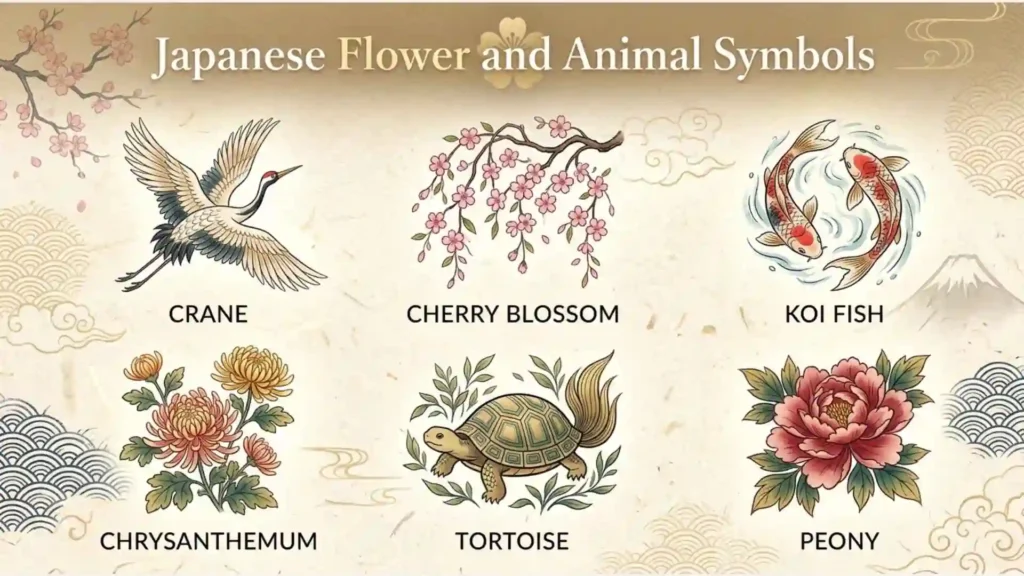
Nature plays an important role in Japanese art and cultural traditions. Flowers and animals frequently appear in traditional paintings, textiles, poetry, and seasonal celebrations.
Japanese Flower Symbols
Chrysanthemum (Kiku): The chrysanthemum is associated with longevity and rejuvenation. It is also connected with the Japanese Imperial family and appears on the Imperial Seal of Japan.
Plum Blossom (Ume): Plum blossoms bloom toward the end of winter and are associated with resilience, hope, and the arrival of spring.
Lotus Flower (Hasu): The lotus is associated with purity and spiritual awakening in Buddhist traditions. Its ability to grow in muddy water while producing beautiful flowers contributes to its symbolism.
Wisteria (Fuji): Wisteria flowers are admired for their hanging clusters and graceful appearance. They are commonly featured in Japanese decorative art and traditional gardens.
Camellia (Tsubaki): Camellia flowers are valued for their beauty and are associated with seasonal traditions and traditional Japanese aesthetics.
Japanese Animal Symbols
Fox (Kitsune): Foxes are important figures in Japanese folklore and are closely associated with Inari, a Shinto kami connected with rice, agriculture, and prosperity.
Turtle (Kame): Turtles are traditionally associated with longevity, wisdom, and good fortune.
Butterfly (Chou): Butterflies can represent transformation, beauty, and the changing stages of life. They also appear in Japanese art and literature.
Deer (Shika): Deer have special religious and cultural significance in places such as Nara, where they are associated with local Shinto traditions.
Tanuki: The tanuki is a folklore creature inspired by the Japanese raccoon dog. It is commonly associated with transformation, playfulness, and good fortune.
Japanese Religious and Spiritual Symbols
Japanese religious symbolism is strongly influenced by Shintoism and Buddhism. Although these traditions have different beliefs, both have contributed significantly to Japanese architecture, art, ceremonies, and everyday customs.
Ensō Circle
Ensō is a circle created with a single brushstroke in Zen Buddhist calligraphy. It can represent enlightenment, the universe, simplicity, and the beauty of imperfection.
Some circles are completely closed, while others have an opening. Both forms are used in Zen-inspired artwork.
Buddhist Manji Symbol
The Manji is an ancient symbol associated with Buddhism and good fortune. It is used in Japanese Buddhist temples and appears on Japanese maps to indicate temple locations.
It should be distinguished from the Nazi swastika, which is associated with a different historical and political context.
Shimenawa Rope
Shimenawa is a sacred rope traditionally made from twisted rice straw. It is placed around sacred objects, trees, rocks, and shrine structures.
It marks sacred spaces and is associated with purification and protection in Shinto traditions.
Shide Paper Decorations
Shide are zigzag-shaped paper strips commonly attached to sacred ropes and other Shinto objects.
They are used to mark sacred spaces and are particularly recognizable at Shinto shrines.
Inari Symbolism
Inari is a Shinto kami associated with rice, agriculture, fertility, and prosperity. Foxes are commonly seen as messengers associated with Inari.
Fox statues are frequently found at Inari shrines, often holding symbolic objects in their mouths.
Japanese Family Crests and Traditional Patterns
Japanese traditional design includes decorative patterns and family crests that communicate identity, history, and artistic heritage.
Kamon (Japanese Family Crests)
Kamon are traditional Japanese family crests used to identify families and their historical lineages.
They often feature simplified images of plants, animals, geometric designs, and natural objects. Some well-known motifs include paulownia leaves, chrysanthemums, wisteria, and butterflies.
Kamon historically appeared on clothing, armor, household objects, and ceremonial items.
Seigaiha (Blue Ocean Waves)
Seigaiha is a traditional Japanese pattern made from overlapping semicircular waves.
It represents the ocean and is often associated with peace, good fortune, and a long-lasting, peaceful future.
Asanoha (Hemp Leaf Pattern)
Asanoha is a geometric pattern inspired by hemp leaves. It is commonly found in Japanese textiles and traditional clothing.
Because hemp plants grow quickly and strongly, the pattern is associated with growth, strength, and healthy development.
Shippo (Seven Treasures Pattern)
Shippo is a decorative pattern made from overlapping circles that create symmetrical shapes.
It is associated with harmony, interconnectedness, and prosperity. The design is frequently used in Japanese crafts, textiles, and decorative artwork.
Japanese Symbols for Tattoos
Japanese symbols are popular tattoo designs because of their detailed artwork and cultural meanings. Traditional Japanese tattooing is known as Irezumi and often incorporates large compositions featuring natural elements, animals, and mythological figures.
Some commonly selected Japanese tattoo designs include:
- Cherry Blossom: Represents beauty, renewal, and the temporary nature of life.
- Koi Fish: Associated with courage, perseverance, and overcoming challenges.
- Japanese Dragon: Represents wisdom, protection, and power.
- Crane: Associated with peace, longevity, and good fortune.
- Phoenix (Houou): Represents renewal, virtue, and prosperity.
- Samurai: Connected with historical warrior traditions, discipline, loyalty, and honor.
- Japanese Waves: Inspired by traditional Japanese artwork and associated with the power of nature.
- Kanji Characters: Used to express ideas such as love, hope, strength, courage, and freedom.
Before choosing a Japanese tattoo, research its cultural background and verify any written characters. A design that looks attractive may have a different meaning from the one intended.
Japanese Symbols for Love, Peace, Strength, and Hope
Japanese language and traditional artwork offer several ways to represent important human values.
| Meaning | Japanese Writing | Reading |
| Love | 愛 | Ai |
| Peace | 平和 | Heiwa |
| Strength | 力 | Chikara |
| Courage | 勇気 | Yuuki |
| Happiness | 幸福 | Koufuku |
| Hope | 希望 | Kibou |
| Friendship | 友情 | Yuujou |
| Freedom | 自由 | Jiyuu |
| Wisdom | 知恵 | Chie |
| Beauty | 美 | Bi |
These expressions are useful for understanding Japanese language and symbolism. Their meanings may be influenced by the surrounding words and the context in which they are used.
Japanese Symbols Used in Everyday Life
Japanese symbols are not limited to ancient traditions or religious ceremonies. Many are still visible in modern Japanese society.
The red sun appears on the national flag, Torii gates identify entrances to Shinto shrines, and the Manji symbol is used on maps to mark Buddhist temples.
Japanese public signs also use internationally recognizable pictograms to communicate information about transportation, safety, facilities, and public services.
Traditional patterns appear in modern clothing, packaging, interior decoration, and graphic design. Lucky charms such as Maneki-neko and Daruma dolls are also popular in homes and commercial spaces.
These examples demonstrate how Japanese visual culture combines historical traditions with modern communication and design.
Frequently Asked Questions About Japan Symbols
What is the most famous symbol of Japan?
The Japanese red sun, known as Hinomaru, is one of the most recognizable national symbols. Cherry blossoms and Mount Fuji are also internationally recognized representations of Japanese culture.
What is the Japanese symbol for love?
The Kanji character 愛 (Ai) means love. It is commonly used in Japanese writing and decorative artwork to express affection and emotional connection.
What Japanese symbol represents strength?
The Kanji character 力 means strength or power. Koi fish and Japanese dragons are also commonly associated with perseverance, courage, and power.
What is the Japanese symbol for peace?
平和 (Heiwa) is the Japanese word for peace. Origami cranes are also widely associated with peace, particularly through Japanese peace traditions.
What is the Japanese symbol for good luck?
Maneki-neko, Daruma dolls, Omamori charms, and cranes are among the popular Japanese symbols associated with good luck and positive wishes.
What does the Japanese cherry blossom symbolize?
Cherry blossoms represent beauty, renewal, and the temporary nature of life. Their short blooming season encourages people to appreciate the present.
What does a Japanese dragon symbolize?
A Japanese dragon, or Ryu, is traditionally associated with wisdom, strength, protection, water, and natural forces.
What is the meaning of a Japanese Torii gate?
A Torii gate marks the entrance to a sacred space associated with Shintoism. It represents the transition between ordinary surroundings and a sacred area.
What is the difference between Kanji and Japanese symbols?
Kanji are characters used in the Japanese writing system, whereas Japanese symbols can include a much broader range of designs, objects, animals, religious signs, and cultural representations.
Which Japanese symbols are popular for tattoos?
Cherry blossoms, koi fish, dragons, cranes, phoenixes, waves, and Kanji characters are popular tattoo designs because of their artistic appearance and symbolic associations.
Conclusion
Japan symbols provide a fascinating connection to the country’s history, spirituality, natural environment, and artistic traditions. From the beautiful cherry blossom and powerful dragon to the peaceful Ensō circle and traditional Daruma doll, every symbol has its own cultural background and interpretation.
Some Japanese symbols represent personal values such as love, courage, hope, and determination, while others reflect religious beliefs, family heritage, and national identity. Whether you are researching Japanese culture, looking for tattoo inspiration, or exploring meaningful Kanji characters, understanding these symbols can help you appreciate the traditions behind them.
Their continued presence in modern art, architecture, fashion, and everyday life shows how Japanese symbolism connects the past with the present.

I am Marcus Lee, a cultural researcher and slang aficionado. I study the roots of informal language and how communities create meaning through words. My books “Slang Origins: A Journey Through Words” and “Words That Move Us: Slang Across Generations” focus on the history and psychology of slang. I enjoy guiding readers to understand not just the words, but the stories and attitudes they carry, so you can truly connect with language in daily life.
 Lisa Reynolds
 John Carter