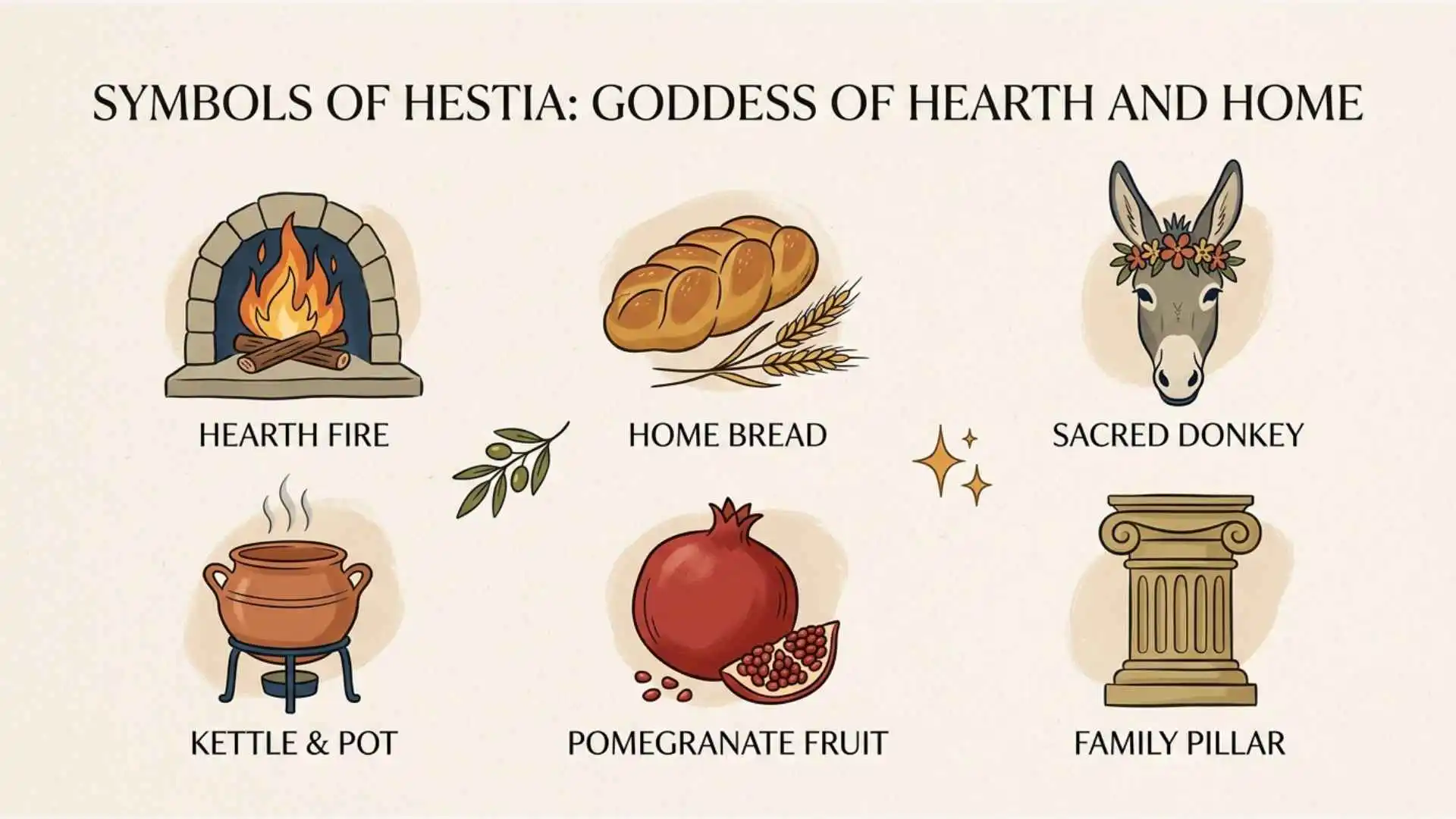
Hestia was the ancient Greek goddess of the hearth, home, family, and sacred fire. Her symbols represent warmth, domestic harmony, hospitality, stability, and the importance of community. Unlike many Greek deities associated with warfare, romance, or powerful natural forces, Hestia represented the peaceful center of everyday life. Her presence was connected to the fire that provided warmth, prepared meals, and brought families together.
The most recognizable Hestia symbols include the hearth and sacred flame. Other traditional attributes, such as the kettle and veil, help explain her connection to domestic responsibilities and her modest appearance in ancient Greek art. Questions about her sacred animals and plants also deserve attention, although not every association found in modern mythology articles is supported by strong historical evidence.
Understanding Hestia symbols provides a deeper look into ancient Greek religious traditions and explains why this goddess remains an important representation of home, family, and peaceful living.
Who Is Hestia in Greek Mythology?
Hestia was one of the original Olympian goddesses in Greek mythology. She was the daughter of Cronus and Rhea and the sister of Zeus, Poseidon, Hades, Hera, and Demeter. Her primary responsibility was protecting the hearth and its sacred fire.
In ancient Greek households, the hearth was an essential part of daily life. It provided warmth, supported cooking, and served as a central gathering place for family members. Hestia represented the religious and spiritual importance of this space.
She was traditionally described as a peaceful and modest goddess who chose to remain unmarried. Unlike other Olympians, she rarely appeared in dramatic mythological conflicts. Instead, her importance came from her connection to family traditions, religious ceremonies, and community life.
Hestia also received offerings at the beginning and end of sacrifices in Greek religious traditions. This special position demonstrated her importance in both private households and public worship.
Her Roman counterpart was Vesta, who was similarly associated with the hearth and sacred fire.
What Are the Main Symbols of Hestia?
Hestia’s symbolism focuses on the objects and traditions connected to the hearth. Some are directly established through ancient religious practices, while others are based on her artistic representation and domestic associations.
1. The Hearth
The hearth is the most important and recognizable symbol of Hestia. It represents the center of the household, where family members gathered to prepare food, stay warm, and participate in religious activities.
In ancient Greece, the hearth was more than a practical household feature. It also had religious significance because it represented the sacred presence of Hestia within the home.
Families maintained their household fires as part of their everyday responsibilities. The hearth therefore became a powerful representation of continuity, belonging, and domestic security.
Symbolic meanings of the hearth include:
- Home and family unity.
- Comfort and emotional security.
- Domestic stability.
- Hospitality and belonging.
- Protection of household traditions.
The hearth reflects Hestia’s central responsibility as the goddess who protected the most important shared space in a Greek household.
2. Sacred Fire and Eternal Flame
Fire is another major symbol associated with Hestia. Her connection to the sacred flame comes from her role as the guardian of the hearth.
In ancient Greek religious traditions, fire was used for cooking, warmth, sacrifices, and ceremonial activities. It was therefore closely connected to both everyday survival and religious worship.
Public communities also maintained sacred fires dedicated to Hestia. These flames represented the continuity and identity of the community.
The expression eternal flame is commonly used in modern discussions of Hestia symbolism. However, it is important to distinguish the general idea of maintaining a sacred communal fire from the claim that every ancient Greek hearth was literally an uninterrupted eternal flame.
The sacred fire symbolizes:
- Continuity and tradition.
- Warmth and comfort.
- Religious devotion.
- Family connections.
- Community identity.
It represents the lasting importance of maintaining the traditions and relationships that bring people together.
3. The Kettle
The kettle is a traditional attribute associated with Hestia and her connection to domestic life. It represents food preparation, hospitality, and the activities that helped maintain an ancient household.
Cooking was an essential part of everyday life in ancient Greece. Household objects connected to food preparation therefore fit naturally into Hestia’s symbolic world.
The kettle is sometimes shown or discussed as one of her identifying objects, although it is less universally recognizable than the hearth and sacred flame.
Its symbolic associations include:
- Nourishment and household care.
- Hospitality toward guests.
- Family gatherings.
- Domestic responsibilities.
- Everyday comfort.
The kettle represents the importance of providing food and creating a welcoming environment for family members and visitors.
4. The Veil
Hestia is traditionally portrayed as a modest woman wearing long garments and sometimes a veil covering her head.
The veil is an element of her artistic representation rather than a symbol with one universally documented ancient meaning. Nevertheless, it is commonly interpreted through her traditional identity as a modest and unmarried goddess.
Her appearance is generally more restrained than that of several other Olympian goddesses, whose representations frequently emphasize distinctive weapons, elaborate clothing, or dramatic attributes.
The veil is associated with:
- Modesty and dignity.
- Traditional religious identity.
- Simplicity and restraint.
- Devotion and personal commitment.
It helps communicate the peaceful and dignified character traditionally associated with Hestia.
5. The Communal Flame
The communal flame represents Hestia’s role beyond individual households. Ancient Greek cities maintained public hearths, often in important civic buildings known as prytaneia.
These communal spaces had religious and political importance. Their fires represented the identity and continuity of the community.
The public hearth was particularly significant because it connected individual citizens through shared traditions and religious practices.
Its symbolic meanings include:
- Social unity.
- Shared cultural identity.
- Community stability.
- Cooperation and belonging.
- Continuity of public traditions.
This symbol demonstrates that Hestia was not simply a household goddess. Her religious importance extended to the wider Greek community.
Hestia’s Sacred Animals and Plants
Questions about Hestia’s sacred animals and plants are common among people researching Greek mythology. However, her animal and botanical associations are less clearly established than her connection to fire and the hearth.
It is important to separate documented religious practices from later interpretations and modern symbolic associations.
Is the Pig Hestia’s Sacred Animal?
The pig is sometimes associated with Hestia in modern discussions of Greek mythology. This connection may relate to ancient sacrificial practices and the broader importance of domestic animals in Greek religious life.
However, there is no universally established ancient tradition identifying the pig as Hestia’s personal sacred animal.
Unlike Athena’s owl or Poseidon’s horse, the pig does not have an equally strong and consistent connection to Hestia in surviving mythology and artistic traditions.
Therefore, it is more accurate to describe the pig as a possible association in discussions of sacrificial and domestic traditions rather than a definitive symbol of the goddess.
Does Hestia Have a Sacred Flower or Plant?
Hestia does not have a universally recognized sacred flower comparable to the plants associated with certain other Greek deities.
Some modern spiritual interpretations connect her with plants representing peace, purity, and domestic harmony. These associations may be meaningful in contemporary devotional practices, but they should not automatically be presented as established ancient Greek traditions.
When researching Hestia’s botanical symbolism, the hearth and sacred fire remain much more firmly supported than any particular flower or plant.
What Do Hestia’s Symbols Mean?
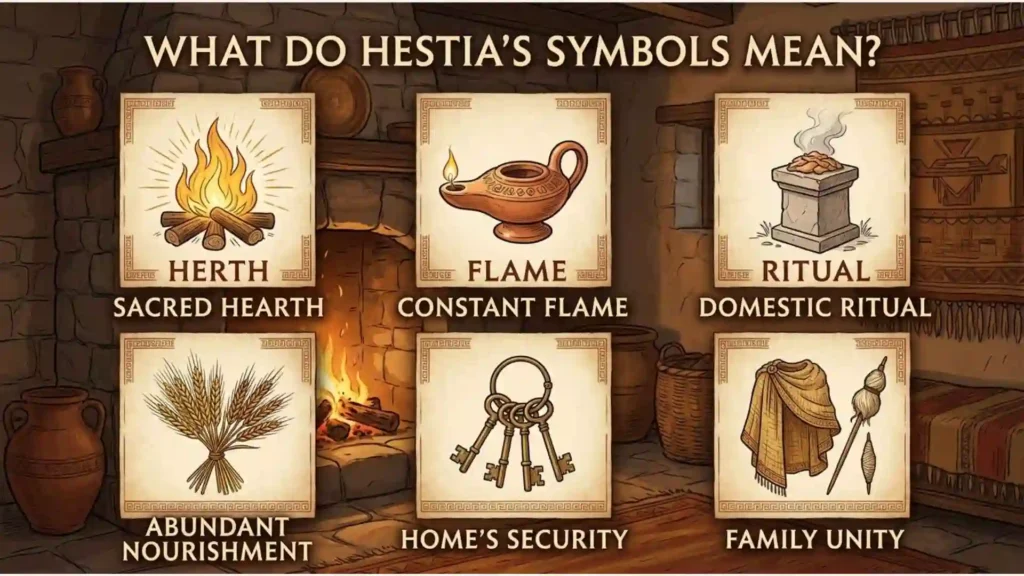
Although Hestia’s symbols include several different objects, their meanings are closely connected to her responsibilities as the goddess of the hearth.
Home and Family
The hearth represents the physical and emotional center of a household. It symbolizes the relationships, traditions, and shared experiences that create a sense of belonging.
Peace and Protection
Hestia’s association with the home makes her a symbol of domestic peace and security. Her traditional role reflects the importance of creating an environment where family members can feel safe and comfortable.
Stability and Continuity
The sacred flame represents the continuation of household and community traditions. Its presence can be understood as a symbol of consistency and stability.
Hospitality and Unity
The kettle and communal flame represent different aspects of bringing people together. Food, shared spaces, and welcoming traditions were important parts of ancient Greek social life.
Together, these meanings explain why Hestia is associated with the peaceful foundations of everyday living.
Hestia’s Appearance and Attributes in Ancient Greek Art
Hestia’s artistic representation is relatively simple compared with that of many other Olympian deities.
She was commonly portrayed as a mature, dignified woman wearing long clothing. In some representations, she appears with a head covering or veil. Her appearance communicates a sense of modesty and seriousness.
Unlike Athena, who is commonly represented with a helmet and shield, or Poseidon, who carries a trident, Hestia does not have one universally recognizable object held in every artistic depiction.
Her strongest identifying attribute remains the hearth.
The Hestia Giustiniani is a well-known ancient statue traditionally identified with Hestia. However, this identification is disputed, and the statue has also been associated with other goddesses, including Hera or Demeter.
This uncertainty is important when identifying Hestia in ancient artwork. Not every veiled female statue should automatically be described as a representation of the goddess.
Hestia’s Role in Ancient Greek Religious Traditions
Hestia held a distinctive position in ancient Greek religion because her responsibilities extended across both private and public life.
Household Worship
Greek families recognized the importance of the household hearth through offerings and religious practices. Hestia was associated with the sacred character of this space.
The hearth represented the center of family life and provided a location for household religious activities.
Public Religious Ceremonies
Hestia was also honored in public religious settings. Greek cities maintained communal hearths, and public ceremonies could involve offerings dedicated to her.
First and Last Offerings
One of Hestia’s distinctive religious roles was receiving the first and last portions of offerings in sacrificial traditions.
This practice reflected her special position among the gods and her connection to the beginning and completion of religious ceremonies.
Her role demonstrates how important the hearth was in ancient Greek religious identity.
Hestia vs. Vesta: Symbols and Differences
Hestia and Vesta are closely related goddesses from Greek and Roman mythology. Both are associated with the hearth, sacred fire, and the protection of domestic and public life.
However, they belong to different religious traditions and developed within different cultural settings.
| Feature | Hestia | Vesta |
| Mythology | Greek | Roman |
| Divine role | Goddess of the hearth | Goddess of the hearth |
| Main symbol | Hearth and sacred fire | Sacred fire and hearth |
| Religious setting | Greek households and cities | Roman households and state religion |
| Important tradition | Household and civic worship | Vestal fire and priestesses |
In Roman religion, Vesta was particularly important to the state. Her sacred fire was maintained by the Vestal Virgins, a group of priestesses responsible for its religious care.
Greek and Roman traditions therefore share important similarities while maintaining distinct religious practices.
Hestia Symbols in Modern Tattoos and Jewelry
Hestia symbols are also used in modern artwork, tattoos, and jewelry inspired by Greek mythology.
People may choose these designs because they connect with the ideas of family, home, stability, and peaceful living.
Hestia Flame Tattoo
A flame-inspired tattoo can represent continuity, warmth, and the importance of maintaining meaningful relationships.
Hearth Symbol Tattoo
A hearth design can communicate family unity, belonging, and the importance of having a peaceful home.
Minimalist Hestia Pendant
A simple flame-shaped pendant can represent an appreciation for Greek mythology and the symbolic meaning of the sacred fire.
Hestia Goddess Illustration
An illustration of a veiled woman beside a hearth can represent the traditional artistic identity of the goddess.
Kettle-Inspired Artwork
A kettle design can reflect hospitality, nourishment, and the domestic responsibilities associated with Hestia.
These are modern creative interpretations rather than a fixed collection of ancient religious symbols. Their meanings can differ according to personal beliefs and design choices.
Frequently Asked Questions About Hestia Symbols
What Is the Main Symbol of Hestia?
The hearth is Hestia’s main symbol. It represents home, family, domestic life, and the sacred fire that played an essential role in ancient Greek households.
What Are the Three Main Symbols of Hestia?
The three most commonly recognized symbols or attributes associated with Hestia are the hearth, sacred fire, and kettle. The hearth and fire have the strongest historical connection to her divine role.
What Animal Represents Hestia?
The pig is sometimes mentioned in connection with Hestia, particularly in discussions of ancient sacrificial practices. However, it is not a universally established sacred animal of the goddess.
What Flower Is Associated With Hestia?
There is no universally documented sacred flower belonging specifically to Hestia. Modern interpretations sometimes connect her with flowers representing peace and domestic harmony, but these should not be confused with established ancient traditions.
What Does Hestia’s Sacred Flame Represent?
Her sacred flame represents warmth, continuity, religious devotion, and the unity of households and communities.
What Does the Kettle Symbolize for Hestia?
The kettle represents food preparation, nourishment, hospitality, and the everyday activities associated with maintaining a household.
Why Does Hestia Wear a Veil?
Hestia is sometimes portrayed wearing a veil as part of her traditional modest appearance. Modern interpretations associate it with dignity, simplicity, and her identity as a virgin goddess.
Is Hestia the Same as Vesta?
No. Hestia is a Greek goddess, while Vesta is her Roman counterpart. Both are associated with the hearth and sacred fire, but their worship developed within different cultural and religious traditions.
Conclusion
Hestia symbols represent the essential values of ancient Greek domestic and religious life. The hearth and sacred flame are her most important symbols, while the kettle and veil provide additional insight into her traditional attributes and artistic representation.
Her association with sacred fire extends beyond household activities to include public worship and community identity. Although modern sources sometimes connect her with particular animals and plants, these associations should be distinguished from historically established attributes.
Hestia remains an important figure in Greek mythology because she represents the peaceful foundations of everyday life. Her symbolism reminds us of the lasting importance of family, hospitality, stability, and creating a place where people feel welcomed and protected.

I am Lisa Reynolds, a linguist fascinated by the ever-changing world of slang. I enjoy researching how slang reflects trends, technology, and social connections. I wrote “Text Talk: Understanding Digital Slang” and “From Street to Screen: Slang in Media”, exploring the influence of digital communication on language. I love sharing my discoveries in a way that feels like a conversation with friends, so you feel the culture and humor behind every phrase.
 John Carter
 Marcus Lee