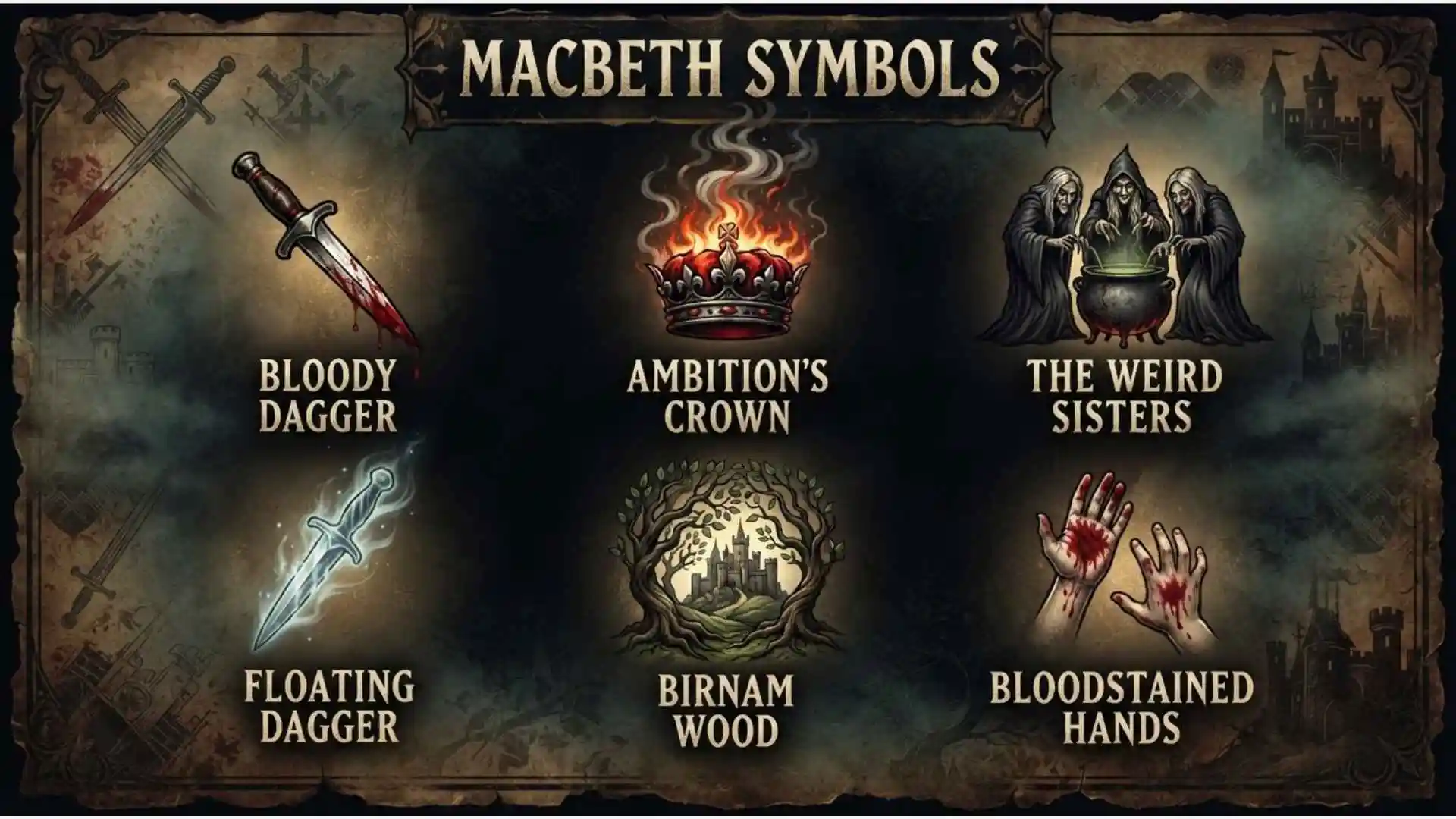
William Shakespeare’s Macbeth is a tragic play that explores ambition, guilt, power, deception, fate, and the consequences of immoral choices. One of the most effective ways Shakespeare develops these themes is through symbolism. Ordinary objects, natural events, and supernatural experiences acquire deeper meanings that reveal the characters’ emotions and the disorder spreading throughout Scotland.
The most important symbols in Macbeth include blood, sleep, darkness, clothing, the imaginary dagger, Banquo’s ghost, the witches, the crown, and serpent imagery. These symbols change in significance as Macbeth moves from a respected soldier to a violent ruler whose ambition eventually destroys him.
Understanding Macbeth symbols helps readers interpret important scenes, support literary essays with quotations, and understand Shakespeare’s message about human nature. This guide examines the major symbols, provides quotations with Act and Scene references, and explains how each symbol contributes to the play’s central themes.
Quick Overview of the Main Macbeth Symbols
The following table summarizes the most important symbols in Shakespeare’s tragedy and their principal meanings.
| Symbol | Main meaning | Key theme |
| Blood | Murder, guilt, and responsibility | Guilt and violence |
| Sleep | Innocence, peace, and restoration | Psychological suffering |
| Darkness | Evil, secrecy, and hidden ambition | Deception |
| Clothing | Identity, status, and illegitimate authority | Appearance versus reality |
| Imaginary dagger | Temptation and psychological conflict | Ambition |
| Banquo’s ghost | Guilt and fear | Consequences of violence |
| The witches | Temptation and uncertainty | Fate and free will |
| The crown | Power and political legitimacy | Ambition and tyranny |
| Serpent imagery | Deception and concealed danger | Appearance versus reality |
| Storms and unnatural events | Disorder and disruption | Natural and political order |
1. Blood Symbolism in Macbeth
Blood is one of the most significant symbols in Macbeth. It initially represents physical violence and the reality of murder, but its meaning gradually develops into a representation of guilt, shame, and psychological suffering.
Blood as a Symbol of Murder and Guilt
After Macbeth murders King Duncan in Act 2, Scene 2, he becomes horrified by the blood on his hands. He understands that the murder has changed him and that its consequences cannot easily be undone.
Macbeth asks:
“Will all great Neptune’s ocean wash this blood”
This quotation expresses Macbeth’s fear that even an enormous amount of water cannot remove the stain of his crime. Neptune, the Roman god of the sea, emphasizes the extraordinary scale of the cleansing Macbeth imagines would be necessary.
Blood becomes more than physical evidence of murder. It represents Macbeth’s awareness of his moral responsibility. Although he can wash his hands, he cannot simply erase the memory of killing Duncan.
Lady Macbeth and the Blood on Her Hands
Lady Macbeth initially believes that guilt can be controlled through practical action. She tells Macbeth:
“A little water clears us of this deed.”
This statement in Act 2, Scene 2 reveals her confidence that they can remove the evidence and continue their lives.
However, her attitude changes dramatically in Act 5, Scene 1. During her sleepwalking episode, she imagines blood on her hands and repeatedly attempts to wash them.
She cries:
“Out, damned spot! out, I say!”
The imagined spot symbolizes the guilt she can no longer suppress. Her earlier confidence proves mistaken because the psychological consequences of murder remain even when physical evidence is removed.
Literary significance: Blood traces the development of guilt throughout the play. Macbeth becomes increasingly accustomed to violence, while Lady Macbeth is eventually overwhelmed by the consequences of their actions.
2. Sleep Symbolism in Macbeth
Sleep symbolizes innocence, peace, restoration, and freedom from fear. Shakespeare uses sleep to demonstrate how murder destroys the natural comfort that both Macbeth and Lady Macbeth once possessed.
Macbeth’s Destruction of Sleep
Immediately after murdering Duncan, Macbeth hears a voice that seems to cry:
“Macbeth does murder sleep.”
This line occurs in Act 2, Scene 2. Sleep is personified as something Macbeth has murdered alongside the king.
The quotation suggests that Macbeth has destroyed his ability to experience genuine peace. Duncan was murdered while sleeping, making sleep especially significant: Macbeth violates a vulnerable person and simultaneously damages his own mental stability.
The loss of sleep also anticipates Macbeth’s increasingly troubled reign. Although he gains the crown, he cannot enjoy the security he expected from power.
Lady Macbeth’s Sleepwalking
In Act 5, Scene 1, Lady Macbeth walks and speaks while apparently asleep. Her behavior reveals memories and guilt that she cannot control while awake.
Sleep, which should provide rest, becomes the setting in which her hidden distress emerges.
This reversal demonstrates that the mind cannot always suppress the consequences of wrongdoing. Lady Macbeth once attempted to dismiss guilt as weakness, but eventually her own conscience becomes impossible to escape.
Literary significance: Sleep symbolizes innocence and psychological peace. Its destruction demonstrates that immoral actions can deprive people of the very security they hope to obtain.
3. Darkness and Light Symbolism in Macbeth
Darkness represents evil, secrecy, deception, and the desire to conceal immoral intentions. Light, by contrast, can suggest visibility, awareness, and the exposure of wrongdoing.
Macbeth’s Desire to Hide His Ambition
In Act 1, Scene 4, Macbeth responds to Duncan’s praise by saying:
“Stars, hide your fires;
Let not light see my black and deep desires.”
The quotation reveals that Macbeth already understands the darkness of his ambition. He does not want the light to expose thoughts that conflict with his public image as a loyal subject.
The contrast between light and darkness therefore reflects the difference between Macbeth’s outward appearance and inner intentions.
Darkness and Duncan’s Murder
Darkness also contributes to the atmosphere surrounding Duncan’s murder. Macbeth hopes that secrecy will protect him from discovery, but concealing the crime does not prevent its consequences.
As Macbeth becomes more violent, the play’s imagery increasingly associates his actions with a threatening and unnatural world.
Darkness should not simply be understood as a symbol of nighttime. Its deeper significance comes from the connection between concealment and the characters’ deliberate moral choices.
Literary significance: Darkness represents hidden ambition and evil, while light creates the possibility of exposure. Together, they reinforce the theme of appearance versus reality.
4. Clothing Symbolism in Macbeth
Clothing symbolizes identity, status, authority, and the difference between possessing a title and genuinely deserving it. Shakespeare uses clothing imagery to suggest that Macbeth’s royal position does not naturally fit him.
Borrowed Robes and Macbeth’s Kingship
After the witches predict Macbeth’s future, Banquo questions whether Macbeth’s new titles might be ill-fitting:
“And wears upon his baby brow the round
And top of sovereignty?”
In Act 1, Scene 3, Banquo compares Macbeth’s unexpected advancement to a garment that does not fit properly. The imagery suggests that Macbeth’s new status is unfamiliar and potentially unsuitable.
Elsewhere, Ross describes Macbeth’s new title of Thane of Cawdor as an honor that fits him well, creating an interesting contrast between a legitimate reward and the later acquisition of kingship through murder.
The clothing motif becomes especially significant after Macbeth takes the throne. He has acquired the outward appearance of a king, but his violent actions undermine the legitimacy of his authority.
Literary significance: Clothing symbolizes social identity and political status. It helps Shakespeare question whether external appearances accurately represent a person’s true character or right to rule.
5. The Imaginary Dagger Symbolism in Macbeth
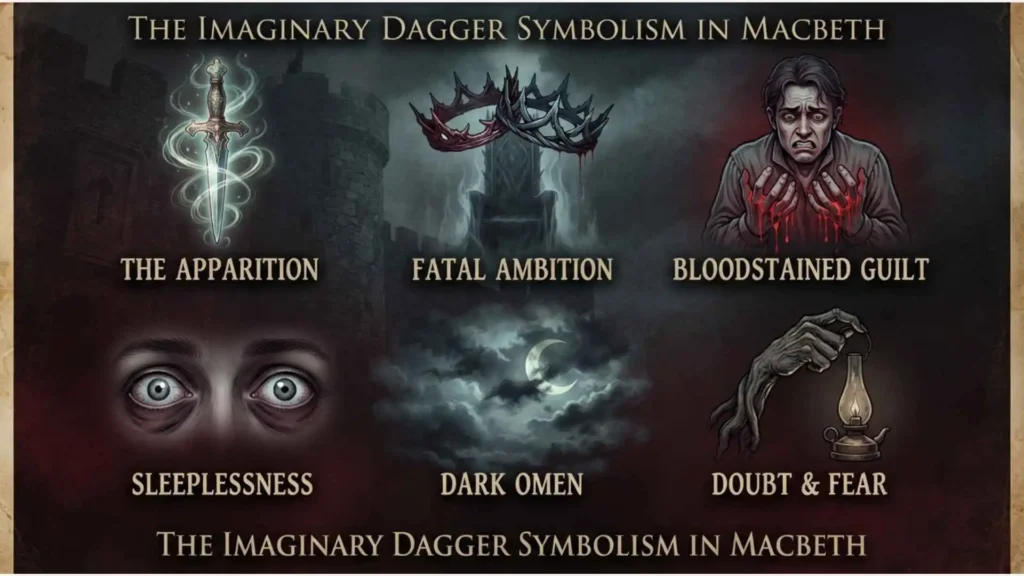
The imaginary dagger is one of the play’s most important symbols of temptation, violence, and psychological conflict.
The Dagger Before Duncan’s Murder
In Act 2, Scene 1, Macbeth sees a dagger seemingly floating before him and asks:
“Is this a dagger which I see before me”
The vision appears to guide him toward Duncan’s chamber. Macbeth questions whether the dagger is real or a product of his troubled imagination.
The vision reflects the conflict between his ambition and his awareness of the terrible act he is about to commit. He desires the crown, but he has not yet completed the murder necessary to obtain it.
The dagger can be interpreted as a symbol of temptation because it appears to lead Macbeth toward the crime he is considering. It also represents the growing influence of his own thoughts on his perception of reality.
The Dagger as a Turning Point
The scene marks the transition from contemplating murder to carrying it out. Before this moment, Macbeth struggles with the decision. Afterward, he proceeds toward Duncan’s chamber.
The dagger is not necessarily evidence of supernatural intervention. Shakespeare leaves room for the interpretation that Macbeth’s imagination reflects his fear and anticipation.
Literary significance: The dagger symbolizes the psychological pressure of ambition and the movement from thought to action.
6. Banquo’s Ghost Symbolism in Macbeth
Banquo’s ghost symbolizes guilt, fear, and the consequences of Macbeth’s continued violence. Unlike Duncan’s murder, which Macbeth commits to obtain the crown, Banquo’s murder is intended to protect the power he has already gained.
The Ghost at the Banquet
In Act 3, Scene 4, Macbeth sees Banquo’s ghost during a royal banquet. The other guests cannot see what Macbeth sees, and his behavior disturbs the gathering.
Macbeth’s reaction reveals that becoming king has not brought him peace. Instead, he remains frightened by the possibility that his crimes will expose his weakness and threaten his authority.
The ghost also represents the consequences of Macbeth’s decision to eliminate anyone he considers a threat. His attempt to secure power through violence creates additional psychological suffering.
Public Power and Private Fear
The banquet scene contrasts Macbeth’s public position with his private mental state. He should appear confident as Scotland’s king, but his reaction exposes the instability beneath his authority.
Lady Macbeth attempts to control the situation, yet Macbeth’s behavior makes it increasingly difficult to conceal his distress.
Literary significance: Banquo’s ghost makes Macbeth’s inner fear visible onstage. It demonstrates that violence may silence an opponent but cannot guarantee psychological freedom from the crime.
7. The Witches and Supernatural Symbolism in Macbeth
The Weird Sisters symbolize temptation, uncertainty, deception, and the complicated relationship between fate and free will.
The Witches’ Prophecies
In Act 1, Scene 3, the witches greet Macbeth with titles that predict his rise to power. Their words awaken his ambition and encourage him to imagine himself as king.
However, the witches do not directly force Macbeth to murder Duncan. He chooses to pursue the crown after considering the possibilities raised by their prophecies.
This distinction is essential to interpreting the play. The witches influence Macbeth, but his decisions remain central to the tragedy.
Good and Evil Become Confused
The witches introduce moral confusion through their paradoxical language:
“Fair is foul, and foul is fair.”
This statement appears in Act 1, Scene 1. It suggests that appearances can be deceptive and that what seems attractive may conceal something dangerous.
The line anticipates Macbeth’s behavior throughout the play. He attempts to appear loyal while hiding murderous intentions, and he increasingly interprets events according to his own desires.
Literary significance: The witches symbolize the temptation to believe misleading promises. Their prophecies raise questions about destiny without removing Macbeth’s responsibility for his choices.
8. Serpent Symbolism in Macbeth
The serpent represents deception, concealed danger, manipulation, and evil. Shakespeare uses this image to show how a harmless appearance can hide dangerous intentions.
Lady Macbeth’s Advice
In Act 1, Scene 5, Lady Macbeth tells her husband:
“Look like th’ innocent flower,
But be the serpent under’t.”
The flower represents innocence and harmlessness, while the serpent represents hidden danger. Lady Macbeth advises Macbeth to maintain a welcoming appearance while concealing his murderous intentions.
The contrast between the two images captures the central conflict between appearance and reality.
Deception and Moral Corruption
Macbeth and Lady Macbeth use deception to protect their plan against Duncan. They hope that convincing appearances will prevent suspicion.
However, their outward behavior cannot erase the reality of their actions. The serpent image therefore warns against trusting appearances without considering what may lie beneath them.
Literary significance: Serpent imagery reinforces the themes of treachery, manipulation, and the corruption of moral judgment.
9. Storms, Weather, and Unnatural Events in Macbeth
Weather and unnatural events establish an atmosphere of disorder and reflect the consequences of violence against the established political order.
Thunder and Lightning
The play begins with the witches appearing amid thunder and lightning. Their surroundings immediately introduce danger, mystery, and uncertainty.
The stormy atmosphere also complements the witches’ paradoxical language. Both the weather and their words suggest a world in which familiar expectations are becoming unstable.
Nature After Duncan’s Murder
In Act 2, Scene 4, Ross and the Old Man discuss unusual events following Duncan’s death. The darkness during daytime and reports of strange animal behavior suggest that nature itself has been disturbed.
One report describes an owl killing a falcon, reversing the expected relationship between predator and prey.
These events reflect the broader consequences of regicide, or the killing of a king. Duncan’s murder is not presented as an ordinary crime; it disrupts the political and moral order of Scotland.
Literary significance: Storms and unnatural events symbolize chaos and the consequences of violating the established order. They connect Macbeth’s personal wrongdoing with the suffering of the wider kingdom.
10. The Crown as a Symbol of Power and Ambition
The crown represents kingship, authority, political legitimacy, and Macbeth’s ambition. However, Shakespeare shows that possessing royal power does not automatically make someone a worthy ruler.
Macbeth’s Desire for the Crown
At the beginning of the play, Macbeth is celebrated for his courage in battle. After hearing the witches’ predictions, he begins imagining a future in which he becomes king.
The crown gradually becomes more important to him than loyalty, justice, or human life. He murders Duncan to obtain it and arranges Banquo’s death to protect it.
Power Without Security
Once Macbeth becomes king, his fear of losing power increases. He orders further violence because he believes that eliminating threats will secure his position.
Instead, these decisions create more enemies and deepen the instability of his reign.
The crown therefore becomes a symbol of the difference between legitimate authority and power maintained through fear. Macbeth possesses the title but fails to provide the security and justice expected of a good ruler.
Literary significance: The crown demonstrates how unchecked ambition transforms a respected soldier into a tyrant. It also exposes the limitations of power gained through immoral means.
11. How Macbeth’s Symbols Develop the Play’s Main Themes
Shakespeare’s symbols work together rather than functioning as isolated images. Their combined meanings develop the play’s major themes.
Ambition and Corruption
The crown represents Macbeth’s desire for power, while the dagger reflects the movement toward murder. Blood then reveals the moral and psychological consequences of achieving ambition through violence.
Guilt and Psychological Suffering
Blood, sleep, and Banquo’s ghost demonstrate that Macbeth and Lady Macbeth cannot fully escape the consequences of their actions. Their experiences show how guilt affects both perception and behavior.
Appearance Versus Reality
Clothing and serpent imagery reveal the danger of judging people by their outward appearance. Macbeth appears to possess the qualities of a king, but his actions expose the corruption beneath his public identity.
Fate and Free Will
The witches introduce predictions that influence Macbeth’s expectations. However, the dagger scene and his subsequent choices demonstrate that he actively participates in shaping his future.
Disorder and the Natural World
Storms, unusual animal behavior, and unnatural darkness reflect the consequences of Duncan’s murder. The disruption of the natural world mirrors the collapse of political stability.
12. How to Write an Essay About Macbeth Symbols
A strong essay about symbolism should do more than list objects and their meanings. It should explain how Shakespeare uses specific images to develop character, atmosphere, and themes.
Step 1: Make a Clear Argument
Begin with a thesis statement that identifies the symbols you will discuss and explains their overall significance.
For example: Shakespeare uses blood, sleep, and darkness in Macbeth to demonstrate how ambition leads to guilt, destroys innocence, and encourages deception.
Step 2: Support Your Argument With Quotations
Choose a relevant quotation from the play and identify its Act and Scene. Make sure the quotation directly supports your argument.
Step 3: Explain the Symbol’s Meaning
Do not simply repeat the quotation in your own words. Explain why the image matters, what it reveals about the character, and how its meaning develops throughout the play.
Step 4: Connect the Symbol to a Theme
Show how the symbol contributes to a broader idea, such as ambition, guilt, appearance versus reality, or political disorder.
Example of Symbolism Analysis
Macbeth’s response to the blood on his hands reveals that he recognizes the moral consequences of murdering Duncan. His question about whether Neptune’s ocean can wash away the blood suggests that ordinary cleansing cannot remove his guilt. Shakespeare therefore uses blood to connect physical violence with psychological suffering, showing that Macbeth cannot escape responsibility simply by concealing his crime.
This approach combines a textual reference, interpretation, and thematic significance, making the analysis more useful for literature essays and examinations.
Frequently Asked Questions About Macbeth Symbols
What is the most important symbol in Macbeth?
Blood is one of the most important symbols because it represents murder, guilt, and moral responsibility. Its meaning develops throughout the play, from physical violence to the psychological suffering experienced by Macbeth and Lady Macbeth.
What does blood symbolize in Macbeth?
Blood symbolizes violence, guilt, and the consequences of immoral actions. Macbeth’s fear that the blood cannot be washed away demonstrates his recognition that physical cleansing cannot eliminate moral responsibility.
What does sleep symbolize in Macbeth?
Sleep represents innocence, peace, and restoration. Macbeth’s belief that he has murdered sleep suggests that his actions have destroyed his ability to experience genuine peace of mind.
What does darkness symbolize in Macbeth?
Darkness symbolizes secrecy, evil, and hidden ambition. Macbeth’s desire to conceal his thoughts from the stars reveals his awareness that his ambitions conflict with his public identity.
What does the dagger symbolize in Macbeth?
The imaginary dagger symbolizes temptation, violence, and psychological conflict. It appears before Duncan’s murder and reflects Macbeth’s struggle between ambition and awareness of wrongdoing.
What does Banquo’s ghost symbolize?
Banquo’s ghost symbolizes Macbeth’s guilt, fear, and inability to escape the consequences of murder. Its appearance also exposes the instability hidden beneath his royal position.
What do the witches symbolize in Macbeth?
The witches symbolize temptation, uncertainty, and the influence of supernatural predictions. Their prophecies encourage Macbeth’s ambition, but his choices determine how he responds to them.
What does clothing symbolize in Macbeth?
Clothing symbolizes status, identity, and the difference between outward appearance and genuine authority. The play’s clothing imagery suggests that Macbeth’s new position does not naturally fit him.
What does the serpent symbolize in Macbeth?
The serpent symbolizes deception, concealed danger, and manipulation. Lady Macbeth’s advice to appear innocent while hiding dangerous intentions illustrates the contrast between appearance and reality.
How does Shakespeare use symbolism to develop guilt in Macbeth?
Shakespeare uses blood, sleep, and Banquo’s ghost to show how guilt affects the characters’ thoughts and behavior. These symbols reveal that the psychological consequences of wrongdoing continue even when characters attempt to conceal their crimes.
Why are symbols important in Macbeth?
Symbols help Shakespeare communicate complex ideas through objects, images, and events. They reveal characters’ emotions, create atmosphere, and develop themes such as ambition, guilt, deception, and the consequences of violence.
Conclusion
The symbols in Shakespeare’s Macbeth reveal the deeper meaning of the tragedy and help explain the consequences of unchecked ambition. Blood represents murder and guilt, sleep symbolizes innocence and peace, darkness reflects secrecy and evil, and clothing exposes the difference between appearance and legitimate authority. The imaginary dagger, Banquo’s ghost, the witches, serpent imagery, and unnatural events further develop the play’s psychological and political conflicts.
By examining these symbols alongside relevant quotations and scenes, readers can understand how Shakespeare connects individual decisions with broader questions about morality, power, and responsibility. Ultimately, Macbeth demonstrates that ambition pursued through violence may bring temporary success, but it cannot guarantee lasting security, innocence, or peace.

I am John Carter, a lifelong enthusiast of language and modern slang. I explore how words evolve and shape culture, and I enjoy uncovering the stories behind everyday expressions. I have authored “Slang and Society: The Language of Youth” and “Modern Words, Modern Worlds”, where I dive into how informal language impacts communication and identity. My goal is to make language accessible, fun, and insightful for everyone who loves words as much as I do.
 Lisa Reynolds
 Marcus Lee