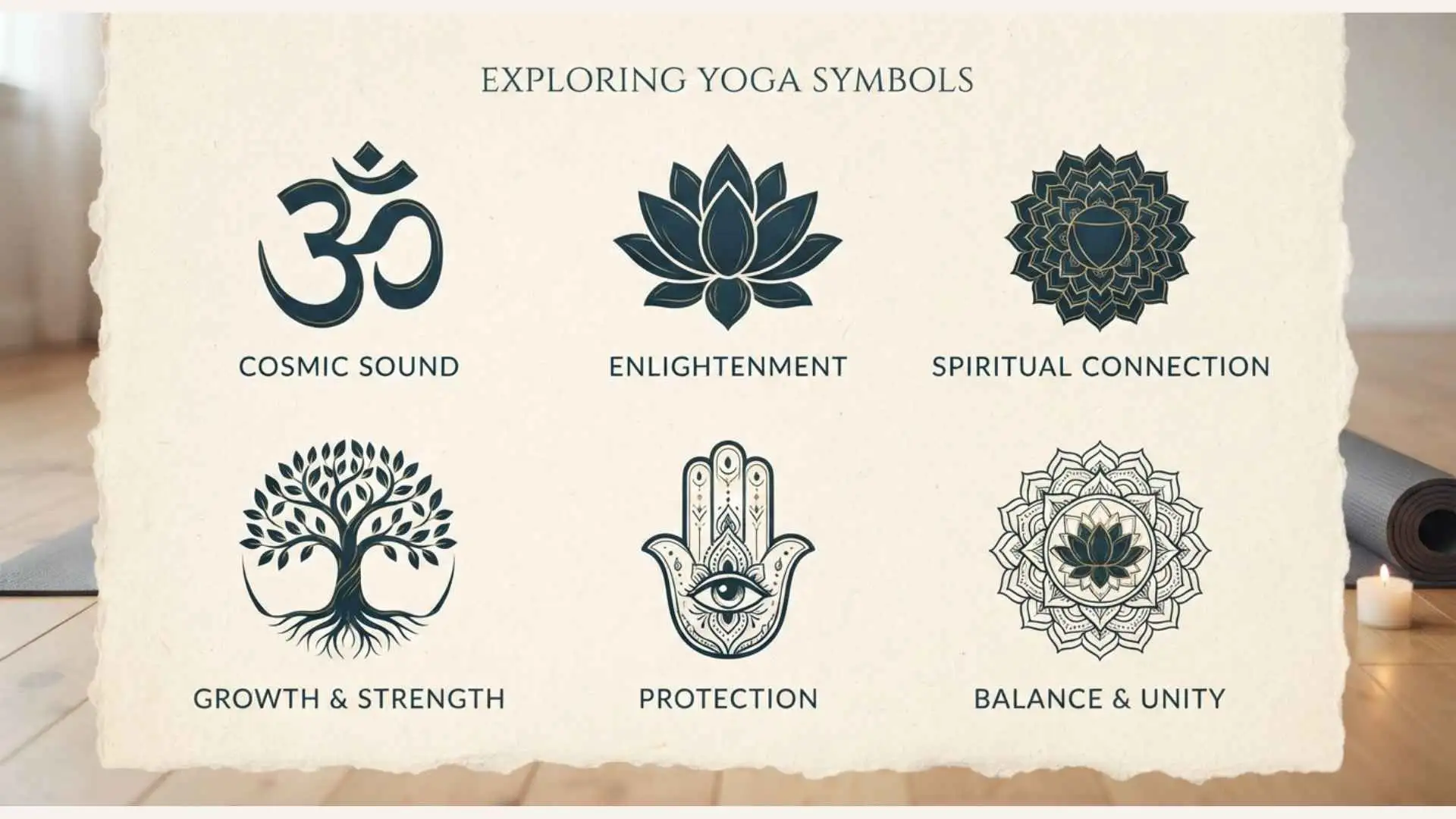
Yoga symbols are meaningful images, signs, and designs connected with yoga, meditation, Indian spiritual traditions, and the broader practice of mindfulness. They can represent ideas such as peace, balance, consciousness, spiritual growth, energy, transformation, and inner awareness.
Some of the most recognizable yoga symbols include the Om symbol, lotus flower, chakra symbols, mandalas, yantras, and mudras. However, not every spiritual symbol commonly seen in yoga studios actually originated in yoga. Some come from Hinduism, Buddhism, Jainism, Chinese philosophy, or other cultural traditions and are now used within modern yoga and wellness practices.
Understanding the meaning and origin of these symbols makes it easier to choose the right one for meditation, artwork, jewelry, tattoos, or personal spiritual practice.
What Are Yoga Symbols?
Yoga symbols are visual representations associated with concepts found in yoga and related Indian philosophical and spiritual traditions. They can be used to express ideas that are difficult to describe with words, including consciousness, unity, balance, awakening, and personal transformation.
Some symbols are directly connected with traditional yoga practices, while others became associated with yoga through meditation, spirituality, and modern wellness culture.
Common examples include:
- Om (ॐ)
- Lotus flower
- Chakra symbols
- Mandalas
- Yantras
- Yoga mudras
- Anjali Mudra
- Gyan Mudra
- Hamsa
The meaning of a symbol can vary depending on the tradition in which it is being used. Therefore, it is useful to understand both its modern yoga meaning and its original cultural context.
Yoga Symbols and Their Meanings
Om Symbol
The Om symbol (ॐ) is probably the most recognizable symbol associated with yoga and meditation.
Om is a sacred syllable with deep roots in Indian spiritual traditions. It is commonly used during meditation and yoga practices and is traditionally connected with consciousness, sacred sound, and the unity of existence.
The sound is often represented as having three primary components—A, U, and M—followed by silence. Different philosophical traditions interpret these elements in different ways.
In modern yoga, Om may symbolize:
- Peace
- Consciousness
- Meditation
- Spiritual awareness
- Unity
- Connection with the universe
Because Om has religious and spiritual significance, it is better understood as more than a decorative yoga logo.
Lotus Flower Symbol
The lotus is one of the most popular symbols associated with yoga, meditation, and spiritual growth.
A lotus grows from muddy water but rises above the surface and blooms. This natural process has made it a powerful metaphor for overcoming difficulties and developing inner awareness.
The lotus can represent:
- Spiritual awakening
- Personal growth
- Purity
- Resilience
- Transformation
- Enlightenment
The lotus is also connected with traditional meditation imagery and the lotus posture, known as Padmasana.
For someone looking for a symbol representing growth after hardship, the lotus can be especially meaningful.
Chakra Symbols
Chakras are described in certain Indian spiritual and yogic traditions as centers of subtle energy. The modern concept of seven major chakras is particularly common in contemporary yoga and wellness culture.
The seven commonly discussed chakras are:
- Root Chakra
- Sacral Chakra
- Solar Plexus Chakra
- Heart Chakra
- Throat Chakra
- Third Eye Chakra
- Crown Chakra
Each chakra has its own traditional associations, symbolism, and visual representation.
For example, the heart chakra is commonly connected with love and compassion, while the throat chakra is associated with communication and expression.
It is important to note that modern chakra systems are not identical across every historical yoga tradition. Their meanings and visual representations can vary.
Mandala Symbol
A mandala is a geometric design generally arranged around a central point. Mandalas are found across several South Asian and Buddhist traditions and are widely used today for meditation and mindfulness.
The word is associated with a circle or sacred diagram, although mandalas can take many forms.
Mandalas commonly represent:
- Wholeness
- Balance
- Unity
- Concentration
- Harmony
- The relationship between the individual and the larger universe
Today, mandalas are popular in yoga studios, meditation spaces, artwork, tattoos, jewelry, and coloring activities.
Sri Yantra
The Sri Yantra is an important sacred geometric diagram associated with Hindu traditions and meditation.
It consists of interlocking triangles arranged around a central point. The design is traditionally understood through complex philosophical and spiritual symbolism.
Sri Yantra is often associated with:
- Meditation
- Consciousness
- Sacred geometry
- Spiritual focus
- Unity
- Divine principles
A yantra should not simply be treated as another type of decorative mandala. Although the two can look similar, they have different histories, structures, and traditional uses.
Yoga Mudras: Hand Symbols Used in Yoga
One major topic missing from many basic articles about yoga symbols is mudras.
Mudras are symbolic hand gestures used in Indian spiritual and yogic traditions. They are commonly practiced during meditation, yoga, and breathing exercises.
Different mudras are traditionally associated with different qualities or intentions.
Gyan Mudra
Gyan Mudra is one of the most recognizable meditation hand gestures. The thumb and index finger are brought together while the other fingers remain extended.
It is commonly associated with:
- Knowledge
- Awareness
- Concentration
- Meditation
- Wisdom
It is frequently shown in images of people meditating.
Anjali Mudra
Anjali Mudra is performed by bringing the palms together, usually in front of the chest.
It is widely associated with:
- Respect
- Gratitude
- Unity
- Devotion
- Balance
The gesture is also commonly used when saying “Namaste,” although the gesture and the word are not exactly the same thing.
Dhyana Mudra
Dhyana Mudra is commonly seen in meditation imagery. The hands rest in the lap with the palms facing upward and the thumbs gently touching.
It is associated with:
- Meditation
- Concentration
- Stillness
- Inner awareness
- Contemplation
Prana Mudra
Prana Mudra involves specific finger positioning and is traditionally connected with the concept of prana, often translated as life force or vital energy.
It is used in some yoga and meditation practices as a symbolic gesture related to vitality and awareness.
Seven Chakra Symbols and Their Meanings
The seven-chakra system is one of the most recognizable forms of spiritual symbolism associated with modern yoga.
Root Chakra
The Root Chakra is commonly represented at the base of the chakra system and associated with grounding, stability, security, and connection to the physical world.
Sacral Chakra
The Sacral Chakra is associated with creativity, emotions, pleasure, and relationships.
Solar Plexus Chakra
The Solar Plexus Chakra is commonly connected with confidence, personal power, motivation, and self-expression.
Heart Chakra
The Heart Chakra is associated with love, compassion, kindness, and emotional connection.
Throat Chakra
The Throat Chakra is connected with communication, expression, and speaking one’s truth.
Third Eye Chakra
The Third Eye Chakra is traditionally associated in modern chakra systems with intuition, insight, perception, and inner awareness.
Crown Chakra
The Crown Chakra is associated with spirituality, consciousness, transcendence, and a sense of connection with something greater.
These descriptions reflect common modern interpretations and should not be assumed to represent one universal historical chakra system.
Yoga Symbols for Meditation and Inner Peace
People often search for yoga symbols because they want something that represents calmness, mindfulness, or inner peace.
Best Symbol for Meditation
The Om symbol is one of the strongest choices for a meditation-related design because of its connection with sacred sound and contemplative practices.
Best Symbol for Personal Growth
The lotus is particularly suitable for representing personal transformation and growth.
Best Symbol for Balance
A mandala can represent balance, harmony, and wholeness.
Best Symbols for Energy Awareness
Chakra symbols are commonly chosen by people interested in meditation systems focused on energy and self-awareness.
The best symbol ultimately depends on the meaning you personally want to express.
Ancient Yoga and Indian Spiritual Symbols
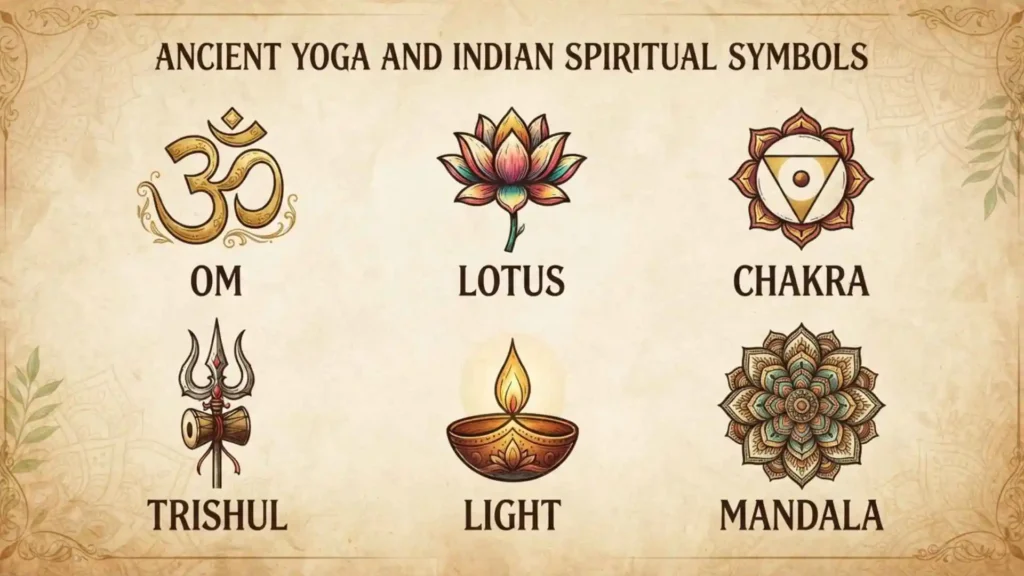
Yoga developed within a much broader Indian philosophical and religious environment. As a result, many symbols now associated with yoga have histories that extend beyond modern yoga classes.
Om has deep roots in Indian spiritual traditions. Lotus imagery appears across Hindu and Buddhist traditions. Yantras have important roles in certain Hindu practices, while mudras are used across several Indian spiritual traditions.
This history is important because calling every spiritual image a “yoga symbol” can oversimplify its cultural background.
A more accurate approach is to distinguish between:
- Symbols originating in yoga traditions
- Symbols originating in Hindu traditions
- Buddhist symbols used in meditation
- Broader spiritual symbols adopted by modern yoga culture
This distinction makes an article about yoga symbols more informative and respectful.
Yoga Symbols vs. Mandalas vs. Yantras
Mandalas and yantras are sometimes treated as interchangeable, but they are not exactly the same.
A mandala is generally a symbolic geometric design organized around a center and is used across different religious and cultural traditions.
A yantra is traditionally a sacred geometric diagram with specific symbolic and ritual significance, particularly within certain Hindu traditions.
Yoga symbols, meanwhile, are a broader category that can include Om, lotus imagery, chakra designs, mudras, and other symbols associated with yoga and meditation.
Understanding these differences prevents confusion when searching for spiritual symbols.
Om vs. Namaste: What Is the Difference?
Om and Namaste are often associated with yoga, but they are not the same.
Om is a sacred syllable used in Indian spiritual traditions and commonly incorporated into meditation and yoga practices.
Namaste is a respectful greeting or expression of acknowledgment. In modern yoga culture, it is often used at the end of a class, although its meaning and usage have broader cultural contexts.
Anjali Mudra, the gesture of bringing the palms together, is frequently associated with Namaste, but the hand gesture itself has meanings beyond that single word.
Yoga Symbols for Tattoos
Yoga-inspired tattoos are popular because many symbols can communicate a meaningful idea with a relatively simple design.
Popular choices include:
- Om
- Lotus
- Mandala
- Chakra symbols
- Sanskrit words or phrases
- Mudra-inspired designs
- Sacred geometry
- Sri Yantra
A lotus tattoo may represent transformation, while an Om tattoo may represent spirituality or meditation.
However, anyone considering a tattoo should research the original meaning of a symbol before using it. Some symbols have religious significance, and using them purely as decoration may not reflect their traditional meaning.
Sanskrit tattoos deserve particular care because incorrect translations and misspellings are common online. A qualified Sanskrit expert can help verify a phrase before it is permanently tattooed.
Yoga Symbols for Jewelry and Home Décor
Yoga symbols are also commonly used in necklaces, bracelets, rings, wall art, posters, candles, and meditation-room decorations.
An Om pendant may serve as a reminder of mindfulness, while lotus jewelry can represent growth and transformation.
Mandalas are often selected for home décor because their symmetrical patterns create a visual association with balance and harmony.
When choosing decorative yoga symbols, consider both appearance and meaning. A symbol becomes more personally meaningful when its traditional significance connects with your own intentions.
How to Choose the Right Yoga Symbol
Choosing a yoga symbol becomes easier when you first decide what you want it to represent.
| Intention | Symbol to Consider |
| Meditation | Om |
| Personal growth | Lotus |
| Balance | Mandala |
| Energy awareness | Chakra |
| Knowledge | Gyan Mudra |
| Gratitude | Anjali Mudra |
| Spiritual focus | Sri Yantra |
| Inner awareness | Third Eye Chakra |
| Peace | Om or Lotus |
| Transformation | Lotus |
There is no single “best” yoga symbol for everyone. The right choice depends on your beliefs, interests, and the message you want the symbol to communicate.
How Yoga Symbols Are Used Today
Yoga symbols are now used in many different settings beyond traditional yoga practice.
They can appear in:
- Yoga studios
- Meditation centers
- Clothing
- Jewelry
- Tattoos
- Wall art
- Books
- Social media graphics
- Wellness brands
- Meditation apps
- Personal journals
Modern usage has made these symbols accessible to a much wider audience. At the same time, learning their origins can help prevent important cultural meanings from being lost.
Frequently Asked Questions About Yoga Symbols
What is the most famous yoga symbol?
The Om symbol is probably the most recognizable symbol associated with yoga and meditation. It has deep spiritual significance in Indian traditions and is commonly used during contemplative practices.
What are the main yoga symbols?
Commonly associated symbols include Om, the lotus, chakra symbols, mandalas, yantras, and mudras such as Gyan Mudra and Anjali Mudra.
What symbol represents yoga?
There is no single universal symbol representing every form of yoga. Om is probably the most widely recognized, but lotus imagery, chakra symbols, and meditation mudras are also strongly associated with yoga.
What is the spiritual symbol for yoga?
Om is often considered one of the most important spiritual symbols associated with yoga. However, its meaning comes from broader Indian spiritual traditions rather than from modern yoga alone.
What does the lotus symbol mean in yoga?
The lotus commonly represents spiritual growth, transformation, resilience, purity, and awakening. Its growth from muddy water is often used as a metaphor for overcoming difficulties.
What are the seven chakra symbols?
The seven commonly discussed chakras are the Root, Sacral, Solar Plexus, Heart, Throat, Third Eye, and Crown chakras. Each has its own traditional associations and symbolic representation.
What is the yoga symbol for peace?
Om and lotus imagery are commonly used to represent peace and spiritual calm. Mandalas can also represent balance and harmony.
What is the yoga symbol for strength?
There is no single universal yoga symbol for strength. The lotus can represent resilience and overcoming challenges, while some chakra traditions associate the Solar Plexus Chakra with confidence and personal power.
What is the difference between a mandala and a yantra?
A mandala is a broad type of symbolic geometric design found across several traditions. A yantra is a more specific sacred diagram traditionally used in certain Hindu spiritual practices, often with defined geometric structures and meanings.
Are all yoga symbols Hindu?
No. Yoga developed within the Indian spiritual and philosophical environment, but symbols associated with modern yoga come from several traditions. Some are specifically connected with Hindu traditions, while others have Buddhist, Jain, Chinese, or broader cultural origins.
Final Thoughts
Yoga symbols offer a visual way to explore ideas such as meditation, balance, consciousness, peace, transformation, and spiritual growth. The Om symbol, lotus, chakras, mandalas, yantras, and mudras are among the most commonly associated with yoga and modern meditation practices.
However, these symbols are not all interchangeable, and they do not all originate specifically from yoga. Understanding their individual histories and meanings gives them greater value and helps you use them respectfully.
Whether you are looking for a symbol for meditation, a meaningful tattoo, spiritual jewelry, home décor, or simply a deeper understanding of yoga culture, the best choice is one whose meaning genuinely connects with your intention.

I am Lisa Reynolds, a linguist fascinated by the ever-changing world of slang. I enjoy researching how slang reflects trends, technology, and social connections. I wrote “Text Talk: Understanding Digital Slang” and “From Street to Screen: Slang in Media”, exploring the influence of digital communication on language. I love sharing my discoveries in a way that feels like a conversation with friends, so you feel the culture and humor behind every phrase.
 John Carter
 Marcus Lee