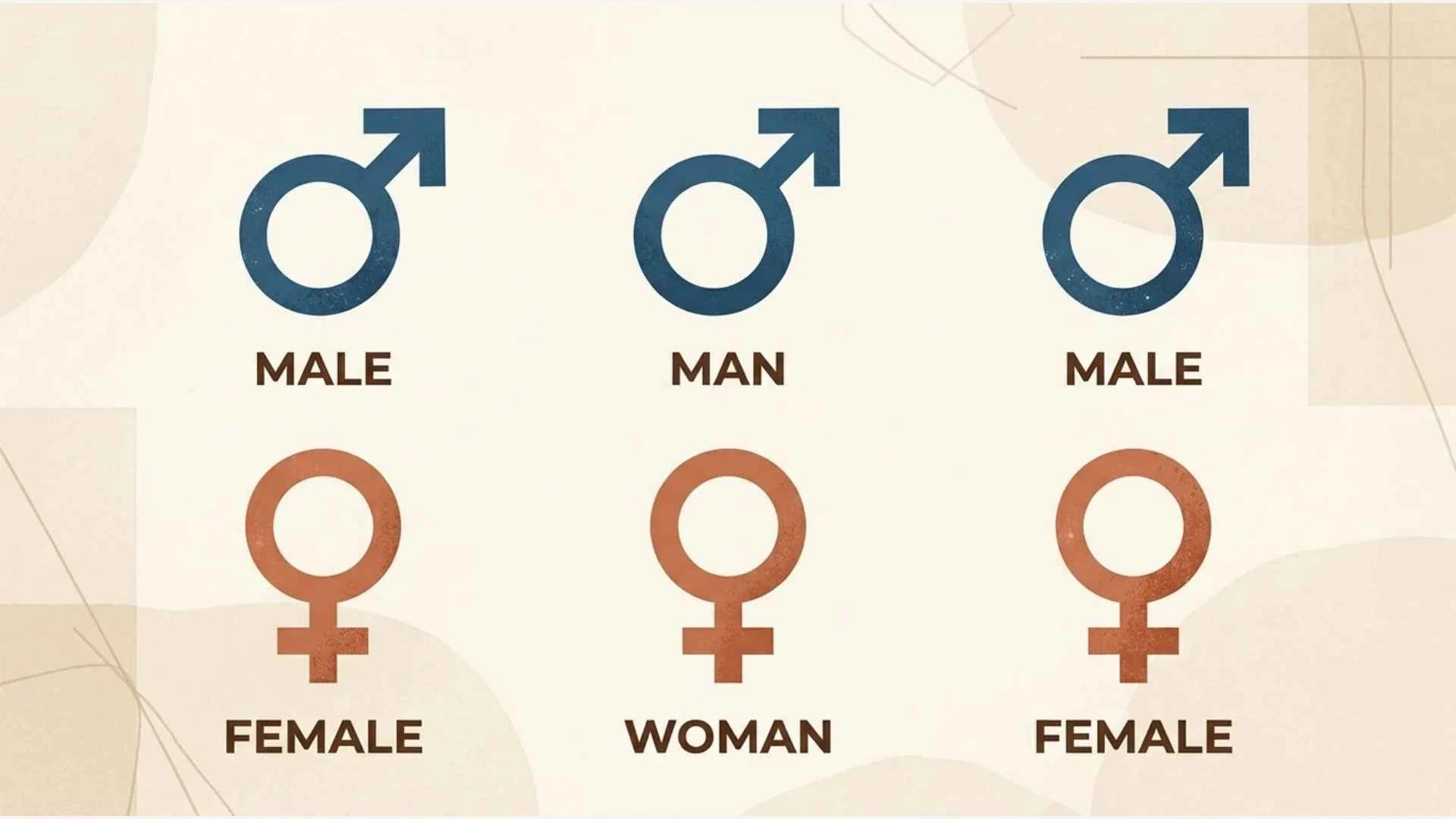
Gender symbols help people communicate identity, represent biological sex, and recognize different communities. From the familiar female symbol (♀) and male symbol (♂) to the transgender symbol (⚧), these signs appear in science, medicine, public spaces, educational materials, and LGBTQ+ communities.
However, gender symbols mean more than a circle, cross, or arrow. Their meanings connect to planetary traditions, historical scientific practices, cultural beliefs, and modern ideas about identity. Some symbols have well-established uses, while others carry different meanings depending on the community or setting.
Understanding these differences makes it easier to recognize gender symbol meanings, explore their history, and use them respectfully. This guide explains the most common symbols, their origins, their scientific applications, and their place in modern society.
What Are Gender Symbols?
Gender symbols are visual signs that communicate information about sex, gender identity, gender diversity, or related social concepts. They make complex information easier to recognize, especially when space is limited.
For example, the female symbol (♀) and male symbol (♂) appear in biological diagrams, educational materials, and some public signs. The transgender symbol (⚧) commonly represents transgender identity and broader gender diversity.
A symbol’s meaning depends on where and how someone uses it. A sign in a genetics textbook might classify an organism by sex, while a symbol on an LGBTQ+ community poster might express identity, visibility, or inclusion.
Gender Symbols, Sex Symbols, and Sexual Orientation Symbols
These three categories overlap in some contexts, but they don’t mean the same thing.
| Category | What it represents | Examples |
| Sex symbols | Biological sex or sex-related classification in a specific context | ♀ and ♂ in biological diagrams |
| Gender identity symbols | Gender identities and gender diversity | ⚧ and community-specific gender symbols |
| Sexual orientation symbols | Identities or relationships associated with attraction | ⚢ and ⚣ in certain conventions |
| Pride symbols | Community, visibility, and solidarity | Rainbow Pride Flag and Transgender Pride Flag |
| Scientific symbols | Information within a technical classification system | Circles and squares in genetic pedigree charts |
The distinction matters because gender identity, biological sex, gender expression, and sexual orientation describe different things.
Biological sex concerns sex-related characteristics. Gender identity describes a person’s internal sense of their gender. Gender expression refers to how someone presents or communicates gender through appearance, behavior, and other forms of expression. Sexual orientation concerns patterns of romantic, sexual, or other forms of attraction.
A symbol may represent one of these concepts without representing the others.
Gender Symbols and Their Meanings: A Complete Reference Chart
The following table provides a quick reference to commonly encountered gender symbols and meanings. Some have broadly recognized uses, while others require additional context.
| Symbol | Common name | Meaning or association |
| ♀ | Female symbol | Female sex; historically associated with Venus |
| ♂ | Male symbol | Male sex; historically associated with Mars |
| ⚧ | Transgender symbol | Transgender identity and gender diversity |
| ⚥ | Combined sex symbol | Combined female and male symbolism in certain conventions |
| ⚢ | Double Venus symbol | Lesbian identity in some symbolic conventions |
| ⚣ | Double Mars symbol | Gay male identity in some symbolic conventions |
| ⚤ | Interlocked sex symbols | A historical symbol whose interpretation depends on context |
| ☿ | Mercury symbol | Mercury in planetary and alchemical notation; also used historically in certain biological contexts |
| □ | Square | Conventionally represents a male individual in many genetic pedigree charts |
| ○ | Circle | Conventionally represents a female individual in many genetic pedigree charts |
| △ | Triangle | Used in some specialized or historical classification systems; meaning depends on the source |
Important: These symbols aren’t interchangeable, and not every community uses the same visual conventions. The combined symbol ⚥, for example, has historical associations with combined sex symbolism, but you shouldn’t automatically interpret it as the universal symbol for bigender identity.
Similarly, geometric shapes don’t have one universal gender meaning. In scientific diagrams, their meanings depend on the discipline and the accompanying legend.
The Female Symbol (♀): Meaning, Origin, and History
The female symbol (♀) is one of the most recognizable gender-related signs. It commonly represents female sex and has a long history connected to the planet Venus and its namesake Roman goddess.
Its design features a circle with a small cross extending downward. Today, people encounter it in biology textbooks, public information, educational resources, and discussions about gender.
What Does the Female Symbol Mean?
The female symbol can communicate several related ideas:
- Female sex: A conventional marker in biological classification.
- Venus: The planetary body associated with the symbol.
- Femininity: A cultural association shaped by historical traditions.
- Gender representation: A visual marker used in certain identity-related settings.
These meanings overlap, but they aren’t identical. For example, a scientific chart may use ♀ to identify an organism’s sex, while a community organization might use it as part of a broader visual identity.
The symbol doesn’t define how every woman looks, behaves, or expresses herself. Women have diverse identities, appearances, and experiences.
Why Is the Female Symbol Associated With Venus?
The connection comes from historical astronomical and astrological notation. Venus also held an important place in Roman mythology as the goddess associated with love and beauty.
The familiar symbol later became useful in scientific writing because it offered a compact way to mark female flowers and other biological classifications. The Swedish botanist Carl Linnaeus helped popularize the use of planetary symbols in botanical descriptions during the 18th century.
The symbol’s association with femininity therefore reflects a combination of historical astronomy, mythology, and scientific practice.
The Female Symbol in Science and Medicine
In biology, ♀ can identify female organisms or reproductive structures when a study uses that convention. Researchers may also use it in diagrams comparing male and female characteristics.
However, scientific symbols require context. A symbol in a plant reproduction diagram may describe a flower’s reproductive function rather than a person’s gender identity.
The Male Symbol (♂): Meaning, Origin, and History
The male symbol (♂) is the familiar counterpart to ♀. It features a circle with an arrow extending diagonally upward to the right.
Its traditional associations include male sex, the planet Mars, and masculinity. Like the female symbol, its modern uses developed through several historical stages.
What Does the Male Symbol Mean?
The male symbol commonly represents:
- Male sex: A conventional marker in biological classification.
- Mars: The planet associated with the sign.
- Masculinity: A traditional cultural association.
- Gender representation: A visual marker in certain social or identity-related settings.
The symbol can be useful when a diagram needs a compact label. Still, it doesn’t describe every aspect of a person’s identity.
Why Is the Male Symbol Associated With Mars?
Mars was the Roman god of war, and ancient traditions linked the planet with iron and military strength. These associations contributed to its historical connection with masculinity.
The female and male signs eventually entered scientific use through a longer chain involving astronomy, astrology, alchemy, chemistry, pharmacy, and botany. Their familiar shapes were established well before modern discussions of gender identity.
A useful historical distinction is that the symbol’s planetary origin predates its widespread use as a marker for human sex. The modern meaning developed through scientific and cultural adoption rather than from one single event.
The Male Symbol in Science and Medicine
The male symbol may identify male organisms in biological diagrams or indicate sex in certain scientific records. Yet many modern genetic pedigree charts use squares and circles instead.
These conventions serve different purposes. A researcher should follow the diagram’s legend rather than assume that every field uses identical symbols.
The Transgender Symbol (⚧): Meaning and Significance
The transgender symbol (⚧) represents transgender identity and gender diversity in many contemporary settings. Its visual form combines familiar gender-symbol elements with a stroke that expands the traditional male and female imagery.
It appears in LGBTQ+ educational materials, awareness campaigns, community resources, and some gender-inclusive signs.
What Does the Transgender Symbol Represent?
The symbol is commonly associated with transgender people and the broader recognition of gender diversity. It can communicate visibility, inclusion, or an interest in creating welcoming spaces.
However, transgender people don’t all use the same symbols or describe their identities in the same way. A symbol can represent a community without serving as an individual person’s preferred identity marker.
Where Is the Transgender Symbol Used?
Common settings include:
- LGBTQ+ community websites and educational resources.
- Transgender awareness materials.
- Gender-diversity presentations and informational graphics.
- Some public signs and institutional resources.
- Digital profiles and online discussions.
Its presence can help readers recognize the topic quickly. When clarity matters, a written label such as transgender-inclusive services can prevent confusion.
Transgender Symbols and Gender-Inclusive Communication
Inclusive communication requires more than adding an icon. Organizations should consider the words, services, and policies that accompany their signs.
For example, a facility sign may use a transgender-related symbol, but visitors still need clear information about who can use the facility. The symbol shouldn’t force people to disclose private information or make assumptions about someone’s identity.
Nonbinary Gender Symbols and Their Meanings
Nonbinary gender symbols represent identities that don’t fit exclusively within the categories of man or woman. Nonbinary is an umbrella term, and people use it in different ways.
Some nonbinary people identify partly with a gender, with multiple genders, with no gender, or with a gender that changes over time. Others use more specific terms to describe their experiences.
What Does Nonbinary Mean?
A nonbinary person may identify outside a strictly male-or-female gender framework. This describes gender identity, not a person’s sexual orientation or necessarily their biological sex characteristics.
For example, a nonbinary person may identify as bisexual, gay, straight, asexual, or with another orientation. Their gender identity and orientation answer different questions.
Common Symbols Associated With Nonbinary Identity
There isn’t one universally adopted symbol for all nonbinary people. Depending on the context, people may use:
- ⚧: A transgender-related symbol that can also communicate broader gender diversity.
- Nonbinary Pride Flag: A flag used to represent nonbinary identity and community.
- Community-created gender symbols: Designs developed for specific identities or groups.
- Gender-inclusive pictograms: Visual signs intended to communicate inclusion rather than one specific identity.
These options aren’t interchangeable. The nonbinary Pride Flag is a community flag, while ⚧ is a Unicode character with a history as a transgender-related symbol.
Are There Universal Nonbinary Symbols?
No single sign represents every nonbinary person or community. Some symbols are widely recognized in particular settings, while others have more limited use.
If you encounter an unfamiliar design, check the accompanying text or the source that published it. That simple step is more reliable than guessing from its shape.
The Combined Gender Symbol (⚥) and Bigender Identity
The symbol ⚥ is officially named the male and female sign in the Unicode character charts. Unicode lists associations including intersex, androgynous, and hermaphroditic uses in botany. These are contextual associations, not interchangeable descriptions of people.
What Does the Combined Venus and Mars Symbol Mean?
The combined sign brings together elements associated with male and female symbolism. Historically, it has appeared in biological and botanical contexts involving combined reproductive characteristics.
Its interpretation depends on where it appears. A historical biology text may use it for a particular reproductive classification, while a modern graphic may assign it a different identity-related meaning.
It’s therefore inaccurate to treat ⚥ as the universal bigender symbol.
What Is Bigender Identity?
Bigender identity generally describes a person who identifies with two genders. Those genders may be experienced simultaneously or at different times.
Bigender identity is not the same as being intersex. Intersex refers to variations in sex characteristics, while bigender describes gender identity. A person’s sex characteristics don’t automatically determine their gender.
Can One Symbol Represent Every Bigender Person?
No. People may choose community-specific signs, flags, words, or other forms of self-expression. Some use broader gender-diversity symbols, while others prefer no symbol at all.
When writing about bigender identity, use a symbol only when its intended meaning is supported by a reliable source or clearly explained by the person or community using it.
Sexual Orientation Symbols: Lesbian, Gay, and Other Identities
Sexual orientation symbols communicate identities or relationships associated with attraction. Some use combinations of familiar male and female signs, while others rely on flags, colors, or distinctive community imagery.
The key distinction is that sexual orientation doesn’t determine gender identity.
The Double Venus Symbol (⚢)
The double Venus symbol is associated with female homosexuality in Unicode’s character documentation. In some modern contexts, it represents lesbian identity or relationships between women.
Its use can vary, and not every lesbian identifies with this symbol. The lesbian Pride Flag and other community imagery may be more recognizable in particular settings.
The Double Mars Symbol (⚣)
The double Mars symbol is associated with male homosexuality in Unicode’s character documentation. It may appear in graphics that represent gay male identity or attraction between men.
As with ⚢, context matters. A character’s official name or historical association doesn’t guarantee that every community uses it in the same way.
The Interlocked Venus and Mars Symbol (⚤)
Unicode identifies ⚤ as the interlocked female and male sign and associates it with heterosexuality. However, the symbol isn’t a universal marker for every heterosexual person or relationship.
It may also be unfamiliar to general audiences. In practical communication, a clear written label often works better than an obscure character.
Gender Identity Symbols vs. Sexual Orientation Symbols
These categories answer different questions.
| Concept | Main question | Example |
| Gender identity | What is a person’s gender? | Woman, man, nonbinary |
| Gender expression | How does someone express gender? | Clothing, hairstyle, presentation |
| Biological sex | What sex-related characteristics does a person have? | Reproductive anatomy and other sex characteristics |
| Sexual orientation | To whom may a person feel romantic or sexual attraction? | Lesbian, gay, bisexual, heterosexual, asexual |
| Community affiliation | Which community or movement does someone identify with? | LGBTQ+ community or a particular Pride community |
A transgender person may be straight, gay, bisexual, asexual, or another orientation. Likewise, a nonbinary person may have any sexual orientation.
Other LGBTQ+ Symbols and Pride Symbols
Not every LGBTQ+ symbol is a gender symbol. Pride flags, for example, often represent communities, shared histories, visibility, or solidarity rather than biological sex.
LGBTQ+ Pride Flags
Several flags are widely used in LGBTQ+ communities:
- Rainbow Pride Flag: A broad symbol of LGBTQ+ pride and community.
- Transgender Pride Flag: Represents transgender communities.
- Nonbinary Pride Flag: Represents nonbinary identity.
- Bisexual Pride Flag: Represents bisexual identity.
- Lesbian Pride Flags: Visual symbols used by lesbian communities, with several designs in circulation.
Flags and gender-symbol characters serve different visual purposes. A flag can communicate community affiliation through a combination of colors, while a character such as ♀ or ⚧ provides a compact sign.
Symbols of Gender Diversity and Inclusion
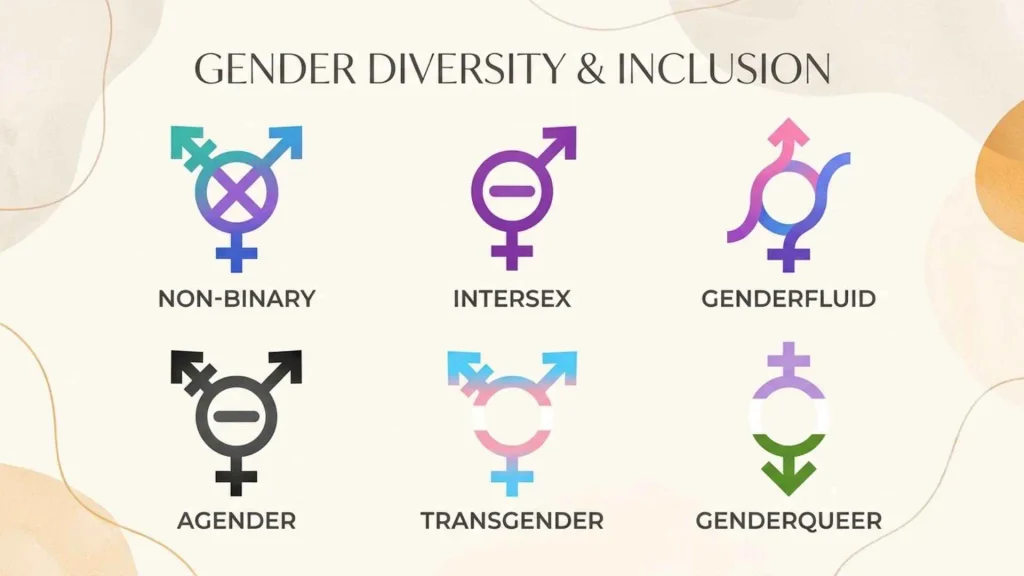
Gender-inclusive communication may use inclusive restroom signs, neutral human pictograms, or explanatory text. These signs aim to make information understandable to a broad audience.
An effective sign should tell people what they need to know. If an icon is unfamiliar, adding a short label can prevent misinterpretation.
Community Symbols and Changing Meanings
Symbols evolve as people adopt, reinterpret, or replace them. A design may begin in one setting and later become associated with another community.
Unicode documentation is useful for identifying encoded characters, but it doesn’t capture every social meaning a symbol may acquire. Community context remains important.
The History and Origins of Gender Symbols
The history of gender symbols stretches across astronomy, mythology, alchemy, botany, and biology. Their development wasn’t a single straight line. Instead, familiar signs moved between fields as people adapted existing notation to new purposes.
Ancient Planetary and Mythological Associations
Ancient civilizations connected celestial bodies with deities, religious traditions, and natural cycles. The Greeks inherited important astronomical and astrological ideas from earlier Mesopotamian traditions, including Babylonian knowledge.
In later Greco-Roman traditions, Venus became associated with love and beauty, while Mars became associated with warfare. These associations helped shape the cultural background of the symbols now recognized as ♀ and ♂.
However, ancient societies didn’t use these signs in precisely the same way people use modern gender markers. Their meanings changed as astronomical notation entered other areas of study.
The Development of Venus and Mars Symbols
The familiar female and male symbols became linked to the planetary signs for Venus and Mars. Historians have examined possible connections between their shapes and abbreviated Greek names for the planets.
The precise development of the symbols involves historical interpretation rather than one simple invention story. Their association with planets is well established, but their journey into biological notation took place over centuries.
NASA’s educational material also explains the connection between the Venus planetary sign and the female symbol. See NASA’s Solar System Symbols guide.
Gender Symbols in Early Modern Science
The 18th-century botanist Carl Linnaeus (1707–1778) played an important role in spreading planetary symbols through botanical classification. These marks offered a compact alternative to repeatedly writing longer descriptions of plant characteristics.
Linnaeus used symbols to distinguish reproductive conditions in plants. Other naturalists found the notation useful and adopted it in additional scientific contexts.
This history shows how a sign can move from astronomy into science without retaining every meaning it originally carried.
The Emergence of Modern Gender and Sexuality Symbols
As scientific notation developed, researchers introduced conventions for recording sex in diagrams and family histories. By the 19th century, male and female signs appeared in biological research, including a pedigree involving color blindness published in 1845.
Later, circles and squares became standard visual elements in many genetic pedigree charts. Meanwhile, LGBTQ+ communities developed and adopted additional symbols to express identities that traditional male and female markers couldn’t adequately represent.
Modern gender identity symbols therefore reflect several overlapping histories: scientific classification, cultural symbolism, and community-led representation.
Venus and Mars Symbols in Mythology, Astrology, and Alchemy
The Venus and Mars signs are especially interesting because they connect several areas of history. They function as planetary symbols, carry mythological associations, and have appeared in alchemical and scientific notation.
Venus: The Goddess, Planet, and Symbol
In Roman mythology, Venus was associated with love, beauty, and fertility. Her Greek counterpart was Aphrodite, although the two goddesses developed distinct stories and religious associations in their respective traditions.
Venus also became an important subject in Western art. Sandro Botticelli’s The Birth of Venus, painted during the Italian Renaissance, is a famous example of the goddess’s cultural influence.
Historical context: Uffizi Gallery
The Venus symbol’s association with femininity grew from this broader history of planetary and cultural symbolism. Yet the goddess’s traditional attributes shouldn’t be treated as rules for how women must behave.
Mars: The God, Planet, and Symbol
Mars was the Roman god of war and a major figure in Roman religious life. His Greek counterpart was Ares, although their roles and cultural importance differed.
Mars became associated with iron in historical alchemical traditions. Iron’s use in tools and weapons helped reinforce the connection between Mars, warfare, and strength.
These associations help explain the traditional link between ♂ and masculinity. They don’t establish that men are naturally aggressive or that masculinity must involve physical strength.
Venus and Mars in Alchemy
Historical alchemy used planetary signs to represent metals and other substances. Two well-known associations were:
| Planetary symbol | Traditional metal association | Chemical symbol |
| ♀ Venus | Copper | Cu |
| ♂ Mars | Iron | Fe |
| ☿ Mercury | Mercury | Hg |
These are historical alchemical associations, not modern chemical notation. Today, chemistry uses standardized element symbols such as Cu, Fe, and Hg.
The distinction is important because planetary symbolism and scientific notation serve different purposes. A historical source may use a planetary sign for a metal, while a modern laboratory uses the element’s chemical symbol.
Why Ancient Symbolism Doesn’t Define Modern Gender
Historical traditions often linked femininity with beauty and masculinity with warfare. Those ideas influenced art, mythology, and symbolic language, but they don’t describe every person or culture.
Modern gender identity is a different concept from ancient planetary symbolism. Using ♀ or ♂ today doesn’t require someone to accept every traditional belief once attached to Venus or Mars.
Gender Symbols in Biology, Genetics, and Medicine
Gender-related signs also have a practical history in science. Researchers need consistent ways to identify individuals, describe reproductive structures, and display relationships in diagrams.
However, scientific notation varies by field. Understanding the legend and purpose of a diagram is more reliable than assuming every symbol has the same meaning everywhere.
Male and Female Symbols in Biology
Biologists may use ♀ and ♂ to identify female and male organisms. In botany, these signs have historically described the reproductive conditions of flowers and plants.
In zoology, similar signs may identify an organism’s sex in a table or diagram. The meaning depends on the study’s methods and terminology.
These conventions don’t automatically describe gender identity. A biological diagram and a social identity graphic may use similar shapes while communicating different information.
Gender Symbols in Botanical Classification
Carl Linnaeus helped establish a systematic approach to naming and classifying organisms. His work made it easier for naturalists to describe species and share information.
He also used compact symbols in botanical descriptions. The familiar male, female, and combined signs proved useful because they could convey reproductive information without lengthy written labels.
The historical development of these conventions is discussed
Symbols in Genetic Pedigree Charts
A genetic pedigree chart represents relationships within a family and may help researchers trace inherited conditions across generations.
Traditional conventions include:
- Square: A male individual in many established pedigree systems.
- Circle: A female individual in many established pedigree systems.
- Diamond: An individual whose sex or gender is unspecified in some conventions.
- Shading: A marked condition or characteristic, as defined by the chart’s legend.
- Connecting lines: Relationships between individuals and their descendants.
For example, a genetic counselor may use a pedigree to track a condition that appears across several generations. The symbols help readers follow family relationships without writing a full description beside every person.
The conventions are evolving. Updated pedigree guidance distinguishes sex from gender and recommends representing gender in ways that better reflect the individuals being documented. See the 2022 pedigree standardization resource in the Journal of Genetic Counseling.
Historical Geometric Symbols in Scientific Research
Circles, squares, and triangles can appear in scientific diagrams for many reasons. Their meanings depend on the research question and the conventions used at the time.
For example, geometric shapes may distinguish categories in an old research chart. That doesn’t make the same shapes universal gender symbols.
A historical diagram should always be read alongside its caption, legend, and original explanation.
Scientific Notation and Personal Identity
Scientific notation provides a concise way to record specific information. It doesn’t capture every part of a person’s identity or experience.
When documenting people, researchers should distinguish between sex-related characteristics and gender identity where relevant. Clear terminology reduces confusion and helps readers understand what the data actually represent.
Gender Symbols Across Cultures and Historical Periods
Cultural symbolism helps explain why gender signs can carry meanings beyond their original scientific use. However, symbols don’t mean the same thing in every society, religion, or historical period.
Gender Symbolism in Ancient Civilizations
Mesopotamian, Greek, and Roman traditions included deities associated with love, fertility, warfare, and other aspects of life. Ishtar, for example, was an important Mesopotamian goddess with associations that varied across periods and traditions.
Greek and Roman cultures later developed their own religious stories and artistic traditions. Some deities shared characteristics across cultures, but their identities and roles weren’t always identical.
These histories provide context for planetary symbolism. They shouldn’t be mistaken for evidence that all ancient societies followed the same gender categories or symbolic systems.
Gender Representation in Art and Literature
Art often reflects the cultural values of the time in which artists created it. Botticelli’s The Birth of Venus, for example, presents the Roman goddess through Renaissance artistic conventions.
Such artworks help explain the lasting association between Venus and feminine beauty. Yet artistic ideals don’t define women’s real experiences, personalities, or appearances.
The same principle applies to masculine imagery associated with Mars. Historical representations reveal cultural ideas rather than universal facts about gender.
Cultural Differences in Gender Symbolism
A sign that feels familiar in one setting may be confusing or carry a different meaning elsewhere. This is especially true when symbols cross languages, religions, and cultural traditions.
When explaining gender representation, consider the source and audience. Avoid assuming that a Western planetary symbol has the same cultural meaning everywhere.
Gender Identity, Biological Sex, and Gender Expression
Understanding these concepts helps readers interpret gender symbols accurately. Although the terms sometimes appear together, each describes a different aspect of human experience.
What Is the Difference Between Sex and Gender?
Biological sex relates to sex characteristics, including reproductive anatomy, hormones, and chromosomes. These characteristics are related but don’t always align in a single, uniform pattern.
Gender identity refers to a person’s internal sense of their gender. A person may identify as a woman, a man, nonbinary, or another gender.
Gender expression describes how someone communicates or presents gender through appearance, clothing, behavior, voice, or other forms of expression.
These distinctions matter when interpreting a symbol. A biological diagram may classify sex-related information, while an identity symbol may communicate how a person understands or describes their gender.
Gender Identity vs. Sexual Orientation
Gender identity and sexual orientation aren’t the same thing.
Consider two examples:
- A transgender woman may be attracted to men, women, people of multiple genders, or people regardless of gender.
- A nonbinary person may identify as gay, bisexual, straight, asexual, or another orientation.
Neither person’s gender identity determines their orientation. Symbols associated with one concept shouldn’t automatically be used to represent the other.
Masculine and Feminine Symbols: What They Do and Don’t Mean
The traditional connection between Mars and masculinity and Venus and femininity remains familiar in many settings. However, these associations reflect cultural history rather than strict rules.
A woman doesn’t need to be feminine to identify as a woman. A man doesn’t need to be masculine in a traditional sense to identify as a man.
Likewise, nonbinary people may express themselves in masculine, feminine, mixed, or gender-neutral ways. Gender symbols are visual conventions, not personality tests.
How Gender Symbols Are Used in Modern Life
Today, gender symbols appear in many settings, from public signs to online communities. Their usefulness depends on how clearly they communicate the intended message.
Gender Symbols in Public Signs and Facilities
Public signs often use simplified human figures or gender-related markers to identify facilities. These signs need to be recognizable at a glance, especially in busy buildings.
Organizations can improve clarity by combining visual symbols with written labels. A clear sign should explain who can use a facility rather than relying on an unfamiliar icon alone.
Gender Symbols in Digital Communication
Unicode allows computers and other digital devices to represent standardized characters, including ♀, ♂, ⚥, ⚢, ⚣, and ⚧.
However, the appearance of a character can vary between fonts, platforms, and applications. Some symbols may look different from the version a writer intended.
Unicode also cautions that pictographic characters can acquire different meanings depending on language, culture, and context. Its official emoji and pictograph FAQ explains why encoded characters shouldn’t always be treated as having one fixed interpretation.
Gender Symbols in Education, Healthcare, and Research
Schools may use gender symbols in educational diagrams, while healthcare professionals may encounter them in records or specialized materials. Researchers also use standardized signs when documenting biological characteristics or family relationships.
In each setting, accuracy matters more than visual convenience. If a symbol could cause confusion, a written explanation should accompany it.
Healthcare providers should also distinguish sex-related information from gender identity when both are relevant. This approach helps ensure that records communicate the intended information without making unnecessary assumptions.
Gender Symbols in Social Media and Community Advocacy
On social media, people may use gender-related symbols to communicate identity, support a community, or make educational content easier to recognize.
Yet a symbol alone may not explain someone’s identity. A short description, a profile label, or a link to an educational resource can provide useful context.
Common Misconceptions About Gender Symbols
Several common misunderstandings arise when people treat symbols as universal definitions rather than context-dependent signs.
– Misconception: The male and female symbols describe every gender.
The signs have established historical associations, but they don’t represent the full range of gender identities.
– Misconception: Gender identity and sexual orientation mean the same thing.
Gender identity describes a person’s gender, while sexual orientation concerns patterns of attraction.
– Misconception: Every LGBTQ+ identity has one universal symbol.
Communities use different symbols, flags, and labels. Some designs are widely recognized, while others are specific to certain groups.
– Misconception: The combined symbol ⚥ always means bigender.
Unicode associates it with intersex, androgynous, and botanical uses. Its meaning in a particular context needs verification.
– Misconception: Venus and Mars symbolism proves gender stereotypes.
Historical associations reflect particular cultural traditions rather than universal facts about men and women.
– Misconception: Circles, squares, and triangles have fixed gender meanings.
Their meanings vary across scientific diagrams and historical classification systems.
– Misconception: A symbol reveals someone’s identity with certainty.
Symbols can communicate affiliation or intended meaning, but you shouldn’t infer someone’s identity from appearance alone.
How to Identify and Interpret an Unfamiliar Gender Symbol
When you encounter an unfamiliar sign, a few simple steps can help you understand it correctly.
- Check the context. Is the symbol appearing in a biology textbook, a public sign, a historical document, or an LGBTQ+ resource?
- Read the accompanying label. A caption or legend often explains the intended meaning.
- Check the character’s identity. Unicode’s character charts can help identify the encoded symbol and its documented name.
- Look for a reliable source. Community organizations, academic publications, and established educational resources can clarify how a symbol is used.
- Distinguish identity from biology. A symbol used to classify an organism doesn’t automatically describe a person’s gender identity.
- Avoid assumptions. If the meaning remains unclear, don’t assign a specific identity to the person or group using it.
For example, if you see ⚥ in an old botanical reference, its historical biological meaning may be the most relevant interpretation. If the same character appears in a modern identity graphic, check the creator’s explanation before drawing conclusions.
Frequently Asked Questions About Gender Symbols
What Are the Most Common Gender Symbols?
The female symbol (♀), male symbol (♂), and transgender symbol (⚧) are among the most recognizable gender-related characters. They appear in educational materials, scientific contexts, and discussions about gender identity.
Their meanings still depend on context. The female and male symbols have historical links to Venus and Mars, while ⚧ is associated with transgender identity and gender diversity.
What Does the Female Symbol (♀) Mean?
The female symbol commonly represents female sex and is historically associated with the planet Venus. It also carries cultural associations with femininity.
In science, its precise meaning depends on the diagram or classification system. It doesn’t represent every aspect of a woman’s identity or experience.
What Does the Male Symbol (♂) Mean?
The male symbol commonly represents male sex and is historically associated with Mars. Its cultural associations include masculinity and strength.
The symbol appears in biological notation and other contexts where a compact male marker is useful. It doesn’t define a person’s personality or gender expression.
What Does the Transgender Symbol (⚧) Mean?
The transgender symbol represents transgender identity and gender diversity in many contemporary contexts. It appears in educational materials, community resources, and awareness campaigns.
Not every transgender person uses or identifies with the same symbol. Written labels can provide additional clarity when needed.
Is There a Universal Symbol for Nonbinary Gender?
No single symbol represents every nonbinary person or community. Some people use ⚧, the Nonbinary Pride Flag, or community-specific designs.
The best choice depends on the identity being represented and the audience’s familiarity with the symbol.
What Is the Difference Between Gender Symbols and LGBTQ+ Symbols?
Gender symbols often communicate sex-related classifications or gender identity. LGBTQ+ symbols can represent specific identities, broader communities, pride, or solidarity.
For example, ⚧ is a gender-related character, while the Rainbow Pride Flag represents the broader LGBTQ+ community.
What Do the Double Venus (⚢) and Double Mars (⚣) Symbols Mean?
Unicode associates ⚢ with female homosexuality and ⚣ with male homosexuality. These signs may represent lesbian and gay male identities in certain symbolic conventions.
However, their use varies. They aren’t necessarily the most familiar or preferred symbols within every LGBTQ+ community.
Why Are Venus and Mars Used as Gender Symbols?
The connection comes from historical planetary notation and its later use in scientific classification. Venus was associated with femininity, while Mars was associated with masculinity in traditional symbolism.
Botanists and other scientists adopted the signs because they offered convenient visual shorthand. Over time, the signs became widely recognized as female and male markers.
What Do Circles and Squares Mean in Genetic Pedigree Charts?
In many traditional genetic pedigree charts, a square represents a male individual and a circle represents a female individual. Shading can indicate an affected individual or another characteristic defined by the legend.
Modern pedigree guidance also addresses how charts can represent gender more accurately. Always consult the chart’s key because conventions may differ.
Can Gender Symbols Have Different Meanings in Different Contexts?
Yes. A symbol may have a historical meaning in alchemy, a technical meaning in biology, and a community-related meaning in modern identity discussions.
The surrounding text, source, and purpose help determine which interpretation applies.
Conclusion: Understanding Gender Symbols and Their Meanings
Gender symbols connect history, science, culture, and modern identity. The female symbol (♀) and male symbol (♂) emerged through traditions involving planetary notation before becoming familiar markers in biological classification and everyday communication.
Other signs, including ⚧, ⚢, and ⚣, help represent transgender identity and certain LGBTQ+ identities. Combined symbols such as ⚥ also have historical and technical meanings that shouldn’t be confused with every modern gender identity.
The most important lesson is simple: a symbol’s meaning depends on its context. Understanding its origins, recognizing the difference between sex and gender, and respecting how communities use their symbols lead to clearer and more accurate communication.

I am Lisa Reynolds, a linguist fascinated by the ever-changing world of slang. I enjoy researching how slang reflects trends, technology, and social connections. I wrote “Text Talk: Understanding Digital Slang” and “From Street to Screen: Slang in Media”, exploring the influence of digital communication on language. I love sharing my discoveries in a way that feels like a conversation with friends, so you feel the culture and humor behind every phrase.
 John Carter