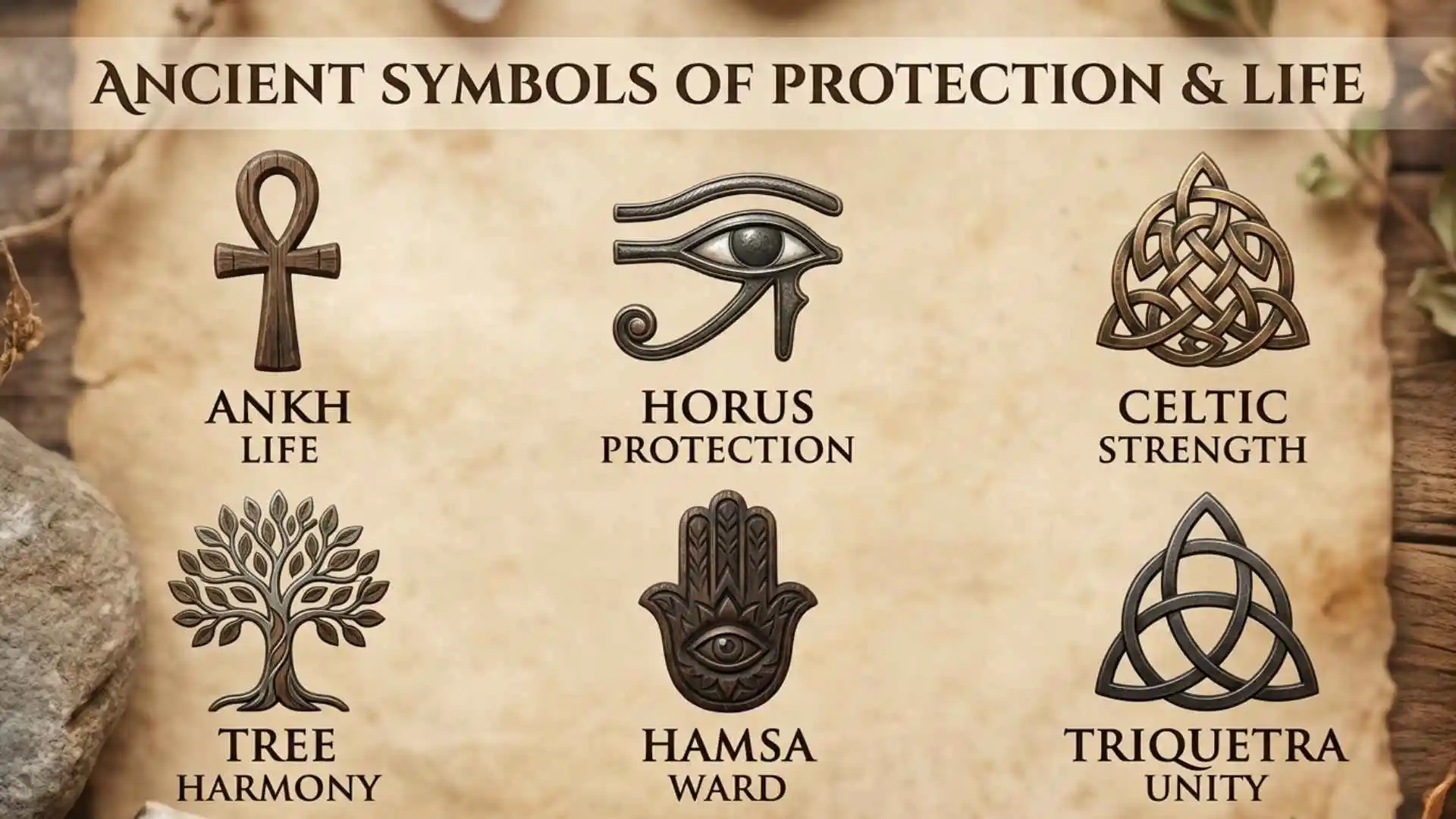
Protection symbols have carried powerful meanings across cultures for thousands of years. People have worn protective amulets, placed sacred signs in their homes, and passed symbolic jewelry through generations to express faith, courage, safety, and hope.
From the Hamsa hand and Evil Eye to the ancient Egyptian Eye of Horus, these designs tell stories about how people understand danger and seek reassurance. Some belong to established religious traditions. Others come from ancient mythology, folklore, or modern spiritual practices.
However, not every protective symbol has the same meaning. A design associated with divine protection in one tradition may represent good fortune, healing, or personal strength in another.
This guide explores the most recognized protection symbols and their meanings, including their histories, cultural connections, religious significance, and modern uses in jewelry. You’ll also learn how to choose a meaningful symbol while respecting the traditions behind it.
What Are Protection Symbols?
Protection symbols are signs, images, objects, or designs that people associate with safety, spiritual defense, divine care, or protection from misfortune. They appear in religious art, ancient amulets, household decorations, clothing, and jewelry.
Throughout history, people have used these symbols to express beliefs about forces they could not fully control. An ancient Egyptian might wear a protective eye amulet, while a Christian traveler might carry a devotional medal. Today, someone might choose a Hamsa pendant as a reminder of faith, cultural heritage, or personal resilience.
These objects don’t all serve the same purpose. Some have well-documented religious meanings, while others carry interpretations that developed much later.
Protection Symbols, Amulets, and Talismans: What’s the Difference?
The terms often overlap, but they describe slightly different things.
| Term | Meaning | Example |
| Protection symbol | A sign or design associated with safety, faith, or defense | Hamsa hand |
| Amulet | An object traditionally worn or carried for protection | Ancient Egyptian Wedjat-eye amulet |
| Talisman | An object believed to attract a particular benefit or outcome | A charm associated with good fortune |
| Protective charm | An object used as a reminder of, or believed to provide, protection | Evil Eye pendant |
| Religious emblem | A sign representing a religious belief or tradition | Christian cross |
| Protective sigil | A designed symbol used within certain magical or esoteric practices | A modern protective sigil |
An object can belong to more than one category. For example, an Eye of Horus pendant is jewelry by form, an amulet by traditional function, and a symbol by design.
What Do Protection Symbols Mean?
The meaning of a protective symbol depends on its history, cultural setting, and the person using it. Still, several themes appear frequently across different traditions.
| Meaning | What it represents | Examples |
| Protection from evil | Defense against harmful intentions or misfortune | Hamsa, Nazar |
| Divine protection | Faith in sacred care or guidance | Cross, devotional medals |
| Strength and courage | Endurance in difficult situations | Helm of Awe in modern interpretations |
| Healing and restoration | Recovery, wholeness, or renewal | Eye of Horus |
| Life and vitality | Existence, continuity, and life | Ankh |
| Guidance and safe travel | Direction and reassurance during journeys | Saint Christopher medal, Vegvisir in modern use |
| Good fortune | Hope for favorable outcomes | Maneki-neko |
| Balance and harmony | Relationships between different elements or forces | Pentagram in some modern pagan traditions |
| Perseverance | Patience and commitment to a goal | Daruma doll |
These meanings aren’t universal definitions. The same design may carry several interpretations, depending on the period and tradition.
Symbols of Protection From Evil
People in many societies have believed that envy, harmful intentions, or supernatural forces could bring misfortune. Protective objects developed partly from these concerns.
The Evil Eye, Nazar, and Hamsa are prominent examples. Their histories overlap in some regions, but they aren’t identical symbols. The Evil Eye describes a belief about a harmful gaze, while a Nazar is a familiar eye-shaped charm used against it.
Symbols of Strength and Resilience
Not every protective symbol focuses on an outside threat. Some represent the inner qualities that help people face adversity.
The oak-inspired symbolism associated with the Dara Knot, for example, connects with strength in modern Celtic-inspired interpretations. The Daruma doll represents perseverance in Japanese culture. Both can serve as reminders to keep going when life becomes difficult.
Symbols of Divine Protection
Religious symbols can express trust in God, sacred guidance, salvation, or devotion. For Christians, the cross recalls the crucifixion and resurrection of Jesus. A Saint Christopher medal traditionally connects with travel and devotional practice.
These objects often matter because of the faith and religious meaning attached to them, not simply because of their physical appearance.
Ancient Protection Symbols and Their History
The history of ancient protection symbols stretches across many civilizations, although no single symbol represents every culture’s approach to safety.
Archaeological evidence shows that ancient people made amulets from stone, clay, metal, glazed materials, and other substances. They wore these objects, placed them in tombs, or incorporated them into religious practices. The Metropolitan Museum of Art documents Egyptian amulets dating from the Predynastic period through the Roman era, roughly 4400 BCE to the fourth century CE.
Ancient Egyptian Protection Symbols
Ancient Egyptian religion offers some of the clearest examples of protective symbols supported by surviving artifacts.
Egyptians used images of deities, animals, and sacred objects to express protection during life and after death. Amulets could combine several features, including shape, color, material, inscriptions, and religious imagery.
Eye of Horus and Wedjat
The Eye of Horus, also called the Wedjat, is one of the best-documented ancient protective symbols. It depicts a stylized eye combining human and falcon features.
According to Egyptian mythology, the god Horus suffered an injury to his eye during a conflict with Seth. The god Thoth restored it, connecting the symbol with healing, regeneration, and restored wholeness.
Ancient Egyptians believed that Wedjat-eye amulets could protect their wearers and transfer regenerative power. Museums hold examples made from materials such as faience and carnelian. The Metropolitan Museum documents a New Kingdom example dated approximately 1386–1347 BCE.
The Wedjat is therefore more than a decorative eye. Its protective meaning connects directly with a story of injury and restoration.
Ankh Symbol Meaning
The Ankh is an ancient Egyptian sign associated with life. Its recognizable shape resembles a cross topped by an oval loop.
Egyptian gods frequently appear holding the Ankh in ancient art. The sign also appears in royal imagery and religious scenes, where it communicates life or the granting of life.
Today, the Ankh appears in pendants, earrings, tattoos, and Egyptian-inspired designs. Some wearers choose it to represent vitality, continuity, or spiritual identity.
However, the Ankh is primarily a symbol of life rather than a universal protection emblem. Its protective associations depend on the context in which people use it.
Scarab Beetle Meaning
The scarab beetle held an important place in ancient Egyptian symbolism. Egyptians associated the beetle with regeneration and the sun’s daily movement, linking it with renewal and continued existence.
Scarab-shaped amulets could also function as seals. Some had inscriptions carved into their flat undersides, giving them practical and symbolic purposes.
Funerary scarabs played a particular role in beliefs about death and the afterlife. Heart scarabs, for example, were associated with the deceased’s judgment and the weighing of the heart.
Key fact: Ancient Egyptian amulets weren’t all designed for the same purpose. Some protected the living, while others addressed specific concerns about death, rebirth, and the afterlife.
Ancient Mesopotamian Protection Symbols
Ancient Mesopotamian societies also developed protective objects and images connected with religious beliefs.
People used amulets, inscriptions, and supernatural guardian figures to address perceived dangers. Protective figures could appear in buildings, while smaller objects served personal or household purposes.
The details varied across periods and communities. Mesopotamia covered many societies, including Sumerian, Akkadian, Babylonian, and Assyrian cultures. It would therefore be misleading to describe all their protective practices as one uniform tradition.
When researching a particular Mesopotamian symbol, look for its original inscription, archaeological setting, and date. These details help distinguish a historically documented meaning from a modern interpretation.
Ancient Greek and Roman Protective Symbols
Ancient Greek and Roman communities also used amulets, engraved objects, and religious imagery to express protection or guard against misfortune.
The Evil Eye tradition has deep roots in the Mediterranean world. People believed that envy or an admiring gaze could cause harm, making protective eyes and related charms meaningful in everyday life.
Engraved rings and small pendants could carry both decorative and symbolic value. Some objects also identified their owners or served practical functions.
These examples show that protection jewelry wasn’t merely ornamental. In many historical settings, jewelry connected personal appearance with religion, social identity, and traditional beliefs.
The Most Recognized Protection Symbols and Their Meanings
Some symbols of protection remain popular because their shapes are easy to recognize and their meanings connect with familiar human concerns. Others have gained new interpretations through contemporary spiritual movements, fashion, and popular culture.
The following guide separates traditional associations from more recent meanings wherever possible.
Hamsa Hand Meaning
The Hamsa is an open-hand motif associated with protection and blessings in several Middle Eastern and North African traditions. Its name relates to the Arabic word for five.
The design often features an eye in the palm, although versions differ in their decorations and proportions. People have used hand-shaped amulets to ward off the Evil Eye and express hopes for well-being.
The Hamsa appears in both Muslim and Jewish cultural settings, among others. The name Hand of Fatima connects it with Fatima, the daughter of the Prophet Muhammad, while Hand of Miriam connects it with Miriam in Jewish tradition.
These names overlap in popular usage, but their religious and cultural contexts deserve attention. The British Museum documents a Moroccan silver Hamsa pendant from around the 1890s and notes its use in protective traditions among Muslim and Jewish communities.
Today, Hamsa necklaces, bracelets, wall hangings, and charms remain widely recognizable. For many people, the hand represents protection, blessing, and a connection with cultural heritage.
Evil Eye Symbol Meaning
The Evil Eye refers to a traditional belief that a person’s envy or harmful gaze can bring misfortune to someone else.
The concept appears in several cultural and historical settings, including the Mediterranean and West Asia. Protective objects associated with the belief often feature an eye designed to guard against the very harm the tradition describes.
People may display Evil Eye charms in homes, cars, shops, or jewelry. Others give them as gifts to express good wishes.
The symbol doesn’t have one universal religious meaning. Its interpretation varies across communities, and some people regard it as a cultural tradition rather than a religious commitment.
Nazar Symbol Meaning
The Nazar is a familiar eye-shaped charm, often made with concentric blue, white, and dark circles. It’s especially associated with Turkish culture and wider regional traditions concerning the Evil Eye.
Nazar charms appear as glass beads, bracelets, necklaces, hanging decorations, and household ornaments. Their common protective association makes them popular gifts for new homes, newborns, and people beginning a new stage of life.
Although the Nazar and the Hamsa can serve similar protective purposes, their shapes are different. The Nazar centers on the eye, while the Hamsa uses an open hand.
Cross Symbol Meaning
The cross is one of Christianity’s central religious symbols. It recalls the crucifixion of Jesus Christ and carries associations with salvation, sacrifice, faith, and hope.
Many Christians wear a cross necklace as an expression of devotion or as a personal reminder of their beliefs. Others display crosses in homes or churches.
The crucifix differs from a plain cross because it includes a representation of Jesus on the cross. That distinction matters when identifying religious jewelry.
Christian protection symbolism shouldn’t be reduced to the idea of a charm that prevents harm. For believers, its meaning may center on faith in God, prayer, spiritual comfort, and trust in divine care.
Pentagram Meaning and Protection Symbolism
A pentagram is a five-pointed star drawn with connected lines. Its history extends across different periods and symbolic traditions, so its meaning depends heavily on context.
In some modern pagan and Wiccan practices, an upright pentagram is associated with the five elements: earth, air, fire, water, and spirit. Practitioners may use it to represent balance, harmony, or spiritual protection.
A pentagram enclosed within a circle is often called a pentacle, particularly in contemporary pagan settings. However, terminology can vary.
The upright and inverted forms have acquired different associations in modern religious and popular contexts. Neither orientation should be interpreted without considering the tradition and setting.
Triquetra and Trinity Knot Meaning
The Triquetra consists of three interconnected arcs that form a continuous-looking knot. Modern audiences often associate it with eternity, unity, and interconnectedness.
Some Christians use the design to represent the Holy Trinity: Father, Son, and Holy Spirit. It also appears in Celtic-inspired art and contemporary jewelry.
However, the label Trinity Knot can cover different designs, and modern interpretations don’t automatically establish the original meaning of every historical knot.
Triquetra pendants and rings appeal to people who value the design’s balance and continuity. Its protective associations are often modern or tradition-specific rather than a universal historical definition.
Algiz Rune Meaning
The Algiz rune belongs to modern discussions of Norse and Germanic symbolism. Contemporary spiritual sources often connect it with protection, awareness, and defense.
Historical runes, however, were part of writing systems used by Germanic peoples. Their forms and sounds changed over time, and the meaning of a rune in an inscription cannot automatically be replaced with a modern spiritual interpretation.
If you’re choosing Algiz jewelry, check whether the seller distinguishes the rune’s historical use from its contemporary symbolic associations. That small detail can make a big difference in understanding what you’re wearing.
Helm of Awe Meaning
The Helm of Awe, also known as Aegishjalmur, is associated with Icelandic magical traditions. Modern interpretations often connect it with protection, courage, and the ability to face threatening situations.
Its familiar radial design appears in modern Norse-inspired tattoos, pendants, and artwork. However, the symbol belongs to a more complex history than many simplified Viking-themed descriptions suggest.
The medieval and early modern Norse worlds left behind varied literary and material records. The Helm of Awe should be discussed in relation to the relevant sources rather than presented as a universal emblem worn by every Viking.
Celtic Shield Knot Meaning
The Celtic Shield Knot is a modern label used for certain interlaced designs associated with defense and protection.
The shield shape naturally suggests safeguarding, while continuous knotwork often evokes connection and endurance. These associations help explain why the design appears in modern Celtic-inspired jewelry and decorative art.
Still, not every interlaced knot has a documented ancient protective meaning. Some designs are modern creations inspired by historical art rather than exact reproductions of a known ancient emblem.
Dara Knot Meaning
The Dara Knot is commonly associated with the oak tree and inner strength in modern Celtic-inspired symbolism. The oak’s long life and sturdy structure make it a natural image for endurance.
Today, people may choose Dara Knot pendants or tattoos to represent resilience, personal growth, and a connection with Irish heritage.
Its popularity shouldn’t be confused with proof that the specific modern design served as a standardized ancient Celtic protective symbol. The oak symbolism and the design’s modern use are better treated as related but distinct subjects.
Vegvisir Meaning
The Vegvisir is a compass-like Icelandic magical stave often associated today with guidance and finding one’s way.
Its history deserves special attention. The earliest known attestation identified in the Huld manuscript dates to 1860, when Geir Vigfússon compiled the Icelandic manuscript. The National and University Library of Iceland’s manuscript is documented in historical catalog records.
Modern jewelry sellers frequently market Vegvisir as an ancient Viking compass. That description overstates the available evidence. Its documented history supports an association with Icelandic magical tradition, but it doesn’t establish widespread use by Viking-age sailors.
As a contemporary symbol, Vegvisir may still represent direction, resilience, and confidence during uncertain journeys.
Ouroboros Meaning
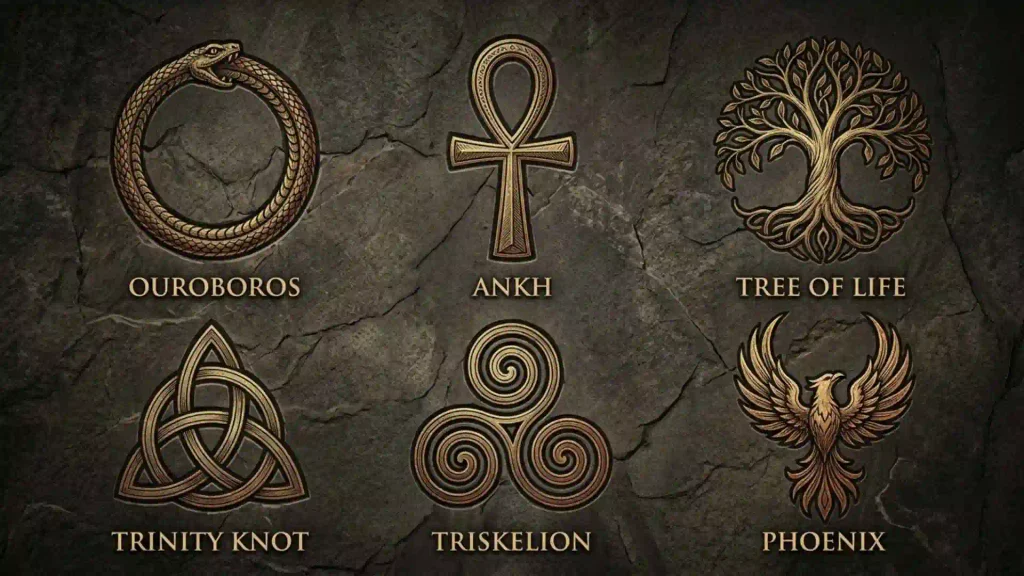
The Ouroboros depicts a serpent or dragon consuming its own tail to form a circle. The design is commonly associated with cycles, eternity, renewal, and wholeness.
Its circular form suggests an ending that becomes a beginning. For this reason, modern audiences often use it to express personal transformation or the repeating cycles of life.
The Ouroboros appears in different historical and symbolic contexts. Although people may interpret it as protective, its strongest common associations concern cyclical continuity and renewal.
Triple Moon Symbol Meaning
The Triple Moon typically combines a waxing crescent, full moon, and waning crescent. In modern Wiccan and pagan symbolism, these phases are often associated with the maiden, mother, and crone.
The design can represent life stages, changing cycles, femininity, and spiritual identity. Its popularity has grown through contemporary spiritual communities and jewelry.
It’s important to distinguish this modern symbolic system from ancient lunar worship as a whole. Different cultures interpreted the moon in different ways, and they didn’t all use this exact three-part emblem.
Bind Runes and Protective Sigils
Bind runes combine two or more runic characters into a single design. Protective sigils are symbols created or used within certain magical and esoteric practices.
Both terms appear frequently in modern spiritual jewelry and artwork. However, a newly created design shouldn’t automatically be presented as an ancient historical artifact.
To understand a bind rune, investigate its individual characters, the inscription’s context, and whether a reliable historical source documents it. For a modern sigil, the creator’s intended meaning may be the most relevant guide.
Religious Protection Symbols and Their Meanings
Religious protection symbols connect protection with faith, prayer, sacred teachings, and devotional practices. Their meanings can differ significantly even when two traditions use similar-looking objects.
Christian Protection Symbols
Christianity includes several symbols and devotional objects associated with faith and protection.
- Cross: Represents the crucifixion of Jesus, salvation, and Christian faith.
- Crucifix: Features the figure of Jesus on the cross and emphasizes his sacrifice.
- Saint Christopher medal: Traditionally associated with travelers seeking protection during journeys.
- Miraculous Medal: Connects with devotion to the Virgin Mary and the Catholic tradition surrounding the medal.
Saint Christopher medals are popular gifts for drivers, travelers, and people beginning a journey. Their importance comes from Christian devotional practice rather than a scientifically verified ability to prevent accidents.
The Miraculous Medal also has a specific religious history. It originated in connection with reported visions of Mary to Catherine Labouré in Paris in 1830. Catholic devotion to the medal developed from that tradition.
Islamic Protection Symbols and Traditions
Islamic approaches to protection include prayer, remembrance of God, and trust in divine care. Some Muslim communities also have cultural traditions involving protective objects.
The Hand of Fatima is a familiar name for the Hamsa in many contexts. Its use varies among communities, and it isn’t a universal Islamic religious requirement.
This distinction matters because a cultural practice associated with Muslims doesn’t automatically represent a teaching accepted by all Muslims. Some people embrace the Hamsa as a cultural emblem, while others have different religious views about protective amulets.
Jewish Protection Symbols and Traditions
Jewish traditions include religious objects, prayers, and customs associated with spiritual life and protection.
The Hand of Miriam appears in some Jewish cultural contexts as a name for the Hamsa. The mezuzah, meanwhile, is a religious object containing specific passages from the Torah, traditionally attached to the doorposts of Jewish homes.
The Star of David is another important Jewish symbol, particularly associated with Jewish identity and community. Although people may use it as a personal reminder of faith and belonging, it isn’t exclusively a protection symbol.
Understanding these distinctions helps avoid treating all Jewish symbols as interchangeable charms.
Japanese Religious Protection Objects
Japanese omamori are small protective or blessing-related charms commonly obtained at Shinto shrines and Buddhist temples. They often come in decorated fabric pouches and serve specific purposes.
Depending on the shrine or temple, an omamori may relate to:
- Good health and well-being.
- Safe travel and traffic safety.
- Success in school or examinations.
- Good fortune and personal goals.
- Protection for families or pets.
Japan’s official tourism organization describes omamori as common shrine and temple charms with purposes that vary by location.
Omamori aren’t simply decorative accessories. Their religious setting and intended purpose are part of their meaning, so it’s worth learning about the institution that provides one.
Cultural Protection Symbols From Around the World
Cultural protection symbols reflect the histories, values, and spiritual practices of the communities that use them. Their meanings often overlap, but similar designs don’t necessarily share the same origins.
Celtic Protection Symbols
Celtic-inspired designs often feature interlaced lines, loops, and repeated geometric patterns.
Modern interpretations connect these designs with continuity, connection, strength, and protection. However, specific claims about ancient meanings require historical evidence.
If you’re interested in Celtic knot jewelry, consider the design’s actual origin. A historical artifact, a modern reconstruction, and a contemporary decorative knot may look similar without having the same documented history.
Norse and Germanic Protection Symbols
Norse-inspired jewelry often features runes, mythological imagery, and magical staves.
The Algiz rune receives modern protective interpretations, while the Helm of Awe and Vegvisir are linked with Icelandic magical traditions. These symbols shouldn’t all be grouped together as interchangeable Viking-age emblems.
The distinction is especially important for Vegvisir, whose earliest known attestation appears in the 1860 Huld manuscript.
When a seller describes a design as an ancient Norse protection symbol, look for evidence that supports the exact claim.
Mediterranean and West Asian Protection Symbols
The Hamsa, Hand of Fatima, Hand of Miriam, and Nazar illustrate the rich protective symbolism found across Mediterranean and West Asian communities.
Some traditions connect these objects with guarding against envy or the Evil Eye. Others emphasize blessings, cultural identity, or religious associations.
Their histories overlap through trade, migration, and cultural exchange. Yet shared use doesn’t mean that every community interprets each symbol identically.
Indigenous and Other Cultural Traditions
Many Indigenous communities have their own protective symbols, sacred objects, and traditional practices. These should be understood within the specific community that maintains them.
Avoid labeling unfamiliar Indigenous designs as generic spiritual protection symbols without reliable documentation. Some objects carry sacred meanings or restrictions that commercial descriptions leave out.
A responsible approach begins with the source: identify the community, consult credible cultural institutions, and listen to knowledgeable members of that tradition.
Spiritual Protection Symbols and Their Modern Interpretations
Modern spiritual practices often draw on historical imagery while adding contemporary meanings. A symbol may serve as a focus for meditation, a reminder of personal values, or an expression of spiritual identity.
However, spiritual protection symbols don’t all belong to one shared belief system.
Symbols Associated With Spiritual Defense
The Hamsa, Nazar, pentagram, and selected sigils are common examples in discussions of spiritual defense.
Their meanings differ:
- The Hamsa is associated with protection and blessings in several cultural traditions.
- The Nazar is linked with protection against the Evil Eye.
- The pentagram has different meanings across historical and modern religious settings.
- Protective sigils depend on the practices and intentions of the people who create or use them.
It’s useful to learn what a symbol means within its own tradition instead of assuming that every protective design works the same way.
Symbols of Grounding, Balance, and Inner Strength
Some symbols focus less on external threats and more on personal stability.
The pentagram can represent elemental balance in certain contemporary pagan practices. Black onyx and hematite are associated with grounding in modern crystal traditions, while oak-inspired imagery can represent endurance.
People may use these symbols as reminders to remain calm, maintain boundaries, or keep working toward a goal. These personal associations can be meaningful even when supernatural claims lack scientific support.
Symbols of Healing, Renewal, and Resilience
The Eye of Horus offers a historical example of symbolism tied to restoration. Its association with the healed eye of Horus connects it with regeneration in ancient Egyptian belief.
The Metropolitan Museum of Art
+1
The scarab beetle also connects with regeneration and new life in Egyptian symbolism. Meanwhile, the Ouroboros represents cyclical renewal in several interpretive traditions.
These symbols can inspire modern reflections on recovery, personal growth, and resilience without requiring every modern interpretation to match an ancient belief.
Protection Symbols in Jewelry: Necklaces, Rings, and Amulets
Protection symbol jewelry gives people a way to carry meaningful imagery in everyday life. A necklace might express religious devotion, while a ring may connect with family heritage or a personal spiritual practice.
For many wearers, the value lies in the story behind the object. Others appreciate the design, craftsmanship, or connection to a particular culture.
Protection Symbol Necklaces and Pendants
Common protective symbol necklaces include:
- Hamsa pendants: Associated with protection and blessings in several traditions.
- Evil Eye pendants: Linked with protection against envy or the harmful gaze.
- Cross pendants: Express Christian faith and devotion.
- Ankh necklaces: Feature the ancient Egyptian symbol of life.
- Celtic knot pendants: Often represent connection and continuity in modern interpretations.
- Norse-inspired pendants: May feature runes or magical staves with historical or modern meanings.
Before buying a pendant, check whether the design accurately represents the symbol you want. Some commercial products combine multiple motifs or use simplified versions of historical imagery.
Protective Rings and Bracelets
Protective jewelry isn’t limited to necklaces. Rings and bracelets can carry the same motifs in a smaller, more subtle form.
An Evil Eye ring might feature a blue eye-shaped stone or enamel design. A signet ring may display a religious emblem, family crest, or personal symbol. Bracelets can combine charms associated with different memories or traditions.
When choosing everyday jewelry, consider fit, comfort, material, and durability. Rings receive frequent contact with surfaces, while bracelets can catch on clothing or other objects.
Gold, Silver, and Gemstone Protection Jewelry
Gold and silver are popular materials for symbolic jewelry because they suit a wide range of designs and finishes.
- Gold: Often chosen for its appearance, workability, and long-standing use in fine jewelry.
- Silver: Offers a bright finish and works well for detailed designs.
- Gemstones: Add color, texture, and traditional symbolic associations.
- Enamel and glass: Allow vivid colors and detailed motifs, particularly in eye-shaped charms.
The material doesn’t establish whether a piece provides protection. Its meaning comes from the symbol, the tradition, and the significance the wearer attaches to it.
Can You Wear Protection Symbols From Another Culture?
You can explore jewelry from different cultures thoughtfully, but context matters.
Before choosing a symbol, consider these questions:
- Where did the design originate?
- Does it have a religious or sacred meaning?
- Is it associated with a particular community or practice?
- Does the seller explain its meaning accurately?
- Could wearing it as a fashion accessory misrepresent its significance?
Cultural appreciation begins with learning. If a symbol has specific religious requirements or community restrictions, respect those boundaries rather than treating every design as a universal accessory.
Protection Stones and Gemstones Traditionally Associated With Protection
Protection stones appear in many traditional healing systems, spiritual practices, and jewelry traditions. Some gemstones have centuries of documented use in ornaments and amulets, while their modern protective meanings may come from more recent crystal practices.
The important distinction is between a stone’s historical use and claims about its effects. A gemstone can have cultural significance without scientific evidence that it blocks negative energy or prevents harm.
Black Onyx Meaning
Black onyx is a variety of chalcedony, a form of microcrystalline quartz. Jewelers use it in rings, pendants, beads, and signet jewelry because of its smooth finish and deep color.
In modern crystal traditions, black onyx is associated with grounding, strength, resilience, and protection from negative influences. People may choose it as a personal reminder to stay steady during stressful periods.
Those associations are spiritual beliefs rather than established scientific properties. When buying black onyx jewelry, focus on the stone’s identity, craftsmanship, setting, and care requirements.
Turquoise Protection Meaning
Turquoise has a long history in jewelry and decorative arts across several regions, including parts of the Middle East, Central Asia, and the Americas.
Different cultures have attached different meanings to the stone. Protective associations appear in some traditions, but turquoise doesn’t have one universal spiritual meaning.
Its cultural importance also deserves respect. In particular, turquoise has deep significance in many Indigenous North American jewelry traditions. Buying from knowledgeable makers and checking claims about origin can help support responsible purchasing.
Obsidian Spiritual Meaning
Obsidian is natural volcanic glass formed when lava cools quickly. People have used it for tools and decorative objects for thousands of years.
Modern crystal practices often associate obsidian with grounding, protection, and confronting difficult emotions. These interpretations differ from its documented archaeological importance as a material for making sharp-edged tools and ornaments.
Obsidian can make striking jewelry, but its spiritual associations shouldn’t be confused with proven medical or protective effects.
Lapis Lazuli Meaning
Lapis lazuli is a deep-blue ornamental stone prized in ancient and modern decorative arts. It was used in beads, inlays, and other objects across several historical trading networks.
Its rich color encouraged associations with prestige, the heavens, and religious imagery in some ancient contexts. Modern spiritual interpretations may connect it with wisdom, intuition, or spiritual awareness.
Lapis lazuli can be an excellent choice for symbolic jewelry if you value its color and history. However, claims about its ability to provide supernatural protection remain matters of belief.
Hematite Meaning
Hematite is an iron oxide mineral with a metallic gray or black appearance in many polished jewelry forms.
Modern crystal traditions often associate hematite with grounding, stability, and strength. Its appearance also makes it popular in beads, bracelets, and pendants.
When shopping, remember that metallic-looking jewelry beads aren’t always natural hematite. Some products use other materials or coatings, so check the seller’s material description if authenticity matters to you.
Comparison of Protection Stones and Their Traditional Associations
| Stone | Common symbolic associations | Typical jewelry uses |
| Black onyx | Grounding, strength, resilience | Rings, pendants, beads |
| Turquoise | Protection in some traditions, heritage, well-being | Pendants, bracelets, rings |
| Obsidian | Grounding and protection in modern crystal practices | Beads, pendants, polished stones |
| Lapis lazuli | Prestige, celestial imagery, spirituality | Necklaces, beads, inlays |
| Hematite | Stability and grounding in modern crystal traditions | Bracelets, rings, beads |
These descriptions summarize cultural and spiritual associations. They don’t establish that any stone prevents injury, treats disease, or creates a measurable protective force.
How to Choose a Protection Symbol That Fits Your Beliefs
The right symbol is one whose meaning you understand and genuinely value. Instead of choosing a design solely because a seller calls it powerful, start with the quality or belief you want it to represent.
Start With the Meaning You Want to Represent
Different symbols suit different intentions.
- Faith and devotion: Consider a religious symbol that belongs to your tradition.
- Protection from the Evil Eye: Explore the history of the Nazar or Hamsa.
- Strength and resilience: Look into symbols associated with endurance, such as the modern interpretation of the Dara Knot.
- Guidance and travel: Consider the devotional tradition surrounding Saint Christopher medals or the modern use of Vegvisir.
- Life and renewal: Explore the Ankh, Eye of Horus, or scarab imagery.
- Cultural heritage: Choose a symbol with a documented connection to your family or community.
These are starting points, not rigid rules. A symbol may hold a personal meaning that differs from its most common interpretation.
Research the Symbol’s Origins
A few minutes of research can prevent common misunderstandings.
Look for museum collections, historical documents, cultural institutions, and religious sources. Check when a symbol first appears in surviving evidence and whether the meaning described by a seller comes from historical records or modern spiritual interpretations.
For example, the Eye of Horus has extensive museum documentation as an ancient Egyptian protective amulet. Vegvisir, by contrast, is documented in the nineteenth-century Huld manuscript. Both have modern protective associations, but their historical records differ substantially.
Choose the Right Jewelry Form
Think about how you intend to use the piece.
- Necklaces: Suitable for visible symbols and pendants.
- Rings: Offer a smaller design that you can keep close throughout the day.
- Bracelets: Work well for charms, beads, and layered styles.
- Earrings: Provide a subtle way to wear symbolic motifs.
- Decorative objects: Allow you to display a symbol in your home without wearing it.
Consider comfort, maintenance, price, and durability before choosing a piece.
Respect Cultural and Religious Context
A symbol’s meaning doesn’t disappear when it becomes fashionable. Some designs remain important to religious communities, while others have been adapted widely for contemporary jewelry.
Learn about the tradition, avoid repeating unsupported origin stories, and consider buying from makers who explain the symbol accurately. This approach makes your choice more meaningful and supports better cultural understanding.
Frequently Asked Questions About Protection Symbols
What Is the Most Powerful Protection Symbol?
There is no universally accepted or scientifically verified most powerful protection symbol. The Hamsa, Evil Eye, cross, and other designs hold different meanings across cultures and religions. The most meaningful choice depends on your beliefs, cultural background, and the symbolism you want to honor.
Which Symbol Represents Protection From Evil?
The Hamsa and Nazar are widely associated with protection against the Evil Eye in several cultural traditions. The Hamsa uses an open-hand design, while the Nazar typically features a blue-and-white eye motif. Their meanings and uses vary across communities.
What Is the Best Symbol for Spiritual Protection?
The best choice depends on your spiritual or religious tradition. Some people value the Hamsa, while others prefer a cross, a traditional amulet, or a symbol from their own faith. Research the symbol’s history and choose one that aligns with your beliefs.
What Is the Difference Between the Evil Eye and the Eye of Horus?
The Evil Eye refers to a belief that a harmful or envious gaze can bring misfortune. The Eye of Horus, also called the Wedjat, comes from ancient Egyptian mythology and is associated with protection, healing, and restoration. The two symbols have different histories even though both feature an eye.
What Is the Oldest Known Protection Symbol?
No single symbol can confidently claim the title of the world’s oldest protection symbol. Archaeologists have found protective objects from very early periods, and many have uncertain origins or meanings. Ancient Egyptian amulets provide particularly well-documented evidence of long-standing protective practices.
Can You Wear Protection Symbols Every Day?
Yes, many people wear symbolic jewelry daily. Choose a durable piece that suits your lifestyle and understand the symbol’s cultural or religious meaning. For practical protection, remember that jewelry doesn’t replace seat belts, medical care, safety equipment, or other proven precautions.
Which Gemstones Are Traditionally Associated With Protection?
Black onyx, turquoise, obsidian, lapis lazuli, and hematite all appear in discussions of protective gemstones. Their associations differ by culture and practice. Some stones have long histories as ornaments or amulets, while specific claims about their spiritual effects come from traditional or modern beliefs rather than established scientific evidence.
Can You Wear Symbols From Different Religions or Cultures?
People often wear jewelry inspired by different traditions, but they should learn about each symbol first. Some symbols are widely shared, while others have specific religious or community meanings. Understanding that context helps you make a respectful and informed choice.
Do Protection Symbols Actually Work?
Protection symbols have documented cultural, historical, and religious significance. They may offer comfort, strengthen a person’s sense of identity, or serve as reminders of faith and personal values. However, there is no reliable scientific evidence that wearing a symbol provides supernatural protection or guarantees safety.
Conclusion: Finding Meaning in Protection Symbols
Protection symbols tell us a great deal about how people across history have understood safety, faith, courage, and uncertainty. From ancient Egyptian amulets to Japanese omamori and Christian devotional medals, these objects connect everyday life with cultural traditions and personal beliefs.
Some symbols have strong archaeological evidence behind their historical use. Others gained their familiar meanings through modern spiritual practices or contemporary jewelry design. Knowing the difference helps you appreciate each symbol without confusing tradition with established fact.
If you’re choosing protection jewelry, begin with the meaning that matters most to you. Research its origins, consider its cultural context, and choose a design you’ll value for years to come.
A meaningful pendant, ring, or charm can serve as a reminder of your faith, heritage, or inner strength. Its greatest personal value may lie in the story it carries and the values it helps you remember.
Further Reading and Historical Sources
For readers who want to explore the history of ancient protection symbols, these museum and cultural resources offer useful starting points:
- The Metropolitan Museum of Art: Ancient Egyptian Amulets — An overview of Egyptian amulets, their materials, functions, and religious significance.
- The Metropolitan Museum of Art: Wedjat Eye Amulet — Historical details about an ancient Egyptian Eye of Horus amulet.
- The British Museum: Hand of Fatima or Khamsa Pendant — A documented example of a protective hand-shaped pendant from Morocco.
- National and University Library of Iceland: Vegvisir Manuscript Record — Information about the Vegvisir design in the nineteenth-century Huld manuscript.
- Japan National Tourism Organization: Shrine and Temple Traditions — Background on Japanese religious sites and traditional objects such as omamori.
These resources help separate documented history from modern interpretations, making it easier to understand the rich meanings behind symbols of protection.

I am John Carter, a lifelong enthusiast of language and modern slang. I explore how words evolve and shape culture, and I enjoy uncovering the stories behind everyday expressions. I have authored “Slang and Society: The Language of Youth” and “Modern Words, Modern Worlds”, where I dive into how informal language impacts communication and identity. My goal is to make language accessible, fun, and insightful for everyone who loves words as much as I do.
 Lisa Reynolds