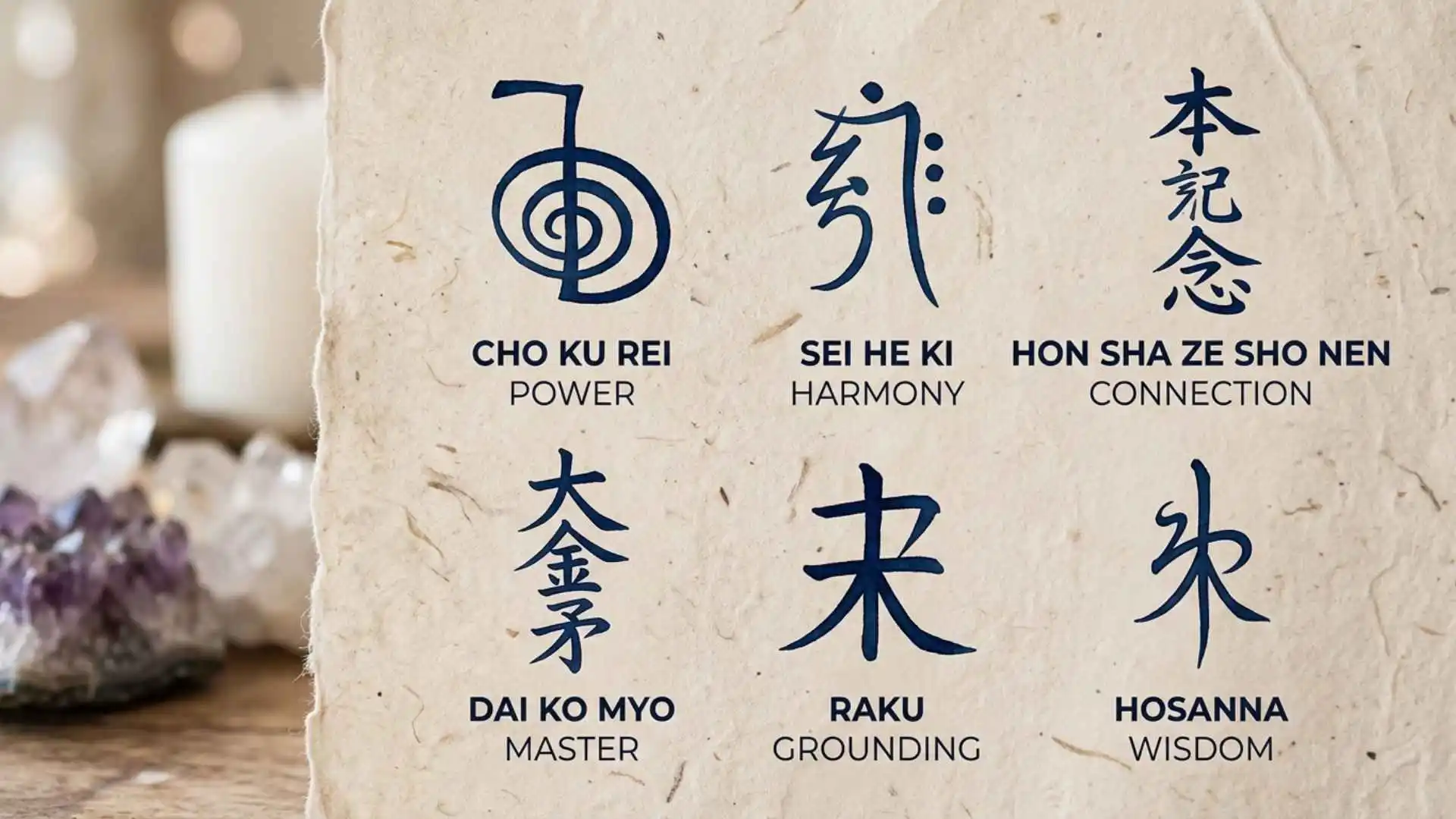
Reiki symbols are traditional signs used in many Reiki lineages to focus attention and intention during energy healing practices. Each symbol has a commonly taught meaning, from the power associated with Cho Ku Rei to the distance practice associated with Hon Sha Ze Sho Nen.
If you’ve searched for Reiki symbols meanings, you may have noticed that different websites list different symbols or explain their purposes in different ways. That’s because Reiki includes several teaching traditions, and not every school follows the same curriculum.
This guide explains the main Usui Reiki symbols, their traditional associations, how practitioners use them, and what beginners should know about drawing, activation, and attunement. It also separates spiritual teachings from medical claims that scientific research hasn’t established.
What Are Reiki Symbols?
Reiki symbols are visual forms and associated names used within certain Reiki practices. Practitioners may draw them, visualize them, or mentally recall their names while conducting a session.
Reiki itself is a complementary wellness practice associated with Mikao Usui, a Japanese spiritual teacher who developed the system known as Usui Reiki in the early 20th century. Practitioners traditionally describe Reiki as working with universal life energy or universal life force energy.
Within this framework, symbols help practitioners focus their attention on particular intentions. Depending on the lineage, those intentions may relate to energy amplification, emotional harmony, distance healing, or spiritual development.
For example, a practitioner might use Cho Ku Rei while setting an intention at the beginning of a session. Another might use Sei He Ki during a practice focused on emotional balance.
These are traditional uses rather than proven medical effects. The National Center for Complementary and Integrative Health explains that Reiki hasn’t clearly demonstrated effectiveness for any health-related purpose and that scientific evidence doesn’t support the proposed energy field behind the practice. Read the NCCIH overview of Reiki.
Why Are Reiki Symbols Considered Sacred?
Some Reiki teachers treat symbols as sacred because they connect them with spiritual discipline, training, and the relationship between teacher and student.
In certain lineages, students traditionally learn the symbols during specific training levels. Teachers may also explain their forms, names, and uses as part of an attunement or initiation process.
However, not every Reiki school treats symbols in exactly the same way. Some emphasize their spiritual significance, while others focus more on their practical role during meditation and sessions.
It’s also important to distinguish Reiki symbols from ordinary Japanese writing. Although several names contain Japanese words or kanji, their Reiki meanings can reflect the interpretations of a particular teaching tradition rather than a simple, universally accepted translation.
How Many Reiki Symbols Are There?
There isn’t one number that covers every Reiki tradition.
Many Western Usui Reiki lineages teach four main symbols: Cho Ku Rei, Sei He Ki, Hon Sha Ze Sho Nen, and Dai Ko Myo. The first three are commonly introduced at the second practitioner level, while Dai Ko Myo is associated with master-level training.
Some teachers also include Raku as a fifth symbol. Raku is particularly associated with certain expanded Reiki systems and is often described as a symbol of grounding or completion.
Other Reiki systems teach additional symbols, while some Japanese Reiki approaches differ from the Western curriculum. Therefore, the number depends on the lineage and how the symbols are classified.
| Symbol count | What it commonly refers to |
| Three symbols | The three commonly taught practitioner-level symbols |
| Four symbols | The three practitioner-level symbols plus Dai Ko Myo |
| Five symbols | A four-symbol list with Raku added in certain lineages |
| Additional symbols | Symbols used in other Reiki systems or expanded teachings |
The key distinction: Four symbols form a common Western Usui Reiki set, but five-symbol lists also appear in Reiki teaching. Neither count represents every tradition.
Reiki Symbols Chart: Names, Meanings, and Uses
The following Reiki symbols chart summarizes the five symbols discussed in this guide. Their meanings describe common Reiki teachings rather than scientifically verified healing properties.
| Reiki symbol | Common name | Traditional association | Commonly taught context |
| Cho Ku Rei | Power Symbol | Focus and amplification | Reiki sessions and self-practice |
| Sei He Ki | Mental and Emotional Symbol | Emotional and mental harmony | Reflective and emotional wellness practices |
| Hon Sha Ze Sho Nen | Distance Symbol | Distance Reiki | Distance sessions |
| Dai Ko Myo | Master Symbol | Spiritual development and master-level practice | Advanced Reiki training |
| Raku | Completion Symbol | Grounding and completion | Certain attunement traditions |
These names provide a useful starting point, but their exact interpretations and teaching methods may vary.
The Five Reiki Symbols and Their Meanings
Cho Ku Rei: The Reiki Power Symbol
Common association: Power, focus, and amplification
Cho Ku Rei is commonly known as the Reiki power symbol. Many practitioners associate it with concentrating intention or amplifying the focus of a Reiki session.
Its meaning is often paraphrased in Reiki teaching as bringing power into a particular place or directing attention toward a specific purpose. However, English explanations vary, so it’s better not to treat one popular translation as the only correct interpretation.
What Is Cho Ku Rei Used For?
Within Reiki practice, Cho Ku Rei may be used for:
- Focusing intention: Establishing a clear purpose for a session.
- Energy amplification: Representing the intention to strengthen or concentrate Reiki practice.
- Protection: Supporting a ritual focused on personal boundaries or a peaceful setting.
- Self-Reiki: Marking the beginning of a personal practice.
- Meditation: Providing a visual focus during quiet reflection.
Some practitioners visualize the symbol over their hands, near a person receiving Reiki, or in a space where they intend to practice. The precise method depends on their training.
These uses describe Reiki traditions. They don’t establish that the symbol increases a measurable energy field or physically protects a person.
Is Cho Ku Rei the Most Powerful Reiki Symbol?
Cho Ku Rei is called the Power Symbol, but that doesn’t mean it has been scientifically proven to be the strongest symbol.
The label describes its traditional role within Reiki. Practitioners may favor it for particular purposes, while other symbols serve different roles in their training.
For a beginner, the useful distinction is simple: Cho Ku Rei is associated with focus and power, not a scientifically established ranking of healing strength.
Sei He Ki: The Mental and Emotional Healing Symbol
Common association: Mental and emotional harmony
Sei He Ki is commonly called the mental and emotional healing symbol or the Harmony Symbol. Reiki teachers often associate it with emotional balance, mental clarity, and harmony between thoughts and feelings.
The symbol may appear in practices that encourage reflection on difficult emotions, recurring thought patterns, or personal relationships. Its role is spiritual and symbolic within Reiki rather than a clinically validated treatment.
What Is Sei He Ki Used For?
Commonly taught uses include:
- Emotional balance: Focusing on feelings that need attention or reflection.
- Mental clarity: Supporting a quiet practice centered on awareness.
- Self-reflection: Encouraging people to notice recurring thoughts and reactions.
- Meditation: Providing a symbolic focus for calm attention.
- Personal growth: Helping practitioners frame intentions around patience, compassion, or self-awareness.
For example, someone who feels overwhelmed after a stressful day might use meditation and journaling alongside a Reiki session. A practitioner might incorporate Sei He Ki into that session because of its traditional association with harmony.
The value of the activity may lie in relaxation, reflection, or personal meaning. There isn’t strong scientific evidence that the symbol itself treats emotional disorders.
Can Sei He Ki Treat Anxiety or Depression?
No Reiki symbol has been established as an effective medical treatment for anxiety or depression. People may find a Reiki session calming, but that experience isn’t the same as demonstrating a clinical treatment effect.
If anxiety, depression, or emotional distress affects daily life, evidence-based mental health care remains important. Reiki, if someone chooses to use it, should complement rather than replace appropriate professional support.
Hon Sha Ze Sho Nen: The Reiki Distance Healing Symbol
Common association: Distance Reiki and intentions beyond physical proximity
Hon Sha Ze Sho Nen is commonly known as the distance healing symbol. In many Western Usui Reiki lineages, practitioners learn it alongside Cho Ku Rei and Sei He Ki at the second practitioner level.
The symbol is associated with distance Reiki, a practice in which the practitioner and recipient aren’t physically present in the same room. Some teachers also connect it with intentions involving past experiences or future events.
Its long name and complex form can make it seem mysterious to newcomers. However, its main role in common Reiki teaching is straightforward: it represents the intention to conduct a session across physical distance.
How Is Hon Sha Ze Sho Nen Used?
Practitioners may incorporate the symbol into distance sessions by:
- Establishing the recipient’s identity and obtaining consent.
- Setting a clear intention for the session.
- Following the visualization or symbol-use method taught in their lineage.
- Conducting the session according to their training.
- Closing the practice and checking in with the recipient when appropriate.
Practitioners may also use the symbol while reflecting on a past event or preparing mentally for a future situation. Such practices should not be confused with changing the past or guaranteeing future outcomes.
Does distance Reiki transmit healing energy across space? This is a belief within Reiki practice, not an established scientific finding. Research hasn’t demonstrated that Reiki symbols enable a measurable healing force to travel between people.
Dai Ko Myo: The Reiki Master Symbol
Common association: Master-level practice and spiritual development
Dai Ko Myo is widely known as the Reiki master symbol. In many Western Usui Reiki lineages, it appears at the master or teacher level rather than in introductory training.
Its name is commonly translated in Reiki literature as “Great Bright Light,” although wording and interpretation can vary. Practitioners often connect it with spiritual development, deeper awareness, and advanced Reiki practice.
What Is Dai Ko Myo Used For?
Depending on the lineage, Dai Ko Myo may be used during:
- Master-level Reiki practice.
- Reiki attunements or initiation rituals.
- Meditation focused on spiritual development.
- Practices intended to deepen a practitioner’s relationship with Reiki teachings.
- Training in the responsibilities associated with teaching Reiki.
Its position in advanced training doesn’t establish that it has greater medical or healing power than other symbols. Rather, it reflects its role within particular Reiki teaching systems.
A Reiki master may learn how to use the symbol through formal training, including the methods their teacher follows for attunements and instruction.
Raku: The Reiki Completion Symbol
Common association: Grounding and completion in certain lineages
Raku is often called the completion symbol or grounding symbol in some Reiki systems. It is commonly associated with certain Western or expanded Reiki teachings rather than being universally included in the core Usui symbol set.
Practitioners who use Raku may associate it with closing an attunement, completing a training ritual, or grounding at the end of a practice.
What Is Raku Used For?
Commonly described uses include:
- Marking the completion of certain attunement procedures.
- Representing grounding after an intensive spiritual practice.
- Providing a symbolic transition from a formal session to everyday activities.
- Supporting a sense of closure at the end of a Reiki ritual.
Raku isn’t a universal requirement for ending every Reiki session. Its use depends on the teacher and the system being taught.
It’s also worth avoiding absolute statements about its historical origin. Its place in contemporary Reiki teaching is clearer than claims that it was one of the original symbols used by Mikao Usui.
Traditional Usui Reiki Symbols vs. Other Reiki Symbols
The term Usui Reiki symbols usually refers to symbols taught within Reiki systems connected to Mikao Usui’s teachings. However, modern Reiki education includes different lineages, and their symbol lists aren’t identical.
Many Western Usui courses teach the four main symbols described above. Other systems include additional symbols or use different methods of instruction.
What Is the Difference Between Japanese Reiki and Western Reiki?
Reiki developed in Japan in the early 20th century. As practitioners carried it to other countries, teaching methods and training structures evolved.
Western Usui Reiki commonly organizes training into levels and introduces particular symbols at specific stages. Japanese Reiki traditions can follow different teaching approaches, terminology, and practices.
| Feature | Common Western Usui teaching | Other Reiki lineages |
| Symbol count | Often four core symbols | May include fewer or additional symbols |
| Level structure | Commonly Level 1, Level 2, and Master | Varies by school |
| Symbol instruction | Often linked to training levels | Depends on the lineage |
| Raku | Included in certain expanded systems | Not universal |
| Teaching methods | May emphasize symbols, names, and attunement | Can differ considerably |
These are broad comparisons rather than fixed rules. The best way to understand a symbol is to identify the specific tradition that teaches it.
Are Reiki Symbols Ancient Sanskrit Symbols?
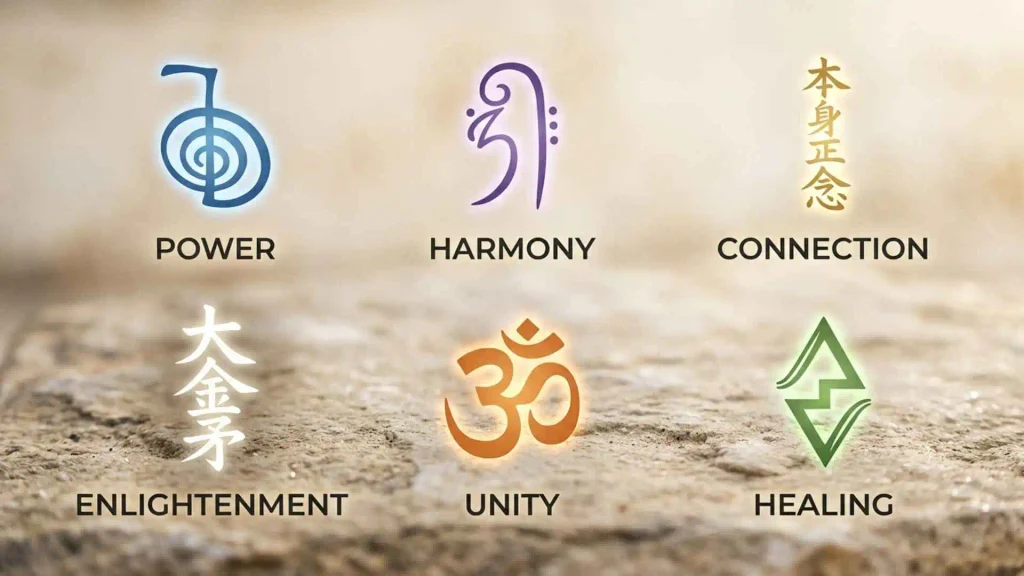
Reiki draws on Japanese spiritual and cultural contexts, but claims about the exact origins of individual symbols require care.
Some online explanations connect Reiki symbols directly to Sanskrit or ancient spiritual writings. However, that doesn’t establish that every modern Reiki symbol originated in Sanskrit or has a documented ancient history.
The symbols used in modern Reiki developed through particular teaching lineages. Their precise historical origins and later interpretations aren’t equally well documented.
When researching a symbol, distinguish its traditional Reiki meaning from claims about its original language, age, or cultural source.
How Do Reiki Symbols Work?
Within Reiki teachings, symbols help practitioners focus intention during a session. Practitioners may draw a symbol, visualize it, repeat its name, or associate it with a particular purpose.
A simple comparison helps explain this idea. A person might use a candle to mark the beginning of meditation or repeat a phrase to focus their attention. The object or phrase becomes a reminder of the mental state they want to cultivate.
In a similar way, Reiki practitioners may use sacred Reiki symbols as reminders of focus, emotional harmony, distance practice, or spiritual development.
However, the traditional explanation differs from a scientific explanation.
What Does Science Say About Reiki Energy?
Reiki is based on the belief that a form of energy supports the body’s natural healing abilities. Scientific research hasn’t established the existence of the proposed Reiki energy field.
The National Center for Complementary and Integrative Health also notes that research hasn’t clearly demonstrated Reiki’s effectiveness for any health-related purpose. Studies involving pain, anxiety, and depression have produced inconsistent results and often have methodological limitations.
That doesn’t mean every person who enjoys Reiki is imagining their experience. Someone may find a session relaxing or meaningful without proving that symbols transmit a special energy.
It’s important to keep three ideas separate:
- Traditional belief: Reiki symbols help focus or direct Reiki energy.
- Personal experience: Someone may feel relaxed, reflective, or emotionally supported during a session.
- Scientific evidence: Current evidence doesn’t establish that Reiki symbols generate specific healing effects.
This distinction allows readers to explore Reiki without confusing spiritual teachings with established medical facts.
How to Use Reiki Symbols
The way practitioners use symbols depends on their training and lineage. In many Usui Reiki systems, students learn their practical use alongside hand positions, meditation, and other parts of Reiki practice.
A typical practice may involve preparing a quiet space, setting an intention, and using the symbol according to the method taught by a Reiki teacher.
How to Draw Reiki Symbols
Reiki students may learn to draw symbols in the air, trace them with a hand, or visualize their forms mentally. Some teachers also demonstrate a particular stroke order.
If you’re learning Reiki, follow the version taught within your training rather than combining drawings from unrelated websites.
Useful points to remember include:
- Learn the symbol’s name and traditional association.
- Follow your teacher’s instructions for its form and stroke order.
- Understand the context in which your lineage uses the symbol.
- Practice calmly rather than treating drawing as a test of artistic ability.
- Ask your teacher about variations if different charts show different forms.
A Reiki symbols chart can help you remember names and associations. However, a chart alone doesn’t provide the full context of a particular training tradition.
How to Activate Reiki Symbols
Reiki symbol activation refers to practices that some teachers use to incorporate a symbol into Reiki work. Depending on the lineage, these may involve visualization, mentally or verbally repeating the symbol’s name, and setting an intention.
Some Reiki systems connect the formal use of symbols with attunement. Others explain activation through their own teaching methods.
There is no single activation procedure that every Reiki practitioner follows.
If you’re learning through a formal course, ask your teacher to demonstrate the method used in that lineage. If you’re simply exploring the topic, you can study the symbols and their cultural context without claiming to activate healing energy.
Can You Combine Reiki Symbols?
Yes. Practitioners in some Reiki lineages combine symbols during a session.
For example, a practitioner might use Cho Ku Rei to establish focus and Sei He Ki when the session’s intention centers on emotional harmony. A distance practitioner may incorporate Hon Sha Ze Sho Nen according to their training.
These combinations reflect traditional practice, not proven formulas with guaranteed results.
Beginners should learn the individual symbols before experimenting with combinations. Understanding each symbol’s role makes the practice easier to follow and helps prevent confusion between different lineages.
Do Reiki Symbols Require Attunement?
In many Reiki traditions, attunement is a formal process through which a teacher introduces students to a particular level of Reiki practice. Some lineages associate it with learning or using specific symbols.
Attunement is part of Reiki’s spiritual teaching framework. It hasn’t been scientifically established as a transfer of measurable healing energy.
You can read about Reiki symbols, learn their names, and study their meanings without completing a Reiki course. Formal practice, however, may follow different expectations depending on the teacher and lineage.
Reiki Level 1
Level 1 commonly introduces Reiki’s basic principles and practice. Students may learn hand positions, self-treatment, and how to conduct a simple session.
Some courses don’t emphasize symbols at this stage. Others may introduce related concepts depending on the curriculum.
Reiki Level 2
Many Western Usui Reiki courses introduce Cho Ku Rei, Sei He Ki, and Hon Sha Ze Sho Nen at Level 2. Students learn their traditional associations and how to incorporate them into practice.
This is why these three symbols are often grouped together as the Reiki Level 2 symbols.
Reiki Master Level
Dai Ko Myo is commonly associated with master-level training. Depending on the course, students may explore advanced practice, teaching responsibilities, and attunement methods.
Some lineages also teach Raku or other symbols. Ask about the curriculum before assuming every Reiki Master course includes the same material.
Reiki Symbols for Self-Healing, Meditation, and Spiritual Practice
Many people explore Reiki symbols because they’re interested in self-healing practices, meditation, or spiritual development.
Within Reiki traditions, symbols provide a focus for intention. Outside those traditions, people may also find symbolic forms useful as reminders to pause, reflect, and pay attention to their thoughts.
The following uses describe common spiritual practices rather than established treatments for medical conditions.
Reiki Symbols for Self-Reiki
Self-Reiki involves practicing Reiki on yourself rather than receiving a session from another practitioner.
Depending on their training, practitioners may use symbols while settling into a quiet space or following their usual hand positions.
A simple routine might include:
- Choose a comfortable, quiet place.
- Set aside a few minutes without distractions.
- Follow the self-Reiki method taught in your lineage.
- Use symbols according to your training.
- Finish by noticing how you feel and returning to your usual activities.
You can also keep a journal to record your experience. Focus on observable details, such as whether you felt relaxed or found it easier to concentrate.
Reiki Symbols for Emotional Healing
Sei He Ki is the symbol most commonly associated with emotional healing and mental harmony.
Some practitioners incorporate it into sessions intended to encourage reflection on difficult feelings or recurring thought patterns. Others use it during meditation or personal spiritual practice.
For example, someone dealing with a stressful week might set aside time to reflect on what caused their stress and what practical changes could help. A Reiki session might accompany that process if the person finds the practice meaningful.
However, Reiki symbols aren’t established treatments for trauma, depression, anxiety disorders, or addiction. People experiencing ongoing emotional distress should seek appropriate professional support.
Reiki Symbols for Distance Healing
Hon Sha Ze Sho Nen is traditionally associated with distance Reiki healing.
Practitioners who follow this approach may conduct a session when the recipient is in another location. They may use visualization, focused intention, and methods taught by their Reiki teacher.
Consent matters. A practitioner should respect the recipient’s wishes and explain what a distance session involves.
Claims that the symbol transmits a measurable healing force across distance remain unproven. People should not use distance Reiki as a substitute for medical care or practical assistance.
Reiki Symbols for Grounding and Protection
Cho Ku Rei is associated with focus and protection in some Reiki teachings, while Raku is linked with grounding and completion in certain lineages.
Some practitioners incorporate these symbols into rituals intended to mark the beginning or end of a session.
Grounding can also involve simple, practical activities:
- Take a few slow, comfortable breaths.
- Notice your feet against the floor.
- Identify the sounds around you.
- Stretch gently if that feels comfortable.
- Return your attention to the task in front of you.
These activities can help you reconnect with your surroundings. They don’t require a belief in energy fields or symbolic protection.
Reiki Symbols vs. Reiki Principles
Reiki symbols and Reiki principles are related to the same broad tradition, but they serve different roles.
Symbols are used in certain Reiki practices as visual or mental focal points. The Reiki principles, also called the Reiki precepts, are ethical and personal guidelines associated with daily living.
A common English version begins with the phrase “Just for today” and includes five themes.
| Reiki principle | Common interpretation |
| Release anger | Notice anger without letting it control your actions |
| Let go of worry | Work toward responding to uncertainty with greater calm |
| Practice gratitude | Appreciate the good things in your life |
| Work honestly | Act with integrity and take responsibility |
| Be kind | Treat yourself and others with compassion |
Translations and wording vary among teachers.
These principles encourage mindfulness, gratitude, honesty, and kindness. Unlike the symbols, they don’t depend on memorizing a specific visual form.
Some practitioners include them in a daily meditation or reflection routine. For example, you might spend a few minutes each evening thinking about a moment when you acted kindly or responded calmly to a difficult situation.
What Are the Benefits of Reiki Symbols?
The benefits associated with Reiki symbols depend on whether you’re discussing traditional beliefs, personal experiences, or scientific findings.
Within Reiki teachings, practitioners associate particular symbols with focus, emotional harmony, distance practice, or spiritual development. Some people also report relaxation or a sense of comfort during Reiki sessions.
However, those reports don’t establish that individual symbols produce measurable health benefits.
The NCCIH Reiki overview states that Reiki hasn’t been clearly shown to be effective for any health-related purpose. It also notes that researchers haven’t established the existence of the energy field proposed by Reiki theory.
If you enjoy Reiki, you can approach it as a complementary wellness or spiritual practice. Just keep the following limits in mind:
- Don’t assume a symbol can cure an illness.
- Don’t use Reiki instead of prescribed treatment.
- Don’t treat spiritual interpretations as medical diagnoses.
- Discuss complementary practices with a qualified health professional when they affect decisions about your care.
Reiki may have personal meaning for some people. That meaning doesn’t need to become a medical claim.
Common Myths About Reiki Symbols
Conflicting explanations online can make Reiki symbols seem more mysterious than they need to be. These distinctions help clear up common misunderstandings.
Myth: Every Reiki tradition uses exactly five symbols.
Reality: Many Western Usui lineages teach four core symbols. Some systems add Raku or other symbols.
Myth: Raku is always one of the original Usui symbols.
Reality: Raku appears in certain Reiki systems, but it isn’t universally included in the core Usui set.
Myth: Every symbol has one universally accepted meaning.
Reality: Common associations exist, but interpretations and teaching methods can vary by lineage.
Myth: Drawing a symbol automatically qualifies someone as a Reiki practitioner.
Reality: Copying a drawing isn’t the same as completing training or learning a particular lineage’s methods.
Myth: Reiki symbols are proven to cure disease.
Reality: Scientific evidence doesn’t establish that Reiki symbols treat medical conditions.
Myth: One symbol is scientifically proven to be the most powerful.
Reality: Labels such as “Power Symbol” describe traditional associations, not measured scientific rankings.
Myth: Reiki symbols and Reiki principles are interchangeable.
Reality: Symbols serve as focal points in certain practices, while the principles offer guidance for daily conduct.
Frequently Asked Questions About Reiki Symbols
What Are the Five Main Reiki Symbols?
A commonly discussed five-symbol list includes Cho Ku Rei, Sei He Ki, Hon Sha Ze Sho Nen, Dai Ko Myo, and Raku. However, many Western Usui lineages teach four core symbols and don’t include Raku in that set.
What Is the Most Powerful Reiki Symbol?
Cho Ku Rei is commonly called the Power Symbol because practitioners associate it with focus and amplification. However, no symbol has scientifically established superior healing power.
Which Reiki Symbol Is Used for Distance Healing?
Hon Sha Ze Sho Nen is traditionally associated with distance Reiki. Practitioners in relevant lineages use it when conducting sessions with recipients who aren’t physically present.
Which Reiki Symbol Is Associated With Emotional Healing?
Sei He Ki is commonly associated with mental and emotional harmony. Its traditional role doesn’t mean it has been proven to treat mental health conditions.
Can Beginners Use Reiki Symbols?
Beginners can study Reiki symbols and their meanings. In many Usui Reiki lineages, formal instruction in the three practitioner-level symbols takes place at Level 2, so practical use depends on the training tradition.
Can You Draw Reiki Symbols Without Attunement?
You can learn about a symbol or reproduce its visual form without completing Reiki training. Whether formal use requires attunement depends on the lineage and the teacher’s approach.
Do Reiki Symbols Need to Be Activated?
Some Reiki traditions teach activation methods involving visualization, intention, or repeating a symbol’s name. There isn’t one universal procedure, and scientific evidence hasn’t established that activation creates a measurable healing effect.
What Is the Difference Between Cho Ku Rei and Dai Ko Myo?
Cho Ku Rei is commonly associated with power and focus. Dai Ko Myo is associated with master-level practice and spiritual development. They have different traditional roles rather than scientifically proven differences in healing strength.
Are Reiki Symbols Religious?
Reiki symbols belong to a spiritual practice with Japanese roots, but Reiki isn’t identical to one particular religion. Practitioners and teachers may interpret their spiritual significance differently.
Can Reiki Symbols Treat Anxiety or Depression?
No Reiki symbol is an established treatment for anxiety or depression. If you choose Reiki as a complementary practice, continue to seek appropriate mental health care.
Conclusion: Understanding Reiki Symbols and Their Meanings
Reiki symbols play a meaningful role in many Reiki traditions. Cho Ku Rei is associated with focus and power, Sei He Ki with mental and emotional harmony, Hon Sha Ze Sho Nen with distance Reiki, and Dai Ko Myo with master-level practice. Some lineages also include Raku for grounding and completion.
The number of symbols, their precise meanings, and the methods used to teach them can vary. That’s why understanding a symbol’s lineage is more useful than assuming every online chart follows one universal standard.
If you’re exploring Reiki, start by learning the names, traditional associations, and history of the symbols. If you want to practice formally, seek instruction from a teacher who clearly explains their lineage and methods.
Above all, approach Reiki with curiosity and realistic expectations. It can be meaningful as a spiritual or complementary wellness practice, but its proposed energy mechanisms and specific healing effects haven’t been scientifically established.

I am Lisa Reynolds, a linguist fascinated by the ever-changing world of slang. I enjoy researching how slang reflects trends, technology, and social connections. I wrote “Text Talk: Understanding Digital Slang” and “From Street to Screen: Slang in Media”, exploring the influence of digital communication on language. I love sharing my discoveries in a way that feels like a conversation with friends, so you feel the culture and humor behind every phrase.
 John Carter