
Harry Potter and the Sorcerer’s Stone introduces readers to a magical world filled with enchanted objects, mysterious places, and unforgettable characters. Yet beneath the spells, flying broomsticks, and moving staircases lies a deeper story about love, identity, courage, ambition, and the choices that shape a person’s life.
The Harry Potter and the Sorcerer’s Stone symbols help bring these ideas to life. Harry’s lightning-shaped scar connects him to a painful past. The Mirror of Erised reveals the emotional power of unfulfilled desires. The Sorcerer’s Stone raises questions about immortality and selfish ambition. Even Hogwarts becomes more than a school because it offers Harry something he has never truly experienced before: a place where he belongs.
Written by J.K. Rowling and first published in 1997 in the United Kingdom as Harry Potter and the Philosopher’s Stone, the novel introduces the central characters and conflicts that shape the series. The American edition followed in 1998 under the title Harry Potter and the Sorcerer’s Stone.
Understanding the novel’s literary symbols makes its story even more meaningful. These symbols connect magical adventures to familiar human experiences, allowing readers to explore how the past influences identity, how desires reveal character, and why the responsible use of power matters.
What Is Symbolism in Harry Potter and the Sorcerer’s Stone?
Symbolism in literature occurs when an object, character, place, action, or image represents an idea beyond its literal meaning. A symbol can deepen a story by connecting something concrete to an emotion, belief, conflict, or theme.
For example, Harry’s scar is a physical mark on his forehead. Within the story, it also connects him to Voldemort’s attack, his survival, and the history he gradually discovers. Its importance extends beyond its appearance because it influences how other people recognize and understand Harry.
Rowling uses several kinds of narrative symbolism throughout the novel:
- Physical symbols: Harry’s scar represents a lasting connection to his past.
- Magical objects: The Mirror of Erised and the Sorcerer’s Stone explore desire, mortality, and ambition.
- Symbolic settings: Hogwarts offers belonging and education, while the Forbidden Forest introduces danger and uncertainty.
- Character symbolism: Harry and Voldemort create a contrast between different responses to power and adversity.
- Recurring motifs: Love, identity, choice, and the tension between knowledge and experience appear repeatedly.
A symbol does not always have one fixed meaning. Its interpretation depends on the scene, the characters involved, and the larger story.
For this reason, effective Harry Potter literary analysis distinguishes between what the novel explicitly establishes and what readers can reasonably interpret. The strongest interpretations connect symbolic meanings to actual events rather than inventing hidden messages without textual support.
Major Harry Potter and the Sorcerer’s Stone Symbols and Meanings
The following table summarizes the novel’s most important symbols and explains how each contributes to its major themes.
| Symbol | Main symbolic meaning | Connection to the novel |
| Harry’s lightning-shaped scar | Survival, identity, and the lasting impact of the past | Connects Harry to Voldemort’s failed attack |
| Mirror of Erised | Deepest desires, longing, and self-reflection | Reveals Harry’s desire to see his parents |
| Sorcerer’s Stone | Immortality, temptation, and moral responsibility | Drives the conflict between Harry and Voldemort |
| Hogwarts | Belonging, education, and personal growth | Gives Harry a community and a place to develop |
| Quidditch | Competition, courage, and cooperation | Helps Harry develop confidence and find his place |
| Invisibility Cloak | Secrecy, freedom, and access to hidden spaces | Enables Harry to explore beyond ordinary boundaries |
| Harry’s parents | Love, memory, and protection | Their absence shapes Harry’s emotional life |
| Voldemort | Destructive ambition and the misuse of power | Contrasts with Harry’s choices and values |
| Forbidden Forest | Danger, uncertainty, and confronting fear | Forces Harry to face threats outside Hogwarts |
| Sorting Hat | Identity, belonging, and choice | Introduces the relationship between personal character and group identity |
These Harry Potter symbols and meanings work together rather than existing in isolation. The Mirror of Erised and the Sorcerer’s Stone both involve desire, for example, but they reveal different aspects of human motivation. Hogwarts and the Sorting Hat both explore belonging, although one provides a community while the other assigns a group identity.
That connection between symbols gives the novel much of its emotional and thematic depth.
Harry’s Lightning-Shaped Scar: Survival, Identity, and Destiny
Harry’s lightning-shaped scar is among the most recognizable images in fantasy literature. It identifies him immediately, connects him to the central villain, and reminds readers that his story began long before he entered Hogwarts.
However, the scar is more than a memorable physical feature. Its symbolic meaning develops through Harry’s discovery of his past and his growing understanding of the wizarding world.
What Does Harry Potter’s Scar Symbolize?
The scar represents survival because Harry receives it during Voldemort’s attack as an infant. Voldemort kills Harry’s parents and attempts to kill Harry, but the curse rebounds. Harry survives while Voldemort loses his physical form.
The scar becomes a lasting reminder of that event. Harry grows up without knowing the full story, yet the mark remains on his forehead as evidence of an experience he cannot remember.
This creates an important contrast: Harry’s physical identity carries a history that his conscious memory cannot explain.
The scar also connects Harry to fate and destiny. Other witches and wizards recognize him because of the attack, and his reputation often precedes his actual achievements. Before Harry understands his own abilities, the wizarding community already treats him as an extraordinary figure.
Yet the scar does not determine every choice Harry makes. His decisions, relationships, and actions shape the person he becomes.
The Scar as a Reminder of Love and Sacrifice
Harry’s survival is closely connected to his mother Lily Potter’s sacrifice. She refuses to step aside when Voldemort comes for her son, and her death becomes central to the protection that saves Harry.
This event introduces love and protection as major themes. Harry benefits from an act of love long before he understands what happened.
The scar therefore connects two opposing forces:
- Destruction: Voldemort’s attempt to kill Harry.
- Protection: Lily’s sacrifice and the protection associated with her love.
- Survival: Harry’s unexpected escape from the attack.
- Identity: The mark that links Harry to his past.
- Conflict: The lasting connection between Harry and Voldemort.
The scar also carries a cost. It sometimes hurts when Voldemort is near or when Harry experiences a connection associated with him. This detail complicates any interpretation of the scar as a simple badge of honor. It signifies survival, but it also points toward danger and an unresolved conflict.
Harry’s Scar and Odysseus’s Scar in The Odyssey
A useful literary comparison involves Odysseus, the hero of Homer’s ancient Greek epic The Odyssey.
In that poem, Odysseus has a distinctive scar from a childhood injury sustained during a boar hunt. The scar helps his former nurse, Eurycleia, recognize him when he returns home in disguise.
Both Harry’s scar and Odysseus’s scar connect a hero’s present identity to an earlier event. Each also helps establish a link between personal history and the story’s unfolding conflict.
However, their functions differ. Odysseus’s scar provides a concrete means of recognition, while Harry’s scar connects him to Voldemort’s attack and the unusual circumstances of his survival.
This comparison illustrates a recurring feature of symbolic scars in literature: a mark on the body can preserve a story that the character carries into the future.
The Mirror of Erised: Desire, Longing, and Self-Discovery
The Mirror of Erised is one of the novel’s clearest examples of magical symbolism. Unlike an ordinary mirror, it does not show a person’s physical appearance. Instead, it reveals the deepest desires of the person standing before it.
The inscription on its frame reads:
“Erised stra ehru oyt ube cafru oyt on wohsi.”
Read backward, the inscription becomes “I show not your face but your heart’s desire.”
This message explains the mirror’s central function. It reflects what a person longs for rather than what actually exists.
What Does the Mirror of Erised Symbolize?
The Mirror of Erised symbolizes desire, emotional longing, and the gap between reality and imagination. It allows readers to see what matters most to a character, even when that character struggles to express those feelings.
For Harry, the mirror reveals his parents and other family members standing around him. He has spent his childhood without knowing their love firsthand, so the image offers a vision of the family life he never experienced.
The mirror exposes a powerful emotional truth: Harry’s deepest desire is not wealth, fame, or magical ability. He wants a family.
This makes the mirror a tool for character development. Instead of explaining Harry’s loneliness through a long speech, Rowling uses a visual image that immediately communicates his longing.
Harry’s Reflection and His Desire for Family
Harry’s experience with the mirror gains meaning from his upbringing with the Dursleys. They provide him with shelter but treat him as an unwanted burden rather than a cherished member of the family.
When Harry sees his parents in the mirror, the image offers a sharp contrast to that childhood experience.
The scene communicates several ideas:
- Family bonds: Harry longs for a relationship he never had the chance to develop.
- Identity: Seeing his parents helps him imagine the family history from which he comes.
- Emotional needs: His desire reveals the loneliness beneath his growing confidence.
- Self-discovery: The mirror shows Harry something important about himself.
- Memory and loss: The image makes the absence of his parents more emotionally immediate.
The mirror cannot bring Harry’s parents back. It can only show him what he wants to see.
That limitation matters because it separates emotional comfort from actual change. Harry may find the image beautiful, but remaining in front of it cannot replace the experience of living, forming relationships, and building a future.
Dumbledore’s Warning About the Mirror
Dumbledore explains that the mirror gives neither knowledge nor truth about the future. People who become absorbed in its reflections may waste their lives watching imagined happiness instead of engaging with reality.
His warning adds a second layer to the mirror’s symbolic interpretation.
Desire itself is not necessarily harmful. Harry’s longing for his parents is natural and understandable. The danger appears when someone becomes so attached to an imagined outcome that they stop living in the present.
The mirror therefore explores the tension between hope and obsession.
It asks readers to consider several questions:
- Can a desire reveal something meaningful about a person?
- When does longing become an obstacle to personal growth?
- Why can imagined happiness feel more appealing than imperfect reality?
- How can someone acknowledge emotional needs without allowing them to control every decision?
What the Mirror Teaches About Desire and Identity
The Mirror of Erised also provides a useful contrast with the Sorcerer’s Stone.
Harry wants something emotionally meaningful: the chance to see his parents. Voldemort wants to regain power and overcome death. These desires differ in nature, although the novel does not suggest that every personal desire is either good or bad.
The mirror reveals what Harry lacks. The Stone tests what a person might do to obtain extraordinary power.
Together, these magical objects explore the relationship between desire and identity. What people want can reveal their values, but their choices determine how they pursue those desires.
The Sorcerer’s Stone: Immortality, Temptation, and Moral Responsibility
The Sorcerer’s Stone drives the novel’s central mystery, but its importance extends beyond its extraordinary magical properties. Created by the alchemist Nicolas Flamel, the Stone can produce the Elixir of Life, which allows its user to extend life, and transform metals into gold.
These powers make the Stone an object of enormous value. They also raise an uncomfortable question: What happens when the desire for power becomes more important than the lives and well-being of others?
What Does the Sorcerer’s Stone Symbolize?
The Stone symbolizes the temptation of immortality, the pursuit of wealth, and the ethical challenges associated with extraordinary power.
Its promise of a longer life appeals to the fear of death. Its ability to produce gold represents material wealth and the possibility of escaping ordinary limitations.
However, the novel doesn’t treat possessing such power as an automatic sign of success. The Stone becomes dangerous because Voldemort wants to use it to restore his strength and regain a form of life.
Its symbolic meanings include:
- Immortality: The desire to escape death and human limitations.
- Ambition: The pursuit of extraordinary achievements or abilities.
- Temptation: The attraction of rewards that may encourage harmful choices.
- Moral responsibility: The need to consider how power affects other people.
- Selflessness: The ability to place a greater good above personal gain.
The Stone is therefore both a magical object and a test of character. Its powers matter less than the reasons someone wants to possess them.
Harry’s Selflessness Versus Voldemort’s Ambition
Harry and Voldemort approach the Stone with very different intentions.
Voldemort seeks the Stone because he wants to regain his strength and overcome his weakened condition. Harry becomes involved in protecting it because he believes someone dangerous intends to steal it.
The difference becomes especially important during the final confrontation with Professor Quirrell, who serves Voldemort. Dumbledore has enchanted the mirror so that someone who wants to find the Stone without using it can obtain it.
Harry qualifies because he wants to find the Stone and prevent Voldemort from getting it. He doesn’t seek to use it for personal gain.
This scene reinforces one of the novel’s central moral lessons: wanting something powerful doesn’t make someone worthy of possessing it.
The contrast also complicates the idea of heroism. Harry doesn’t defeat Voldemort through superior knowledge or magical strength alone. His motives matter because he approaches the Stone differently from those who seek to exploit it.
Why the Stone Matters Beyond Its Magical Powers
The Stone connects the novel’s mystery to its broader themes of mortality, greed, and ethical choice.
Harry and his friends initially investigate the Stone because they suspect someone wants to steal it. Their investigation leads them through clues, dangers, and increasingly difficult decisions.
The object gives these events a shared purpose. It also creates a clear contrast between protecting something valuable and possessing it for selfish reasons.
Ultimately, Dumbledore explains that the Stone will be destroyed and that Flamel and his wife will have time to settle their affairs. The decision emphasizes the risks associated with preserving immortality at any cost.
The deeper message isn’t that every pursuit of knowledge or longer life is inherently wrong. Rather, the novel asks readers to consider the consequences of allowing fear, greed, or personal ambition to override moral judgment.
Hogwarts: Belonging, Education, and Personal Growth
Hogwarts School of Witchcraft and Wizardry represents a turning point in Harry’s life. Before arriving there, he lives with the Dursleys, who treat him as an outsider within his own household. At Hogwarts, he discovers friendships, teachers who recognize his abilities, and a community that welcomes him.
This transformation makes Hogwarts one of the most important symbolic settings in Harry Potter.
Hogwarts as a Symbol of Belonging
Hogwarts gives Harry a place where he can begin to understand himself. His acceptance into the school introduces him to a world that explains his unusual experiences and gives him a new sense of possibility.
The contrast with Privet Drive is striking. At the Dursleys’ home, Harry receives little affection or encouragement. At Hogwarts, he starts forming relationships that help him grow.
The school symbolizes:
- Belonging: Harry becomes part of a community.
- Identity: He learns about his family history and magical abilities.
- Friendship: He develops meaningful relationships with Ron and Hermione.
- Independence: He begins making decisions beyond the control of his relatives.
- Personal growth: He encounters challenges that test his judgment and courage.
Hogwarts isn’t a perfect environment. Its rules can be confusing, its corridors contain dangers, and its students sometimes behave cruelly toward one another. Those imperfections make it more than an idealized refuge.
The school offers opportunities for growth, but Harry and his friends must still decide how to respond to them.
Education, Knowledge, and Moral Development
The novel also explores the relationship between academic knowledge and practical experience.
Hermione Granger frequently demonstrates the value of preparation, careful reading, and logical reasoning. She often knows the correct spell or relevant fact when her friends face a difficult situation.
Harry, meanwhile, relies on quick thinking, courage, and his ability to act under pressure. Ron contributes practical knowledge of the wizarding world and often recognizes details his friends overlook.
Their different strengths show why effective problem-solving requires more than one kind of intelligence.
Consider the trio’s journey through the obstacles protecting the Stone. Hermione’s knowledge of magic helps them navigate dangerous situations, while Ron’s strategic thinking becomes crucial during the enchanted chess game. Harry contributes determination and a willingness to confront danger.
The novel doesn’t suggest that academic learning is unimportant. Instead, it demonstrates that knowledge and experience work best together.
Hogwarts Houses and Identity
The Sorting Hat introduces another layer of symbolism by assigning students to Gryffindor, Hufflepuff, Ravenclaw, or Slytherin.
Each house has an established identity. Gryffindor values bravery, Hufflepuff emphasizes qualities such as loyalty and fairness, Ravenclaw prizes learning and wit, and Slytherin values ambition and resourcefulness.
These identities help students find a community, but they can also encourage assumptions about people.
Harry’s reluctance to join Slytherin illustrates the role of personal preference in shaping identity. His placement in Gryffindor becomes part of his developing sense of belonging.
The scene introduces an important distinction: group identity can influence a person without completely defining that person.
Quidditch: Teamwork, Courage, and Competition
Quidditch is the wizarding world’s most recognizable sport. Players fly on broomsticks, score goals with the Quaffle, defend against Bludgers, and pursue the Golden Snitch.
The game adds excitement to Hogwarts life while offering another way to understand Harry’s character and relationships.
What Does Quidditch Symbolize?
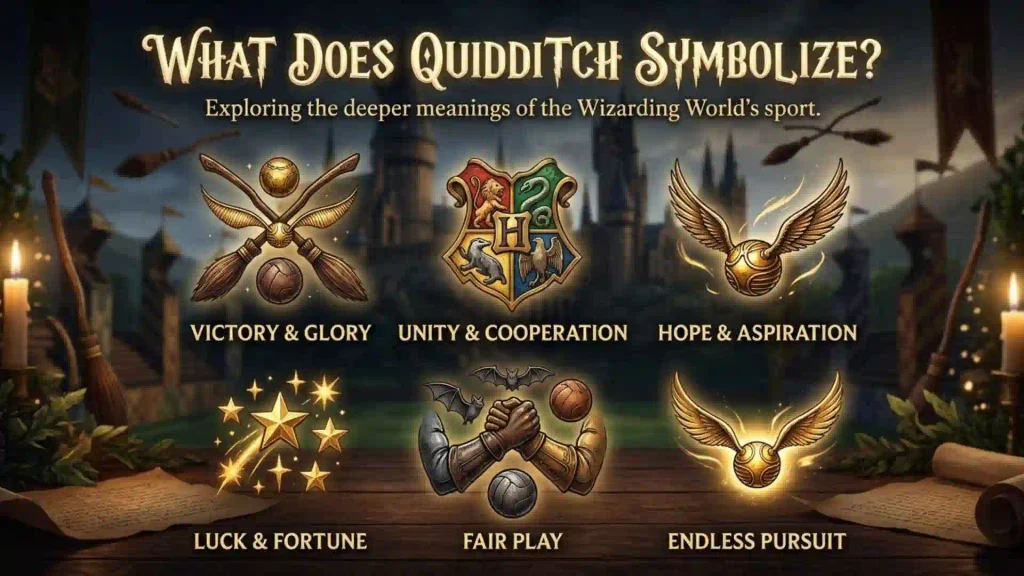
Quidditch can symbolize competition, cooperation, school identity, and the development of individual talent.
Harry becomes a Seeker for Gryffindor, a position that requires him to locate and catch the Golden Snitch. His exceptional flying ability allows him to contribute to his team in a distinctive way.
However, his success doesn’t occur in isolation. A Quidditch team depends on several positions working together, and each player contributes to the result.
The sport therefore offers a useful example of individual talent within collective achievement.
Individual Talent Versus Team Success
Harry’s natural ability attracts attention, but the game also requires practice, coordination, and trust among teammates.
This distinction matters because the novel repeatedly places individual achievements within a wider social context. Harry may be unusually talented, yet his relationships with Ron, Hermione, and other students remain essential to his development.
Quidditch also creates opportunities for friendship and shared identity. Supporting a house team becomes a way for students to participate in Hogwarts life.
Its symbolic value doesn’t depend on every match teaching a direct moral lesson. Rather, the sport provides a setting where competition, skill, teamwork, and courage become visible through action.
Quidditch and Harry’s Character Development
Harry’s participation in Quidditch helps him gain confidence after years of being treated as insignificant by the Dursleys.
On the pitch, his abilities earn recognition from teachers and fellow students. He finds an activity where his natural talent has a clear purpose.
This experience reinforces the relationship between identity and belonging. Harry doesn’t become valuable because he plays Quidditch. Instead, the sport gives him an opportunity to discover and express abilities that others previously ignored.
His experience also shows how personal confidence can grow through meaningful participation rather than praise alone.
The Invisibility Cloak: Secrecy, Freedom, and Responsibility
The Invisibility Cloak allows Harry to become invisible when he wears it. He receives it anonymously as a Christmas gift and later learns that it belonged to his father, James Potter.
The cloak serves an immediate practical purpose, helping Harry explore Hogwarts without being seen. Yet its symbolic significance comes from the opportunities and risks that secrecy creates.
What Does the Invisibility Cloak Symbolize?
The cloak can represent freedom, secrecy, curiosity, and access to hidden knowledge.
Harry uses it to move through places where he would normally be noticed. This gives him greater independence, but it also makes rule-breaking easier.
The cloak doesn’t decide whether Harry’s actions are right or wrong. Its value depends on how he chooses to use it.
For example, Harry’s nighttime explorations help him discover the Mirror of Erised and investigate the mystery surrounding the Stone. However, those same explorations expose him to danger and potential punishment.
The cloak therefore introduces an ethical question: Does having the ability to avoid detection justify using it?
Its connection to James Potter also gives it emotional significance. The gift becomes a tangible link between Harry and a father he never had the chance to know.
Harry’s Parents: Love, Memory, and Protection
Harry’s parents are absent from most of the novel’s present-day action, yet their influence shapes his story from the beginning. Their deaths explain his orphaned childhood, his scar, and the protection associated with Lily Potter’s sacrifice.
Their symbolic importance lies in how love and memory can shape a person’s identity even when loved ones are no longer present.
Love as a Lasting Form of Protection
Lily’s sacrifice becomes one of the novel’s defining events. Her decision to protect Harry has consequences that Voldemort fails to understand fully.
This establishes love as more than a comforting emotion. Within the story, love becomes a force that affects the outcome of the central conflict.
Harry doesn’t need to remember his mother’s final moments for her sacrifice to matter. The consequences remain part of his life.
Memory and the Search for Family
Harry’s longing for his parents becomes especially clear when he encounters the Mirror of Erised.
The image gives emotional form to a loss he has experienced since infancy. It also helps readers understand why family matters so deeply to him.
His parents symbolize more than the tragedy of his childhood. They represent the possibility of love, belonging, and a family history that exists beyond the Dursleys’ treatment of him.
Their influence also contrasts with Voldemort’s approach to relationships. Harry’s story repeatedly connects protection and friendship with strength, while Voldemort seeks power through domination and fear.
Voldemort: Power, Fear, and the Consequences of Selfish Ambition
Lord Voldemort is the central source of danger in Harry Potter and the Sorcerer’s Stone. Although he remains physically weakened for much of the novel, his influence drives the mystery surrounding the Stone.
His symbolic role develops through his pursuit of immortality, his willingness to harm others, and his inability to accept the limits of his own power.
Voldemort as a Symbol of Destructive Ambition
Voldemort’s desire to regain his former strength reveals an ambition that places personal survival above the lives of others.
He seeks the Stone because it offers a path toward restoring his power. His goal contrasts with Harry’s effort to prevent the Stone from falling into dangerous hands.
This contrast supports the novel’s exploration of selflessness versus selfishness.
However, Voldemort is more than a simple symbol of evil. His specific actions matter: he murders Harry’s parents, attempts to kill Harry, and manipulates Quirrell to pursue his own goals.
Those actions make his moral position clear without requiring every aspect of his character to represent an abstract concept.
Power Without Responsibility
Voldemort treats other people as tools. Quirrell becomes a means to an end, and Harry’s life has little value in Voldemort’s calculations.
This behavior reveals the danger of separating power from responsibility.
The Stone intensifies that danger because its abilities promise extraordinary rewards to anyone who can obtain it. Voldemort’s pursuit demonstrates how a desire for control can lead someone to disregard ethical limits.
By contrast, Harry’s actions suggest that courage becomes meaningful when it serves a purpose beyond personal glory.
The Forbidden Forest: Danger, Uncertainty, and Moral Courage
The Forbidden Forest surrounds Hogwarts with an atmosphere of mystery. It contains dangerous creatures and unfamiliar spaces that students are warned not to enter casually.
Its role in the novel makes it a useful symbol of uncertainty and confrontation with fear.
Facing Danger Beyond the Classroom
Harry’s experiences in the forest take him beyond the structured environment of Hogwarts lessons. He encounters threats that cannot be handled simply by recalling textbook information.
The forest therefore contrasts with the relative safety of school life. It reveals that knowledge gained in a classroom may need to be applied under pressure.
Harry’s experiences also show that courage doesn’t mean feeling no fear. It means responding to danger despite uncertainty.
The Forest and the Conflict Between Good and Evil
The forest becomes especially important when Harry encounters a hooded figure drinking unicorn blood. He later learns that the figure is connected to Voldemort.
This disturbing scene connects the forest’s physical danger to the novel’s larger moral conflict.
The setting doesn’t need a single fixed meaning. Its darkness, unfamiliar creatures, and hidden threats help create an environment where Harry begins to understand the seriousness of the danger facing him.
The forest’s symbolic value comes from its role in the narrative: it moves Harry beyond ordinary school experiences and closer to the conflict surrounding the Stone.
The Sorting Hat: Identity, Choice, and Belonging
The Sorting Hat determines which Hogwarts house each first-year student will join. Although the ceremony appears to be a school tradition, it introduces an important question about identity: Are people defined by their natural qualities, their social groups, or the choices they make?
What Does the Sorting Hat Symbolize?
The Sorting Hat represents identity, belonging, and the relationship between personal qualities and social expectations.
Each Hogwarts house has its own reputation. Students may take pride in their house or develop assumptions about students who belong to another one.
Harry’s sorting is especially meaningful because he doesn’t want to join Slytherin. He has heard enough about the house to fear that placement, and he expresses a preference for Gryffindor.
His experience suggests that a person’s wishes can matter alongside the qualities others perceive in them.
The Sorting Hat also introduces a distinction between potential and behavior. A student may possess certain abilities or ambitions, but those qualities don’t automatically determine every future action.
This idea becomes important throughout the series, although the first novel already establishes the value of personal decisions.
The Main Themes Connected to Harry Potter’s Symbols
The novel’s symbols become more powerful when readers examine how they work together. Several objects and settings reinforce the same themes from different angles.
Good Versus Evil
The conflict between Harry and Voldemort provides the foundation for the novel’s moral struggle.
Voldemort seeks power and the restoration of his former strength. Harry becomes involved in protecting the Stone because he recognizes the danger of allowing Voldemort to obtain it.
The Stone makes this contrast concrete. Its extraordinary abilities create a temptation that tests the motives of anyone seeking it.
The story also avoids suggesting that heroism requires Harry to understand every detail of the conflict. He often acts with incomplete information, relying on courage, friendship, and the guidance of others.
Love, Protection, and Sacrifice
Lily Potter’s sacrifice shapes Harry’s survival and establishes love as a central force in the story.
Her influence connects several Harry Potter themes and symbols:
- Harry’s scar links him to the attack that killed his parents.
- The Mirror of Erised reveals his longing for the family he lost.
- Hogwarts provides relationships that help Harry develop a new sense of belonging.
- The contrast with Voldemort highlights the difference between protecting others and exploiting them.
These connections show how a single event can influence several parts of a story without requiring every symbol to mean exactly the same thing.
Identity and Belonging
Harry’s scar, the Sorting Hat, and Hogwarts each explore a different part of identity.
The scar gives Harry a public identity before he understands his past. The Sorting Hat assigns him a group identity. Hogwarts then becomes the place where he begins to develop his own understanding of himself.
The Mirror of Erised adds an emotional dimension by revealing what Harry feels he lacks.
Together, these symbols suggest that identity develops through a combination of personal history, relationships, social expectations, and individual choices.
Desire Versus Selflessness
The Mirror of Erised and the Sorcerer’s Stone offer two contrasting perspectives on desire.
The mirror reveals Harry’s longing for his parents, while the Stone attracts people who want extraordinary powers or a longer life.
Neither object should be reduced to a simple statement that desire is bad. Harry’s longing is understandable, and the Stone’s powers are not inherently a moral judgment.
Instead, the novel explores the difference between recognizing a desire and allowing it to control behavior.
Dumbledore’s warning about the mirror emphasizes the danger of becoming trapped in an unattainable dream. The Stone’s role in the final conflict shows the consequences of pursuing power without sufficient regard for others.
Knowledge, Experience, and Courage
Hermione’s academic strengths, Ron’s practical knowledge, and Harry’s willingness to act demonstrate different forms of ability.
The trio succeeds because they contribute different skills rather than relying on one person’s strengths alone.
This theme connects the school setting to the novel’s wider moral concerns. Education matters, but knowledge becomes most useful when characters apply it thoughtfully.
Courage also requires judgment. Acting boldly without considering consequences can create danger, while careful reasoning can help determine when action is necessary.
The novel presents these qualities as complementary rather than competing virtues.
How Symbolism Develops Characters in Harry Potter and the Sorcerer’s Stone
Symbolism helps readers understand characters by connecting their experiences to the novel’s larger themes.
| Character | Symbolic association | What it reveals |
| Harry Potter | Scar, Mirror of Erised, and the Invisibility Cloak | Survival, emotional longing, and growing independence |
| Hermione Granger | Academic learning and practical spell knowledge | Preparation, intelligence, and reasoned problem-solving |
| Ron Weasley | Quidditch, friendship, and wizarding knowledge | Loyalty, cooperation, and contributions beyond academic ability |
| Albus Dumbledore | The Mirror of Erised and the Stone’s enchantment | Wisdom, moral judgment, and awareness of human motives |
| Lord Voldemort | The pursuit of the Stone and immortality | Destructive ambition, fear of death, and misuse of power |
| The Dursleys | Privet Drive and Harry’s cupboard under the stairs | Exclusion, neglect, and the absence of emotional belonging |
Harry Potter: From Isolation to Belonging
Harry begins the novel as a child who knows little about his parents or his place in the world.
His scar connects him to a past he doesn’t understand, while Hogwarts gives him the opportunity to discover his abilities and build meaningful relationships.
The Mirror of Erised reveals his emotional vulnerability. The Invisibility Cloak gives him greater independence, and his involvement in protecting the Stone tests his developing judgment.
These symbols trace different aspects of Harry’s growth without suggesting that he becomes a completely different person overnight.
Hermione Granger: Knowledge and Reason
Hermione demonstrates how learning can become a practical resource.
She often approaches problems by gathering information, remembering spells, and thinking carefully about possible solutions. Her strengths become especially valuable when Harry and Ron encounter obstacles that require more than bravery.
Her character challenges the idea that heroism depends solely on dramatic action. Preparation, patience, and clear reasoning can be just as important.
Ron Weasley: Friendship and Cooperation
Ron brings practical knowledge of the wizarding world and a strong personal connection to Hogwarts traditions.
His role in the enchanted chess challenge highlights his strategic thinking and willingness to contribute to the group’s success.
Ron also provides emotional companionship. His friendship helps Harry experience the everyday pleasures of belonging to a group rather than constantly feeling like an outsider.
Albus Dumbledore: Wisdom and Moral Judgment
Dumbledore’s role in the Mirror of Erised episode shows that wisdom involves understanding human motives, not merely possessing knowledge.
His enchantment of the Stone also makes intention central to the final test. Someone who seeks the Stone without intending to use it can obtain it.
Dumbledore therefore connects knowledge with moral judgment. He recognizes that the same object can have different consequences depending on what a person wants from it.
The Dursleys: Exclusion and Social Conformity
The Dursleys represent the ordinary world from which Harry initially feels excluded. Their discomfort with anything unusual leads them to suppress Harry’s identity and conceal information about his parents.
The cupboard under the stairs reinforces this treatment by placing Harry in a cramped, marginal space within the family home.
This contrast makes Hogwarts more meaningful. Harry’s move to the magical world isn’t simply an escape into adventure; it also marks his movement toward recognition, friendship, and a stronger sense of self.
How to Interpret Symbols in Harry Potter Without Overreading Them
A strong literary interpretation needs evidence. Although readers can explore several meanings for a symbol, not every object in a fantasy novel must represent a hidden philosophical idea.
Use the following approach when analyzing symbolism.
- Start with the literal function. Identify what the object or setting actually does in the story.
- Examine the scene. Consider when the symbol appears and what the characters experience.
- Look for recurring ideas. Notice whether the object connects to themes that appear elsewhere in the novel.
- Separate fact from interpretation. The mirror explicitly reveals desires, while its connection to identity is a literary interpretation supported by Harry’s experience.
- Consider character differences. The same symbol may mean different things to different people.
- Avoid unsupported claims. Don’t assign an elaborate meaning to an object unless the story provides a reasonable basis.
For example, the Mirror of Erised clearly reveals a person’s deepest desires. Harry’s reflection supports an interpretation involving family, loneliness, and identity.
However, claiming that every mirror in the wizarding world represents the same psychological process would require additional evidence.
The best symbolic analysis combines close reading with thoughtful interpretation. It respects what the novel says while exploring the deeper ideas its details suggest.
Frequently Asked Questions About Harry Potter and the Sorcerer’s Stone Symbols
What are the main symbols in Harry Potter and the Sorcerer’s Stone?
The main symbols include Harry’s lightning-shaped scar, the Mirror of Erised, the Sorcerer’s Stone, Hogwarts, Quidditch, and the Invisibility Cloak. Each contributes to themes involving identity, desire, belonging, courage, and moral responsibility.
What does Harry Potter’s lightning-shaped scar symbolize?
Harry’s scar represents survival and his connection to Voldemort’s attack. It also shapes his identity within the wizarding world and reminds readers that his past continues to influence his life.
What does the Mirror of Erised symbolize?
The Mirror of Erised symbolizes a person’s deepest desires and emotional longings. Harry sees his parents in its reflection, revealing his need for family and belonging. The mirror also warns against becoming so absorbed in an imagined life that reality loses its importance.
What does the Sorcerer’s Stone represent?
The Sorcerer’s Stone represents the temptation of immortality, wealth, and extraordinary power. Its role in the novel also highlights the importance of intention, selflessness, and responsible choices.
What does Hogwarts symbolize in Harry Potter?
Hogwarts symbolizes belonging, education, friendship, and personal growth. It gives Harry a community where he can discover his abilities and develop relationships that contrast sharply with his childhood at the Dursleys’ home.
How does Quidditch represent teamwork?
Quidditch demonstrates how individual talent contributes to a shared goal. Each position requires different skills, and the team depends on players working together. Harry’s talent as a Seeker also helps him build confidence and find his place at Hogwarts.
How does Voldemort contrast with Harry symbolically?
Voldemort represents destructive ambition and the pursuit of power without sufficient regard for others. Harry’s actions, by contrast, emphasize friendship, courage, and protecting others. Their conflict explores how motives and choices influence the use of power.
Is Harry’s scar similar to Odysseus’s scar in The Odyssey?
Yes, both scars connect a character’s present identity to a significant past event. Odysseus’s scar helps Eurycleia recognize him, while Harry’s scar links him to Voldemort’s attack. Their narrative purposes differ, but both illustrate how physical marks can preserve personal history.
What role does symbolism play in Harry Potter’s character development?
Symbolism helps readers understand Harry’s emotions, relationships, and changing sense of identity. His scar connects him to his past, the Mirror of Erised reveals his longing for family, and Hogwarts provides opportunities for growth. These elements deepen the story without relying solely on direct explanations.
What is the difference between a symbol and a motif in Harry Potter?
A symbol represents an idea beyond its literal function. For example, the Mirror of Erised represents desire and longing. A motif is a recurring element, image, or idea that reinforces a theme. Love, belonging, and the responsible use of power recur throughout the novel and connect its different symbols.
Conclusion: The Deeper Meaning of Harry Potter and the Sorcerer’s Stone Symbols
The symbols in Harry Potter and the Sorcerer’s Stone transform a magical adventure into a story about recognizable human experiences. Harry’s scar connects survival with identity, while the Mirror of Erised explores longing and the dangers of becoming trapped in an unattainable dream.
The Sorcerer’s Stone introduces questions about immortality, ambition, and the ethical use of power. Hogwarts represents the importance of belonging and education, while Quidditch shows how individual abilities can contribute to collective success.
Other elements add further depth. The Invisibility Cloak raises questions about secrecy and responsibility. The Forbidden Forest places courage under pressure, and the Sorting Hat explores the relationship between identity and choice.
Together, these Harry Potter symbols and meanings reveal a central idea: a person’s character depends on more than talent, reputation, or extraordinary abilities. Motives, relationships, and decisions matter just as much.
That is what makes Rowling’s symbolism so effective. The magical objects may belong to an imaginary world, but the questions they raise remain familiar. What do you truly desire? Where do you belong? How should you use the abilities you possess? And when power comes at a moral cost, what are you willing to sacrifice?
These questions give Harry Potter and the Sorcerer’s Stone its lasting literary appeal and make its symbols worth exploring long after the final page.
Sources and Further Reading
For readers who want to explore the novel and its symbolism further, these resources provide useful background and official commentary.
- The Mirror of Erised — HarryPotter.com: Official reference explaining the mirror’s magical properties and role in the story.
- J.K. Rowling on the Mirror of Erised — HarryPotter.com: The author’s commentary on desire, dreams, and the dangers of obsession.
- Harry Potter and the Sorcerer’s Stone — Pottermore Publishing: Publication information and an official overview of the novel.

I am John Carter, a lifelong enthusiast of language and modern slang. I explore how words evolve and shape culture, and I enjoy uncovering the stories behind everyday expressions. I have authored “Slang and Society: The Language of Youth” and “Modern Words, Modern Worlds”, where I dive into how informal language impacts communication and identity. My goal is to make language accessible, fun, and insightful for everyone who loves words as much as I do.
 Lisa Reynolds