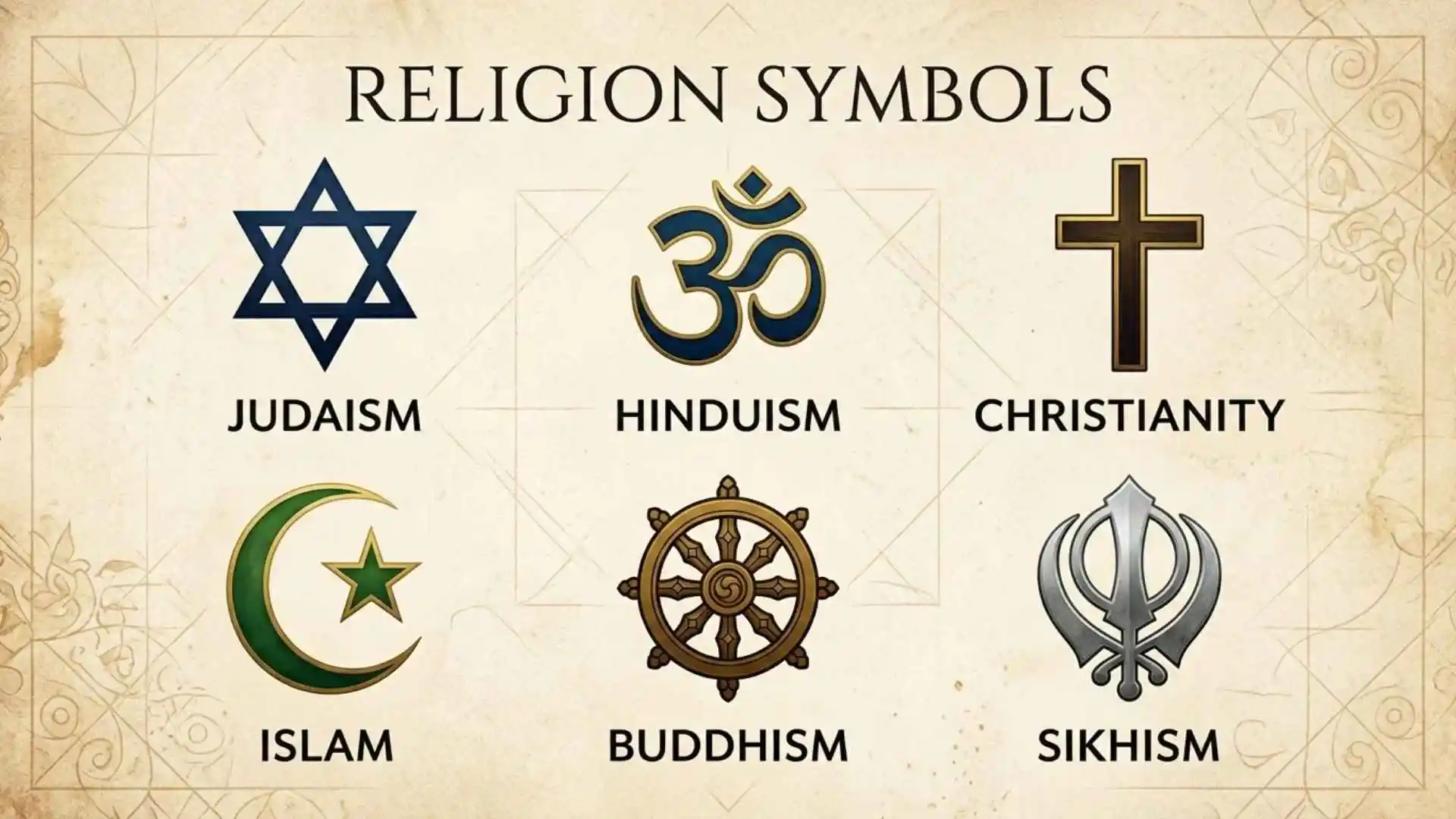
Religious symbols tell powerful stories about faith, spiritual wisdom, identity, and humanity’s search for meaning. A simple sound, a wheel, a star, or a cross can express ideas that entire books struggle to explain. Across cultures, these symbols help people connect with sacred teachings, remember their history, and share beliefs across generations.
The symbols of world religions differ in appearance and meaning, yet many address familiar human questions. What is the nature of existence? How should people live? What does spiritual freedom mean? And how can individuals find peace in a changing world?
From the Hindu Om symbol and the Buddhist Dharma Wheel to the Jewish Star of David and the Christian cross, each emblem carries a distinctive story. Some developed through ancient scriptures and religious practices. Others gained recognition through art, architecture, historical events, and cultural identity.
This guide explores the religious symbols and meanings associated with Hinduism, Confucianism, Taoism, Buddhism, Islam, Judaism, Christianity, Sikhism, Jainism, Shinto, and the Baháʼí Faith. It also explains their origins, traditional uses, and modern significance while distinguishing established facts from popular interpretations.
What Are Religious Symbols?
Religious symbols are images, sounds, objects, shapes, gestures, or signs that communicate ideas connected with faith and spiritual life. They can represent divine qualities, sacred teachings, moral duties, religious communities, or important events.
A symbol often expresses several layers of meaning at once. For example, Christians use the cross to remember Jesus’ crucifixion and to express beliefs about salvation. Buddhists use the Dharma Wheel to represent the Buddha’s teachings and the path toward awakening.
Religious symbolism also extends beyond recognizable emblems. Temple architecture, ritual objects, sacred writing, and particular gestures can all carry religious meaning. These forms of religious iconography help communities preserve and communicate their beliefs.
According to the reference work Encyclopaedia Britannica’s overview of religious symbolism and iconography, religious traditions use visual, auditory, and physical forms to communicate ideas that may be difficult to express through ordinary language alone.
Why Do Religious Symbols Matter?
Religious symbols serve several important purposes:
- Teaching: They make complex religious ideas easier to recognize and remember.
- Worship: They help communities focus on sacred teachings and religious practices.
- Identity: They communicate a person’s connection to a faith or community.
- History: They preserve memories of important people, events, and traditions.
- Reflection: They encourage contemplation of spiritual questions and ethical responsibilities.
- Cultural heritage: They appear in buildings, manuscripts, clothing, art, and community celebrations.
However, a symbol’s meaning depends on its context. The same shape may carry different meanings in different cultures, and some traditions use several symbols rather than one official emblem.
Hinduism Symbol: Om (Aum)
The Om symbol (ॐ) is one of the most recognizable sacred signs associated with Hinduism. Known as Om or Aum, it represents a sacred syllable used in prayer, meditation, chanting, and philosophical reflection.
Om appears in several Hindu traditions and has a long history in Indian religious literature. Its importance extends beyond a visual mark because the spoken sound itself carries religious significance.
What Does the Om Symbol Mean?
Om is closely associated with Brahman, the ultimate reality discussed in many Hindu philosophical traditions. Brahman should not be confused with Brahma, the creator deity in Hindu traditions.
The precise interpretation of Om varies across Hindu schools. Some understand it as a sacred sound encompassing all existence. Others connect it with the relationship between the individual self and ultimate reality.
The Mandukya Upanishad, a short but influential Hindu text, explores Om through its sounds and their relationship to states of consciousness.
Om, Aum, and Sacred Sound
The spelling Aum highlights three sounds traditionally associated with the syllable: A, U, and M. Some interpretations connect these sounds with waking, dreaming, and deep sleep, followed by silence associated with a state beyond ordinary experience.
These interpretations are especially important in particular philosophical traditions rather than universal explanations accepted by every Hindu community.
Om in Hindu Prayer and Meditation
People may chant Om at the beginning or end of prayers, yoga sessions, meditation, and religious ceremonies. The sound helps practitioners focus their attention and settle their minds.
The symbol also appears on temple walls, devotional objects, books, and household shrines. Its use in modern yoga has introduced Om to people outside Hindu communities, although its religious roots remain important.
Key fact: Om is more than a decorative emblem. Its sound, written form, and philosophical interpretations all contribute to its significance in Hindu religious life.
Confucianism Symbol: Ethics, Virtue, and Harmony
Unlike Hinduism’s Om or Christianity’s cross, Confucianism does not have one universally accepted religious symbol. Its visual identity is more closely connected with Confucius, Chinese calligraphy, ancestral traditions, ritual objects, and the teachings associated with his school of thought.
Confucianism developed from the teachings of Confucius, who lived from approximately 551 to 479 BCE. It emphasizes ethical conduct, education, responsible leadership, family relationships, and social harmony.
Is There an Official Confucianism Symbol?
No single emblem represents all Confucian communities worldwide. Images of Confucius, Chinese characters associated with his name, and inscriptions in Confucian temples can communicate the tradition’s identity.
The Chinese character 孔 (Kǒng), associated with Confucius’s family name, may appear in relevant cultural settings. However, it should not be presented as an official symbol used by every Confucian community.
Confucius, Virtue, and Social Harmony
Confucian thought places great importance on ren, often translated as humaneness or benevolence, and li, which refers to ritual, proper conduct, and social norms.
These ideas help explain the values associated with Confucian traditions:
- Humaneness: Treat others with care and consideration.
- Ritual propriety: Show respect through appropriate behavior and customs.
- Filial responsibility: Honor family relationships and responsibilities.
- Learning: Develop moral judgment through education and reflection.
- Responsible leadership: Lead through ethical example rather than force alone.
Confucian temples, ancestral halls, and traditional ceremonies give these teachings a visible cultural presence.
Important distinction: Confucianism is often described as a philosophical and ethical tradition, although it also has religious dimensions in some communities. Its symbols and practices therefore vary according to historical and cultural context.
Taoism Symbol: Yin and Yang
The Yin-Yang symbol (☯), also called the Taijitu, is one of the best-known images associated with Chinese philosophy and Taoism. Its circular design contains two interlocking shapes, usually black and white, each holding a small dot of the opposite color.
The image expresses a central idea: apparently contrasting forces can depend on one another and form part of a larger whole.
What Does the Yin-Yang Symbol Mean?
In traditional Chinese thought, Yin and Yang describe complementary aspects of existence. Yin is commonly associated with qualities such as darkness, coolness, stillness, and receptivity. Yang is associated with light, warmth, activity, and outward movement.
These are relational qualities rather than fixed categories of good and evil.
For example, night and day differ, but each belongs to the same cycle. Rest and activity also contrast while supporting a healthy pattern of daily life.
The symbol’s central message concerns interdependence, change, and balance, not a permanent victory of one side over the other.
What Do the Dots and Curves Represent?
The design contains several meaningful features:
- The circle: Suggests a unified whole.
- The curved division: Shows that Yin and Yang flow into one another rather than remaining rigidly separated.
- The black and white areas: Represent complementary aspects of existence.
- The contrasting dots: Indicate that each aspect contains the potential or seed of its counterpart.
Together, these features illustrate the dynamic relationship between contrasting qualities.
Yin and Yang in Taoist Philosophy
Taoism, also spelled Daoism, emphasizes living in harmony with the Dao or Tao, commonly understood as the Way underlying the natural order.
Yin-Yang thinking helps explain patterns of transformation in nature, human life, and the wider universe. It is also important in other Chinese philosophical and cultural traditions, including Chinese medicine and cosmological thought.
Although the symbol is strongly associated with Taoism, it does not belong exclusively to Taoist religious practice.
Remember: Yin and Yang do not simply mean good versus evil. They describe complementary relationships that continually change.
Buddhism Symbol: The Dharma Wheel
The Dharma Wheel, also called the Dharmachakra, is one of the most important Buddhist symbols and their meanings. It represents the Buddha’s teachings, known as the Dharma, and the path that leads toward liberation from suffering.
The wheel commonly appears with eight spokes. These spokes are associated with the Noble Eightfold Path, a practical framework for developing wisdom, ethical conduct, and mental discipline.
What Does the Dharma Wheel Represent?
In Buddhist tradition, the Buddha’s first teaching after his awakening is associated with setting the wheel of Dharma in motion. This image represents the communication and continuation of his teachings.
The wheel’s shape also offers a useful visual reminder of a path that requires ongoing practice. Buddhist traditions differ in their art and interpretations, but the Dharma Wheel remains widely recognized across many Buddhist communities.
What Are the Eight Spokes of the Buddhist Wheel?
The eight spokes correspond to the principles of the Noble Eightfold Path.
| Spoke | Principle | Meaning |
| One | Right View | Understand reality, suffering, and its causes more clearly. |
| Two | Right Intention | Develop intentions rooted in goodwill and freedom from harmful desires. |
| Three | Right Speech | Avoid lying, harmful gossip, and abusive speech. |
| Four | Right Action | Avoid harmful behavior and act ethically. |
| Five | Right Livelihood | Earn a living without causing serious harm. |
| Six | Right Effort | Encourage wholesome mental states and reduce harmful ones. |
| Seven | Right Mindfulness | Pay careful attention to bodily, mental, and emotional experience. |
| Eight | Right Concentration | Develop stable attention through appropriate meditation practices. |
These principles work together rather than forming a simple sequence that a person completes once.
For example, mindfulness can help someone notice anger before speaking harshly. Right Effort supports the practice of responding more skillfully, while Right Speech guides the final choice of words.
The Dharma Wheel and Buddhist Practice
The wheel appears on Buddhist temples, religious paintings, statues, flags, and teaching materials. Its details may vary by Buddhist school and artistic tradition.
Some representations include a hub and rim, which can receive additional interpretations. However, the eight spokes’ association with the Noble Eightfold Path is the most widely recognized explanation.
The Dharma Wheel is also different from the Wheel of Life, or Bhavachakra, which depicts cyclic existence and the forces that sustain it.
Key takeaway: The Dharma Wheel represents more than Buddhism as an identity. It points toward a way of understanding life and practicing the Buddha’s teachings.
Islam Symbol: Crescent and Star
The crescent and star is widely recognized as a visual emblem associated with Islam and Muslim-majority countries. Yet its status differs from that of the cross in Christianity or Om in Hinduism.
Islam does not prescribe the crescent and star as a universal religious emblem. Its association with Islam developed through historical and cultural use, particularly in connection with the Ottoman Empire and later national flags.
What Does the Crescent and Star Mean in Islam?
The crescent moon is connected with the lunar calendar, which determines the timing of Islamic months, including Ramadan and the Hajj season.
However, the crescent-and-star combination does not have one universally accepted theological meaning. Some people interpret it as an expression of Muslim identity, while others regard it mainly as a cultural or political emblem.
The Federal Territories Mufti Office of Malaysia explains that the crescent and star are not prescribed as Islam’s official symbol.
History of the Crescent and Star
The crescent and star appeared in several cultures before becoming widely associated with Islam. Its later use in Ottoman imagery helped strengthen its connection with Muslim societies.
Over time, the design appeared on national flags, public buildings, and religious architecture. Today, its meaning depends on the setting in which it appears.
Islamic Art and Religious Symbolism
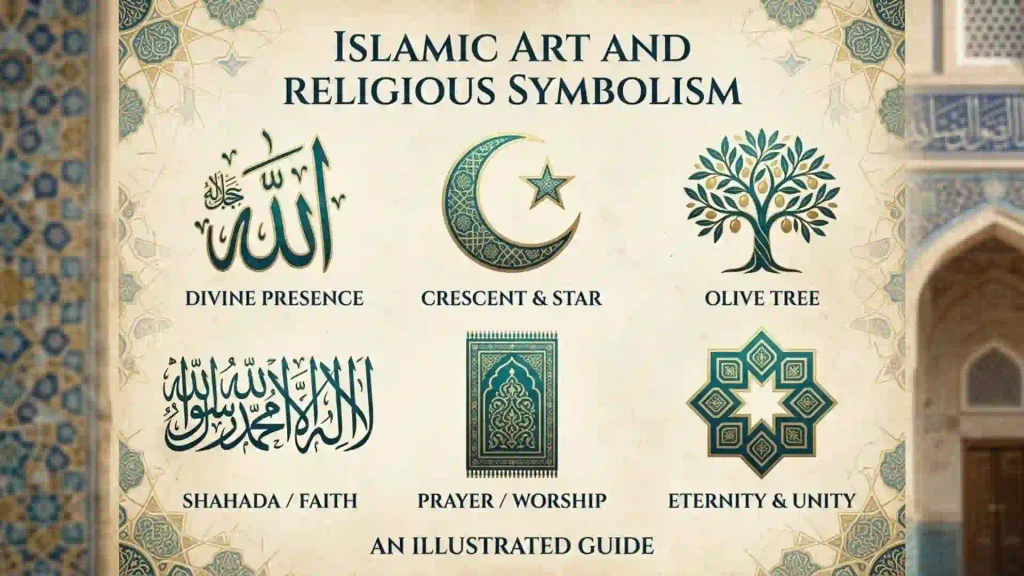
Islamic visual traditions include much more than the crescent and star. Arabic calligraphy, geometric patterns, and flowing plant-inspired designs feature prominently in many mosques, manuscripts, and decorative objects.
Calligraphy often displays verses from the Quran or other religious expressions. Geometric patterns can create a sense of order and repetition, while arabesque designs use flowing plant-like forms.
Some artistic traditions avoid images of living beings in religious settings, particularly when depicting prophets. However, Islamic art varies across regions and historical periods, and figural imagery has also appeared in certain secular and courtly contexts.
Important distinction: The crescent and star is a familiar symbol of Muslim identity, but it is not a universal requirement of Islamic belief or worship.
Judaism Symbols: Star of David and Menorah
Judaism has several important Jewish religious symbols, but two stand out for their historical and cultural significance: the Star of David and the Menorah. Both are associated with Jewish heritage, although their histories and uses differ.
Star of David (Magen David): Meaning and History
The Star of David, known in Hebrew as Magen David, consists of two overlapping triangles that form a six-pointed star. Today, it is one of the most widely recognized symbols of Jewish identity.
The Hebrew name is commonly translated as “Shield of David.” Despite this traditional name, the symbol’s historical development is more complex than a direct connection with the biblical King David.
Six-pointed stars appeared in various cultures and artistic traditions. Their association with Jewish communities developed gradually, becoming especially prominent in European Jewish life during the early modern period and later centuries.
The Star of David became a powerful marker of Jewish identity. It also appears on the flag of Israel, adopted in 1948 when the modern state was established.
Its meaning can include:
- Jewish identity: Recognition of Jewish heritage and community.
- Religious association: A familiar emblem used in synagogues and Jewish institutions.
- Historical memory: A symbol associated with Jewish persecution and survival, particularly because the Nazis forced Jews in occupied Europe to wear yellow badges bearing the star.
- National identity: A central feature of Israel’s national flag.
The Star of David is important today, but it was not always Judaism’s primary emblem.
The Menorah: Light and Jewish Heritage
The Menorah is a seven-branched lampstand with deep roots in Jewish religious tradition. The Torah describes a golden menorah for the ancient Tabernacle, and a menorah later stood in the Jerusalem Temple.
The menorah represents sacred light and worship. It has also become a lasting symbol of Jewish continuity and heritage.
The seven-branched menorah should not be confused with the nine-branched Hanukkah lamp, called a hanukkiah. The hanukkiah holds eight lights associated with the eight days of Hanukkah, plus a helper light known as the shamash.
| Symbol | Appearance | Main association |
| Star of David | Six-pointed star | Jewish identity and heritage |
| Menorah | Seven-branched lampstand | Ancient Jewish worship and sacred light |
| Hanukkiah | Nine lights or branches | The Hanukkah celebration |
| Mezuzah | Small case attached to a doorpost | Jewish scripture and religious practice |
| Shofar | Ram’s horn | Religious ceremonies, especially Rosh Hashanah |
Why These Jewish Symbols Matter
Jewish symbols connect religious practice with history, family, community, and collective memory. Their meanings can vary depending on whether they appear in a synagogue, home, historical memorial, or national setting.
The Star of David and the Menorah are not interchangeable. One became a prominent emblem of Jewish identity, while the other has a particularly ancient connection to Jewish worship.
Christianity Symbol: The Cross
The Christian cross is among the most recognizable symbols of faith in the world. It represents the crucifixion of Jesus Christ and carries central meanings connected with sacrifice, redemption, forgiveness, and hope.
Christians interpret the cross through their beliefs about Jesus’ death and resurrection. Although Christian traditions differ in their worship and visual art, the cross remains a central emblem across much of Christianity.
What Does the Cross Symbolize in Christianity?
The cross recalls the Roman method of execution used to kill Jesus. Christian theology connects this event with God’s saving work and the possibility of reconciliation between humanity and God.
For many Christians, the cross also represents love, self-sacrifice, endurance, and hope in the face of suffering.
The cross’s meaning is closely connected to the resurrection. Christianity does not generally treat Jesus’ death as an isolated tragedy; the resurrection is central to the Christian understanding of victory over sin and death.
The Crucifix and the Empty Cross
Christian traditions use different forms of the cross.
- Plain cross: Often emphasizes the crucifixion and the Christian faith in the resurrection.
- Crucifix: Depicts Jesus’ body on the cross and highlights his suffering and sacrifice.
- Eastern Christian cross: May feature additional crossbars and distinctive details associated with particular traditions.
- Celtic cross: Combines a cross with a ring and is associated with Celtic Christian art and heritage.
Catholic and Eastern Orthodox communities commonly use crucifixes or other images of the crucifixion in devotional settings. Many Protestant churches favor a plain cross, although practices vary widely.
The Fish and the Ship in Early Christian Symbolism
The cross was not the only image early Christians used.
The ichthys, or fish symbol, became associated with Christianity. The Greek word ichthys means “fish,” and the letters were also used as an abbreviation expressing a confession of faith in Jesus Christ.
The ship also appears in Christian symbolism. It can represent the Church as a community traveling through the dangers of the world toward spiritual safety.
Some Christian interpretations connect the ship with biblical accounts involving boats and storms. However, the ship is a secondary symbol rather than a universal emblem of Christianity.
The Cross in Christian Art and Architecture
The cross appears on church buildings, altars, jewelry, religious books, paintings, and personal devotional objects. Its design varies across regions and historical periods.
In some traditions, images of Jesus portray him as a suffering figure. Others emphasize his role as the risen Lord, King, or victorious Christ.
These differences reflect distinct artistic and theological emphases rather than a single uniform approach to Christian iconography.
Key fact: The cross’s importance comes from its connection with Jesus’ crucifixion and resurrection, not simply from its geometric shape.
Other Important Symbols Across Religious Traditions
The world’s religious landscape extends beyond the seven traditions discussed above. Other faiths have distinctive symbols that express their teachings, values, and community identities.
Sikhism: The Khanda
The Khanda is a prominent emblem associated with Sikhism. Its design combines a double-edged sword in the center, a circular weapon called a chakkar, and two curved swords known as kirpans.
The components are commonly interpreted through Sikh ideas about divine unity, spiritual wisdom, justice, and the relationship between spiritual and worldly responsibilities.
The Khanda is displayed on Sikh flags and at gurdwaras, the places where Sikhs gather for worship and community activities.
Another important Sikh expression is Ik Onkar (ੴ), which communicates the belief in one divine reality. It appears in Sikh scripture and has deep theological significance.
Jainism: The Jain Emblem and Ahimsa
Jainism emphasizes nonviolence, self-discipline, truthfulness, and liberation from the cycle of rebirth. Its widely recognized emblem combines several visual elements associated with these teachings.
A hand with a wheel in its palm is often used to represent ahimsa, or nonviolence. The hand serves as a reminder to stop harmful actions, while the wheel connects with the cycle of existence and the path toward liberation.
The Jain emblem also commonly includes a swastika in its traditional Indian religious sense. In Jain contexts, it can represent the four states of existence in the cycle of rebirth.
This ancient symbol has meanings that differ sharply from the Nazi swastika, which appropriated the shape and gave it a destructive modern political association.
Shinto: The Torii Gate
The torii gate is a recognizable feature of Shinto shrines in Japan. It often marks the entrance to a sacred area associated with a kami, a sacred presence or spiritual being in Shinto tradition.
Passing through a torii can mark a transition from an ordinary space into a place connected with religious observance.
Torii gates come in different architectural styles and materials. Although red-painted gates are especially famous, not every torii is red.
The gate is an architectural marker rather than simply a decorative logo. Its meaning comes from its role in shrine spaces and Japanese religious culture.
Baháʼí Faith: The Nine-Pointed Star
The nine-pointed star is a widely used emblem of the Baháʼí Faith. The number nine is associated with completeness in some Baháʼí explanations, and the star provides a recognizable visual expression of the faith.
Baháʼí teachings emphasize the unity of God, the unity of religion, and the unity of humanity. The star can therefore appear in settings that communicate community identity and the faith’s message of unity.
However, the nine-pointed star is a customary emblem rather than a symbol that every Baháʼí must use.
Indigenous Traditions: Respecting Cultural Context
Indigenous spiritual traditions around the world use diverse symbols, sacred objects, patterns, and ceremonial designs. Their meanings depend on specific peoples, languages, histories, and practices.
There is no single symbol that accurately represents all Indigenous religions. Some designs belong to particular communities, while others carry meanings that outsiders may not fully understand.
A responsible explanation should identify the community and tradition involved. It should also distinguish publicly shared cultural imagery from sacred designs whose use may be restricted.
This approach avoids reducing diverse living traditions to generic spiritual symbols.
How Religious Symbols Differ Across Cultures
Although religious symbols across cultures often look simple, their meanings can be layered and complex. Understanding those meanings requires looking beyond appearance and considering the beliefs, practices, and histories connected with each symbol.
Symbols of Divinity, Enlightenment, and Salvation
Some religious symbols express ideas about ultimate reality or humanity’s relationship with the sacred.
For example, Om connects with sacred sound and ultimate reality in Hindu philosophy. The Christian cross points to Jesus’ crucifixion and resurrection, while the Buddhist Dharma Wheel represents teachings that guide practitioners toward awakening.
These symbols address spiritual questions through different traditions. They should not be treated as interchangeable expressions of one universal doctrine.
Symbols of Balance, Harmony, and Ethical Living
Other symbols emphasize how people should live or understand the world.
- Yin-Yang: Represents complementary forces and their changing relationship.
- Dharma Wheel: Represents Buddhist teachings and a disciplined path of practice.
- Khanda: Connects with Sikh religious identity and principles of spiritual and worldly responsibility.
- Jain emblem: Emphasizes nonviolence and the path toward liberation.
- Confucian imagery: Often communicates ethical cultivation, learning, and social harmony.
These examples show that religious symbolism can communicate practical responsibilities as well as abstract spiritual ideas.
Religious Symbols and Cultural Identity
Symbols often become markers of community belonging. The Star of David, for instance, communicates Jewish identity in religious, cultural, historical, and national contexts.
Similarly, the Khanda identifies Sikh communities, while the crescent and star appears on the flags of several Muslim-majority countries.
However, a symbol’s cultural recognition does not necessarily make it a universal religious requirement. Some people embrace a particular emblem, while others within the same tradition may not use it.
How Symbols Change Throughout History
Religious symbols do not always retain the same meaning across centuries.
A shape may begin as a decorative motif, become associated with a particular religious community, and later acquire political or national significance. The Star of David and the crescent and star illustrate how historical use can influence modern recognition.
These changes make historical context essential. An interpretation that fits one period may not accurately describe another.
Similarities and Differences Between World Religion Symbols
The symbols of world religions share certain visual features, yet their meanings emerge from different religious teachings and historical experiences.
| Comparison | Examples | Important distinction |
| Sacred sound | Om in Hinduism | Sound itself can have religious significance. |
| Complementary forces | Yin-Yang in Chinese philosophy | Balance and transformation differ from a doctrine of salvation. |
| Spiritual guidance | Dharma Wheel in Buddhism | The wheel represents teachings and a path of practice. |
| Divine sacrifice | Cross in Christianity | The meaning centers on Jesus’ crucifixion and resurrection. |
| Community identity | Star of David in Judaism | Historical and cultural meanings complement religious associations. |
| Cultural and political identity | Crescent and star | Widespread recognition does not establish a universal religious requirement. |
| Sacred space | Torii gate in Shinto | Architecture can mark a transition into a sacred area. |
| Nonviolence | Jain emblem | The symbol emphasizes ethical conduct and spiritual liberation. |
Shared Themes of Light, Life, Peace, and Transformation
Some religious traditions use light to express knowledge, holiness, or spiritual understanding. The Menorah, for example, has a long association with sacred light in Judaism.
Other traditions use circles, wheels, or repeating patterns to express continuity, interconnectedness, or cycles of existence. Yet similar shapes do not automatically carry identical meanings.
The Dharma Wheel and the Yin-Yang symbol both contain circular forms, but they communicate different ideas. Their shapes provide a starting point for interpretation rather than a complete explanation.
Why Similar Shapes Do Not Always Mean Similar Beliefs
A star, circle, or cross-like form can appear in several cultures without sharing a single origin. Artists and communities often reuse familiar geometric shapes for different reasons.
For this reason, comparative religion should examine each symbol within its own context. It should not assume that visual resemblance proves a shared belief or historical connection.
Frequently Asked Questions About Religious Symbols
What Are the Main Symbols of World Religions?
Commonly recognized symbols include Om in Hinduism, the Dharma Wheel in Buddhism, the Star of David and Menorah in Judaism, and the cross in Christianity. Yin-Yang is associated with Chinese philosophy and Taoism, while the crescent and star is widely associated with Muslim identity.
Other important examples include the Khanda in Sikhism, the Jain emblem, the Shinto torii gate, and the nine-pointed star used by Baháʼís. Not every tradition has one universally accepted emblem.
Which Religion Uses the Om Symbol?
Hinduism is the religious tradition most strongly associated with Om, or Aum. The sacred syllable appears in Hindu prayers, meditation, and philosophical texts. Om also has significance in certain Buddhist and Jain contexts, reflecting connections across South Asian religious history.
What Does the Yin-Yang Symbol Mean?
Yin-Yang represents complementary aspects of existence that depend on and transform into one another. Yin is often associated with darkness and stillness, while Yang is associated with light and activity.
Neither side is inherently evil or morally inferior. The symbol emphasizes their changing relationship and the balance that emerges through their interaction.
What Are the Eight Spokes of the Buddhist Dharma Wheel?
The eight spokes represent Right View, Right Intention, Right Speech, Right Action, Right Livelihood, Right Effort, Right Mindfulness, and Right Concentration.
Together, these principles form the Noble Eightfold Path. Buddhist practitioners use this framework to develop wisdom, ethical conduct, and mental discipline.
Is the Crescent and Star the Official Symbol of Islam?
No single emblem is prescribed as the official symbol of Islam. The crescent and star is widely recognized because of its historical and cultural associations, particularly with the Ottoman Empire and modern national flags.
Many Muslims use the design as an expression of identity, while others do not regard it as a religious symbol.
What Is the Difference Between the Star of David and the Menorah?
The Star of David is a six-pointed star that has become a prominent emblem of Jewish identity and heritage. The Menorah is a seven-branched lampstand with ancient roots in Jewish worship.
The two symbols have distinct histories and functions. The Star of David is widely used as an identity marker, while the Menorah recalls sacred light and the religious life of ancient Israel.
Why Is the Cross Important in Christianity?
The cross represents Jesus Christ’s crucifixion and is closely connected with Christian beliefs about salvation, forgiveness, sacrifice, and resurrection. It appears in churches, religious art, devotional objects, and Christian community life.
Some traditions use a plain cross, while others favor a crucifix depicting Jesus’ body.
Do All Religions Have a Single Main Symbol?
No. Some traditions have widely recognized emblems, but others use several symbols or have no universally accepted visual identity.
Confucianism, for example, is associated with teachings, calligraphy, ritual practices, and images of Confucius rather than one universal emblem. Islam also has no universally prescribed symbol equivalent to the Christian cross.
Conclusion: Understanding the Meaning of Religious Symbols
The symbols of world religions offer a window into the beliefs, values, histories, and identities of diverse communities. Om expresses sacred sound and philosophical ideas in Hindu traditions. Yin-Yang illustrates complementary forces, while the Dharma Wheel points toward Buddhist teachings and ethical practice.
The Star of David and Menorah preserve different aspects of Jewish identity and heritage. The Christian cross recalls Jesus’ crucifixion and resurrection, while the crescent and star reflects a complex history of cultural and political associations.
Other traditions contribute equally meaningful symbols. The Khanda, Jain emblem, torii gate, and nine-pointed star illustrate the diversity of religious expression across the world.
Ultimately, understanding religious symbols and meanings requires more than memorizing shapes and definitions. You need to consider the communities that use them, the teachings they express, and the histories that have shaped their significance.
When interpreted with care, these symbols offer valuable insight into how people understand the sacred, practice their beliefs, and pass their traditions to future generations.
Further Reading and Research Sources
For deeper study, consult reputable reference works, museums, and religious institutions. These sources can help distinguish historical evidence from modern interpretations.
- Encyclopaedia Britannica: Religious Symbolism and Iconography — An introduction to the role of symbols in religious expression.
- The Metropolitan Museum of Art — Museum collections and essays on religious art and cultural history.
- The David Collection: Symbolism in Islamic Art — Discussion of symbols, decorative traditions, and artistic meaning in Islamic cultures.
- Federal Territories Mufti Office: Are Crescent and Star the Symbols of Islam? — A religious perspective on the status of the crescent and star in Islam.
These resources provide useful starting points for exploring sacred symbols, religious iconography, and the historical significance of symbols of faith. For the most accurate interpretation, compare historical scholarship with explanations from the religious communities themselves.

I am Lisa Reynolds, a linguist fascinated by the ever-changing world of slang. I enjoy researching how slang reflects trends, technology, and social connections. I wrote “Text Talk: Understanding Digital Slang” and “From Street to Screen: Slang in Media”, exploring the influence of digital communication on language. I love sharing my discoveries in a way that feels like a conversation with friends, so you feel the culture and humor behind every phrase.
 John Carter