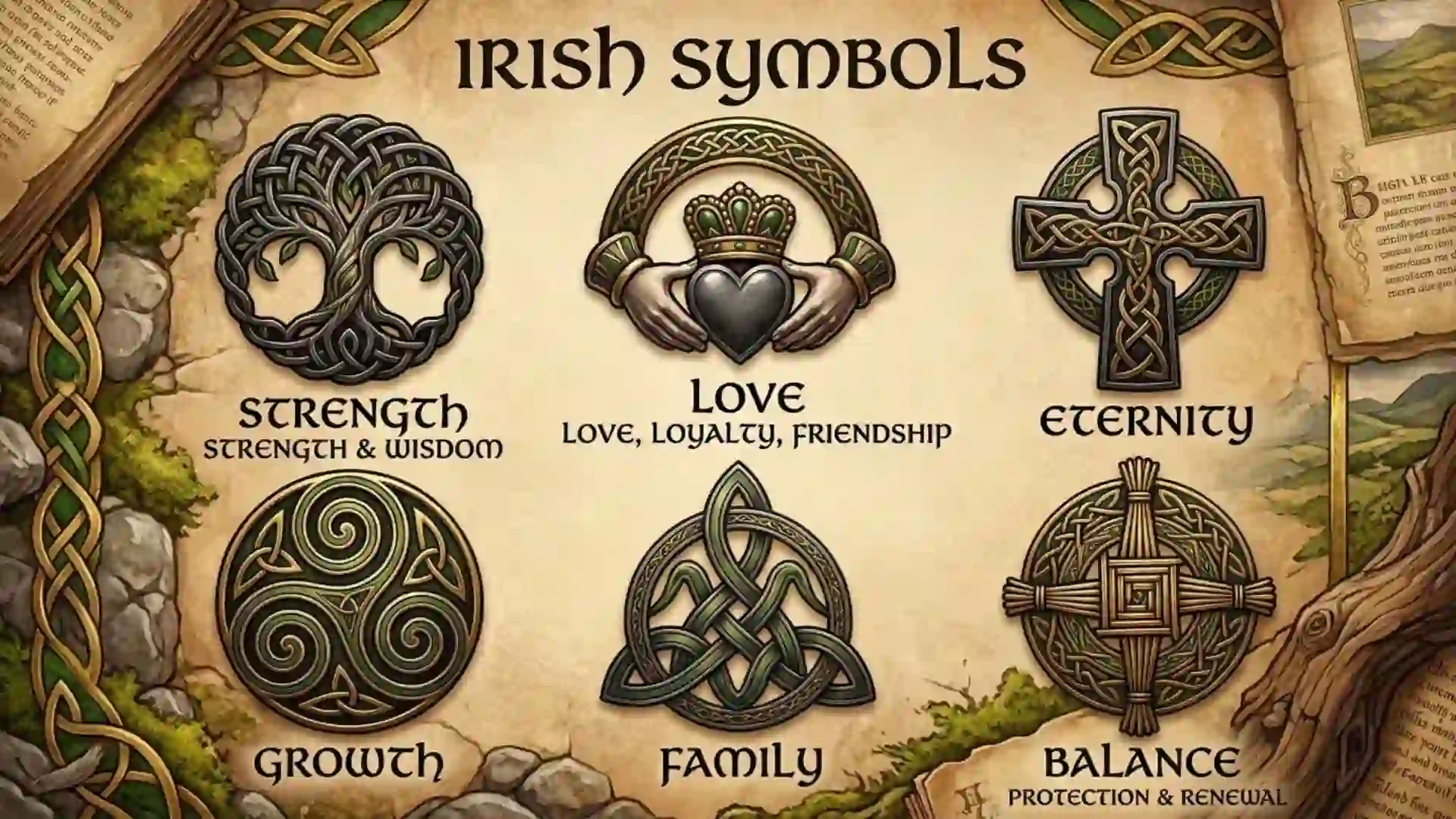
Celtic symbols have fascinated people for centuries. Their intricate knots, spirals, crosses, and animal designs appear in ancient monuments, medieval manuscripts, jewelry, and modern tattoos. Each design carries a story connected to history, religion, mythology, or cultural identity.
From the Triquetra and Celtic Cross to the Claddagh and Awen, these symbols represent ideas such as love, loyalty, protection, wisdom, strength, and spiritual connection. However, their meanings aren’t always as ancient or straightforward as modern interpretations suggest.
The Celts weren’t one unified nation. They were diverse groups of people who lived across parts of Europe and spoke related Celtic languages. Their artistic traditions changed over time as different communities developed their own beliefs and customs.
In this guide, you’ll discover more than 30 Celtic symbols and meanings, including their historical origins, cultural importance, spiritual associations, and modern uses. You’ll also learn which symbols have genuine historical evidence and which gained popularity through contemporary Celtic-inspired designs.
What Are Celtic Symbols?
Celtic symbols are visual designs, patterns, and motifs associated with ancient Celtic-speaking communities and later Celtic cultural traditions. They appear in metalwork, stone carvings, illuminated manuscripts, religious objects, and decorative artwork.
Many recognizable designs feature Celtic knotwork, spirals, geometric patterns, and animal imagery. These artistic elements developed across different periods and regions rather than following one universal symbolic system.
Ancient Celtic art often featured:
- Interlacing patterns: Curving lines that weave over and under one another.
- Spirals: Circular designs found in prehistoric monuments and later artwork.
- Animal motifs: Horses, boars, birds, and other creatures.
- Geometric patterns: Repeating shapes and symmetrical arrangements.
- Religious imagery: Crosses, biblical figures, and Christian decorative elements.
Celtic symbolism developed through several historical periods. Iron Age La Tène art introduced distinctive curving patterns and stylized animal designs. Later, early medieval Insular artists combined interlace, spirals, and Christian imagery in manuscripts and stone crosses.
It’s important to remember that not every design sold as an ancient Celtic symbol actually comes from antiquity. Some familiar meanings developed much later through folklore, religious traditions, and the modern Celtic Revival.
30+ Important Celtic Symbols and Their Meanings
The following symbols represent some of the best-known examples of Celtic art and cultural heritage. Their meanings reflect historical evidence alongside clearly identified modern interpretations.
Triquetra (Trinity Knot)
The Triquetra consists of three interconnected arcs that create a continuous, three-cornered design. Its name comes from Latin and refers to a three-cornered shape.
The motif appears in early medieval European artwork, including Christian manuscripts. Christians later used it to represent the Holy Trinity: Father, Son, and Holy Spirit.
Today, people also associate the Triquetra with:
- Threefold unity and interconnectedness.
- Eternal life and continuity.
- Mind, body, and spirit.
- Family connections and spiritual balance.
Although modern interpretations often describe it as an ancient Celtic symbol of eternity, its precise original meaning isn’t established.
Triskele (Triple Spiral)
The Triskele, also called the Triple Spiral, features three curved arms or spirals radiating from a central point.
One famous example appears on the entrance stone at Newgrange, a prehistoric passage tomb in County Meath, Ireland. The monument dates to approximately 3200 BCE, long before the historical Iron Age Celts.
Its recurring three-part structure inspires modern interpretations involving:
- Movement and progress.
- Natural cycles and renewal.
- Birth, life, and death.
- Personal transformation.
- Three interconnected stages of existence.
The Triskele is particularly popular in Celtic-inspired jewelry, tattoos, and artwork.
Celtic Cross
The Celtic Cross combines a Christian cross with a circular ring surrounding its central intersection. Medieval examples often feature intricate interlacing patterns and biblical scenes.
Irish and British high crosses became important religious monuments during the early medieval period. They served as expressions of Christian faith and displayed religious stories through detailed stone carvings.
The Celtic Cross commonly represents:
- Christian faith and devotion.
- Irish religious heritage.
- Spiritual commitment.
- Remembrance and memorials.
- The relationship between religious and artistic traditions.
Although people sometimes connect its circle with eternity or the sun, interpretations vary across individual designs and historical contexts.
Awen Symbol
The Awen is a Welsh symbol of inspiration, commonly represented by three rays descending from three points.
The Welsh word awen refers to poetic or artistic inspiration. It has strong connections with Welsh literary culture and later Druidic traditions.
The symbol became especially recognizable through Iolo Morganwg, an eighteenth-century Welsh poet and antiquarian associated with the modern Druid revival.
Today, Awen represents:
- Creativity and imagination.
- Poetic inspiration.
- Artistic expression.
- Spiritual reflection.
- Welsh cultural identity.
Claddagh Symbol
The Claddagh features two hands holding a heart topped with a crown. Each element carries a recognizable meaning:
| Design element | Meaning |
| Heart | Love |
| Hands | Friendship |
| Crown | Loyalty |
The design comes from the Claddagh fishing village near Galway, Ireland. The Claddagh ring became an enduring expression of Irish craftsmanship and personal relationships.
People commonly exchange these rings as romantic gifts, friendship tokens, or family heirlooms.
Celtic Tree of Life (Crann Bethadh)
The Celtic Tree of Life usually depicts a tree with spreading branches and deep roots. Its circular composition connects the upper and lower parts of the design.
Trees held important places in Irish mythology, traditional stories, and cultural practices. Certain trees, especially oak, ash, and yew, carried particular significance.
Modern interpretations associate the Tree of Life with:
- Family heritage and ancestry.
- Growth and personal development.
- Strength and stability.
- Nature and interconnectedness.
- Renewal and continuity.
The familiar symmetrical Tree of Life artwork is largely a modern Celtic-inspired design rather than one universally documented ancient emblem.
Dara Knot
The Dara Knot is a modern Celtic-inspired interlaced design associated with oak trees.
Its name relates to the Irish word dair, meaning oak. Oak trees have long held cultural importance in European traditions and appear in historical discussions of sacred groves.
Modern Dara Knot designs commonly represent:
- Inner strength.
- Resilience and endurance.
- Stability and determination.
- Deep family roots.
- Connection with nature.
Celtic Shield Knot
The Shield Knot features interwoven lines arranged within a shield-like or four-sided shape.
Modern interpretations connect it with protection, security, and courage. Its bold structure also makes it popular in contemporary tattoos and decorative artwork.
However, there isn’t one universally documented ancient Shield Knot with a fixed protective meaning. Its interpretation depends on the design and context.
Celtic Spiral and Double Spiral
Spirals are among the most recognizable motifs in prehistoric European art.
Single spirals feature one curling line. Double spirals contain two connected or opposing spiral forms.
They appear in prehistoric monuments and later decorative traditions. Newgrange provides one of Ireland’s best-known examples of ancient spiral carving.
Modern interpretations often associate these designs with movement, transformation, duality, natural cycles, and renewal.
St. Brigid’s Cross
St. Brigid’s Cross is traditionally woven from rushes or similar plant materials. Its distinctive woven shape connects it with Irish Christian folk traditions.
Families traditionally displayed these crosses in their homes for blessings and protection. They are especially associated with St. Brigid’s Day on February 1.
The cross represents:
- Saint Brigid and Irish Christian heritage.
- Household blessings.
- Faith and devotion.
- Protection in traditional Irish customs.
Shamrock
The Shamrock is a three-leaved plant strongly associated with Ireland. Traditional stories connect it with Saint Patrick and his explanation of the Christian Trinity.
Its three leaves helped make it an enduring symbol of Irish identity.
The shamrock commonly represents Irish heritage, Christianity, national pride, and cultural celebration. It shouldn’t be confused with the four-leaf clover, which has separate folklore associations with good luck.
Celtic Harp
The Celtic Harp represents Ireland’s rich musical and literary traditions. Known as cláirseach in Irish, the traditional harp played an important role in Gaelic culture.
Harpists performed music at royal courts and gatherings. Their work also connected with poetry, storytelling, and oral traditions.
The harp remains an important emblem of Irish national identity. The historic instrument commonly called Brian Boru’s Harp is preserved at Trinity College Dublin, although its traditional attribution to Brian Boru isn’t historically established.
Ogham Symbols (Ogam)
Ogham is an early medieval writing system associated primarily with Ireland. Its letters consist of groups of strokes arranged along a central line or edge.
Ogham inscriptions appear on standing stones across Ireland and other parts of the British Isles. Many commemorate personal names or family connections.
The script is important because it provides evidence of early Irish language and literacy.
Modern Ogham designs often incorporate tree associations. However, the popular idea of a complete ancient Celtic tree alphabet requires caution because later interpretations expanded beyond what surviving inscriptions establish.
Serch Bythol
Serch Bythol is a modern Welsh-inspired design commonly formed from two interlocking Triquetra shapes.
The Welsh words relate to enduring love. Contemporary jewelry and tattoo designs use the motif to represent romantic commitment, spiritual connection, and lasting relationships.
Although popular online descriptions sometimes call it an ancient Welsh symbol, its specific traditional antiquity isn’t firmly established.
Five-Fold Symbol
The Celtic Five-Fold Symbol appears in several modern geometric designs involving five interconnected forms.
Contemporary interpretations associate it with balance, harmony, and interconnectedness. Some designs connect the five parts with natural elements or different aspects of human existence.
However, these interpretations shouldn’t be presented as one established ancient Celtic belief system.
Solar Cross (Sun Wheel)
The Solar Cross consists of a circle divided by a cross. Similar motifs appear in prehistoric European artwork.
Modern interpretations often connect it with solar imagery, seasonal cycles, and the four directions.
Its meaning depends on the specific artifact and historical context. Not every ancient circular cross can confidently be identified as a Celtic religious symbol.
Green Man
The Green Man usually appears as a human face surrounded by foliage or emerging from leaves.
Examples became prominent in medieval European church decoration. The image is now associated with vegetation, nature, renewal, and seasonal growth.
Although modern interpretations sometimes connect the Green Man with ancient Celtic nature deities, direct historical links are difficult to establish.
Celtic Dragon
The Celtic Dragon is especially associated with Welsh cultural imagery. The red dragon, known as Y Ddraig Goch, appears on the national flag of Wales.
Dragon imagery commonly represents power, national identity, courage, and guardianship in modern Celtic-inspired designs.
Other Celtic Animal Symbols
Animals also appear in Celtic mythology, literature, and archaeological artwork.
| Animal | Cultural and symbolic associations |
| Stag | Antlers, nature, sovereignty, and Cernunnos imagery |
| Raven | Warfare, prophecy, and the Morrígan |
| Boar | Hunting, martial imagery, and warrior culture |
| Horse | Mobility, prestige, and the goddess Epona |
| Salmon | Wisdom and the Salmon of Knowledge |
| Swan | Transformation and the Children of Lir |
| Wolf | Wilderness and later associations with loyalty |
| Bull | Cattle wealth, fertility, and power |
| Serpent | Religious narratives and mythological imagery |
| Cat | Scottish folklore and the Cat Sìth |
Celtic Symbols in Irish, Scottish, and Welsh Heritage
Celtic traditions developed across different regions, creating distinct artistic styles, languages, and cultural identities. Ireland, Scotland, and Wales share historical connections, but their symbols aren’t interchangeable.
Irish Celtic Symbols and Their Meanings
Ireland has some of the world’s most recognizable Celtic heritage symbols.
Important examples include:
- Claddagh: Love, friendship, and loyalty.
- Shamrock: Irish identity and Christian tradition.
- St. Brigid’s Cross: Household blessings and faith.
- Celtic Cross: Medieval Christian heritage.
- Ogham: Early Irish writing and ancestral inscriptions.
- Irish Harp: Music, poetry, and national identity.
Ireland’s prehistoric monuments also preserve remarkable artwork. Newgrange, built around 3200 BCE, contains intricate stone carvings, including famous spiral designs.
Scottish Celtic Symbols and Their Meanings
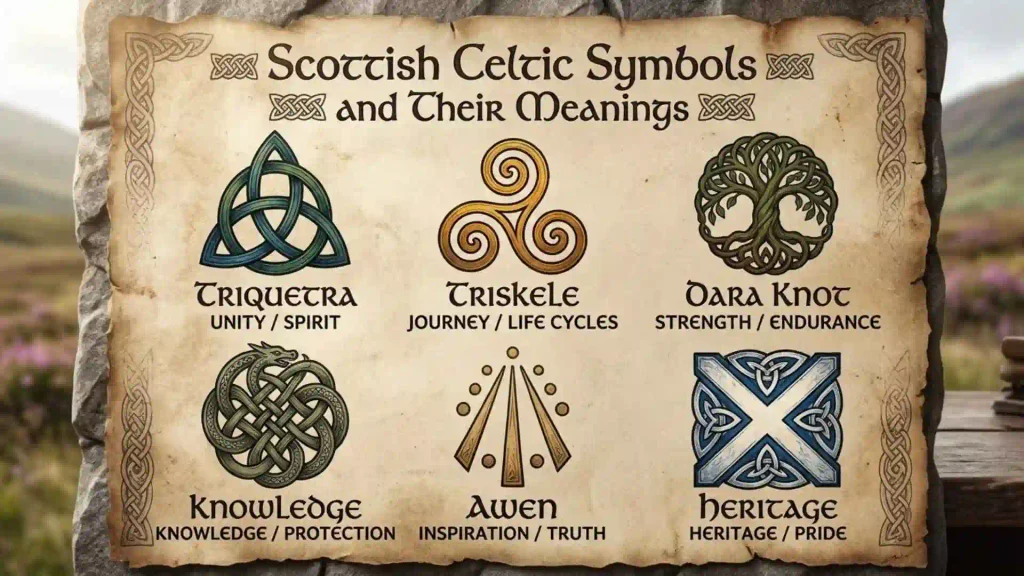
Scottish heritage includes Gaelic traditions, Pictish artwork, Christian monuments, and distinctive clan heraldry.
Important cultural examples include:
- Pictish symbols: Carved images found on early medieval Scottish stones.
- Clàrsach: Traditional Gaelic harp.
- Celtic knotwork: Decorative patterns found in manuscripts and stonework.
- Clan crests: Heraldic emblems associated with Scottish families and clans.
- Cat Sìth: A supernatural creature from Scottish folklore.
Iona Abbey also holds an important place in Scottish Christian history and Insular artistic traditions.
Welsh Celtic Symbols and Their Meanings
Welsh culture preserves a strong connection with Celtic languages, poetry, mythology, and national identity.
Important examples include:
- Awen: Inspiration and poetic creativity.
- Welsh Dragon: National identity and cultural heritage.
- Serch Bythol: Modern Celtic-inspired romantic symbolism.
- Bran the Blessed: A legendary figure from Welsh mythology.
- Interlaced patterns: Decorative designs used in contemporary Welsh heritage artwork.
The Welsh language remains an important part of this cultural identity.
Celtic History: How Ancient Symbols Developed
Understanding Celtic history helps explain why these designs look different across historical periods.
Celtic Symbols in the Bronze and Iron Ages
Prehistoric European communities created spirals, geometric carvings, and decorative objects long before the historical Celts emerged.
During the Iron Age, La Tène art became a recognizable artistic tradition. It featured flowing curves, stylized plants, animal forms, and elaborate metalwork.
The National Museum of Ireland documents La Tène decoration on objects such as collars, brooches, and weapons. These designs helped shape later Irish artistic traditions.
National Museum of Ireland+1
Celtic Symbols in Early Medieval Art
Between approximately 400 and 1200 CE, Irish and British artists developed remarkable forms of Insular art.
This period produced:
- Elaborately decorated manuscripts.
- Religious stone crosses.
- Metalwork and ceremonial objects.
- Intricate interlacing and geometric patterns.
The Book of Kells remains one of the best-known examples of medieval Irish manuscript decoration.
Its pages combine Christian imagery with complex patterns and ornamental designs.
Celtic Symbols in the Modern Celtic Revival
The nineteenth century brought renewed interest in Celtic languages, literature, folklore, and artistic heritage.
Artists and cultural movements revived older decorative patterns while creating new interpretations. The Welsh Druid Revival also influenced the modern presentation of symbols such as Awen.
Consequently, some designs now described as ancient Celtic symbols actually belong to modern Celtic-inspired traditions.
Celtic Knotwork and Traditional Celtic Designs
Celtic knotwork is one of the most recognizable features of Celtic-inspired artwork. It uses interwoven lines to create complex decorative patterns.
These designs appear in early medieval manuscripts, stone crosses, metalwork, and contemporary jewelry.
Common features include:
- Continuous-looking lines.
- Interwoven strands.
- Repeating geometric patterns.
- Symmetrical arrangements.
- Intricate loops and intersections.
Three-Strand Celtic Knots
Three-strand patterns appear in designs such as the Triquetra. Their modern interpretations often focus on unity, connection, and threefold symbolism.
Four-Strand and Fourfold Knots
Four-part knotwork creates more complex interlaced arrangements. Modern interpretations sometimes connect these patterns with four seasons or cardinal directions.
Endless Celtic Knot Patterns
Endless knot designs feature lines that appear to continue without a clear beginning or ending.
People often associate them with eternity, lasting relationships, and interconnectedness. However, these meanings aren’t universal historical definitions.
Celtic Spiritual Symbols and Religious Traditions
Celtic religious history includes pre-Christian beliefs, early Christianity, local folklore, and modern spiritual movements.
Celtic Pagan Symbols
Ancient Celtic religious traditions included sacred landscapes, ritual practices, deities, and connections with the natural world.
Spirals, animal imagery, and decorated objects provide evidence of ancient artistic and religious expression. However, archaeologists cannot always determine exactly what individual designs meant.
Celtic Christian Symbols
Christianity influenced Irish and British artwork during the early medieval period.
Important examples include:
- Celtic Crosses.
- Triquetra designs in Christian manuscripts.
- Shamrock traditions associated with Saint Patrick.
- St. Brigid’s Cross.
- Biblical imagery in illuminated manuscripts.
These traditions demonstrate how local artistic styles developed within Christian religious communities.
Celtic Festivals and Seasonal Traditions
Four festivals commonly appear in discussions of Celtic seasonal traditions.
| Festival | Traditional date | Main associations |
| Imbolc | February 1 | Saint Brigid and seasonal transition |
| Beltane | May 1 | Fire customs and the beginning of summer |
| Lughnasadh | August 1 | Harvest and community gatherings |
| Samhain | October 31–November 1 | Seasonal transition and supernatural folklore |
Imbolc connects with early spring traditions and Saint Brigid’s Day. Beltane marks the beginning of summer in traditional Irish seasonal reckoning.
Lughnasadh connects with harvest gatherings and the deity Lugh. Samhain marks the transition into winter and features prominently in Irish folklore.
Modern Pagan communities also include these festivals in the Wheel of the Year. However, contemporary practices shouldn’t automatically be treated as unchanged ancient customs.
Modern Uses of Celtic Symbols
Celtic designs remain popular because they combine striking artwork with meaningful cultural associations.
Celtic Tattoos
Popular Celtic tattoo designs include:
- Triquetra for threefold unity.
- Claddagh for love and loyalty.
- Celtic Cross for Christian faith.
- Dara Knot for modern strength symbolism.
- Ogham inscriptions for linguistic heritage.
- Triskele for movement and transformation.
Before choosing an Ogham tattoo, verify the inscription with a reliable language specialist. A small spelling mistake can permanently change its intended meaning.
Celtic Jewelry and Rings
Celtic jewelry includes knotwork pendants, Claddagh rings, cross necklaces, and Ogham-inspired pieces.
People often choose these designs to celebrate family connections, romantic relationships, or cultural heritage.
Celtic Home Décor and Artwork
Celtic-inspired patterns appear in wall decorations, furniture, textiles, garden ornaments, and carved artwork.
The intricate designs also work well in wedding decorations, family gifts, and traditional craft projects.
How to Choose the Right Celtic Symbol
Choosing a symbol becomes easier when you start with its intended meaning.
| What you want to represent | Symbols worth exploring |
| Love and commitment | Claddagh, Serch Bythol |
| Family and ancestry | Tree of Life, Ogham |
| Protection | St. Brigid’s Cross, Shield Knot |
| Strength | Dara Knot, boar imagery |
| Wisdom | Salmon of Knowledge |
| Creativity | Awen |
| Eternity | Triquetra, endless knotwork |
| Renewal | Triskele and spiral motifs |
| Irish heritage | Shamrock, harp, Claddagh |
| Welsh heritage | Awen, Welsh Dragon |
Before choosing, consider three things:
- Historical background: Does the design have documented historical origins?
- Cultural connection: Is it associated with Ireland, Scotland, Wales, or a broader European tradition?
- Personal meaning: Does its symbolism reflect the message you want to express?
This approach helps you choose a design with genuine significance rather than relying on popular marketing descriptions.
Are All Celtic Symbols Ancient?
No. Some Celtic symbols have ancient archaeological roots while others developed during medieval Christianity or modern artistic movements.
For example, the Newgrange triple spiral belongs to Neolithic artwork. Newgrange itself dates to approximately 3200 BCE, thousands of years before the historical Iron Age Celts.
National Museum of Ireland+1
Ogham inscriptions provide a different kind of historical evidence. The earliest surviving examples date approximately from the fourth to seventh centuries CE. More than 400 Ogham stones and fragments have been recorded.
The Heritage Council+1
Consider these distinctions:
| Symbol or design | Historical classification |
| Newgrange spirals | Neolithic prehistoric artwork |
| La Tène animal motifs | Iron Age European art |
| Ogham | Early medieval writing system |
| Celtic Cross | Medieval Christian tradition |
| St. Brigid’s Cross | Irish Christian folk tradition |
| Awen | Welsh inspiration concept with modern Druidic symbolism |
| Dara Knot | Modern Celtic-inspired design |
| Motherhood Knot | Contemporary decorative symbolism |
| Serch Bythol | Modern Celtic-inspired romantic design |
The most important lesson is simple: a meaningful symbol doesn’t need an invented ancient origin to deserve appreciation.
Frequently Asked Questions About Celtic Symbols
What Are the Most Important Celtic Symbols?
Some of the best-known Celtic symbols include the Triquetra, Triskele, Celtic Cross, Claddagh, Awen, Tree of Life, Shamrock, and Ogham. Each connects with different artistic, historical, religious, or cultural traditions.
What Is the Oldest Celtic Symbol?
There isn’t one universally recognized oldest Celtic symbol. The triple spiral at Newgrange is among the oldest famous motifs associated with later Celtic-inspired symbolism, but it dates to approximately 3200 BCE, long before the historical Celts.
What Is the Celtic Symbol for Eternal Love?
The Claddagh is a popular Irish symbol of love, loyalty, and friendship. Serch Bythol and contemporary Celtic love knots also represent lasting romantic connections.
What Is the Celtic Symbol for Protection?
St. Brigid’s Cross has traditional Irish associations with household blessings and protection. Shield-shaped knotwork also carries protective meanings in modern Celtic-inspired artwork.
What Is the Celtic Symbol for Strength?
The Dara Knot is commonly associated with strength, resilience, and stability. Its modern symbolism draws inspiration from the oak tree and its strong roots.
What Is the Celtic Symbol for Family?
The Tree of Life is commonly used to represent family connections, ancestry, growth, and interconnectedness. Ogham inscriptions can also provide meaningful links to family heritage.
Are Celtic Symbols Pagan or Christian?
Celtic symbols include both pre-Christian and Christian traditions. Spirals and ancient animal motifs appear in prehistoric and Iron Age artwork while Celtic Crosses and illuminated manuscripts reflect medieval Christianity.
What Is the Difference Between the Triquetra and Triskele?
The Triquetra consists of three interconnected arcs that create a triangular knot. The Triskele features three curved or spiral arms radiating from a central point.
What Do Celtic Knots Represent?
Celtic knots are decorative interlacing patterns. Modern interpretations commonly associate them with eternity, unity, relationships, and interconnectedness.
Can You Use Celtic Symbols for Tattoos?
Yes. Celtic symbols are popular tattoo choices because of their detailed designs and cultural associations. Research the design’s origins and verify any language-based inscription before making it permanent.
Conclusion: The Lasting Meaning of Celtic Symbols
Celtic symbols preserve a remarkable artistic and cultural legacy. Their spirals, interwoven knots, crosses, and animal motifs connect different generations with ancient artwork and historical traditions.The Triquetra represents threefold unity in many modern interpretations. The Claddagh expresses love, loyalty, and friendship while the Awen celebrates inspiration and creativity. Other designs connect with Irish Christianity, Welsh heritage, Scottish folklore, and early medieval art.However, understanding their origins matters just as much as appreciating their beauty. Some designs come from archaeological discoveries while others developed through Christian traditions or modern Celtic-inspired creativity.Whether you’re exploring Celtic symbols and meanings for cultural research, jewelry, tattoos, or personal inspiration, look beyond the artwork. Understanding the history behind each design makes its significance far more meaningful.

I am Marcus Lee, a cultural researcher and slang aficionado. I study the roots of informal language and how communities create meaning through words. My books “Slang Origins: A Journey Through Words” and “Words That Move Us: Slang Across Generations” focus on the history and psychology of slang. I enjoy guiding readers to understand not just the words, but the stories and attitudes they carry, so you can truly connect with language in daily life.
 Lisa Reynolds
 John Carter