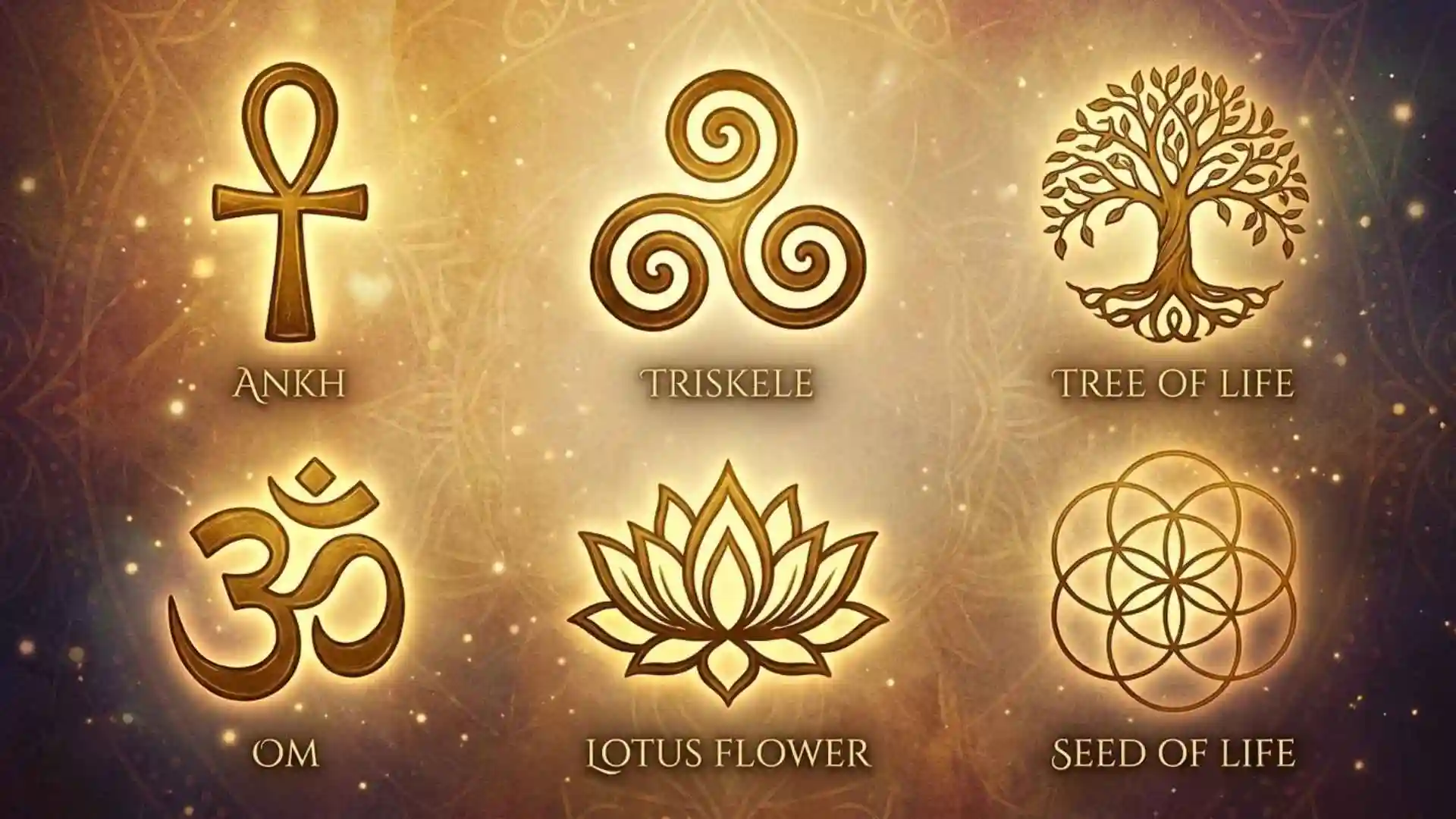
Spiritual symbols carry deep meanings that connect people with faith, wisdom, protection, healing, and the mysteries of life. Across different cultures and religions, people have used these sacred signs to express beliefs that words alone cannot capture.
Some symbols represent divine energy and higher consciousness. Others remind people to seek balance, overcome challenges, protect their homes, or find inner peace. From the ancient Om symbol to the Buddhist Lotus Flower and the Egyptian Ankh, each design carries a distinctive history and spiritual message.
However, spiritual symbols don’t have one universal meaning. Their interpretations often change across religions, historical periods, and cultural traditions. A symbol that represents protection in one culture may communicate faith, authority, or transformation in another.
In this guide, you’ll discover 23 spiritual symbols and their meanings, including their origins, religious connections, historical significance, and traditional uses. You’ll also learn how people incorporate these symbols into meditation, personal reflection, jewelry, and everyday spiritual practices.
What Are Spiritual Symbols?
Spiritual symbols are images, shapes, objects, letters, or signs that represent religious beliefs, sacred ideas, and deeper aspects of human experience. They help people express concepts such as divine presence, spiritual growth, protection, wisdom, and the relationship between humanity and the universe.
Unlike ordinary decorative designs, sacred symbols often carry meanings shaped by centuries of religious practice, mythology, philosophy, and cultural traditions.
For example:
- The Om symbol represents a sacred sound and spiritual reality in Hindu traditions.
- The Christian Cross represents the crucifixion and resurrection of Jesus Christ.
- The Lotus Flower represents purity, detachment, and liberation in several Indian religious traditions.
- The Yin Yang symbol illustrates complementary forces and their relationship within Chinese philosophy.
- The Hamsa Hand traditionally serves as a protective sign in several Middle Eastern and North African communities.
Spiritual symbols can serve different purposes. Some appear in religious ceremonies, while others feature in meditation, sacred architecture, prayer objects, manuscripts, and personal ornaments.
Why Are Spiritual Symbols Important?
Spiritual symbols make abstract beliefs easier to understand and remember. A simple image can represent an entire religious teaching or philosophical principle.
Their importance often comes from several functions:
- Religious identity: Symbols identify particular faiths, communities, and traditions.
- Spiritual protection: Certain amulets and sacred signs traditionally represent protection against harm or misfortune.
- Personal reflection: Symbols provide visual reminders of values such as patience, compassion, and courage.
- Meditation: Geometric patterns, sacred images, and written mantras can support concentration.
- Cultural heritage: Traditional symbols preserve stories, customs, and beliefs across generations.
- Spiritual transformation: Certain images represent enlightenment, rebirth, forgiveness, and personal development.
However, a symbol’s meaning depends on its cultural setting. Understanding its original context matters more than assigning it a convenient modern interpretation.
23 Spiritual Symbols and Their Meanings
The following 23 sacred symbols come from different religious, philosophical, and cultural traditions. Each has a distinctive history and set of associations.
Some represent protection and healing. Others focus on spiritual awakening, divine connection, balance, or the journey toward enlightenment.
Om Symbol (Aum)
The Om symbol (Aum) is one of the most recognizable sacred signs in Indian spiritual traditions. It represents a sacred sound associated with ultimate reality, consciousness, and the interconnected nature of existence.
In Hinduism, Om appears in the Vedas, Upanishads, prayers, and meditation practices. The Mandukya Upanishad explores its spiritual significance through the sounds A, U, and M.
These three sounds are traditionally associated with different states of consciousness:
- A: The waking state of ordinary awareness.
- U: The dream state and inner experience.
- M: Deep, dreamless sleep.
- The silence after Om: A state associated with pure awareness and the transcendent reality known as Turiya.
The familiar written symbol represents this sacred syllable visually. Its curves and crescent-like form are interpreted through different philosophical explanations.
People often chant Om during meditation, prayer, and yoga. The repetition can provide a steady point of focus and help establish a contemplative atmosphere.
Spiritual meaning: Universal consciousness, sacred sound, inner awareness, and connection with ultimate reality.
Cross Symbol
The Cross symbol is the central emblem of Christianity. It represents the crucifixion of Jesus Christ and the Christian belief that his death and resurrection brought redemption and hope.
The cross originally referred to a Roman execution method. Christianity transformed its meaning into a powerful expression of faith, sacrifice, divine love, and eternal life.
Different Christian communities use distinct cross designs, including:
- Latin Cross: The familiar upright cross associated with Jesus’ crucifixion.
- Greek Cross: A cross with four equal arms.
- Celtic Cross: A cross surrounded by a distinctive circular ring.
- Orthodox Cross: A design that commonly features additional horizontal bars.
- Jerusalem Cross: A large central cross surrounded by four smaller crosses.
Each design has its own historical and religious associations.
For Christians, the cross also represents forgiveness, perseverance, and the promise of resurrection. It appears in churches, cemeteries, religious artwork, jewelry, and personal devotional practices.
Spiritual meaning: Faith, sacrifice, redemption, forgiveness, resurrection, and divine love.
Vajra Symbol (Dorje)
Tradition: Vajrayana Buddhism and other tantric Buddhist traditions
The Vajra symbol, also called the Dorje in Tibetan, represents indestructible spiritual power, clarity, and the strength of enlightened wisdom.
The Sanskrit word vajra means thunderbolt or something adamantine. Buddhist traditions use the vajra as both a philosophical symbol and a ritual object.
In Vajrayana Buddhism, practitioners often use a vajra alongside a ritual bell. These objects represent complementary aspects of spiritual practice.
The vajra traditionally represents method or skillful means, while the bell represents wisdom. Their combination expresses the relationship between these essential qualities.
The five-pronged vajra also appears in Tibetan Buddhist ceremonies and sacred artwork. Its detailed structure carries additional meanings within different tantric traditions.
The symbol reminds practitioners that genuine wisdom can overcome confusion and ignorance. Its diamond-like quality represents the indestructible nature of enlightened understanding.
Spiritual meaning: Indestructible wisdom, spiritual strength, clarity, compassion, and enlightenment.
The Smithsonian’s National Museum of Asian Art provides a useful explanation of the
Hamsa Symbol (Hand of Fatima)
The Hamsa symbol is an open hand with five fingers. Many versions feature an eye in the center of the palm.
The symbol appears across parts of the Middle East, North Africa, and the Mediterranean. It is commonly associated with protection, blessings, and good fortune.
Different communities use different names for the Hamsa. These include the Hand of Fatima in Muslim cultural contexts and the Hand of Miriam in Jewish contexts.
Its five fingers may receive different interpretations depending on the tradition. Some associate them with religious teachings, blessings, or spiritual protection.
The central eye is particularly important. It connects the hand with traditional beliefs about the evil eye and protection against envy or harmful attention.
Hamsa designs appear on doorways, necklaces, bracelets, wall decorations, and household objects. Their use varies between religious and cultural communities.
Spiritual meaning: Protection, blessings, good fortune, divine care, and resistance to envy.
Khanda Symbol
The Khanda symbol is one of the most recognizable emblems of Sikhism. It represents Sikh identity, spiritual commitment, divine unity, and the responsibility to defend justice.
The emblem contains three main visual elements:
- Central Khanda: A double-edged sword associated with divine knowledge and the distinction between truth and falsehood.
- Chakkar: A circular weapon surrounding the central sword. Its unbroken shape represents eternity and divine unity.
- Two Kirpans: Curved swords representing Miri and Piri, the worldly and spiritual dimensions of responsibility.
Together, these elements communicate an important Sikh principle: spiritual devotion should guide everyday actions.
The Khanda also appears on the Nishan Sahib, the Sikh religious flag displayed at gurdwaras.
Sikh tradition emphasizes equality, service, courage, justice, and devotion to one God. The emblem reflects these interconnected values.
Spiritual meaning: Divine knowledge, oneness of God, justice, courage, equality, and spiritual responsibility.
For additional historical context, see the Sikh Coalition’s explanation of the
Lotus Flower Symbol
The Lotus Flower symbol represents purity, spiritual awakening, transformation, and liberation. Its significance comes partly from its natural growth pattern.
A lotus grows from muddy water yet produces a clean and beautiful flower above the surface. This characteristic makes it a powerful metaphor for spiritual development.
In Hinduism, the lotus appears in religious art associated with several deities. Lakshmi and Saraswati are commonly depicted with lotus imagery.
In Buddhism, the flower represents purity and the possibility of awakening despite the difficulties of ordinary life. Different lotus colors also carry symbolic associations in Buddhist traditions.
In Jainism, lotus imagery appears in religious art and sacred representations.
The flower’s unfolding petals can also suggest the gradual development of wisdom and awareness.
Spiritual meaning: Purity, enlightenment, spiritual growth, detachment, rebirth, and liberation.
Seal of Melchizedek
Tradition: Biblical references and later esoteric symbolism
The Seal of Melchizedek is a name used in some modern esoteric and sacred geometry circles for geometric designs involving overlapping squares and star-like forms.
Melchizedek appears in the Hebrew Bible as a king of Salem and priest of God Most High. Genesis 14 describes his encounter with Abraham.
The biblical figure also appears in Psalm 110 and the New Testament Letter to the Hebrews. These passages establish his religious importance, particularly in discussions of priesthood and spiritual authority.
However, interpretations of the geometric Seal of Melchizedek require care. The Bible does not provide a universally established geometric emblem for Melchizedek.
Modern spiritual communities sometimes associate the design with:
- Divine order and harmony.
- Spiritual authority.
- Unity between different dimensions of existence.
- Sacred geometry.
- Balance and interconnectedness.
These are modern or esoteric interpretations rather than universally accepted biblical teachings.
Spiritual meaning: Divine order, spiritual authority, harmony, and sacred geometry in modern esoteric interpretations.
Yin Yang Symbol (Taijitu)
The Yin Yang symbol, known as the Taijitu, represents complementary forces that interact within the natural world.
Its familiar circular design contains two curved sections: one black and one white. Each section contains a small circle of the opposite color.
Yin traditionally represents qualities such as darkness, stillness, receptivity, and coolness. Yang represents qualities such as brightness, activity, warmth, and movement.
However, neither force is inherently good or evil. Both contribute to the changing patterns of existence.
The small contrasting dots illustrate another important principle: each force contains the potential for its opposite.
In Chinese philosophy, Yin and Yang help explain relationships between natural processes, human experiences, and changing conditions.
The symbol encourages people to recognize interdependence rather than treating opposites as completely separate.
Spiritual meaning: Balance, harmony, duality, interconnectedness, and complementary energy.
Unalome Symbol
The Unalome symbol is commonly associated with the spiritual journey toward enlightenment. Its design typically features a spiral, a winding line, and a series of dots.
Modern interpretations often connect the spiral with confusion, uncertainty, and the struggles of life. The winding path represents gradual personal development and increasing awareness.
The straightening line suggests greater clarity and spiritual direction. Dots near the end often represent the completion of the journey or liberation.
Unalome designs appear frequently in tattoos, jewelry, and meditation-inspired artwork.
However, the symbol’s modern popularity should not be mistaken for a universally standardized ancient Buddhist emblem. Its precise historical interpretation and use vary.
Spiritual meaning: Spiritual growth, life’s journey, overcoming difficulties, wisdom, and enlightenment.
Antahkarana Symbol
Tradition: Modern Reiki-related and esoteric practices
The Antahkarana symbol appears in some modern Reiki-related and energy-healing traditions. It is often presented as a geometric pattern containing repeated or overlapping forms.
The Sanskrit term antahkarana has a broader philosophical meaning. In Indian philosophical traditions, it refers to the inner instrument of the mind, including aspects of thought, understanding, and self-awareness.
Modern energy-healing interpretations associate the geometric symbol with inner balance, meditation, and spiritual awareness.
Some practitioners use it during visualization exercises or place it in meditation spaces.
However, the modern graphic Reiki symbol should not be confused with the broader classical Indian philosophical concept. They are related through terminology but do not represent the same established historical object.
Spiritual meaning: Inner awareness, mental clarity, meditation, and spiritual balance in modern energy-healing practices.
Tree of Life Symbol
Tradition: Ancient Near Eastern cultures and multiple religious traditions
The Tree of Life symbol represents growth, interconnectedness, renewal, and the relationship between different levels of existence.
Trees have long served as powerful religious and cultural images. Their roots extend into the earth while their branches reach toward the sky.
This natural structure makes the tree an effective symbol of connection between the physical and spiritual worlds.
Ancient Near Eastern, Egyptian, Jewish, and other traditions developed different tree-related images and ideas. These symbols do not all share one origin or identical meaning.
In Norse mythology, Yggdrasil is the great cosmic tree connecting different worlds. In Celtic cultural symbolism, trees also carry associations with nature, ancestry, and continuity.
In Jewish Kabbalah, the Tree of Life refers to a distinct diagram of ten sefirot representing divine attributes and their relationships.
The symbol’s interpretation therefore depends on the tradition in which it appears.
Spiritual meaning: Growth, grounding, wisdom, family connections, renewal, and the relationship between heaven and earth.
Eye of Horus (Wedjat)
Tradition: Ancient Egyptian religion
The Eye of Horus, also known as the Wedjat symbol, is an ancient Egyptian emblem associated with healing, restoration, protection, and renewal.
According to Egyptian mythology, Horus lost his eye during a conflict with Seth. The god Thoth restored it, transforming the eye into a symbol of recovery and wholeness.
Ancient Egyptians used Wedjat-eye amulets to represent protection and well-being. These objects appeared in burial practices as well as everyday life.
The Metropolitan Museum of Art identifies the Wedjat as a symbol of the healed eye of Horus. Its collection includes an amulet dating to approximately 1386–1347 BCE.
The Metropolitan Museum of Art+1
The eye’s detailed markings combine human and falcon-like features. Horus himself was closely associated with the falcon.
People today sometimes use the Eye of Horus as a symbol of spiritual protection and healing. Its original Egyptian context, however, remains essential to understanding its significance.
Spiritual meaning: Protection, healing, restoration, wholeness, and renewal.
Infinity Symbol
Tradition: Mathematics and modern spiritual symbolism
The Infinity symbol (∞) represents something without an end or limit. Its continuous loop makes it a popular image for eternity, endless possibility, and lasting connection.
The mathematical symbol is known as the lemniscate. John Wallis introduced the familiar infinity notation in 1655.
In modern spiritual and personal symbolism, people often associate it with:
- Eternal love and commitment.
- Endless possibilities.
- The continuity of existence.
- Interconnectedness.
- Renewal and transformation.
- The relationship between beginnings and endings.
Some designs combine the infinity sign with feathers, hearts, names, or other symbols.
Although it carries spiritual interpretations today, the infinity symbol is not an ancient religious emblem with one established universal meaning.
Spiritual meaning: Eternity, continuity, infinite potential, lasting love, and interconnectedness.
Spiral Sun Symbol
Tradition: Various ancient solar and modern symbolic traditions
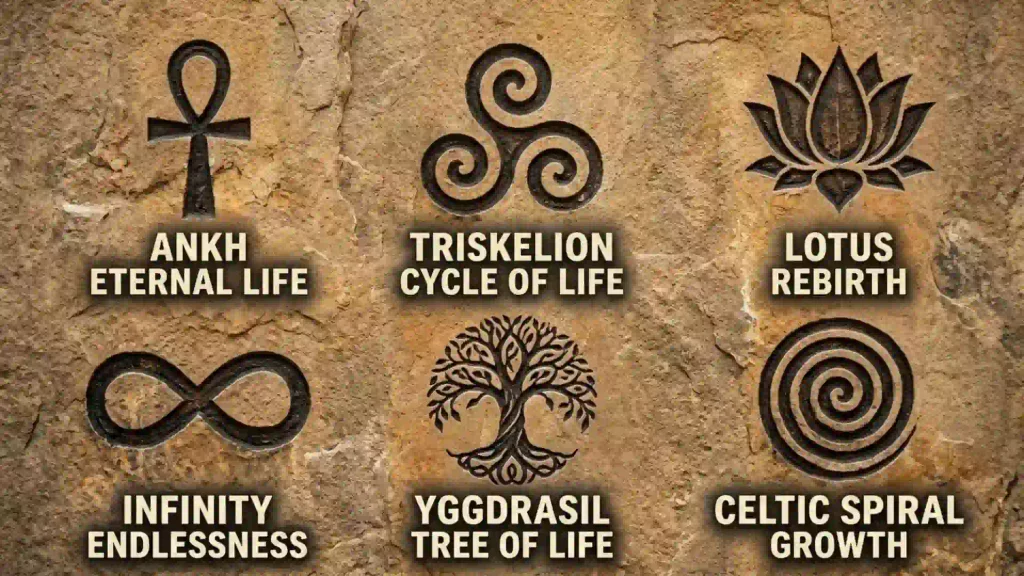
The Spiral Sun symbol combines two familiar natural forms: the sun and the spiral.
The sun has represented life, warmth, fertility, and renewal in many ancient cultures. Spirals appear in prehistoric art and later religious designs across different regions.
Together, these forms can communicate movement, cycles, growth, and the recurring rhythms of nature.
However, there is no single internationally recognized Spiral Sun emblem with one fixed historical meaning. Similar spiral designs appear in different archaeological and artistic contexts.
Modern spiritual interpretations often connect this imagery with life energy, seasonal change, personal renewal, and the movement of consciousness.
The symbol can also serve as a visual reminder of natural cycles, including sunrise, sunset, and seasonal transitions.
Spiritual meaning: Renewal, life, movement, natural cycles, vitality, and transformation.
Sri Yantra (Shri Yantra)
The Sri Yantra, also called the Shri Chakra, is one of the most intricate diagrams in Hindu sacred geometry.
It contains nine interlocking triangles arranged around a central point called the bindu. Five triangles point downward while four point upward.
Together, these triangles create 43 smaller triangles within a carefully structured geometric arrangement.
In Shri Vidya traditions, the Sri Yantra represents the goddess Tripura Sundari and the relationship between divine consciousness and creative power.
The upward and downward triangles are often interpreted through complementary principles associated with Shiva and Shakti.
The surrounding lotus petals and outer square complete the design. Practitioners use the yantra in specific ritual and meditative settings.
Its structure is not simply decorative. Within Shri Vidya, it serves as a sacred diagram connected to worship, mantra, and philosophical teachings.
Spiritual meaning: Divine unity, cosmic creation, sacred geometry, consciousness, and the relationship between Shiva and Shakti.
A detailed academic discussion appears in the study.
Reiki Symbols
Reiki symbols are visual elements used in certain forms of Japanese energy-healing practice. They are traditionally taught as part of practitioner training rather than treated as universal religious emblems.
The best-known symbols in modern Usui Reiki lineages include:
| Reiki symbol | Common name | Traditional association |
| First | Cho Ku Rei | Power and focus |
| Second | Sei He Ki | Mental and emotional harmony |
| Third | Hon Sha Ze Sho Nen | Distance practice and connection |
| Fourth | Dai Ko Myo | Master-level practice and spiritual development |
| Fifth | Raku | Grounding and completion in some lineages |
The exact number and teaching of Reiki symbols vary across schools. Raku, for example, is associated with some later Reiki traditions rather than being one of the original three Usui symbols commonly taught at the second-degree level.
Practitioners may use these designs during treatments, meditation, and intention-setting exercises.
It’s important to distinguish traditional Reiki beliefs from scientific evidence. Reiki’s claimed energy mechanisms have not been established by modern science.
Spiritual meaning: Focus, compassion, balance, connection, and spiritual development within Reiki practice.
The provides additional information about their traditional applications.
Ankh Symbol
The Ankh symbol is an ancient Egyptian hieroglyph representing life and the concept of living.
Its distinctive shape features a loop above a cross-like structure. Egyptian deities frequently appear holding ankhs in religious artwork.
The symbol was associated with life, vitality, and divine power. Egyptian art sometimes shows gods presenting the ankh to rulers as an expression of life-giving authority.
It also appeared in amulets, tomb decorations, and religious objects.
The Ankh’s meaning extended beyond ordinary physical existence. In Egyptian religious beliefs, it was closely connected with continued life and the afterlife.
Today, people often recognize it as the Egyptian Cross or a symbol of eternal life.
Its exact physical origin remains debated. One explanation suggests that it may have developed from a sandal-strap design, but Egyptologists have not established a definitive answer.
Spiritual meaning: Life, vitality, divine power, rebirth, and eternal existence.
The Metropolitan Museum’s educational resource explains
Bagua Map
Tradition: Chinese cosmology and Feng Shui
The Bagua map is an important tool in Feng Shui. It organizes space through eight areas associated with different aspects of life.
The term Bagua means eight trigrams. These trigrams come from the I Ching, also known as the Book of Changes.
Each trigram consists of three lines that may be broken or unbroken. Together, the eight combinations represent patterns of change in Chinese cosmology.
Traditional Bagua arrangements associate these areas with themes such as:
| Bagua area | Common association |
| Career | Life direction and work |
| Knowledge | Learning and personal development |
| Family | Ancestry and relationships |
| Wealth | Prosperity and resources |
| Fame | Reputation and recognition |
| Relationships | Partnership and marriage |
| Children | Creativity and descendants |
| Helpful people | Support and travel |
Different Feng Shui schools use different Bagua arrangements and application methods.
Practitioners may use the map when organizing rooms, planning buildings, or assessing the symbolic qualities of living spaces.
Spiritual meaning: Harmony, life changes, balance, prosperity, and the relationship between people and their surroundings.
Dreamcatcher
Tradition: Ojibwe and other Indigenous cultural contexts
The Dreamcatcher is associated particularly with Ojibwe culture. It traditionally takes the form of a circular hoop containing a woven web.
In Ojibwe stories, dreamcatchers connect with protective traditions involving children and sleep. The web is commonly understood as catching harmful dreams while allowing beneficial dreams to pass through.
The protective figure Asibikaashi, often called the Spider Woman in English retellings, appears in accounts of these traditions.
Traditional dreamcatchers may include willow hoops, sinew, beads, and feathers. Their construction and interpretation vary among makers and communities.
Over time, dreamcatchers became popular outside Indigenous communities. Mass production and commercial marketing often removed them from their original cultural context.
The Smithsonian’s discussion of dreamcatcher history examines their Ojibwe origins and the modern appropriation of Indigenous designs.
Smithsonian Institution+1
Spiritual meaning: Protection during sleep, care for children, traditional wisdom, and the preservation of cultural identity.
Evil Eye Symbol (Nazar)
Tradition: Mediterranean, Middle Eastern, and other cultural traditions
The Evil Eye symbol represents a widespread belief that envy or harmful attention can bring misfortune to another person.
This belief appears in numerous societies around the Mediterranean, the Middle East, and other parts of the world.
The Nazar amulet is a familiar protective object associated with this tradition. It often features concentric circles of dark blue, light blue, white, and black.
People traditionally place Nazar charms in homes, vehicles, shops, and jewelry.
The eye design represents watchfulness and protection against the harmful gaze. Some communities also use prayers, gestures, or other protective customs.
The evil eye should not be confused with the ancient Egyptian Eye of Horus. Both involve eye imagery, but they developed within different cultural and religious contexts.
Spiritual meaning: Protection against envy, misfortune, harmful attention, and negative intentions.
Helm of Awe (Aegishjalmur)
Tradition: Medieval Icelandic magical tradition and Norse literature
The Helm of Awe, known as Aegishjalmur, is associated with courage, intimidation, and protection in medieval Icelandic literary and magical traditions.
The name is commonly translated as Helm of Awe or Helm of Terror.
The concept appears in Fáfnismál, a poem preserved in the medieval Poetic Edda. In the story, the dragon Fafnir refers to possessing a helm of awe.
However, an important historical distinction often gets overlooked. The familiar eight-armed geometric stave design appears in much later Icelandic magical manuscripts rather than securely identified Viking Age archaeological objects.
The medieval literary reference and the later graphic symbol therefore have related but distinct histories.
Modern interpretations commonly associate the design with bravery, confidence, and protection during difficult situations.
Spiritual meaning: Courage, strength, protection, intimidation, and personal resolve.
Mjolnir (Thor’s Hammer)
Tradition: Norse mythology and modern Heathen practice
Mjolnir, also written Mjölnir, is the legendary hammer of Thor, the Norse god associated with thunder.
In Norse mythology, Thor uses the hammer to defend the gods and humanity against destructive forces. Its stories connect the weapon with strength, protection, and divine authority.
Mjolnir also held religious and cultural importance beyond mythology.
Archaeologists have discovered Viking Age hammer-shaped pendants. These objects demonstrate that the hammer was an important symbol in Norse cultural and religious life.
Some people wore Mjolnir pendants as expressions of religious identity or devotion. Modern Heathen communities continue to use the symbol.
Its meaning is not limited to physical strength. It also reflects the responsibility to defend communities and maintain order.
Spiritual meaning: Protection, strength, courage, divine power, and the defense of community.
Pentacle Symbol (Pentagram)
Tradition: Modern Paganism, Wicca, and older philosophical traditions
The Pentacle symbol usually consists of a five-pointed star enclosed within a circle. Its meaning depends on the historical period and spiritual tradition.
The five points are commonly associated with the elements of earth, air, fire, water, and spirit in modern Wiccan interpretations.
The surrounding circle represents unity, continuity, or the interconnected nature of these elements.
A pentagram is simply a five-pointed star. A pentacle commonly refers to a pentagram enclosed in a circle, although terminology varies.
Historically, pentagram designs appeared in several ancient contexts, including Greek mathematical and philosophical traditions.
In modern Wicca and other Pagan practices, the pentacle can represent spiritual protection, elemental balance, and the relationship between nature and spirit.
Spiritual meaning: Protection, elemental harmony, unity, balance, and spiritual connection.
Spiritual Symbols by Their Meanings and Purposes
Although these 23 symbols come from different traditions, many share similar themes. Some focus on protection, while others represent healing, wisdom, spiritual growth, or the connection between humanity and the divine.
Understanding these categories makes it easier to identify a symbol that reflects a particular belief or intention.
Powerful Spiritual Symbols for Strength and Courage
Some sacred designs represent resilience, confidence, and the ability to overcome difficult circumstances.
They remind people that strength involves more than physical power. It can also mean patience, moral courage, discipline, and spiritual determination.
Popular examples include:
- Vajra: Represents indestructible wisdom and spiritual strength.
- Khanda: Reflects courage, divine knowledge, and the responsibility to defend justice.
- Mjolnir: Represents Thor’s protective power and strength.
- Helm of Awe: Traditionally associated with courage and intimidation.
- Pentacle: Represents elemental harmony and spiritual protection in modern Pagan traditions.
These symbols often appear in jewelry, artwork, personal accessories, and religious objects.
Healing Spiritual Symbols
Healing symbols represent restoration, renewal, wholeness, and emotional well-being. Their meanings often come from religious stories or traditional healing practices.
| Symbol | Healing association | Cultural background |
| Eye of Horus | Restoration and recovery | Ancient Egypt |
| Lotus Flower | Spiritual renewal and liberation | Hinduism and Buddhism |
| Reiki Symbols | Healing intentions and energy practices | Japanese Reiki |
| Ankh | Life and vitality | Ancient Egypt |
| Hamsa | Protection and blessings | Middle Eastern and North African traditions |
| Tree of Life | Growth and renewal | Multiple traditions |
The Eye of Horus has especially strong historical associations with healing. Ancient Egyptians used Wedjat-eye amulets to represent protection and regeneration.
However, spiritual symbolism should not replace medical treatment. A healing symbol may offer personal meaning or support reflection, but it cannot independently diagnose or cure an illness.
Spiritual Protection Symbols
Protection symbols have appeared in religious traditions for thousands of years. People have used them on amulets, buildings, clothing, and sacred objects.
Their purposes vary, but many represent safety, divine care, courage, and protection from misfortune.
Common examples include:
- Hamsa Hand: Traditionally associated with protection against the evil eye.
- Nazar Amulet: Represents protection against envy and harmful attention.
- Vajra: Symbolizes indestructible spiritual power in Buddhist traditions.
- Dreamcatcher: Associated with traditional Ojibwe protective practices.
- Helm of Awe: Connected with protection and courage in later Icelandic magical traditions.
- Mjolnir: Represents Thor’s protective strength.
- Pentacle: Used as a protective emblem in some modern Pagan practices.
People commonly display these symbols in homes or wear them as jewelry.
Their significance comes from cultural beliefs and religious traditions rather than scientifically demonstrated protective powers.
Spiritual Symbols for Balance and Harmony
Balance is an important concept in many spiritual and philosophical systems. It involves recognizing relationships between different forces rather than treating everything as separate.
Some symbols communicate this idea through symmetry, circles, opposing shapes, or interconnected patterns.
| Symbol | Main concept |
| Yin Yang | Complementary forces and harmony |
| Sri Yantra | Interconnected cosmic principles |
| Khanda | Spiritual and worldly responsibilities |
| Tree of Life | Connection between different levels of existence |
| Bagua | Relationships between natural and human conditions |
| Lotus Flower | Spiritual purity and detachment |
The Yin Yang symbol provides a particularly clear example. Its contrasting halves demonstrate how opposing qualities can depend on each other.
The Sri Yantra communicates a different form of harmony through carefully arranged geometric shapes.
Spiritual Symbols for Enlightenment and Awakening
Spiritual awakening generally describes a growing awareness of one’s beliefs, experiences, and relationship with existence.
Different religions explain enlightenment in different ways. Buddhism, Hinduism, Jainism, and other traditions do not treat every spiritual goal as identical.
Nevertheless, certain symbols frequently represent wisdom, awareness, liberation, and inner transformation.
These include:
- Om: Represents sacred sound and ultimate reality.
- Lotus Flower: Symbolizes purity and awakening.
- Unalome: Commonly represents the journey toward enlightenment.
- Vajra: Represents indestructible enlightened wisdom.
- Sri Yantra: Represents divine consciousness within Shri Vidya traditions.
- Antahkarana: Associated with inner awareness in modern esoteric practices.
These symbols can encourage self-reflection and remind practitioners of their spiritual goals.
Spiritual Symbols From Different Religions and Cultures
Spiritual symbolism is not limited to one religion or geographical region. Different communities have developed their own sacred images to communicate beliefs about existence, morality, creation, and the divine.
Understanding these cultural connections helps explain why similar-looking symbols can carry very different meanings.
Hindu Spiritual Symbols
Hinduism has a rich visual tradition that includes sacred sounds, geometric diagrams, deities, animals, and natural objects.
Important examples include:
- Om: Sacred syllable associated with ultimate reality.
- Sri Yantra: Sacred geometric representation associated with Tripura Sundari.
- Lotus Flower: Represents purity, detachment, and liberation.
- Swastika: An ancient Hindu auspicious symbol associated with well-being and good fortune.
- Trishula: The trident associated with Shiva and divine power.
- Tilak: A religious forehead mark with different meanings across Hindu traditions.
The Hindu swastika deserves particular explanation. It has ancient religious associations with prosperity and auspiciousness. Its traditional South Asian meaning is distinct from the Nazi appropriation of the symbol in the twentieth century.
Buddhist Spiritual Symbols
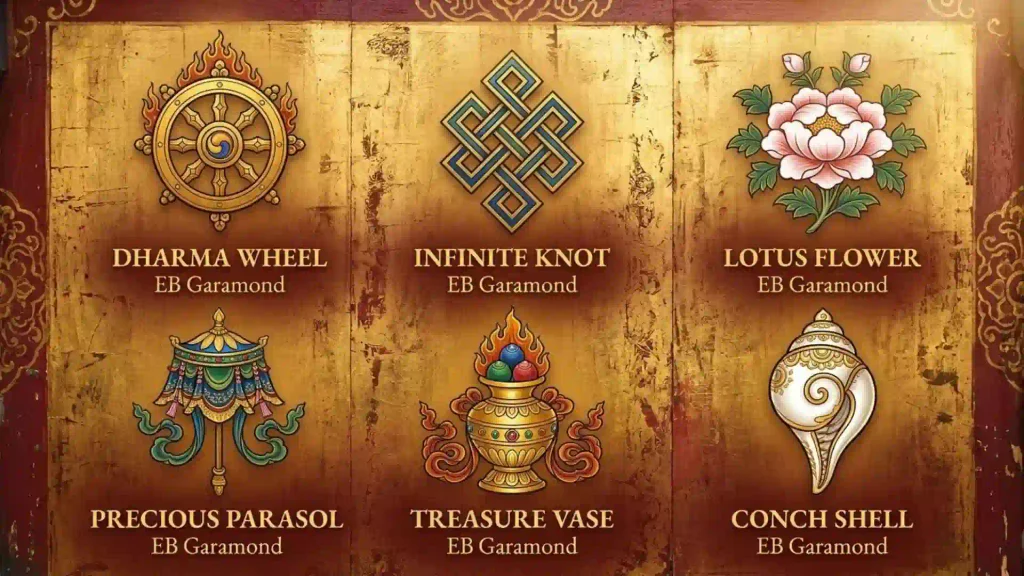
Buddhist traditions use symbols to communicate teachings about wisdom, compassion, suffering, and liberation.
Some important examples include:
- Dharma Wheel: Represents the Buddha’s teachings and the Noble Eightfold Path.
- Lotus Flower: Represents purity and spiritual awakening.
- Vajra: Represents indestructible wisdom and spiritual realization.
- Buddha Eyes: Commonly represent awareness and the enlightened perspective.
- Endless Knot: Represents interconnectedness and the relationship between wisdom and compassion.
- Bodhi Tree: Represents the Buddha’s enlightenment.
Tibetan Buddhism also uses ritual objects such as the vajra and bell. Their combination communicates complementary principles within tantric practice.
Christian Spiritual Symbols
Christianity uses a wide range of symbols connected with Jesus Christ, the Trinity, salvation, and religious devotion.
Important examples include:
- Cross: Represents crucifixion, redemption, and resurrection.
- Ichthys: The fish symbol associated with early Christian identity.
- Dove: Represents the Holy Spirit and peace.
- Alpha and Omega: Represent God as the beginning and the end.
- Chi-Rho: A monogram formed from the first two Greek letters of Christ.
- Shepherd’s Crook: Represents Christ as the Good Shepherd.
These designs appear in churches, manuscripts, stained glass, religious paintings, and devotional objects.
Sikh Spiritual Symbols
Sikh symbolism centers on the oneness of God, equality, service, and spiritual responsibility.
Two particularly important symbols are:
- Ik Oankar: Represents the belief in one supreme creator.
- Khanda: Represents Sikh identity, divine knowledge, justice, and the relationship between spiritual and worldly responsibilities.
The Ik Oankar appears at the beginning of the Guru Granth Sahib’s opening composition, the Mul Mantar.
The Khanda is commonly displayed on the Nishan Sahib at Sikh gurdwaras.
Islamic Spiritual and Cultural Symbols
Islam emphasizes the oneness of Allah and generally avoids using images to represent God.
The crescent and star is widely associated with Muslim identity today, although it is not a universal Islamic religious symbol established by the Quran.
Other important visual elements include:
- Arabic calligraphy of Allah’s name.
- The Shahada inscription.
- Geometric patterns.
- Decorative representations of Quranic verses.
- The Hamsa in some Muslim cultural settings.
The Hamsa should not be treated as an exclusively Islamic symbol. It also appears in Jewish and other regional traditions.
Jewish Spiritual Symbols
Jewish religious and cultural traditions contain several important symbols.
Examples include:
- Star of David: A widely recognized symbol of Jewish identity.
- Menorah: An ancient seven-branched lampstand associated with Jewish worship.
- Chai: Hebrew letters representing life.
- Hamsa: Used in some Jewish cultural traditions.
- Shofar: A ram’s horn used in religious ceremonies.
The Star of David has become a particularly prominent expression of Jewish identity and heritage.
Taoist and Chinese Spiritual Symbols
Chinese philosophical traditions use symbolic imagery to explain nature, harmony, and the changing patterns of existence.
Important examples include:
- Yin Yang: Represents complementary forces.
- Bagua: Organizes eight trigrams associated with natural patterns.
- Taijitu: The familiar diagram representing the Supreme Ultimate.
- Dragon: Often associated with power, auspiciousness, and imperial authority in Chinese culture.
These symbols appear in philosophical texts, traditional architecture, decorative art, and Feng Shui practices.
How to Use Spiritual Symbols in Everyday Life
Spiritual symbols can become meaningful reminders of personal beliefs and values. You don’t need to participate in elaborate ceremonies to appreciate their significance.
However, their use should reflect an understanding of their original cultural and religious context.
Here are several practical ways to incorporate them into daily life.
Use Spiritual Symbols During Meditation
Meditation provides an opportunity to focus attention and observe thoughts without immediately reacting to them.
Some practitioners use sacred symbols as visual anchors during meditation.
For example:
- Focus on the Om symbol while practicing mantra meditation.
- Observe the Lotus Flower while reflecting on patience and personal growth.
- Study the Yin Yang symbol while considering balance and opposing experiences.
- Use the Sri Yantra within an appropriate Shri Vidya meditation practice.
- Reflect on the Tree of Life while thinking about personal connections and responsibilities.
A simple practice involves choosing one symbol and quietly observing its design for several minutes.
Consider what it represents within its original tradition. Then reflect on how its teachings relate to your current experiences.
Wear Spiritual Symbols as Jewelry
Jewelry offers a practical way to keep meaningful symbols close throughout the day.
Common choices include:
- Om pendants for people connected with Hindu spiritual practices.
- Cross necklaces expressing Christian faith.
- Hamsa bracelets associated with traditional protective beliefs.
- Mjolnir pendants expressing Norse religious or cultural identity.
- Lotus necklaces representing spiritual growth.
- Khanda pendants expressing Sikh identity.
Before purchasing or wearing a sacred emblem, understand its meaning and cultural background.
Some religious communities have specific expectations about how sacred symbols should appear and be handled.
Display Sacred Symbols at Home
Many people display spiritual artwork, religious objects, or meaningful symbols in their homes.
These objects can reflect personal beliefs and help establish a contemplative atmosphere.
Some examples include:
- A cross in a Christian prayer space.
- A Buddha image in an appropriately arranged Buddhist devotional area.
- A Hamsa decoration associated with traditional protective beliefs.
- A Bagua arrangement used in Feng Shui.
- A Tree of Life artwork representing family connections.
- A lotus design in a meditation room.
Think about the original tradition before placing a sacred object in a purely decorative setting.
Use Spiritual Symbols for Tattoos
Spiritual tattoos can express personal values, religious devotion, cultural identity, or important life experiences.
However, permanent body art deserves careful consideration.
Before choosing a design:
- Research the symbol’s historical origins.
- Understand its meaning within its original tradition.
- Check whether the symbol has religious restrictions.
- Choose an accurate and culturally appropriate design.
- Avoid combining sacred symbols without understanding their relationship.
- Consider whether its meaning will remain important to you over time.
For example, a lotus tattoo may represent personal transformation, while a cross can express Christian faith.
An Unalome tattoo may represent a personal spiritual journey. However, its cultural and religious associations deserve consideration before using it as decoration.
Practice Spiritual Visualization
Visualization involves creating a mental image to support concentration, reflection, or relaxation.
Some spiritual practitioners use sacred geometry and traditional symbols during this practice.
You might visualize:
- A lotus opening as a reminder of personal growth.
- A tree developing strong roots as a reminder of stability.
- A circle as an image of unity and completeness.
- The Yin Yang design as a reminder to recognize balance.
- A rising sun as a representation of renewal.
These exercises can help organize thoughts and reinforce personal intentions. Their benefits should not be confused with supernatural effects.
How to Choose the Right Spiritual Symbol
Choosing a meaningful symbol starts with understanding what you want it to represent.
Rather than selecting an image simply because it looks attractive, consider its history, traditional meaning, and relationship to your beliefs.
Use this comparison as a starting point:
| Your intention | Symbols to explore |
| Protection | Hamsa, Nazar, Vajra |
| Healing and restoration | Eye of Horus, Lotus |
| Spiritual awakening | Om, Lotus, Unalome |
| Balance and harmony | Yin Yang, Sri Yantra |
| Strength and courage | Mjolnir, Khanda, Vajra |
| Eternal life | Ankh, Infinity |
| Family and connection | Tree of Life |
| Faith and devotion | Cross, Khanda, Om |
| Meditation | Om, Sri Yantra, Lotus |
| Spiritual journey | Unalome, Tree of Life |
Consider These Five Factors
Understand the origin. Research where the symbol comes from and which communities traditionally use it.
Learn its original meaning. Modern interpretations can differ considerably from historical explanations.
Consider your intention. Decide whether you want to express faith, remember a personal value, or explore a spiritual tradition.
Respect religious boundaries. Some symbols and ritual designs have specific requirements for appropriate use.
Choose something meaningful. A symbol should reflect genuine understanding rather than temporary fashion.
Cultural Respect When Using Sacred Symbols
Spiritual symbols belong to real communities with living histories and religious practices. Their meaning cannot always be separated from the people who created and preserved them.
This is especially important when using Indigenous, religious, or ceremonial imagery.
The dreamcatcher provides a useful example. Its traditional connection to Ojibwe culture is often overlooked when mass-produced versions appear as generic decorative objects.
Similarly, the vajra is not simply a decorative thunderbolt. It serves a specific role in Vajrayana Buddhist rituals and teachings.
Here are several ways to approach sacred imagery respectfully:
- Learn about the community associated with the symbol.
- Use reliable historical and cultural sources.
- Avoid presenting one tradition’s interpretation as universal.
- Support artists and craftspeople from the relevant communities.
- Understand whether an object has ceremonial or restricted uses.
- Avoid changing sacred designs in ways that misrepresent their meaning.
- Distinguish traditional beliefs from modern commercial interpretations.
Respect begins with understanding. A little historical research can prevent major misunderstandings.
Frequently Asked Questions About Spiritual Symbols and Their Meanings
What Are the Most Powerful Spiritual Symbols?
Several symbols have deep religious and cultural significance. Popular examples include the Om symbol, Cross, Vajra, Hamsa, Lotus Flower, Khanda, and Eye of Horus.
Their meanings differ across traditions. There is no universally accepted ranking that establishes one symbol as more powerful than all others.
What Is the Most Powerful Symbol for Protection?
The Hamsa and Nazar are among the best-known traditional protective symbols. The Hamsa represents blessings and protection, while the Nazar is associated with protection against the evil eye.
The Vajra, Mjolnir, and Pentacle also carry protective associations within their respective traditions.
What Is the Spiritual Symbol for Healing?
The Eye of Horus is one of the strongest historical examples of a healing symbol. Ancient Egyptians associated it with restoration, protection, and regeneration.
The Lotus Flower and Reiki symbols also have healing-related associations in different spiritual traditions.
What Symbols Represent Spiritual Awakening?
The Om symbol, Lotus Flower, Unalome, and Vajra are commonly associated with spiritual awakening or enlightenment.
The Om represents sacred reality and consciousness. The lotus represents purity and liberation, while the Vajra symbolizes indestructible enlightened wisdom.
What Is the Symbol of Higher Consciousness?
The Om symbol is closely associated with ultimate reality and consciousness in Hindu philosophy.
Its philosophical significance appears in the Mandukya Upanishad, which explores waking, dreaming, deep sleep, and the transcendent state of awareness called Turiya.
What Symbol Represents the Universe?
The Sri Yantra is associated with cosmic creation and divine reality in Shri Vidya traditions.
The Tree of Life also represents connections between different levels of existence. Meanwhile, Om is associated with ultimate reality and sacred sound in Hindu traditions.
What Does the Tree of Life Symbolize Spiritually?
The Tree of Life commonly represents growth, interconnectedness, grounding, wisdom, and renewal.
Its roots and branches illustrate relationships between the earth, living beings, and the heavens. However, different traditions give the symbol distinct interpretations.
What Does the Hamsa Hand Represent?
The Hamsa traditionally represents protection, blessings, and good fortune.
It appears in several Middle Eastern and North African cultural traditions. Some versions include an eye in the center to strengthen its association with protection against the evil eye.
What Is the Spiritual Meaning of the Lotus Flower?
The Lotus Flower represents purity, spiritual growth, detachment, and enlightenment.
Its growth from muddy water into a beautiful flower provides a metaphor for developing wisdom despite life’s challenges.
What Does the Yin Yang Symbol Mean Spiritually?
The Yin Yang symbol represents the relationship between complementary forces.
Its black and white sections illustrate how contrasting qualities depend on each other. It communicates balance, harmony, and the changing nature of existence.
What Is the Meaning of the Unalome Symbol?
The Unalome commonly represents a person’s spiritual journey toward enlightenment.
Its spiral represents struggles and uncertainty, while the winding line suggests gradual development. The straightening path represents increasing clarity and awareness in modern interpretations.
What Are the Five Reiki Symbols?
Five symbols commonly discussed in modern Reiki lineages include:
- Cho Ku Rei
- Sei He Ki
- Hon Sha Ze Sho Nen
- Dai Ko Myo
- Raku
Their use and teaching vary between Reiki schools. Raku is not included in every traditional Usui Reiki curriculum.
What Is the Difference Between the Eye of Horus and the Evil Eye?
The Eye of Horus comes from ancient Egyptian mythology and represents healing, restoration, and protection.
The Evil Eye belongs to a much broader set of cultural beliefs about harm caused by envy or a harmful gaze. Its Nazar amulet represents protection against that danger.
Although both use eye imagery, they have different histories and cultural meanings.
Can You Use Spiritual Symbols From Another Culture?
You can learn about and appreciate symbols from different cultures. However, some designs have sacred, ceremonial, or community-specific meanings.
Research their origins, understand their traditional uses, and avoid treating sacred imagery as meaningless decoration.
When possible, support artists and craftspeople who belong to the communities associated with the symbols.
How Do You Use Spiritual Symbols in Meditation?
Start by selecting a symbol that has a meaningful connection to your spiritual practice.
Place an image of it somewhere visible. Observe its shape, consider its traditional meaning, and use it as a focus for quiet reflection.
You can also combine this practice with breathing exercises or mantra meditation when appropriate to the tradition.
Are Spiritual Symbols Connected to Specific Religions?
Yes. Many spiritual symbols have direct connections to particular religions.
For example, the Cross belongs to Christianity, the Khanda represents Sikh identity, and the Vajra has an important role in Vajrayana Buddhism.
Other symbols, such as the Tree of Life, appear in multiple traditions with different meanings.
Which Spiritual Symbols Represent Inner Peace?
The Lotus Flower, Yin Yang, Om, and Tree of Life are commonly associated with ideas connected to inner peace.
Their traditional meanings include harmony, spiritual awareness, purity, and interconnectedness.
Final Thoughts on Spiritual Symbols and Their Meanings
Spiritual symbols offer a fascinating way to explore humanity’s religious beliefs, cultural heritage, and understanding of existence. Each design tells a different story about faith, protection, healing, wisdom, or the search for enlightenment.
The Om symbol represents sacred sound and ultimate reality. The Cross communicates Christian faith and redemption. The Lotus Flower illustrates purity and spiritual growth, while the Yin Yang expresses harmony between complementary forces.
Other symbols, including the Hamsa, Ankh, Khanda, Vajra, and Tree of Life, carry equally meaningful histories within their respective traditions.
The most important thing is to understand what a symbol represents before using it. Its history, cultural background, and traditional purpose often reveal much more than its appearance.
Whether you’re exploring ancient spiritual symbols, researching sacred designs, choosing meaningful jewelry, or learning about different religious traditions, approach each symbol with curiosity and respect.
A meaningful symbol isn’t simply an attractive design. It’s a visual connection to the beliefs, stories, and values that people have carried across generations.

I am John Carter, a lifelong enthusiast of language and modern slang. I explore how words evolve and shape culture, and I enjoy uncovering the stories behind everyday expressions. I have authored “Slang and Society: The Language of Youth” and “Modern Words, Modern Worlds”, where I dive into how informal language impacts communication and identity. My goal is to make language accessible, fun, and insightful for everyone who loves words as much as I do.
 Lisa Reynolds