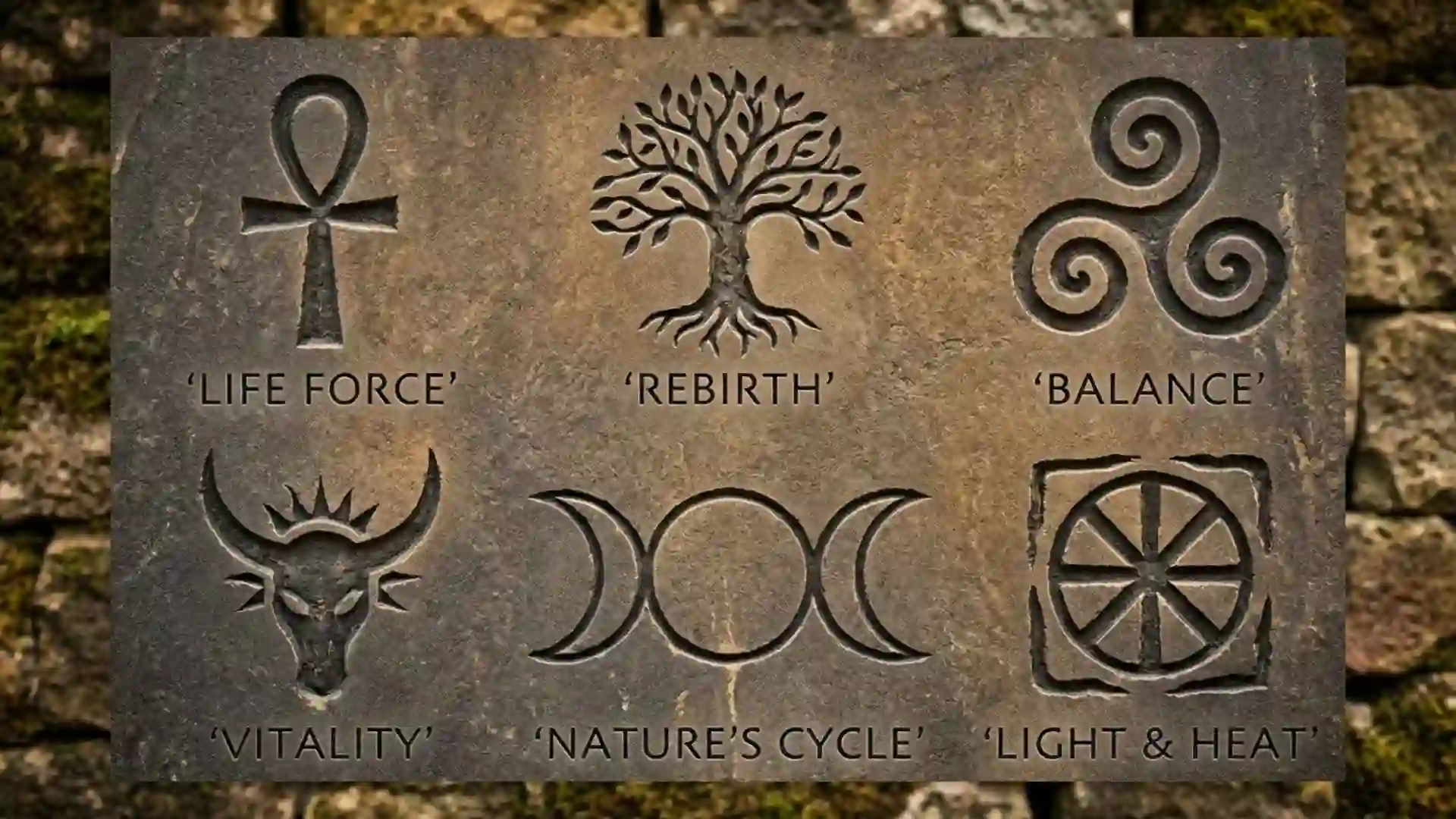
Pagan symbols carry centuries of history, spiritual beliefs, cultural traditions, and personal meaning. From the five-pointed star of the pentacle to the mysterious spirals carved into ancient stones, these designs help people explore nature, spirituality, protection, renewal, and the cycles of life.
However, Pagan symbols don’t all come from one religion. Some have roots in ancient Egyptian beliefs, Norse mythology, or prehistoric European art. Others, such as the Triple Moon, gained their familiar spiritual meanings through modern Pagan traditions, especially Wicca.
Understanding these differences makes each symbol more meaningful. A design that represents spiritual protection in one tradition might express cultural heritage, artistic beauty, or personal growth in another.
This guide explores Pagan symbols and meanings, their historical origins, their place in modern spirituality, and their associations with love, protection, nature, and personal transformation. You’ll also learn how to distinguish documented history from modern interpretations so you can appreciate these symbols with greater confidence.
Change block type or style
Move Heading block from position 5 up to position 4
Move Heading block from position 5 down to position 6
Change alignment
Change text alignment
Displays more block tools
What Are Pagan Symbols?
Pagan symbols are images, shapes, objects, and artistic designs associated with particular Pagan religions, spiritual practices, historical cultures, or modern interpretations of ancient traditions. They can represent deities, natural forces, religious beliefs, seasonal changes, or personal values.
The word Pagan describes a broad range of religious and spiritual traditions rather than one unified belief system. Modern Paganism includes religions such as Wicca, contemporary Druidry, and Heathenry, along with other nature-centered and polytheistic paths.
As a result, there is no single list of symbols that every Pagan recognizes or uses.
What Does Paganism Mean?
Historically, the word pagan developed from Latin terminology and became associated with non-Christian religious traditions. Today, many people use Paganism to describe modern religious movements that draw inspiration from pre-Christian religions, nature-centered spirituality, polytheism, and related practices.
Some Pagans worship multiple deities. Others focus on a goddess and god, honor ancestors, celebrate seasonal cycles, or follow non-theistic spiritual philosophies.
Their symbols reflect this diversity.
For example:
- Wicca: The pentacle and Triple Moon appear in many modern Wiccan settings.
- Norse-inspired Heathenry: Runes and symbols from Norse mythology may express religious or cultural identity.
- Modern Druidry: Trees, natural landscapes, and seasonal cycles often feature in spiritual practice.
- Celtic-inspired Paganism: Spirals and interlaced designs may express connections to Celtic art and contemporary interpretations of Celtic spirituality.
- Secular Paganism: Some people use nature-based symbols as expressions of environmental values, personal identity, or a sense of connection to the natural world.
These examples are not rigid rules. Individual practitioners often interpret symbols differently, even within the same religious tradition.
Why Do Pagan Traditions Use Symbols?
Symbols offer a visual way to express ideas that can otherwise be difficult to explain. A tree, for instance, can suggest growth, stability, ancestry, and the relationship between the earth and sky.
In religious practice, symbols may serve several purposes:
- Spiritual connection: Representing a deity, religious belief, or sacred concept.
- Protection: Serving as a reminder of safety, spiritual boundaries, or protective intentions.
- Nature awareness: Expressing respect for the sun, moon, trees, wildlife, and changing seasons.
- Ritual practice: Marking sacred spaces, altars, ceremonies, and seasonal celebrations.
- Personal growth: Representing transformation, resilience, self-discovery, or a new beginning.
- Cultural identity: Connecting practitioners with a religious community or a particular historical tradition.
A symbol can also become a personal reminder. Someone might wear a spiral pendant to represent a period of growth or keep a tree design nearby as a reminder to stay grounded.
Its significance depends on its history, context, and the meaning assigned to it.
Are Pagan Symbols the Same as Witchcraft Symbols?
Not exactly. Paganism and witchcraft overlap in some communities, but they are not interchangeable terms.
Wicca is a modern Pagan religion that commonly incorporates ritual magic. However, some Pagans don’t practice witchcraft, while some people who practice witchcraft don’t identify as Pagan.
Candles, herbs, moons, cauldrons, and pentacles can appear in contemporary witchcraft. Yet these objects and designs also have uses outside Pagan religions.
Understanding the context is more useful than assuming that every spiritual symbol belongs to one specific belief system.
The History and Origins of Pagan Symbols
The history of Pagan symbolism stretches across many cultures and historical periods. Ancient people used images of animals, celestial bodies, plants, geometric shapes, and deities in their art and religious practices.
However, archaeologists cannot always determine what a particular design meant to the people who created it. A symbol’s modern spiritual interpretation may differ from its original purpose.
Symbols in Ancient Pagan Religions
Ancient religious traditions frequently used visual imagery to express relationships between humans, gods, animals, and the natural world.
Ancient Egyptian art, for example, includes the ankh, a symbol associated with life. Norse mythology preserves stories about Mjölnir, Thor’s hammer, while archaeological evidence from prehistoric Europe includes elaborate spiral carvings.
These examples belong to different cultural settings. They shouldn’t be combined into a single ancient Pagan religion.
The word Pagan is often applied broadly to non-Christian religions, but ancient communities had their own names, beliefs, rituals, and religious structures.
When studying ancient Pagan symbols, it’s helpful to separate three things:
- Historical evidence: What artifacts, inscriptions, and reliable records establish.
- Scholarly interpretation: What historians and archaeologists believe the evidence may indicate.
- Modern spiritual meaning: How contemporary practitioners interpret or use the symbol today.
This distinction prevents modern ideas from being mistakenly presented as ancient facts.
Celtic Symbols and Their Historical Context
Celtic art includes intricate patterns, spirals, animal imagery, and interlaced designs. Archaeological sites and surviving metalwork, stonework, and manuscripts help researchers study these artistic traditions.
The triple-spiral carving at Newgrange in Ireland is a well-known example of prehistoric spiral art. Newgrange dates to approximately 3200 BCE, long before the modern religious movements that use similar imagery.
Its exact original meaning remains uncertain.
Today, some practitioners associate Celtic-inspired spirals with movement, continuity, spiritual development, or the cycles of life. These interpretations may be meaningful, but they shouldn’t be treated as proven explanations of what prehistoric artists intended.
Norse Symbols and Pre-Christian Germanic Traditions
Norse religious traditions left behind mythological texts, archaeological objects, inscriptions, and other evidence that help researchers understand their symbols.
Runes are particularly important because they were historical writing characters. The Elder Futhark contains 24 runes and was used during the early Germanic runic period. The later Younger Futhark contains 16 characters and became associated with the Viking Age.
Modern Pagan practitioners sometimes use runes for meditation, divination, or personal reflection. However, many specific rune meanings found in contemporary spiritual guides are interpretations rather than universally established historical definitions.
The same caution applies to other Norse-inspired symbols. A design’s modern popularity doesn’t automatically prove that ancient people used it in the same way.
Ancient Egyptian Symbols in Modern Paganism
Ancient Egyptian religion developed its own rich visual language, including divine figures, sacred animals, solar imagery, and symbols associated with life and death.
The ankh is among the best-known examples. Egyptian artwork frequently shows gods holding or offering the ankh, connecting it with life and divine vitality.
Contemporary Pagans and other spiritual practitioners may also use Egyptian symbols in devotional practices, jewelry, or artwork.
However, ancient Egyptian religious traditions should be understood within their own cultural context. The ankh is an ancient Egyptian symbol, not a symbol created exclusively for modern Paganism.
The Revival of Pagan Symbols in Modern Spirituality
Modern Pagan movements have helped bring many older symbols into contemporary religious practice.
Wicca emerged as a modern religious movement in the mid-20th century and popularized the pentacle and other recognizable forms of spiritual symbolism. Contemporary Druidry and Heathenry have also developed practices that draw on historical sources while adapting them for modern communities.
This revival involves both preservation and reinterpretation.
A symbol may retain an older cultural association while gaining additional meanings through modern use. Recognizing that process helps explain why the same symbol can mean different things to different people.
Pagan Symbols and Their Meanings: A Complete List
Different symbols express different ideas, and their meanings often depend on the tradition in which people use them. The following table offers a quick overview before exploring each design in greater detail.
| Pagan symbol | Common modern associations | Important context |
| Pentacle | Protection, elements, balance | Common in Wicca and other modern Pagan settings |
| Pentagram | Fivefold symbolism, spiritual practice | Used in many historical and modern contexts |
| Triple Moon | Lunar cycles, Goddess symbolism | Especially recognizable in modern Wicca |
| Tree of Life | Growth, connection, renewal | Appears across many cultural traditions |
| Celtic Cross | Faith, heritage, continuity | Strongly associated with Christian Celtic art |
| Triskelion | Movement, threefold patterns, cycles | Related forms appear in ancient art |
| Triple Spiral | Cycles, transformation | Famous examples appear at prehistoric Newgrange |
| Sun Wheel | Solar cycles, seasonal change | Interpretations depend on the specific design |
| Solar Cross | Sun, four directions, cycles | A cross within a circle has varied historical uses |
| Horned God | Nature, wildlife, fertility | A deity concept in modern Wiccan theology |
| Ankh | Life, vitality, afterlife | Originates in ancient Egyptian culture |
| Spiral | Growth, movement, continuity | Appears in many unrelated artistic traditions |
| Celtic Knot | Interconnection, enduring bonds | Many current meanings are modern interpretations |
| Awen | Inspiration, creative wisdom | A modern Druid symbol |
| Mjölnir | Thor, strength, religious identity | Associated with Norse mythology and historical material culture |
| Yggdrasil | The cosmos, interconnected realms | The World Tree in Norse mythology |
| Valknut | Norse-inspired identity, possible links to Odin | Its original meaning remains debated |
These are common associations, not universal definitions. The historical evidence for a symbol’s original use may differ considerably from the way people interpret it today. For example, the National Museum of Ireland discusses Newgrange and its prehistoric context, while archaeological scholarship continues to examine the significance of its decorated stones.
The Pentacle: Protection, Balance, and the Five Elements
The pentacle is one of the most recognizable Pagan spiritual symbols. It usually features a five-pointed star enclosed within a circle. In many modern Wiccan traditions, the five points represent earth, air, fire, water, and spirit.
Each element has its own symbolic associations. Earth may represent stability, air thought or communication, fire transformation, water emotion, and spirit the sacred or connecting principle.
The circle brings the design together. Some practitioners interpret it as a sign of unity, wholeness, or the relationship between the elements.
People may display a pentacle on an altar, wear it as a pendant, or include it in ritual settings. For many practitioners, it expresses religious identity as well as spiritual intention.
Important distinction: The pentacle is not proof that someone practices witchcraft, and its presence doesn’t establish a person’s beliefs. The five-pointed star and related forms have appeared in numerous historical contexts.
The Pentagram: The Five-Pointed Star
The pentagram is a five-pointed star drawn with five connected lines. When enclosed in a circle, it is commonly described as a pentacle, although terminology can vary.
Historically, the pentagram appeared in different societies and served different purposes. It wasn’t always a religious symbol, nor did it carry one fixed meaning throughout history.
In contemporary Paganism, the pentagram may represent the five elements, harmony, or spiritual practice. Some people use it as a symbol of protection or as an expression of Wiccan identity.
The orientation can influence interpretation. An upright pentagram is common in Wiccan contexts, while an inverted pentagram has different associations in different communities. It doesn’t automatically communicate one universal belief.
The key is to consider the design, its surrounding imagery, and the person or tradition using it.
The Triple Moon: Lunar Cycles and the Divine Feminine
The Triple Moon usually depicts a waxing crescent, a full moon, and a waning crescent arranged in a row. It is widely recognized in modern Wiccan and Goddess-centered spirituality.
The three lunar phases can represent growth, fullness, and decline. Some practitioners connect them to the Maiden, Mother, and Crone, a modern religious framework for understanding different aspects of the Goddess.
Other people interpret the symbol through themes of change, intuition, femininity, and life’s recurring cycles.
The moon’s changing appearance offers a natural visual reminder that circumstances rarely stay the same. A difficult period can pass, and a fresh beginning can follow.
Although lunar symbolism is ancient and widespread, the familiar Triple Moon design and its popular Goddess interpretation should not automatically be described as a universal symbol from prehistoric religion.
The Tree of Life: Growth, Connection, and Renewal
The Tree of Life represents a powerful image: roots reach into the earth while branches extend toward the sky. This structure makes the tree a natural symbol for growth, grounding, and connection.
In modern Pagan spirituality, some people associate trees with the relationship between the physical world and the spiritual world. Roots may suggest ancestry or stability, while branches can represent new opportunities and personal development.
However, the Tree of Life is not exclusive to Paganism. Similar imagery appears in several religious, mythological, artistic, and philosophical traditions.
The Norse World Tree, Yggdrasil, is a specific example with its own mythological context. It connects different realms in Norse cosmology and should not be treated as identical to every generic Tree of Life design.
The Celtic Cross: Faith, Heritage, and Continuity
The Celtic Cross generally combines a cross with a circle around its intersection. It is strongly associated with medieval Christian monuments in Ireland and Britain.
Today, people may connect it with Irish heritage, Christian faith, cultural identity, or continuity. Some modern Pagans also interpret cross-and-circle imagery through solar or nature-centered symbolism.
However, the Celtic Cross shouldn’t automatically be described as an ancient Pagan symbol. Many of the famous monumental examples belong to Christian artistic and religious traditions.
If you’re researching Celtic symbols, this distinction matters. Celtic culture, Celtic art, and Celtic Pagan religion are related topics, but they aren’t interchangeable.
The Triskelion: Movement and Threefold Patterns
The Triskelion, also called a triskele, is a three-part design with curved or spiral arms radiating from a central point. Related threefold motifs appear in ancient art, including prehistoric Irish monuments.
Modern interpretations associate the design with movement, cycles, and the relationship between three connected forces. Some practitioners apply ideas such as land, sea, and sky or mind, body, and spirit.
These interpretations can be meaningful in contemporary spirituality. However, there is no single proven interpretation that explains every historical example.
Its dynamic shape makes the Triskelion popular in jewelry, artwork, and tattoos. It can express change, balance, or a connection with Celtic-inspired traditions.
The Triple Spiral: Cycles and Transformation
The Triple Spiral features three connected spirals and is closely associated with prehistoric Irish passage tomb art. One famous example appears at Newgrange, a monumental site built around 3200 BCE.
Newgrange was constructed during the Neolithic period, thousands of years before modern Wicca or contemporary Pagan movements emerged. Its artwork provides valuable evidence of prehistoric artistic expression, but researchers cannot confidently assign one definitive spiritual meaning to every carving.
In modern spirituality, people may associate the Triple Spiral with transformation, recurring life cycles, or the connection between different aspects of existence.
If you choose this symbol for a tattoo or spiritual object, remember that its prehistoric origins are documented while many specific modern interpretations are later additions.
The Sun Wheel: Solar Cycles and the Seasons
The Sun Wheel is a broad term for wheel-shaped designs associated with the sun, seasons, or cycles of time. Its appearance can vary, so the name doesn’t always refer to one precise historical symbol.
In contemporary Pagan settings, solar wheel imagery may represent the turning of the year, seasonal celebrations, and the changing relationship between sunlight and darkness.
Some practitioners connect it with solstices, harvests, and the annual cycle of nature.
However, similar wheel designs appear in different cultures and periods. The meaning of a specific example depends on its archaeological context, artistic details, and documented use.
The Solar Cross: Sunlight and the Turning Year
The Solar Cross usually consists of a circle divided by a vertical and horizontal line. Its four sections can invite modern interpretations involving the cardinal directions, seasonal change, or the relationship between the sun and the earth.
Some modern Pagan practitioners connect this form with seasonal observances and the passage of time.
Yet a cross inside a circle can appear in several contexts, and not every example was intended as a solar or religious symbol. A design’s shape alone cannot establish its original meaning.
The Solar Cross and Sun Wheel may overlap in modern usage, but their labels aren’t always applied consistently.
The Horned God: Nature, Wildlife, and Fertility
The Horned God is a deity concept in modern Wiccan theology. Practitioners may associate him with wildlife, fertility, the natural world, and seasonal cycles.
Antlers provide a visual connection to deer and other horned or antlered animals. Because antlers grow and shed, they can also inspire interpretations involving renewal and natural change.
The Horned God isn’t one universal deity shared by all Pagan religions. Nor should every ancient horned figure automatically be identified as the same god.
Different cultures developed their own religious traditions and divine figures. Modern Wiccan interpretations draw on a range of historical and contemporary influences.
The Ankh: Life and Immortality
The Ankh is a loop-topped symbol from ancient Egypt. It is widely associated with life and appears in Egyptian religious art, including depictions of gods and rulers.
Its meaning also connects with ancient Egyptian ideas about divine vitality and continued existence after death. The U.S. National Park Service discusses the ankh as an Egyptian symbol of life and eternal life.
Today, the ankh appears in jewelry, artwork, and modern spiritual practices. Some Pagans who follow Egyptian-inspired religious traditions use it as a meaningful religious symbol.
Its cultural origins remain important, though. The ankh belongs first to the history of ancient Egypt rather than exclusively to Paganism as the term is used today.
The Spiral: Growth, Movement, and Continuity
The spiral appears in many forms of prehistoric and historic art. It can be carved into stone, painted on pottery, woven into decorative patterns, or used in contemporary spiritual artwork.
Modern interpretations often connect spirals with growth, movement, renewal, and the unfolding of life. Their continuous curves can suggest a journey that changes over time rather than following a straight path.
However, a spiral doesn’t have one universal religious meaning. Some examples may have served decorative, practical, or other symbolic purposes that remain uncertain.
In modern Pagan spirituality, the spiral can serve as a personal reminder of learning, adaptation, and ongoing change.
The Celtic Knot: Interconnection and Enduring Bonds
Celtic knotwork features interlaced lines that pass over and under one another. The patterns appear in medieval manuscripts, metalwork, stone carvings, and other forms of Celtic-associated art.
Modern audiences often interpret knotwork as a symbol of unity, continuity, love, or interconnectedness. These associations make Celtic-inspired knots popular in wedding jewelry, friendship gifts, and tattoos.
Still, not every knot has a documented ancient meaning. Some designs marketed today as ancient Celtic symbols are modern creations.
If you want a knot to represent a specific idea, consider that meaning a contemporary interpretation unless reliable historical evidence supports a more specific claim.
Awen: Inspiration and Druidry
The Awen is a modern symbol associated with Druidry. It is often depicted as three rays descending from three dots or points within a circular arrangement.
In contemporary Druidic contexts, Awen is associated with inspiration, creativity, and spiritual insight. Some interpretations connect its three rays with different aspects of Druid practice.
It is particularly relevant to modern Druidry because it offers a visual expression of poetic inspiration and the pursuit of wisdom.
However, the familiar Awen emblem should not be casually described as a universally established symbol of ancient Celtic religion. Its current use reflects modern Druidic traditions and interpretations.
Mjölnir: Thor’s Hammer and Norse Religious Identity
Mjölnir, Thor’s hammer, is a prominent object in Norse mythology. Thor is associated with thunder, and the hammer plays an important role in mythological stories.
Archaeological discoveries of hammer-shaped pendants provide evidence that the design had significance in Viking Age material culture. In modern Heathenry and related Norse-inspired traditions, Mjölnir may express devotion to Thor, religious identity, or connection with Norse heritage.
Its meaning can vary by individual and community. It is not simply a generic Pagan symbol, and its historical and contemporary uses should be considered in context.
Yggdrasil: The World Tree of Norse Mythology
Yggdrasil is the World Tree in Norse mythology. Mythological accounts describe it as connecting different realms within the Norse cosmos.
Modern Norse-inspired Pagans may associate Yggdrasil with interconnection, the structure of existence, and the relationship between different worlds.
Its meaning is more specific than that of a generic Tree of Life. Yggdrasil belongs to a particular mythological tradition, so its story should not be reduced to a general symbol of growth.
It is a popular image in Norse-inspired artwork, jewelry, and tattoos because it brings together nature and the wider mythological universe.
The Valknut: A Mysterious Norse-Inspired Symbol
The Valknut consists of three interlocking triangles and appears on some archaeological objects associated with the Viking Age.
Its exact historical meaning remains debated. Researchers have proposed different interpretations, including possible connections with Odin, death, or the afterlife, but the evidence doesn’t establish one definitive explanation.
Today, some Heathens and Norse-inspired Pagans use the Valknut as a symbol of identity or interest in Norse mythology.
Its uncertain origin makes it a good example of why historical caution matters. A modern interpretation can be meaningful without being a proven explanation of the symbol’s original purpose.
Pagan Symbols by Meaning and Purpose
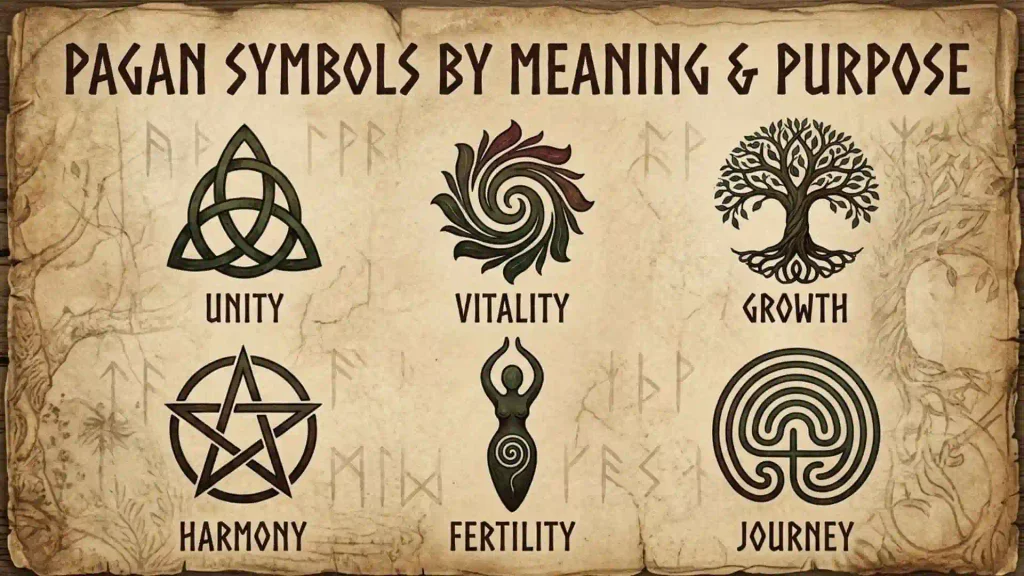
Sometimes you know the idea you want to express before you know which symbol fits. You might be looking for a protective emblem, a design associated with love, or an image representing personal growth.
The following categories make those choices easier while keeping historical context in view.
Pagan Symbols for Protection
Pagan protection symbols appear in religious practices, personal jewelry, and decorative objects. For some practitioners, these symbols represent spiritual boundaries, courage, or a sense of reassurance.
Common examples include:
- Pentacle: Used in many modern Wiccan settings and associated with elemental symbolism and spiritual practice.
- Protective runes: Certain runes receive protective interpretations in modern Norse-inspired spirituality, although meanings depend on the rune and interpretive tradition.
- Mjölnir: Associated with Thor in Norse mythology and used by some modern Heathens as a religious emblem.
- Protective knotwork: Interlaced patterns sometimes receive protective meanings in modern interpretations, though not every historical knot was a protective charm.
- Personal talismans: Objects selected or prepared to represent an individual’s protective intentions.
Historical protective practices weren’t exclusive to Pagan religions. For example, Historic England documents protective marks found on historic buildings, including marks around entrances and fireplaces. Their precise purposes can vary, and some interpretations remain debated.
It’s important to distinguish cultural or religious meaning from proven effects. A symbol may offer comfort or help someone focus their intentions, but there is no reliable scientific evidence that wearing one guarantees supernatural protection.
Pagan Symbols for Love and Relationships
Pagan love symbols can represent affection, partnership, commitment, and emotional connection. However, many popular designs are broader cultural symbols rather than emblems that originated specifically within Pagan religions.
Consider these options:
- Celtic knotwork: Often interpreted today as a representation of enduring bonds and interconnected lives.
- Rose imagery: Commonly associated with romance, affection, and beauty across various cultural traditions.
- Intertwined designs: Can represent partnership, mutual support, or two lives joined together.
- Tree imagery: May express the idea of a relationship that grows stronger through time.
- The Triple Moon: Some people associate it with feminine spirituality and changing life stages, although it isn’t specifically a universal symbol of romantic love.
A symbol’s personal meaning can matter just as much as its traditional associations. For example, a couple might choose a tree design to represent the relationship they’ve built together.
If you’re choosing a pendant or tattoo, research the design’s origin before assuming that it carries an established ancient meaning.
Pagan Symbols for Nature and the Five Elements
Nature plays an important role in many modern Pagan religions. Symbols of the sun, moon, trees, and natural cycles can help practitioners express reverence for the living world.
In many Wiccan traditions, the five elements form an important symbolic framework.
| Element | Common symbolic associations |
| Earth | Stability, grounding, physical life, and endurance |
| Air | Thought, communication, breath, and awareness |
| Fire | Energy, transformation, passion, and action |
| Water | Emotion, intuition, cleansing, and adaptability |
| Spirit | Sacred connection, unity, or the principle linking the other elements |
These meanings are common modern interpretations rather than universal definitions shared by all Pagans.
The pentacle is frequently associated with this elemental model. Other symbols can express related ideas without belonging to the same formal system.
For example, a tree can represent grounding and growth, while a sun symbol may suggest vitality and seasonal change. A moon design can encourage reflection on natural cycles.
Nature symbolism doesn’t always require a supernatural belief. Someone following a secular Pagan path might use the same images to express environmental values, ecological awareness, or a deep appreciation for the natural world.
Pagan Symbols for Growth, Renewal, and Rebirth
Growth and renewal are recurring themes in modern interpretations of Pagan symbolism. Natural processes provide familiar examples: plants emerge from seeds, trees lose their leaves, and daylight changes throughout the year.
Several symbols can express these ideas.
- Spiral: Represents growth, movement, or an ongoing journey in many modern interpretations.
- Tree of Life: Can express resilience, personal development, and interconnectedness.
- Triple Spiral: May represent recurring cycles or transformation in contemporary spiritual contexts.
- Sun Wheel: Can symbolize the turning year and the changing seasons.
- Lunar imagery: May represent changing circumstances and the movement from one life stage to another.
These symbols can become useful reminders during personal transitions. Someone starting a new career, recovering from a setback, or beginning a different chapter might choose a spiral or growing tree as a personal emblem.
Such interpretations are meaningful without requiring the claim that every ancient culture assigned the same meaning to these designs.
Pagan Symbols Associated With Life and Immortality
Life, death, and continuity appear in numerous religious traditions. However, symbols associated with these concepts often carry different meanings depending on their cultural setting.
The ankh is a strong example because ancient Egyptian religious art connects it with life and divine vitality. Its use in funerary contexts also links it to ancient Egyptian beliefs about continued existence after death.
Other symbols receive related interpretations in contemporary spirituality:
- Tree of Life: Continuity, interconnectedness, and the relationship between generations.
- Spiral: Cycles, change, and the continuing journey of life.
- Solar imagery: Renewal and the return of light.
- Lunar imagery: Change and recurring natural cycles.
These meanings should not be treated as interchangeable. Life, rebirth, and immortality are distinct ideas, and not every symbol represents all three.
Pagan Symbols Associated With Feminine Spirituality
Some modern Pagan traditions place particular emphasis on Goddess-centered spirituality. In these settings, lunar imagery can represent aspects of the divine feminine, intuition, and changing life stages.
The Triple Moon is the best-known example. Its three lunar forms are sometimes associated with the Maiden, Mother, and Crone.
These figures offer a symbolic way to explore different stages of life and different expressions of feminine identity. However, the framework doesn’t represent every Pagan religion, every Goddess tradition, or every woman’s experience.
Other lunar designs can carry personal meanings related to reflection, emotional awareness, or natural cycles.
The key is to avoid treating feminine symbolism as a fixed rule. Modern Pagan communities include many different approaches to gender, deity, and spiritual identity.
Pagan Symbols Across Different Traditions
Although people often search for Pagan religious symbols as one category, the symbols used by particular traditions can have distinct histories and purposes.
Understanding those differences makes it easier to identify the right cultural context.
Wiccan Symbols and Their Meanings
Wicca is a modern Pagan religion that developed in the mid-20th century. Its symbolism often includes the pentacle, pentagram, Triple Moon, and representations of the elements.
The pentacle is particularly recognizable because many Wiccans use it to represent elemental relationships or religious identity.
Some Wiccan traditions also use symbols associated with the Goddess and God. Practices vary, however, and not every Wiccan follows the same theology or ritual system.
For an introductory guide, the most useful distinction is that Wiccan symbols belong to a particular modern religious context, even when their individual shapes have older histories.
Celtic Pagan Symbols and Their Meanings
Celtic-associated symbolism includes spirals, interlaced designs, and motifs found in ancient and medieval art.
Modern Celtic-inspired Pagan practitioners may interpret these forms through themes such as nature, continuity, ancestry, or spiritual development.
However, Celtic identity encompasses different peoples, languages, periods, and artistic traditions. There was no single ancient Celtic religion with one universally accepted set of symbols.
When exploring Celtic spirituality, look for archaeological evidence and reputable historical sources rather than assuming that every modern design has a documented ancient meaning.
Norse Pagan Symbols and Their Meanings
Norse-inspired Heathenry draws on pre-Christian Germanic religious traditions and Norse mythology.
Symbols and motifs associated with this tradition include:
- Mjölnir: Thor’s hammer.
- Yggdrasil: The World Tree of Norse mythology.
- Runes: Characters from historical Germanic writing systems.
- Valknut: A symbol found on archaeological objects whose original meaning remains uncertain.
These examples serve different purposes. Runes were writing characters, while Mjölnir appears in mythological and archaeological contexts.
Modern Heathens may use these symbols for devotion, community identity, or personal spiritual practice. Their contemporary uses don’t always match what historians can establish about their earlier meanings.
Druid Symbols and Their Meanings
Modern Druidry includes spiritual and philosophical movements that emphasize nature, poetry, learning, and relationships with the natural world.
The Awen is a recognizable modern Druid symbol. It commonly features three rays and three dots and is associated with inspiration and creative insight.
Trees, seasonal cycles, and natural landscapes also appear in contemporary Druidic practice.
However, modern Druidry shouldn’t be treated as an unchanged continuation of every ancient practice associated with historical Druids. Ancient sources are limited, and contemporary traditions have developed their own beliefs and symbolism.
Ancient Egyptian Symbols in Pagan and Spiritual Practice
Ancient Egyptian religious symbols appear in some modern Pagan paths, particularly Egyptian-inspired traditions often called Kemeticism.
The ankh is a prominent example. Other Egyptian religious imagery may involve deities, solar motifs, and symbols associated with protection or the afterlife.
When studying these designs, begin with ancient Egyptian history rather than assuming they originated in European Pagan traditions.
Modern practitioners may give these symbols additional personal or devotional meanings. Those interpretations can be described accurately without confusing them with the beliefs of every ancient Egyptian community.
Pagan Symbols, Witchcraft, and Common Misconceptions
Misunderstandings about Pagan symbols often arise when people treat different religious traditions as though they were identical. A little context clears up many of these misconceptions.
Are Pagan Symbols Evil?
No symbol has one universal moral meaning across all cultures and religions.
A pentacle, for example, may represent religious identity or elemental symbolism to a Wiccan practitioner. Someone unfamiliar with that tradition might interpret it differently because of popular culture, religious teaching, or personal experience.
A symbol’s appearance alone doesn’t establish whether someone is kind, harmful, religious, or nonreligious.
It’s more useful to ask what the symbol means within its actual context than to assign it a moral label based on assumptions.
What Does the Bible Say About Pagan Symbols?
The Bible discusses idolatry, worship, and religious practices in specific historical and theological contexts. Christian interpretations of these passages vary, particularly when readers apply ancient teachings to modern religious symbols.
However, the Bible doesn’t provide a direct, comprehensive explanation of every symbol now used in Pagan communities.
If you’re examining a particular design from a Christian perspective, consider three questions:
- Does the relevant biblical passage actually mention the symbol?
- What religious practice or historical setting does the passage address?
- Is a modern interpretation being presented as though it were a direct biblical statement?
These questions help distinguish scripture from later commentary and popular assumptions.
Can You Use Pagan Symbols Without Being Pagan?
Yes. People may appreciate a symbol for its artistic design, historical background, cultural associations, or personal meaning without identifying with the religion that uses it.
However, context matters. Before wearing a symbol or incorporating it into a design, research its origin and current significance.
A historical symbol can carry religious importance for a living community. Understanding that context helps you make an informed choice.
Pagan Symbols in Jewelry, Tattoos, and Everyday Life
Today, modern Pagan symbols appear on necklaces, rings, clothing, artwork, tattoos, and ritual objects. Some people use them to express religious identity, while others choose them as reminders of personal values.
Pagan Symbols for Tattoos
Pagan-inspired tattoos can express heritage, spirituality, resilience, or a connection to nature.
Popular designs include:
- Pentacle tattoos: Often chosen by people who identify with Wicca or related spiritual traditions.
- Triple Moon tattoos: May express lunar symbolism or Goddess-centered spirituality.
- Tree of Life tattoos: Commonly represent growth, connection, and family.
- Triskelion tattoos: May express movement, transformation, or interest in Celtic-inspired symbolism.
- Mjölnir tattoos: Can represent a connection to Thor or modern Heathen identity.
- Ankh tattoos: Often express an interest in ancient Egyptian symbolism and the idea of life.
Before choosing a design, research its cultural background and the meanings associated with it today. A symbol may have a specific religious or historical significance beyond its appearance.
Pagan Jewelry and Protective Amulets
Jewelry offers a practical way to keep a symbol close. A pendant might express religious identity, while a ring could serve as a personal reminder of a value or commitment.
Some practitioners use amulets or talismans within spiritual practices. Historically, people across many cultures have worn objects believed to offer protection or support.
The belief attached to an object is important to its religious meaning, but it doesn’t prove that the object provides supernatural protection.
Pagan Symbols in Personal Rituals
Symbols can help organize a ritual or give a physical form to an intention.
For example, someone might place a pentacle on an altar as part of a Wiccan practice. Another person might use a tree image during meditation as a reminder of patience and resilience.
Such practices differ across traditions. There is no single ritual method that every Pagan follows.
How to Choose a Pagan Symbol That Fits Your Values
Choosing a symbol becomes easier when you begin with the meaning you want to express.
Follow these steps:
- Identify your intention. Consider whether you want to represent protection, love, growth, nature, or religious identity.
- Research its origins. Check whether the symbol comes from ancient art, a particular religion, or a modern movement.
- Understand its current use. A symbol may mean different things to different communities.
- Separate history from interpretation. Learn which meanings are documented and which come from modern spiritual practice.
- Consider cultural respect. Think about whether the symbol has a particular significance to a living religious or cultural community.
- Choose a meaningful design. Select something that reflects your values rather than relying on appearance alone.
A symbol becomes more meaningful when you understand what it represents and why it matters to you.
Frequently Asked Questions About Pagan Symbols
What Are Pagan Symbols?
Pagan symbols are designs, images, and objects associated with particular Pagan religions, spiritual practices, and cultural traditions. Examples include the pentacle, Triple Moon, and symbols drawn from Norse mythology. Their meanings vary by tradition, and some symbols commonly used by modern Pagans originated in other historical or religious settings.
What Are the Most Common Pagan Symbols?
Some widely recognized examples include the pentacle, pentagram, Triple Moon, spiral, Tree of Life, and Celtic knotwork. Norse-inspired Pagans may also use Mjölnir, while practitioners of Egyptian-inspired Pagan traditions may use the ankh. Not every symbol is shared across all Pagan religions.
What Does the Pentacle Mean in Paganism?
The pentacle commonly represents the five elements—earth, air, fire, water, and spirit—in modern Wiccan practice. The surrounding circle may symbolize unity or wholeness. Many practitioners use it as a religious emblem or include it in ritual settings, although its exact significance varies.
What Is the Difference Between a Pentacle and a Pentagram?
A pentagram is a five-pointed star formed by connected lines. A pentacle commonly refers to a pentagram enclosed in a circle, especially in modern Pagan contexts. However, usage varies, and both terms have appeared in different historical and spiritual settings.
What Does the Triple Moon Symbolize?
The Triple Moon typically shows the waxing crescent, full moon, and waning crescent. In some modern Wiccan traditions, it represents the Goddess through the Maiden, Mother, and Crone framework. It can also symbolize change, lunar cycles, and different stages of life.
What Does the Tree of Life Mean?
The Tree of Life commonly represents growth, connection, continuity, and renewal in modern spiritual interpretations. Its roots and branches can suggest the relationship between the earth and sky or between generations. Similar imagery appears across multiple cultures, so its meaning depends on the particular tradition.
What Does the Triskelion Represent?
The Triskelion is a three-part design with curved or spiral arms. Modern interpretations associate it with movement, cycles, and threefold concepts. Related motifs appear in ancient European art, but historians cannot confidently assign one universal meaning to every historical example.
What Is the Meaning of the Ankh?
The ankh is an ancient Egyptian symbol associated with life and divine vitality. It appears in Egyptian religious artwork and is connected with ancient Egyptian beliefs about life and continued existence after death. Modern Pagans and other spiritual practitioners also use it, particularly in Egyptian-inspired traditions.
What Are Pagan Symbols for Protection?
The pentacle is commonly associated with spiritual practice and protection in modern Wiccan settings. Some Norse-inspired practitioners use Mjölnir as a religious emblem, while others work with runes or personal talismans. These practices reflect spiritual beliefs rather than scientifically established protective effects.
What Are Pagan Symbols for Love?
Celtic knotwork, roses, intertwined designs, and tree imagery can represent love, affection, or enduring relationships in modern interpretations. However, many of these are broader cultural symbols rather than specifically Pagan religious emblems. Their meaning depends on their history and the intention behind their use.
Are Pagan Symbols Connected to Witchcraft?
Some Pagan symbols also appear in witchcraft, particularly in Wicca and other nature-based spiritual practices. However, Paganism and witchcraft aren’t the same thing. Some Pagans don’t practice witchcraft, and some people who practice witchcraft don’t identify as Pagan.
Are Pagan Symbols Evil or Dangerous?
No symbol has one universal meaning across every religion and culture. A design that represents religious devotion to one person may be unfamiliar to someone else. Understanding a symbol’s historical background and present-day use is more reliable than judging it solely by appearance.
What Does the Bible Say About Pagan Symbols?
The Bible discusses idolatry and religious worship within particular historical and theological contexts. It doesn’t directly explain every symbol used in modern Paganism. To understand a specific symbol from a Christian perspective, examine the relevant biblical passage and distinguish its original context from later interpretations.
Can Non-Pagans Wear Pagan Symbols?
Yes. People may wear these symbols because of their artistic appeal, historical interest, personal meaning, or cultural connections. However, it’s worth researching a symbol’s origins and contemporary religious significance before using it in jewelry, tattoos, or public displays.
How Can I Find a Pagan Symbol That Represents Me?
Start by identifying the value you want to express, such as growth, love, nature, or spiritual connection. Then research symbols associated with that idea and check their historical background. Choose a design whose meaning resonates with you while respecting its cultural and religious context.
Final Thoughts on Pagan Symbols and Their Meanings
Pagan symbols offer a fascinating window into history, spirituality, mythology, and the human relationship with nature. From the pentacle and Triple Moon to the ankh and Norse World Tree, each design has its own cultural background and range of interpretations.
The most important thing to remember is that these symbols don’t all share one origin or meaning. Some have documented ancient histories, while others gained their familiar associations through modern Pagan movements.
Whether you’re researching Pagan symbols and meanings for personal interest, religious study, jewelry, or a tattoo, take time to understand the context behind each design. That knowledge helps you appreciate the symbol more deeply and distinguish established history from modern spiritual interpretation.

I am Lisa Reynolds, a linguist fascinated by the ever-changing world of slang. I enjoy researching how slang reflects trends, technology, and social connections. I wrote “Text Talk: Understanding Digital Slang” and “From Street to Screen: Slang in Media”, exploring the influence of digital communication on language. I love sharing my discoveries in a way that feels like a conversation with friends, so you feel the culture and humor behind every phrase.
 John Carter