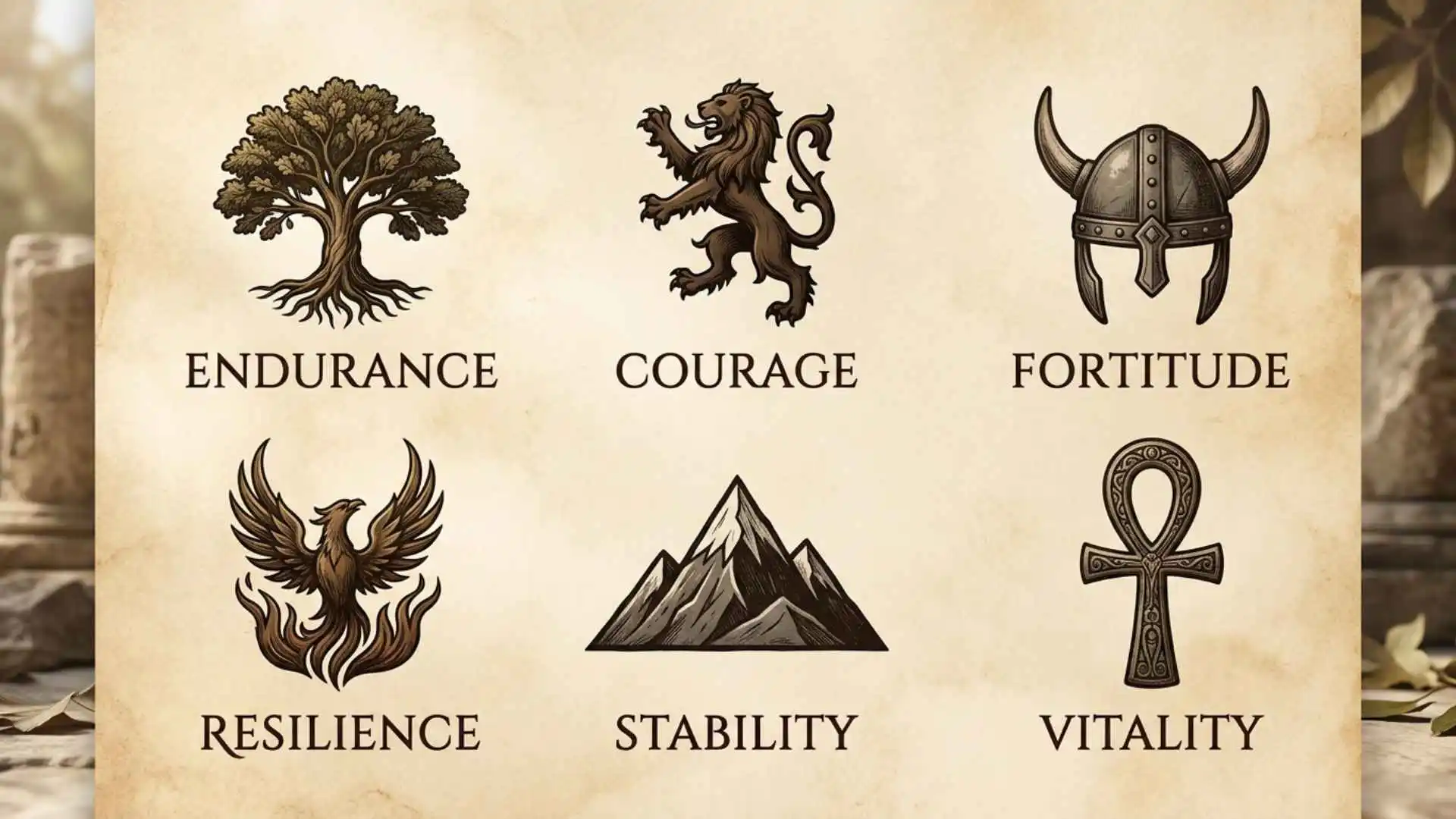
Strength symbolism appears in ancient myths, religious art, family crests, national emblems, jewelry, and modern tattoos. A lion may represent courage, an oak tree may suggest endurance, and a phoenix may express the hope of beginning again. Each image tells a different story about what it means to remain strong.
However, strength isn’t always about physical power or defeating an opponent. It can mean staying calm during a crisis, adapting to change, protecting someone you love, or finding the courage to rebuild after a painful experience. Across cultures, people have used symbolic images to express these qualities in ways that words sometimes cannot.
This guide explores more than 25 symbols of strength, including their meanings, cultural backgrounds, historical associations, and modern uses. You’ll discover symbols of inner strength, spiritual imagery, animals, flowers, trees, and meaningful designs for tattoos and jewelry. You’ll also learn how to distinguish documented traditions from newer personal interpretations.
What Does Strength Symbolize?
Strength symbolizes the ability to withstand challenges, act with courage, protect what matters, and continue despite difficulty. Its meaning depends on the situation and cultural context. In one setting, strength may represent authority or physical power. In another, it may express patience, faith, humility, or emotional recovery.
The most common meanings associated with strength symbolism include:
- Physical strength: Power, energy, endurance, and the ability to overcome physical challenges.
- Inner strength: Self-control, confidence, determination, and the ability to stay grounded.
- Emotional strength: The capacity to process difficult feelings and recover from setbacks.
- Mental strength: Focus, discipline, clear thinking, and persistence toward a goal.
- Spiritual strength: Faith, spiritual development, devotion, and commitment to personal values.
- Protective strength: Courage, responsibility, and the desire to defend others.
- Resilience: The ability to adapt, recover, and move forward after adversity.
- Strength with humility: The ability to use power responsibly without becoming arrogant or aggressive.
These qualities overlap, but they aren’t identical. Courage means facing fear, while resilience emphasizes adaptation and recovery. Physical power describes one kind of strength; emotional steadiness describes another.
A symbol can help you remember the quality you want to develop. An oak tree might remind you to remain patient during uncertainty. A mountain might represent a difficult goal you’re determined to reach.
25+ Powerful Symbols of Strength and Their Meanings
Symbols of strength come from the natural world, mythology, religious traditions, and human craftsmanship. The following examples explain what each symbol commonly represents and where its associations come from.
Lion: Courage, Leadership, and Power
The lion is one of the most recognizable symbols of strength. Its powerful build, commanding presence, and position as a major predator have made it an enduring image of courage and authority.
Lions appear in royal imagery, sculptures, flags, and coats of arms. In European heraldry, a lion often communicates bravery, nobility, or authority, although the meaning of a particular emblem depends on its history.
The lion also represents leadership. A lion design may suggest confidence, decisiveness, and the willingness to accept responsibility.
Common meanings of lion symbolism:
- Courage and bravery
- Leadership and authority
- Confidence and determination
- Protection and power
A lion tattoo may suit someone who values boldness and self-confidence. A lion emblem can also commemorate a personal achievement or represent a commitment to lead with courage.
Oak Tree: Endurance, Stability, and Longevity
The oak tree represents strength that develops over time. Its sturdy wood, substantial trunk, and long life make it a natural metaphor for endurance and stability.
Oak symbolism has deep roots in European history. Research published in New Phytologist discusses the oak’s associations with strength, longevity, endurance, and power, including its connections with deities in ancient Greek and Roman mythology. Read the research on oak symbolism.
Unlike a sword or lion, the oak doesn’t primarily suggest force or aggression. Instead, it represents the quiet power of remaining steady through changing circumstances.
Oak tree symbolism commonly includes:
- Endurance through hardship
- Stability and reliability
- Patience and maturity
- Family roots and lasting connections
An oak tree can represent someone who has weathered difficult experiences without losing their values. Its roots may symbolize family heritage, while its branches can suggest growth and new opportunities.
Bear: Protection, Physical Power, and Independence
The bear represents physical power, protective instincts, and independence in various cultural and artistic traditions. Its size, strength, and ability to survive in demanding environments contribute to these associations.
Bear imagery also appears in folklore, mythology, and regional emblems. However, bear symbolism varies widely, so it’s important not to assign one meaning to every culture.
In modern designs, the bear can represent a protective parent, a determined individual, or someone who values self-reliance.
A bear tattoo may express the desire to protect loved ones or face difficult circumstances with confidence. Its meaning can also emphasize survival and personal boundaries rather than aggression.
Phoenix: Rebirth, Renewal, and Resilience
The phoenix is a mythical bird associated with renewal and the possibility of beginning again. In familiar versions of the legend, the bird dies or burns and subsequently returns to life.
This powerful image has become a popular metaphor for strength and resilience. It suggests that a painful ending doesn’t necessarily prevent a new beginning.
The phoenix also appears in cultural traditions beyond the familiar Western rebirth narrative. For example, the phoenix motif in Chinese art has associations with peace and enlightened rule. The Royal Collection Trust’s guide to Japanese art symbols explains related East Asian phoenix imagery and its historical associations.
Phoenix symbolism commonly represents:
- Rebirth after hardship
- Personal transformation
- Hope and renewal
- Recovery and perseverance
A phoenix tattoo can mark recovery from a difficult period or a major life transition. It works particularly well for someone who wants to celebrate growth without pretending the past never happened.
Lotus Flower: Perseverance and Spiritual Growth
The lotus flower is an important symbol in Buddhist and Hindu traditions. Its roots grow in muddy environments while its flowers rise above the water, creating a compelling image of development under challenging conditions.
The Smithsonian’s National Museum of Asian Art explains the lotus’s historical and contemporary significance, including associations with resilience, hope, rebirth, and enlightenment. Explore the Smithsonian’s lotus resource.
In Buddhist imagery, the lotus can represent spiritual awakening and the development of an enlightened mind. In Hindu traditions, it appears in connection with deities and themes such as purity, creation, and spiritual significance.
The lotus is therefore more than a general emblem of toughness. Its meaning comes from specific religious and artistic traditions.
Lotus symbolism can represent:
- Perseverance through difficulty
- Spiritual growth and enlightenment
- Purity and renewal
- Hope and personal development
A lotus design may remind someone to grow through difficult circumstances. When using it as a tattoo or decorative motif, understanding its religious context adds depth and respect.
Mountain: Determination, Stability, and Endurance
Mountains symbolize strength through their size, apparent permanence, and resistance to ordinary human efforts. They can also represent the challenges people must overcome to reach meaningful goals.
In literature and personal symbolism, climbing a mountain often represents persistence. The summit becomes a metaphor for achievement, while the journey reflects the work required to reach it.
Mountains also hold sacred significance in particular religious and cultural traditions. Their specific meanings vary, so a mountain should not be treated as a universal religious symbol with one fixed interpretation.
Mountain symbolism commonly expresses:
- Determination and perseverance
- Stability and grounding
- Overcoming obstacles
- Ambition and personal achievement
A mountain tattoo may represent a difficult goal, a major life milestone, or the determination to keep moving forward. It can also remind you that progress often happens one step at a time.
Bull: Physical Power, Energy, and Determination
The bull is a traditional image of physical power and force. Its muscular build and imposing horns have influenced its appearance in ancient art, mythology, and modern emblems.
Bull imagery carries different meanings in different settings. In some historical traditions, bulls have been associated with fertility, vitality, royal authority, or religious significance. Their meanings cannot be reduced to physical aggression alone.
In modern symbolism, the bull often represents determination, confidence, and the willingness to confront a challenge.
A bull design may suit someone who values direct action and persistence. However, a person seeking gentler forms of strength might prefer a bamboo plant, an oak tree, or an anchor.
Eagle: Freedom, Vision, and Authority
Eagles represent power and freedom in many forms of public and artistic imagery. Their ability to fly at great heights has also made them useful symbols of vision, ambition, and independence.
The eagle appears in the heraldry and national imagery of several countries. The bald eagle holds a specific place in the United States, where it serves as the national emblem. Its American associations include national identity and freedom.
Still, an eagle’s meaning depends on the design and setting. A national seal carries a different message from an eagle in a personal tattoo.
Common eagle symbolism includes:
- Freedom and independence
- Vision and ambition
- Authority and leadership
- Courage and power
An eagle design may represent the desire to rise above limitations or make independent decisions. It can also symbolize responsibility when used in official or civic imagery.
Anchor: Stability, Hope, and Emotional Steadiness
An anchor holds a vessel in place, making it a practical symbol of stability and security. Its function helps explain why people use anchor imagery to represent commitment and emotional steadiness.
Anchors also appear in Christian symbolism, where they have associations with hope and steadfastness. Their historical religious significance differs from their modern use as a general emblem of loyalty or grounding.
An anchor may symbolize a person, belief, or commitment that helps someone remain steady during uncertainty.
Anchor symbolism includes:
- Hope and steadfastness
- Stability and emotional balance
- Loyalty and commitment
- Security during difficult times
An anchor necklace might commemorate a meaningful relationship or a personal promise. A tattoo could remind its wearer to stay grounded when life feels unpredictable.
Hercules or Heracles: Extraordinary Strength and Perseverance
Heracles, known as Hercules in Roman tradition, is a legendary hero of Greek mythology. His extraordinary physical strength and the Twelve Labors make him one of mythology’s best-known examples of heroic effort.
The Nemean lion is central to one of these stories. Heracles defeats the creature as part of his first labor and later wears its hide in familiar artistic depictions.
The stories connect strength with more than muscle. Heracles must also demonstrate persistence, resourcefulness, and the ability to complete demanding tasks.
His mythological image can represent:
- Extraordinary physical power
- Courage in the face of danger
- Perseverance through difficult work
- Heroic achievement
Hercules is a useful symbol for someone who associates strength with effort and determination. However, his myths include violence and moral complexity, so they shouldn’t be reduced to a simple lesson about being powerful.
Dwennimmen: Strength Balanced With Humility
Dwennimmen is an Akan Adinkra symbol commonly described as a pair of ram’s horns. It represents the relationship between strength and humility.
The U.S. National Park Service’s explanation of Dwennimmen describes the symbol as a reminder that even strong people must remain humble.
This combination makes Dwennimmen especially meaningful. It challenges the idea that strength requires domination or constant displays of power.
Dwennimmen commonly represents:
- Strength balanced with humility
- Controlled power
- Wisdom and self-awareness
- Courage without arrogance
The symbol belongs to a specific Akan cultural tradition associated with Ghana. It shouldn’t be treated as a generic emblem representing every African culture.
For a personal design, Dwennimmen can communicate a commitment to act firmly while remaining open to learning. Understanding its cultural background is essential when choosing it for a tattoo or piece of jewelry.
Sword: Courage, Resolve, and Defense
The sword symbolizes strength through action, authority, and defense. Historically, swords served as weapons and sometimes as ceremonial objects that communicated rank or status.
In heraldry and literature, swords can represent courage, justice, determination, or the willingness to defend a principle. Yet their meaning also includes conflict and violence.
That dual nature matters. A sword can communicate the courage to confront wrongdoing, but it may also suggest aggression or a readiness to fight.
Sword symbolism commonly includes:
- Courage and resolve
- Defense and protection
- Authority and duty
- Justice and confrontation
Someone who wants to express determination may choose a sword design. Someone seeking strength without aggression might prefer an anchor or bamboo motif.
Wolf: Loyalty, Cooperation, and Survival
The wolf is often associated with loyalty, instinct, endurance, and survival. Its appearance in folklore and literature has produced many different interpretations, from a dangerous outsider to a devoted member of a group.
Wolves are social animals, and their relationships within packs help explain why people use them as symbols of cooperation and belonging. However, human stories about wolves don’t always reflect their actual behavior.
In contemporary imagery, the wolf can represent independence while still acknowledging the importance of community.
Wolf symbolism often includes:
- Loyalty and cooperation
- Survival and endurance
- Instinct and adaptability
- Independence and belonging
A wolf tattoo might represent family bonds or the ability to survive difficult circumstances. The design can express strength through teamwork rather than individual dominance.
Bamboo: Flexibility, Adaptability, and Resilience
Bamboo offers a different picture of strength. Rather than appearing rigid, it can bend under pressure, illustrating how flexibility may help something withstand demanding conditions.
Bamboo appears in East Asian art and literature, where its associations vary by tradition and artistic context. It can be understood alongside other plants celebrated for vitality and endurance.
This makes bamboo a strong metaphor for strength through adaptability. Remaining flexible doesn’t mean abandoning your values. It means changing your approach when circumstances require it.
Bamboo symbolism can represent:
- Adaptability and flexibility
- Resilience during change
- Integrity and steady growth
- Patience and endurance
A bamboo design may suit someone who has navigated major changes or learned to approach problems differently. Its central message is simple: being strong doesn’t always mean refusing to bend.
Kintsugi: Recovery, Acceptance, and Renewal
Kintsugi is a Japanese ceramic repair tradition that uses lacquer and decorative materials, often including gold-colored powder, to mend broken pottery. Rather than concealing every repair, the technique can make the repaired lines visible.
The craft has inspired modern interpretations of recovery and resilience. A repaired object can remain useful and beautiful even after damage.
However, kintsugi is a craft tradition, not a universal ancient emblem with one fixed symbolic meaning. Its modern connection to personal healing is a meaningful metaphor, but it should be distinguished from documented historical practice.
Kintsugi-inspired symbolism may represent:
- Recovery after hardship
- Acceptance of imperfection
- Renewal and transformation
- The value of experience
A kintsugi-inspired tattoo or artwork can commemorate a period of healing. It may also remind someone that recovery doesn’t require pretending that painful experiences never happened.
Lioness: Protective Strength and Courage
The lioness represents courage, protection, and leadership in various forms of modern imagery and cultural storytelling. Its role as a hunter and caregiver contributes to its association with protective strength.
Today, the lioness is frequently used in designs celebrating female empowerment. It can express independence, confidence, and the determination to protect loved ones.
These modern meanings shouldn’t be confused with a single historical interpretation shared by every culture. The lioness’s significance depends on the artistic, cultural, or personal context.
A lioness tattoo may symbolize maternal protection, female leadership, or the courage to stand firm under pressure.
Ram’s Horns: Controlled Power and Determination
Ram’s horns can suggest persistence, force, and the willingness to face resistance. In particular cultural settings, the ram carries meanings connected with courage and strength.
The horns associated with Dwennimmen have a more specific message: strength must remain balanced with humility. The two ideas work together rather than canceling each other out.
It’s important to distinguish the general ram motif from Dwennimmen itself. A drawing of ram’s horns doesn’t automatically carry the complete meaning of an Akan Adinkra symbol.
Tree Roots: Grounding, Heritage, and Stability
Tree roots represent the foundations that allow a tree to grow and remain anchored. In modern symbolic imagery, they often stand for family heritage, personal identity, and emotional grounding.
Roots can also represent the quiet work that supports visible success. A tree’s branches may attract attention, but its roots help sustain the whole structure.
This makes root imagery suitable for family artwork, personal keepsakes, and tattoos that commemorate heritage or resilience.
Oak Leaves: Honor, Endurance, and Achievement
Oak leaves appear in heraldic designs, civic imagery, and certain military decorations. Their associations often draw on the oak tree’s established connections with strength and longevity.
In specific institutional settings, oak leaves can represent achievement, distinction, or honor. The precise meaning depends on the emblem, award, or organization.
Oak leaves are therefore best understood through their context rather than as a universal sign of strength.
Fire: Energy, Transformation, and Renewal
Fire can destroy, warm, illuminate, and transform. Its double nature makes it a powerful image for strength that changes circumstances rather than merely withstands them.
In myths and literature, fire may represent vitality, purification, destruction, or renewal. Its meaning depends on the story and cultural tradition.
As a modern metaphor, fire can symbolize determination, passion, and the energy needed to begin again. It can also remind readers that powerful emotions require care and self-control.
Rising Sun: Hope and New Beginnings
The rising sun represents the beginning of a new day. In personal symbolism, it often communicates hope, renewed energy, and the possibility of moving beyond a difficult period.
Sun imagery also carries specific cultural, religious, and national meanings. Those associations should be considered before assigning a design a general meaning.
A sunrise tattoo may commemorate recovery or a fresh start. Its message is less about remaining unchanged and more about welcoming another opportunity.
Shield: Protection, Defense, and Courage
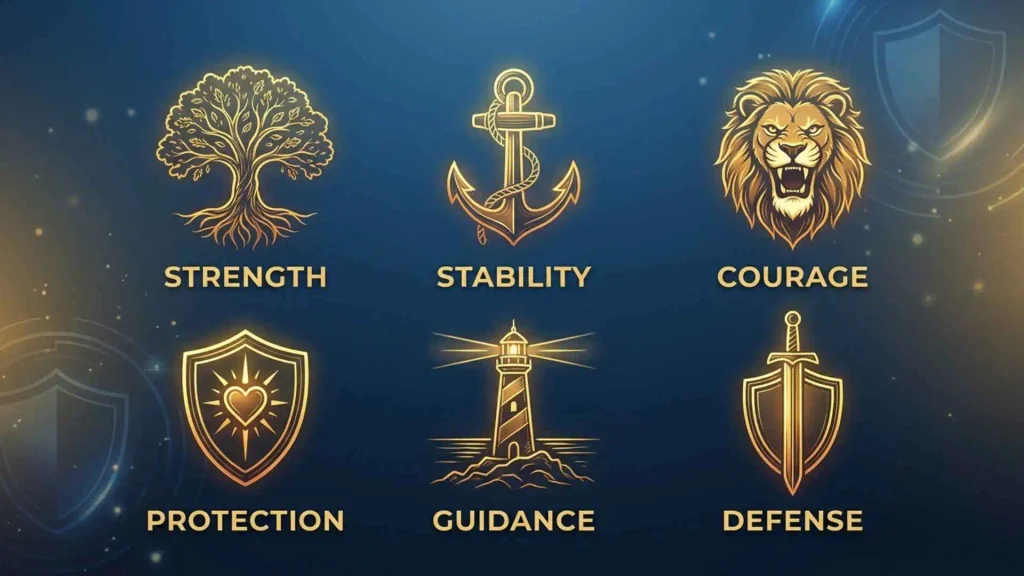
The shield represents protection because its practical purpose is to defend the person carrying it. In historical warfare and heraldry, shields also became important surfaces for displaying identifying designs.
In modern symbolism, a shield may represent safeguarding family, defending personal values, or maintaining healthy boundaries.
A shield design can communicate courage without implying a desire to attack others. Its emphasis is on protection and responsibility.
Christian Cross: Faith, Sacrifice, and Spiritual Strength
The cross is the central symbol of Christianity. It represents the crucifixion of Jesus Christ and, within Christian belief, connects with themes of sacrifice, redemption, and resurrection.
For many Christians, the cross also expresses faith during suffering and hope in the face of adversity. These meanings come from Christian theology rather than from a generic definition of strength.
When discussing the cross as a symbol of strength, its religious significance should remain central. Treating it merely as a decorative sign of endurance overlooks its importance to Christian communities.
Bald Eagle: Freedom and American National Identity
The bald eagle serves as the national emblem of the United States. It appears in important government imagery, including the Great Seal of the United States.
In American contexts, the bird is associated with national identity, freedom, and authority. Those meanings are more specific than the broader symbolism associated with eagles worldwide.
A bald eagle design may express patriotism or a connection to American civic ideals. Its significance depends on the wearer’s intentions and the setting in which it appears.
Helm of Awe: Protection in Icelandic Magical Tradition
The Helm of Awe, or Ægishjálmur, is associated with Icelandic magical traditions and appears in historical magical texts. Modern designs often depict it as a radial pattern with arms extending from a central point.
It is frequently marketed as an ancient Viking symbol, but that description needs care. The existence of a symbol in later Icelandic magical texts does not establish that Viking Age people universally used the same design.
Its modern associations with protection and power should therefore be distinguished from claims about its early history.
Symbols of Strength in Different Cultures and Traditions
The meaning of a symbol often becomes clearer when you examine its cultural setting. Similar images can communicate different ideas depending on their religious, historical, and artistic roles.
African Symbols of Strength
Dwennimmen is a notable example from the Akan Adinkra tradition associated with Ghana. Its relationship between strength and humility illustrates that power can coexist with restraint.
Adinkra symbols communicate ideas and values through recognizable designs. Their meanings are connected to particular cultural traditions, so readers should avoid treating them as interchangeable symbols of a single African identity.
Japanese Symbols of Strength
Kintsugi provides a useful example of a Japanese craft that has inspired modern discussions of recovery. Its visible repairs have become a metaphor for accepting damage while continuing to value the whole object.
Bamboo and pine also appear in East Asian artistic traditions, including Japanese imagery. Their associations can include vitality, endurance, and strength, depending on the setting. The Royal Collection Trust’s guide to Japanese art symbols provides examples of these traditional plant motifs.
Buddhist Symbols of Strength
The lotus is associated with spiritual development and enlightenment in Buddhist traditions. Its growth through muddy water offers a visual metaphor for the development of wisdom amid difficult conditions.
However, the lotus’s religious meaning extends beyond generic resilience. Its interpretation depends on the Buddhist tradition, artwork, and surrounding imagery.
Hindu Symbols of Strength
The lotus appears in Hindu art and religious imagery, including representations of deities. Its associations can include purity, creation, spiritual significance, and prosperity.
The lotus may also serve as a modern symbol of personal development. When using it, distinguish those personal interpretations from its specific religious meanings.
Christian Symbols of Strength and Hope
The cross represents the central Christian story of sacrifice and resurrection. The anchor has also been used in Christian imagery to communicate hope and steadfastness.
These symbols can both express strength, but they do so differently. The cross carries theological significance, while the anchor emphasizes stability and hope.
Greek and Roman Symbols of Strength
Heracles and the Nemean lion illustrate strength through mythological storytelling. The oak also carries historical associations with deities and power in Greek and Roman traditions.
These examples show why historical context matters. An ancient myth, a later artistic interpretation, and a modern tattoo may use the same image for different purposes.
Strength Symbols in European Heraldry
European heraldry uses animals, plants, weapons, and geometric designs to identify families, institutions, and civic bodies. Lions and swords can appear in coats of arms, while oak leaves may appear in particular awards or decorations.
A symbol’s meaning depends on the complete emblem and its documented history. Not every lion represents the same family or every sword the same virtue.
Strength Symbols in American National Imagery
The bald eagle is a recognizable symbol of American national identity. Its use in official imagery connects it with civic authority and national ideals.
This is a specific national association rather than a universal meaning of the eagle. In another country or artistic tradition, the same bird may communicate different ideas.
Which Animals Symbolize Strength?
Animals are popular symbols because people connect their visible characteristics with human qualities. A powerful body may suggest physical strength, while social behavior may inspire associations with loyalty or cooperation.
| Animal | Common symbolic associations | Best suited to represent |
| Lion | Courage, leadership, authority | Confidence and boldness |
| Bear | Physical power, protection | Protective strength |
| Bull | Force, energy, determination | Physical power |
| Eagle | Freedom, vision, authority | Independence and ambition |
| Wolf | Loyalty, cooperation, survival | Strength through teamwork |
| Lioness | Courage, protection, leadership | Protective and feminine strength |
| Ram | Persistence, assertiveness | Determination |
| Phoenix | Renewal, rebirth, hope | Recovery after hardship |
Which Animal Represents Inner Strength?
The phoenix is a strong modern metaphor for inner strength after hardship. It represents renewal and the possibility of beginning again.
The wolf can represent cooperation and survival, while the lion may suggest confidence and courage. The best choice depends on whether you want to emphasize recovery, belonging, leadership, or determination.
No animal has one universally accepted symbolic meaning.
Which Animal Represents Female Strength?
The lioness frequently appears in contemporary imagery celebrating courage, independence, and protective strength. Other animal designs may communicate female empowerment depending on the wearer’s personal associations.
The key is to choose a symbol that reflects the quality you value. Strength isn’t restricted to one gender, and no symbol belongs exclusively to women unless a particular context defines it that way.
Natural Symbols of Strength and Resilience
Nature offers many images of endurance and adaptability. Trees, flowers, and mountains provide different ways to express strength and resilience without relying on images of weapons or dominance.
Trees That Represent Strength and Endurance
The oak is particularly associated with longevity, strength, and stability. Its symbolism draws on the tree’s durable wood and long life, as discussed in research on oak symbolism.
Bamboo offers a different lesson. Its flexibility suggests that adaptation can help something withstand pressure.
Tree roots represent grounding, family heritage, and the foundations that sustain growth. Together, these images express three complementary qualities: endurance, adaptability, and stability.
Flowers That Symbolize Strength
The lotus is a well-documented religious and artistic symbol with associations that include spiritual development, purity, and enlightenment. Its natural growth pattern also makes it a compelling modern metaphor for perseverance.
Other flowers can represent strength in particular cultural settings, but their meanings should be verified rather than assumed. For example, a flower may symbolize hope, mourning, love, or renewal depending on the tradition.
Mountains, Fire, and the Rising Sun
Mountains suggest endurance and the effort required to overcome obstacles. Fire can symbolize energy and transformation, while a rising sun may represent hope and a fresh beginning.
These images work well because they express different stages of change. A mountain represents the challenge, fire represents transformation, and sunrise represents a new opportunity.
Spiritual and Religious Symbols of Strength
Spiritual strength often involves faith, discipline, reflection, and commitment to personal values. Religious symbols can express these qualities, but their meanings must remain connected to the traditions that give them significance.
Symbols of Spiritual Strength and Faith
The Christian cross represents sacrifice, redemption, and resurrection within Christian belief. The lotus carries important spiritual meanings in Buddhist and Hindu traditions.
An anchor can symbolize hope and steadfastness, including in Christian imagery. Although all three may inspire people during difficult periods, they do not carry identical religious meanings.
Symbols of Protection and Inner Peace
A shield represents defense, while an anchor may express stability and security. Dwennimmen communicates the relationship between strength and humility within Akan Adinkra tradition.
These symbols can remind people of the values they want to practice. However, their presence doesn’t guarantee physical safety or supernatural protection.
Can a Symbol Give You Strength?
A symbol can serve as a meaningful reminder, even though the image itself doesn’t guarantee success or healing.
For example, someone recovering from a difficult experience might wear a phoenix pendant as a reminder of personal growth. Another person might keep an anchor nearby to represent stability during an uncertain period.
Symbols can support reflection by giving an abstract goal a recognizable form. Their value often comes from the meaning people attach to them and the actions they take in response.
Symbols of Mental Strength, Emotional Strength, and Perseverance
Not every form of strength involves physical power. Mental discipline, emotional awareness, and the ability to recover from setbacks can be equally meaningful.
Symbols of Mental Strength
The mountain represents persistence toward a difficult goal. The oak suggests steadiness over time, while bamboo represents adapting to changing conditions.
These symbols can remind you to focus on what you can control. They also offer different perspectives: keep going, remain grounded, or change your approach when necessary.
Symbols of Emotional Strength
Kintsugi offers a modern metaphor for recovery and acceptance. An anchor represents emotional steadiness, while a phoenix symbolizes renewal after hardship.
Emotional strength doesn’t mean hiding every feeling or refusing help. It can mean acknowledging pain, setting boundaries, seeking support, and continuing to care for yourself.
Symbols of Perseverance and Determination
The mountain, oak tree, bamboo, and Hercules each offer a different image of persistence.
- Mountain: Continue working toward a demanding goal.
- Oak tree: Build strength through patience and consistency.
- Bamboo: Adapt when your original approach no longer works.
- Hercules: Persist through difficult tasks and demanding responsibilities.
These examples show that perseverance isn’t a single behavior. Sometimes you need to stand firm; at other times, you need to change direction.
Symbols of Strength Without Aggression
Strength doesn’t require domination. Bamboo illustrates flexibility, Dwennimmen emphasizes humility, and an anchor represents steadiness.
These images can help communicate strength without violence. They suggest that self-control, cooperation, and thoughtful action can be more valuable than constant confrontation.
Ancient Symbols of Strength and Their Historical Origins
Ancient symbols often developed within specific religious, political, or artistic settings. Understanding those settings helps separate documented history from modern assumptions.
Ancient Mythological Symbols
Heracles represents extraordinary strength in Greek mythology, while the Nemean lion is central to his first labor. The phoenix became an enduring image of renewal in ancient Mediterranean traditions.
Bull imagery also appeared in ancient Near Eastern and Mediterranean art, where its meaning could involve power, fertility, or religious significance. The precise interpretation depends on the artifact and historical context.
Historical Symbols in Heraldry and Civic Designs
Lions, swords, oak leaves, and eagles appear in different heraldic and civic settings. These designs can communicate identity, authority, honor, or institutional affiliation.
However, a symbol’s general association doesn’t prove the meaning of a specific emblem. Historical claims should rely on the relevant coat of arms, document, artifact, or institutional record.
Separating Historical Evidence From Modern Claims
A popular design isn’t necessarily ancient just because it looks old. Symbols may have been adapted, revived, or reinterpreted centuries after their original appearance.
The Helm of Awe illustrates this issue. Its connection with Icelandic magical texts should not automatically be treated as proof that every modern version was widely used during the Viking Age.
A careful account distinguishes documented historical meanings, later cultural interpretations, and contemporary personal symbolism. That distinction makes a guide more accurate and respectful.
Strength Symbols for Tattoos, Jewelry, and Personal Designs
A meaningful design should express a quality you genuinely value. The best symbol isn’t necessarily the most elaborate or visually striking one.
Best Strength Symbols for Tattoos
| Tattoo symbol | Meaning to consider | Best suited to |
| Phoenix | Renewal and transformation | A new beginning |
| Lion | Courage and leadership | Confidence and ambition |
| Oak tree | Endurance and stability | Long-term resilience |
| Bamboo | Flexibility and adaptation | Navigating change |
| Mountain | Perseverance and achievement | Overcoming a challenge |
| Lotus | Spiritual growth and enlightenment in relevant traditions | Personal or spiritual development |
| Dwennimmen | Strength and humility | A culturally informed expression of balanced power |
| Anchor | Hope and steadfastness | Stability and commitment |
| Kintsugi-inspired design | Recovery and acceptance | A personal metaphor for healing |
Before choosing a design, research its history and cultural context. This matters especially for religious symbols and culturally specific motifs.
Strength Symbols for Women and Personal Empowerment
The lioness can express protective courage, while the phoenix can represent transformation. The oak tree suggests endurance, and the lotus may communicate spiritual growth.
These interpretations are useful starting points rather than fixed rules. A woman may choose a sword to represent resolve or bamboo to express adaptability. The design should reflect her values rather than an assumption about how women ought to express strength.
Strength Symbols for Jewelry and Keepsakes
An anchor pendant can represent commitment, while a lion or eagle motif may communicate courage and authority. A lotus design can hold religious or personal meaning, depending on the wearer’s connection to it.
Personal engravings also offer a simple option. A date, short phrase, or meaningful image can commemorate a milestone without relying on a symbol from a tradition you don’t know well.
How to Choose a Meaningful Strength Symbol
Use these questions to narrow your options:
- What kind of strength matters most? Decide whether you value courage, endurance, recovery, protection, or spiritual growth.
- What does the symbol mean historically? Research its cultural or religious background before using it.
- Does the modern interpretation fit your values? A personal metaphor can be meaningful even when it isn’t the symbol’s original meaning.
- Will the design remain meaningful over time? Choose an image that connects with a lasting value rather than a passing trend.
- Can you represent the meaning respectfully? Take extra care with culturally specific and religious designs.
A symbol becomes more meaningful when you understand its background and know why it matters to you.
How Strength Symbols Differ From One Another
Several symbols may represent strength while emphasizing very different qualities. Comparing them helps you choose an image that fits your purpose.
| Symbol | Primary theme | Type of strength |
| Lion | Courage and authority | Leadership |
| Oak tree | Stability and endurance | Long-term resilience |
| Phoenix | Renewal and rebirth | Recovery |
| Bamboo | Flexibility and adaptation | Adaptive resilience |
| Dwennimmen | Strength and humility | Controlled power |
| Hercules | Heroic effort | Physical and moral endurance |
| Lotus | Spiritual growth | Spiritual perseverance |
| Anchor | Hope and steadfastness | Emotional stability |
| Shield | Defense and protection | Protective strength |
| Kintsugi | Repair and acceptance | Recovery and transformation |
Strength vs. Courage
Strength describes the capacity to withstand demands, meet challenges, or exercise power. Courage involves facing fear or risk despite uncertainty.
A person may show courage while feeling frightened. Another may demonstrate strength by remaining patient during a long recovery. The qualities often overlap, but they aren’t interchangeable.
Strength vs. Resilience
Strength can describe physical power, determination, or the ability to withstand pressure. Resilience focuses more on adaptation and recovery.
Bamboo makes a useful metaphor for resilience because it can bend rather than remain rigid. Kintsugi offers a different modern metaphor by showing how a repaired object can retain its value.
Power vs. Humility
Power is the ability to act, influence, or achieve an outcome. Humility involves recognizing limits and avoiding excessive pride.
Dwennimmen brings these ideas together by associating strength with humility. Its message challenges the belief that powerful people must constantly prove their superiority.
Traditional Meaning vs. Personal Meaning
A symbol’s traditional meaning may differ from what it means to an individual today. The lotus, for instance, has specific religious significance in Buddhist and Hindu traditions, while a modern wearer might also interpret it as a personal reminder of perseverance.
Both meanings can matter, but they shouldn’t be confused. Understanding that distinction helps preserve cultural context while allowing room for personal expression.
Frequently Asked Questions About Strength Symbolism
What Is the Most Recognizable Symbol of Strength?
The lion is one of the most recognizable symbols of strength, especially in imagery associated with courage, leadership, and authority. However, no single symbol holds the same position across every culture. The oak tree, phoenix, and bear are also widely used to express different forms of strength.
What Is the Best Symbol of Strength and Resilience?
The phoenix is a popular modern symbol of renewal after hardship. Bamboo represents adaptability, the oak tree suggests endurance, and kintsugi offers a metaphor for recovery and acceptance. Choose according to whether you want to emphasize rebirth, flexibility, endurance, or healing.
What Flower Symbolizes Strength?
The lotus is a strong choice because of its religious and artistic significance in Buddhist and Hindu traditions. It is associated with spiritual growth and enlightenment, while its growth in muddy water also inspires modern interpretations of perseverance. Its exact meaning depends on the context.
What Tree Symbolizes Strength and Endurance?
The oak tree is strongly associated with strength, longevity, and endurance in European symbolism. Its sturdy wood and long life contribute to these associations. Bamboo provides a complementary image of resilience through flexibility.
What Is an African Symbol of Strength?
Dwennimmen is an Akan Adinkra symbol associated with strength and humility. Its ram’s-horn design communicates the idea that strength should be balanced with humility. It comes from a specific cultural tradition associated with Ghana rather than representing every African culture.
What Symbol Represents Mental Strength?
The mountain can represent determination, the oak tree can suggest steadiness, and bamboo can symbolize adaptability. Each offers a different metaphor for mental strength. The best choice depends on whether you want to emphasize persistence, stability, or flexible thinking.
What Is a Christian Symbol of Strength?
The Christian cross represents faith, sacrifice, and the resurrection of Jesus Christ. It can also express spiritual strength during suffering. The anchor is another symbol associated with hope and steadfastness in Christian imagery.
Which Symbol Represents Strength Without Violence?
Bamboo, Dwennimmen, and the anchor are useful examples. Bamboo suggests flexibility, Dwennimmen combines strength with humility, and the anchor represents steadiness. Their meanings show that strength can involve self-control and protection rather than aggression.
What Is the Best Strength Symbol for a Tattoo?
The best choice depends on the message you want to communicate. A phoenix can represent renewal, a lion can symbolize courage, an oak tree can suggest endurance, and bamboo can express adaptability. Research the symbol’s background before choosing a permanent design.
What Does the Phoenix Symbolize Beyond Strength?
The phoenix is associated with renewal, rebirth, and transformation in familiar literary and cultural traditions. Its image can express hope after a difficult period. However, phoenix symbolism differs across traditions, so its meaning should be understood within the relevant cultural setting.
Conclusion: Finding the Right Symbol of Strength
Strength symbolism offers many ways to express courage, endurance, protection, resilience, and personal growth. The lion represents boldness, the oak tree suggests stability, the phoenix expresses renewal, and bamboo shows how flexibility can become a source of strength.
Other symbols carry more specific meanings. Dwennimmen connects strength with humility in Akan Adinkra tradition, while the lotus holds important spiritual significance in Buddhist and Hindu contexts. Kintsugi, meanwhile, has inspired a modern metaphor for recovery and acceptance.
The right symbol depends on what strength means to you. You might value the courage to speak up, the patience to keep going, or the flexibility to begin again after disappointment.
Choose a symbol that reflects that quality, learn its cultural background, and use it with intention. After all, strength isn’t always about being unbreakable. Sometimes, it’s about adapting, recovering, and continuing forward with greater wisdom.

I am John Carter, a lifelong enthusiast of language and modern slang. I explore how words evolve and shape culture, and I enjoy uncovering the stories behind everyday expressions. I have authored “Slang and Society: The Language of Youth” and “Modern Words, Modern Worlds”, where I dive into how informal language impacts communication and identity. My goal is to make language accessible, fun, and insightful for everyone who loves words as much as I do.
 Lisa Reynolds