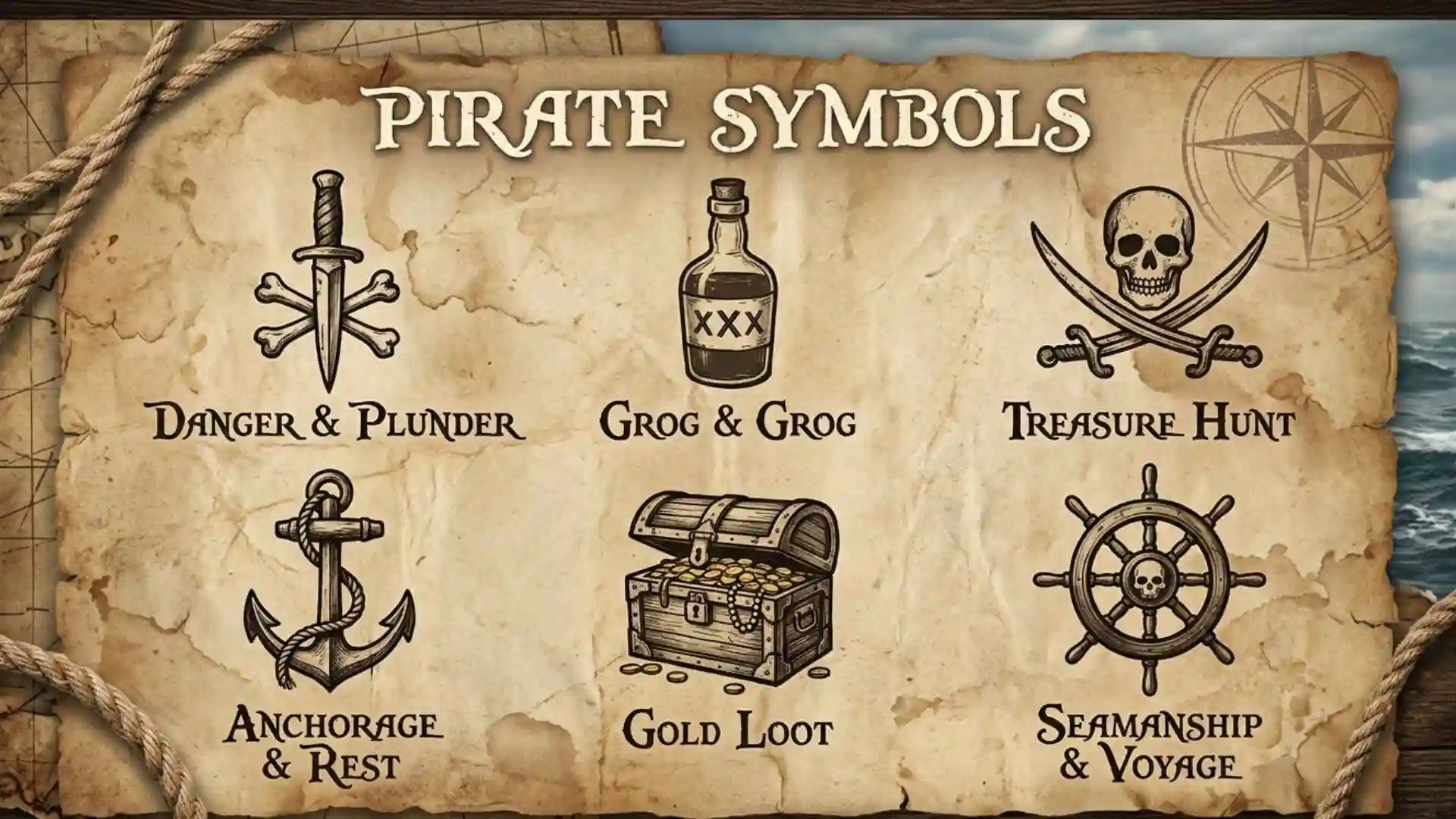
Pirate symbols have fascinated people for centuries with their bold designs, mysterious meanings, and connections to adventure on the high seas. From the famous skull and crossbones to pirate flags, crossed swords, anchors, and ships, these symbols represent danger, rebellion, freedom, and the daring spirit of pirates. Today, you can find pirate symbols in movies, video games, tattoos, Halloween decorations, clothing, and online messages. Many are also popular among people who love nautical history and pirate culture.
Each pirate symbol has its own story and significance. The skull and crossbones is widely associated with danger, death, and the legendary Jolly Roger flag, while crossed swords often represent combat and bravery. Anchors symbolize the sea and stability, and pirate ships evoke exploration, independence, and adventure. Some symbols have genuine historical connections to piracy, while others became popular through books, films, folklore, and modern entertainment.
In this complete guide to pirate symbols, you will discover their meanings, historical origins, and cultural significance. You will also find pirate symbols to copy and paste, explore famous pirate flags, learn about skull-and-crossbones variations, and understand how these designs are used in tattoos, emojis, usernames, and digital messages. Whether you are researching pirate history, looking for a creative symbol, or simply curious about the meaning behind these iconic designs, this guide will help you explore the fascinating world of pirate symbolism.
Pirate Symbols Copy and Paste
Here are popular pirate symbols and related emojis you can copy and use in messages, usernames, social media bios, captions, and creative projects.
| Symbol | Name | Common association |
| 🏴☠️ | Pirate flag | Piracy, adventure, rebellion |
| ☠ | Skull and crossbones | Danger, death, warning |
| ☠️ | Skull and crossbones emoji | Danger, pirate themes |
| ⚓ | Anchor | Ships, sailing, stability |
| ⚔️ | Crossed swords | Combat, conflict, adventure |
| 🗡️ | Dagger | Weapons, danger, fantasy |
| 🏴 | Black flag | Pirate flags and rebellion |
| 🏴☠ | Pirate flag text variant | Pirate-themed decoration |
| 🦜 | Parrot | Traditional pirate fiction |
| 🗺️ | World map | Exploration, treasure hunting |
| 🧭 | Compass | Navigation, discovery |
| 💰 | Money bag | Loot, wealth, treasure |
| 🏝️ | Desert island | Hidden treasure and adventure |
| 🌊 | Water wave | Ocean travel and sailing |
| 🚢 | Ship | Sea voyages and maritime life |
| 💀 | Skull | Mortality, danger, pirate aesthetics |
Note: These symbols do not all have the same historical status. The skull and crossbones and pirate flag have direct associations with pirate imagery, while the parrot, compass, and treasure map are often used to create a broader pirate-adventure theme.
Pirate Symbol Combinations
You can also combine symbols to create decorative text for social media profiles, gaming names, and pirate-themed posts.
- 🏴☠️⚓ — Pirate ship theme
- ☠️🏴☠️ — Classic pirate aesthetic
- 🏴☠️🗺️💰 — Treasure-hunting adventure
- ⚔️☠️🏴☠️ — Battle and danger
- 🦜🏴☠️🌊 — Pirate sailing theme
- 🧭🗺️🏝️ — Exploration and discovery
- ⚓🌊🚢 — Nautical adventure
- 🏴☠️💀🔥 — Bold pirate-inspired design
To use a symbol, select and copy it, then paste it into a supported application. Its appearance may vary across devices, fonts, operating systems, and social media platforms.
What Is the Most Famous Pirate Symbol?
The most famous pirate symbol is the Jolly Roger, commonly represented as a black flag featuring a white skull and two crossed bones. It is widely recognized as a symbol of pirates and piracy.
Historically, pirate flags were not all identical. Some featured skulls, bones, swords, skeletons, hourglasses, or bleeding hearts, while others were plain black or red. Their designs could communicate a threatening message to ships approaching them. The familiar skull-and-crossbones version became especially influential in modern pirate imagery.
The Jolly Roger is now used in entertainment, games, decorations, costumes, and pirate-themed merchandise. Its modern meaning can range from danger and defiance to adventure and playful mischief.
Common Pirate Symbols and Their Meanings
Different pirate symbols communicate different ideas. Some are closely connected to historical pirate flags, while others became associated with pirates through stories, illustrations, and movies.
1. Skull and Crossbones
The skull and crossbones is one of the most recognizable symbols associated with pirates. It typically shows a human skull above two crossed bones, often in white against a black background.
Historically, similar designs appeared on pirate flags to frighten targeted ships and encourage their crews to surrender. The image communicated danger and the possibility of death if a ship resisted.
Today, the skull and crossbones also appears on warning labels, Halloween decorations, pirate costumes, and fictional adventure imagery. Its meaning depends on the context in which it is used.
2. The Jolly Roger Flag
The Jolly Roger is the traditional name commonly associated with pirate flags. Although people often picture a black flag with a white skull and crossed bones, historical designs varied significantly.
Some pirates used simple black flags, while others displayed more elaborate images. The flags could serve as psychological weapons, helping pirates establish a frightening reputation before boarding another vessel.
The term Jolly Roger did not always refer exclusively to the familiar skull-and-crossbones design. It became closely associated with that particular image over time.
3. Crossed Swords
Crossed swords represent combat, confrontation, and the threat of violence. They are frequently used in pirate illustrations to suggest armed encounters between pirates, naval forces, and merchant ships.
Historical pirates commonly carried weapons suitable for close combat, including cutlasses and other blades. However, crossed swords were not a universal feature of pirate flags.
Today, crossed swords are popular in pirate logos, gaming graphics, fantasy artwork, and adventure-themed designs.
4. Skeletons and Death Figures
Skeletons and death figures appeared in some historical pirate flag designs. They represented mortality and threatened consequences for anyone who resisted capture.
Some flags depicted a skeleton holding a weapon or pointing toward a bleeding heart. Such imagery was intended to create fear rather than provide a universal symbolic code followed by every pirate crew.
In modern culture, skeletons are common in pirate costumes, Halloween artwork, cartoons, and fictional pirate flags.
5. The Hourglass
An hourglass measures the passage of time and can symbolize mortality, urgency, or the limited time remaining before a threat is carried out.
On some historical pirate flags, an hourglass appeared alongside a skeleton or other threatening image. Its placement suggested that time was running out for the targeted ship.
In modern pirate artwork, hourglasses also represent adventure, mystery, and the passage of time.
6. The Bleeding Heart
A bleeding heart appears in some historical descriptions and illustrations of pirate flags. It could reinforce a message of violence and the threat of death.
Certain flags combined a heart with a spear, sword, or other weapon. The image was designed to make the approaching pirate crew appear especially dangerous.
Although bleeding hearts remain part of traditional pirate imagery, they were not used by every pirate captain.
7. The Anchor
The anchor is a maritime symbol representing ships, sailing, stability, and the ability to remain in one place. It is often included in pirate-themed artwork because pirates are closely associated with life at sea.
Unlike the skull and crossbones, the anchor is not specifically a pirate symbol. It is a general nautical emblem used by sailors, naval organizations, ports, and maritime businesses.
In decorative designs, an anchor can complement a pirate flag or ship illustration.
8. The Pirate Ship
Pirate ships are central to the stories and historical accounts of piracy. They represent sea travel, exploration, attacks on merchant vessels, and life aboard a ship.
Historically, pirates used different kinds of vessels depending on their location, resources, and intended activities. The image of a large ship with black sails, however, is often more cinematic than historically representative.
Today, pirate ships appear in films, video games, children’s illustrations, logos, and adventure-themed decorations.
9. The Parrot
The parrot is one of the most recognizable accessories in fictional pirate imagery. In popular culture, it often sits on a pirate’s shoulder and accompanies the character on sea voyages.
Parrots became associated with pirate adventures through stories, illustrations, stage performances, and films. They should not be treated as a defining feature of real historical pirates.
The parrot emoji 🦜 is useful for creating playful pirate-themed captions and social media combinations.
10. The Treasure Map and Compass
Treasure maps and compasses represent navigation, exploration, and the search for hidden riches. They frequently appear in pirate stories involving mysterious islands, buried treasure, and dangerous voyages.
Compasses are genuine navigational instruments, while the familiar treasure map marked with a large X is primarily a popular storytelling convention.
Together, these images communicate the adventurous side of pirate culture rather than a specific historical pirate code.
11. The Treasure Chest and Gold
Treasure chests, coins, and gold represent the wealth associated with pirate legends. Stories about buried treasure have helped make these objects essential parts of pirate-themed imagery.
Historical piracy involved the seizure of ships and cargo, including valuable goods. However, the familiar image of pirates regularly burying treasure on remote islands is strongly shaped by fiction.
The money bag emoji 💰 and treasure-related combinations are useful for playful pirate-themed messages and graphics.
Famous Pirate Flags in History
Historical pirate flags were more diverse than the single design commonly seen in movies. Some famous captains are associated with recognizable flag designs, but the evidence supporting individual attributions is not equally strong.
| Pirate or captain | Flag association | Historical context |
| Emanuel Wynn | Skull, crossed bones, and hourglass | Often cited in historical discussions of early Jolly Roger designs |
| Calico Jack Rackham | Skull above crossed cutlasses | A widely recognized pirate flag design associated with Rackham |
| Edward England | Skull-and-crossbones imagery | Associated with a version of the Jolly Roger |
| Bartholomew Roberts | Several distinctive flag designs | Historical accounts describe different flags used by his fleet |
| Blackbeard | Black flags and death-head imagery | Contemporary descriptions exist, but the famous skeleton-and-bleeding-heart design is disputed |
Historical accounts of pirate flags are discussed by the National Maritime Museum and World History Encyclopedia. Their histories show that pirate flags varied in design and that the familiar Jolly Roger was not a single standardized flag used by everyone.
Blackbeard’s Flag: Fact and Fiction
Blackbeard, whose real name was Edward Teach, remains one of history’s best-known pirates. Modern illustrations often show his flag as a skeleton holding an hourglass while piercing a bleeding heart with a spear.
However, that famous design should not be presented as an unquestionably documented personal flag of Blackbeard. Historical accounts describe him using black flags and death-head imagery, but the exact design commonly attributed to him is disputed.
This distinction matters because many modern pirate illustrations combine genuine historical details with later legends.
Calico Jack’s Flag
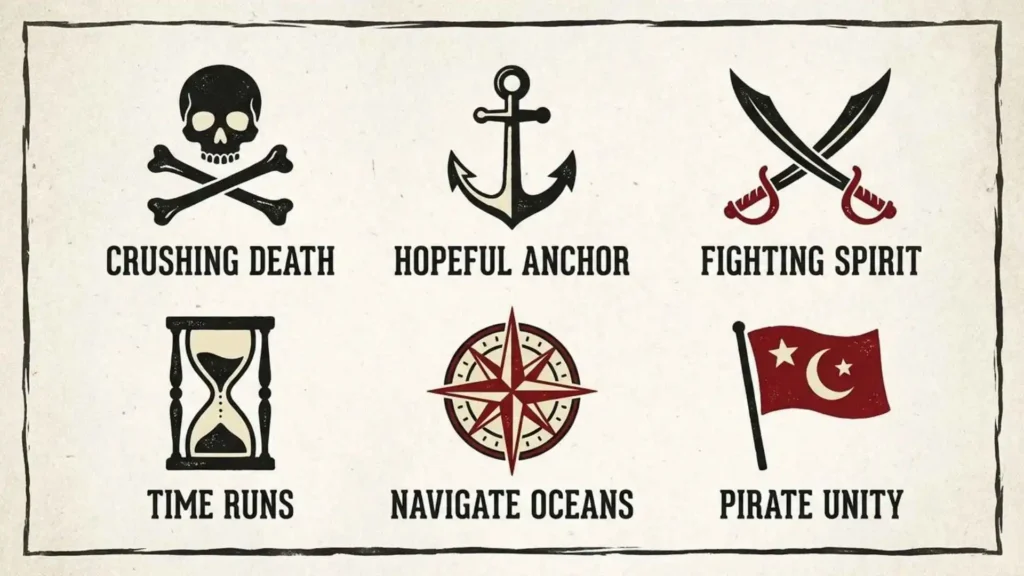
Calico Jack Rackham is commonly associated with a black flag displaying a skull above two crossed cutlasses. The design is among the most recognizable variations of the Jolly Roger in modern pirate imagery.
Crossed cutlasses help distinguish this design from the more familiar skull-and-crossbones arrangement. It is frequently reproduced in pirate books, costumes, illustrations, and themed merchandise.
When discussing historical flags, it is useful to distinguish a commonly attributed design from a flag preserved in a contemporary image or supported by strong documentary evidence.
What Did Black and Red Pirate Flags Mean?
Black and red flags appear frequently in accounts of historical piracy, but their use was not governed by one universal rule followed by every pirate.
Black Pirate Flags
Black flags became strongly associated with pirate threats and surrender demands. A recognizable flag could warn an approaching ship that it faced a dangerous encounter.
Some black flags displayed skulls, bones, skeletons, or other threatening images. Others were plain black, demonstrating that a complicated design was not always necessary to communicate danger.
Red Pirate Flags
Red flags are associated in some historical accounts with a more explicit threat that no quarter would be given. In this context, no quarter meant that those who resisted might not be spared.
Nevertheless, it would be inaccurate to claim that every red flag used by every pirate always had exactly the same meaning. Maritime practices changed over time, and flags could also be used for identification, deception, or other purposes.
The safest interpretation is that black and red flags could serve as threatening signals in particular historical circumstances, rather than as a perfectly standardized color code.
Historical Pirate Symbols vs. Fictional Pirate Imagery
Not every image associated with pirates has the same historical importance. Separating documented practices from popular storytelling makes the subject more accurate and useful.
| Symbol or object | Historical connection | Modern association |
| Skull and crossbones | Used in some pirate flag designs | Piracy, danger, rebellion |
| Black flag | Used by some historical pirate crews | Classic pirate identity |
| Red flag | Associated in some accounts with threats of no quarter | Danger and warning |
| Cutlass or sword | Weapons used in maritime combat | Adventure and battle |
| Hourglass | Appeared in certain threatening flag designs | Time running out |
| Parrot | Not a defining pirate accessory | Fictional pirate companion |
| Eye patch | Not a universal pirate characteristic | Classic pirate costume |
| Treasure map | Navigation and treasure stories have historical and fictional elements | Hidden treasure and quests |
| Buried treasure chest | Some cargo was stolen, but the familiar trope is heavily fictionalized | Adventure and discovery |
Pirate films and novels often blend historical facts with imaginative details. The resulting imagery is memorable, but not every popular feature accurately reflects how pirates lived or operated.
Pirate Symbols in Tattoos, Logos, and Modern Culture
Pirate symbols remain popular because they are visually striking and communicate recognizable ideas with relatively simple designs.
Pirate Tattoos
People may choose pirate-themed tattoos to represent independence, courage, adventure, defiance, or an interest in maritime history. A skull and crossbones can suggest danger, while an anchor may symbolize stability and connection to the sea.
These meanings are personal and cultural rather than universal. The same design can communicate different things depending on the person wearing it.
Logos and Graphic Design
Pirate flags, skulls, crossed swords, and ships are common in gaming logos, entertainment branding, themed events, and fantasy illustrations. Their bold shapes make them easy to recognize at small sizes.
Designers should consider the intended audience and context. A threatening skull-and-crossbones design may suit a fictional pirate game but may not be appropriate for a professional maritime service.
Social Media and Gaming
The pirate flag emoji 🏴☠️ and related symbols are frequently used in usernames, bios, captions, and gaming profiles. They can suggest adventure, mischief, rebellion, or a playful pirate identity.
The pirate flag emoji is a digital character sequence that may render differently across platforms. Some applications support it as a single flag, while unsupported fonts or systems may display separate components.
Movies, Books, and Video Games
Pirate symbols play a major role in popular entertainment. The Jolly Roger, treasure maps, parrots, ships, and skulls help audiences identify pirate characters immediately.
These conventions are especially useful in visual storytelling because they communicate a setting or character type without lengthy explanations. However, entertainment imagery should not be mistaken for definitive historical evidence.
Frequently Asked Questions About Pirate Symbols
What is the main symbol of pirates?
The Jolly Roger is the best-known pirate symbol. It is commonly represented by a black flag with a white skull and crossed bones, although historical pirate flags came in different designs.
What does the Jolly Roger symbolize?
Historically, pirate flags could communicate a threat and encourage targeted ships to surrender. Today, the Jolly Roger can represent piracy, adventure, defiance, rebellion, or fictional pirate culture.
What does the skull and crossbones mean?
The skull and crossbones is associated with death, danger, and warnings. On some pirate flags, it was used to frighten other ships and reinforce the threat of attack.
What does the pirate flag emoji 🏴☠️ mean?
The pirate flag emoji generally represents pirates, piracy, adventure, rebellion, or pirate-themed entertainment. Its meaning depends on the context in which it appears.
Did all pirates use the same flag?
No. Historical pirates used different flags, and some used plain black or red flags. Others used designs featuring skulls, bones, weapons, hourglasses, and other threatening imagery.
What is the difference between a pirate flag and a Jolly Roger?
A pirate flag is any flag used by a pirate crew, while the Jolly Roger is the traditional term associated with pirate flags and is now especially linked to the skull-and-crossbones design.
Did Blackbeard really use a skeleton flag?
Historical accounts associate Blackbeard with black flags and death-head imagery, but the famous design featuring a skeleton, hourglass, and bleeding heart is not securely established as his personal flag.
What do crossed swords mean in pirate designs?
Crossed swords generally represent combat, conflict, and danger. They appear in pirate-themed art and in some flag designs, but they were not included on every historical pirate flag.
Are parrots and eye patches real pirate symbols?
They are widely recognized features of fictional pirate characters. Although sailors could have parrots or eye injuries, neither a parrot nor an eye patch was a universal feature of historical pirates.
Where can I use pirate symbols?
You can use pirate emojis and text symbols in social media bios, messages, gaming profiles, captions, artwork, and themed designs, depending on the platform’s character support and content rules.
Conclusion
Pirate symbols combine historical maritime imagery with legends developed through books, movies, and modern entertainment. The Jolly Roger and skull and crossbones remain the most recognizable examples, while crossed swords, hourglasses, bleeding hearts, ships, and anchors help communicate danger and adventure.
For historical accuracy, it is important to distinguish documented pirate flags from designs whose origins are uncertain and from fictional accessories such as the stereotypical parrot or treasure map. Whether you want to understand their history or copy and paste symbols for creative use, knowing these differences makes pirate imagery more meaningful.

I am John Carter, a lifelong enthusiast of language and modern slang. I explore how words evolve and shape culture, and I enjoy uncovering the stories behind everyday expressions. I have authored “Slang and Society: The Language of Youth” and “Modern Words, Modern Worlds”, where I dive into how informal language impacts communication and identity. My goal is to make language accessible, fun, and insightful for everyone who loves words as much as I do.
 Lisa Reynolds